
- How Do Fixed Price, T&M and Dedicated Team Models Compare in Fintech?
- How Does Fixed Price Work in Fintech, and When Does It Break?
- How Does Time and Materials (T&M) Work in Fintech?
- How Do You Cap T&M Spend on a Fintech Build?
- Fixed Price vs Dedicated Team for Fintech Software Development: Which Fits?
- What Does Hybrid Pricing Look Like for Regulated Fintech Builds?
- Which Fintech Pricing Model Should You Choose?
- How Does Space-O Canada Help You Choose a Fintech Pricing Model?
- Frequently Asked Questions About Fintech Software Development Pricing Models
Fintech Software Development Pricing Models: Fixed Price vs. Time and Materials

 Last Updated: November, 17 2026

Key Takeaways
- Fixed price fits a small, locked fintech scope; T&M or a dedicated team fits evolving regulated builds.
- The comparison table scores fixed price, T&M and a dedicated team on scope, compliance, change and cost.
- The T&M controls list shows how a ceiling, fixed labor-category rates and weekly demos cap spend.
- The hybrid section prices regulatory change with a fixed-price discovery phase and a change-order clause.
Buyers comparing fixed price vs time and materials for fintech software development should start with scope stability. Fixed price fits a small, well-defined, short-term scope with minimal expected change. Time and materials (T&M) with spend controls, or a dedicated team, fits long-term regulated builds whose requirements keep moving.
Regulated scope rarely holds still. A card program pulls in PCI-DSS, and customer onboarding pulls in AML/KYC checks. A regulator may update guidance mid-build, and a fixed contract has no slot for that. The fix then arrives as a change order, priced after the fact.
Mapping regulatory exposure during discovery, as we do as a fintech software development company, tells you how stable your scope is before you pick a model. This guide compares fixed price, T&M and the dedicated team model. It then adds a hybrid built for rule changes.
How Do Fixed Price, T&M and Dedicated Team Models Compare in Fintech?
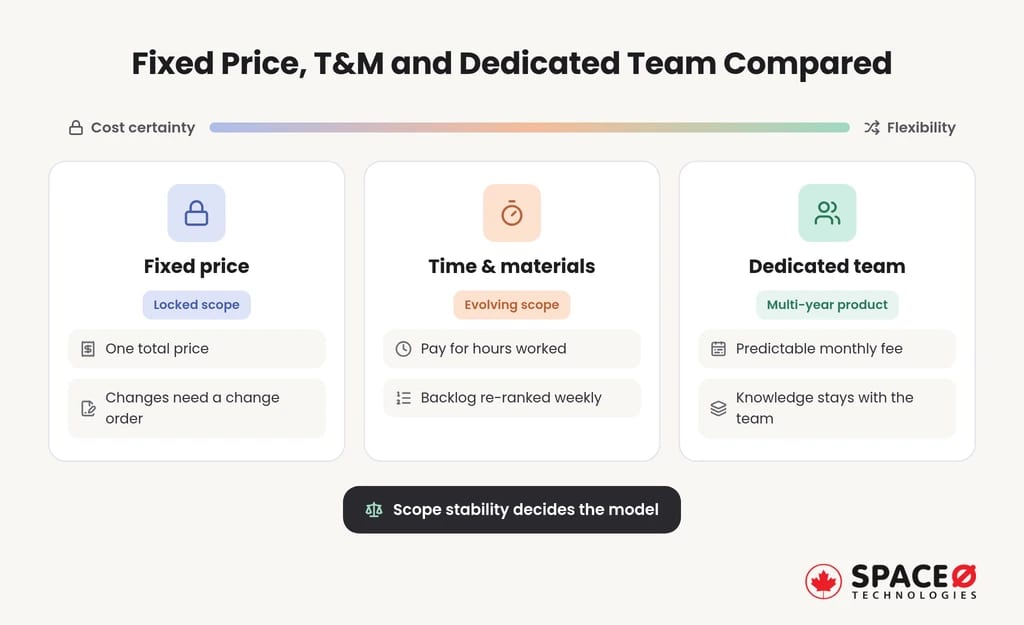
Fixed price trades flexibility for cost certainty. T&M and a dedicated team trade some certainty for room to change.
| Factor | Fixed price | Time and materials (T&M) | Dedicated team |
|---|---|---|---|
| Scope stability needed | Complete, locked spec before signing | Can evolve sprint by sprint | Can evolve across a long product life |
| Compliance scoping | Defined in full up front; late findings become change orders | Compliance tasks enter the backlog as they surface | Team builds regulatory domain knowledge over time |
| Change handling | Formal change order or re-negotiation | Backlog re-prioritized every week | You redirect the team directly |
| Cost visibility | One total invoice paid through milestone payments | Hourly or daily rates that need a ceiling | Predictable monthly fee with a higher cumulative cost |
| Post-launch support | New scope needs a new contract or change order | Continues at the agreed rates | The same team stays on the product |
| Best fit in fintech | Simple MVP or isolated component with zero ambiguity | Evolving requirements and iterative delivery | Long-term, complex regulated products |
The table shows the broad tradeoff in one view. Fixed price comes first, since it promises the most and bends the least.
How Does Fixed Price Work in Fintech, and When Does It Break?
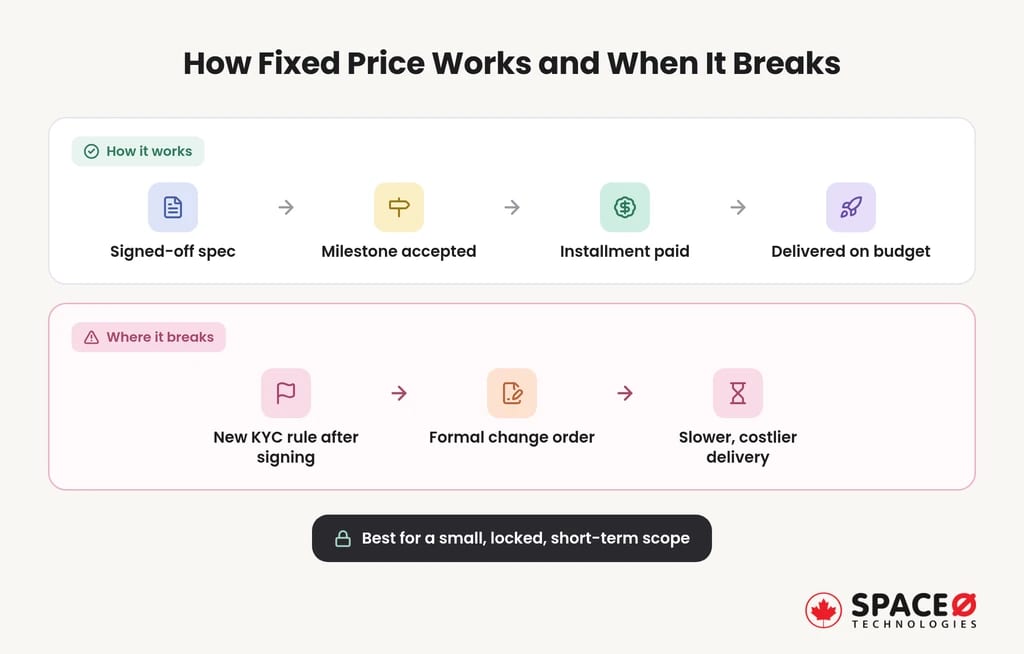
Fixed price works only when the vendor can see every requirement before signing. In regulated fintech, that condition is harder to meet than it looks.
How it works: The vendor prices a complete spec and wireframes as one total price. You gain cost certainty and a defined timeline. Payment is tied to milestones, so each installment is released only when an agreed deliverable is accepted. Tie every milestone to a reviewable output, such as signed-off wireframes, a tested build or a completed compliance review.
Why it is risky in fintech: Regulated requirements move after signing. A new KYC rule or card-data change needs a formal change order or a re-negotiation. Both are slow and costly. Its core weakness is that the contract leaves no room to adjust scope once it is signed.
The catch: The vendor carries the scope risk, so it prices in a safety buffer for the unknowns, which raises the quoted price. Ask the vendor which assumptions that buffer covers and what happens when a regulatory finding falls outside them. Under budget pressure, some vendors also cut corners on quality. Quality shortcuts are one of the risks of outsourcing fintech software development worth weighing.
When to use it: Pick fixed price for a simple MVP or an isolated component with zero ambiguity. The scope should be small, short-term and unlikely to change
In-line CTA.
Not Sure Fixed Price Fits Your Scope?
Share your scope and compliance requirements, and our fintech team will recommend the pricing model that fits your build.

Fixed price rewards certainty and penalizes surprise. T&M makes the opposite bet, so it needs different protections.
How Does Time and Materials (T&M) Work in Fintech?
Time and materials (T&M) bills for the hours your team actually works. It suits fintech builds whose requirements shift as regulators, partners and users respond.
How it works: You pay agreed hourly or daily rates for each team member. Work ships sprint by sprint. You re-prioritize the backlog every week.
Why it fits fintech: A new compliance requirement becomes a backlog item, not a contract dispute. That flexibility matters most while scope is still being discovered, because each sprint can absorb what the previous one revealed.
The catch: Spend is open-ended. Without controls, a long backlog turns into a long invoice. If an engagement is already over budget, here is how to switch fintech software development vendors mid-project.
What it costs: Your invoice is the agreed rate multiplied by hours worked, so the total depends on team size and how long the backlog runs. Ask the vendor for a forecast range per sprint and for rates by labor category, such as senior engineer, QA engineer and compliance analyst, so you can compare quotes on the same basis.
When to use it: Pick T&M when requirements will evolve and your product owner can review progress weekly.
T&M stays affordable only when the contract writes its limits down. The controls below turn an open-ended rate card into a managed budget.
How Do You Cap T&M Spend on a Fintech Build?
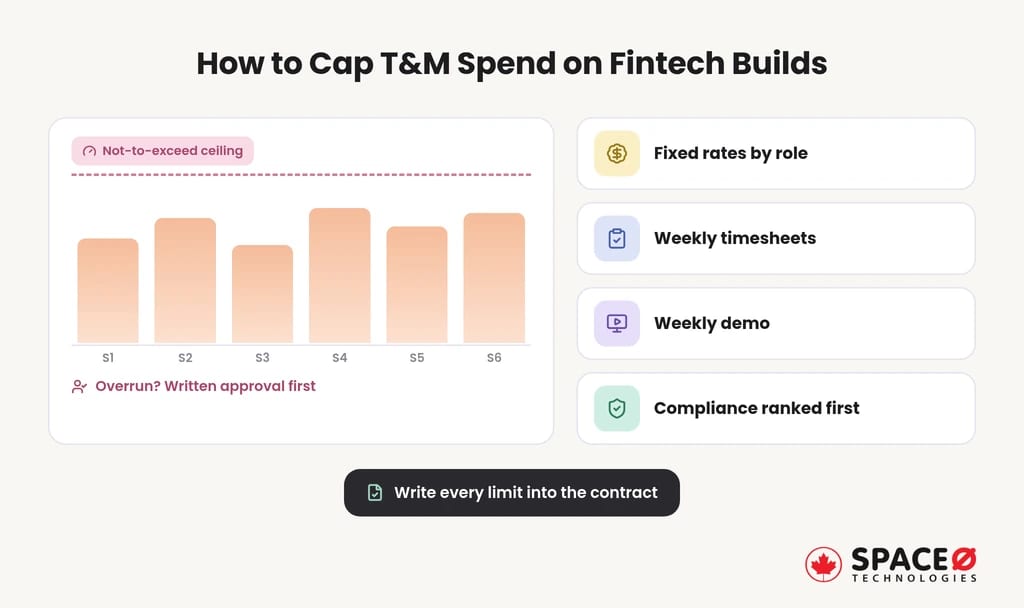
Cap T&M spend in the contract, not in a status meeting. Lock in these controls before the first sprint begins.
- Set a not-to-exceed ceiling for each sprint or phase, with written approval before any overrun. Agree the ceiling in the contract itself, so the vendor must stop and request approval rather than absorb extra hours quietly.
- Fix hourly rates by labor category, so each seniority tier carries one agreed price. List the categories you expect to use, such as senior engineer, QA engineer and compliance analyst, and hold those rates for the life of the contract.
- Require weekly timesheets tied to named labor categories and specific backlog items. This lets your team match every logged hour to a deliverable and spot drift before the invoice arrives.
- Hold a weekly demo, so every dollar spent maps to working software. Use the demo to confirm that completed items meet their acceptance criteria and to re-order the backlog for the week ahead.
- Rank compliance items first, so regulatory work never waits behind nice-to-have features. Flag each compliance item in the backlog with the framework it serves, so audit evidence is built alongside the feature.
These controls give fintech buyers flexibility without an open checkbook. Pair them with code ownership and data-export terms to avoid fintech software vendor lock-in before you sign. A dedicated team stretches that flexibility across years, with a different cost profile.
Fixed Price vs Dedicated Team for Fintech Software Development: Which Fits?
Fixed price buys a defined deliverable. A dedicated team buys sustained capacity for a product that keeps changing.
What it is: Under the dedicated team model, you get a hand-picked group of full-time specialists. They work as an extension of your institution. You pay a predictable monthly fee that covers their salaries and the provider’s overhead.
How the fee works: The monthly fee typically covers each team member’s salary plus the provider’s overhead, so you can budget it as a fixed line item. Confirm in the contract how you can scale the team up or down and what notice either side must give.
Best for: Long-term, complex products with evolving requirements, such as core banking modules, lending platforms or wealth client portals.
Pros for fintech:
- Flexibility to redirect work when a framework or partner requirement changes. You move the team to the new priority directly, with no change order or fresh quote in between.
- Domain knowledge that deepens with every release. The team learns your data flows, partner integrations and audit needs, so later releases need less onboarding and review.
- Direct control over priorities, process and team composition. You decide what ships next, how the team works and when to add a specialist such as a security or compliance engineer.
Cons for fintech:
- Higher cumulative cost than a short fixed-price engagement. The monthly fee runs for as long as the team is engaged, so the total only pays off when the product keeps needing new work. For a longer view of cost, see the total cost of ownership for custom fintech software.
- Ongoing management effort from your product and compliance leads. Expect regular planning, reviews and decisions from them, not a hand-off at the end.
Direct comparison: Fixed price wins on cost certainty when scope is small and locked. A dedicated team wins when the product runs for years and rules keep moving. Fixed-price work ends at delivery. A dedicated team keeps its regulatory knowledge after launch.
Weighing a Dedicated Team Against Fixed Price?
Share your product roadmap and the rule changes you expect, and our fintech team will size the team and recommend the model that fits your build.
Neither pure model fits a build whose regulatory scope is only partly known. That middle ground is where a hybrid earns its place.
What Does Hybrid Pricing Look Like for Regulated Fintech Builds?
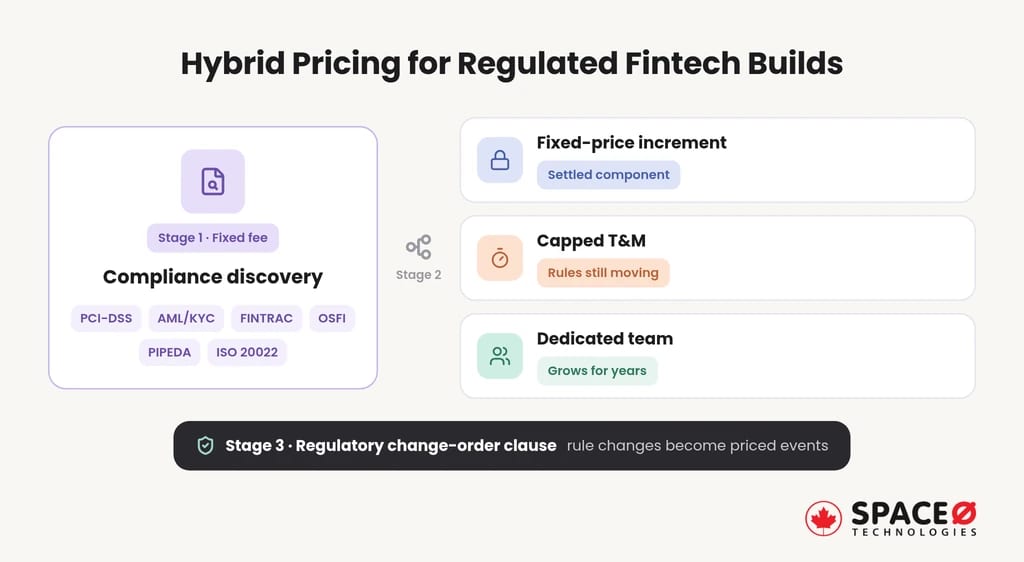
A hybrid model fixes the price of discovery, then picks a delivery model once regulatory exposure is known. It turns rule changes from surprises into priced events.
The structure runs in three stages:
- Fixed-price compliance discovery maps every framework in scope before anyone locks the architecture. You get a written map of obligations, so the later estimate rests on known requirements.
- Delivery then runs under capped T&M, fixed-price increments or a dedicated team, chosen from discovery findings. Each part of the build gets the model that suits how settled its scope is.
- A regulatory change-order clause states in advance how rule-driven changes get priced. Both sides know the pricing path before a rule changes, so a change does not stall delivery.
How discovery picks the model: if discovery shows a settled, isolated component, price it as a fixed-price increment. If it shows frameworks still in motion, run capped T&M. If the product will grow for years, set up a dedicated team.
What discovery should map before delivery pricing
Discovery should name each framework and the build component it touches.
- PCI-DSS shapes any component that stores, processes or transmits card data. Discovery should note which components fall inside that boundary, because each one adds controls and audit work.
- AML/KYC checks shape customer onboarding and transaction monitoring. Identity checks, watchlist screening and alert handling each need defined screens, records and owners. To see what these checks look like in a finished product, read what fintech compliance software includes.
- FINTRAC and OSFI expectations shape banking and payments builds with Canadian scope. Reporting duties and risk-management expectations affect both the features and the records the platform keeps. For federally regulated institutions, OSFI B-10 third-party risk requirements also apply to outsourced development.
- PIPEDA shapes how the platform handles personal information about Canadian customers. That covers consent, access requests and retention, which in turn affect the data model and admin screens.
- ISO 20022 shapes payments messaging wherever the build exchanges payment instructions. The message format affects data fields, validation and reconciliation across the payment flow.
Space-O Canada engineers platforms to support PIPEDA, FINTRAC and OSFI, and builds card systems to support PCI-DSS. For institutions serving both US and Canadian customers, we cover both frameworks in dual-market products. Each named framework becomes a known cost driver instead of a mid-build surprise. The key features of custom fintech compliance software show how those frameworks turn into screens and controls.
Regulatory change-order clause essentials
The clause decides how a rule change gets priced, and it does so before signing.
- A trigger that defines which regulatory changes the clause covers. Examples include a new rule, an update to regulator guidance or a change to a card-network requirement.
- A pricing path, either the contract’s labor-category rates or a fixed-price increment quoted first. Naming the path in advance stops the two sides from debating how to price each change.
- An approver on your side who signs off before work starts. Name that person in the contract so approvals do not wait on an unclear chain of command.
- A turnaround window, such as a written estimate within a set number of business days, so a compliance deadline never waits on a quote.
- A review rule for cumulative change orders, so small rule-driven changes cannot quietly add up to a large overrun.
With the clause in place, nobody negotiates price while a compliance deadline runs.
Matching the model to regulatory-change exposure
Match the model to how much your rules are likely to move.
| Factor | Fixed price | T&M | Dedicated team | Discovery-first hybrid |
|---|---|---|---|---|
| Scope stability | Fully locked before signing | Partly known and evolving | Evolving over years | Locked for discovery, flexible after |
| Regulatory change risk | Low | Moderate to high | High and ongoing | Any level, priced by clause |
| Audit-trail needs | Specified in full up front | Added as backlog items | Owned by a standing team | Mapped in discovery, built from the first sprint |
| Security baseline | Baseline on every build | Baseline on every build | Baseline on every build | Baseline on every build |
| Post-launch change volume | Low | Moderate | High | Any; the model can shift after launch |
Security stays the same in every column. Every Space-O Canada build includes encryption in transit and at rest, role-based access control, audit logging and segmented environments.
Space-O Canada’s engagement record grounds this table:
The hybrid does not replace the three standard models; it sequences them around regulatory risk. The checklist below helps you place your own build.
Which Fintech Pricing Model Should You Choose?
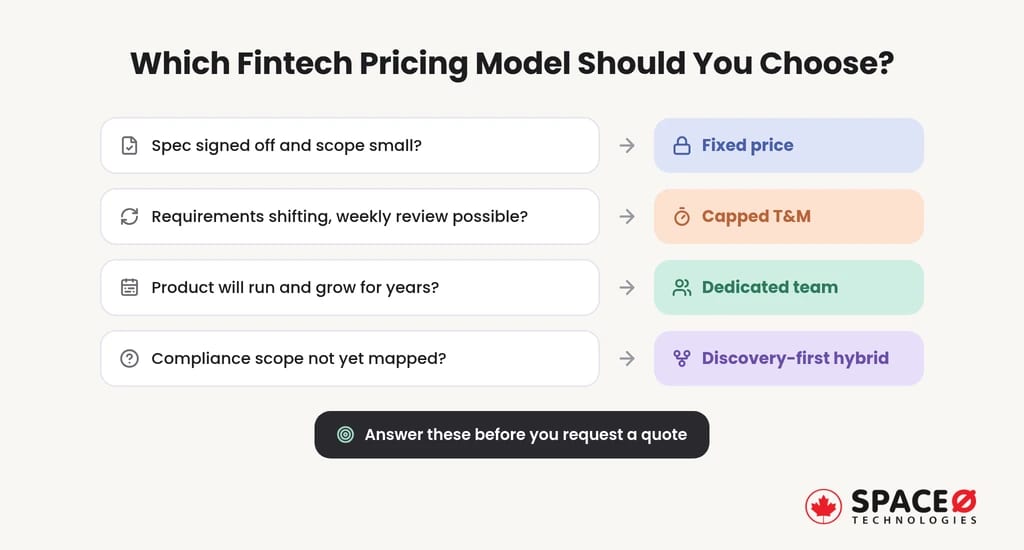
Choose the model your scope and regulatory exposure can actually support. Check your build against these conditions.
Choose fixed price when:
- Your spec and wireframes are complete and signed off. Every screen, integration and business rule should be written down, because anything missing becomes a change order later.
- The build is a simple MVP or an isolated component. A single payment flow or onboarding module with few outside dependencies is a typical fit.
- Regulatory scope is settled and unlikely to move before launch. Confirm this in discovery, since a framework that shifts mid-build removes the cost certainty you are paying for.
Choose T&M when:
- Requirements will shift as partners and regulators respond. Card networks, banking partners and regulators can each change what the build must do, and T&M lets the backlog absorb those changes sprint by sprint.
- Your product owner can review timesheets and demos weekly. Someone on your side needs the time and authority to approve work and re-order priorities, or the model loses its main safeguard.
- The contract can hold a not-to-exceed ceiling per sprint. The ceiling keeps flexibility from turning into open-ended spend, and any overrun needs your written approval first.
Choose a dedicated team when:
- The product will run and grow for several years. Ongoing releases, new modules and regular regulatory updates keep a standing team busy, so you are not paying for idle capacity.
- You want one stable team to hold regulatory domain knowledge. The same engineers who built the audit trail and consent flows will understand why they were built that way when a rule changes.
- Your leads have time to direct the team actively. Your product and compliance leads set priorities, answer questions quickly and review work as it ships.
Choose the hybrid when:
- Compliance scope is not yet mapped. You cannot yet say which frameworks apply to which components, so any price quoted today would rest on guesses.
- Frameworks in scope may change after launch. A fixed-price discovery phase settles the unknowns first, and the delivery model can shift once the product is live.
Answer these qualifying questions before you request a quote:
- Are you building an MVP or scaling a live product? An MVP with a narrow scope can suit fixed price, while a live product with a steady stream of changes usually needs T&M or a dedicated team.
- What product type is it: payments, lending, banking, insurance or wealth? Each type pulls in different frameworks, so the type shapes how much regulatory work to expect.
- Is your spec locked, or is it still moving? A locked, signed-off spec supports a fixed price, and a moving one calls for a model that can absorb change.
Clear answers point to a model before any vendor quotes a price. A capable partner tests those answers in discovery rather than after signing.
Not Sure Which Pricing Model Fits Your Build?
Share your product type, spec status and regulatory scope, and our fintech team will map your exposure and recommend the right model for your build.
How Does Space-O Canada Help You Choose a Fintech Pricing Model?
Space-O Canada starts every pricing conversation with regulatory exposure, not a rate card, and matches the model to the exposure levels in the decision table above. Our recommendation is plain: price discovery first, then commit to a model.
In practice, that means a short discovery phase that maps the frameworks in scope, the components they touch and the parts of the spec that are still moving. From that map, we recommend fixed price for settled components, capped T&M where scope is still evolving, or a dedicated team for a product that will grow for years. We also agree the regulatory change-order clause before work starts, so a rule change becomes a priced event you planned for rather than a dispute mid-build.
Since 2018, our one in-house team has served 100+ clients, including Fortune 500 companies. We maintain a 98% on-time delivery rate, and 65% of our business is repeat and referral. Every project includes up to 90 days of post-launch support. That record stands behind every pricing recommendation Space-O Canada makes. The FAQs below answer what buyers ask before booking a consultation.
Frequently Asked Questions About Fintech Software Development Pricing Models
Which is an example of a fixed-price contract?
A fixed-price fintech contract quotes one total and a defined timeline, paid in milestones, for work whose spec is signed off before anyone starts. The cleanest fintech example is often not the product build at all but the compliance-discovery phase itself, because its deliverable (a map of frameworks in scope) can be defined fully up front. A useful test for anything larger: if even one framework in scope could move before launch, the vendor’s buffer and later change orders will erode the certainty you paid for.
When would you use a time and materials contract?
Use T&M when you cannot write a complete spec today but can staff weekly review. That second condition is the deciding one: if nobody on your side can read timesheets and attend demos each week, the controls that keep T&M affordable stop working, and fixed-price increments or a dedicated team become the safer choice. Before the first sprint, confirm that rates are fixed by labor category and that overruns need written approval.
What is the difference between fixed capacity and T&M?
Fixed capacity (the dedicated team model) buys people for a period; T&M buys hours against a backlog. A practical rule: if you expect steady work for years after launch, fixed capacity spreads the knowledge and the cost over a team that stays, at the price of more management time. If your workload swings from sprint to sprint, T&M lets you scale effort up or down without paying for idle capacity, provided a ceiling holds the total.
What is the difference between fixed price and time and materials?
Fixed price sets one total for a defined scope, so the vendor carries the scope risk and any change needs a change order. Time and materials bills for the hours worked, so you carry more of the cost risk but can change direction every sprint. In regulated fintech, the deciding factor is how stable your compliance scope is.
Which pricing model is best for a fintech MVP?
A fintech MVP with a small, signed-off spec and settled regulatory scope can suit fixed price. If the MVP touches frameworks such as PCI-DSS or AML/KYC that are not yet mapped, start with a fixed-price discovery phase and choose the delivery model from what it finds.
How do you keep time and materials costs under control?
Write the limits into the contract: a not-to-exceed ceiling per sprint or phase, fixed hourly rates by labor category, weekly timesheets tied to backlog items and a weekly demo. Together, these controls tie every hour billed to working software you can review.
What is a hybrid pricing model for fintech software development?
A hybrid model prices compliance discovery at a fixed fee, then runs delivery under capped T&M, fixed-price increments or a dedicated team, depending on what discovery finds. A regulatory change-order clause agreed up front states how rule-driven changes get priced.


Let’s Discuss Your Idea
Share your idea with our fintech development team and get a practical breakdown of what you need to build, integrate, secure, and launch it.
 Your project is covered by an NDAYour information stays secure and confidential




What our clients say


When we set out to build our Estate Tax Planning Tool, we needed a development partner we could trust with something this complex and consequential. Space-O Canada brought the technical expertise and attention to detail needed to handle intricate tax calculations and edge cases. They communicated clearly, delivered on time without cutting corners, and built a product we trust completely.
 Ed Chetan EdwinFounder, CharityCalc
We partnered with Space-O Canada to build a fintech platform that could support secure transactions, third-party integrations, and future scalability. Their team understood our business requirements from the beginning and delivered a well-architected solution without unnecessary complexity. Communication was consistent, milestones were met on time, and every challenge was handled proactively.
 Michael CarterCo-Founder, Digital Payments Platform
The fintech app came out exactly the way I pictured in terms of functionality. I will refer future UI/UX clients to their team. During the testing phase of the app, it performed according to the initial designs in terms of functionality. Their team was dedicated to creating the best version of the app and provided their own ideas to improve it.
 Amanda LewisProduct Manager, Lending Platform
Our banking modernization project involved complex integrations and strict security requirements, and Space-O Canada handled both with confidence. They developed a reliable banking platform that improved operational efficiency while maintaining a smooth customer experience. Their structured development process and clear communication kept the project on track from start to finish.
 Daniel RobertsVP of Technology, Regional Bank
Our legacy insurance system created delays across policy management and claims processing. Space-O Canada developed a centralized platform that streamlined our workflows and improved efficiency across departments. The project was delivered on schedule, and the team’s understanding of insurance technology was evident throughout the engagement.
 Emily FosterOperations Director, Insurance Provider
Developing a trading platform requires speed, reliability, and technical precision. Space-O Canada delivered a solution that performs exceptionally well while supporting real-time market data and intuitive trading workflows. Their project management was excellent, and the team remained responsive throughout every stage of development.
 Ethan MorganChief Product Officer, Investment Platform
The fintech app was successfully launched, and users loved its sleek design and features. Space-O Technologies worked in an organized and collaborative manner, allowing them to achieve quality results. They also took the time to deeply understand the project. They were very organized and had a good track record.
 David WilsonFounder, Personal Finance App