
- What is the Cost Breakdown by App Complexity?
- What Drives the Cost of a Fintech App?
- Where Does the Fintech Development Budget Go?
- What Hidden and Post-Launch Costs Should You Budget For?
- How Can You Lower the Cost of a Fintech App?
- What Does a Fintech Specialist Change About the Number?
- Which Build Path Fits a Regulated Fintech App?
- What Does It Cost to Build Around the Core You Already Run?
- What Should Your Scoping Checklist Include?
- How Can Space-O Canada Help You Budget a Fintech App?
- Frequently Asked Questions About Fintech App Development Cost in USA
How Much Does It Cost to Develop a Fintech App in the USA

 Last Updated: November, 16 2026

Key Takeaways
- Total cost: A fintech app in the USA costs between $40,000 and $400,000+, as of November 2026. A basic MVP starts near $40,000, while complex enterprise platforms run $150,000-$400,000+. Money movement, compliance load and integrations set that price, not screen count.
- Cost tiers: This guide prices nine build types, from a basic MVP to a complex enterprise platform.
- Hidden costs: It also budgets the maintenance, audits, legal work and usage fees outside the build quote.
- Cost control: It shows how Banking-as-a-Service (BaaS), cross-platform builds and MVP-first scoping reduce spend.
A US fintech app starts near $40,000, and a complex enterprise platform runs $150,000-$400,000+. Yearly maintenance then sits on top of the build.
Budgets usually break on regulation, not code. An app that moves funds pulls in KYC/AML checks, PCI-DSS scope, SOC 2 audits and sponsor bank oversight. State money transmitter licenses can follow.
As a fintech app development company, Space-O Canada wrote this guide for banks, credit unions, lenders, insurers, payment service providers, trading firms and funded fintech startups. It breaks the budget down by app type, development phase and post-launch cost, and shows where regulation adds line items to each. Use it to set a realistic range before you request quotes, so every vendor prices the same scope.
What is the Cost Breakdown by App Complexity?
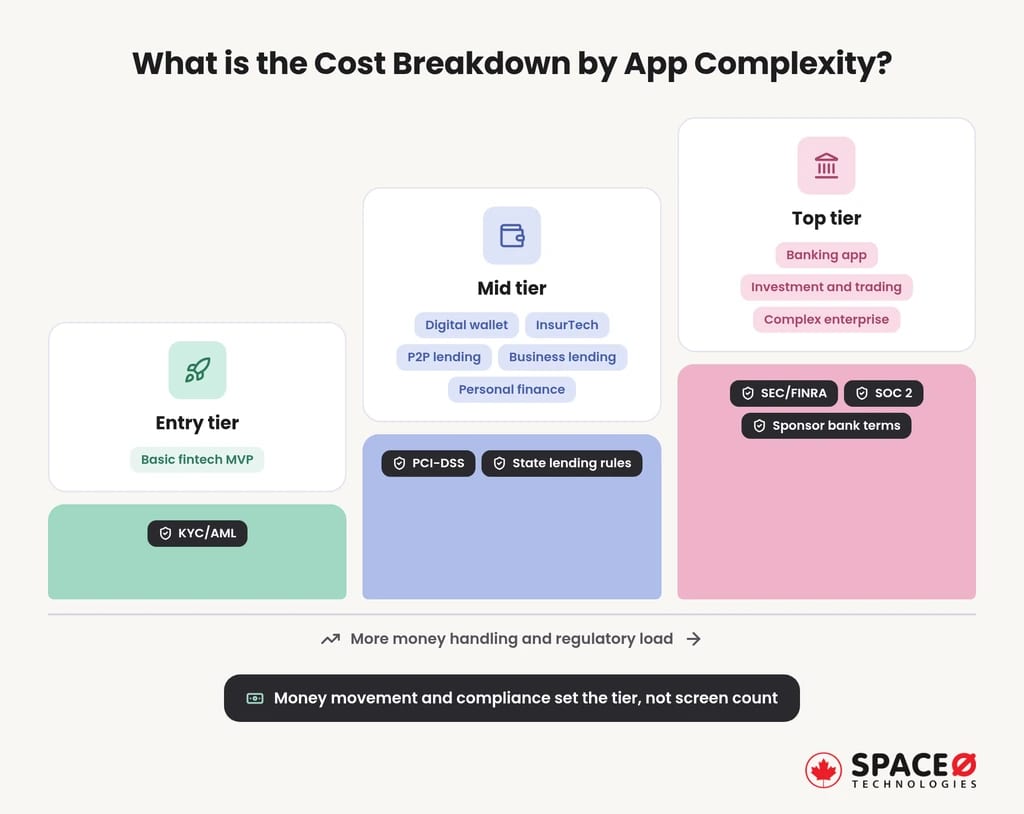
Fintech app cost climbs with money handling and regulatory load. A basic MVP sits at the low end. Wallets, insurance, lending and personal finance apps fill the middle. Banking, trading and complex enterprise platforms sit at the top. The table below prices nine build types, as of November 2026.
| App type | What puts it in this tier | Price range (USD, as of November 2026) | Compliance scope |
|---|---|---|---|
| Basic fintech MVP | Core features, baseline security, single platform | $40,000-$80,000 | KYC/AML, plus PCI-DSS for card data |
| Digital wallet | Payment integration and security carry most of the budget | $40,000-$120,000 | KYC/AML, PCI-DSS |
| InsurTech app | Claims automation takes the largest share | $45,000-$180,000 | Depends on the carrier-partner, MGA or broker route |
| P2P lending platform | Credit scoring swings the budget most | $50,000-$160,000 | KYC/AML, plus state lending rules |
| Personal finance (PFM) app | Number of connected financial institutions | $50,000-$150,000 | Data security controls, plus KYC/AML if it moves money |
| Banking or mobile banking app | Core banking integration depth | $55,000-$300,000+ | KYC/AML, PCI-DSS, sponsor bank terms |
| Investment and trading app | Trading engine and market-data feeds | $60,000-$200,000+ | SEC/FINRA |
| Business lending platform | Underwriting logic | $60,000-$180,000 | KYC/AML, plus state lending rules |
| Complex enterprise platform | Full banking or trading features, deep compliance scope, AI/ML, high availability | $150,000-$400,000+ | SOC 2, PCI-DSS, licensing |
A Robinhood-style product sits in the investment and trading tier, where the trading engine and market-data feeds drive most of the spread. Firms weighing that route can review our trading app development services.
Those tiers show where an app lands, not why it lands there. The next section explains the factors affecting fintech app cost behind each jump.
What Drives the Cost of a Fintech App?
Whether an app moves money is the first cost question. Compliance load and financial integrations come next. A read-only app and a money-moving app carry different regulatory exposure. As of November 2026, these line items show how the gap builds.
- Compliance load ($5,000-$60,000 for security and compliance work): KYC/AML, encryption, audit logging and penetration testing sit on this line, and deeper regulatory scope pushes it higher. See what it takes to build a compliant fintech app in the US.
- Financial integrations ($10,000-$40,000 for most connections): Payment, bank-account and market-data integrations typically fall in this range, while core banking integration can reach $80,000. Plaid, Stripe, BaaS providers, payment gateways and credit bureaus all count.
- Team rates vary by engagement model (full-time, part-time or hourly) and by vendor, so request a quote through the free consultation.
- Ledger design: Skipping a proper ledger early forces costly rework. A double-entry ledger posts each movement to two accounts.
Compliance and integrations explain much of the price jump between tiers. Next, the budget split shows where those dollars land inside a build.
Where Does the Fintech Development Budget Go?
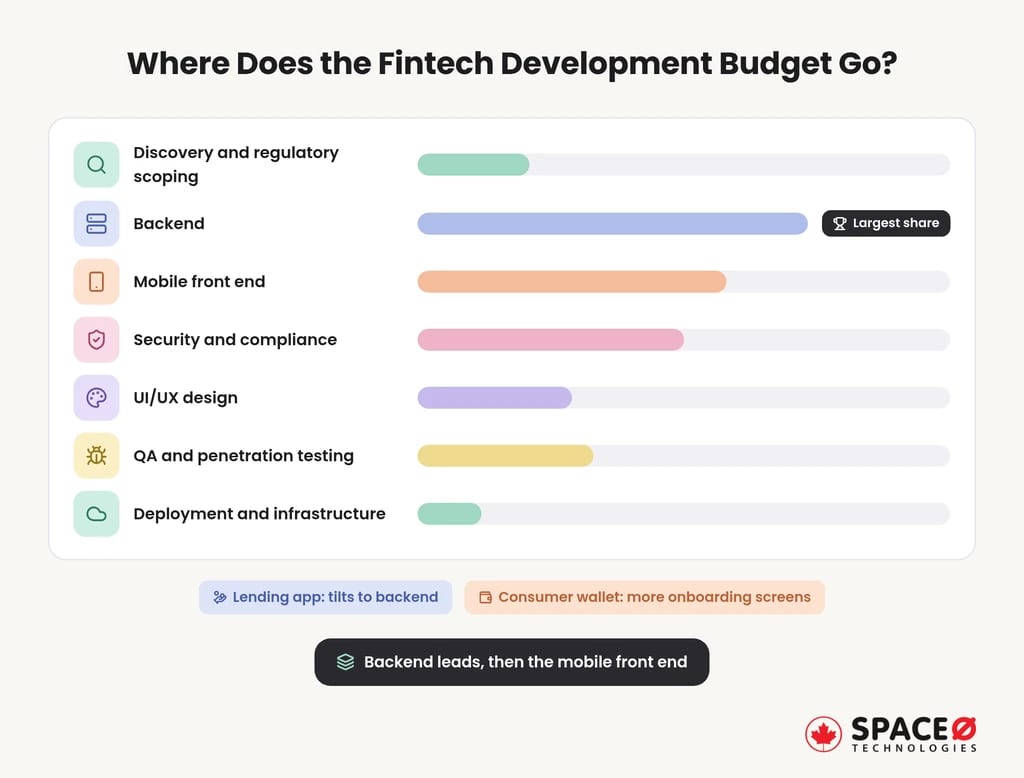
Backend work takes the largest share of a fintech build, followed by the mobile front end. Security and compliance can claim more budget than design or QA. The typical split below gives a useful planning baseline for a regulated product.
- Discovery and regulatory scoping ($4,000-$25,000): Requirements, the architecture plan and compliance mapping happen here, before code.
- Backend ($12,000-$120,000): Ledgers, APIs and transaction logic sit here and take the largest share of the budget. This layer also runs reconciliation, so balances stay accurate as transaction volume grows.
- Mobile front end ($8,000-$70,000): iOS and Android interfaces sit here. Biometric login, push alerts for transactions and secure session handling add work on both platforms.
- Security and compliance ($5,000-$60,000): Encryption, audit logging and KYC/AML flows sit here. Fraud monitoring and role-based access control belong on this line too, since partner banks and auditors expect both.
- UI/UX design ($5,000-$35,000): Onboarding and transaction screens sit here. Clear fee, consent and error screens build user trust and cut support tickets around money movement.
- QA and penetration testing ($4,000-$40,000): Regression and security testing sit here. Fintech QA also covers edge cases such as failed payments, duplicate transactions and network timeouts before each release.
- Deployment and infrastructure ($2,000-$15,000): Cloud provisioning, segmented environments, CI/CD and release sit here.
Treat this order as a starting baseline: a lending app with heavy underwriting logic tilts further toward the backend, while a consumer wallet spends more on onboarding screens.
Get a Phase-by-Phase Estimate for Your Fintech App
Share your feature list and target states, and our team will map each development phase to a USD range.

The split covers the build quote and nothing after it. Post-launch spending needs its own budget line.
What Hidden and Post-Launch Costs Should You Budget For?
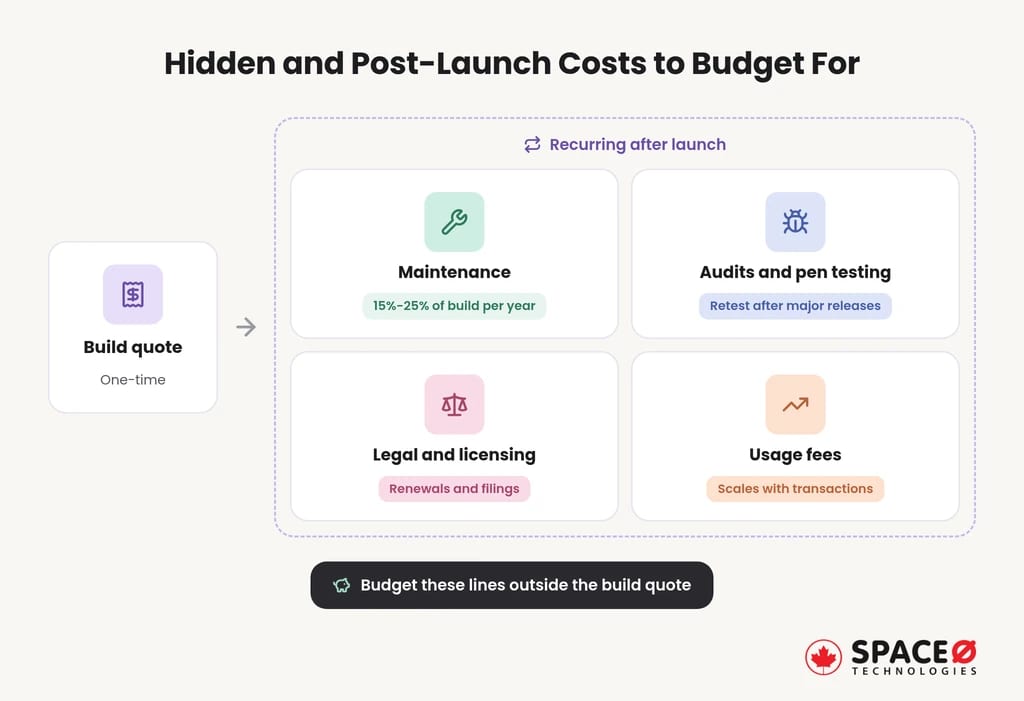
Hidden fintech costs mostly arrive after the build invoice. Maintenance recurs every year, and audits return with each compliance cycle. Legal work can sit outside the quote too. Budget these lines separately, using the figures below, which are current as of November 2026.
- Maintenance (15%-25% of build per year): This covers bug fixes, OS updates, security patches and compliance updates. The share rises when regulations change or new OS versions force releases outside the planned roadmap.
- Audits and penetration testing (recurring): Periodic testing keeps the product defensible under audit. At build stage, QA and penetration testing run $4,000-$40,000. Plan to retest after major releases and before partner bank or enterprise client reviews.
- Legal and licensing (scope-dependent): Money transmitter licenses and sponsor bank terms sit on this line. Renewals, regulatory filings and contract reviews make it a recurring cost, not a one-time launch fee.
- Usage fees (volume-based): Financial APIs and KYC/AML vendors can charge as activity grows. Model these fees against projected transaction counts. Cloud hosting grows with the same volumes, so review both lines together each quarter.
Recurring lines add up over time, so trim scope early. The next section covers where trimming works.
How Can You Lower the Cost of a Fintech App?
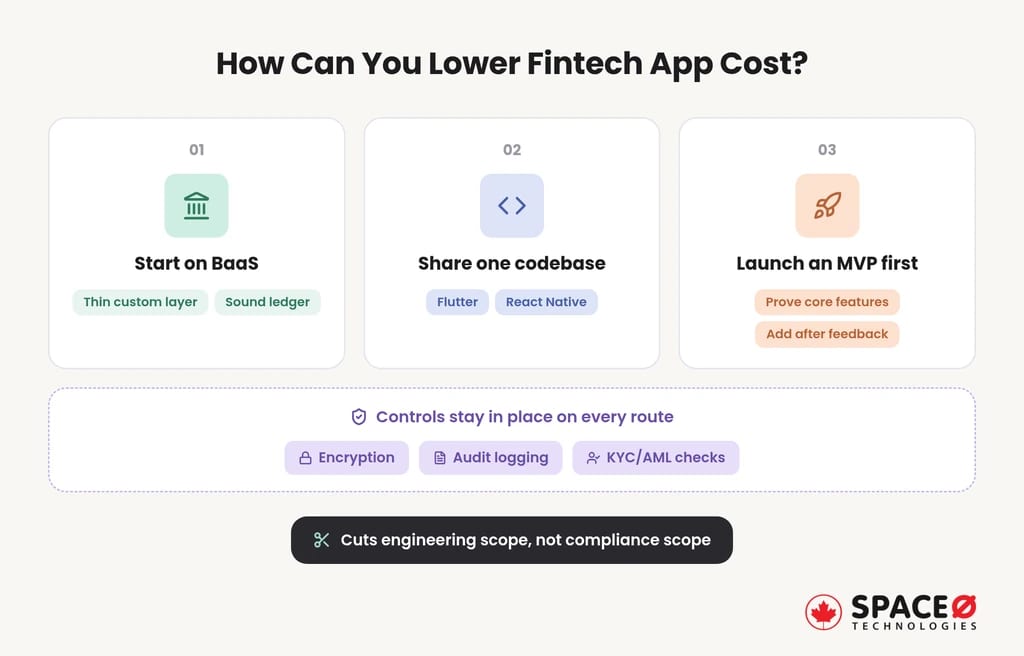
Three moves lower fintech build cost without weakening controls: renting regulated rails, sharing one codebase and narrowing version one. Each move cuts engineering scope, not compliance scope. Encryption, audit logging and KYC/AML checks stay in place whichever route you choose.
- Start on BaaS: A thin custom layer over BaaS is typically the lowest-cost, quickest route. Keep the ledger design sound from the start.
- Share one codebase: Flutter and React Native builds can reduce cost compared with building two separate native apps. Weigh that choice within your wider fintech tech stack.
- Launch an MVP first: Limit version one to the features you must prove first, and add advanced functionality after user feedback.
These moves reduce build cost, yet architecture choices still decide retrofit risk. A specialist team changes that part of the number.
What Does a Fintech Specialist Change About the Number?
A fintech specialist changes when compliance enters the budget. Retrofitting compliance after QA costs far more than designing it in during discovery. Scoping it before architecture locks avoids that rework. Timing protects the budget in a way an hourly rate cannot.
Space-O Canada maps regulatory exposure during discovery, not during QA. Encryption in transit and at rest, role-based access control and audit logging are baseline on every build. Card systems are built to support PCI-DSS.
One in-house team runs each project from discovery to support. All projects include up to 90 days of post-launch support. That coverage spans bug fixes, OS updates and performance monitoring. Paper Trader, our virtual stock trading simulator, was built around six core modules.
Scope Compliance Before Your Architecture Locks
Share your product scope and regulatory exposure, and our team will map the compliance controls your build needs from discovery.
Timing and team structure shape cost alongside rates. The next comparison puts those factors side by side.
Which Build Path Fits a Regulated Fintech App?
The right build path depends on who owns regulatory scope and who stays through launch. Hourly rates alone hide those risks. The table compares four build paths on those points, with market rates as published as of November 2026. Confirm each “varies” cell in writing before signing.
| Build path | When regulatory scope is mapped | Who staffs it through launch | Post-launch coverage | Fit to an existing core | Rate or cost model |
|---|---|---|---|---|---|
| One in-house fintech team (Space-O Canada) | During discovery, before architecture | Same in-house team, no handoffs | Up to 90 days included | Connects to the core you already run | Scoped in a free consultation |
| Blended US/offshore team | Varies by vendor | Split across locations | Varies by contract | Varies by vendor | Varies by vendor; request a quote in the free consultation |
| Generalist agency | Varies by agency | Varies by agency | Varies by contract | Varies by agency | Varies by agency |
| White-label platform | Shaped by the vendor’s platform | Vendor plus your own team | Vendor’s support terms | Product fits the vendor’s data model | License and usage fees |
Each path shifts risk as well as price. Institutions with live core systems face one more cost question.
What Does It Cost to Build Around the Core You Already Run?
The published cost guides we reviewed do not price legacy-core work, so we do not quote a figure here. For banks and credit unions, lenders and insurers, three inputs shape the estimate. Phased modernization also keeps operations running, which rip-and-replace puts at risk.
- Systems integrated: Each connected system adds integration, testing and security work.
- Migration style: A phased rollout spreads risk across releases, while a cutover concentrates it.
- Reports touched: Each changed compliance report adds validation and audit logging work.
- Data migration: Moving account and transaction history needs reconciliation checks so balances match across the old and new systems.
Ask each vendor to price these inputs as separate line items. A quote that bundles legacy integration into one number hides where the risk sits. Ask, too, how the plan keeps the existing core running during each release.
One client’s banking modernization project combined complex integrations with strict security requirements, and Space-O handled both.
Note for US institutions with Canadian exposure: Our platforms are engineered to support PIPEDA, FINTRAC and OSFI requirements. Scope those obligations separately during discovery.
Core constraints belong in the estimate from day one. A short checklist captures them before you request a quote.
What Should Your Scoping Checklist Include?
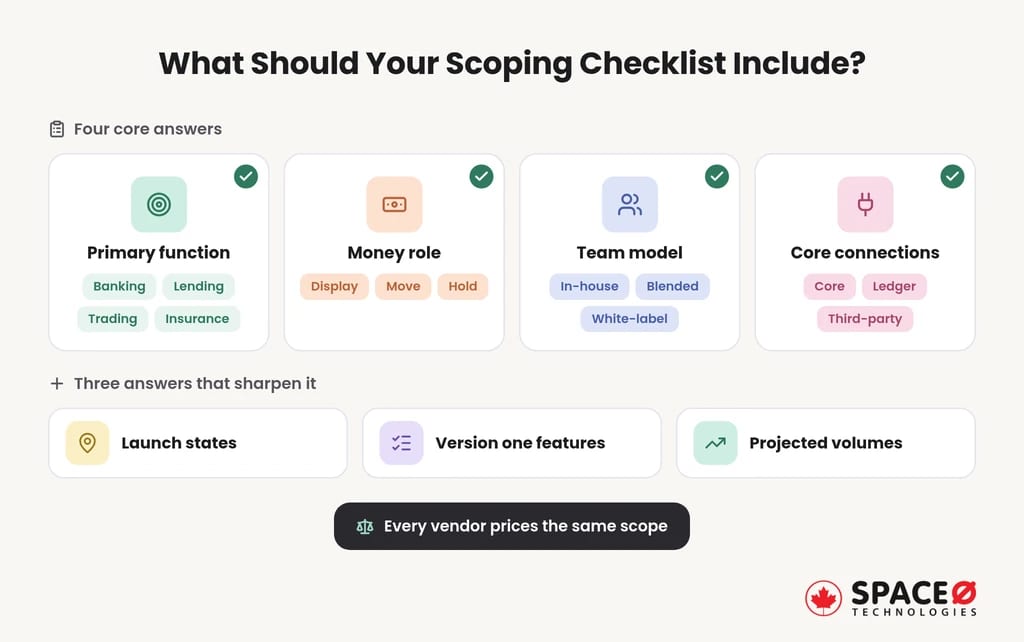
A credible fintech estimate starts with four answers. Prepare them before you request a quote, because each one can move your app to a different cost tier. Vendors can then price the same scope, and you can compare their answers on equal terms.
- Name the primary function: budgeting, P2P lending, crypto, banking, insurance or trading.
- State the money role: display data, move money or hold money.
- Choose the team model: in-house fintech team, blended team or white-label platform.
- List the core connections: existing core, ledger and third-party financial systems.
Three more answers sharpen the estimate further:
- Set the launch footprint: name the states you will operate in, since money transmitter licensing is set state by state.
- Define version one: list the features the MVP must prove, and park the rest for later releases.
- Project your volumes: estimate users and monthly transactions, since financial API and KYC/AML vendor fees scale with activity.
Send these answers to our team, and we’ll turn them into a scoped estimate during your free consultation.
Turn Your Scoping Answers Into a Fintech Budget
Share your app type, money role and core connections, and our team will turn them into a scoped estimate with compliance costs included.
Those answers turn a wide market range into a usable estimate. The final section shows how to act on them.
How Can Space-O Canada Help You Budget a Fintech App?
A US fintech budget holds up when regulation, money flows, and post-launch costs get priced before code. That order matters more than any single quote, because late scope changes are the expensive ones.
Space-O Canada has operated since 2018 and has served 100+ clients, including Fortune 500 companies. Our team maintains a 98% on-time delivery rate, and 65% of our business is repeat and referral. One in-house team maps compliance in discovery and stays through launch.
Frequently Asked Questions About Fintech App Development Cost in USA
What compliance requirements apply to a US fintech app that moves money?
Payments and wallet apps need KYC/AML checks, plus PCI-DSS when they handle card data. Complex enterprise platforms typically add SOC 2 and licensing. Trading platforms face SEC/FINRA rules, insurance apps depend on the carrier-partner, MGA or broker route, and banking apps built on a partner bank work under sponsor bank terms.
What is a double-entry ledger and why does it affect fintech build cost?
A double-entry ledger posts each money movement to two accounts. It drives build cost because skipping a proper ledger early forces costly rework. Ledgers, APIs and transaction logic sit in the backend, which is usually the single largest cost line at $12,000-$120,000.
Why do fintech apps cost more than regular apps?
Money movement brings compliance and security work that ordinary apps avoid. Security and compliance work alone runs $5,000-$60,000, and KYC/AML adds to backend and integration lines. Each financial integration, such as Plaid, Stripe or a credit bureau, typically adds $10,000-$40,000.
How long does it take to develop a fintech app?
A basic fintech MVP typically takes 3-6 months to build. A complex platform with AI-driven features, deep integrations and broad compliance scope can take a year or more. Timeline and cost move together, because a longer build funds the development team for more sprints.
Do I need a money transmitter license to launch a fintech app in the USA?
It depends on how your app handles funds. Apps that hold or transmit customer money may need money transmitter licenses, which are issued state by state. Partnering with a sponsor bank through a BaaS provider can change that licensing path, so confirm your model with legal counsel during discovery.
Is a cross-platform fintech app cheaper than native iOS and Android apps?
Usually, yes. A cross-platform framework such as Flutter or React Native lets one codebase serve iOS and Android, which lowers build and maintenance cost. Native Swift and Kotlin builds suit apps that need maximum performance or deep device-level security features.
How much do AI features add to fintech app development cost?
AI features such as fraud detection, credit scoring and robo-advisory raise cost sharply, because they need training data, model validation and ongoing monitoring. In lending and credit decisions, models also need explainable outcomes and audit trails. That is why AI/ML scope usually places a build in the complex enterprise tier, at $150,000-$400,000+.
Should I hire freelancers or a dedicated team to lower fintech app cost?
Freelancers can look cheaper upfront, but fintech products need consistent security practices, audit trails and compliance ownership across the whole build. Handoffs between separate developers are where scope and cost leak. A dedicated fintech team reduces rework and handoff risk, which usually lowers total cost of ownership.


Let’s Discuss Your Idea
Share your idea with our fintech development team and get a practical breakdown of what you need to build, integrate, secure, and launch it.
 Your project is covered by an NDAYour information stays secure and confidential




What our clients say


When we set out to build our Estate Tax Planning Tool, we needed a development partner we could trust with something this complex and consequential. Space-O Canada brought the technical expertise and attention to detail needed to handle intricate tax calculations and edge cases. They communicated clearly, delivered on time without cutting corners, and built a product we trust completely.
 Ed Chetan EdwinFounder, CharityCalc
We partnered with Space-O Canada to build a fintech platform that could support secure transactions, third-party integrations, and future scalability. Their team understood our business requirements from the beginning and delivered a well-architected solution without unnecessary complexity. Communication was consistent, milestones were met on time, and every challenge was handled proactively.
 Michael CarterCo-Founder, Digital Payments Platform
The fintech app came out exactly the way I pictured in terms of functionality. I will refer future UI/UX clients to their team. During the testing phase of the app, it performed according to the initial designs in terms of functionality. Their team was dedicated to creating the best version of the app and provided their own ideas to improve it.
 Amanda LewisProduct Manager, Lending Platform
Our banking modernization project involved complex integrations and strict security requirements, and Space-O Canada handled both with confidence. They developed a reliable banking platform that improved operational efficiency while maintaining a smooth customer experience. Their structured development process and clear communication kept the project on track from start to finish.
 Daniel RobertsVP of Technology, Regional Bank
Our legacy insurance system created delays across policy management and claims processing. Space-O Canada developed a centralized platform that streamlined our workflows and improved efficiency across departments. The project was delivered on schedule, and the team’s understanding of insurance technology was evident throughout the engagement.
 Emily FosterOperations Director, Insurance Provider
Developing a trading platform requires speed, reliability, and technical precision. Space-O Canada delivered a solution that performs exceptionally well while supporting real-time market data and intuitive trading workflows. Their project management was excellent, and the team remained responsive throughout every stage of development.
 Ethan MorganChief Product Officer, Investment Platform
The fintech app was successfully launched, and users loved its sleek design and features. Space-O Technologies worked in an organized and collaborative manner, allowing them to achieve quality results. They also took the time to deeply understand the project. They were very organized and had a good track record.
 David WilsonFounder, Personal Finance App