
- Late Compliance Scoping Breaks Fintech Budgets Before Launch
- Five Elements Every Fintech Business Case Needs
- 1. An Executive Summary and Problem Statement Built on One Market Friction
- 2. Strategic Alignment and a Monetization Model That Funds the Build
- 3. Alternative Options Analysis: Custom Build, White-Label or BaaS
- 4. Quantified Benefits and ROI Over a 3-5 Year Horizon
- 5. Risk Assessment and a Regulatory Roadmap Mapped Before Architecture
- Cost Tiers Follow Complexity and Compliance Load
- What are the 7 Core Budget Categories for a Fintech Build?
- How Does Space-O Canada Build Your Case and Budget in Five Steps?
- Space-O Canada Builds Fintech Business Cases That Hold Up Under Audit
- Frequently Asked Questions About Fintech Business Case and Budget Planning
Fintech Business Case and Budget Planning for Banks, Lenders and Fintech Startups

 Last Updated: November, 18 2026
Key takeaways:
- A fintech business case rests on technical requirements, regulatory compliance and financial ROI, and the budget follows that scope.
- Compliance scope, more than screen count, decides your cost tier, so it needs its own budget line from day one.
- Five elements make the case: a problem statement, strategic alignment, an options analysis, quantified ROI and a regulatory roadmap.
- Custom build, white-label and Banking-as-a-Service (BaaS) routes each leave a different share of compliance with you.
A fintech business case answers two questions: what will the build cost, and what does it return? The answer to the first depends on scope, because compliance obligations, integrations and the core system you already run move the price more than screen count does.
Settling those three early gives a finance committee numbers it can trust. Space-O Canada, a fintech software development company, helps banks, lenders and fintech startups build that case, and we map regulatory exposure in discovery, so the compliance line sits in the budget before architecture is locked.
This guide is for the people who have to defend the spend: banks, credit unions, lenders and fintech startups preparing a case for a finance or risk committee. It walks through the five elements of a fintech business case, compares building custom, buying a white-label platform and partnering with a BaaS provider, and splits the budget into seven categories with compliance on its own line. The return side comes down to two measures a committee can check: payback period and net present value (NPV) over a three-to-five-year horizon.
Late Compliance Scoping Breaks Fintech Budgets Before Launch
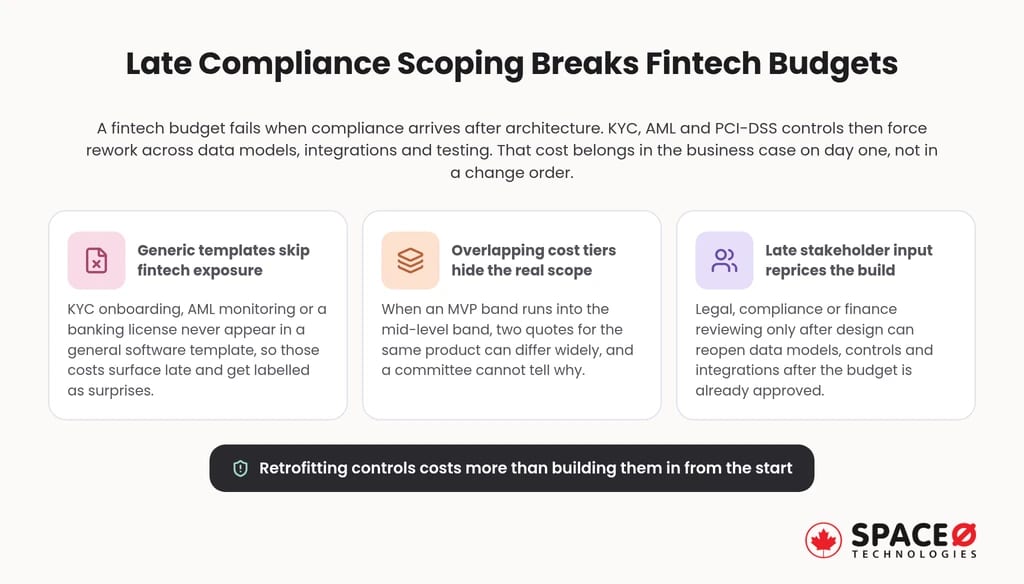
A fintech budget fails when compliance arrives after architecture. KYC, AML and PCI-DSS controls then force rework across data models, integrations and testing. Retrofitting those controls costs more than building them in from the start. Compliance work added late can raise total build cost sharply, because every layer built before the controls must be reopened. That cost belongs in the business case on day one, not in a change order.
Three gaps show up in fintech budgets again and again:
- Generic business case templates skip fintech exposure, e.g., KYC onboarding, AML monitoring or a banking license. A template built for general software projects never asks which regulator the product answers to, so those costs surface late and get labelled as surprises.
- Overlapping cost tiers hide the real scope, e.g., an MVP band that runs into the mid-level band. When tiers blur together, two quotes for the same product can differ widely, and a committee cannot tell why.
- Late stakeholder input reprices the build, e.g., legal, compliance or finance reviewing only after design. Each late review can reopen decisions already made on data models, controls and integrations, and the revised estimate arrives after the budget is approved.
These gaps come from scoping, not engineering. The service below closes each one before anyone writes code.
Five Elements Every Fintech Business Case Needs
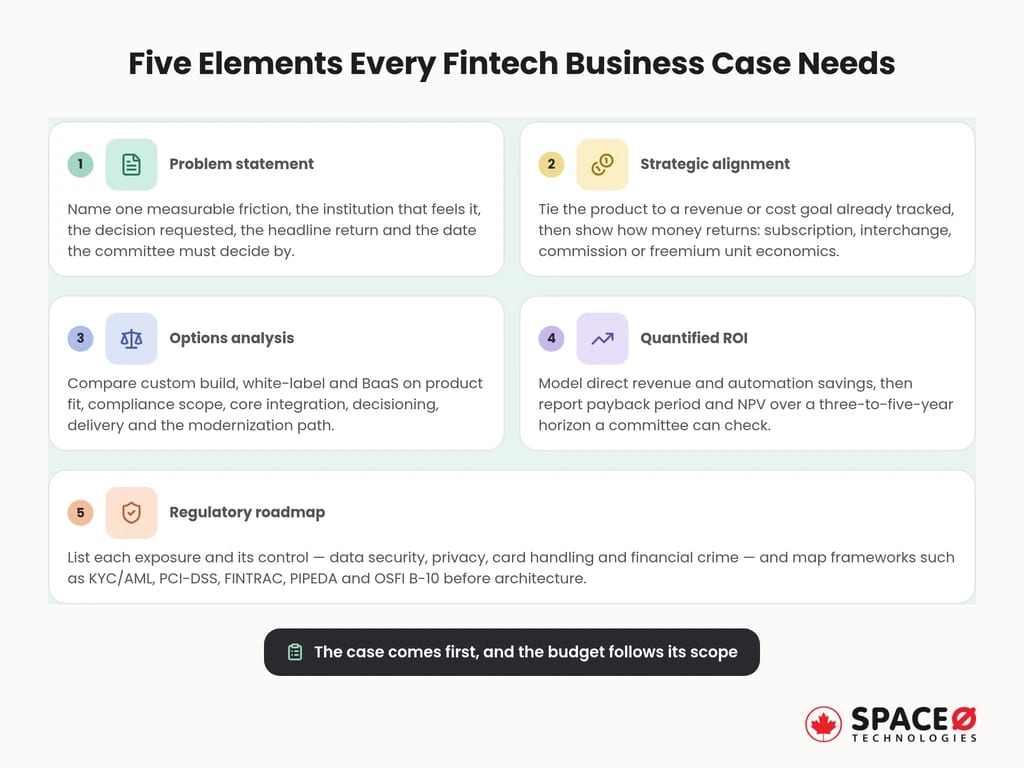
Space-O Canada delivers the business case and the budget as one discovery output. Each element below answers a question a finance or risk committee will ask. The case comes first, and the budget follows its scope.
1. An Executive Summary and Problem Statement Built on One Market Friction
A strong executive summary names one specific friction and the institution that feels it. Examples include cross-border fees at a payment service provider and slow onboarding at a credit union. Legacy core-banking bottlenecks at a bank are another common case. We state the problem in measurable terms, such as days to open an account. A sharp problem statement keeps every later number honest. The summary should also state the decision requested, the headline return, and the date the committee must decide by. Committees read this page first, and many read nothing else.
2. Strategic Alignment and a Monetization Model That Funds the Build
Strategic alignment ties the product to a revenue or cost goal the institution already tracks. The monetization model then shows how the money returns:
- Subscription revenue suits wealth and advisor platforms, e.g., tiered client portal access. Recurring fees give a predictable revenue line, so the case can model retention and churn month by month.
- Interchange revenue suits card and wallet products, e.g., debit cards or digital wallets. Earnings scale with card spend, so the model needs expected transaction volume and the share the issuing partner keeps.
- Commission revenue suits trading and payment flows, e.g., per-trade or per-transaction fees. Revenue tracks activity, so the case should test a quiet quarter as well as a busy one.
- Freemium revenue suits consumer startups, e.g., free budgeting with paid premium features. Only a share of free users convert to paid, so the case needs a realistic conversion assumption and the cost of serving the free tier.
We check unit economics before any architecture decision. A model that loses money per customer never earns back its build cost.
3. Alternative Options Analysis: Custom Build, White-Label or BaaS
Every fintech business case should compare three routes: build custom, buy white-label, or partner with a BaaS provider. For the five-year cost comparison, see our guide to the total cost of ownership of custom vs off-the-shelf fintech software for banks.
Adopting a ready-made platform means adapting your product to it. That dependency is how vendor lock-in in fintech software development starts. SDK.finance, for example, sells a white-label transaction platform and ledger, licensed as SaaS or as source code. Adopting it means fitting your product to its data model, and self-hosting if you license the source code. Buying software does not provide a banking license.
| Decision factor | Custom build | White-label platform | BaaS partner |
|---|---|---|---|
| Product fit | Built around your workflows | Product adapts to the vendor’s data model | Product adapts to the partner’s APIs and program rules |
| Compliance scope | Mapped in discovery for your exposure | Shaped by the vendor’s design; your gaps stay yours | Shared with the partner; your own obligations remain |
| Core integration | Connects to the core you already run | Set by the vendor’s ledger | Set by the partner’s infrastructure |
| Decisioning | Explainable, auditable rules your team owns | Logic defined by the vendor | Controls defined by the partner |
| Delivery and support | One in-house team from discovery through post-launch | License fees plus your own integration work | Partner fees plus your own integration work |
| Modernization path | Phased, so operations keep running | Migration onto the platform | Migration onto the partner’s rails |
We recommend a custom build when compliance fit and core integration decide the outcome. For regulated institutions, those two factors usually carry the case.
4. Quantified Benefits and ROI Over a 3-5 Year Horizon
Quantified benefits turn the case from a pitch into a decision. We model two benefit lines:
- Direct revenue comes from the monetization model, e.g., new fees, interchange or retained deposits.
- Cost savings come from automation, e.g., KYC/AML screening, underwriting or manual reconciliation.
The payback period marks the month when cumulative net benefit turns positive. Net present value (NPV) discounts projected cash flows over a three-to-five-year horizon. Together, the two measures tell a committee when the money comes back and what it is worth.
Payback period equals the month in which cumulative benefits first exceed cumulative costs. NPV equals the sum of each year’s net benefit divided by (1 + discount rate) raised to that year, minus the upfront build cost. Gather four inputs before modelling: build cost, annual run cost, annual benefit and your institution’s discount rate.
5. Risk Assessment and a Regulatory Roadmap Mapped Before Architecture
The risk section lists every exposure the product creates and the control that answers it. Typical entries cover four areas:
- Data security covers stored and moving financial data, e.g., account records, card numbers or credentials.
- Privacy covers personal information, e.g., GDPR for EU data subjects or PIPEDA for Canadian customers.
- Card handling covers payment data, e.g., PCI-DSS scope for card issuing or acceptance.
- Financial crime covers identity and transactions, e.g., KYC onboarding or AML transaction monitoring.
Mitigation often runs through certified third parties, such as KYC and identity verification providers. For the controls themselves, see the key features of custom fintech compliance software for banks.
For builds with Canadian exposure, we scope FINTRAC reporting and OSFI technology and cyber risk expectations. Where a vendor or BaaS partner is involved, a federally regulated bank also has to meet OSFI B-10 third-party risk requirements. Dual-market products get both frameworks covered, and we map compliance scope during discovery.
Not sure which frameworks apply to your product?
We map KYC, AML, PCI-DSS, FINTRAC and PIPEDA exposure in a free consultation, before any budget is committed.

With exposure mapped, the next question is what the build will cost.
Cost Tiers Follow Complexity and Compliance Load
Fintech build cost scales with feature depth, integrations and compliance load. Published price ranges vary widely by vendor and scope, so we group builds into three tiers by what each one must do and what it must prove to a regulator. We then price each tier in discovery.
| Tier | Typical scope | Compliance load | What drives the cost |
|---|---|---|---|
| MVP | One core flow, e.g., onboarding, a wallet or expense tracking | Baseline KYC and data protection | A single flow, few integrations and a small test surface |
| Mid-level | Several flows plus integrations, e.g., a payment gateway or KYC provider | KYC/AML screening; PCI-DSS when cards are involved | Number of integrations, certified third-party fees and depth of security testing |
| Enterprise-grade | Core banking integration, real-time processing, multi-role access | A full regulatory roadmap, often across more than one framework | Core integration, audit evidence, resilience and multi-framework compliance work |
When your scope straddles two tiers, price the compliance load first. It should decide your tier more than screen count does. Timeline moves cost too, so see how long fintech software development takes for a bank. Tier sets the overall range, and the seven categories below show where that money goes.
What are the 7 Core Budget Categories for a Fintech Build?
A fintech budget splits into seven categories. The right size for each depends on your scope, and your compliance load will shift them more than any other factor.
| Category | How to size it | What it covers in a fintech build |
|---|---|---|
| Personnel | Driven by team size and the length of discovery and build | Engineers, QA, product owners and compliance analysts |
| Software and licensing | Driven by the number of integrations and third-party fees | KYC provider fees, core banking APIs and development tooling |
| Hardware | Small and fixed once the test device list is set | iOS and Android test devices and secure workstations |
| Cloud and infrastructure | Grows with environments, data volume and uptime targets | Hosting, segmented environments and backups |
| Security and compliance | Set by the frameworks that apply, so scope it first | Penetration testing, audit logging and PCI-DSS scope work |
| Support and maintenance | Ongoing, planned as a yearly line after launch | Bug fixes, OS updates and performance monitoring |
| Innovation | Optional, ring-fenced for pilots after the core build | AI decisioning pilots and new payment rails |
Fill every row from the discovery estimate rather than a generic percentage. Ask each vendor to price personnel, licensing and cloud separately so you can compare bids line by line.
Give security and compliance its own line, never a slice of personnel. That keeps audit readiness visible to whoever approves the spend.
Get Your Fintech Business Case Scoped Before Code Starts
Book a free consultation with Space-O Canada. We cover scope, cost and timeline, and map your compliance exposure before you commit budget.
The case and the budget together give a committee one document to approve. The steps below turn that document into a delivery plan.
How Does Space-O Canada Build Your Case and Budget in Five Steps?
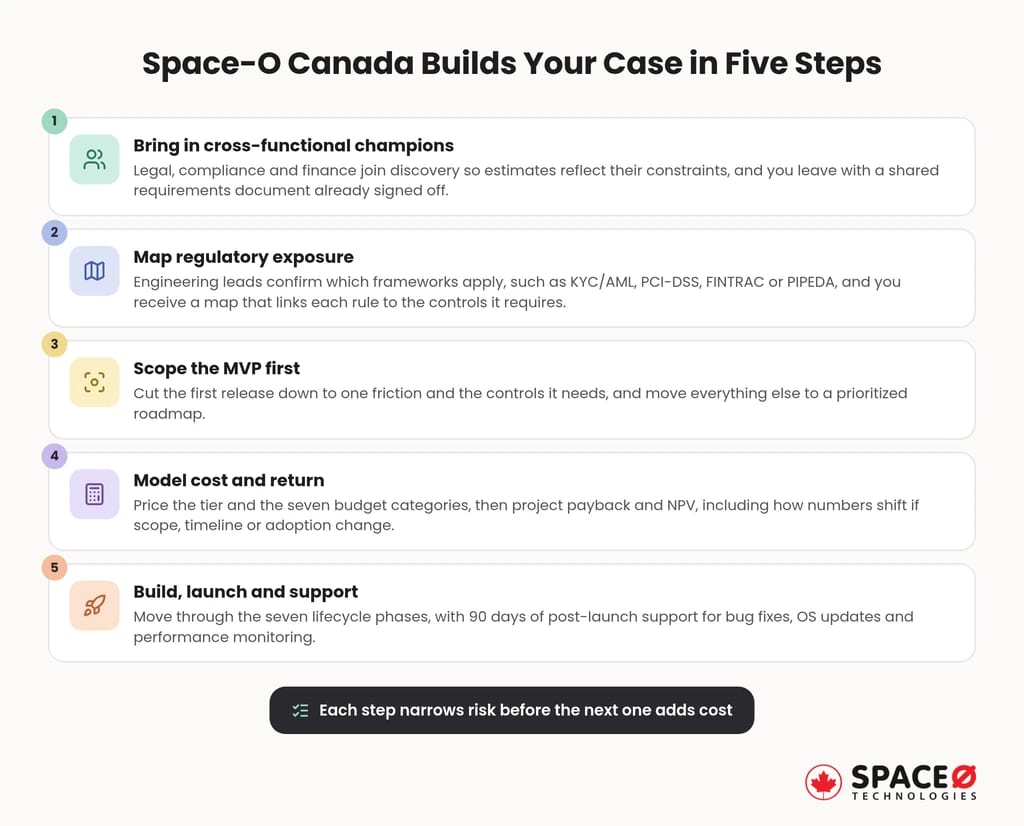
Our engagement follows five steps, and each one produces something a committee can review. The order matters, because compliance and scope must settle before the price does. When the budget comes last, it reflects real constraints rather than early guesses, and decision-makers can trace every number back to a documented requirement.
- Bring in cross-functional champions. Legal, compliance and finance join discovery, so estimates reflect their constraints from the start. Involving them early prevents late-stage objections that force redesigns, and it gives each department a stake in the outcome. The result is a shared requirements document that every stakeholder has already signed off on.
- Map regulatory exposure. Engineering leads confirm which frameworks apply, e.g., KYC/AML, PCI-DSS, FINTRAC or PIPEDA. Each framework brings its own technical controls, such as identity verification, data encryption, transaction monitoring and audit logging, and these directly affect effort and cost. You receive a compliance map that links each regulation to the features and safeguards it requires.
- Scope the MVP first. We cut the first release down to one friction and the controls it needs. Focusing on a single, high-value problem keeps the initial investment lean and lets you validate demand before committing to a full product. Everything else moves to a prioritized roadmap, so later phases are planned rather than forgotten.
- Model cost and return. We price the tier and the seven categories, then project payback and NPV. This turns the estimate into a financial case your committee can weigh against other investments. The model also shows how costs and returns shift if scope, timelines or adoption assumptions change.
- Build, launch and support. We move through the seven phases of the fintech software development lifecycle, from architecture and UI/UX to development, security testing and deployment. Every project includes 90 days of post-launch support covering bug fixes, OS updates and performance monitoring. Regular progress reviews at each phase keep the build aligned with the approved scope and budget, so there are no surprises at launch.
Each step narrows risk before the next one adds cost. The record below shows how that discipline holds up in production.
Space-O Canada Builds Fintech Business Cases That Hold Up Under Audit
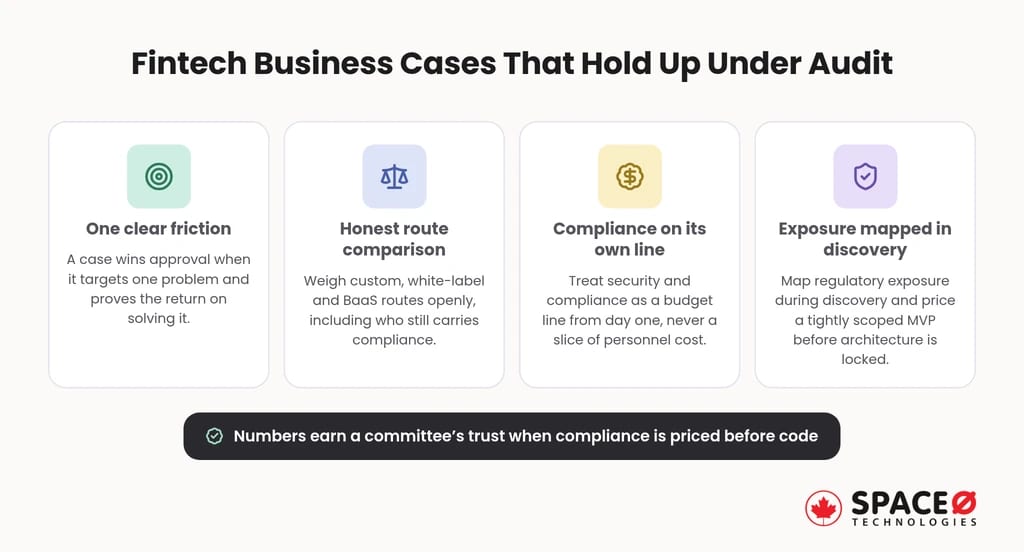
A fintech business case wins approval when it targets one clear friction and proves the return on solving it. It weighs custom, white-label and BaaS routes honestly, and it treats compliance as its own budget line from day one, not an afterthought. That is how the numbers earn the committee’s trust.
At Space-O Canada, we map your regulatory exposure during discovery and build every estimate around it. We recommend starting with a tightly scoped MVP, priced before the architecture is locked, so you commit only to what you can justify.
to review scope, cost and timeline before you make any commitment. Bring your problem statement, and we’ll bring the regulatory map.
Frequently Asked Questions About Fintech Business Case and Budget Planning
How to build a fintech?
Start by naming one market friction, then map the regulatory exposure (KYC/AML, PCI-DSS and any regional rules) before architecture is locked. Scope an MVP around that single friction and the controls it needs. Then price the build, project payback and NPV, and move through architecture, UI/UX, development, security testing and deployment. Bring legal, compliance and finance in at the start so their constraints shape the estimate.
What should a business case have in it?
A fintech business case needs five elements: an executive summary and problem statement, strategic alignment with a monetization model, an alternatives analysis (custom build, white-label or BaaS), quantified benefits and ROI over three to five years, and a risk assessment with a regulatory roadmap. The budget then follows that scope. Compliance should carry its own line rather than sit inside personnel cost.
What is a fintech app?
A fintech app is software that delivers a financial service, such as account onboarding with KYC, a digital wallet, expense tracking, payments or investment management. Banks, credit unions, lenders and startups build them. Because they handle money and personal data, they must meet rules such as KYC/AML and PCI-DSS.
Can you give me an example of a fintech app?
Common examples include a credit union eKYC onboarding flow, a digital wallet, an expense tracker and a lender origination and underwriting platform. Others are a wealth management client portal with advisor dashboards, and a payment product built on a gateway and a KYC provider. Each solves one specific friction, such as slow onboarding or manual reconciliation.
Does a white-label or BaaS partner carry my compliance obligations?
Not fully. With a white-label platform, the vendor’s design shapes compliance, but your gaps remain yours. With a BaaS partner, compliance is shared, yet your own obligations remain. Buying software also does not provide a banking license, so the budget should still carry its own compliance line.


Let’s Discuss Your Idea
Share your idea with our fintech development team and get a practical breakdown of what you need to build, integrate, secure, and launch it.
 Your project is covered by an NDAYour information stays secure and confidential




What our clients say


When we set out to build our Estate Tax Planning Tool, we needed a development partner we could trust with something this complex and consequential. Space-O Canada brought the technical expertise and attention to detail needed to handle intricate tax calculations and edge cases. They communicated clearly, delivered on time without cutting corners, and built a product we trust completely.
 Ed Chetan EdwinFounder, CharityCalc
We partnered with Space-O Canada to build a fintech platform that could support secure transactions, third-party integrations, and future scalability. Their team understood our business requirements from the beginning and delivered a well-architected solution without unnecessary complexity. Communication was consistent, milestones were met on time, and every challenge was handled proactively.
 Michael CarterCo-Founder, Digital Payments Platform
The fintech app came out exactly the way I pictured in terms of functionality. I will refer future UI/UX clients to their team. During the testing phase of the app, it performed according to the initial designs in terms of functionality. Their team was dedicated to creating the best version of the app and provided their own ideas to improve it.
 Amanda LewisProduct Manager, Lending Platform
Our banking modernization project involved complex integrations and strict security requirements, and Space-O Canada handled both with confidence. They developed a reliable banking platform that improved operational efficiency while maintaining a smooth customer experience. Their structured development process and clear communication kept the project on track from start to finish.
 Daniel RobertsVP of Technology, Regional Bank
Our legacy insurance system created delays across policy management and claims processing. Space-O Canada developed a centralized platform that streamlined our workflows and improved efficiency across departments. The project was delivered on schedule, and the team’s understanding of insurance technology was evident throughout the engagement.
 Emily FosterOperations Director, Insurance Provider
Developing a trading platform requires speed, reliability, and technical precision. Space-O Canada delivered a solution that performs exceptionally well while supporting real-time market data and intuitive trading workflows. Their project management was excellent, and the team remained responsive throughout every stage of development.
 Ethan MorganChief Product Officer, Investment Platform
The fintech app was successfully launched, and users loved its sleek design and features. Space-O Technologies worked in an organized and collaborative manner, allowing them to achieve quality results. They also took the time to deeply understand the project. They were very organized and had a good track record.
 David WilsonFounder, Personal Finance App