
- What are the Core Regulatory Retention Timelines for Banks?
- When Does Each Retention Clock Start, and Which Rule Wins?
- What are the Key Document Management Software Capabilities for Banks?
- How Do You Build Software That Enforces the Schedule?
- Build, Buy, or Extend: What Should Your Bank Compare?
- How Does Space-O Canada Build Retention-Ready Banking Software?
- Why Choose Space-O Canada for Bank Record Retention Software?
- Frequently Asked Questions About Record Retention Requirements
Record Retention Requirements for Financial Document Management Software at Banks A Complete Guide

 Last Updated: November, 17 2026

Key Takeaways
- Retention periods: BSA and AML records run 5 years, tax support 7 years, and charters, minutes and ledgers permanently.
- Clock triggers: a matrix shows when each period starts and which rule wins when several apply.
- Software controls: five capabilities and a four-layer build turn the schedule into enforced lifecycle states.
- Build decision: a comparison weighs a retention module inside one DMS against logic connected to your core.
US banks keep core Bank Secrecy Act (BSA) and AML records for 5 years and supporting tax documents for 7. Charters, bylaws, minutes and general ledgers are kept permanently, and your document management software must enforce that schedule. Building it means combining secure data storage, automated lifecycle engines, and immutable audit trails, each mapped to the rule it serves.
Retention rarely fails at banks because someone forgot a period. It fails because the clock started on the wrong date. A signature card kept 5 years from opening, not closing, can be purged while the account is still open. Space-O Canada maps that exposure in discovery, before architecture is locked, as part of its banking software development services.
The periods themselves are easy to find. FinCEN, IRS-driven accounting practice and NCUA guidance supply most of them. The harder part is encoding them so a document management system (DMS) or enterprise content management (ECM) platform obeys them. That means metadata at upload, a rules engine, legal holds and a disposal log an examiner can read.
This guide follows the order a compliance officer works in. It starts with the periods, then the triggers, then the software controls and build steps. It closes with a build-versus-buy comparison and the questions that decide which rules apply. Regulation and best practice are labeled separately throughout, because examiners treat them differently.
What are the Core Regulatory Retention Timelines for Banks?
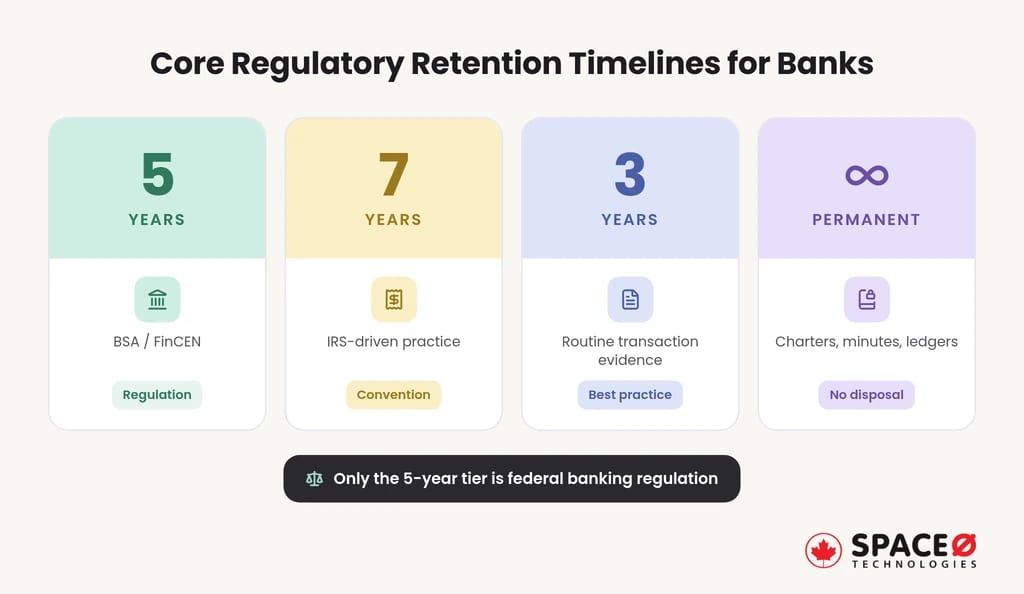
Bank retention periods fall into four tiers: 5 years, 7 years, 3 years and permanent. Only the first tier is a federal banking regulation. The others come from accounting conventions and NCUA guidelines.
1. Records the Bank Secrecy Act Requires for 5 Years
The 5-year tier is regulatory. It is set by the Bank Secrecy Act (BSA) and administered by FinCEN.
- Signature cards and verifying information: 5 years, after the account is closed (FinCEN BSA rules). These show who is authorized to transact on the account.
- Customer Identification Program (CIP) and beneficial ownership records: 5 years, after the account is closed (FinCEN BSA rules). These document how the bank verified its customers and the owners behind them.
- Deposit account statements: 5 years, from the statement date (BSA). These give examiners a complete view of account activity.
- Copies of checks over $100: 5 years, from the item date (BSA). These copies show who was paid and by whom.
- Currency Transaction Reports (CTRs) for cash over $10,000: 5 years, after the date of filing (FinCEN). The bank keeps its own copy of each report it files.
- Suspicious Activity Reports (SARs): 5 years, after the date of filing (FinCEN). Supporting documentation is kept for the same period.
- Funds transfers over $3,000: 5 years, from the execution date (BSA). These records let the bank trace a transfer from sender to recipient.
These seven record types share one pattern: the 5-year count begins at an event, not at creation. Signature cards, CIP and beneficial ownership records start counting when the account closes, while statements, checks, CTRs, SARs and funds transfers start at their own statement, item, filing or execution date. One account can therefore hold records that expire in different years. Records must also be kept in a way that lets the bank retrieve them within a reasonable time, so storage alone is not enough. Banks that produce CTRs and SARs through monitoring tools can review transaction monitoring software features for banks to see how filing dates and audit logs are captured.
One precision point matters here. FinCEN’s 5-year count from April 15 of the following year applies to FBAR filers, not bank account records.
For software design, each BSA record needs its own trigger date, and the account-closed date must come from the core banking system rather than from the upload date. The next section turns each of these start events into a rule value.
2. Records Banks Keep for 7 Years
The 7-year tier is accounting convention tied to IRS exposure. It is not a banking regulation.
- Tax-return supporting documents: 7 years, from the filing date (IRS-driven convention; Callaway, Bank of America). These include the workpapers and receipts that back each line of a filing.
- General bank statements: 7 years by default, from the statement date (Landmark CPAs). This is convention above the 5-year BSA floor for deposit statements.
- Vendor invoices: 7 years, from the fiscal year end (Landmark CPAs). They support expense deductions and any later vendor payment dispute.
- Payroll records: 7 years, from the pay period end (Landmark CPAs). They back up wage, withholding and employment tax filings.
- Sarbanes-Oxley (SOX) audit records: 7 years, from audit completion (SOX audit-record rules). Confirm with counsel how the rule applies to your institution.
The tax return itself is kept permanently. Only its supporting documents age out at 7 years. In a retention system, that means the return and its support need separate rules, even though they belong to the same filing. The return takes the permanent rule with no disposal date, while each supporting document gets a 7-year clock that starts on the filing date.
3. Records Banks Keep for 3 Years
The 3-year tier covers routine transaction evidence under accounting best practice.
- Deposit slips: 3 years, from the deposit date (Callaway, Landmark CPAs). They show what was deposited and when, and can be matched to the bank statement. They show what was deposited and when.
- Canceled checks: 3 years, from the clearing date (Callaway). They confirm that a payment cleared the account. The clock starts when the check clears, not when it is written.
- General expense reports: 3 years, from the report date (Callaway). They record internal spending and the approvals behind it. They back up internal spending and reimbursements.
This tier is where convention and regulation collide most often, as the conflict list below shows. These records support the transactions behind larger ones. Because checks over $100 fall under the BSA’s 5-year tier, tag canceled checks by amount at upload so the 3-year default never shortens a record that a regulation covers.
4. Records Banks Keep Permanently
Permanent records define the institution and its books. They never start a disposal clock.
- Articles of incorporation and bank charters: permanent, no trigger (NCUA Appendix A; Callaway). They prove the institution legally exists.
- Bylaws: permanent, no trigger (NCUA Appendix A to Part 749). They set the rules for how the institution is run.
- Board and shareholder minutes: permanent, no trigger (NCUA Appendix A; Callaway). They record the decisions leaders made and when.
- General ledgers: permanent, no trigger (NCUA Appendix A; Callaway). They hold the full account of the institution’s finances.
- Audit reports and financial statements: permanent, no trigger (Callaway, Landmark CPAs). They show the institution’s financial position over time.
NCUA publishes Appendix A to Part 749 as guidelines for credit unions, not as mandatory periods.
Those four tiers answer how long a record lives. The harder question is when each clock starts, and most retention guides skip it.
Unsure Which Retention Clock Applies to Your Records?
Share your record types and systems, and our fintech team will map each start event and period. We will outline the right rule set for your document platform.

When Does Each Retention Clock Start, and Which Rule Wins?
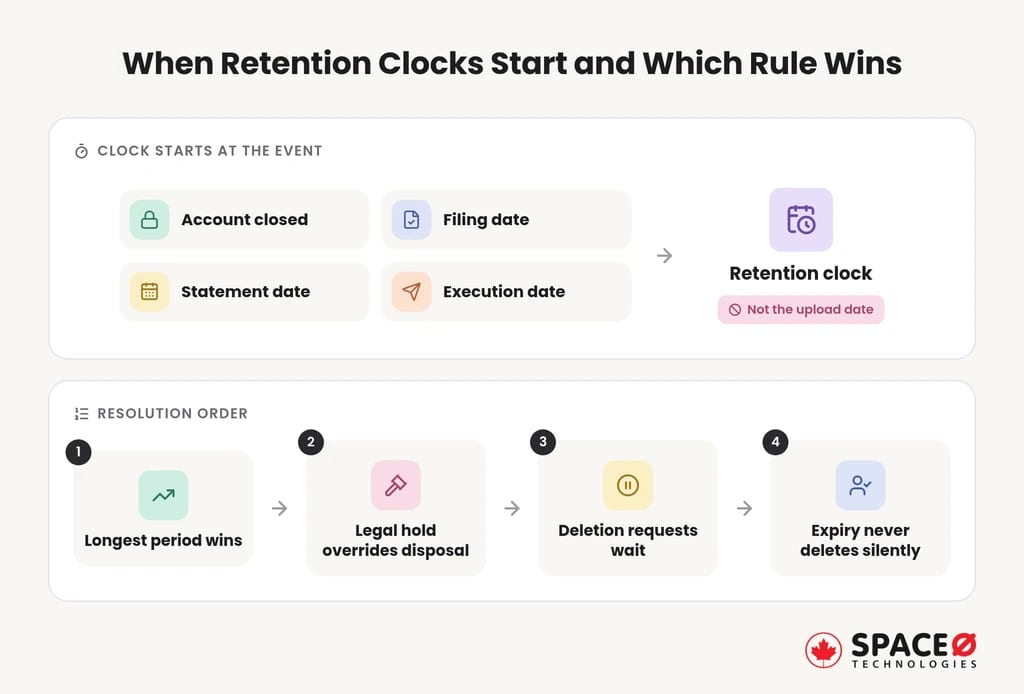
Each clock starts at a record-specific event, such as account closure or the filing date, and when several rules apply, the longest period wins. A retention period means nothing until the system knows its start event. This section is the specification most retention guides leave out.
1. What Does the Trigger-Event Matrix Look Like?
The matrix joins each record type to its period, its start event and the rule value that encodes it. It also covers the regimes most retention answers omit.
| Record type | Period | Clock-start event | trigger_event value | Behavior at expiry |
|---|---|---|---|---|
| Signature cards, CIP and beneficial ownership records | 5 years | Account closed | ACCOUNT_CLOSED | Eligibility report to compliance |
| CTRs and SARs | 5 years | Date of filing | FILING_DATE | Eligibility report to compliance |
| Deposit account statements | 5 years | Statement date | STATEMENT_DATE | Eligibility report to compliance |
| Copies of checks over $100 | 5 years | Item date | ITEM_DATE | Eligibility report to compliance |
| Funds transfers over $3,000 | 5 years | Execution date | EXECUTION_DATE | Eligibility report to compliance |
| ECOA (Regulation B) application records | 25 months | Notice of action taken | ACTION_NOTICE_DATE | Eligibility report to compliance |
| Truth in Lending (Regulation Z) records | 2 years | Disclosure or action date | DISCLOSURE_DATE | Eligibility report to compliance |
| Truth in Savings (Regulation DD) records | 2 years | Disclosure date | DISCLOSURE_DATE | Eligibility report to compliance |
| EFTA (Regulation E) records | 2 years | Disclosure or action date | DISCLOSURE_DATE | Eligibility report to compliance |
| Regulation X servicing records | Set per record type in the rule | Loan paid or servicing discharged | LOAN_PAID / SERVICING_DISCHARGED | Eligibility report to compliance |
| Tax-return supporting documents | 7 years (convention) | Return filing date | RETURN_FILED | Eligibility report to compliance |
| Deposit slips | 3 years (convention) | Deposit date | DEPOSIT_DATE | Eligibility report to compliance |
| Charters, bylaws, minutes, general ledgers | Permanent | None | NONE | Never eligible |
| Broker-dealer records | Per SEC Rule 17a-4 and FINRA | Record creation | CREATED_DATE | Eligibility report plus storage check |
Sources: the 5-year rows follow FinCEN’s BSA rules. The ECOA, Truth in Lending, Truth in Savings, EFTA and Regulation X rows follow Confidata and America’s Credit Unions. Convention rows follow Callaway and Landmark CPAs.
Every row except the permanent one ends in a report, not a deletion.
The consumer-compliance rows run shorter than BSA records but are easy to miss, because their clocks start on disclosure or action dates held in lending systems, not in the DMS. ECOA application records, for example, start counting at the notice of action taken, so a declined application’s clock cannot start until that notice is logged.
2. Where Do Sources Disagree, and Which Governs?
Sources disagree on several record types. The bank’s regulatory floor governs, and stricter internal policy can only lengthen it. Guides often give different numbers for the same record.
- Bank statements: Bank of America cites 12 months, Callaway 3 or 6 years, and Landmark CPAs 7. The BSA’s 5 years is a bank’s floor. Shorter figures from other sources do not override it.
- Canceled checks: Callaway suggests 3 years. BSA keeps copies of checks over $100 for 5, so BSA governs. The longer regulatory period wins over the shorter guidance.
- SOX audit records: One build guide cites 5 to 7 years. Audit-record rules support 7, so configure 7. This avoids shortening a record that audit rules cover.
Consumer guidance addresses households, not institutions. Treat it as context, never as the governing figure. Banks answer to regulators and examiners, so household advice does not set their periods.
3. What Order Should the Retention Engine Resolve Rules In?
Resolve every record through four checks, in this order. The order makes every outcome repeatable and explainable to an examiner. Each check runs before the next, so no record skips a step.
- Longest period wins: a record under several rules keeps the longest applicable period. The shorter periods never cut it short.
- Legal hold overrides disposal: an active hold freezes the clock and blocks purge, whatever the period says. The hold stays until legal counsel releases it.
- Deletion-rights requests wait: a GDPR or CCPA request during an active hold or period is logged and deferred. The requester gets an answer once the hold or period ends.
- Expiry never deletes silently: the record moves to Eligible for Disposal and waits for approval. A named reviewer must sign off before anything is purged.
That order replaces vague advice to “balance” deletion rights with a mechanism that logs every deferral.
Space-O Canada writes this order into the discovery-stage compliance map before the schema is built. Since 2018, we have helped banks, credit unions, lenders, insurers, and funded fintech startups build financial software that holds up in production. Our banking modernization project involved complex integrations and strict security requirements, and we have handled both with confidence.
The matrix and the rule order define the logic. The software capabilities below are what carry that logic into daily operations.
What are the Key Document Management Software Capabilities for Banks?
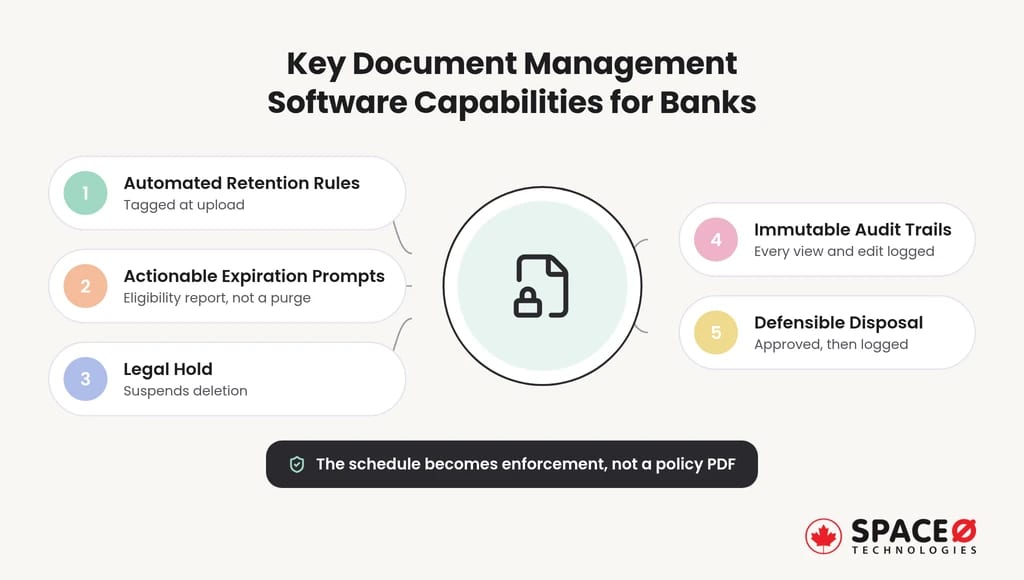
Bank DMS and ECM platforms carry five capabilities that turn a schedule into enforcement. Bank document management software must enforce schedules through automated tagging, role-based access controls, audit logs, and compliant disposal or legal holds.
1. Automated Retention Rules
Automated Retention Rules: documents are tagged at upload by customer, account or collateral type, and the matching policy applies. ICBA guidance sponsored by Alogent describes this tag-then-apply pattern. Without it, staff assign periods by hand, and hand-assigned periods drift. The metadata, not the folder, carries the retention clock.
2. Actionable Expiration Prompts
Actionable Expiration Prompts: at expiry, the system produces an eligibility report, and nothing is purged silently. Alogent frames this as a prompt for human review rather than an automatic purge. The report lists each record, its rule and its trigger date. A reviewer acts on facts, not on a folder count.
3. Legal Hold
Legal Hold: an active hold suspends deletion for every record it covers, as Neologix and getfileflo describe. It sits above every period in the resolution order. A named person places it and a named person releases it. Both actions land in the audit trail.
4. Immutable Audit Trails
Immutable Audit Trails: the log records who viewed, edited, downloaded or shared each record, and when. ICBA, Neologix and Cloudvara all treat this log as the core proof of control. Entries cannot be altered by the users they describe. That separation is what makes the trail credible under examination.
5. Defensible Disposal
Defensible Disposal: deletion happens only after approval, with the approver and time written to a verifiable log. Neologix calls these destruction logs, and getfileflo route approval through a compliance manager. The log outlives the record it describes. A deleted file is then explainable, not merely missing.
Those five capabilities describe what the software must do. The build section turns them into architecture, states and workflows.
How Do You Build Software That Enforces the Schedule?
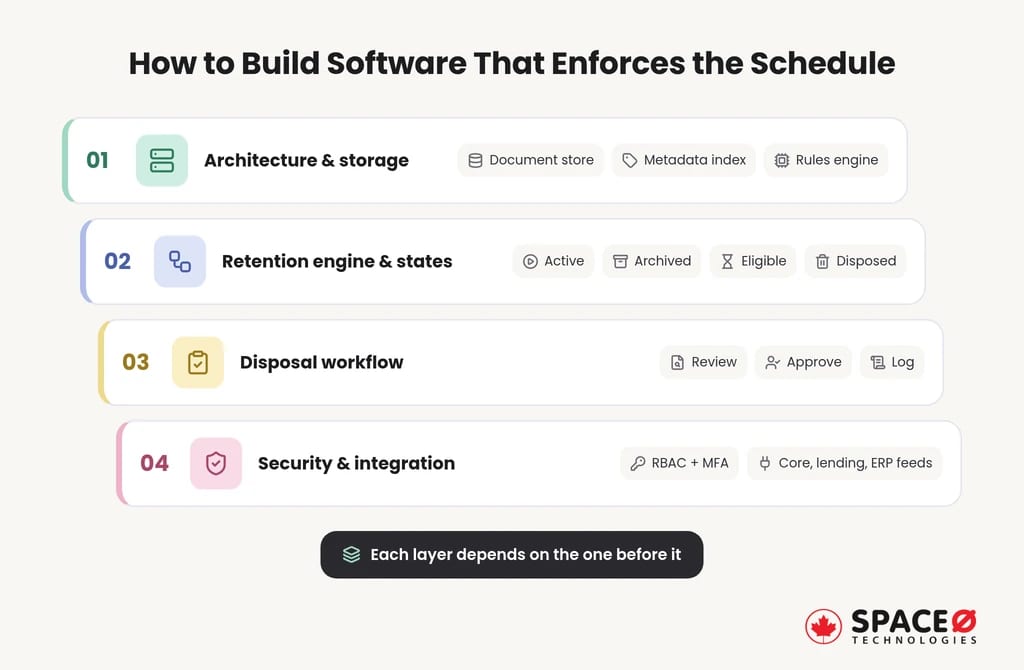
Financial document management software that meets record retention rules is built in four layers. Each layer depends on the one before it.
1. How Should Architecture and Storage Be Set Up?
Architecture and Storage: separate the document store, the metadata index and the rules engine. Keeping them apart lets you change a period without touching stored files. Trigger dates should flow in from the system of record, such as the core’s account-closed date. See modern banking software architecture components for how these layers sit within a wider banking stack.
- Document store: tiered primary and archive storage, with WORM storage as a design choice. Active files stay easy to reach, while older ones move to the archive.
- Integrity check: a SHA-256 hash at ingest, as a design choice, lets you detect any later change to the file. This helps show a record is unchanged.
- Metadata index: document type, trigger fields and hold flags, searchable by role. It lets staff find records without opening the files.
- Rules engine: the retention schema plus the four-step resolution order. It decides how long each record stays.
WORM is a design choice for most bank records, so confirm requirements where SEC Rule 17a-4 applies. Check this before you choose the storage tier.
2. How Do the Retention Engine and Lifecycle States Work?
Retention Engine: map each document type to a rule, then move records through named lifecycle states. The sequence runs Active, Inactive/Archived, Eligible for Disposal, then Disposed. A legal hold overlays any state before disposal.
| State | Trigger | Storage tier | Allowed actions |
|---|---|---|---|
| Active | Record ingested and tagged | Primary storage | View, share and edit metadata by role |
| Inactive/Archived | Trigger event recorded; clock running | Archive storage | View by role; no content edits |
| On Legal Hold (overlay) | Hold placed by legal or compliance | Unchanged | View only; clock frozen; no disposal |
| Eligible for Disposal | Period expired; no hold | Archive storage | Review, approve or extend |
| Disposed | Approval logged | Content deleted; disposal record kept | Read the disposal record only |
The rule schema behind those states needs only a handful of fields.
| Field | Example value | Purpose |
|---|---|---|
| document_type | SIGNATURE_CARD | Classifies the record at upload |
| trigger_event | ACCOUNT_CLOSED | Names the clock-start event |
| trigger_source | Core banking system | Identifies the system that supplies the date |
| period_months | 60 | Stores every period in one unit |
| period_basis | Regulation or policy | Separates law from convention |
| authority | BSA / FinCEN | Records the governing source |
| hold_behavior | Freeze clock; block disposal | Defines the legal hold effect |
| expiry_action | Eligibility report | Prevents silent deletion |
Store periods in months, because ECOA’s 25 months does not fit whole years.
Worked example: a 7-year tax-record clock from filing.
- Workpapers upload tagged TAX_SUPPORT, with period_months set to 84.
- The record sits in Active, and no clock runs until the return is filed.
- Suppose the return is filed October 15, 2026, which sets the trigger date.
- The record moves to Inactive/Archived, and the engine sets eligibility at October 15, 2033.
- If a legal hold arrives first, the clock freezes until a named person releases it.
- At eligibility, the record enters the disposal workflow, while the return itself stays permanent.
The clock starts at filing, not at upload, and that one field decides the outcome.
3. What Does a Defensible Disposal Workflow Include?
Disposal Workflow: route every expired record through review and approval before anything is deleted. The steps below keep each deletion explainable. No record leaves the system without a trail.
- The engine runs a scheduled check and lists records whose periods expired. This list is the starting point for review.
- It re-checks each listed record for holds and deferred deletion requests. A record with either one stays in place.
- A records manager reviews the eligibility report and flags exceptions. Flagged records wait for a decision.
- A compliance manager approves, and the name and time are logged. This shows who signed off and when.
- The system deletes the content and keeps a disposal record with its hash. The hash ties the record to the file that was deleted.
The disposal record is the evidence. Keep it on the permanent tier. It lets you answer an examiner’s question years later.
4. How Do Security and Integration Close the Build?
Security and Integration: restrict access by role and connect every system that supplies a trigger date. Role-based access control (RBAC) with multi-factor authentication (MFA) limits who can view, place holds or approve disposal. GLBA expectations for customer financial data apply to the whole store.
- Core banking: supplies account-closed dates for BSA and CIP records. These dates start the clock for account records.
- Lending systems: supply action notices, payoff dates and servicing discharge dates. Each date marks when a loan record’s clock begins.
- Accounting platforms: QuickBooks, Xero or Sage supply invoice and filing dates. These cover the bank’s own books and tax support.
- ERP: supplies payroll and fiscal-year dates. These dates anchor payroll and year-end records.
- Payments: wire records arriving as ISO 20022 messages supply execution dates. The execution date starts the clock for each wire record.
Where card data enters scope, PCI-DSS controls apply to those records. Everywhere else, the integration map decides whether a clock can start at all.
Retention triggers spread across your core, lending and document systems? .
Those four layers make the schedule enforceable in production. The next decision is whether to buy that logic, extend it or build it.
Build, Buy, or Extend: What Should Your Bank Compare?
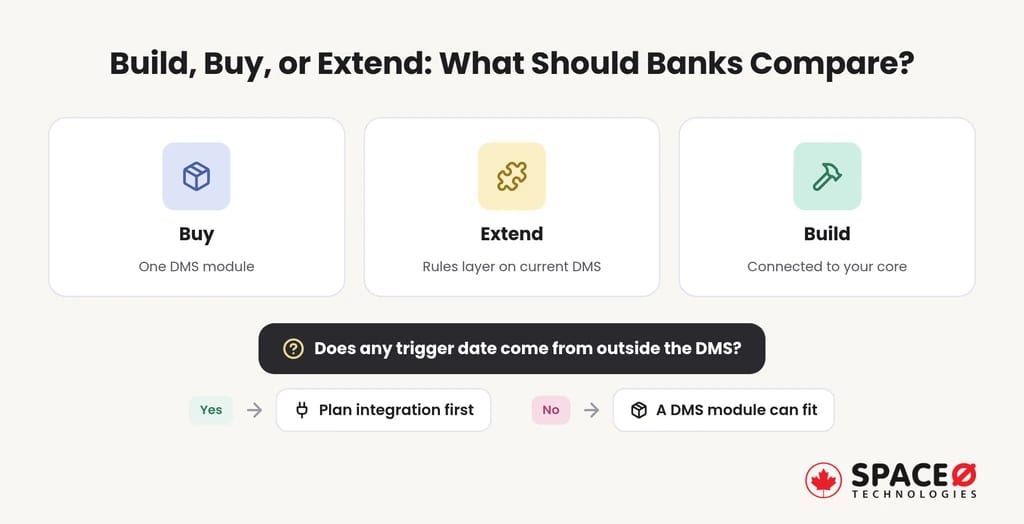
The right choice depends on where your clock-start dates live. A retention module inside one DMS works well for dates it captures itself.
| Axis | Buy: retention inside one DMS module | Extend: rules layer on your current DMS | Build: retention connected to your core |
|---|---|---|---|
| Trigger dates | Captured in the module; others imported or keyed in | Synced from systems the DMS already reaches | Read from core, lending and accounting systems |
| Core replacement | Can require moving documents into the module | No replacement; adds to what runs | No rip-and-replace; connects to the core you run |
| Modernization path | Cutover to the new module | Rules added incrementally | Phased, one record type at a time |
| Compliance mapping | Configured to the vendor’s templates | Mapped by your internal team | Mapped in discovery before architecture |
| Administration | Administrators maintain module rules | Your team maintains custom rules | Rules live in a schema you own |
| Security controls | Set by the module vendor | Inherited from the current DMS | Specified per build in discovery |
A simple test settles most cases. If any trigger date comes from outside the DMS, plan for integration first. Our build vs buy banking software guide walks through the same decision layer by layer.
Want Retention Built Into Your Core Systems?
Share your core, lending and document systems. Our fintech team will draft a build plan with compliance mapped in discovery.
That test favors connected retention for most banks and credit unions running several systems. The next section shows how Space-O Canada approaches that build.
How Does Space-O Canada Build Retention-Ready Banking Software?
Space-O Canada is a fintech software development company that builds secure banking platforms for banks, credit unions and lenders. Compliance is mapped during discovery, not bolted on during QA.
We sit with your team and learn how money and records move through your operations. Then we work out where the regulatory exposure sits and build around it. Our in-house team handles discovery, architecture, development, security testing and deployment, so there are no handoffs.
Security is baseline, not an upgrade. Every build includes encryption in transit and at rest, role-based access control, audit logging, and segmented environments. Our integration specialists connect fintech software with core banking systems, accounting platforms, KYC providers and payment gateways.
For a commercial bank with records spread across seven repositories, we consolidated more than 3.7 million records into one searchable system with role-based access, as our banking document management software case study shows.
Why Choose Space-O Canada for Bank Record Retention Software?
Bank record retention comes down to three things: the right period, the right start event and enforced disposal. BSA records anchor the 5-year tier, and accounting convention sets most 7-year periods. Software earns its keep by tagging at upload, honoring holds and logging every approval. Space-O Canada has built financial software for banks, credit unions and lenders since 2018.
We have served 100+ clients, including Fortune 500 companies. Every project includes up to 90 days of post-launch support from the same team. Explore Space-O Canada to see the full range of our fintech development work. If your retention rules span several systems, is the sensible next step. The questions below cover what readers ask most about retention periods.
Frequently Asked Questions About Record Retention Requirements
What financial records to keep?
A bank keeps four groups of records. BSA and AML records (signature cards, CIP and beneficial ownership files, account statements, checks over $100, CTRs, SARs, funds transfers over $3,000) are kept 5 years. Tax-supporting documents, vendor invoices, payroll and SOX audit records are kept 7 years by convention. Deposit slips, canceled checks and expense reports are kept 3 years, and charters, bylaws, minutes, general ledgers and audit reports are kept permanently.
How long must a bank retain records?
It depends on the record type. The regulatory floor for core BSA and AML records is 5 years, and the clock usually starts at account closing, filing, statement, item or execution date. Accounting convention adds 7-year and 3-year tiers, and some records, such as charters and ledgers, never expire. When several rules apply to one record, keep it for the longest applicable period.
How long do banks keep records for closed accounts?
Signature cards, verifying information, CIP records and beneficial ownership records are kept 5 years after the account is closed. The system must therefore treat the account-closed date as the clock-start event, not the opening or upload date. A signature card counted from opening could be purged while the account is still open.
How long do banks keep bank statements?
Under the BSA, deposit account statements are kept 5 years from the statement date, and that is the bank’s regulatory floor. Other sources disagree: one bank cites 12 months, one source cites 3 or 6 years, and another cites 7. Consumer guidance addresses households, so treat it as context and never as the governing figure for an institution.
Does federal law require all financial institutions to maintain effective recordkeeping and record retention programs?
The guide does not describe a general federal requirement for recordkeeping programs. It describes specific retention periods for specific records, such as 5 years for BSA records administered by FinCEN and 25 months for ECOA application records. Common periods like 7 years for tax support and 3 years for deposit slips are accounting convention, not banking regulation. Credit unions also follow NCUA Appendix A to Part 749, which is published as guidelines rather than required periods.
Can you give me some examples of accounting software?
QuickBooks, Xero and Sage are the accounting platforms named in this guide. A bank’s retention software can integrate with them to pull invoice and filing dates that start retention clocks. An ERP can likewise supply payroll and fiscal-year dates.
How to implement a document management system?
Start by mapping each record type to its period, authority and clock-start event, then build in four layers. First separate the document store, metadata index and rules engine. Next define lifecycle states (Active, Inactive/Archived, Eligible for Disposal, Disposed, with a legal-hold overlay) and an approval-gated disposal workflow. Finish with role-based access control, multi-factor authentication, and integrations that supply trigger dates.


Let’s Discuss Your Idea
Share your idea with our fintech development team and get a practical breakdown of what you need to build, integrate, secure, and launch it.
 Your project is covered by an NDAYour information stays secure and confidential




What our clients say


When we set out to build our Estate Tax Planning Tool, we needed a development partner we could trust with something this complex and consequential. Space-O Canada brought the technical expertise and attention to detail needed to handle intricate tax calculations and edge cases. They communicated clearly, delivered on time without cutting corners, and built a product we trust completely.
 Ed Chetan EdwinFounder, CharityCalc
We partnered with Space-O Canada to build a fintech platform that could support secure transactions, third-party integrations, and future scalability. Their team understood our business requirements from the beginning and delivered a well-architected solution without unnecessary complexity. Communication was consistent, milestones were met on time, and every challenge was handled proactively.
 Michael CarterCo-Founder, Digital Payments Platform
The fintech app came out exactly the way I pictured in terms of functionality. I will refer future UI/UX clients to their team. During the testing phase of the app, it performed according to the initial designs in terms of functionality. Their team was dedicated to creating the best version of the app and provided their own ideas to improve it.
 Amanda LewisProduct Manager, Lending Platform
Our banking modernization project involved complex integrations and strict security requirements, and Space-O Canada handled both with confidence. They developed a reliable banking platform that improved operational efficiency while maintaining a smooth customer experience. Their structured development process and clear communication kept the project on track from start to finish.
 Daniel RobertsVP of Technology, Regional Bank
Our legacy insurance system created delays across policy management and claims processing. Space-O Canada developed a centralized platform that streamlined our workflows and improved efficiency across departments. The project was delivered on schedule, and the team’s understanding of insurance technology was evident throughout the engagement.
 Emily FosterOperations Director, Insurance Provider
Developing a trading platform requires speed, reliability, and technical precision. Space-O Canada delivered a solution that performs exceptionally well while supporting real-time market data and intuitive trading workflows. Their project management was excellent, and the team remained responsive throughout every stage of development.
 Ethan MorganChief Product Officer, Investment Platform
The fintech app was successfully launched, and users loved its sleek design and features. Space-O Technologies worked in an organized and collaborative manner, allowing them to achieve quality results. They also took the time to deeply understand the project. They were very organized and had a good track record.
 David WilsonFounder, Personal Finance App