
- What are the Cost vs. Investment Tiers for Bank Fintech Software?
- What are the Key Drivers of ROI in Banking?
- How Do You Calculate Your Bank’s ROI on Fintech Software?
- Is Custom Fintech Software Worth the Cost for a Credit Union?
- How Do Custom Build, Integrate and Banking-as-a-Service (BaaS) Compare?
- How Does Space-O Canada Reduce ROI Risk on Bank and Credit Union Builds?
- Why Choose Space-O Canada for Fintech ROI at Banks and Credit Unions?
- Frequently Asked Questions About Fintech Software Development ROI for Banks
Fintech Software Development ROI for Banks How to Calculate Costs, Returns, and Payback

 Last Updated: November, 17 2026

Key Takeaways
- Four drivers decide whether a bank fintech build pays back: operating cost, processing speed, self-service and fraud mitigation.
- Cost tiers run from a modular MVP to enterprise core modernization, with timelines to match.
- A net ROI and payback model corrects the gross-savings math behind most ROI claims.
- A credit union section delivers a verdict, a scorecard and a 5-year cost-of-ownership worksheet.
Fintech software development ROI for banks depends on net benefit, not gross savings. Returns come from automated lending, digital banking platforms and streamlined payment processing. Below, you can calculate net ROI and payback yourself, and see when custom software pays off for credit unions. According to McKinsey research, 70 percent of digital transformations exceed their original budgets, so a credible ROI case must count the costs that vendor figures leave out.
Most bank ROI cases break after launch, not in the boardroom. Ownership costs after go-live rarely appear in vendor math. An underwriting tool that saves hours can still lose money once PCI-DSS scope and run costs arrive. That risk applies to any institution hiring a fintech software development company to build around an existing core.
This guide works from a reproducible method rather than vendor-published figures. Where a figure is an estimate or uncited, the text says so. The method stays reproducible, so your finance team can rerun it with its own data. It starts with what each level of investment actually buys.
What are the Cost vs. Investment Tiers for Bank Fintech Software?
Bank and credit union fintech builds fall into three cost tiers, set by scope, integration depth and timeline.
| Tier | Relative cost | Timeline | Who it suits |
|---|---|---|---|
| Modular MVP | Smallest budget, one function | 12-16 weeks | A bank or credit union proving one function, such as digital onboarding. |
| Growth platform/core digital upgrade | Mid-range budget, several functions | 20-28 weeks | Institutions adding lending, payments or mobile banking to a running core. |
| Enterprise custom/core modernization | Largest budget, core-level work | 32-52+ weeks | Banks and larger credit unions wrapping or replacing a legacy core. |
The tier you pick sets the denominator of your ROI. A modular MVP and a core modernization cannot share one benchmark.
Cost tells you only half the equation. Four drivers decide whether that spend comes back.
What are the Key Drivers of ROI in Banking?
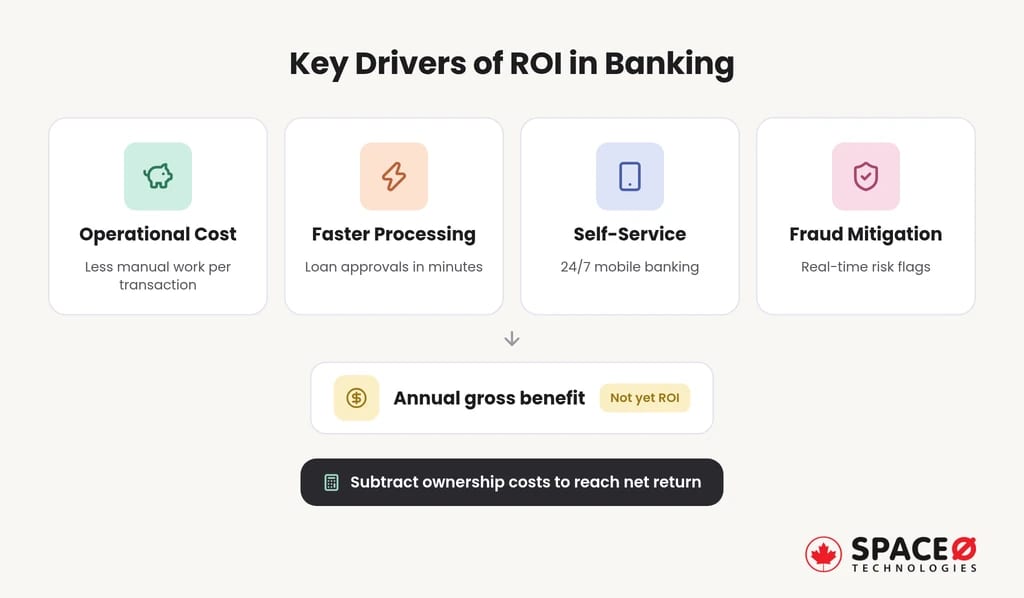
Bank fintech ROI flows from lower operating costs, faster turnaround times and higher customer retention. Four drivers produce those gains:
- Operational cost reduction: Automated mortgage processing, digital KYC/AML and streamlined payment processing cut manual work per transaction. Each hour of manual handling removed, priced at loaded staff cost, becomes a line in your annual gross benefit.
- Faster time-to-market and processing: AI credit scoring moves loan approvals from weeks to minutes. Shorter turnaround lets lenders close more applications before a borrower goes elsewhere, which adds loan revenue to the benefit side.
- Enhanced self-service and digital adoption: 24/7 mobile banking shifts routine requests away from branches and call centers. Fewer branch visits and support calls lower the cost of each service request, and easier access can help retain deposits.
- Risk and fraud mitigation: Real-time AI/ML fraud detection and compliance monitoring flag suspect activity as it happens. Avoided losses count as benefit, yet vendors rarely publish them separately. That makes this the hardest driver to model, because the benefit is a loss that never happened.
To quantify this driver, take last year’s fraud losses and chargebacks from your ledger and apply the reduction your vendor commits to in writing. Count only the avoided portion as annual benefit, and leave it out of the model if you cannot trace it to a ledger line. Keep this line conservative, since a board or examiner will test it first.
Not Sure Which ROI Drivers Apply to Your Bank?
Share your institution type and target function, and our fintech team will map the drivers that fit your core and the project scope to capture them.

Each driver yields gross benefit, which is not the same as return. The next section subtracts the costs those figures leave out.
How Do You Calculate Your Bank’s ROI on Fintech Software?
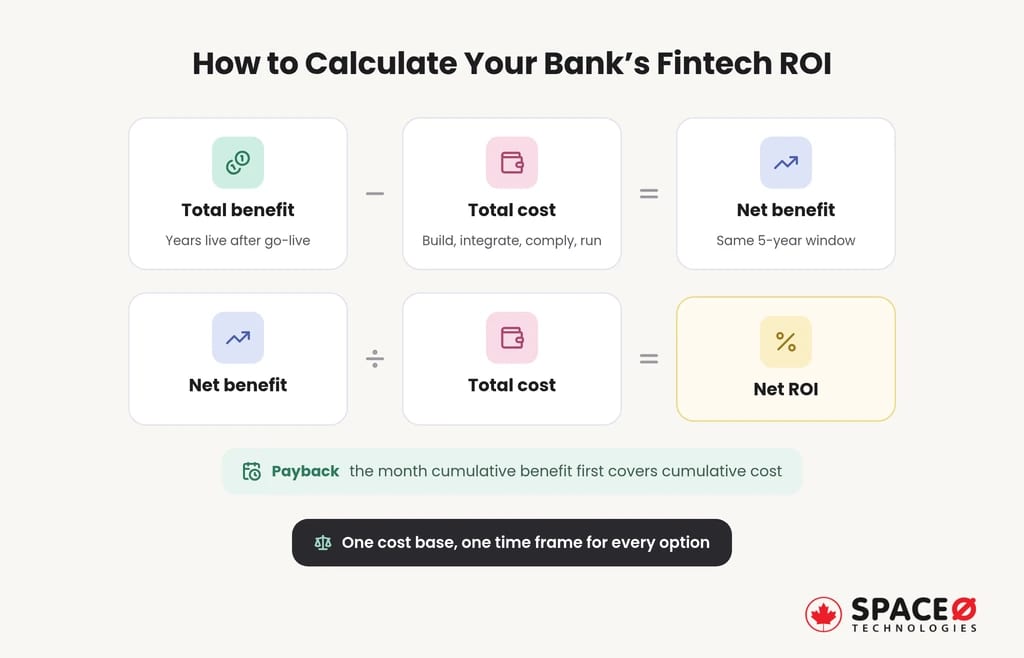
Net ROI equals net benefit divided by total cost, with both measured over the same period. Payback period is the month when cumulative benefit first covers cumulative cost.
1. Why gross savings divided by investment overstates ROI
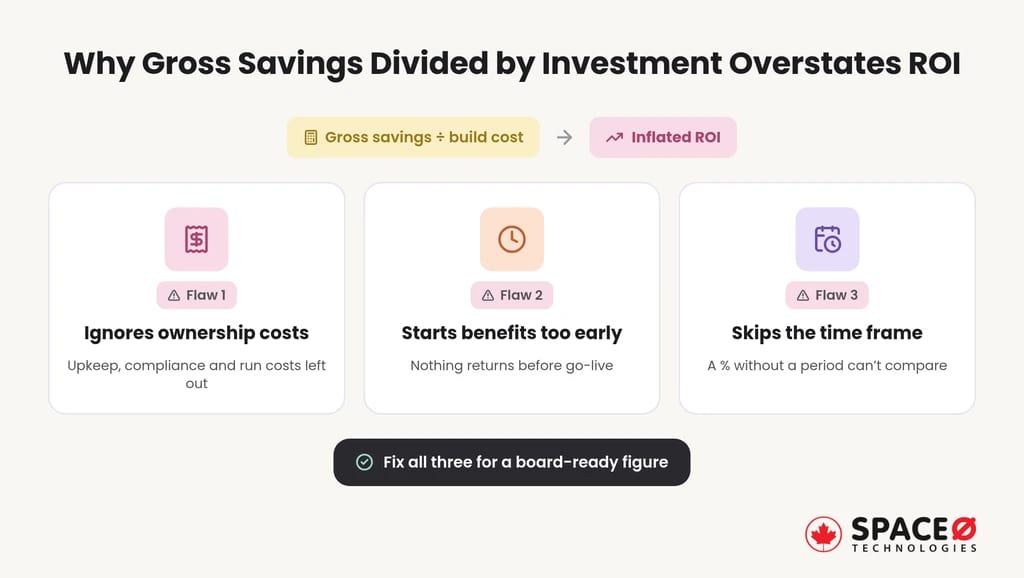
Gross ROI divides one function’s savings by its build cost and stops there. That shortcut inflates the result in three ways:
- It ignores ownership costs: Maintenance, integration, compliance and run costs never enter the denominator. A build that costs $150,000 can carry several times that over five years once upkeep and audits are counted.
- It starts benefits too early: Savings get counted from day one, although nothing returns before go-live. Every month of build time is a month of cost with no benefit against it, which pushes the real payback date later.
- It skips the time frame: A percentage without a period cannot be compared across projects. A 200% return over two years and a 200% return over five years describe very different investments.
Fix all three and the result becomes defensible to a board and an examiner. Each input then traces to a ledger line or a project plan, so a reviewer can rerun the math and reach the same figure.
2. The net ROI and payback formula for banks
Use one cost base and one time frame for every option you compare.
Total cost (5 yr) = Build + Integration + Compliance (setup + annual × 5) + (Maintenance × 5) + (Run × 5) Total benefit (5 yr) = Annual gross benefit × years live after go-live Net benefit = Total benefit − Total cost Net ROI (%) = Net benefit ÷ Total cost × 100 Payback month = First month, counted from project start, where cumulative benefit ≥ cumulative cost
Annual gross benefit sums hours saved at loaded staff cost, added loan revenue, retained deposits and avoided fraud losses. Every term traces to a ledger line or an operating report.
3. A reconciled lending example
A reconciled example states every input as an assumption, then shows the math closing to the dollar.
| Input | What it covers | Where the figure comes from |
|---|---|---|
| Build cost | Origination, underwriting and decisioning modules | Partner quote within your cost tier |
| Integration | Connectors to the core and credit bureaus | Integration scope from discovery |
| Compliance | PCI-DSS scope, testing and audit work | Compliance budget and audit invoices |
| Annual maintenance | Fixes, updates and minor features | Partner quote as a share of build cost |
| Annual run cost | Hosting, monitoring and licenses | Infrastructure estimate |
| Months to go-live | Build window before any benefit | Tier timeline and project plan |
| Annual gross benefit | Turn-time savings, added loans, avoided losses | Loan volumes and staff cost data |
Illustrative example (assumptions, not client data): A growth-tier lending platform has a $150,000 build, $25,000 integration and $15,000 compliance setup. It also has $8,000 annual compliance, $20,000 annual maintenance and $12,000 annual run cost. Go-live comes at month 6, and annual gross benefit is $200,000.
Total cost (5 yr) = $150,000 + $25,000+($15,000 + $8,000×5)+($20,000 × 5) + ($12,000 × 5) = $390,000.
Total benefit = $200,000 × 4.5 years live = $900,000. Net benefit = $510,000. Net ROI = $510,000 ÷ $390,000 = 130.8%.
Payback: setup costs of $190,000 are spent over months 1-6 and recurring costs run evenly across all 60 months, so cumulative cost is $210,000 at go-live. After that, benefit grows by about $16,667 a month against about $3,333 of cost, so cumulative benefit first covers cumulative cost in month 22.
Once filled, the table lets any reviewer reproduce the result line by line. Credit unions apply the same logic to a sharper build-or-buy question.
Is Custom Fintech Software Worth the Cost for a Credit Union?
Custom fintech software pays off for a credit union needing member personalization, legacy-core integration and digital-experience ownership. Credit unions that put speed or budget control first fit commercial off-the-shelf (COTS) or low-code platforms.
Treat the choice as CapEx for differentiation versus predictable OpEx for standard compliance and utility functions.
1. When custom software is worth it for a credit union
Three triggers justify custom spend for a credit union:
- Legacy fragmentation: Credit unions on Fiserv, Jack Henry or FIS cores often need proprietary middleware or APIs fitted to their data architecture. Off-the-shelf connectors can leave gaps at the core, and custom middleware closes them without replacing the core itself.
- Field-of-membership workflows: Credit unions serving educators, military members or labor unions need niche workflows that packaged platforms rarely carry. Building those workflows into the member journey spares staff the manual workarounds that packaged tools force on them.
- UX differentiation: Buying the same SaaS platform as nearby institutions makes your member experience identical to theirs. A custom build lets you shape onboarding, dashboards and service flows around your own members.
One trigger may justify a targeted build, while all three point firmly toward custom. Score your own situation against each trigger before you commit budget.
2. Hidden risks and long-term costs
Three risks offset those gains. The commonly cited figures behind them carry no traceable source, so test each one.
- Maintenance: Upkeep is estimated at a meaningful share of the initial build cost each year. Budget it as an estimate until a partner confirms it. That covers bug fixes, security patches, platform updates and the small feature requests that follow every launch.
- Liability: Custom software shifts regulatory and security liability to the credit union. That spans SOC 2, PCI-DSS and NCUA expectations. A vendor platform would carry part of that load, while a custom build leaves your team answerable to examiners for every control.
- Black-box talent drain: Undocumented code becomes unmaintainable once its original developers leave. The institution then pays twice to understand its own system. Documentation requirements written into the contract keep that cost from landing on you later.
Contracts and documentation set before kickoff keep each risk manageable. For the wider causes of cost overruns, see why fintech software projects fail.
3. Liability-transfer and code-handover checklist
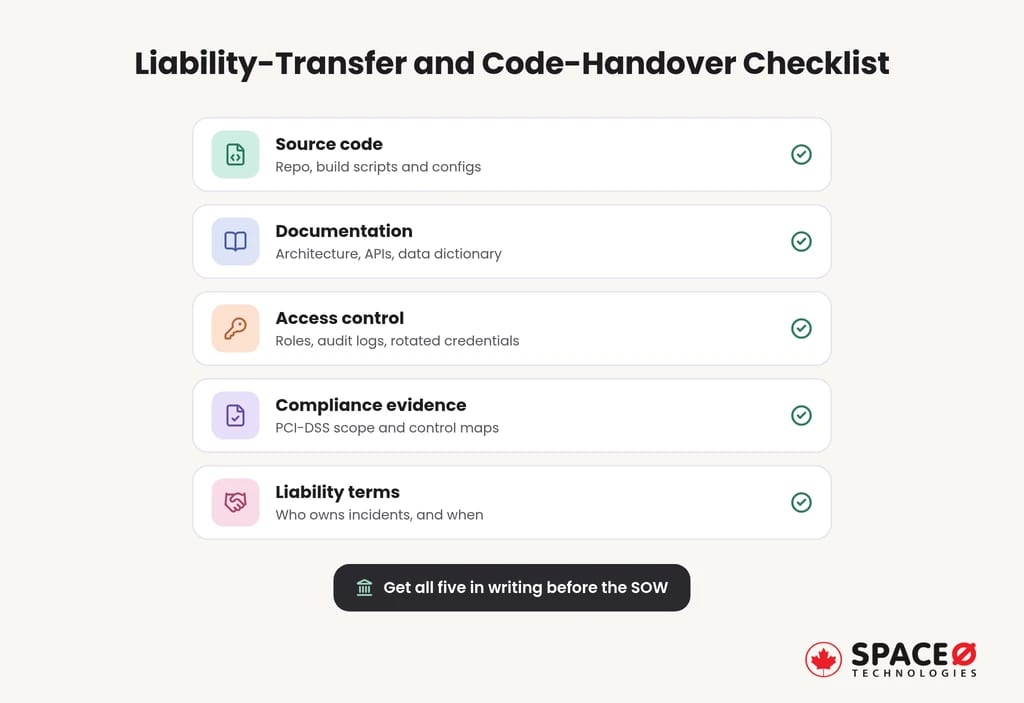
Five contract items keep custom code from becoming a black box:
- Source code: The repository, build scripts and deployment configuration transfer to the credit union at every release. That lets another team rebuild and redeploy the product if the partnership ends.
- Documentation: Architecture diagrams, API contracts and data dictionaries ship with the code, not months later. Handover is far cheaper while the original engineers still remember why each decision was made.
- Access control: Role-based access control settings and audit logging records hand over with admin credentials rotated. That way no former contractor keeps access to member data after the project closes.
- Compliance evidence: PCI-DSS scope notes and control mappings sit in a file your examiners can read. Keeping them current after each release saves scrambling when an audit date arrives. The features of custom fintech compliance software include the audit trails that produce this evidence.
- Liability terms: The contract names which party owns security incidents during and after the support period. Naming the response time and the reporting duties for each party avoids disputes when an incident happens.
Ask for all five in writing before you sign a statement of work. The guide to avoiding fintech vendor lock-in before you sign covers these contract clauses in more depth.
4. Why hybrid is the recommended path for mid-sized credit unions
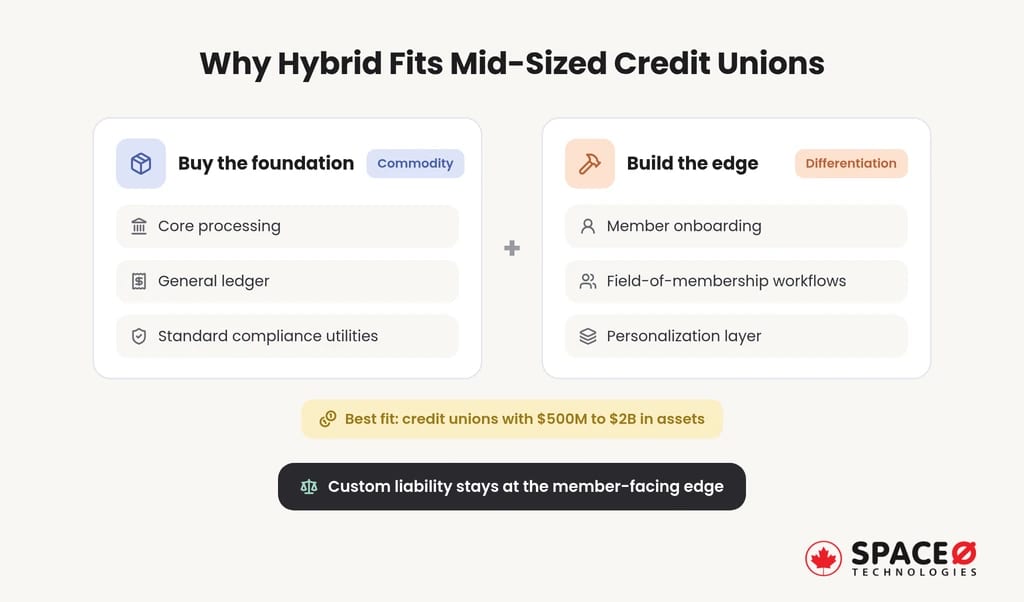
Hybrid means buying the commodity foundation and building the member-facing edge. The recommendation targets credit unions holding $500M to $2B in assets, a band no cited source confirms.
- Buy: Core processing, general ledger and standard compliance utilities that every institution runs the same way. These functions rarely set one credit union apart, so a proven vendor product carries them at lower risk and cost.
- Build: Member onboarding, field-of-membership workflows and the personalization layer that sets you apart. These are the touchpoints members notice, so this is where custom code earns its cost.
Hybrid narrows custom liability to the edge and spends budget where members actually notice it.
Hybrid also keeps the ROI denominator stable. Packaged cores arrive with vendor-covered compliance controls and predictable subscription costs, so only the member-facing edge carries build and maintenance risk. A credit union that scores 5 to 8 on the scorecard below can usually fund that edge in one or two phases, without a multi-year program.
5. Build, hybrid or buy scorecard for your credit union
Score each criterion 0, 1 or 2, then add the six results.
| Criterion | 0 points | 1 point | 2 points |
|---|---|---|---|
| Asset size | Under $500M | $500M to $2B | Over $2B |
| Internal IT capacity | No in-house engineers | Small team that manages vendors | Team able to own and maintain code |
| Legacy fragmentation | One core, few integrations | Several point-to-point links | Many disconnected systems around the core |
| Field-of-membership workflows | Standard retail needs | Some niche processes | Core workflows no package supports |
| UX differentiation priority | Parity is enough | Selective differentiation | Experience is the strategy |
| Speed and budget pressure | Hard deadline and fixed budget | Some flexibility | Multi-year budget and timeline |
Read the total against three results:
- 0 to 4 points: Buy a COTS or low-code platform and configure it.
- 5 to 8 points: Go hybrid, with a packaged foundation and a custom edge.
- 9 to 12 points: Build custom, phased against your existing core.
Treat these cut-offs as a starting rule, then adjust for your board’s risk appetite.
6. 5-year cost-of-ownership worksheet
Fill one worksheet for custom and one for the packaged alternative, using the same five years. For a deeper comparison, read the total cost of ownership for custom vs off-the-shelf fintech software.
| Cost line | Year 0 | Each of Years 1-5 | 5-year total |
|---|---|---|---|
| Build or implementation (B) | B | None | B |
| Maintenance (rate m) | None | B × m | 5 × B × m |
| Integration (I) | Initial connectors | Connector upkeep | Sum of both |
| Compliance (C) | Scoping and initial testing | Annual audits and testing | Sum of both |
| Run costs (R) | None | Hosting, monitoring, licenses | 5 × R |
| Total cost of ownership | Year 0 sum | Annual sum | 5-year sum |
Set m from the maintenance estimate in the risks list, or from a partner quote. For the packaged option, B becomes implementation cost and R carries the subscription.
Read the cost total next to the scorecard result, not instead of it. The four delivery models compare most clearly side by side.
How Do Custom Build, Integrate and Banking-as-a-Service (BaaS) Compare?
Banks and credit unions choose among four delivery models, each trading control against speed and disruption.
| Factor | Custom build / phased modernization | COTS or low-code | Integrate third-party or BaaS | Hybrid |
|---|---|---|---|---|
| Legacy-core integration | Built to your core’s data model and APIs. | Limited to the vendor’s prebuilt connectors. | Runs beside the core through provider APIs. | Packaged core with custom middleware at the gaps. |
| Member-specific workflows | Fully shaped to your field of membership. | Configurable within platform limits. | Fixed to the provider’s product set. | Custom on member-facing layers only. |
| UX ownership | You own design and roadmap. | Shared look with other licensees. | Branded front end, provider-defined flows. | You own the edge experience. |
| Compliance mapping | Mapped to your scope; liability stays with you. | Vendor covers standard controls; you verify fit. | Provider covers its layer; you oversee it. | Vendor for the foundation, you for the edge. |
| Disruption to operations | Low when phased, high with rip-and-replace. | Moderate during migration and setup. | Low at launch, with reliance on one provider. | Low, because the foundation stays put. |
| Explainable decisioning and audit logging | Designed in; you control rules and logs. | Depends on what the vendor exposes. | Depends on provider reporting access. | Custom logs at the edge, vendor logs below. |
| Post-launch support | Set by the build partner’s terms. | Vendor support plans. | Provider service levels. | Vendor plus build partner. |
| Phased rollout | Modules ship in sequence. | Tied to vendor release cycles. | Fast for supported products only. | Native at the edge. |
No column wins every row, so your weighting decides the model. Execution then decides whether the projected ROI survives production.
How Does Space-O Canada Reduce ROI Risk on Bank and Credit Union Builds?
Bank fintech ROI usually erodes in three places: late compliance rework, disruptive cutovers and vendor handoffs. Space-O Canada designs against each one:
- Compliance mapped in discovery: Regulatory scope gets set before architecture locks, not bolted on during QA. Dual-market products get both frameworks covered.
- Phased modernization: We connect custom software to the core you already run. Modules ship in phases, so member services keep running.
- One in-house team: The same team runs discovery, architecture, UI/UX, development, security testing and deployment.
Our integration specialists also connect payment gateways, Open Banking APIs, accounting platforms and KYC providers. Platforms are engineered to support PIPEDA, FINTRAC and OSFI for institutions operating in Canada or cross-border. Federally regulated institutions can also review the OSFI B-10 third-party risk requirements for outsourced fintech development. Card systems are built to support PCI-DSS.
Every build includes encryption in transit and at rest, the access controls and logging named in the handover checklist, and segmented environments. All projects include up to 90 days of post-launch support for bug fixes, OS updates and performance monitoring.
Get a Clear ROI Case Before You Commit Budget
Share your institution type, core system and target function. We will scope cost, timeline and compliance exposure in a free consultation, with no commitment.
Why Choose Space-O Canada for Fintech ROI at Banks and Credit Unions?
Fintech ROI for banks holds up only when net benefit, not gross savings, carries the business case. Published benchmarks set expectations, while your own costs, timelines and volumes set the real figure. Credit unions also face the build, hybrid or buy test scored above. Space-O Canada has helped banks, credit unions and lenders build financial software since 2018.
We have served 100+ clients, including Fortune 500 companies. Our team learns how money actually moves through your operations, then builds around your regulatory exposure. Explore the full fintech practice at Space-O Canada. When you want the model run against your own numbers, the next step is simple.
Frequently Asked Questions About Fintech Software Development ROI for Banks
How do I build a fintech app?
Start with the smallest tier in the cost table that proves one function, then expand. A modular MVP is the fastest route at 12-16 weeks, while core modernization can run past 52 weeks. Because a modular MVP and a core modernization cannot share one benchmark, measure each phase’s ROI separately rather than against the full program.
Why do vendor price tiers rarely match a bank’s final fintech budget?
Vendor tiers price the build only; the ownership costs in the ROI formula sit outside the quote. At the unverified annual maintenance estimate, five years of upkeep alone can add a large share of the original build cost. Ask for a partner quote on maintenance before treating any tier price as your budget.
Should a bank choose BaaS or a custom build if it needs to launch quickly?
Choose Banking-as-a-Service (BaaS) only if the product you need is already in the provider’s set and launch speed outweighs owning the experience. If you need workflows the provider does not support, BaaS loses its speed advantage, and a phased custom build or hybrid fits better. The comparison table above shows the full trade-offs.
How is fintech used in the banking industry?
Banks apply fintech software across the four ROI drivers above: operating cost, processing speed, self-service and fraud mitigation. Credit unions also use it for member onboarding and niche membership workflows.
How do you calculate ROI on fintech software for a bank?
Divide net benefit by total cost, with both measured over the same five-year period. Total cost includes build, integration, compliance, maintenance and run costs, and total benefit counts only the years after go-live. Payback is the first month where cumulative benefit covers cumulative cost.
When should a credit union build custom software instead of buying?
Build when legacy-core fragmentation, field-of-membership workflows and member experience all matter to your strategy. One trigger may justify a targeted build, while a score of 5 to 8 on the scorecard usually points to a hybrid of packaged foundation and custom edge.
What should a credit union ask for in a custom software contract?
Ask for the source code, documentation, access control records, compliance evidence and liability terms in writing before you sign the statement of work. Those five items keep custom code from becoming a black box and name which party owns security incidents after launch.


Let’s Discuss Your Idea
Share your idea with our fintech development team and get a practical breakdown of what you need to build, integrate, secure, and launch it.
 Your project is covered by an NDAYour information stays secure and confidential




What our clients say


When we set out to build our Estate Tax Planning Tool, we needed a development partner we could trust with something this complex and consequential. Space-O Canada brought the technical expertise and attention to detail needed to handle intricate tax calculations and edge cases. They communicated clearly, delivered on time without cutting corners, and built a product we trust completely.
 Ed Chetan EdwinFounder, CharityCalc
We partnered with Space-O Canada to build a fintech platform that could support secure transactions, third-party integrations, and future scalability. Their team understood our business requirements from the beginning and delivered a well-architected solution without unnecessary complexity. Communication was consistent, milestones were met on time, and every challenge was handled proactively.
 Michael CarterCo-Founder, Digital Payments Platform
The fintech app came out exactly the way I pictured in terms of functionality. I will refer future UI/UX clients to their team. During the testing phase of the app, it performed according to the initial designs in terms of functionality. Their team was dedicated to creating the best version of the app and provided their own ideas to improve it.
 Amanda LewisProduct Manager, Lending Platform
Our banking modernization project involved complex integrations and strict security requirements, and Space-O Canada handled both with confidence. They developed a reliable banking platform that improved operational efficiency while maintaining a smooth customer experience. Their structured development process and clear communication kept the project on track from start to finish.
 Daniel RobertsVP of Technology, Regional Bank
Our legacy insurance system created delays across policy management and claims processing. Space-O Canada developed a centralized platform that streamlined our workflows and improved efficiency across departments. The project was delivered on schedule, and the team’s understanding of insurance technology was evident throughout the engagement.
 Emily FosterOperations Director, Insurance Provider
Developing a trading platform requires speed, reliability, and technical precision. Space-O Canada delivered a solution that performs exceptionally well while supporting real-time market data and intuitive trading workflows. Their project management was excellent, and the team remained responsive throughout every stage of development.
 Ethan MorganChief Product Officer, Investment Platform
The fintech app was successfully launched, and users loved its sleek design and features. Space-O Technologies worked in an organized and collaborative manner, allowing them to achieve quality results. They also took the time to deeply understand the project. They were very organized and had a good track record.
 David WilsonFounder, Personal Finance App