
- What Does Premium Payment Integration Include?
- Which Security and Compliance Controls Does Premium Payment Integration Need?
- How Does the Premium Payment Integration Flow Work?
- Where Does Premium Payment Integration Break in Production?
- Which Payment Providers Do Insurers Integrate With?
- How Do Premium Financing and Multi-Party Payments Fit the Integration?
- How Much Does Premium Payment Integration Cost?
- What Should an Insurer Decide Before Building Premium Payments?
- Why Choose Space-O Canada for Premium Payment Integration?
- Frequently Asked Questions About Premium Payment Integration
Premium Payment Integration in Insurance App Development: Features, Flow and Policy-State Mapping

 Last Updated: October, 23 2026
Key Takeaways
- Core answer: Premium payments clear through a gateway, then webhooks update the policy administration system (PAS) and ledger.
- Features and controls: Gateway tokenization and PCI-DSS controls protect card, ACH and wallet payments across a six-step integration flow.
- Event-to-state map: Every payment event, from a declined card to a returned ACH debit, needs a defined PAS status change and ledger entry.
- Decisions and cost: Provider choice, premium financing and four scoping decisions (line of business, PAS, payment pattern and region) set the final build cost.
Premium payment integration in insurance app development links a payment gateway to policy administration and ledger systems in real time. Each payment event then updates policy status, while tokenization and PCI-DSS controls keep raw card numbers off app servers.
Real-time sync only helps when the app trusts the right event, and bank debits make that harder. According to Nacha, consumers made 17.17 billion ACH bill payments and other consumer debits in 2025.
A premium paid this way can clear on screen and still fail the insurer. An ACH debit shows pending, the app displays “paid,” and days later the bank returns the debit, leaving the policy active on a premium that never arrived.
The guide below maps each payment event to the policy status change and ledger entry it should trigger. Space-O Canada builds that mapping into payment layers for insurers as part of its insurance app development services.
What Does Premium Payment Integration Include?
Premium payment integration includes five components that turn a checkout screen into a billing system an insurer can audit.
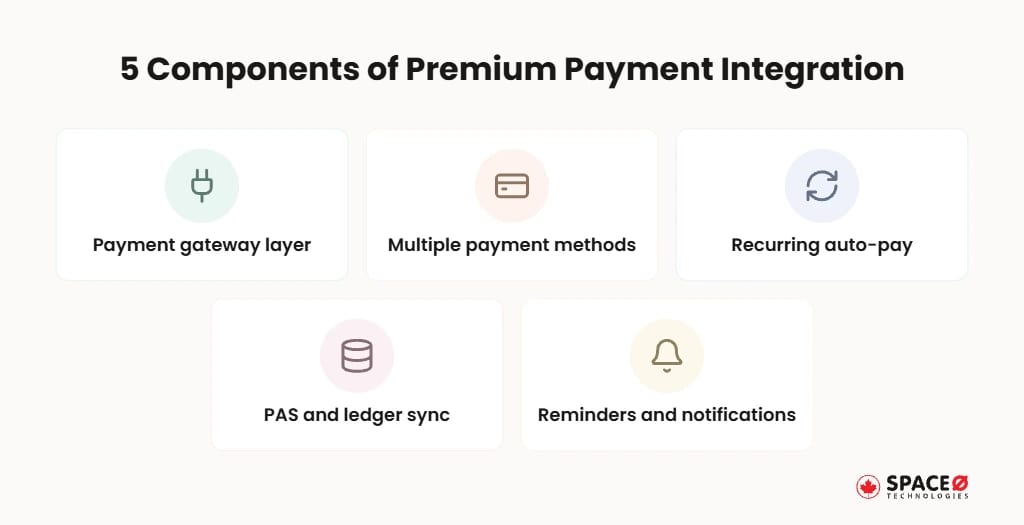
- Payment gateway layer: A gateway such as Stripe or Adyen authorizes and settles each premium. The insurer’s backend reaches it through a REST API.
- Multiple payment methods: Policyholders pay by credit or debit card, ACH bank debit, Apple Pay or Google Pay. Real-time rails such as FedNow and RTP suit insurers needing instant confirmation.
- Recurring auto-pay and installments: Scheduled charges collect monthly, quarterly or annual installments and renewals automatically. Automated collection is the main defense against unintended lapses.
- Real-time PAS and ledger sync: Every payment event updates policy status in the PAS and posts to the general ledger. Real-time sync separates true integration from a standalone checkout.
- Reminders and notifications: Push, SMS and email alerts warn policyholders before a due date and after a failed charge. Each alert should show the policy number and amount due.
The insurance app development guide shows where these payment components sit among the app’s wider features.
Together, these five components shape what the policyholder sees and what the insurer books. Components that touch card or bank data also widen the security scope, which the next section covers.
Which Security and Compliance Controls Does Premium Payment Integration Need?
Accepting card data places an insurance app inside PCI-DSS scope, so security decisions precede screen design.
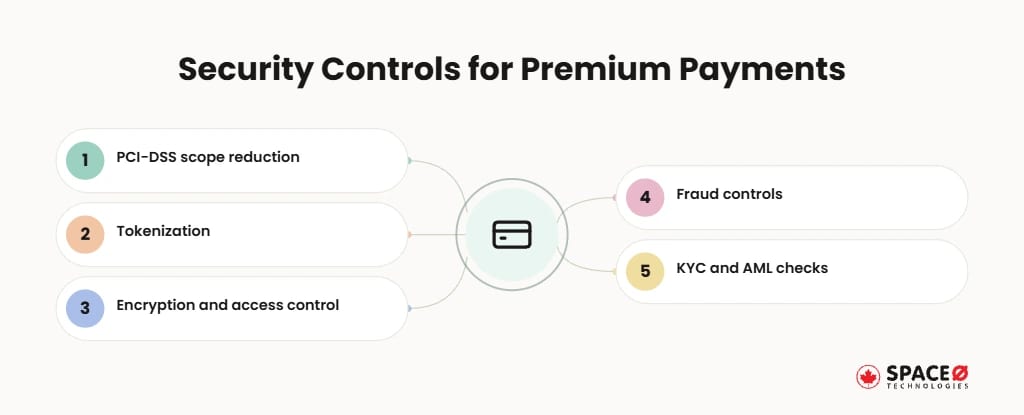
- PCI-DSS scope reduction: Hosted fields or a gateway SDK capture card details on the gateway’s side. Raw card numbers never reach the insurer’s servers, which shrinks the audit surface.
- Tokenization: The gateway returns a token that stands in for the card or bank account. The app stores only that token for future auto-pay charges.
- Encryption and access control: Encryption in transit and at rest protects payment metadata. Role-based access control limits who can open billing records, and audit logging records every view or change.
- Fraud controls: 3D Secure authenticates the cardholder, while velocity checks and risk scoring flag stolen cards and repeated failed attempts. Multi-factor authentication guards any change to a stored payment method.
- KYC and AML checks: Identity and anti-money-laundering screening apply where financing or large refunds move money. Scope these checks during discovery, not during QA.
Space-O Canada builds card systems to support PCI-DSS from the first sprint. US state insurance rules vary, so confirm them with legal counsel before launch.
Build PCI-DSS, Fraud and KYC Controls Into Your First Sprint
Our team scopes hosted fields, tokenization, fraud checks and audit logging with you, so security decisions are settled before screen design starts.

Security controls protect the data, yet they do not decide what happens after a charge. The integration flow sets that sequence.
How Does the Premium Payment Integration Flow Work?
A premium payment travels through six steps, from the policyholder’s screen to a posted ledger entry.
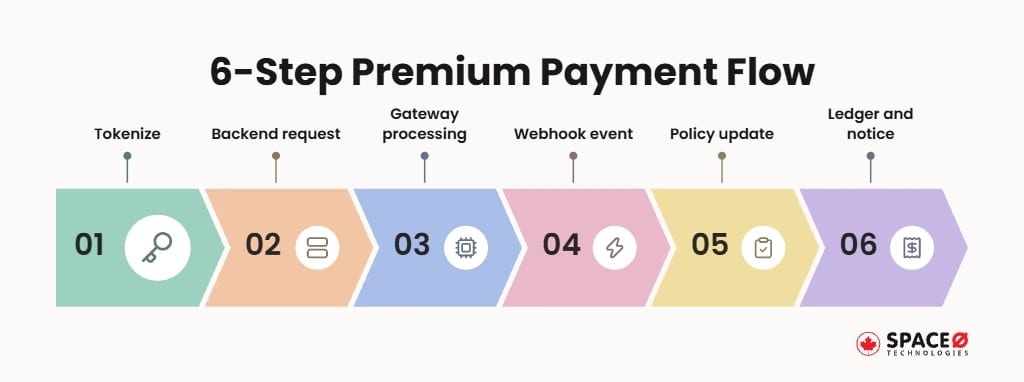
- Client tokenization: The app collects card or bank details in hosted fields and receives a gateway token. For ACH payments, the same screen records the policyholder’s debit authorization. The app can also verify the bank account through instant account verification or micro-deposits.
- Backend request: The insurer’s backend sends the token, amount and policy number to the gateway’s REST API. The request also carries an idempotency key, so a network retry cannot create a second charge for the same installment. The policy number travels in the payment’s metadata or reference field, which lets every later webhook point back to the right policy.
- Gateway processing: The gateway authorizes the card or submits the ACH debit, then returns a pending or approved result. A declined card returns a reason code right away, so the app can prompt the policyholder to try another payment method. An approved or pending result confirms only the request, not the final movement of money.
- Webhook event: The gateway posts a signed webhook when the payment settles, fails or returns. Each webhook carries an event ID, an event type and a timestamp, along with the policy number from the original request. The insurer’s endpoint replies with a success code quickly and handles the heavier processing afterward.
- Policy status update: A listener verifies the webhook signature and updates the policy record in the PAS. Signature checks use a secret shared with the gateway, which blocks forged events from changing coverage. The listener then applies the status rule for that event type, such as paid through the next due date or past due.
- Ledger posting and notice: The system posts the general ledger entry and sends a receipt or alert. Each entry references the gateway transaction ID, which the daily reconciliation job later matches against settlement reports. Receipts go to the policyholder, while failed-payment alerts can also reach the agent or billing team.
Webhooks, not the app’s success screen, should decide policy status. The flow looks clean when every payment succeeds. Production rarely delivers that, so the next section maps what actually happens.
Where Does Premium Payment Integration Break in Production?
Most failures start when a payment event arrives with no matching PAS rule.
Payment events that change policy status
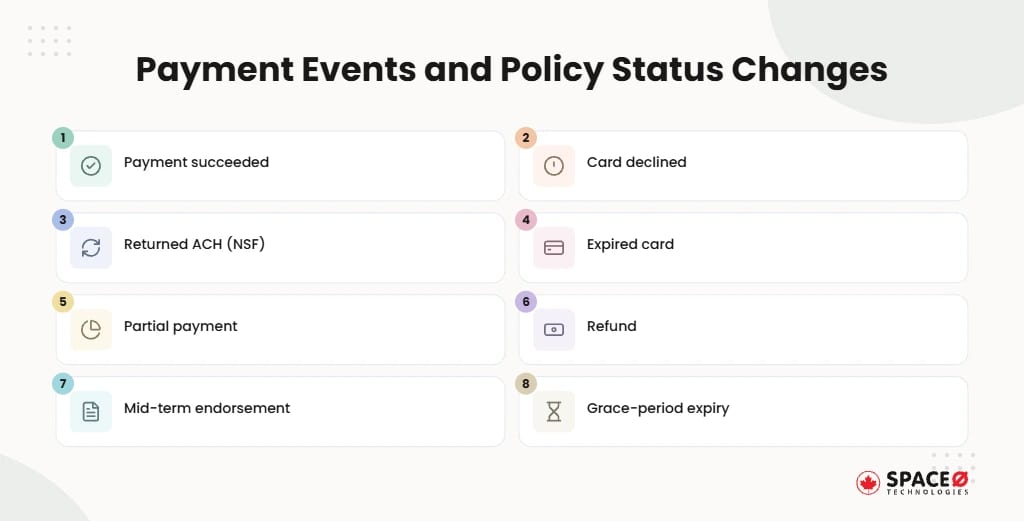
The reference map below ties each payment event to its trigger, PAS status change and ledger entry.
| Payment event | Trigger | PAS status change | Ledger entry |
|---|---|---|---|
| Payment succeeded | Settlement webhook from the gateway | Paid through the next due date | Cash received posted against premium receivable |
| Card declined | Failure webhook; retry schedule starts | Active, flagged past due | No posting; failed attempt logged |
| Returned ACH (NSF) | Return webhook after an earlier pending result | Paid status reversed; grace period opens | Earlier cash entry reversed; receivable reopened |
| Expired card | Decline or pre-expiry update signal | Active; policyholder asked to update method | No posting until a new charge settles |
| Partial payment | Settlement below the amount due | Active with an open balance | Amount received posted; balance stays open |
| Refund | Refund webhook from the gateway | Premium adjusted or policy canceled | Return premium recorded against cash |
| Mid-term endorsement | PAS recalculates premium after a policy change | New installment schedule issued | Additional or return premium posted |
| Grace-period expiry | Scheduled job finds no settled payment | Lapse or cancellation notice triggered | Receivable reversed for the uncovered period |
Your own grace-period lengths and retry counts belong in this map, set per line of business.
Edge cases that need explicit rules
Four engineering rules keep the event map trustworthy under real traffic.
- Idempotent listeners: Gateways can resend a webhook, so each event ID updates the PAS only once.
- Event ordering: A return for an earlier debit can arrive after a later payment succeeds, so listeners check timestamps before changing status.
- Single retry owner: Either the gateway or the PAS schedules failed-payment retries, never both at once.
- Daily reconciliation: A scheduled job matches gateway settlements against ledger postings and flags every mismatch.
Teams without payment engineers in-house can hire insurance app developers to build these rules into their webhook listeners.
Get these rules wrong and the policyholder, PAS and ledger tell three different stories. With failure modes mapped, the next choice is which provider sits underneath.
Which Payment Providers Do Insurers Integrate With?
Insurers draw from three provider groups, and each group asks something different of the build team.
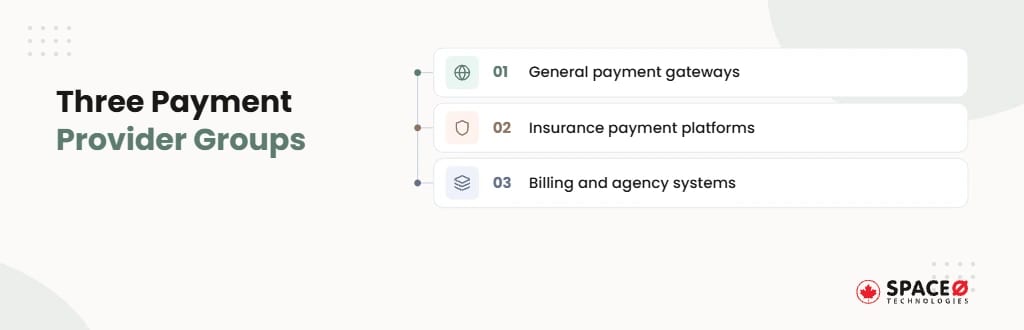
| Provider group | Examples | What adopting it requires |
|---|---|---|
| General payment gateways | Stripe, Braintree, Adyen, PayPal | Custom webhook listeners, PAS mapping and ledger posting built by the insurer’s team. |
| Insurance-specific payment platforms | InsurePay, One Inc, Input 1 | Setup that matches the platform’s billing model, plus integration with the existing PAS. |
| Billing and agency-management systems | Guidewire BillingCenter, Applied Epic with Applied Pay | Work inside the system’s own billing workflow and its available APIs. |
InsurePay partners with Stripe, so some insurers see both names in one evaluation.
No provider removes the insurer-side work. Every option still needs an event-to-state map, one retry owner and daily reconciliation.
Not Sure Which Payment Provider Fits Your PAS?
Our fintech engineers compare gateways, insurance payment platforms and billing systems against your PAS, then map the event rules, retries and reconciliation each option still needs.
Provider choice settles how money moves between policyholder and insurer. Two insurance-specific flows, premium financing and multi-party payments, add more payers and payees to that picture.
How Do Premium Financing and Multi-Party Payments Fit the Integration?
Premium financing and multi-party payments change who pays, who gets paid and when the PAS reacts.
- Embedded premium financing: A finance partner pays the premium upfront while the policyholder repays in installments. The PAS tracks the finance agreement separately from paid status.
- Lienholder and mortgagee payments: Lenders on auto or property policies may pay the premium or require payment notices. Each payer needs its own record and notification route.
- Agent commission splits: Split payments route a commission share to the agent or broker at settlement. Commission logic belongs in the ledger, not in the app.
- Pay-as-you-go premiums: Workers’ compensation lines can bill against payroll data each period. The integration recalculates the premium before every charge.
Each flow adds a payer, a payee or a recalculation the event map must cover. Each addition also moves the budget.
How Much Does Premium Payment Integration Cost?
Premium payment integration typically costs $30,000 to $70,000 as a billing module, while a full insurance app runs from $60,000 for an MVP to $400,000+.
| Build scope | Third-party range (Botree) |
|---|---|
| MVP | $60,000-$120,000 |
| Production app | $150,000-$300,000 |
| Enterprise platform | $400,000+ |
Premium payment integration sits mostly inside that billing module. Your own quote depends on PAS age, provider choice and the number of event rules. Our insurance app development cost breakdown covers project scale, build phases and post-launch spend.
Ranges this wide reflect scope, so pin scope down before comparing quotes. Four decisions do most of that work.
What Should an Insurer Decide Before Building Premium Payments?
Four scoping decisions shape the payment architecture, so settle them before anyone writes payment code.
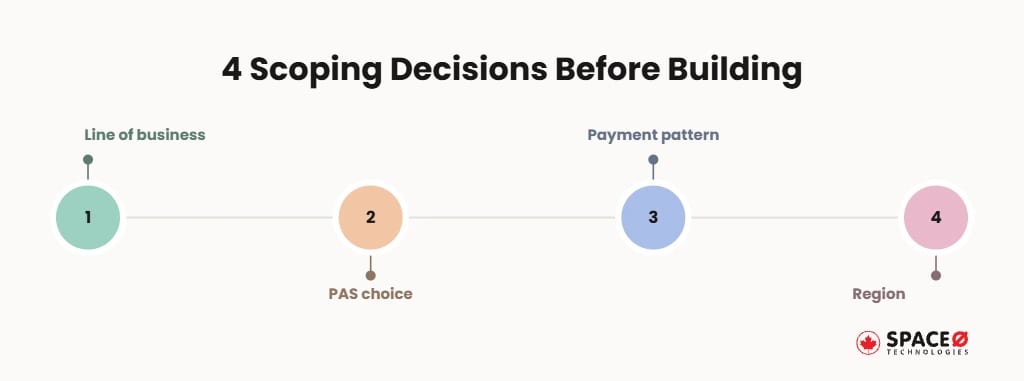
- Line of business: Personal auto, property and workers’ compensation each bill differently and need distinct event rules. Each line also runs on its own term length, installment options and cancellation notice requirements. Document those for every line before mapping a single payment event.
- Policy administration system: Decide whether the current PAS stays and how payment events will reach it. Older systems may accept only batch file imports, while newer platforms expose APIs that can receive webhook-driven updates. The answer decides whether payment events post in near real time or in scheduled batches.
- Payment pattern: Recurring auto-pay, installments and one-time payments each change retry and grace-period logic. Auto-pay relies on stored tokens and advance notice when the debit amount changes. One-time payments and installments need a quick way to pay again after a decline.
- Region: US-only carriers and Canada-linked carriers face different regulatory frameworks from day one. US carriers answer to state insurance departments, so billing notice and cancellation timelines can differ from one state to the next. Canada-linked carriers add provincial insurance rules on top of federal requirements, so a policyholder’s province can change notice wording and timing.
A phased approach suits insurers and managing general agents (MGAs) that keep their existing PAS. The payment layer connects to that core in stages rather than replacing it. The insurance app development timeline breaks down how long each build phase takes. For Canada-linked carriers, Space-O Canada builds that layer to support PIPEDA, FINTRAC and OSFI requirements.
Get a Cost Estimate for Your Build
Share your line of business, PAS, payment pattern, and region, and our team will outline a scoped estimate for your payment layer.
Settling these four decisions turns a vague payments request into a buildable scope. The right build partner then carries that scope through launch and audit.
Why Choose Space-O Canada for Premium Payment Integration?
Space-O Canada builds premium payment integrations that give every payment event a PAS rule and a matching ledger entry. Gateways get you to launch, but the event map gets you through audit.
Since 2018, Space-O Canada has built fintech software for 100+ clients, including Fortune 500 companies. Three practices carry this guide into your build:
- Event map first: Every decline, returned ACH debit and grace-period expiry gets a written rule before coding starts.
- Smaller PCI-DSS scope: Hosted fields and tokenization keep raw card numbers off your servers from the first sprint.
- Insurance billing flows: Premium financing, lienholder payments and commission splits each get their own ledger logic.
One in-house team builds and tests your integration, then provides up to 90 days of post-launch support.
Frequently Asked Questions About Premium Payment Integration
What do I need in place before connecting a gateway to my PAS and ledger?
You need a REST-accessible gateway, hosted fields or an SDK, and a webhook listener that verifies signatures. Add an event-to-state map, one retry owner and a daily reconciliation job before writing payment code.
What PCI-DSS obligations remain if I use hosted fields or a gateway SDK?
Hosted fields and SDKs keep raw card numbers off your servers, but the app stays inside PCI-DSS scope. You still need encryption, role-based access, audit logging and multi-factor authentication on payment method changes.
How do I set up auto-pay for a policyholder for the first time?
Collect card or bank details in hosted fields so the app receives a gateway token. Store only that token for scheduled charges, and protect any change to it with multi-factor authentication.
How do I handle a returned ACH debit after the app already showed the policy as paid?
Treat the gateway’s return webhook as the trigger. Reverse the paid status in the PAS, open a grace period, and reverse the earlier cash entry in the ledger. Check timestamps first, because a return for an earlier debit can arrive after a later payment succeeds.
Can I add premium payments without replacing my policy administration system?
Yes. A payment layer connects to an existing PAS through APIs, webhooks or middleware, then rolls out in phases by line of business. The PAS stays the system of record for policy status, while the payment layer feeds it each payment event.
Who should own failed-payment retries, the gateway or the PAS?
Pick one owner. If the gateway and the PAS both schedule retries, a policyholder can be charged twice. Document the retry count and grace period per line of business.


Let’s Discuss Your Idea
Share your idea with our fintech development team and get a practical breakdown of what you need to build, integrate, secure, and launch it.
 Your project is covered by an NDAYour information stays secure and confidential




What our clients say


When we set out to build our Estate Tax Planning Tool, we needed a development partner we could trust with something this complex and consequential. Space-O Canada brought the technical expertise and attention to detail needed to handle intricate tax calculations and edge cases. They communicated clearly, delivered on time without cutting corners, and built a product we trust completely.
 Ed Chetan EdwinFounder, CharityCalc
We partnered with Space-O Canada to build a fintech platform that could support secure transactions, third-party integrations, and future scalability. Their team understood our business requirements from the beginning and delivered a well-architected solution without unnecessary complexity. Communication was consistent, milestones were met on time, and every challenge was handled proactively.
 Michael CarterCo-Founder, Digital Payments Platform
The fintech app came out exactly the way I pictured in terms of functionality. I will refer future UI/UX clients to their team. During the testing phase of the app, it performed according to the initial designs in terms of functionality. Their team was dedicated to creating the best version of the app and provided their own ideas to improve it.
 Amanda LewisProduct Manager, Lending Platform
Our banking modernization project involved complex integrations and strict security requirements, and Space-O Canada handled both with confidence. They developed a reliable banking platform that improved operational efficiency while maintaining a smooth customer experience. Their structured development process and clear communication kept the project on track from start to finish.
 Daniel RobertsVP of Technology, Regional Bank
Our legacy insurance system created delays across policy management and claims processing. Space-O Canada developed a centralized platform that streamlined our workflows and improved efficiency across departments. The project was delivered on schedule, and the team’s understanding of insurance technology was evident throughout the engagement.
 Emily FosterOperations Director, Insurance Provider
Developing a trading platform requires speed, reliability, and technical precision. Space-O Canada delivered a solution that performs exceptionally well while supporting real-time market data and intuitive trading workflows. Their project management was excellent, and the team remained responsive throughout every stage of development.
 Ethan MorganChief Product Officer, Investment Platform
The fintech app was successfully launched, and users loved its sleek design and features. Space-O Technologies worked in an organized and collaborative manner, allowing them to achieve quality results. They also took the time to deeply understand the project. They were very organized and had a good track record.
 David WilsonFounder, Personal Finance App