
- What are the Steps to Build an Automated Transaction Monitoring System for a Bank?
- How to Build a Real-Time Transaction Monitoring Engine for a Payment Provider?
- How Do You Prove the System Works to Examiners?
- Build, Buy, or Hybrid: Which Fits Your Institution?
- Why Build Transaction Monitoring With Space-O Canada?
- Frequently Asked Questions About Building Transaction Monitoring
How to Build an Automated Transaction Monitoring System for a Bank A Step-by-Step Guide

 Last Updated: November, 17 2026

Key Takeaways
- Build it as a layered pipeline: ingest data, score it with rules and ML, rank alerts, then manage cases.
- The five build steps below map each stage to the BSA/AML obligation it supports.
- A separate section adapts the same pipeline for a payment provider that must decide in milliseconds.
- The final sections cover the evidence examiners test and a build, buy or hybrid decision test.
Transaction monitoring is how a bank detects suspicious activity across customer payments, and it runs at scale: financial institutions filed approximately 4.7 million suspicious activity reports (SARs) with FinCEN in fiscal year 2024. At that volume, a program is only as good as the data feeding it. Many programs struggle in production for that reason: missing feeds and stale KYC profiles flood the alert queue, and examiners notice.
That is why this guide starts with scope and data before detection models. Banks, credit unions and lenders can follow the same five steps, which draw on obligations in the Bank Secrecy Act (BSA) and FinCEN rules.
Each step names its tools, its controls and the decision it settles, in the order the build actually runs. Space-O Canada delivers this work through its mobile banking software development services.
What are the Steps to Build an Automated Transaction Monitoring System for a Bank?
Five steps take a bank from regulatory scope to a tuned, examiner-ready system. Each one depends on the step before it.
Step 1: Map regulatory scope and assess risk
Monitoring that ignores the institution’s own risk profile produces noise, not evidence. Start with the obligations you carry and the customers you actually serve.
- US regulatory map: The Bank Secrecy Act (BSA) and FinCEN rules set duties for the AML program, due diligence and SAR filing. FATF guidance shapes the risk-based approach behind them.
- Sanctions scope: OFAC screening checks customers, counterparties and payment messages against sanctions lists. Decide early whether sanctions screening sits in the same engine or in a separate service.
- Risk profile: Rate products, channels, geographies and PEP exposure before you write a single rule. Thresholds that suit one risk profile will not suit another.
- Decision boundary: The system scores and routes activity, and a compliance officer decides on suspicion and SAR filing. Write that boundary into the requirements, not just the user manual.
Map every later step to the BSA/AML obligation it serves. Examiners judge the system against your program, not against its feature list.
| Build step | BSA/AML obligation it supports |
|---|---|
| 1. Regulatory scope & risk assessment | A risk-based AML program fitted to the institution |
| 2. Data ingestion & unified profiling | Customer due diligence and recordkeeping |
| 3. Detection engine & AI integration | Identifying potentially suspicious activity |
| 4. Alert triage & case management | Documented investigation and escalation |
| 5. Reporting, testing & tuning | SAR filing and independent testing of the program |
With scope and risk settled, every rule has a documented reason to exist. The next step makes sure the data behind those rules is complete.
Step 2: Ingest data and build unified profiles
Data completeness decides more outcomes than detection sophistication. A clever model that sees half the ledger still misses the other half.
- Source feeds: Pull core banking transactions, payment rails, card activity, KYC/CDD records and sanctions lists into one pipeline. Every missing feed is a blind spot that examiners will find first.
- Streaming ingestion: Apache Kafka carries high-volume events with fault-tolerant durability and replay. Replay lets the team reprocess history after a rule or model changes.
- Payment message mapping: Parse ISO 20022 fields such as originator, beneficiary and purpose into structured attributes. Unmapped fields leave structuring and cross-border patterns invisible.
- Single Customer View: Join each customer’s legal identity, beneficial owners, risk rating and alert history into one profile. Connect shared devices, IP addresses and counterparties so that linked accounts surface together.
- Phased core integration: Connect to the core you already run through adapters rather than a rip-and-replace. Our guide to modern banking architecture components shows how those layers fit together, and our core banking modernization case study covers a related project. Operations and member services keep running while feeds go live one at a time.
Complete, unified data turns detection into a fair test. Step 3 decides what the engine looks for in that data.
Step 3: Build the detection engine with rules and ML
Rules alone flood investigators with alerts. Models alone are hard to defend in an exam, so the consensus build pairs the two. For a full checklist, see our guide to transaction monitoring software features.
- Deterministic rules: Encode known typologies such as velocity spikes, transfers to high-risk jurisdictions and structuring below reporting thresholds. Rules stay readable for examiners and are quick to change.
- ML and anomaly models: Score each transaction against the customer’s own baseline to catch patterns no rule names. Apache Flink handles the complex event processing that multi-event patterns require.
- Behavioral segmentation: Group customers by observed activity rather than by static KYC buckets such as account type. Peers that behave alike support tighter thresholds and fewer false positives.
- Explainable AI: SHAP or LIME show which features drove each model score. Investigators and examiners can then see why an alert fired, not just that it fired. Canadian dual-market banks should also align model governance with OSFI E-23 AI model risk management.
- Model operations: Apache Airflow schedules retraining, and MLflow tracks each model version’s performance. Language models can also scan logs and PEP lists for red flags, but analysts keep the final review. For wider context, see these AI use cases in banking.
Unsure Which Rules and Models Fit Your Bank?
Share your typologies and data sources, and our fintech team will map the right detection approach for your monitoring build.

Detection produces alerts, and every alert costs investigator hours. Step 4 decides how those hours get spent.
Step 4: Set up alert triage and case management
An unranked alert queue spends senior investigator time on low-risk noise. Tiered review protects that time.
- Risk-ranked alerts: Score and sort every alert by risk exposure so investigators open the highest-risk cases first. Lower-scored alerts still get reviewed, but they wait their turn.
- Tiered L1/L2 review: L1 screens out clear false positives so that L2 capacity goes to genuine suspicion. Every disposition carries a written reason.
- Case management: Group related alerts into one case with the customer profile, transactions and notes attached. Investigators no longer rebuild context one alert at a time.
- Audit trail: Log every score, note, override and status change with the user and a timestamp. The record shows who decided what, and why.
- Escalation path: FFIEC examination guidance expects a defined escalation process from alert to SAR decision. Encode that process as workflow states rather than leaving it as tribal knowledge.
The table below shows how the two review tiers divide the work.
| Tier | Question it answers | Inputs | Output |
|---|---|---|---|
| L1 | Is this alert a clear false positive, or worth escalating? | Alert details, transaction history, KYC/CDD profile, prior alert history | Close with documented rationale, or escalate |
| L2 | Is the activity suspicious enough to need a SAR decision? | The L1 package plus EDD, open-source research and related accounts | A recommendation to the compliance officer, who decides on filing |
A tiered, logged workflow turns raw alerts into defensible decisions. Step 5 confirms the whole system holds up before and after go-live.
Step 5: Report, test, deploy and keep tuning
A system that works in a demo can still fail its first exam. Reporting, testing and tuning close that gap.
- SAR/STR output: Confirmed cases generate pre-filled SAR drafts for FinCEN, or STRs where another regime applies. The compliance officer reviews, edits and files each one.
- Sandbox tuning: Tune thresholds and segments in a sandbox using the institution’s own historical data. Production rules change only after the sandbox shows the effect.
- Parallel run: Run the new system beside existing tools long enough to compare outputs alert by alert. Explain every gap before you switch off the old system.
- Feedback loop: Feed investigator dispositions back into rules and models on a set schedule. Closed false positives become a training signal instead of wasted effort.
- Security baseline: Every build includes encryption in transit and at rest, role-based access control (RBAC), audit logging and segmented environments. These controls ship as a baseline, not as upgrades.
That completes the build for a bank. Payment providers run the same pipeline under a far tighter clock.
How to Build a Real-Time Transaction Monitoring Engine for a Payment Provider?
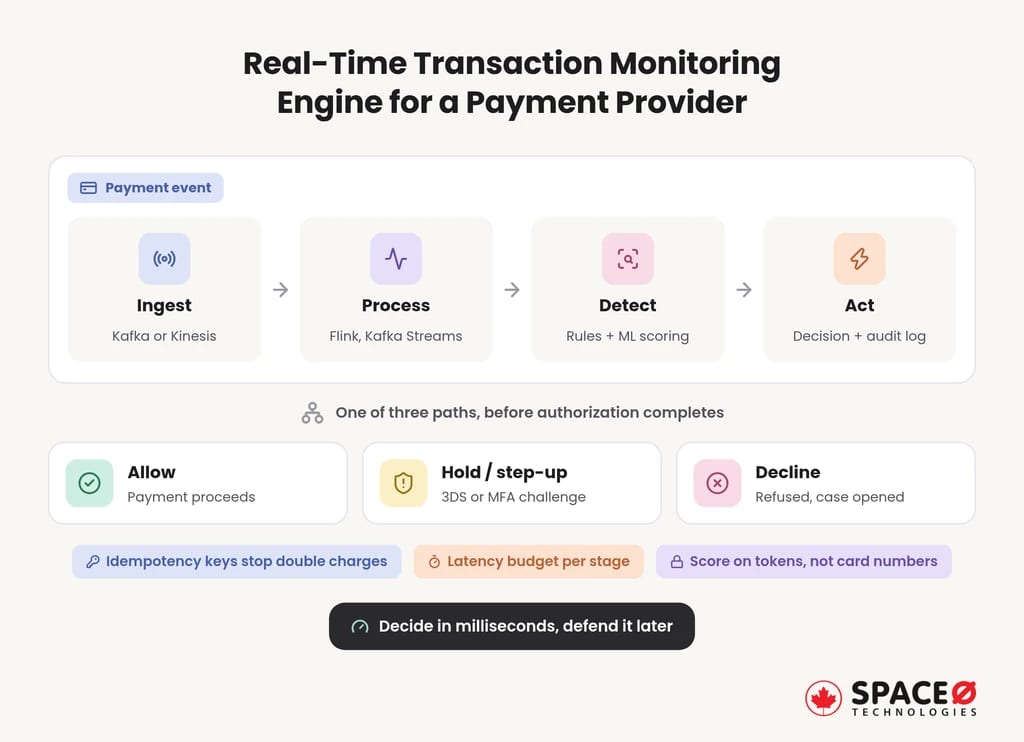
A payment service provider cannot review a payment first and decide later. The engine must allow, hold or decline it before authorization completes.
1. Design the layers of the real-time pipeline
Each layer has one job, and each job has a direct payment consequence.
- Ingestion: Apache Kafka or AWS Kinesis receives every payment event on one streaming bus, from card, wallet or bank transfer. One bus means fraud, AML and sanctions checks all read the same event once.
- Processing: Apache Flink, Kafka Streams or Apache Spark Streaming computes stateful aggregates such as per-card velocity. Choose based on your latency target and the skills your team already has.
- Detection: Rules, stateful aggregation and ML scoring run together on each event. Rules catch known patterns instantly, and models flag behavior that drifts from the customer’s baseline.
- Action: The decision service returns a path to the payment flow and writes the reason to the audit log. Suspected AML activity also enters the compliance queue for L1/L2 review.
2. Return one of three decision paths
Every scored payment leaves the engine on exactly one of three paths.
| Path | When it applies | What happens next |
|---|---|---|
| Allow | Low risk score and no rule hits | The payment proceeds, and the event stays logged for AML analysis |
| Hold / step-up | Medium risk or unusual behavior | The customer gets a 3DS challenge or an MFA prompt, and the payment resumes on success |
| Decline | High risk, a sanctions hit or a blocked entity | The payment is refused, and a case opens for review |
3. Prevent duplicate charges and hold the latency budget
Speed and correctness have to hold at the same time.
- Idempotency: Each payment request carries an idempotency key, so a retry returns the original result instead of charging again. Retries after timeouts are common, so a missing check creates duplicate charges.
- Latency budget: Split the authorization window across ingestion, scoring and decision, with a ceiling for each stage. Set those ceilings from your own load tests, and treat any other figure as illustrative.
- PCI-DSS scope: Design the card flow to stay within PCI-DSS scope, and have the engine score on tokens rather than raw card numbers. Tokenization keeps the monitoring layer’s compliance footprint narrow.
4. Settle three scope points first
Settle these three points before the architecture is locked.
- Transaction volume: Define your peak TPS today and at forecast growth. Peak load sets the throughput the streaming layer and decision service must sustain, so size for the busiest hour, such as a sale or payroll day, rather than the daily average.
- Monitoring scope: Decide whether AML, fraud and sanctions run in one engine or separately. One engine shares a single event stream and customer view, while separate engines let each team tune its own thresholds. Either way, document how alerts from each reach the compliance queue.
- Rails and programs: List the card, wallet and bank transfer rails in scope, including any Banking-as-a-Service (BaaS) partners. Each rail has its own message formats, settlement timing and risk patterns, so this list shows which feeds the pipeline needs and which partner data you must receive.
Speed only matters if each decision holds up later. The next section covers the evidence examiners ask for.
Need Payment Decisions in Milliseconds?
Share your peak transaction volume and payment rails, and our fintech team will map the right latency budget and decision paths for your payment platform.
How Do You Prove the System Works to Examiners?
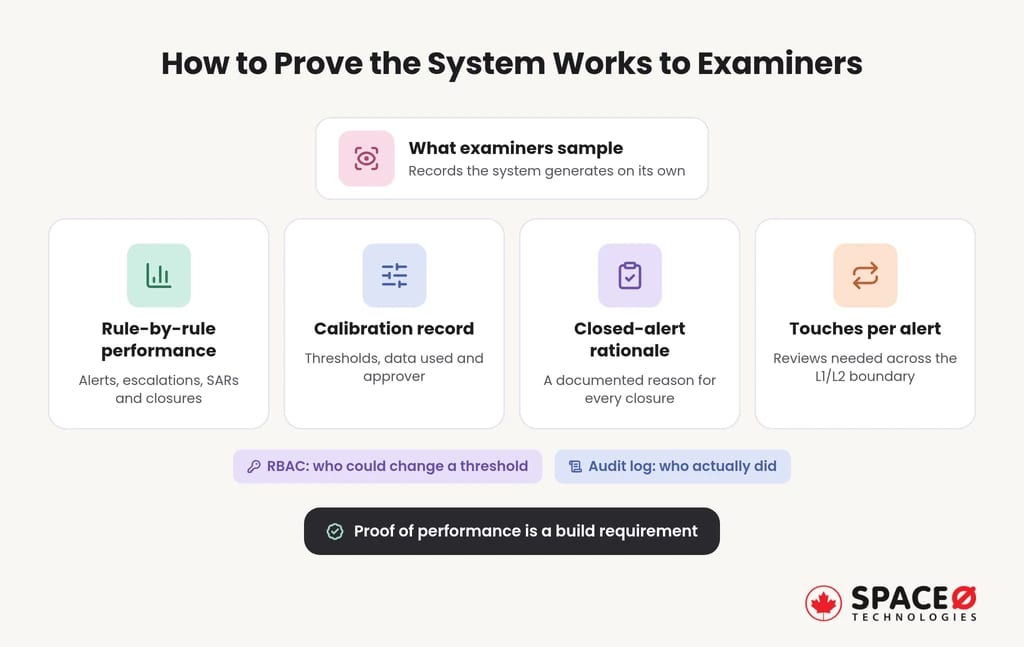
Examiners expect proof that the system performs as designed, not only that it exists. Most build guides stop at detection and workflow, so this is the part teams miss.
Treat proof of performance as a build requirement. The system should generate these four records on its own, not leave staff to assemble them before an exam.
- Rule-by-rule performance review: For each rule and model, report alerts generated, escalations, SARs filed and closures. Rules that never escalate get retuned or retired, and the reason is logged.
- Calibration record: Store where each threshold sits, the data it was set on and who approved it. Each change carries before-and-after sandbox results.
- Closed-alert rationale: Every closed alert carries a documented reason tied to evidence in the case. Examiners sample closed alerts, so a blank rationale field becomes a finding.
- Touches-per-alert: Track how many reviews each alert takes across the L1/L2 boundary. Rising touch counts point to unclear rules or defensive escalation at L1.
Space-O builds these reports on the audit logging and role-based access control that ship with every build. RBAC proves who could change a threshold, and the audit log proves who actually did.
Evidence like this turns a working system into a defensible one. The remaining decision is whether to build, buy or combine the two.
Build, Buy, or Hybrid: Which Fits Your Institution?
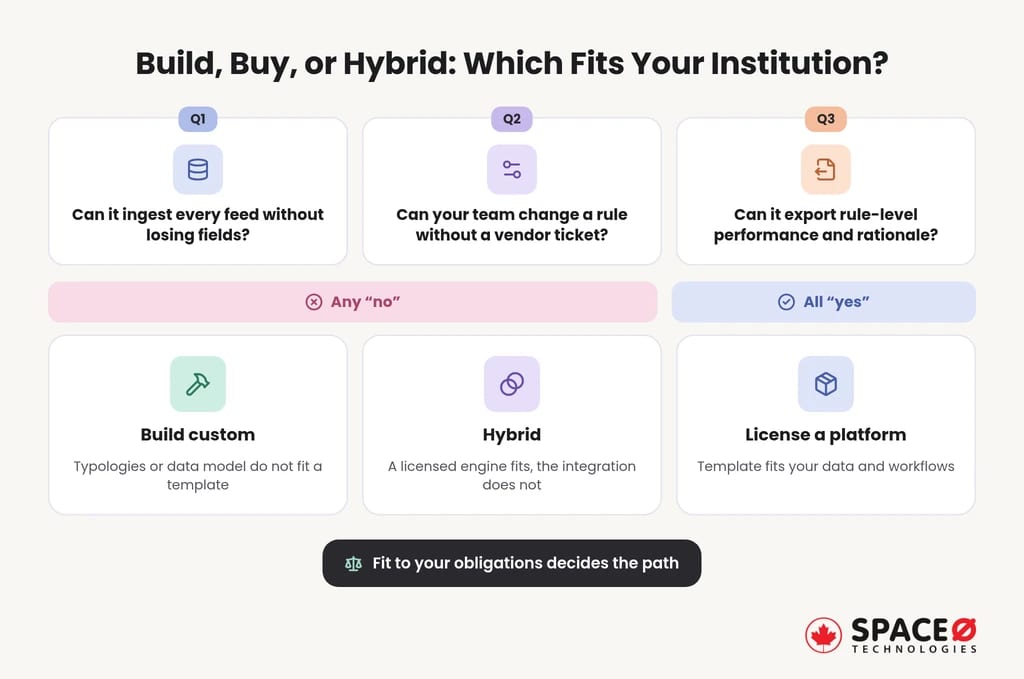
Which option fits depends on how closely your data, typologies and workflows match a vendor template. Licensing a platform means fitting your data model, typologies and workflows to the vendor’s template. Building custom means the system fits your obligations instead.
| Axis | Build custom | License a platform | Hybrid around your existing core |
|---|---|---|---|
| Regulatory mapping | Done in discovery against your own obligations | Configured inside the vendor’s framework after purchase | Mapped in discovery for the custom layers |
| Core integration | Phased adapters to the core you already run | Your data mapped into the vendor’s data model | A vendor engine fed by custom adapters |
| Explainable decisioning | Rules and SHAP/LIME outputs your team owns | Limited to what the vendor exposes | Your rules, plus vendor explanations as exposed |
| Security controls | Encryption, RBAC, audit logging and segmentation specified per build | Set by the vendor’s hosting and plan | Split between the vendor and your environment |
| Delivery team | One in-house team from discovery to support | Vendor support plus your internal administrators | Two parties to coordinate |
Licensed AML platforms include Abrigo, Napier AI and IBM, and Sumsub offers monitoring as a service. Adopting any of them requires data mapping, configuration and administrators on your side.
Before you decide, test each option against three questions. Can it ingest every feed you identified in Step 2 without losing fields? Can your team change a rule or threshold without raising a vendor ticket? Can it export rule-level performance and closed-alert rationale in the form examiners ask for? A “no” on any of these is a signal to build or go hybrid.
Build custom when your typologies, core or data model do not fit a vendor template. Choose a hybrid when a licensed engine fits but the integration does not. For the wider decision across your banking stack, read our guide on build vs buy banking software.
US banks with Canadian customers also face FINTRAC reporting, PIPEDA privacy duties and OSFI technology risk expectations. Space-O Canada engineers its builds to support these frameworks, with dual-market scope mapped during discovery.
Ready to Build Your Bank Transaction Monitoring System?
Share your scope with our fintech engineers and receive a clear plan, timeline and cost estimate for your monitoring build.
Whichever path you take, the build steps and the evidence requirements stay the same. The partner you choose decides how cleanly they land.
Why Build Transaction Monitoring With Space-O Canada?
Space-O Canada builds monitoring systems that fit an institution’s own obligations rather than a vendor template. A strong monitoring system scores complete data, routes alerts to people and proves its own performance. Build it step by step, from regulatory scope to continuous tuning.
Examiners judge the whole system, so budget for tuning and evidence as well as detection. Start with scope, and the remaining steps follow.
Space-O Canada has built financial software since 2018. Its 100+ clients include Fortune 500 companies, and 65% of its business is repeat and referral.
One in-house team runs discovery, build and deployment, with up to 90 days of post-launch support. Engagements start with a discovery phase that maps your regulatory scope, data feeds and typologies before any architecture is locked. That output becomes the requirements baseline for the build, so every rule and report traces back to an obligation you documented.
Frequently Asked Questions About Building Transaction Monitoring
1. What is a transaction profile?
A transaction profile is the baseline of a customer’s observed activity. New transactions are scored against it. It sits inside a Single Customer View that also holds identity, risk rating and alert history.
2. How does transaction monitoring work?
Monitoring runs as a layered pipeline. It ingests data, scores each event with rules and ML, and ranks alerts by risk. Investigators work grouped cases with an audit trail. Confirmed cases produce pre-filled SAR drafts for the compliance officer.
3. How can banks reduce false positives without missing suspicious activity?
Use behavioral segmentation so similar customers share tighter thresholds. Tune in a sandbox on your own historical data before changing production rules. Feed investigator outcomes back on a set schedule, and retire rules that never escalate.
4. Who decides whether to file a SAR?
A compliance officer decides on suspicion and SAR filing. The system scores activity, ranks alerts and pre-fills drafts. People review, edit and file each report.
5. Should a bank build or buy transaction monitoring software?
It depends on fit. Custom suits institutions whose data model or typologies a vendor template cannot express, and a hybrid suits those that can adopt a licensed engine but need custom adapters. Start by mapping your obligations.
6. What data does a transaction monitoring system need?
It needs core banking transactions, payment rail and card activity, KYC/CDD records and sanctions lists. Device and IP signals add context where available. Missing feeds are the most common cause of blind spots and false positives.
7. How does real-time monitoring differ for a payment provider?
The engine must allow, hold or decline each payment before authorization completes. Hold paths trigger a 3DS challenge or MFA prompt. Idempotency keys stop retries from charging customers twice.


Let’s Discuss Your Idea
Share your idea with our fintech development team and get a practical breakdown of what you need to build, integrate, secure, and launch it.
 Your project is covered by an NDAYour information stays secure and confidential




What our clients say


When we set out to build our Estate Tax Planning Tool, we needed a development partner we could trust with something this complex and consequential. Space-O Canada brought the technical expertise and attention to detail needed to handle intricate tax calculations and edge cases. They communicated clearly, delivered on time without cutting corners, and built a product we trust completely.
 Ed Chetan EdwinFounder, CharityCalc
We partnered with Space-O Canada to build a fintech platform that could support secure transactions, third-party integrations, and future scalability. Their team understood our business requirements from the beginning and delivered a well-architected solution without unnecessary complexity. Communication was consistent, milestones were met on time, and every challenge was handled proactively.
 Michael CarterCo-Founder, Digital Payments Platform
The fintech app came out exactly the way I pictured in terms of functionality. I will refer future UI/UX clients to their team. During the testing phase of the app, it performed according to the initial designs in terms of functionality. Their team was dedicated to creating the best version of the app and provided their own ideas to improve it.
 Amanda LewisProduct Manager, Lending Platform
Our banking modernization project involved complex integrations and strict security requirements, and Space-O Canada handled both with confidence. They developed a reliable banking platform that improved operational efficiency while maintaining a smooth customer experience. Their structured development process and clear communication kept the project on track from start to finish.
 Daniel RobertsVP of Technology, Regional Bank
Our legacy insurance system created delays across policy management and claims processing. Space-O Canada developed a centralized platform that streamlined our workflows and improved efficiency across departments. The project was delivered on schedule, and the team’s understanding of insurance technology was evident throughout the engagement.
 Emily FosterOperations Director, Insurance Provider
Developing a trading platform requires speed, reliability, and technical precision. Space-O Canada delivered a solution that performs exceptionally well while supporting real-time market data and intuitive trading workflows. Their project management was excellent, and the team remained responsive throughout every stage of development.
 Ethan MorganChief Product Officer, Investment Platform
The fintech app was successfully launched, and users loved its sleek design and features. Space-O Technologies worked in an organized and collaborative manner, allowing them to achieve quality results. They also took the time to deeply understand the project. They were very organized and had a good track record.
 David WilsonFounder, Personal Finance App