
- Which Consolidation Target Fits: Lakehouse, MDM Hub or One Acquirer Core?
- 1. How Do You Choose the Target Architecture?
- 2. How Do You Inventory, Clean and Model Core Banking Data?
- 3. How Do You Ingest Data With CDC and Bronze, Silver and Gold Layers?
- 4. How Do You Reconcile, Cut Over, Govern and Decommission?
- How to Consolidate Core Banking Data After a Bank Acquisition?
- Big Bang or Phased: Which Consolidation Path Fits Your Institution?
- Why Choose Space-O Canada for Core Banking Data Consolidation?
- Frequently Asked Questions About Consolidating Data From Multiple Core Banking Systems
How to Consolidate Data From Multiple Core Banking Systems Into One Platform A Step-by-Step Guide

 Last Updated: November, 17 2026

Key Takeaways
- Consolidating core banking data is a structured, multi-phase migration and integration strategy. It replaces fragile point-to-point links with one lakehouse, MDM hub or target core.
- The process runs in four steps: choose the target, clean and model the data, ingest through medallion layers, then reconcile and cut over.
- A separate section covers acquisitions: target core choice, duplicate profiles, mock conversions, conversion weekend and hypercare. It also explains why customer master data and the general ledger need the strictest reconciliation.
- A decision table answers three deciding questions and names a target and a first phase for each. Four criteria then settle the choice between big bang and phased.
Every additional core brings its own customer IDs, product codes and ledger rules. Over time, the connections between cores become point-to-point integrations that fail quietly. Under audit, nobody can produce one consistent customer, balance or lineage trail. Rip-and-replace rarely fixes it either: According to IBM, 94% of banking core modernization projects run past their planned timelines.
Space-O Canada builds the consolidation layer on top of the cores you already run. The approach is phased modernization, not rip-and-replace, so customer and member services keep running. Our banking software development team first learns how money actually moves through your operations.
This guide is for banks, credit unions and lenders consolidating after growth or an acquisition. The sequence holds whatever your cores run on, whether a mainframe, a packaged vendor platform, or the cloud. It starts with one decision that shapes every later step: where the consolidated data will live.
Which Consolidation Target Fits: Lakehouse, MDM Hub or One Acquirer Core?
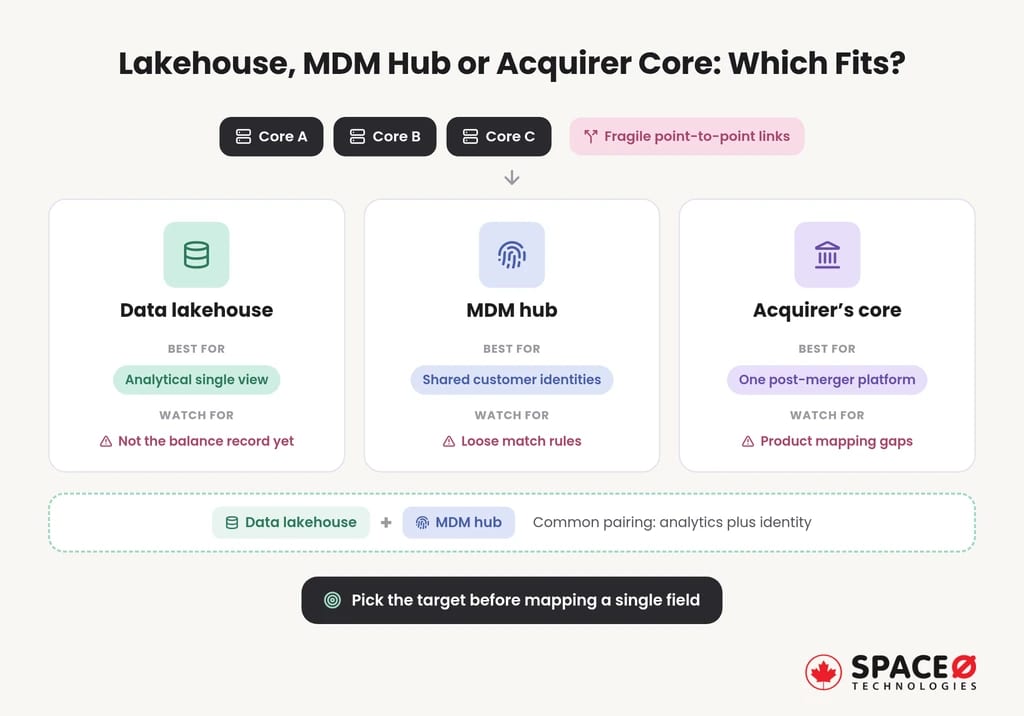
Pick the target before you map a single field: a lakehouse for an analytical view, an MDM hub for shared identities, or the acquirer’s core after a merger.
| Target option | Best for | Main risk |
|---|---|---|
| Data lakehouse | An analytical single view across several running cores | Being treated as the balance system of record too early |
| MDM hub | Consistent customer, product and account identities in near real time | Loose match rules that merge two distinct customers |
| Migration onto the acquirer’s core | Post-acquisition consolidation into one operating platform | Product concepts that do not map cleanly between cores |
Many institutions pair a lakehouse for analytics with an MDM hub for identity. The four steps below assume that choice has been made.
1. How Do You Choose the Target Architecture?
Choose the layer that replaces point-to-point links before any data moves.
- Point-to-point problem: Direct links between cores are fragile and break when either side changes. Each new core multiplies the links a team must maintain. Four cores need up to six direct links, and six cores need up to fifteen.
- Data lakehouse: A lakehouse pairs low-cost object storage, such as Amazon S3 or Google Cloud Storage, with Apache Iceberg or Delta Lake. Those open table formats add ACID transactions and SQL analytics on top of stored files. One copy of the data then serves reporting, analytics and reconciliation without repeated exports.
- MDM hub: A master data management (MDM) hub keeps customer, product and account identities consistent across cores. It merges duplicate customer records into one trusted profile. Match and survivorship rules decide which value wins, so every channel sees the same customer.
- Integration layer: BIAN-aligned connectors, Kafka event streaming and an API gateway expose each core through one contract. Channels and partners call the layer, not the core. Because the contract stays stable, channels never need to know which core holds the data.
Define each integration contract per domain (customer, account, transaction) and version it. That way, upgrading or replacing one core changes one adapter, not every channel and partner connection. Each version change also gives teams a clear date to retire the older contract. For the full layer-by-layer reference, see modern banking software architecture components.
Once the layer is chosen, the old links can retire one at a time. The next job is making the data worth moving.
2. How Do You Inventory, Clean and Model Core Banking Data?
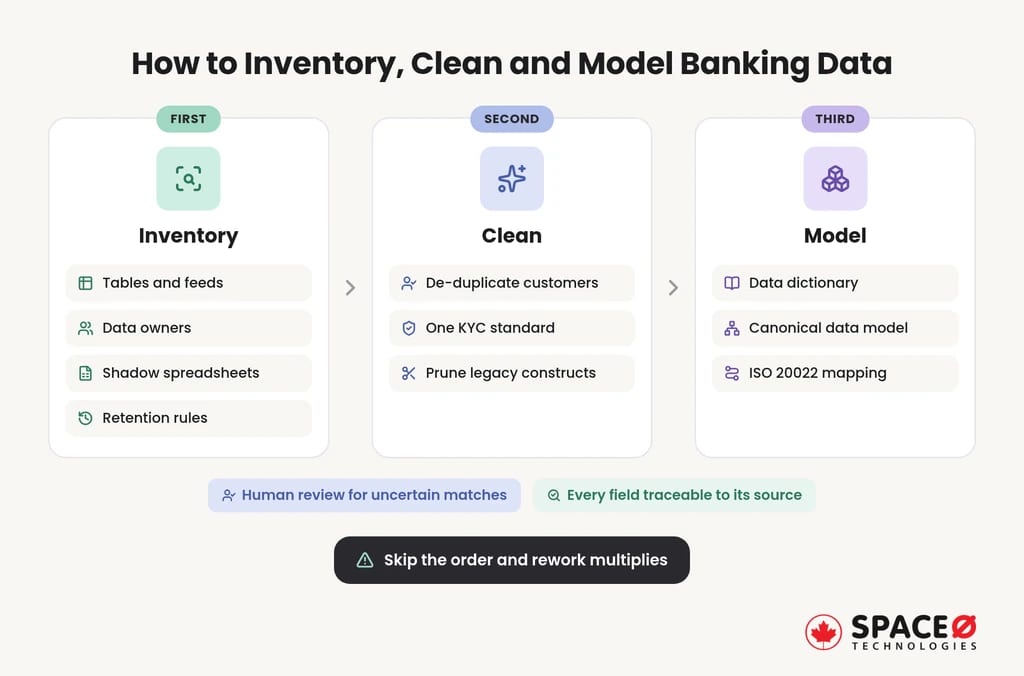
Inventory every source first, clean it second and model it third. Skipping that order multiplies rework.
- Source inventory: List each core with its tables, feeds, owners and retention rules. Include shadow spreadsheets that feed regulatory reports. Record data volumes and refresh schedules too, so the team can size each pipeline before building it.
- De-duplication: Match customers across cores on tax IDs, names, addresses and dates of birth. Send uncertain matches to human review rather than merging them automatically. Log every match decision, so a reviewer can later explain why two records were joined or kept apart.
- KYC standardization: Align KYC status, risk ratings and document records to one standard. No customer should carry two risk ratings after consolidation. Keep the original rating and review date beside the standardized value, so the history stays traceable.
- Data dictionary: Give each field one definition and one named owner. Settle definitions and ownership early, because late fixes reopen every mapping. Publish the dictionary where analysts and engineers both work, so the definitions stay in use.
- Canonical data model: Map customer IDs, account numbers and product codes into one model. Map payment fields to ISO 20022 elements where your rails already use them. Keep a mapping table for every source core, so any field in the model can be traced back to its origin.
- Legacy pruning: Drop legacy constructs that no longer serve a purpose. Carrying them forward imports old workarounds into the new platform. Review each candidate with its business owner before dropping it, because some old constructs still feed reports.
A clean canonical model turns the remaining work into mechanics. Ingestion then fills that model without disturbing the cores.
3. How Do You Ingest Data With CDC and Bronze, Silver and Gold Layers?
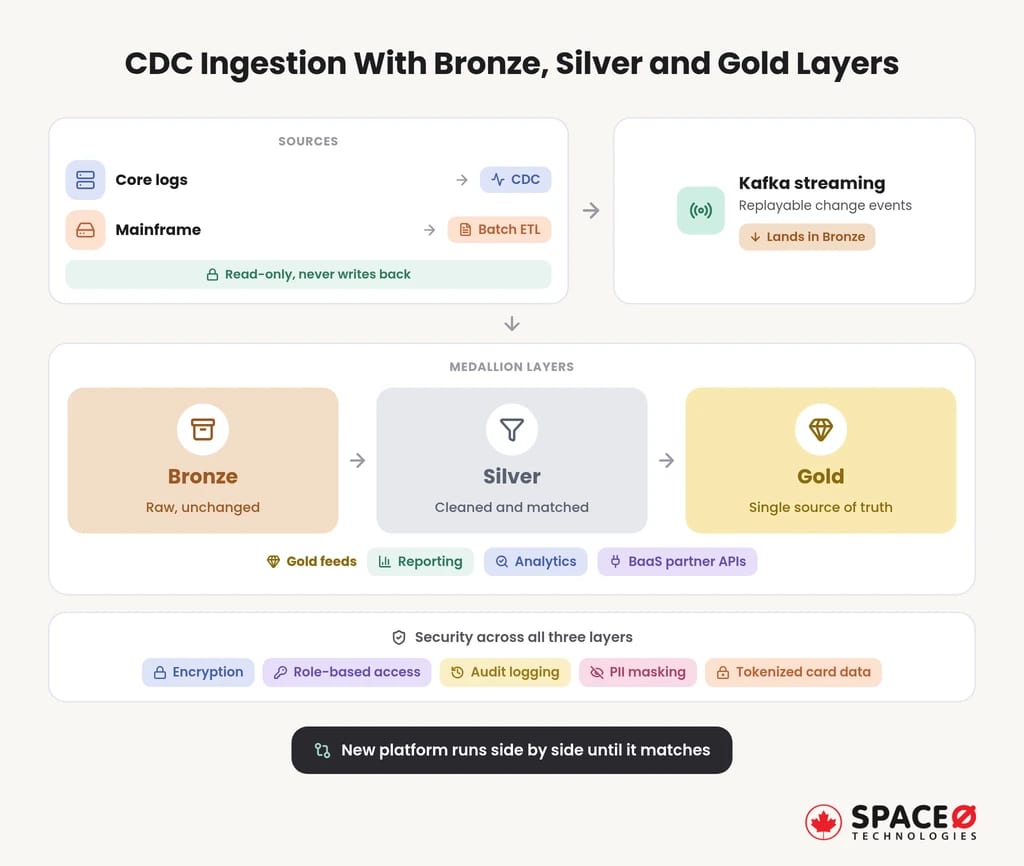
Ingest through change data capture (CDC), so the pipeline reads from each core and never writes back.
- CDC: Change data capture streams inserts and updates from core logs without locking source tables. The cores stay untouched by the pipeline.
- Kafka streaming: Kafka carries change events to the lakehouse and MDM hub in near real time. Consumers can replay events when a downstream fix is needed.
- Batch ETL: Mainframe sources without CDC hooks feed scheduled ETL extracts. Each extract carries control totals for later reconciliation.
- Side-by-side build: The new platform stands up alongside the legacy cores. Production stays on the old systems until reconciliation proves the two match.
The Bronze, Silver and Gold Layers
The medallion architecture splits refinement into three layers, and each layer has one job.
- Bronze: Raw, immutable data lands exactly as each core sent it. Nothing is altered, so every later figure can be traced back.
- Silver: Records are cleaned, deduplicated and reconciled against source control totals. Column-level PII masking is applied here.
- Gold: Curated tables become the single source of truth. Reporting, analytics and Banking-as-a-Service (BaaS) partner APIs all read from Gold.
Security controls apply across all three layers, not only Gold. Every Space-O build includes encryption in transit and at rest, role-based access control, audit logging and segmented environments. Card data stays tokenized, so PCI-DSS scope does not spread into the lakehouse.
Loaded layers are not yet proof that the data is correct. Reconciliation and cutover supply that proof.
4. How Do You Reconcile, Cut Over, Govern and Decommission?
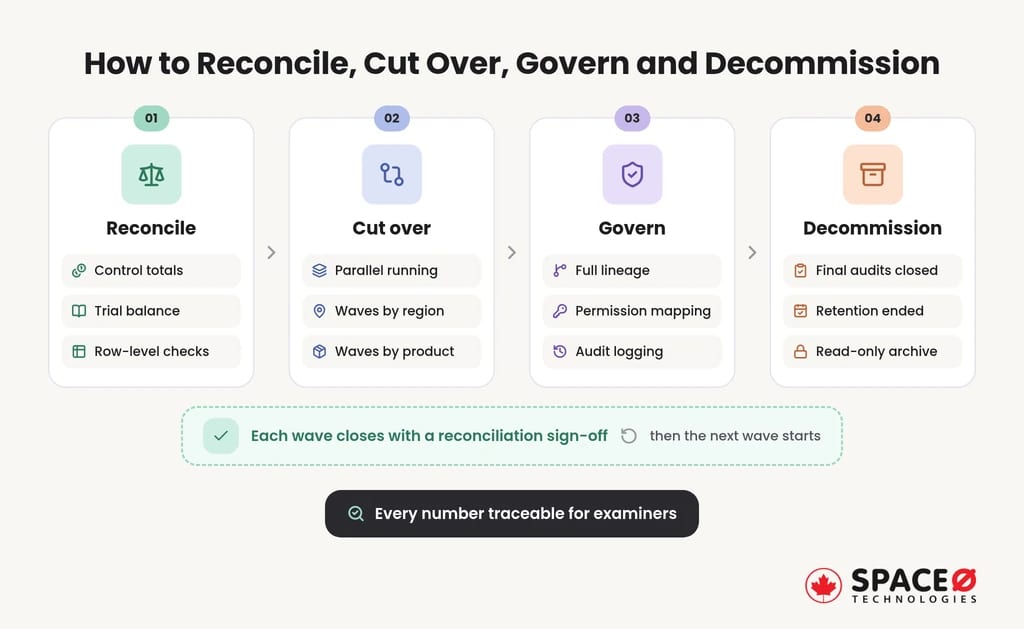
Prove the numbers match, run both platforms in parallel, then cut over in waves under full lineage.
Proving the consolidated numbers are correct
Reconciliation turns a migration from an act of faith into an audited result.
- Control totals: Compare record counts and balance sums by source, product and branch. Any gap blocks promotion to Gold.
- Trial balance reconciliation: Tie opening balances and the trial balance to the penny before cutover. The general ledger must agree with every subledger.
- Row-level validation: Check migrated accounts row by row against source data. Sampling hides the outliers that auditors find.
- Parallel running: Run the old and new platforms side by side until both produce the same balances. Explain every difference rather than averaging it away.
Only matched results earn a cutover date. Space-O Canada built a reconciliation layer across seven banking systems that auto-matches records and routes exceptions to one audited queue.
Planning cutover waves
Phased waves cap the damage any single mistake can cause.
- By region: Convert a small group of accounts first, perhaps one region. Leave time between waves to fix what the first wave exposed.
- By product: Move simple deposit products before complex lending products. Save complexity for later waves, after the team has learned from earlier ones.
- By customer batch: Go live with defined customer batches rather than everyone at once. Give each batch its own sign-off and rollback point.
Each wave closes with a reconciliation sign-off before the next one starts.
Governance and decommissioning
Regulators will ask where a number came from, so lineage must survive the migration.
- Lineage: Record which core, file and transformation produced each Gold value. Metadata catalogs make that trail searchable.
- Permissions mapping: Map legacy entitlements to role-based policies in a tool such as Apache Ranger. Former core permissions should not quietly widen.
- Audit logging: Log every read, change and approval in the new platform. Examiners expect the log to cover the whole migration, not just go-live.
- Decommissioning: Retire each legacy core only after final audits and retention periods end. Keep a read-only archive until both are complete.
Not Sure When to Retire a Legacy Core?
Share your core landscape and audit calendar, and our banking software team will map a retirement and archive plan that satisfies your auditors.

Decommissioning is where the savings finally appear, but only after audits close. Acquisitions add pressures this general sequence does not cover.
How to Consolidate Core Banking Data After a Bank Acquisition?
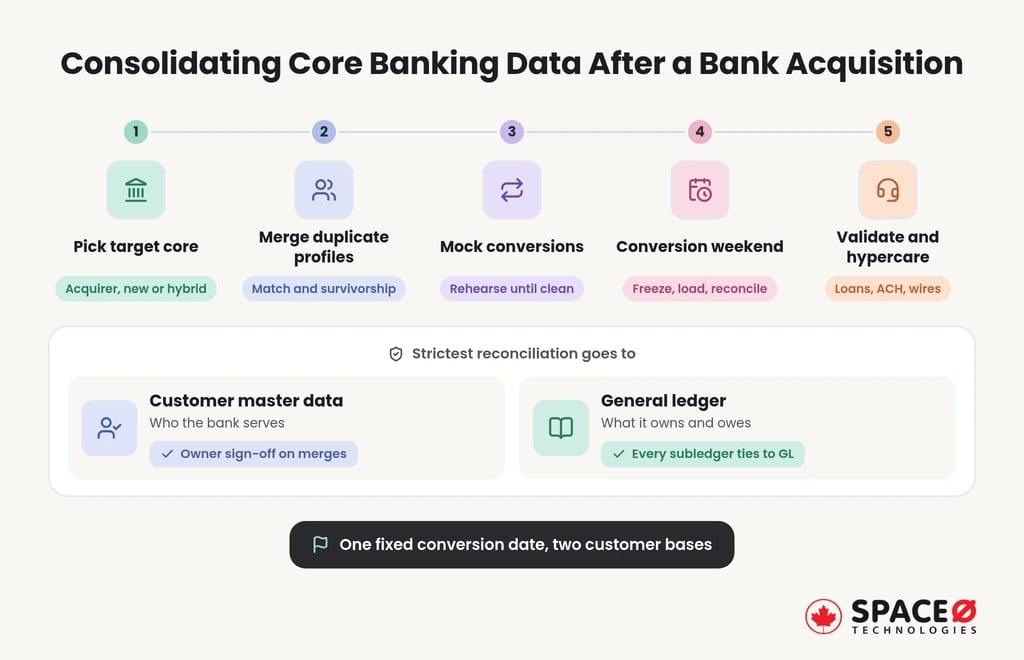
An acquisition compresses the same four steps into a fixed conversion date, with two customer bases watching. Each phase below carries three checks.
1. Choosing the target core for the combined bank
Settle the target core before any mapping starts.
- Acquirer’s core: Converting onto the acquirer’s core is the most common route. It reuses proven products, trained staff and existing vendor contracts.
- New core: Both banks move onto a new core together. This suits deals where neither platform can carry the combined product set.
- Hybrid or federated: Both cores keep running behind one integration layer and MDM hub. This buys time but extends dual operating costs.
Whichever core wins, its product definitions become the mapping target.
2. Merging duplicate customer profiles across two banks
Many acquired customers already bank with the acquirer, so duplicate profiles are certain.
- Match rules: Match on tax IDs, names and addresses across both banks. Route borderline matches to a review queue.
- Survivorship rules: Decide which bank’s value wins for each attribute. Record each rule so auditors can retrace every merge.
- Relationship mapping: Carry joint owners, beneficiaries and business signers onto the merged profile. A lost signer becomes a branch complaint on day one.
The merged customer list then feeds every conversion rehearsal.
3. Mock conversions and conversion weekend
Rehearsals catch the problems that conversion weekend cannot absorb.
- Mock conversions: Run full ETL rehearsals on copies of production data. Repeat them until results reconcile without manual fixes.
- System freeze: Freeze new products and account types at the acquired bank before conversion. A moving target breaks mappings.
- Conversion weekend ETL: Extract, transform and load the final data over the conversion weekend. Reconcile the trial balance before Monday opening.
Monday opening is a milestone, not the finish line.
4. Post-conversion validation
Post-conversion validation targets the items customers notice first.
- Loans and escrow: Check principal, rate, payment schedule and escrow balance on every loan. Escrow errors surface at the next tax or insurance payment.
- ACH recurring items: Confirm that recurring ACH debits and credits carried over with the right dates. A missed payroll deposit erodes trust at once.
- Wire templates: Verify saved wire templates, beneficiaries and limits for business customers. Treasury clients test wires in the first week.
Validation findings feed straight into hypercare.
5. Hypercare and Regulatory Close-Out
The weeks after conversion decide whether acquired customers stay.
- Hypercare: Staff a dedicated conversion team that triages issues daily. Branch and contact center staff escalate through one channel.
- Regulatory reporting: Produce Call Reports and Fed reporting from the combined data. In the first cycle, reconcile them against both legacy sources.
- Decommissioning: Retire the acquired core under the same audit-and-retention rule used in Step 4, and keep archived data queryable for examiners.
Close-out ends the project, but two data domains decide its long-term quality.
6. Why customer master data and the general ledger matter most
Two domains decide whether the combined bank behaves like one institution. Customer master data defines who the bank serves, and errors there repeat across every channel. The general ledger defines what the bank owns and owes, and errors there reach financial statements. Both deserve the strictest reconciliation and the earliest owner sign-off.
For customer master data, require owner sign-off on match rules, survivorship rules and the merged-profile count before any wave converts. For the general ledger, tie every subledger to the GL by product and branch, and freeze chart-of-accounts mappings before rehearsals begin. A small ledger break found in rehearsal costs far less than one found in a regulatory filing.
An acquisition leaves no room to debate the approach on conversion weekend. The choice between big bang and phased belongs months earlier.
Big Bang or Phased: Which Consolidation Path Fits Your Institution?
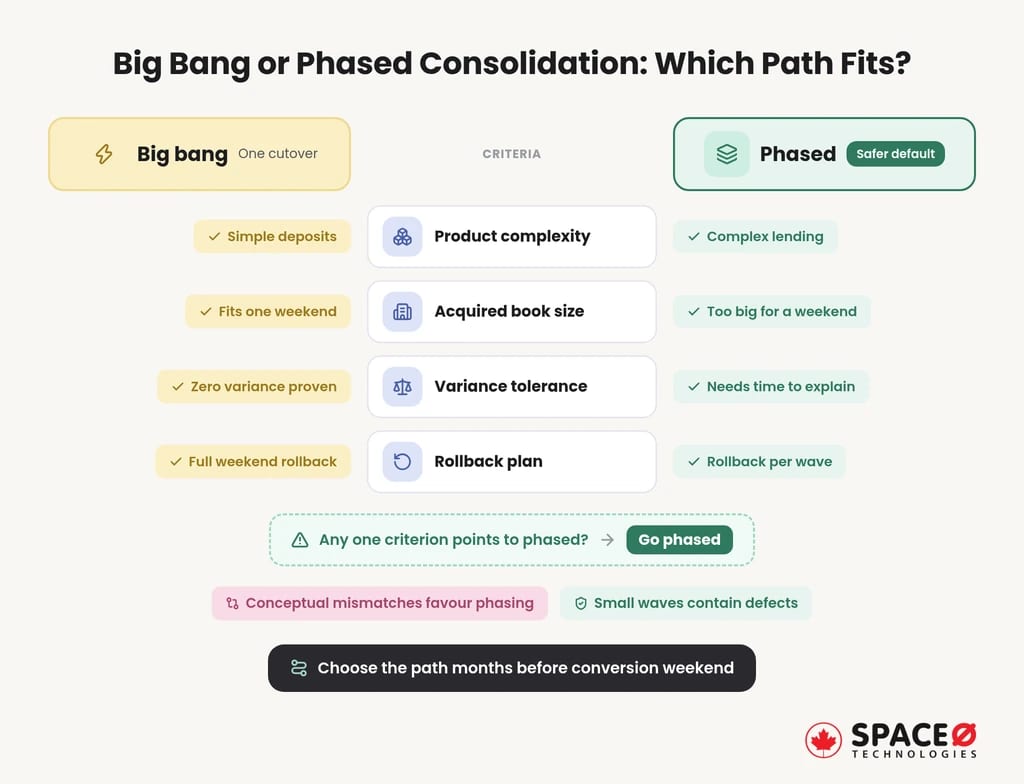
Phased is the safer default whenever any one of four criteria applies. This section turns the big bang versus phased choice into criteria you can apply.
Target and first phase by situation
Three questions decide the target: how the cores arrived, what the view must do and where the sources run.
| Deciding question | Your situation | Recommended target | First phase |
|---|---|---|---|
| Several cores or post-M&A cores? | One bank running several cores | Lakehouse plus MDM hub alongside the cores | Inventory sources and land one domain in Bronze through CDC |
| Several cores or post-M&A cores? | Cores inherited through an acquisition | Migration onto the acquirer’s core | Choose the target core, freeze products and start mock conversions |
| Real-time or analytical view? | Real-time operational view | MDM hub with Kafka events and an API gateway | Harmonize the customer identity domain |
| Real-time or analytical view? | Analytical view | Lakehouse with Bronze, Silver and Gold layers | Build Silver reconciliation against control totals |
| Mainframe or cloud sources? | Mainframe sources | Read-only batch ETL into the lakehouse | Schedule extracts that carry control totals per file |
| Mainframe or cloud sources? | Cloud sources | CDC streams into Kafka | Define event contracts for each domain |
The target tells you where to start. The next question is how fast to move.
When big bang is safe and when phased is safer
Four criteria settle the choice.
| Criterion | Big bang can work when | Phased is safer when |
|---|---|---|
| Product complexity | A few simple deposit products map one-to-one | Lending, escrow or commercial products need conceptual remapping |
| Size of the acquired book | The book is small enough to reconcile in one weekend | The book is too large for one weekend’s reconciliation |
| Reconciliation tolerance | Rehearsals already prove zero variance | Any variance needs investigation time between waves |
| Rollback plan | A tested full rollback exists for the weekend | Rollback must stay possible per region, product or batch |
When any one criterion points to phased, treat phased as the default.
Failure modes the plan should expect
Migration failures fall into recognizable patterns.
- Translation mismatches: A field maps to the wrong code or format. These errors are tedious but straightforward to fix once found.
- Conceptual mismatches: The two cores model a product differently, such as how interest is calculated. These are harder to fix than translation mismatches, because the business logic differs and not just the format.
- Single-cutover failure: A single big-bang cutover exposes defects to every customer at once. No small wave exists to contain the damage.
A single cutover is the hardest of these failures to recover from. When every customer converts at once, a defect in one product reaches everyone before the team can contain it. A phased wave limits that exposure to a small group first.
Conceptual mismatches are the strongest argument for phasing.
A worked example
Consider an illustrative case. A regional bank acquires a smaller bank that runs a different core. Deposits map cleanly, but commercial loans calculate interest differently. Balance reconciliation tolerance is zero. Product complexity and tolerance both point to phased. Deposits convert in the first wave, and commercial loans follow once interest logic is remapped. The acquired core stays read-only until loans reconcile, which preserves rollback by product.
Before wave two starts, the team would set a pass rule, such as zero unexplained variance on loan balances and interest accruals across two consecutive rehearsals.
Phasing works best when the team building the platform has run waves like this before.
Where Space-O Canada fits
Space-O Canada is best for mid-size banks and credit unions running two or more cores after a merger or acquisition. These institutions need consolidation built around their existing cores while those cores keep running.
- Compliance mapped in discovery: Compliance scope is mapped during discovery, before architecture is locked. Nothing is bolted on during QA.
- Reconciliation from the first sprint: Control totals and an audit trail ship with the first pipeline. Proof of correctness grows alongside the platform.
- One in-house team: The same team runs discovery, build and post-launch support. No handoffs. No subcontracting.
- Cross-border scope: For institutions with Canadian operations, platforms are engineered to support PIPEDA, FINTRAC and OSFI. Dual-market products get both frameworks covered.
Our clients trust Space-O Canada to deliver compliant platforms that hold up under audit and production workloads, not just good demos. See how that plays out in our banking software development case studies.
Packaged consolidation products bring their own data models. Adopting one means fitting your data and roadmap to that product’s model, which is why this approach builds around the cores you already run. Our comparison of build vs buy banking software shows how to split that choice one layer at a time.
Unsure Whether a Packaged Product Fits Your Cores?
Share your core landscape and consolidation goals, and our banking software team will map an approach that builds around the cores you already run.
The right path depends on your cores, your book and your tolerance for variance. Here is how the whole program comes together.
Why Choose Space-O Canada for Core Banking Data Consolidation?
Consolidating several cores works when the target comes first and reconciliation decides every cutover. Clean data feeds a canonical model, CDC fills the Bronze, Silver and Gold layers, and phased waves replace a single big bang cutover. Each step earns the next one: a trusted model makes ingestion routine, matched control totals earn a cutover date, and full lineage keeps regulators and auditors satisfied long after go-live. After an acquisition, mock conversions and hypercare carry the same discipline through one conversion weekend, with customer master data and the general ledger held to the strictest standard.
Space-O Canada has built financial software since 2018 for 100+ clients, including Fortune 500 companies. We build the consolidation layer around the cores you already run, so customer and member services keep running while the new platform proves itself. Every project includes up to 90 days of post-launch support, covering bug fixes and performance monitoring. To see how banks and credit unions approach the wider build, read our complete guide to banking software development, then plan your first consolidation wave with the people who will build it.
Frequently Asked Questions About Consolidating Data From Multiple Core Banking Systems
What is considered core banking?
Core banking covers the system of record for accounts, deposits, loans, payments and the general ledger. Channels, analytics and reporting layers sit around the core but are not the core. When you consolidate, the core’s customer, product and ledger data is what you must reconcile.
What does consolidated mean in banking?
In a data context, consolidated means combining records from several core banking systems into one consistent set of customers, accounts, products and ledger balances. The consolidated figures must tie to each source through control totals and trial balance reconciliation. The target can be a data lakehouse, an MDM hub or one acquirer core.
What is it called when you combine data from multiple sources?
It is called data consolidation. In banking it usually means pulling data from several cores into one platform through change data capture (CDC), Kafka streaming or batch ETL. The result is a single, reconciled view instead of fragile point-to-point links.
What is the process of consolidation?
The process has four steps: choose the target architecture; inventory, clean and model the data; ingest it; then reconcile, cut over, govern and decommission. Reconciliation compares control totals and ties the trial balance to the penny. Each legacy core is retired only after final audits and retention periods end.
What are the 5 layers of a data platform?
A data platform has no single standard five-layer list. The consolidation platform in this guide combines source cores, ingestion (CDC, Kafka, batch ETL), object storage with open table formats such as Apache Iceberg or Delta Lake, the Bronze, Silver and Gold refinement layers, and governance with lineage, catalogs and audit logging. Security controls apply across the Bronze, Silver and Gold layers.
What happens when two banks merge?
The combined bank picks a target core, most often the acquirer’s, and maps the acquired bank’s data to that core’s product definitions. Duplicate customer profiles are merged under match and survivorship rules. Mock conversions are rehearsed, then the final conversion runs over a freeze-and-conversion weekend.
What happens after a bank merger?
After conversion, the team validates loans and escrow, recurring ACH items and wire templates. A dedicated hypercare team triages issues daily. Call Reports and Fed reporting are produced from the combined data and reconciled against both legacy sources in the first cycle. The acquired core is retired once retention periods and final audits end.


Let’s Discuss Your Idea
Share your idea with our fintech development team and get a practical breakdown of what you need to build, integrate, secure, and launch it.
 Your project is covered by an NDAYour information stays secure and confidential




What our clients say


When we set out to build our Estate Tax Planning Tool, we needed a development partner we could trust with something this complex and consequential. Space-O Canada brought the technical expertise and attention to detail needed to handle intricate tax calculations and edge cases. They communicated clearly, delivered on time without cutting corners, and built a product we trust completely.
 Ed Chetan EdwinFounder, CharityCalc
We partnered with Space-O Canada to build a fintech platform that could support secure transactions, third-party integrations, and future scalability. Their team understood our business requirements from the beginning and delivered a well-architected solution without unnecessary complexity. Communication was consistent, milestones were met on time, and every challenge was handled proactively.
 Michael CarterCo-Founder, Digital Payments Platform
The fintech app came out exactly the way I pictured in terms of functionality. I will refer future UI/UX clients to their team. During the testing phase of the app, it performed according to the initial designs in terms of functionality. Their team was dedicated to creating the best version of the app and provided their own ideas to improve it.
 Amanda LewisProduct Manager, Lending Platform
Our banking modernization project involved complex integrations and strict security requirements, and Space-O Canada handled both with confidence. They developed a reliable banking platform that improved operational efficiency while maintaining a smooth customer experience. Their structured development process and clear communication kept the project on track from start to finish.
 Daniel RobertsVP of Technology, Regional Bank
Our legacy insurance system created delays across policy management and claims processing. Space-O Canada developed a centralized platform that streamlined our workflows and improved efficiency across departments. The project was delivered on schedule, and the team’s understanding of insurance technology was evident throughout the engagement.
 Emily FosterOperations Director, Insurance Provider
Developing a trading platform requires speed, reliability, and technical precision. Space-O Canada delivered a solution that performs exceptionally well while supporting real-time market data and intuitive trading workflows. Their project management was excellent, and the team remained responsive throughout every stage of development.
 Ethan MorganChief Product Officer, Investment Platform
The fintech app was successfully launched, and users loved its sleek design and features. Space-O Technologies worked in an organized and collaborative manner, allowing them to achieve quality results. They also took the time to deeply understand the project. They were very organized and had a good track record.
 David WilsonFounder, Personal Finance App