
- Why Do Fragmented KYC and AML Tools Leave Audit Gaps and Regulatory Exposure?
- How Does One Integrated KYC and AML Platform Work With Your Core Banking System?
- How Does Space-O Canada Deliver From Regulatory Mapping to Launch?
- What Verified Numbers Back Space-O Canada’s KYC Workflow Delivery?
- Should Banks Build, Buy or Extend Their Core for KYC and AML?
- Why Choose Space-O Canada for KYC and AML Compliance Software?
- Frequently Asked Questions About KYC and AML Compliance Software
KYC and AML Compliance Software Development for Banks: Features, Architecture and Implementation

 Last Updated: November, 16 2026
Key Takeaways
- KYC and AML compliance software for banks is one integrated platform that verifies identities, scores risk and monitors transactions.
- Fragmented KYC and AML tools leave audit gaps and flood analysts with false positives.
- Extending your existing core with a phased compliance layer is usually lower risk than replacing it.
- Backtesting monitoring rules on your own transactions measures false-positive reduction before each phase launches.
Fragmented KYC and AML tools split onboarding from monitoring, which leaves audit gaps and floods analysts with false positives. Those gaps carry real cost: in October 2024, FinCEN assessed a record $1.3 billion penalty against TD Bank for Bank Secrecy Act violations, including failures in transaction monitoring.
For banks and credit unions, the fix is KYC and AML compliance software development that delivers one integrated platform to verify identities, score risk and monitor transactions. KYC is the identity and risk component of that platform, and it sits inside the wider AML compliance framework.
Space-O Canada, a fintech software team, builds this platform as a custom layer around the core banking system you already run. Because most onboarding now starts in a mobile app, the platform can plug into the same customer journey Space-O Canada builds through its mobile banking software development services.
Why Do Fragmented KYC and AML Tools Leave Audit Gaps and Regulatory Exposure?
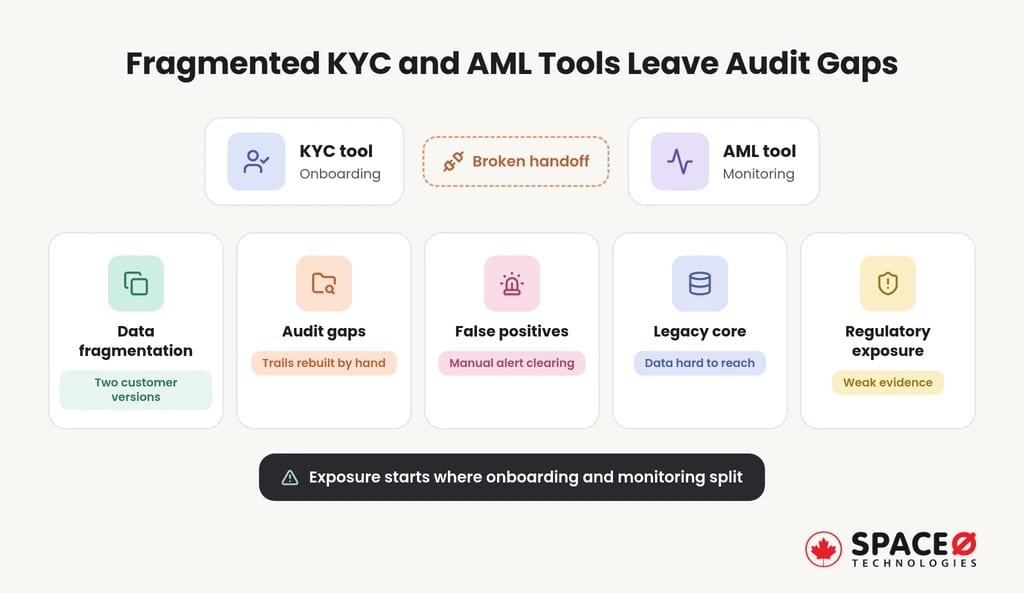
Fragmented compliance tools fail at the handoff between onboarding and monitoring. Customer data sits in separate systems, so risk scores go stale and evidence scatters.
Analysts lose hours to false positives. Legacy cores resist integration.
The institution carries the resulting audit gaps and regulatory exposure.
- Data Fragmentation: Separate KYC and AML tools hold different versions of the same customer.
- Audit Gaps: Investigators must rebuild each decision trail across disconnected systems.
- False Positives: Rule-only monitoring floods analysts with alerts that need manual clearing.
- Legacy Core Integration: Older core banking systems make customer and transaction data harder to reach.
- Regulatory Exposure: Incomplete records weaken the institution’s position when an auditor asks for evidence.
1. KYC operates inside the broader AML framework
KYC and AML are not parallel programs. KYC establishes the customer’s identity and risk at onboarding, while AML governs the wider system that keeps watching afterward.
| Axis | KYC | AML |
|---|---|---|
| Scope | Identity verification, risk assessment and fraud prevention for each customer | Laws, policies and procedures that stop criminals disguising illicit funds |
| Timing | Before or during onboarding | Ongoing throughout the customer relationship |
| What it produces | Verified identity record, screening results and a risk tier | Flagged activity, investigated cases, filed reports and audit records |
###
2. US law sets the compliance baseline
Three US anchors shape the requirements for a bank’s compliance software:
- Bank Secrecy Act (BSA): This law provides the US legal basis for AML programs.
- Financial Crimes Enforcement Network (FinCEN): This agency is the main US regulator for AML reporting.
- Office of Foreign Assets Control (OFAC): This agency maintains the US sanctions lists used in screening.
In practice, these anchors create concrete software requirements. Banks must file a Currency Transaction Report (CTR) for cash transactions over $10,000 in a single business day. They must file a Suspicious Activity Report (SAR) within 30 calendar days of first detecting suspicious activity. FinCEN’s Customer Due Diligence Rule also requires banks to identify the beneficial owners of legal entity customers, meaning anyone who owns 25% or more, plus one person with significant control. Each deadline and threshold becomes a rule, a timer or a data field inside the platform.
This page describes SAR, CTR and screening modules as engineering capabilities. Space-O Canada maps each obligation’s scope with your team during discovery.
3. Covered institutions reach beyond retail banks
AML and KYC duties apply across financial services and several adjacent sectors:
- Banks and Credit Unions: These institutions run identity checks and monitor deposit and payment activity.
- Payment Processors: These providers screen customers and monitor the transactions they move.
- Insurers: These carriers verify customers and assess financial crime risk.
- Crypto Platforms: These platforms verify account holders and monitor digital asset activity.
- Casinos: These operators identify customers and monitor their financial activity.
- High-Value Dealers: These sellers apply AML controls to high-value sales.
4. Institutions operating in Canada add further frameworks
A bank with Canadian operations adds PIPEDA, FINTRAC and OSFI to its KYC and AML requirements. Any card system adds PCI-DSS.
FINTRAC, the Financial Transactions and Reports Analysis Centre of Canada, receives suspicious transaction reports and large cash transaction reports of C$10,000 or more. OSFI, the Office of the Superintendent of Financial Institutions, supervises federally regulated banks and sets expectations for technology, cyber and third-party risk. PIPEDA governs how customer personal information is collected and stored. A dual-market platform therefore needs separate report formats, data residency choices and consent handling for each country.
Space-O Canada designs a dual-market platform to support both countries’ frameworks. It settles that scope during discovery.
In-line CTA
Map Your KYC and AML Obligations
Our team maps BSA, FinCEN and OFAC duties to the three platform modules, then confirms scope before architecture is locked.

The exposure starts wherever these obligations meet disconnected systems. A single platform closes that gap, and the next section shows how it is built around your core.
How Does One Integrated KYC and AML Platform Work With Your Core Banking System?
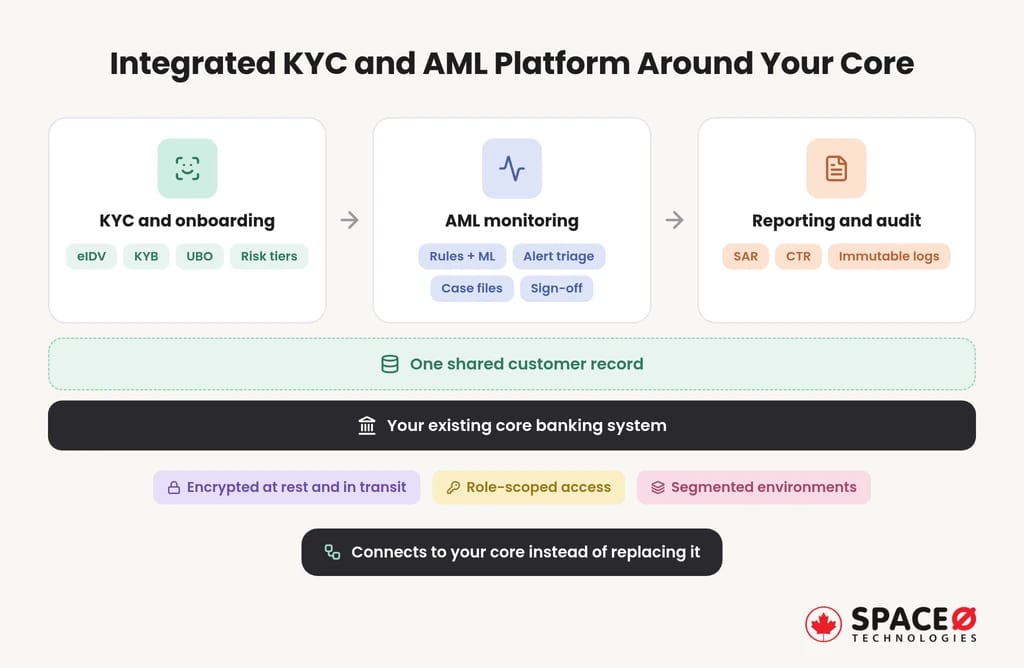
Space-O Canada builds the platform as three connected modules that share one customer record. That record avoids data fragmentation and audit gaps.
Onboarding data feeds monitoring, monitoring feeds case work, and closed cases feed regulatory reports. The platform connects to your core banking system rather than replacing it.
1. The KYC and onboarding module confirms identity and risk
This module confirms who the customer is and how much risk the customer carries.
- Electronic Identity Verification (eIDV): Document scanning, facial biometrics and liveness checks confirm an applicant’s identity.
- Know Your Business (KYB): Registry checks and director screening verify a corporate customer.
- Ultimate Beneficial Owner (UBO): Ownership checks identify the people who ultimately control a corporate customer.
- Dynamic Risk Scoring: Customer, screening and activity data place each customer in a low, medium or high tier.
2. The AML and transaction monitoring module turns activity into cases
This module watches account activity after onboarding and turns unusual behavior into reviewable work.
- Transaction Monitoring: Deterministic rules plus machine learning (ML) anomaly detection flag unusual activity and cut false positives.
- Alert Triage: Case management ranks flagged activity so analysts review the highest risks first.
- Case Investigation: Case files hold customer records, transaction evidence and analyst notes in one place.
- Supervisor Sign-Off: A supervisor approves the outcome before a case closes.
3. The regulatory reporting and audit module produces filings
This module converts finished investigations into filings and a record an auditor can follow.
- Suspicious Activity Report (SAR): Closed cases auto-populate the report fields for analyst review.
- Currency Transaction Report (CTR): Closed cases supply the transaction and customer data the report requires.
- Immutable Audit Logs: Tamper-evident, timestamped entries record every action taken on a case.
4. Every compliance step becomes a software capability
KYC and AML programs follow five steps in a fixed order. Each one maps to a specific system behavior:
- Customer Identification Program (CIP): The intake flow captures legal name, date of birth, address and identification numbers.
- Customer Due Diligence (CDD): The screening service checks sanctions lists, watchlists and politically exposed persons (PEPs), including OFAC, EU and UN lists.
- Enhanced Due Diligence (EDD): The routing engine sends high-risk customers to adverse media and credit history checks.
- Ongoing Monitoring: The monitoring engine flags unusual transaction changes and updates risk levels over time.
- Suspicious Activity Reporting (SAR): The case system moves confirmed concerns into a report for filing with regulatory authorities.
All three modules share one security baseline: encrypted data at rest and in transit, role-scoped access, logged activity for audit, and segmented environments.
Together, the modules and step map define what the platform must do. Delivery then determines whether those capabilities hold up in production and under audit.
How Does Space-O Canada Deliver From Regulatory Mapping to Launch?
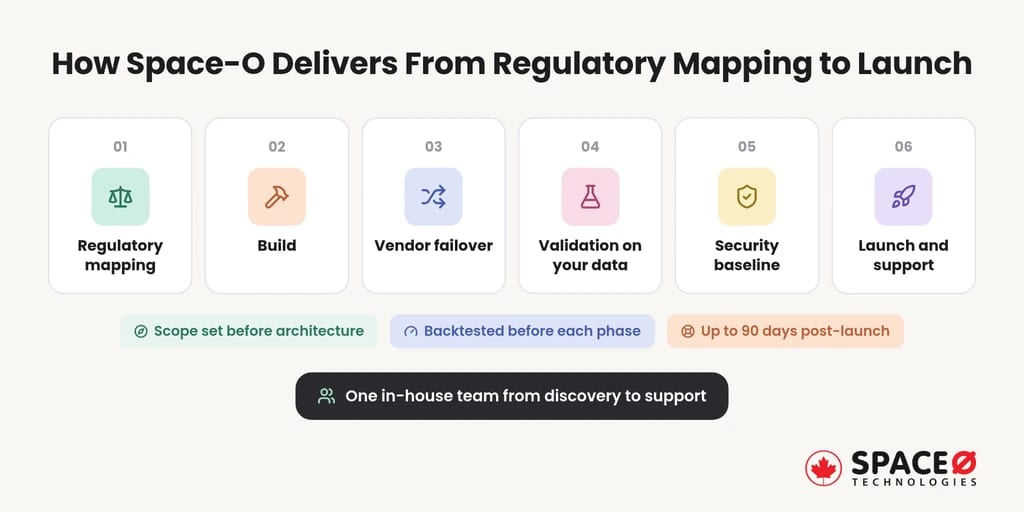
Space-O Canada delivers KYC and AML platforms in six stages. Regulatory scope comes first, before architecture is locked.
Provider failure and false-positive performance get tested before launch, not discovered afterward. The same in-house team stays with the work from discovery through post-launch support.
- Regulatory Mapping: Discovery maps BSA, FinCEN and OFAC exposure, using FATF standards and regulators such as FCA or AUSTRAC where relevant. Each obligation becomes a documented requirement, such as a rule, a reporting deadline or a data field, before architecture is locked.
- Build: The team designs the architecture and interface, then develops the three modules and core integrations. Analysts, supervisors and auditors each get screens shaped around their part of the case workflow.
- Vendor Orchestration and Failover: A failed biometric or watchlist provider triggers a fallback, so onboarding continues without a block. Every switch between providers is logged, so the audit trail shows which service made each check.
- Validation on Your Own Data: Backtesting tunes monitoring thresholds against your historical transactions, not sample data. The team reports false-positive rates and alert-to-case ratios before each phase goes live.
- Security Baseline: Security testing confirms the required controls work across every environment before deployment. This covers encryption, role-scoped access, activity logging and environment segmentation.
- Launch and Support: The team deploys the platform, then monitors performance and fixes issues after go-live. Post-launch support runs for up to 90 days and covers performance monitoring, OS updates and bug fixes.
Each stage leaves the next with a tested foundation instead of an open compliance question. The track record behind that process comes next.
What Verified Numbers Back Space-O Canada’s KYC Workflow Delivery?
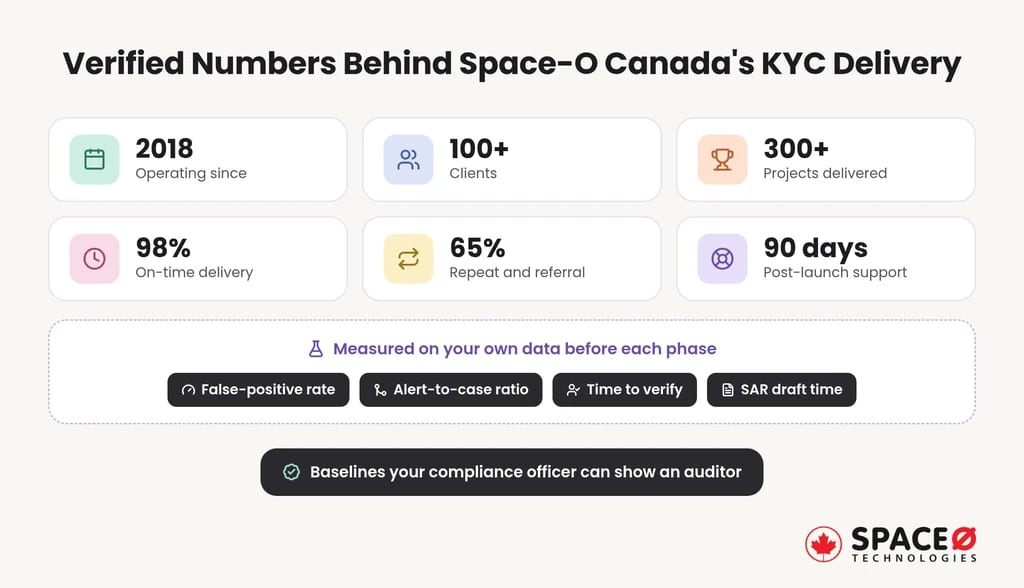
For a bank or credit union, this service centers on KYC-led customer onboarding alongside core banking and account management modules. It also covers planned integrations linking the core, payment gateways and identity verification providers.
- Operating History: Space-O Canada reports operating since 2018.
- Client Base: Space-O Canada reports 100+ clients, including Fortune 500 companies.
- Projects Delivered: Space-O Canada reports 300+ successful projects delivered.
- On-Time Delivery: Space-O Canada reports 98% on-time project delivery.
- Repeat and Referral: 65% of Space-O Canada’s business comes from repeat clients and referrals.
- Post-Launch Support: For up to 90 days after go-live, the package covers performance monitoring, OS updates and bug fixes.
For a compliance build, the numbers that matter most are measured on your own data. Before each phase launches, the team reports the false-positive rate, the alert-to-case conversion ratio, the average time to verify a new customer and the time to complete a SAR draft. These baselines turn “fewer false positives” into a figure your compliance officer can take to an auditor.
These numbers show how the team delivers, while the service scope shows what it builds. The next decision is which route suits the core you already run.
Should Banks Build, Buy or Extend Their Core for KYC and AML?
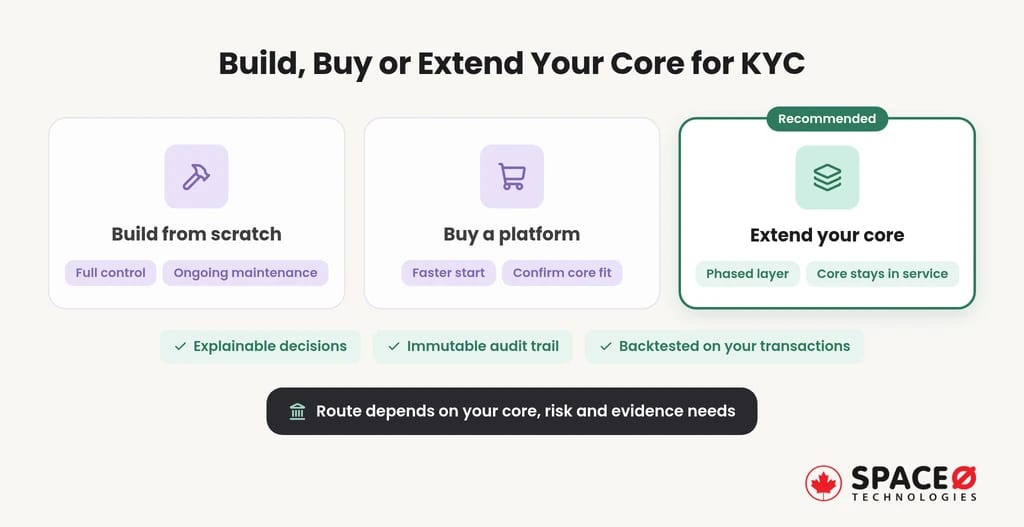
Most banks and credit unions face three options: build from scratch, buy a platform or extend the current core. Custom work gives control and deep integration but needs maintenance.
Buying accelerates time-to-market. Extending adds a phased KYC and AML layer without replacing the core system your operations depend on.
| Option | Core integration | Explainable decisioning | Audit trail | False-positive proof on your data |
|---|---|---|---|---|
| Build from scratch | Deep integration under your control, with ongoing maintenance | Designed to your requirements | Designed to your evidence needs | Testable before launch |
| Buy a platform | Faster start; confirm the connection to your core during evaluation | Confirm what the vendor exposes to analysts | Confirm log access and export format | Request a test on your transactions |
| Extend your core (the Space-O Canada path) | Phased layer connected to the core you already run | Rules and model outcomes recorded with reasons | Immutable logs across all three modules | Backtested on your transactions before each phase launches |
We recommend the extension path when your core stays in service and your compliance tools sit around it. Four differentiators support that recommendation:
- Compliance Mapped in Discovery: Regulatory scope shapes the architecture early, rather than being bolted on during QA.
- One In-House Team: Nothing is subcontracted; whoever scopes your build also supports it post-launch.
- Phased Modernization: Your legacy system stays while KYC and AML modules connect in stages.
- Explainable Decisioning: Recorded reasons let a reviewer see why the system reached each outcome.
In-line CTA
Get a Cost Estimate for Your Build
Share your core system details and alert volumes, and our team returns a phased cost estimate and timeline for your platform.
The right route depends on your core, your risk and your evidence needs. The next section pulls these points together and shows how Space-O Canada helps.
Why Choose Space-O Canada for KYC and AML Compliance Software?
KYC and AML compliance software works best as one platform that extends your core instead of replacing it. Disconnected tools leave audit gaps, so a phased layer with immutable logs protects your institution.
Since 2018, Space-O Canada has served 100+ clients, including Fortune 500 companies. 65% of its business is repeat and referral.
One in-house team carries your build from regulatory scoping through launch. Backtesting on your own transactions proves false-positive gains before each phase launches.
The team builds for the people who use the system every day. Analysts get ranked alert queues and complete case files, supervisors get a clear sign-off step, and auditors get a timestamped trail they can follow without rebuilding it by hand.
For institutions operating in both the US and Canada, the same platform can support BSA, FinCEN and OFAC duties alongside FINTRAC, OSFI and PIPEDA requirements. Report formats, data residency and consent handling for each country are settled during discovery.
If your team is working to close audit gaps or reduce false-positive volume, start with a scoping conversation. Share your core banking system details, current alert volumes and any open audit findings, and Space-O Canada will map your regulatory scope and outline a phased path to launch.
Frequently Asked Questions About KYC and AML Compliance Software
What is the AML and KYC process?
The process runs in five steps: CIP, CDD, EDD, ongoing monitoring and SAR. Identity and risk are set at onboarding. Monitoring, investigation and filing continue afterward.
What are OFAC and FATF?
OFAC, the Office of Foreign Assets Control, maintains the US sanctions lists used in screening. The Financial Action Task Force (FATF) is an intergovernmental body that sets the international AML standards, known as the 40 Recommendations, that national regulators build on. FATF standards inform the compliance scope during regulatory mapping. OFAC, EU and UN lists feed the platform’s screening service.
What is the difference between KYC and AML?
KYC verifies each customer’s identity and risk at onboarding. AML is the wider framework of laws and procedures that keeps watching afterward. KYC sits inside AML.
Why use one integrated platform instead of separate tools?
One shared record stops data fragmentation and audit gaps. Onboarding data feeds monitoring, monitoring feeds case work, and closed cases feed regulatory reports.
Can a bank keep its existing core system?
Yes. The extend path adds a phased KYC and AML layer connected to your current core. Your legacy system stays while the modules connect in stages.
What should a bank bring to a first scoping conversation?
Bring your core banking system details, your alert challenges such as false-positive volume, and any open audit findings. These let the team map regulatory scope before architecture is locked.


Let’s Discuss Your Idea
Share your idea with our fintech development team and get a practical breakdown of what you need to build, integrate, secure, and launch it.
 Your project is covered by an NDAYour information stays secure and confidential




What our clients say


When we set out to build our Estate Tax Planning Tool, we needed a development partner we could trust with something this complex and consequential. Space-O Canada brought the technical expertise and attention to detail needed to handle intricate tax calculations and edge cases. They communicated clearly, delivered on time without cutting corners, and built a product we trust completely.
 Ed Chetan EdwinFounder, CharityCalc
We partnered with Space-O Canada to build a fintech platform that could support secure transactions, third-party integrations, and future scalability. Their team understood our business requirements from the beginning and delivered a well-architected solution without unnecessary complexity. Communication was consistent, milestones were met on time, and every challenge was handled proactively.
 Michael CarterCo-Founder, Digital Payments Platform
The fintech app came out exactly the way I pictured in terms of functionality. I will refer future UI/UX clients to their team. During the testing phase of the app, it performed according to the initial designs in terms of functionality. Their team was dedicated to creating the best version of the app and provided their own ideas to improve it.
 Amanda LewisProduct Manager, Lending Platform
Our banking modernization project involved complex integrations and strict security requirements, and Space-O Canada handled both with confidence. They developed a reliable banking platform that improved operational efficiency while maintaining a smooth customer experience. Their structured development process and clear communication kept the project on track from start to finish.
 Daniel RobertsVP of Technology, Regional Bank
Our legacy insurance system created delays across policy management and claims processing. Space-O Canada developed a centralized platform that streamlined our workflows and improved efficiency across departments. The project was delivered on schedule, and the team’s understanding of insurance technology was evident throughout the engagement.
 Emily FosterOperations Director, Insurance Provider
Developing a trading platform requires speed, reliability, and technical precision. Space-O Canada delivered a solution that performs exceptionally well while supporting real-time market data and intuitive trading workflows. Their project management was excellent, and the team remained responsive throughout every stage of development.
 Ethan MorganChief Product Officer, Investment Platform
The fintech app was successfully launched, and users loved its sleek design and features. Space-O Technologies worked in an organized and collaborative manner, allowing them to achieve quality results. They also took the time to deeply understand the project. They were very organized and had a good track record.
 David WilsonFounder, Personal Finance App