
- Why Does Legacy Core Banking Data Stay Fragmented?
- Which Integration Patterns Consolidate Data From a Legacy Core?
- 1. A data lakehouse built on ETL/ELT consolidates bank data across products and subsidiaries
- 2. Change data capture pulls changes from DB2 and IMS in near real time
- 3. An API layer or middleware exposes legacy core data in real time
- 4. The strangler fig pattern supports hybrid coexistence while the core is retired
- 5. How Do the Four Patterns Compare?
- Should You Run a Big-Bang Cutover or a Phased Migration?
- How Do Governance and Data Lineage Hold Up Under Audit?
- How Much of the IT Budget Does Legacy Maintenance Consume?
- Which Integration Path Fits Your Core?
- What Should Banks and Credit Unions Expect From an Integration Partner?
- How Does Space-O Canada Deliver Legacy Core Banking Data Integration?
- Frequently Asked Questions About Legacy Core Banking Data Integration
Legacy Core Banking Data Integration for Financial Data Consolidation A Reconciliation-First Guide

 Last Updated: November, 18 2026
Key Takeaways
- The direct answer is to integrate around the running core first and treat core replacement as a separate, later decision.
- This guide compares four integration patterns: data lakehouse, Change Data Capture, API layer and strangler fig.
- It sets out a numbered parallel reconciliation process that proves consolidated balances tie to the general ledger.
- It covers governance controls, BCBS 239 lineage, cost and decision rules for Fiserv, FIS, Jack Henry and mainframe cores.
Legacy core banking data integration for financial data consolidation is how banks unify data trapped in aging, batch-driven cores. Teams extract, cleanse, map and synchronize records from monolithic or mainframe systems into a unified reporting platform. The safest route keeps the core live, adds an integration layer, and migrates in phases with parallel reconciliation.
A consolidation project is judged at its first month-end close, not at go-live. Suppose the consolidated report and the legacy general ledger disagree. Someone must then explain the gap to an auditor. That gap usually starts in data the old core never meant to share.
This guide follows the order in which the problem unfolds: obstacles, patterns, cutover, governance, cost and fit. Each pattern carries a plain rule on when to use it and where it breaks.
Space-O Canada builds this work as part of banking software development services that connect to the core your institution already runs. Delivery moves in phases, so customer and member services keep running throughout.
Why Does Legacy Core Banking Data Stay Fragmented?
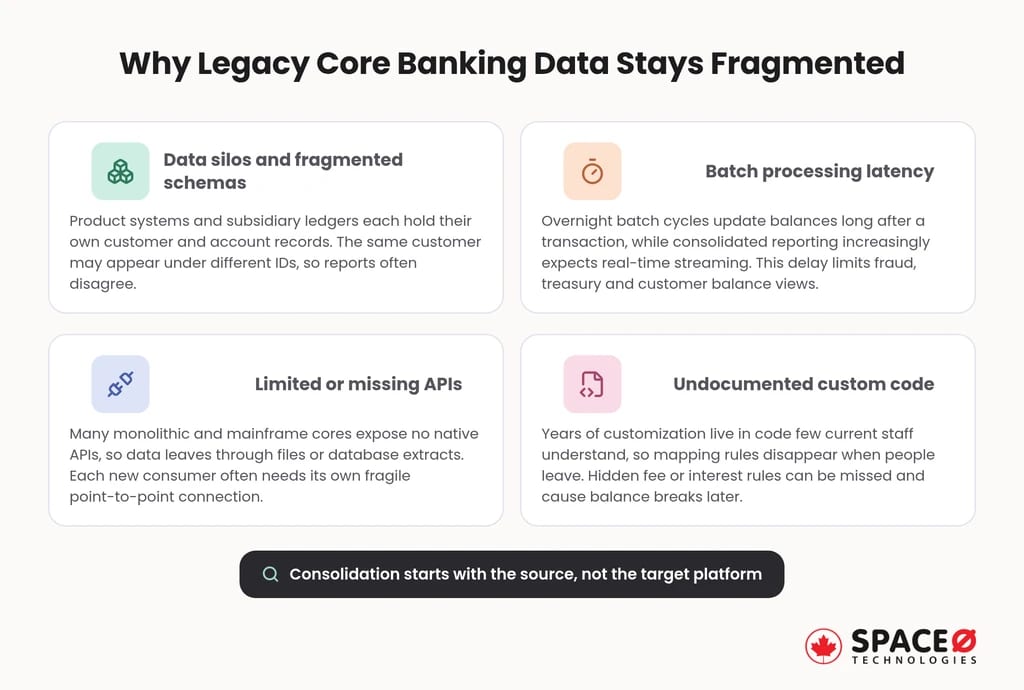
Fragmentation is a design trait of legacy cores, not a cleanup backlog. Four obstacles recur in banks and credit unions running older cores:
- Data silos and fragmented schemas: Product systems and subsidiary ledgers each hold their own customer and account records, creating duplicated, inconsistent data. The same customer may appear under different IDs across systems, so reports often disagree.
- Batch processing latency: Overnight batch cycles update balances long after a transaction, while consolidated reporting increasingly expects real-time streaming. This delay limits fraud monitoring, treasury decisions and customer-facing balance views.
- Limited or missing APIs: Many monolithic and mainframe cores expose no native APIs, so data leaves through files or database extracts. Each new consumer often needs its own extract, creating fragile point-to-point connections.
- Undocumented custom code: Years of customization live in code few current staff understand, so mapping rules disappear when people leave. Hidden logic, such as fee or interest rules, can be missed during consolidation and cause balance breaks later.
These obstacles compound each other. A core without APIs forces file-based extracts, and those extracts carry whatever the core’s undocumented code already did to the data. Duplicate customers and mismatched account identifiers then reach the consolidated layer unless they are profiled out first. That is why consolidation starts with understanding the source, not choosing the target platform.
Each obstacle limits which pattern can reach the data safely. The next section matches four integration patterns to those constraints.
Which Integration Patterns Consolidate Data From a Legacy Core?
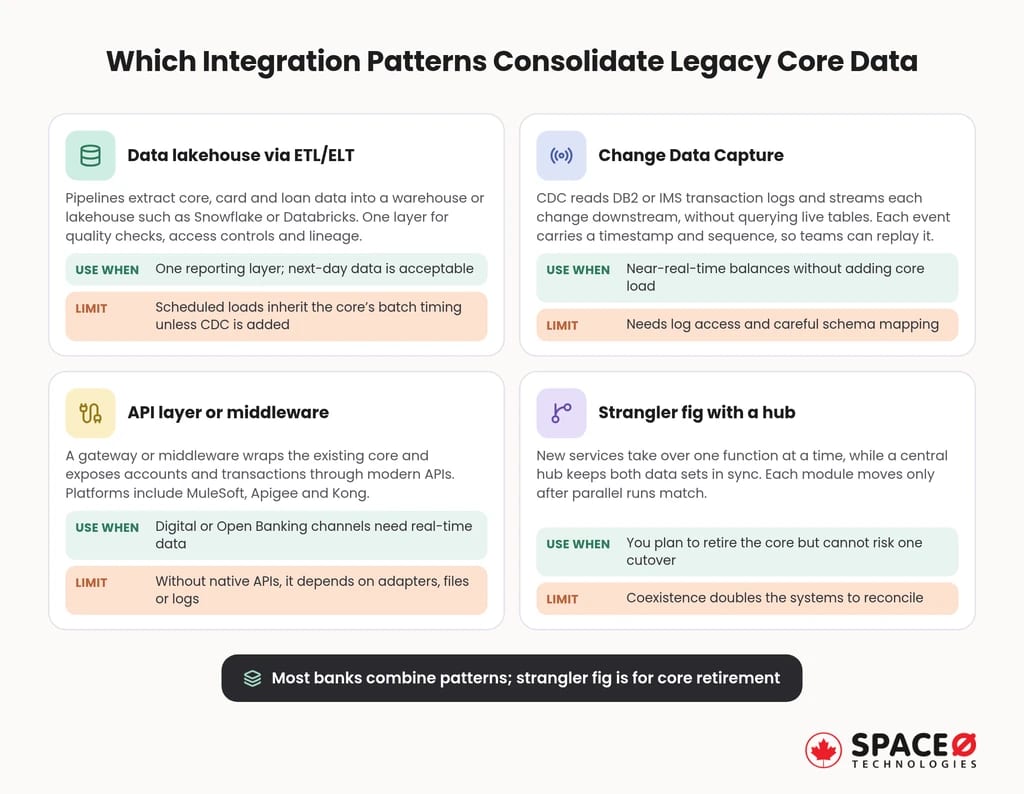
Four patterns cover most consolidation work, and they combine rather than compete. Each one below follows the same shape: mechanism, best fit and limit.
1. A data lakehouse built on ETL/ELT consolidates bank data across products and subsidiaries
A data lakehouse is the core consolidation pattern for reporting and analytics, because it brings product and subsidiary data into one reporting layer.
Data lakehouse via ETL/ELT: Pipelines extract core, card and loan data into a warehouse or lakehouse such as Snowflake or Databricks. ETL transforms data before loading. ELT loads raw data first and transforms it inside the platform. A lakehouse also stores structured and semi-structured data together, so statements, logs and documents can sit alongside core records. A single layer gives you one place to apply data quality checks, access controls and lineage tracking, which simplifies regulatory reporting.
Use when: You need one reporting layer across products and subsidiaries, and next-day data is acceptable.
Limit: Scheduled loads inherit the core’s batch timing unless Change Data Capture feeds them.
Many teams start here because it leaves the core untouched. Once data is consolidated, the same layer can support analytics and AI; see the data requirements for each banking AI use case.
2. Change data capture pulls changes from DB2 and IMS in near real time
Change Data Capture closes the freshness gap that batch loads leave behind.
Change Data Capture (CDC): CDC reads database transaction logs, such as IBM DB2 or IMS logs, and streams each change downstream. The core keeps processing normally because CDC reads logs instead of querying live tables. Tools such as IBM InfoSphere Data Replication and Precisely Connect support CDC from these sources. Because each change carries a timestamp and sequence, downstream teams can replay events to rebuild a balance or trace an error.
Use when: Reporting, fraud or treasury views need near-real-time balances without adding load to the core. Fraud monitoring is a common case; see real-time versus batch transaction monitoring for how the two modes differ.
Limit: CDC needs log access and careful schema mapping. A missed change can also break downstream balances.
CDC rarely replaces the lakehouse; it usually feeds it. Where the same data must also reach digital channels, an API layer takes over.
3. An API layer or middleware exposes legacy core data in real time
An API layer suits consolidation work that also feeds digital channels.
API wrapper or middleware layer: A gateway or middleware tier wraps the existing core and exposes accounts and transactions through modern APIs. The layer also handles authentication, rate limiting and caching, so traffic spikes from digital channels never reach the core directly. Versioned APIs let channels evolve without forcing changes on the core. Common platforms include MuleSoft, Apigee and Kong.
Use when: Mobile banking, Open Banking or partner channels need the same consolidated data in real time.
Limit: Where the core lacks native APIs, the wrapper depends on adapters, files or logs underneath.
The wrapper hides the core’s age from consumers, but not from your reconciliation team. When the goal is to retire the core itself, the strangler fig pattern is the route.
4. The strangler fig pattern supports hybrid coexistence while the core is retired
The strangler fig pattern turns consolidation into a gradual migration.
Strangler fig with a consolidation hub: New services take over one function at a time, while a central hub keeps both data sets in sync. Event-driven synchronization lets both systems run side by side during hybrid coexistence. Banks often start with a low-risk function, such as customer notifications or account opening, before moving payments or the general ledger. Each module moves only after parallel runs show matching results, which gives auditors a clear record of every step.
Use when: You plan to retire the core eventually but cannot risk a single cutover.
Limit: Coexistence doubles the systems to reconcile until the final module moves.
It is the slowest pattern, but it gives the safest exit from a legacy core. Banks planning that exit can follow a phased core modernization without a rip-and-replace.
5. How Do the Four Patterns Compare?
Each pattern trades disruption, latency and audit fit differently, and the table compares all four on the points that matter during live operations.
| Pattern | Disruption to live operations | Latency achieved | Needs a native API on the core | Reconciliation effort | Audit and lineage fit |
|---|---|---|---|---|---|
| Data lakehouse via ETL/ELT | Low; reads extracts | Batch to scheduled intraday | No | Moderate; checked per load | Strong when transformations are documented |
| Change Data Capture | Low; reads logs | Near-real-time | No; needs log access | Ongoing; stream vs. ledger | Strong; each change is traceable |
| API wrapper / middleware | Low to moderate | Real-time for exposed functions | Preferred; adapters fill gaps | Moderate | Depends on gateway audit logging |
| Strangler fig with hub | Moderate; staged by module | Varies by module | No | High; parallel runs per module | Strong when parallel runs are recorded |
In practice, most banks pair CDC with a lakehouse for analytics, add an API layer for digital channels, and adopt the strangler fig only when retiring the core is on the roadmap. Space-O sequences these patterns so consolidation work does not interrupt core processing.
Not Sure Which Pattern Fits Your Core?
Our engineers review your core’s logs, interfaces and documentation to recommend the right pattern mix.

No single pattern wins every row, so many programs combine two or three. Combining them raises the stakes on how the cutover itself is run.
Should You Run a Big-Bang Cutover or a Phased Migration?
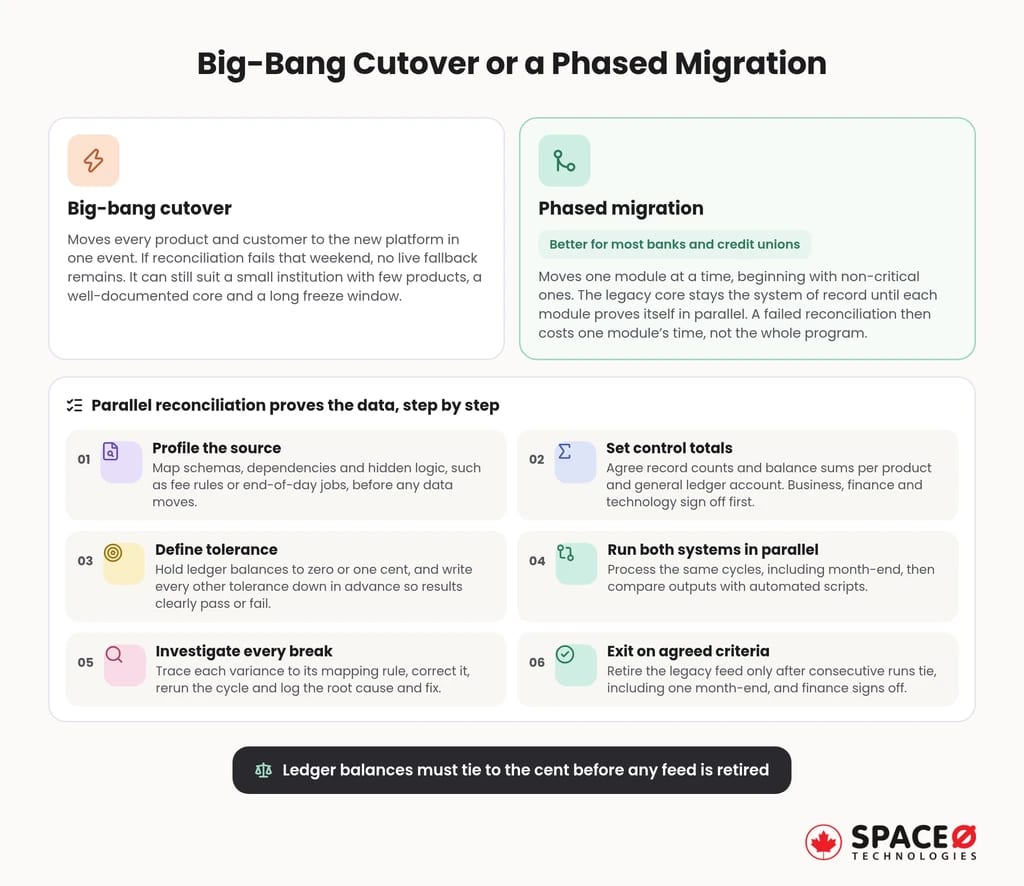
Most banks and credit unions are better served by phased coexistence than by a big-bang cutover.
A big-bang cutover moves every product and customer to the new platform in one event. If reconciliation fails that weekend, no live fallback remains. A phased migration moves one module at a time, beginning with non-critical ones. The legacy core stays the system of record until each module proves itself in parallel.
A big-bang cutover can still suit a small institution with few products, a well-documented core and a long freeze window. Banks and credit unions with several product systems, subsidiary ledgers or undocumented customizations usually carry too much unknown risk for one event. A phased plan also lets finance keep closing the books on the legacy core while the first modules prove themselves. A failed reconciliation then costs one module’s time instead of the whole program.
- ### Parallel reconciliation proves migrated data step by step
Parallel reconciliation runs come before any decommissioning, and they prove the new data ties to the cent. The six steps below follow that sequence.
- Profile the source. Map schemas, dependencies and customizations in the legacy core before any data moves. This step also surfaces hidden logic, such as hard-coded fee rules or end-of-day batch jobs, that the new platform must reproduce. The output is a data inventory that every later step tests against.
- Set control totals. Agree record counts and balance sums per product and per general ledger account. Typical controls include account counts, outstanding loan balances, deposit totals and accrued interest. Business, finance and technology teams sign off on these totals before migration starts, so no one can redefine success later.
- Define tolerance. Fix the acceptable variance per control total, with ledger balances held to zero or one cent and other controls to a stated tolerance. Writing tolerances down in advance removes debate during testing, because every result either passes or fails against a known threshold.
- Run both systems in parallel. Process the same cycles through the legacy and new platforms, then compare outputs. The runs should include month-end and other high-volume cycles, since interest accruals, fees and statements often expose issues that daily runs miss. Automated comparison scripts help teams spot variances quickly across large record sets.
- Investigate every break. Trace each variance to its mapping rule, correct it and rerun the affected cycle. Each break is logged with its root cause and fix, which builds the audit trail regulators expect. Recurring breaks often point to a flawed mapping rule rather than isolated data errors.
- Exit on agreed criteria. Retire the legacy feed only after consecutive runs tie within tolerance and finance signs off. Exit criteria commonly require several clean cycles in a row, including at least one month-end. A rollback plan stays in place until the legacy feed is formally retired.
Each step leaves a record that holds up under a regulator’s review.
Parallel runs turn migration risk into evidence an auditor can read. That evidence only holds if governance and lineage are designed in from the start.
How Do Governance and Data Lineage Hold Up Under Audit?
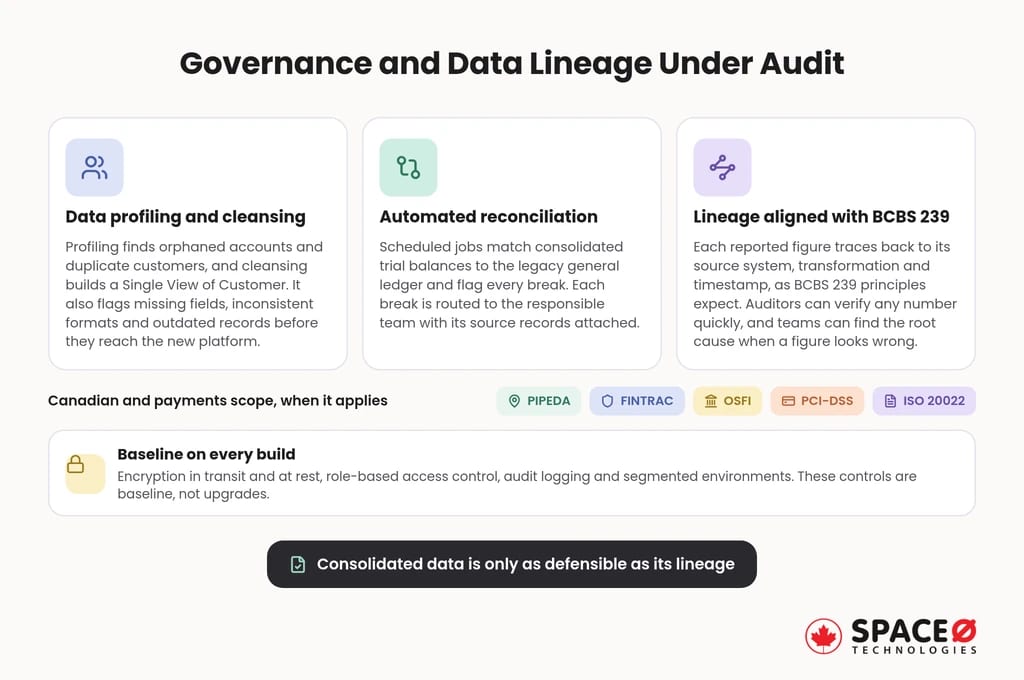
Consolidated data is only as defensible as its lineage. Three controls carry most of the audit weight:
- Data profiling and cleansing: Profiling finds orphaned accounts and duplicate customers, and cleansing then builds a Single View of Customer. It also flags missing fields, inconsistent formats and outdated records, such as old addresses or invalid identifiers, before they reach the new platform. A clean customer record supports accurate KYC checks, risk reporting and personalized service across every channel.
- Automated reconciliation: Scheduled jobs match consolidated trial balances to the legacy general ledger and flag every break. Each break is routed to the responsible team with its source records attached, which shortens investigation time. Automation replaces manual spreadsheet checks, so teams can reconcile larger volumes more often and with fewer errors.
- Lineage aligned with BCBS 239: Each reported figure traces back to its source system, transformation and timestamp, as BCBS 239 principles expect. These principles, issued by the Basel Committee on Banking Supervision, set standards for accurate, complete and timely risk data aggregation and reporting. Clear lineage lets auditors and regulators verify any number quickly, and it helps teams find the root cause when a figure looks wrong.
For institutions with Canadian exposure, Space-O builds consolidation platforms engineered to support PIPEDA, FINTRAC and OSFI requirements. Where consolidated data feeds AI models, OSFI E-23 model risk management requirements can also come into scope. Card data in scope is built to support PCI-DSS. Where payment messages use ISO 20022, mapping preserves their structured fields in the consolidated model.
Every build includes encryption in transit and at rest, role-based access control, audit logging and segmented environments. These controls are baseline, not upgrades.
Governance turns a data pipeline into a reporting system regulators can trust. Cost is the other force pushing institutions toward consolidation now.
How Much of the IT Budget Does Legacy Maintenance Consume?
Banks running legacy systems spend most of their IT budgets on maintenance, and published estimates differ only on the exact share.
- Banks running legacy systems spend most of their IT budgets keeping those systems running. Industry estimates generally place maintenance at roughly 60% to 80% of total IT spending, and they differ mainly on the exact share rather than the overall picture.
- That money goes into patching aging code, paying for scarce mainframe and COBOL skills, renewing vendor licences and building workarounds for systems that were never designed to share data. Every dollar spent there is a dollar unavailable for reporting, analytics and compliance work, which is exactly where banks face the most pressure to improve.
- These figures work best as ranges, because definitions of maintenance vary and no general estimate reflects a specific institution. For a business case, compare your own run-versus-change spending before and after consolidation. That comparison shows what your bank actually spends to stand still and how much capacity consolidation can free up.
- Consolidation does not remove legacy maintenance costs on day one. It does stop new reporting work from deepening dependence on the old core, so each new requirement is built on the consolidated layer instead of adding another patch to the legacy system. Over time, that shift moves budget from keeping the lights on toward work that creates value.
The budget case explains why to act, but not which path to take. That choice depends on the core you run today.
Which Integration Path Fits Your Core?
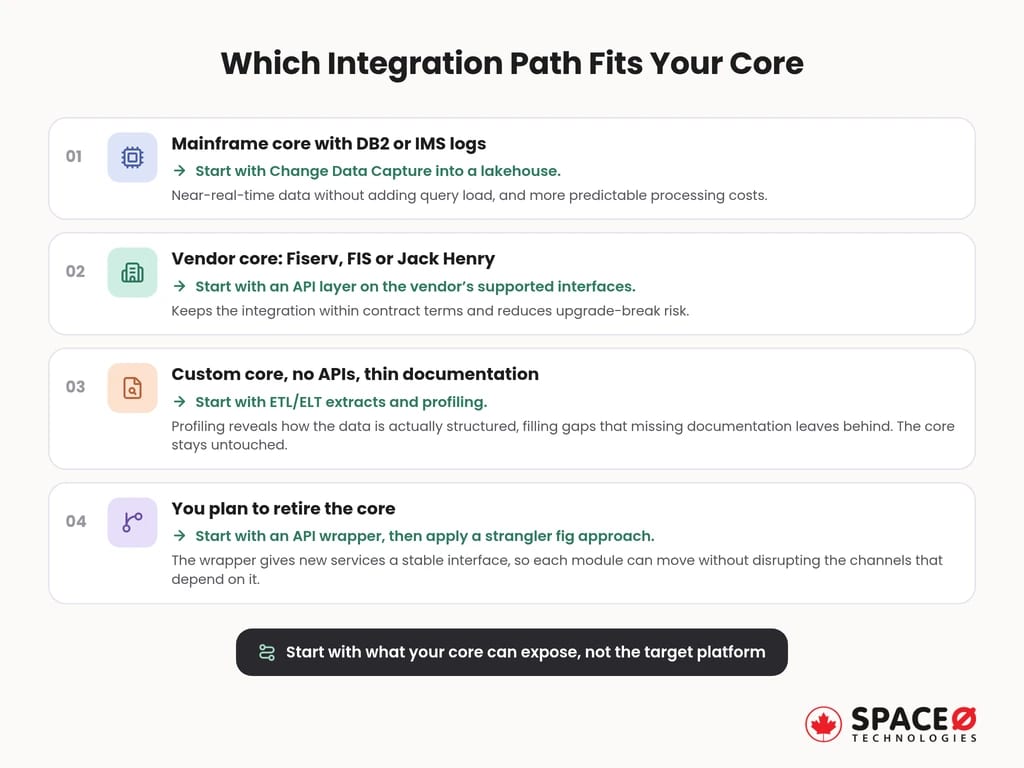
Start with what your core can expose, not with the target platform. The core’s logs, interfaces and documentation decide which patterns are practical, how fast data can move and how much disruption the work will cause.
The first fork is full core replacement versus data warehouse or reporting consolidation. If the pain sits in reporting and analytics, consolidate now and defer replacement. Consolidation delivers results in months rather than years, and it leaves the core running while the bank builds confidence in the new data layer. Institutions weighing that fork module by module can use this build-versus-buy decision for banking software. Four decision rules then set the starting pattern:
- If your mainframe core exposes DB2 or IMS logs, start with Change Data Capture into a lakehouse. This gives near-real-time data without adding query load to the mainframe, and it keeps processing costs predictable.
- If a vendor core such as Fiserv, FIS or Jack Henry offers integration interfaces, start with an API layer. Using the vendor’s supported interfaces keeps the integration within your contract terms and reduces the risk of breaking during vendor upgrades.
- If a custom core has no APIs and thin documentation, start with ETL/ELT extracts and profiling. Profiling reveals how the data is actually structured, which fills the gaps that missing documentation leaves behind.
- If you plan to retire the core, start with an API wrapper and then apply a strangler fig approach. The wrapper gives new services a stable interface, so each module can move without disrupting the channels that depend on it.
Many banks combine these rules over time, for example by starting with extracts and adding Change Data Capture once log access is in place.
These rules pick a starting pattern, not a full runbook. The partner you choose decides how well that runbook holds in production. Look for a team with hands-on experience in your core, a clear reconciliation method and a record of delivering consolidation work without interrupting live operations.
What Should Banks and Credit Unions Expect From an Integration Partner?
Expect one accountable team from discovery to support, because consolidation work breaks at handoffs, where mapping knowledge leaves with a departing team. When the people who designed the mapping rules are not the ones fixing breaks after go-live, every issue takes longer to trace and resolve.
Space-O Canada’s team avoids that break through four commitments:
- One team throughout: The same engineers run discovery, build and post-launch support, with no subcontracting. This keeps decisions, context and accountability in one place, so you always know who owns each part of the work.
- Compliance mapped in discovery: Discovery maps regulatory scope before architecture is locked, not during QA. Catching requirements early avoids costly redesigns and keeps the timeline and budget realistic from the start.
- Fintech specialization: The team works as a fintech specialist for regulated institutions, not as a generalist agency. That focus means familiarity with core banking data, ledger logic and the audit expectations that come with them.
- Phased modernization: Builds connect to the core you already run, including a Fiserv core, rather than replacing it. Your institution gains modern capabilities without the risk and disruption of a full core replacement.
Integration specialists also connect core banking systems with payment gateways, Open Banking APIs, accounting platforms and KYC providers. No handoffs. No gaps. Each connection follows the same mapping, testing and reconciliation standards as the core consolidation work.
Before signing, ask a prospective partner four questions. Who runs discovery, and will the same people build? How do they document mapping rules so the knowledge stays with you? What control totals and tolerances do they propose for parallel runs? How do they scope regulatory requirements for your jurisdiction? Clear, specific answers show a partner has done this work before, while vague answers often signal risk later in the project. Institutions that follow US guidance can map these questions to FFIEC third-party risk management for outsourced banking software.
Those commitments matter most in the months after go-live, when real transaction volumes, month-end cycles and regulatory reports test the new data layer. The summary below shows how they translate into delivery.
Work With One Team From Discovery to Post-Launch Support
The same team maps your compliance scope, runs reconciliation and supports your first month-end close.
How Does Space-O Canada Deliver Legacy Core Banking Data Integration?
Consolidation succeeds when reconciliation evidence, not a launch date, decides each phase. Lakehouse loads, CDC and an API wrapper reach the data; strangler fig retires modules safely. Parallel reconciliation proves every balance before the legacy feed shuts down. Lineage then keeps each reported figure traceable when an auditor asks. Teams new to the wider field can start with our banking software development guide.
Space-O Canada has built financial software since 2018 for 100+ clients, including Fortune 500 companies. Every project includes up to 90 days of post-launch support, delivered by the same team that built your integration. If your institution is weighing consolidation against replacement, start with a . We will review your core and regulatory scope, then recommend a starting pattern. The questions below cover what buyers usually ask before that first call.
Frequently Asked Questions About Legacy Core Banking Data Integration
What does “legacy data” mean?
Legacy data is the customer, account and transaction information held in aging, batch-driven core systems. Product systems and subsidiary ledgers each keep their own records, which leaves duplicated and inconsistent data. When a core has no native APIs, the data typically leaves through files or database extracts.
What is core banking software?
Core banking software is the system of record that holds a bank’s or credit union’s accounts, transactions and balances. Legacy versions are often monolithic or mainframe systems that update balances in overnight batch cycles. Consolidation projects usually integrate around this running core rather than replacing it first.
How does integration help modernize the core without replacing it?
Integration adds new data and reporting capabilities around the legacy core while it stays the live system of record. Replacement then becomes a separate, later decision rather than a prerequisite. A strangler fig approach can later retire the core one module at a time while both systems stay in sync.
How do we start consolidating data if the core has no APIs and little documentation?
Start with ETL/ELT extracts and profiling, because a custom core with no APIs and thin documentation gives you little else to work with. Profiling maps schemas, dependencies and customizations before any data moves, and loading extracts into a warehouse or lakehouse leaves the core untouched. Add Change Data Capture later if you need fresher data, keeping in mind that it requires log access and careful schema mapping.
How do we know the consolidated data is accurate?
Parallel reconciliation proves accuracy before any legacy feed is retired. Both systems process the same cycles, and outputs are compared against agreed control totals, with ledger balances held to zero or one cent. Every break is traced to its mapping rule, corrected and rerun, and the legacy feed shuts down only after consecutive runs tie and finance signs off.
Can you integrate with vendor cores such as Fiserv, FIS or Jack Henry?
Yes. Where a vendor core offers integration interfaces, an API layer is usually the best starting point, because it works within the vendor’s supported methods and contract terms. Data from the vendor core can then feed a lakehouse for reporting while the core keeps running as the system of record.
How long does a legacy data consolidation project take?
Timelines depend on the number of source systems, the state of the data and the documentation available. A focused first phase, such as consolidating reporting for one product line, typically delivers results in months rather than years. Parallel runs and agreed exit criteria then decide when each phase is complete, rather than a fixed launch date.
How do you keep data secure and compliant during integration?
Regulatory scope is mapped during discovery, before architecture is locked, so frameworks such as PIPEDA, FINTRAC or BCBS 239 shape the design from the start. Data is encrypted in transit and at rest, and access controls limit who can view or change records. Lineage then traces every reported figure back to its source, giving auditors a clear record of how data moved and changed.


Let’s Discuss Your Idea
Share your idea with our fintech development team and get a practical breakdown of what you need to build, integrate, secure, and launch it.
 Your project is covered by an NDAYour information stays secure and confidential




What our clients say


When we set out to build our Estate Tax Planning Tool, we needed a development partner we could trust with something this complex and consequential. Space-O Canada brought the technical expertise and attention to detail needed to handle intricate tax calculations and edge cases. They communicated clearly, delivered on time without cutting corners, and built a product we trust completely.
 Ed Chetan EdwinFounder, CharityCalc
We partnered with Space-O Canada to build a fintech platform that could support secure transactions, third-party integrations, and future scalability. Their team understood our business requirements from the beginning and delivered a well-architected solution without unnecessary complexity. Communication was consistent, milestones were met on time, and every challenge was handled proactively.
 Michael CarterCo-Founder, Digital Payments Platform
The fintech app came out exactly the way I pictured in terms of functionality. I will refer future UI/UX clients to their team. During the testing phase of the app, it performed according to the initial designs in terms of functionality. Their team was dedicated to creating the best version of the app and provided their own ideas to improve it.
 Amanda LewisProduct Manager, Lending Platform
Our banking modernization project involved complex integrations and strict security requirements, and Space-O Canada handled both with confidence. They developed a reliable banking platform that improved operational efficiency while maintaining a smooth customer experience. Their structured development process and clear communication kept the project on track from start to finish.
 Daniel RobertsVP of Technology, Regional Bank
Our legacy insurance system created delays across policy management and claims processing. Space-O Canada developed a centralized platform that streamlined our workflows and improved efficiency across departments. The project was delivered on schedule, and the team’s understanding of insurance technology was evident throughout the engagement.
 Emily FosterOperations Director, Insurance Provider
Developing a trading platform requires speed, reliability, and technical precision. Space-O Canada delivered a solution that performs exceptionally well while supporting real-time market data and intuitive trading workflows. Their project management was excellent, and the team remained responsive throughout every stage of development.
 Ethan MorganChief Product Officer, Investment Platform
The fintech app was successfully launched, and users loved its sleek design and features. Space-O Technologies worked in an organized and collaborative manner, allowing them to achieve quality results. They also took the time to deeply understand the project. They were very organized and had a good track record.
 David WilsonFounder, Personal Finance App