
- What are the Core Features of Custom Wealth Management Software?
- What are the Advanced and Enterprise Features Wealth Firms Add?
- What Belongs on a Wealth Management Software Feature Checklist for RIAs and Private Banks?
- Which Must-Have Features in Wealth Management Platform Development Should You Build First?
- Should You Build Custom, Customize White-Label or Buy a Suite?
- How Does Space-O Canada Build Wealth Management Software?
- What Should You Decide Before You Scope Your Build?
- Why Choose Space-O Canada for Custom Wealth Management Software?
- Frequently Asked Questions About Key Features of Wealth Management Software
What are the Key Features of Custom Wealth Management Software for Wealth Firms

 Last Updated: November, 16 2026
Key Takeaway
- The short answer: wealth firms need integrated technology, automated compliance, and client-facing tools across seven core features.
- The checklist: a must-have and should-have table weighted for an independent RIA and a private bank.
- The sequence: which features belong in the MVP, phase two, or later, and what discovery must settle first.
- The decision: when a custom build beats a white-label platform or an off-the-shelf suite.
Custom wealth management software is a platform built to one firm’s own workflows rather than a vendor’s, so client records, portfolio automation, compliance checks, and analytics share a single data model. Its key features cover operational, client-facing, and regulatory capabilities: CRM, portfolio analytics, planning, risk, compliance, open APIs, and portals. Space-O Canada builds these platforms through its wealth management software development services.
Wealth platforms rarely fail on screens. They fail on data. A custodian feed lands late, and the client portal shows a balance the custodian never reported. An advisor edits a household record, and no log shows who changed it.
Both failures trace back to feature decisions made before any code exists. Integration scope, retention design, and access roles get set early or patched late. Each one shapes how the platform answers an SEC or FINRA examiner. The gap is common: 74% of advisors say their technology is not fully integrated, according to Advisor360’s 2025 Connected Wealth Report.
This guide lists the features wealth firms expect, then weights them for RIAs and private banks. It also sequences them into build tiers and maps each one to the obligation it supports. It then compares building, white-labeling, and buying, and ends with what to decide before you scope a build. The seven core features come first.
What are the Core Features of Custom Wealth Management Software?
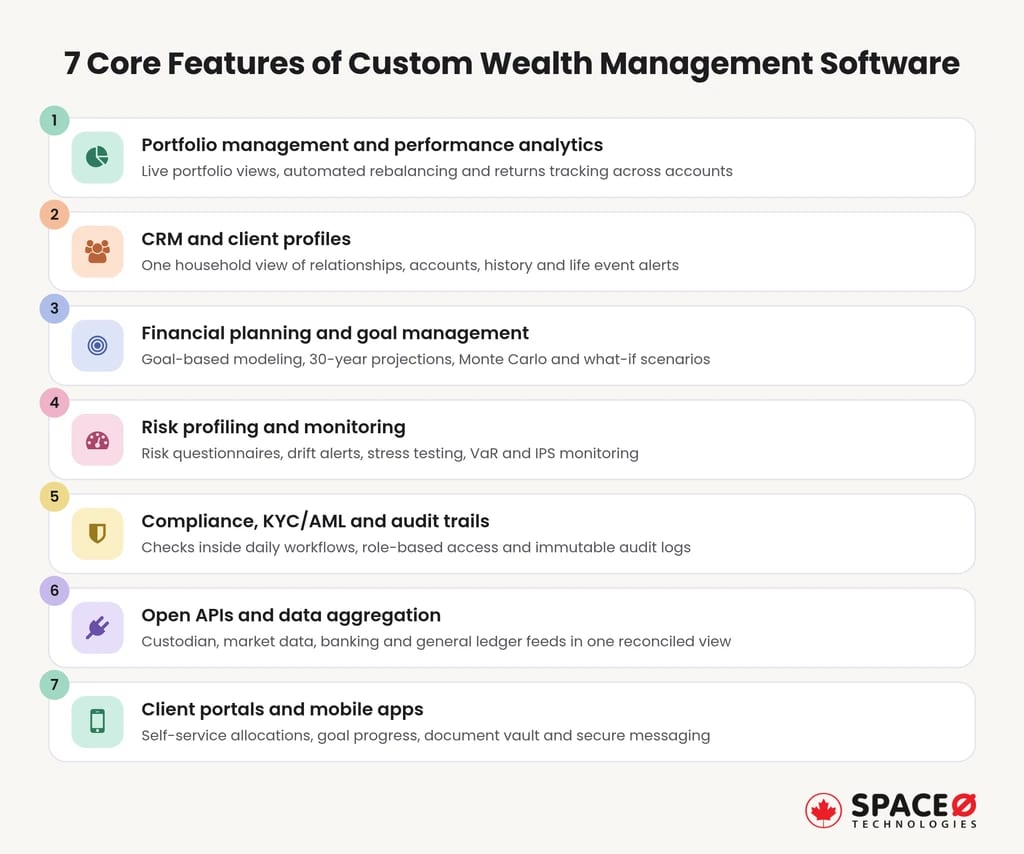
Seven features form the core of a credible wealth platform, from portfolio analytics through client portals.
1. Portfolio Management and Performance Analytics
Portfolio management and performance analytics give advisors live portfolio views, automated rebalancing, and performance tracking across accounts. Expect allocation views, rules-based or AI-assisted rebalancing, returns tracking, and Alpha, Beta, and other key performance indicators. Build consideration: load market data feeds into the same store as positions, so analytics never lag the book.
2. CRM and Client Profiles
CRM and client profiles give each advisor one household view of relationships, accounts, and history. Capabilities include a 360-degree household view, interaction history, life event alerts, and linked profiles for trusts, spouses, and holding companies. Build consideration: a multi-office firm needs role-based access, so each advisor sees only their own book.
3. Financial Planning and Goal Management
Financial planning and goal management support goal-based financial modeling, 30-year projections, and what-if scenarios. Add Monte Carlo cash-flow analysis, retirement calculators, and tax calculators, so advisors can test trade-offs with clients. Build consideration: run projections server-side, so advisor and client screens always show identical numbers.
4. Risk Profiling and Monitoring
Risk profiling and monitoring tie each portfolio to the client’s stated tolerance and keep it there. Capabilities include risk-tolerance questionnaires, portfolio drift alerts, stress testing, value at risk (VaR), and IPS monitoring. Build consideration: link each portfolio to its IPS record, so monitoring checks the actual mandate, not a generic band.
5. Compliance, KYC/AML, and Audit Trails
Compliance, KYC/AML, and audit trails embed regulatory controls inside daily workflows rather than after-the-fact reviews. The baseline is automated regulatory checks, AML controls, role-based access, and immutable audit logs, plus regulatory reporting. Look for audit-ready record-keeping that supports SEC Rule 17a-4 retention requirements and FINRA record-keeping. Build consideration: run checks inside the workflow, so an advisor cannot skip them.
6. Open APIs and Data Aggregation
Open APIs and data aggregation connect the platform to custodians, market data, banking, and accounting for a single reconciled view. Expect REST/GraphQL APIs, webhook support, a sandbox environment, custodian feeds, and general ledger sync with accounting software. Build consideration: reconcile every feed against the general ledger daily, and flag breaks before clients see them.
7. Client Portals and Mobile Apps
Client portals and mobile apps give clients self-service access without a call to their advisor. Include allocations, goal progress, tax documents, a document vault, and secure messaging on web, iOS, and Android. Build consideration: serve web and mobile from the same APIs, so balances match the advisor view.
These seven features carry the daily work of advising, reporting, and staying compliant. The next layer is what lets a platform scale across client segments and asset types.
What are the Advanced and Enterprise Features Wealth Firms Add?
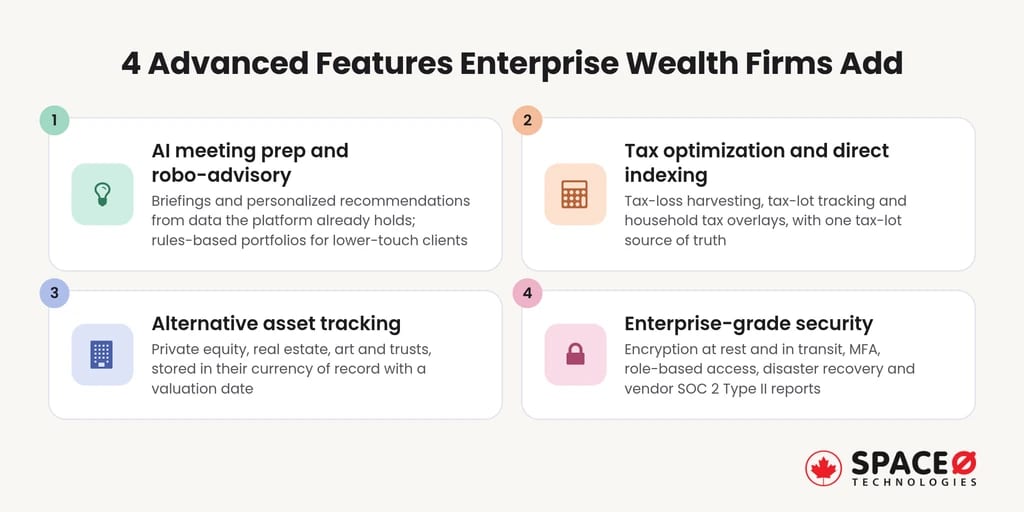
Enterprise firms add four capabilities once the core runs cleanly.
1. AI Meeting Prep and Robo-Advisory
AI insights generate meeting prep, briefings, and hyper-personalized investment recommendations from data the platform already holds. Robo-advisory extends rules-based portfolios to clients who want lower-touch service.
2. Tax Optimization and Direct Indexing
Tax optimization and direct indexing let advisors manage after-tax returns at the tax-lot level. Capabilities include tax-loss harvesting, tax-lot tracking, tax overlays across a household’s accounts, and direct indexing portfolios. Build consideration: choose one tax-lot source of truth, either the custodian or the platform, and never both.
3. Alternative Asset Tracking
Alternative asset tracking records the holdings that custodian feeds do not cover. Wealth platforms should track private equity, real estate, art, trusts, and multi-currency LLC structures alongside listed securities. Build consideration: store each value in its currency of record, not only as a converted figure. Alternatives often arrive as statements or manual entries rather than feeds, so plan an approved manual-entry workflow with a valuation date on every record. A stale private-asset value then shows as stale instead of flowing silently into net worth.
4. Enterprise-Grade Security
Enterprise security goes past passwords to controls an auditor can test. The baseline is encryption at rest and in transit, multi-factor authentication (MFA), role-based access, and disaster recovery. Build consideration: ask every hosting or SaaS component vendor for its SOC 2 Type II report before connecting client data.
Get a Feature Roadmap Sized to Your Firm
Tell us your firm type and custodians. Our engineers will sequence the advanced features against your core build.
Advanced features earn their place only when the core underneath them is stable. Which of them matter first depends on whether you run an independent RIA or a private bank.
What Belongs on a Wealth Management Software Feature Checklist for RIAs and Private Banks?
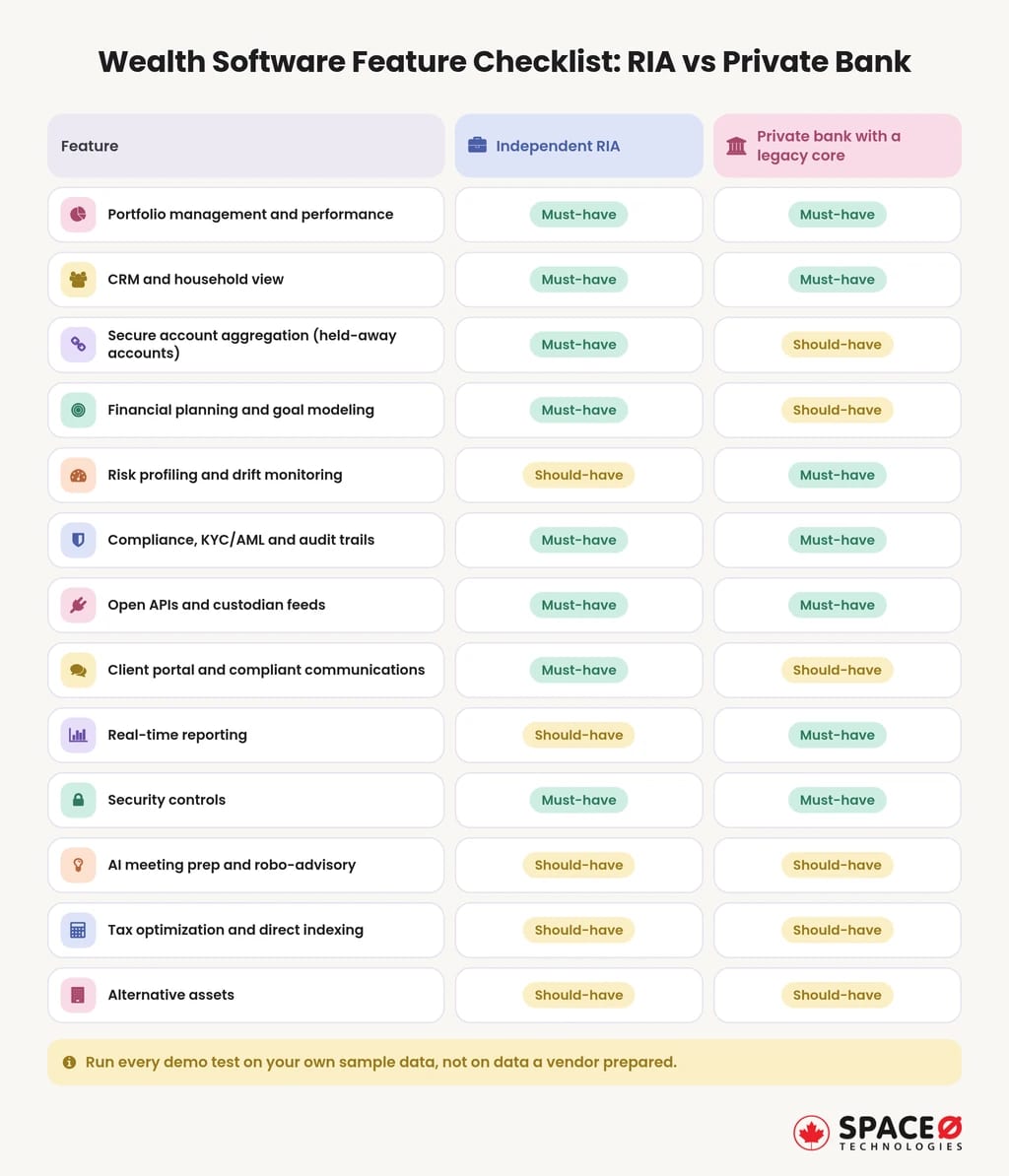
RIAs and private banks buy from the same feature list, but they weight it differently. According to Broadridge, RIAs prioritize held-away aggregation, planning tools, and compliant client communications. Bank wealth divisions prioritize security, real-time reporting, and risk controls instead.
| Feature | Independent RIA | Private bank with a legacy core | Demo test |
|---|---|---|---|
| Portfolio management and performance | Must-have | Must-have | Rebalance one household and confirm the report updates without a manual export. |
| CRM and household view | Must-have | Must-have | Open a household and show interaction history and life event alerts on one screen. |
| Secure account aggregation (held-away accounts) | Must-have | Should-have | Link a held-away brokerage account and show it in the net-worth view. |
| Financial planning and goal modeling | Must-have | Should-have | Change the retirement age and watch the 30-year projection recalculate. |
| Risk profiling and drift monitoring | Should-have | Must-have | Push a portfolio past tolerance and show where the drift alert lands. |
| Compliance, KYC/AML, and audit trails | Must-have | Must-have | Edit a client record, then show who changed it and when. |
| Open APIs and custodian feeds | Must-have | Must-have | Show a live connection to the existing core, not a file export. |
| Client portal and compliant client communications | Must-have | Should-have | Send a client message and retrieve the retained copy. |
| Real-time reporting | Should-have | Must-have | Pull an intraday position report without waiting for an overnight batch. |
| Security controls | Must-have | Must-have | Attempt a login without MFA and confirm access is refused. |
| AI meeting prep and robo-advisory | Should-have | Should-have | Generate a briefing and trace each fact to its source record. |
| Tax optimization and direct indexing | Should-have | Should-have | Sell a position and show which tax lot the platform selected. |
| Alternative assets | Should-have | Should-have | Add a real estate holding and see it in the net-worth view. |
Run every demo test on your own sample data, never on vendor-prepared data.
A weighted checklist tells you what to demand from a vendor or a build team. It does not tell you what ships first, and that sequence drives both budget and risk.
Which Must-Have Features in Wealth Management Platform Development Should You Build First?
Build the controls every later record depends on first: KYC/AML, audit trails, security, the CRM, custodian feeds, portfolio management, and the web portal. Feature lists say what to build, not when. The table below tiers each must-have, names the U.S. obligation it supports, and states the decision discovery must settle first. Obligations appear as design inputs, never as a certification claim.
How Do the Must-Haves Tier Across MVP, Phase Two and Later?
This is the sequence we recommend: seven features in the MVP, six in phase two, and three later.
| Feature | Tier | U.S. obligation it supports (design input) | Decision discovery must settle first | Segment shift |
|---|---|---|---|---|
| KYC/AML onboarding | MVP | KYC and AML program requirements | KYC/AML scope and screening steps, before onboarding is built | None. |
| Immutable audit trails | MVP | SEC and FINRA record-keeping, including SEC Rule 17a-4 retention | Retention periods and immutable log storage | None. |
| Security controls | MVP | Access control and audit logging that record-keeping relies on | Data classification and which environments are segmented | None. |
| CRM and household view | MVP | Retained records of client interactions | Build the CRM or connect to the one you already run | None. |
| Open APIs and custodian feeds | MVP | Accurate books and records | Custodian and market-data connections, before aggregation | Private bank: the legacy core connection enters MVP scope. |
| Portfolio management and performance | MVP | Feeds the records above; no standalone obligation | Which performance figures clients see, and how they are calculated | None. |
| Client portal (web) | MVP | Compliant client communications, retained | Which documents and messages are retained, and for how long | None. |
| Risk profiling and drift monitoring | Phase two | IPS monitoring evidence | Tolerance bands and alert routing | Private bank: moves to MVP. |
| Real-time reporting | Phase two | Inherits record-keeping controls | Intraday or overnight data refresh | Private bank: moves to MVP. |
| Automated rebalancing | Phase two | Audit logging of every trade decision | Rules-based, AI-assisted, or both | None. |
| Secure account aggregation | Phase two | Inherits access control and audit logging | Aggregation data source and client consent flow | RIA: moves to MVP. |
| Financial planning and goal modeling | Phase two | Retained plan versions shown to clients | Assumption versioning | RIA: moves to MVP. |
| Mobile app | Phase two | Same retention rules as the web portal | Native Swift and Kotlin, or React Native or Flutter | None. |
| AI meeting prep and robo-advisory | Later | Traceable records of AI-generated recommendations | Which data the model may read | None. |
| Tax optimization and direct indexing | Later | Inherits record-keeping controls | Custodian or platform as tax-lot source | None. |
| Alternative assets | Later | Inherits record-keeping controls | Valuation sources per asset class | None. |
Read the “Segment shift” column before you lock the MVP, because it changes the first release’s scope.
Treating SEC and FINRA obligations as design inputs
An obligation shapes the data model, not just the test plan, which is why our discovery phase settles each one before code. Retrofitting an audit trail means rewriting records that already exist. Designing it first does not. In practice that means three decisions before build: what each log entry must record (who, what, when, and the prior value), where records live so they cannot be altered, and who can retrieve them for an examiner. Settling these keeps compliance in the data model rather than in a later review.
Once the sequence is set, the remaining question is who builds it. That choice falls between three delivery models, each with its own trade-offs.
Should You Build Custom, Customize White-Label or Buy a Suite?
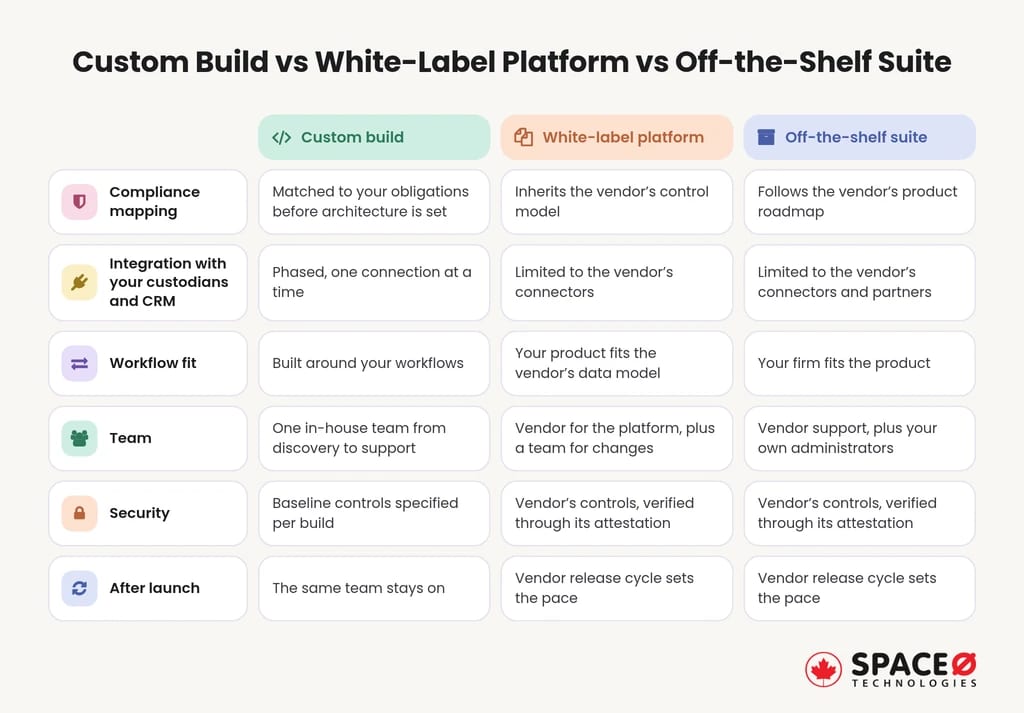
Each model trades speed against fit, and the trade shows up in integration and compliance work.
| Axis | Custom build (Space-O Canada) | White-label platform | Off-the-shelf suite |
|---|---|---|---|
| Compliance mapping | Matched to your obligations before architecture is set. | Inherits the vendor’s control model. | Follows the vendor’s product roadmap. |
| Integration with custodians and CRM you run | Phased, one connection at a time. | Limited to the vendor’s connectors. | Limited to the vendor’s connectors and partners. |
| Workflow fit | Built around your workflows. | Your product fits the vendor’s data model. | Your firm fits the product. |
| Team | One in-house team from discovery to support. | Vendor for the platform, plus a team for changes. | Vendor support, plus your own administrators. |
| Security | Baseline controls specified per build. | The vendor’s controls, verified through its attestation. | The vendor’s controls, verified through its attestation. |
| After launch | The same team stays on. | Vendor release cycle sets the pace. | Vendor release cycle sets the pace. |
Where Do Salesforce Financial Services Cloud and Redtail Technology Fit?
Salesforce Financial Services Cloud and Redtail Technology are packaged CRM options that wealth firms can license instead of building. Adopting either means configuring it to your workflows and assigning administrators to run it. Connecting is the middle path: keep the CRM you run and build custom features around it through APIs. A packaged CRM fits best when your edge is in advice, not workflow. If your regulated workflows, retention rules, and custodian feeds fit its data model, license it. If you would have to bend them to fit, cost a custom layer on top of the CRM you already run.
What Does Custom Wealth Management Software Cost?
Published market guides start custom builds at $40,000, in U.S. dollars. Appinventiv and Saigon Technology publish cost ranges well above that starting point for custom wealth management builds. These figures are market context, not our pricing. Four things move the number most: how many custodian and data connections the MVP needs, how many user roles and offices need separate access, how much compliance logic runs inside workflows, and whether the first release includes mobile or AI features. Scope those four in discovery and the estimate becomes a range you can plan against.
Get a Scoped Estimate for Your Build
Share your custodians, user roles, and first-release scope. Our engineers will turn them into a planning range.
The model you pick sets the cost curve, but the team you pick sets the outcome. Here is how Space-O Canada runs a wealth build.
How Does Space-O Canada Build Wealth Management Software?
Space-O Canada is a fintech specialist that builds portfolio systems, advisor dashboards, and client portals through its wealth management software development service, so every wealth build starts from regulatory exposure, not screen design.
- Discovery first: we scope data flows, retention, and access before architecture is locked, so compliance is mapped in discovery, not bolted on in QA.
- Phased integration: we connect to the custodians, CRM, and core you already run, one phase at a time.
- Security by default: the controls listed earlier ship on every build, alongside audit logging and segmented environments.
- One in-house team: the same engineers run discovery, build, launch, and support, with no subcontracting.
- Post-launch care: every project includes up to 90 days of post-launch support covering bug fixes, OS updates, and performance monitoring.
Some U.S. wealth firms also serve Canadian clients. For those dual-market products, platforms are engineered to support PIPEDA, FINTRAC, and OSFI requirements.
A build partner is only as useful as the inputs you bring to the first call. Four decisions make that call productive.
What Should You Decide Before You Scope Your Build?
Settle these answers before discovery starts, and the tier table becomes a project plan.
- Firm size: how many advisors, offices, and client users the platform must serve.
- Key integrations: which custodians, CRM, core systems, and data vendors must connect.
- Rollout scope: whether you need an MVP first or a full enterprise rollout.
- Segment: whether you operate as an independent RIA or a private bank with a legacy core.
Write the answers down, even if they are rough. They decide your first tier, your integration order, and your budget envelope. With those answers written down, the last question is who you trust to build against them.
Why Choose Space-O Canada for Custom Wealth Management Software?
Choose Space-O Canada when you want one in-house fintech team to build against your SEC and FINRA obligations and the custodians you already run. Custom wealth management software works when the core reconciles, controls are evidenced, and the build runs in tiers. Seven core features carry daily advising. Four advanced ones extend it across segments and asset types.
Space-O Canada has built financial software since 2018 for 100+ clients, including Fortune 500 companies, and our team turns the tier and obligation table into a phased plan for your firm. Our recommendation is plain: ship the MVP tier, connect the custodians you already run, then phase in the rest.
Frequently Asked Questions About Key Features of Wealth Management Software
Who should consider custom wealth software instead of a licensed suite?
Use a simple decision rule against the comparison table above: if a connector you need is missing from a vendor’s list, or the vendor’s data model forces you to change a regulated workflow, a custom build is worth costing. If both fit, a suite or white-label platform is the faster path. Test fit in discovery, using your own sample data, before committing.
Do U.S. wealth firms with Canadian clients need extra compliance scope?
Yes, and the Canadian frameworks listed in the build section add to the SEC and FINRA design inputs in the tier table rather than replacing them. The caveat is timing: decide in discovery whether Canadian clients are in the MVP tier, because that changes retention and access design before architecture is locked. Which frameworks apply to your firm should be confirmed there.
What do we need ready before connecting custodians and market data?
Have the list of custodians and market-data sources signed off first, because the tier table places those connections ahead of aggregation. Then test each one in the vendor’s sandbox before it touches production data, and for a private bank, treat the legacy core connection as MVP scope, not phase two.


Let’s Discuss Your Idea
Share your idea with our fintech development team and get a practical breakdown of what you need to build, integrate, secure, and launch it.
 Your project is covered by an NDAYour information stays secure and confidential




What our clients say


When we set out to build our Estate Tax Planning Tool, we needed a development partner we could trust with something this complex and consequential. Space-O Canada brought the technical expertise and attention to detail needed to handle intricate tax calculations and edge cases. They communicated clearly, delivered on time without cutting corners, and built a product we trust completely.
 Ed Chetan EdwinFounder, CharityCalc
We partnered with Space-O Canada to build a fintech platform that could support secure transactions, third-party integrations, and future scalability. Their team understood our business requirements from the beginning and delivered a well-architected solution without unnecessary complexity. Communication was consistent, milestones were met on time, and every challenge was handled proactively.
 Michael CarterCo-Founder, Digital Payments Platform
The fintech app came out exactly the way I pictured in terms of functionality. I will refer future UI/UX clients to their team. During the testing phase of the app, it performed according to the initial designs in terms of functionality. Their team was dedicated to creating the best version of the app and provided their own ideas to improve it.
 Amanda LewisProduct Manager, Lending Platform
Our banking modernization project involved complex integrations and strict security requirements, and Space-O Canada handled both with confidence. They developed a reliable banking platform that improved operational efficiency while maintaining a smooth customer experience. Their structured development process and clear communication kept the project on track from start to finish.
 Daniel RobertsVP of Technology, Regional Bank
Our legacy insurance system created delays across policy management and claims processing. Space-O Canada developed a centralized platform that streamlined our workflows and improved efficiency across departments. The project was delivered on schedule, and the team’s understanding of insurance technology was evident throughout the engagement.
 Emily FosterOperations Director, Insurance Provider
Developing a trading platform requires speed, reliability, and technical precision. Space-O Canada delivered a solution that performs exceptionally well while supporting real-time market data and intuitive trading workflows. Their project management was excellent, and the team remained responsive throughout every stage of development.
 Ethan MorganChief Product Officer, Investment Platform
The fintech app was successfully launched, and users loved its sleek design and features. Space-O Technologies worked in an organized and collaborative manner, allowing them to achieve quality results. They also took the time to deeply understand the project. They were very organized and had a good track record.
 David WilsonFounder, Personal Finance App