
- What Does the Insurance Tech Stack Look Like Layer by Layer?
- Which Mobile Framework Should an Insurance App Use?
- Which Backend Should Run Insurance Workloads?
- Which Database Should Hold Policy, Claims and Billing Data?
- Which Cloud and DevOps Setup Should Host an Insurance Platform?
- Should You Integrate Guidewire or Duck Creek, or Build Your Own Core?
- Which Payment Gateways Fit Premium Collection?
- What Security and Compliance Baseline Does an Insurance Stack Need?
- Where Does AI Fit in Claims and Underwriting?
- Which Stack Fits Your Insurance Build: MVP, Core Integration or Modernization?
- How Does Space-O Canada Help Insurers Choose the Best Insurance Tech Stack?
- Frequently Asked Questions About Tech Stack for Insurance App Development
Best Tech Stack for Insurance App Development: A Layer-by-Layer Guide

 Last Updated: November, 13 2026

Key Takeaways
- The best insurance tech stack pairs React Native or Flutter, Node.js or Python, and PostgreSQL.
- Integrate with the Guidewire or Duck Creek core you already run, and build custom only in the layer around it.
- Apply encryption, role-based access control, audit logging and segmented environments from the first sprint, and add PCI-DSS once premiums are paid by card.
- Your build type, whether a greenfield MVP, core integration or legacy modernization, decides the backend and integration pattern.
Most insurance apps don’t fail on the screen. They fail where the app meets the rest of the business: a quote service that can’t write back to the policy system, or a claims app that can’t show an examiner who changed a reserve. Those older systems aren’t going away soon. According to a West Monroe survey, 54% of insurers spend more than half their IT budgets maintaining existing systems.
The right stack prevents those failures, and most of it is settled. React Native or Flutter runs the client, Node.js or Python runs the backend, PostgreSQL holds the records and AWS or Azure hosts it all. What changes from insurer to insurer is how those choices meet your core system, line of insurance and AI plans.
Drawing on our insurance app development services, this guide walks through each layer in the order architects decide it. It ends with a scenario matrix that maps three common builds (a new MVP, a core integration and a legacy modernization) to a stack and the controls each one triggers.
What Does the Insurance Tech Stack Look Like Layer by Layer?
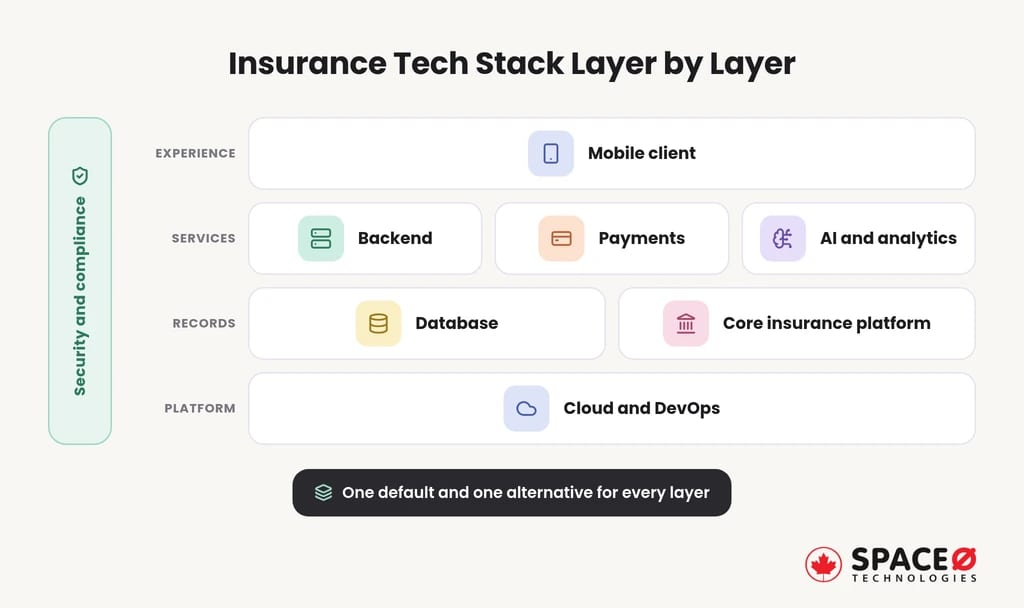
Every insurance platform rests on the same eight layers, whatever the line of insurance. Each layer has a default most architects agree on and a credible alternative. The table lists both, plus the condition that should make an insurer switch.
| Layer | Primary choice | Alternative | When to switch |
|---|---|---|---|
| Mobile client | React Native | Flutter; Swift and Kotlin native | Go native when offline document scanning or biometrics dominate the app. |
| Backend | Node.js | Python (Django or FastAPI) | Lead with Python when risk scoring sits close to the API. |
| Database | PostgreSQL | MongoDB for unstructured files | Add a document store when claim photos and files strain relational tables. |
| Cloud and DevOps | AWS or Azure | Docker and Kubernetes on either cloud | Adopt Kubernetes when several services must scale independently. |
| Core insurance platform | Integrate Guidewire or Duck Creek | Custom policy service | Build custom only when no packaged platform can model the product. |
| Payments | Stripe | Braintree | Match the gateway your finance team already reconciles. |
| Security and compliance | Encryption, role-based access control, audit logging, segmented environments | No alternative; this is the floor | Add PCI-DSS controls once premiums are collected by card. |
| AI and analytics | Python ML services behind APIs | Event-driven pipelines | Decouple whenever a model touches claims, fraud or underwriting. |
Read the table as a set of defaults, not mandates. The client layer comes first, because policyholders judge the platform there.
Which Mobile Framework Should an Insurance App Use?
React Native or Flutter should power most insurance mobile apps, because one codebase serves iOS and Android. That cuts development time and cost for self-service, claims intake and quote flows. Native Swift and Kotlin earn their place only when device-heavy work dominates.
- React Native or Flutter: one codebase for policyholder self-service and claims apps on both platforms. Shared UI and business logic also mean a new coverage option or claims step ships to both app stores in one release.
- Swift or Kotlin: full device access for offline document scanning and biometric authentication. Native code talks directly to the camera, the iOS Secure Enclave and the Android Keystore, with no bridge layer in between.
- SwiftUI or Jetpack Compose: modern native interfaces once you commit to native screens. Both are declarative toolkits from Apple and Google, so screens are faster to build and stay consistent with each platform’s design guidelines.
Switch to native when the app must process documents offline or depends heavily on device biometrics.
Cross-platform wins the client layer for most insurers. The harder decisions start behind the screen, in the backend.
Which Backend Should Run Insurance Workloads?
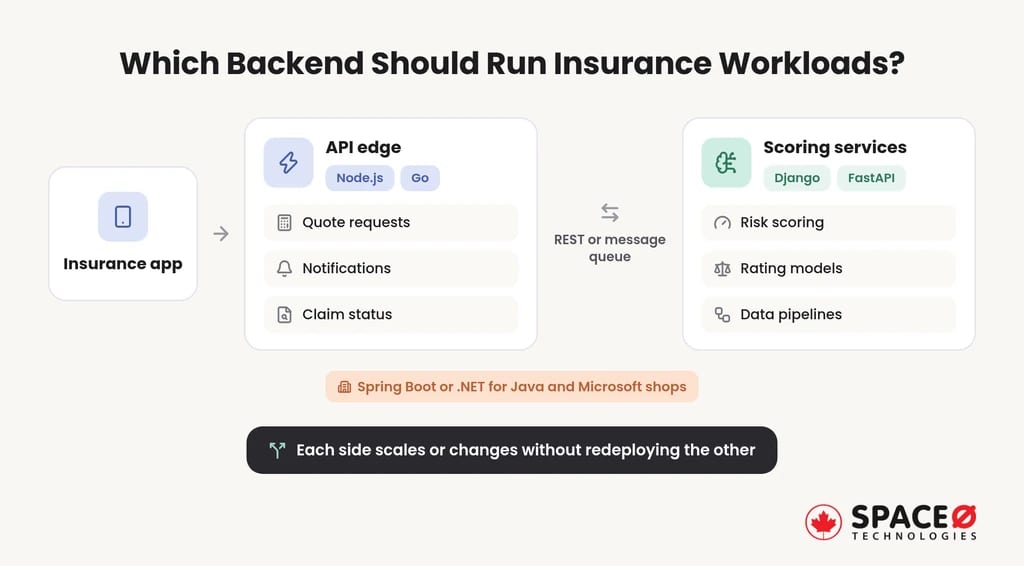
Node.js or Python should run the backend, depending on where the heavy work sits. Node.js handles real-time, high-concurrency traffic such as quote requests and claim status checks. Python suits risk scoring, rating logic and machine learning.
- Node.js or Go: event-driven APIs for quotes, notifications and claim status at high concurrency. Both handle thousands of open connections on modest hardware, which keeps quote and status requests fast during a storm-driven spike in claims.
- Django or FastAPI: Python services for risk scoring, rating models and data pipelines. Python gives the same team direct access to pandas, scikit-learn and other data libraries, so a model moves from notebook to production API with less rework.
- Spring Boot or .NET: enterprise services when your IT team already standardizes on Java or Microsoft tooling. Both bring mature tooling for transactions, security and long-term support, which suits policy and billing services expected to run for a decade or more.
Run both when you need both: Node.js at the API edge, Python services for scoring behind it. The two communicate over REST or a message queue, so either side can scale or change without redeploying the other.
Need Backend Engineers Who Know Insurance?
Our in-house team builds quote APIs, rating services and scoring models in Node.js and Python that connect cleanly to your core.

The backend decides how fast the platform answers. Where those answers are stored decides whether they survive an audit.
Which Database Should Hold Policy, Claims and Billing Data?
PostgreSQL should hold policy, claims and billing records, because insurance data is relational at its core. A policy links to coverages, endorsements, premiums, claims and payments. Transactions and foreign keys keep those links consistent when a midterm change touches several tables.
- PostgreSQL or MySQL: the system of record for policies, claims, billing and audit tables. ACID transactions keep a premium payment, a coverage change and its audit entry consistent, even when one step fails midway.
- MongoDB or Firebase: flexible storage for claim documents, photos and app session data. Each claim can carry a different mix of photos, estimates and adjuster notes without schema changes, while the claim record itself stays in the relational database.
- Supabase or a managed cloud PostgreSQL service: hosted Postgres for a fast-moving MVP team. It bundles authentication, row-level security and auto-generated APIs, so a small team can launch quickly and later move to self-managed PostgreSQL without rewriting the data model.
Add a document store when unstructured claim files strain the schema, but keep money and coverage in PostgreSQL.
Data lives in the database, but the database runs somewhere. Hosting shapes uptime, scaling and the edges of your security boundary.
Which Cloud and DevOps Setup Should Host an Insurance Platform?
AWS or Azure should host the platform, with Docker and Kubernetes packaging the services. Both clouds offer managed databases, key management and centralized logging. The choice usually follows the carrier’s existing enterprise agreements and identity system.
- AWS or Azure: managed PostgreSQL, key management and logging under one account structure. Both publish compliance reports such as SOC 2, which shortens security reviews with auditors and enterprise clients.
- Docker with Kubernetes: repeatable deployments and independent scaling for quote, policy and claims services. During a renewal rush, the quote service can scale up on its own while claims and policy services keep their normal footprint.
- Segmented environments: isolated development, staging and production so test data never touches live policies. Each environment gets its own accounts, credentials and network rules, and staging uses masked or synthetic policyholder data instead of real records.
Choose Azure when the carrier already runs Microsoft identity and tooling. Otherwise, AWS is a sound default.
Hosting gives the platform a home. Most insurers, though, already own its most important system: the core.
Should You Integrate Guidewire or Duck Creek, or Build Your Own Core?
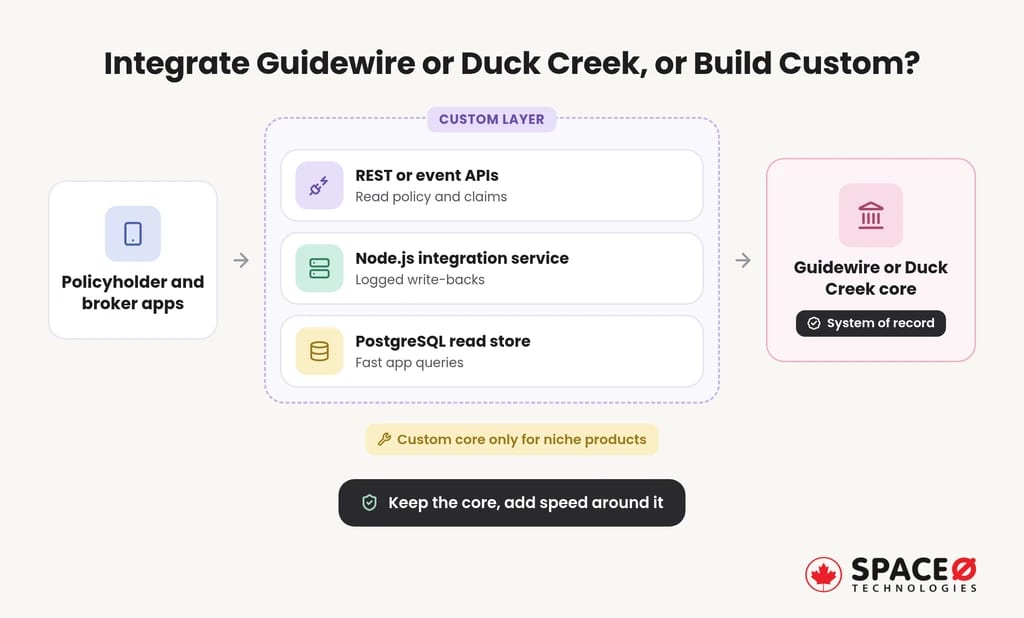
Integrate with the core you already run rather than rebuilding it. Guidewire is the enterprise standard for tier-1 and tier-2 P&C carriers, through PolicyCenter, ClaimCenter and BillingCenter. Duck Creek is a common alternative core. Custom work belongs in the layer around it.
Core integration keeps your existing core as the system of record
A clean integration keeps the core as the system of record and adds speed around it. Three components usually do that work.
- REST or event-driven APIs: the app reads policy and claim data without duplicating core logic.
- Node.js integration service: one controlled, logged path for every write-back to the core.
- PostgreSQL read store: fast app queries without loading the core on every screen refresh.
Build a custom core only when your product is too narrow for any packaged platform to model.
The three delivery approaches differ in effort, ownership and risk
The core decision is really a choice between three delivery approaches. Each one carries different effort, ownership and risk.
| Axis | Custom layer on your existing core (Space-O Canada) | Full core replacement | Low-code platform |
|---|---|---|---|
| Regulatory exposure mapped before architecture is locked | Yes, during discovery | Depends on the integrator’s method | Bounded by the platform’s data model |
| Keeps current operations running | Yes, through phased modernization | Requires a migration and cutover plan | Runs alongside, with logic split across tools |
| One in-house team from discovery to launch | Yes, no handoffs or subcontracting | Typically a vendor plus an integrator | Platform vendor plus your own administrators |
| Post-launch support | Up to 90 days of post-launch support | Set by the vendor contract | Set by the platform subscription |
| Security baseline | Named controls on every build | Set by platform configuration | Limited to what the platform exposes |
See How We Build Around Existing Insurance Cores
Explore the insurance apps we have delivered for policy management, quoting and claims, from discovery through launch.
For most insurers, the value sits in the layer around the core. That layer also carries the payment flows that bring in premium.
Which Payment Gateways Fit Premium Collection?
Stripe or Braintree should handle card-based premium collection. Both support recurring billing for monthly premiums and refunds for cancellations. Accepting cards puts the payment flow in PCI-DSS scope, so choosing a gateway is also a compliance decision.
- Stripe or Braintree: recurring premium billing, cancellation refunds and hosted card entry fields. Both also support Apple Pay and Google Pay, so policyholders can pay a premium in one tap from the app.
- BillingCenter or your core’s billing module: the source of truth for what each policyholder owes. The gateway reports what was paid, while installment plans, midterm premium changes and earned versus unearned premium stay in the billing module.
- ACH or bank debit through the same gateway: lower-cost recurring premiums for policyholders who prefer to pay from a bank account. Bank debits take a few business days to settle and can be returned, so billing status should update only after the payment clears.
- Tokenized card storage: the gateway holds card data, so your servers never store raw card numbers and PCI-DSS scope stays smaller. The app and backend handle only a token, which can be charged again for each renewal or installment.
- Payment webhooks into the billing service: success, failure and refund events update the policy’s billing status automatically. Verify each webhook’s signature and log every event, so the payment history holds up in an audit.
Plan for failed payments from the start. A declined monthly premium should trigger retries, a policyholder notice and, eventually, the grace-period and lapse rules your core already defines. Wiring those events to the core, not just the gateway, keeps billing status and coverage status in sync.
Keep the core’s billing module as the ledger, and let the gateway only move money.
Payments are the first place an auditor looks for weak controls. The full security baseline deserves its own layer.
What Security and Compliance Baseline Does an Insurance Stack Need?
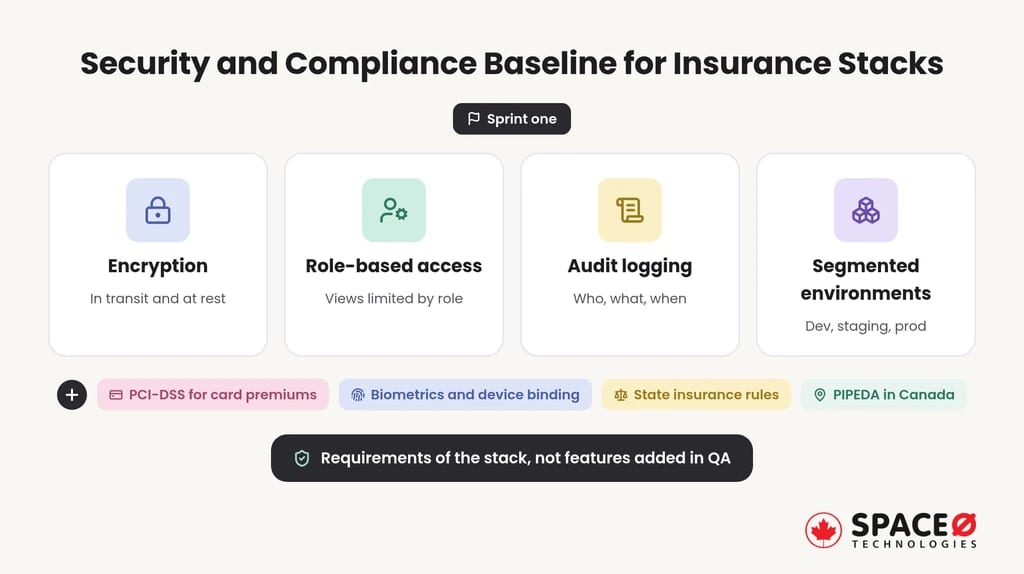
An insurance stack needs four named security controls from the first sprint: encryption, role-based access control, audit logging and segmented environments. Security and regulatory compliance are requirements of the stack, not features added during QA. PCI-DSS joins them when the platform collects premiums by card.
- Encryption in transit and at rest: encrypted API traffic and AES-256 for stored policy and claim data.
- Role-based access control: policyholders, adjusters, underwriters and brokers see only what their role permits.
- Audit logging: every change to coverage, reserves or payments records who, what and when.
- Segmented environments: production data stays isolated from development and test systems.
Biometric authentication, device binding and secure session handling round out the baseline on every Space-O Canada build.
The stack must satisfy US state insurance rules
US insurers answer to state insurance regulators rather than one federal rulebook. In practice, that program needs a written risk assessment, an incident response plan and oversight of third-party providers that touch policyholder data, such as cloud hosts and payment gateways.
States that adopted the model law also expect insurers to notify the insurance commissioner within 72 hours of a cybersecurity event. The audit logging and access controls above should produce the evidence these reviews ask for.
Settle which rules apply during discovery, before the architecture is locked. Space-O Canada builds card systems to support PCI-DSS. For carriers that also operate in Canada, we engineer builds to support PIPEDA.
These controls protect the data every model will learn from. That makes them a prerequisite for the AI layer, not a parallel track.
Where Does AI Fit in Claims and Underwriting?
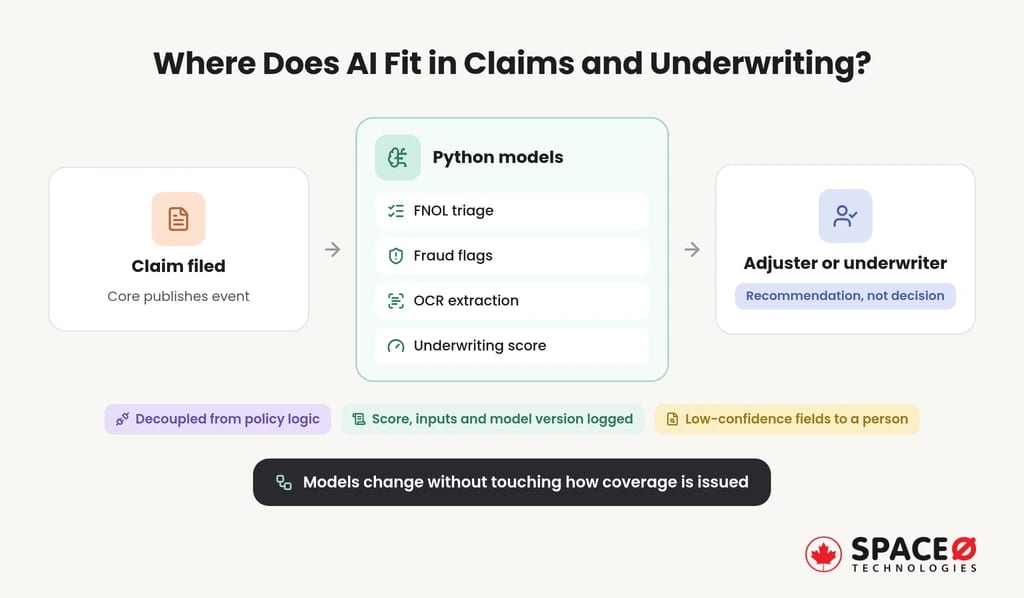
AI belongs in claims triage, fraud detection, document processing and underwriting support, built mostly in Python. Keep it decoupled from core policy logic through APIs or an event-driven architecture. A model can then change without touching how coverage is issued.
- First notice of loss (FNOL) automation: guided intake that structures claim details for triage. Photos, location and policy details are captured at the moment of loss, so adjusters start with a complete file instead of a phone transcript.
- Fraud detection and anomaly models: flags unusual claims for human review, not automatic denial. Keeping a person in the loop also matters to regulators, who expect insurers to explain why a claim was delayed or denied.
- OCR document processing: pulls data from claim forms and receipts to remove manual entry. Low-confidence fields go to a person for confirmation, so extraction errors don’t flow into reserves or payments.
- Underwriting risk scoring: Python models that inform the underwriter’s decision rather than replace it. Log each score with its inputs and model version, so the decision can be explained to a regulator or applicant later.
Wire models to events, such as a newly filed claim, rather than embedding them in the core. When a claim is filed, the core publishes an event, the triage and fraud models score it, and the results return as recommendations the adjuster can see.
Every layer now has a default and an alternative. The real question is which combination fits your build.
Which Stack Fits Your Insurance Build: MVP, Core Integration or Modernization?
The right stack depends on which of three builds you are running. Most insurers fall into a greenfield MVP, a core integration, or a legacy modernization. Each one shifts the backend and integration choices, and each triggers different controls.
Each scenario needs a different stack and set of controls
The client layer barely changes across scenarios. The backend, integration pattern and triggered controls change a great deal.
| Scenario | Client | Backend and data | Integration pattern | Controls it triggers |
|---|---|---|---|---|
| Greenfield MVP for a new product or line | React Native or Flutter | Node.js, Python scoring, PostgreSQL on AWS or Azure | Owned policy service; Stripe or Braintree for premiums | PCI-DSS for card premiums; role-based access control; audit logging from sprint one |
| Connect to an existing Guidewire or Duck Creek core | React Native or Flutter | Node.js integration service; PostgreSQL read store | Core APIs for policy, claims and billing; the core stays the system of record | Audit logs on every write-back; roles mapped to core user roles; encrypted integration calls |
| Legacy modernization of a homegrown policy system | React Native or Flutter for new channels | Node.js and Python services in Docker and Kubernetes | Event-driven layer that retires legacy modules in phases | Segmented environments; data segregation during migration; one audit trail across old and new systems |
Our insurance software development covers policy administration, quote-and-bind engines, claims processing automation and broker portals. We build insurance software platforms that streamline policy management, claims processing and customer communication.
Four questions settle the stack before discovery ends
Four questions decide which row you are in. Answer them before anyone writes code.
- Consumer-facing or internal: policyholder apps need React Native or Flutter, while staff tools can start as web portals.
- Line of insurance: P&C carriers on Guidewire should integrate, while narrow niche products may justify a custom policy service.
- Legacy core: a working core gets an integration layer, while a failing one gets phased modernization.
- AI features: plan Python services and event hooks from day one, even if models ship later.
Tell Us About Your Insurance Build and Core System
Share your line of insurance, audience, current core and AI plans. We will map regulatory exposure and recommend a stack before any code.
The matrix turns open questions into a build plan. The next step is putting one accountable team behind that plan.
How Does Space-O Canada Help Insurers Choose the Best Insurance Tech Stack?
Space-O Canada helps insurers turn these defaults into a stack that fits their own core system, with one in-house team from architecture through launch. Most insurers land on the same cross-platform, Node.js or Python, PostgreSQL and cloud defaults. The real difference lies in how those defaults meet your core, your controls and your AI plans. Space-O Canada has built fintech software since 2018, serving 100+ clients including Fortune 500 companies. No handoffs. No guesswork about the core.
Our plain recommendation: integrate with the core you already run, and lock the security baseline before the first sprint. Space-O Canada builds insurance platforms that stay standing under audit and production load.
Frequently Asked Questions About Tech Stack for Insurance App Development
What is the best tech stack for mobile apps?
React Native or Flutter is the best default for most insurance mobile apps, because one codebase serves both iOS and Android and cuts development time and cost. Native Swift and Kotlin are justified only when device-heavy work dominates, such as offline document scanning or biometric authentication. SwiftUI and Jetpack Compose are the modern native interface options once you commit to native screens.
What software is used in insurance companies?
Insurers typically run a packaged core platform such as Guidewire (PolicyCenter, ClaimCenter, BillingCenter) or Duck Creek for policy, claims and billing. Around it sit customer apps built on React Native or Flutter, Node.js or Python services, PostgreSQL databases, and payment gateways such as Stripe or Braintree. Python-based machine learning services increasingly handle fraud detection, document processing and underwriting support.
What are the 7 stages of app development?
A typical process runs through seven stages: discovery and requirements, UI/UX design, architecture and tech stack selection, development, testing and QA (including security testing), deployment, and post-launch support. For insurance builds, regulatory exposure should be mapped during discovery, before the architecture is locked.
Why does your tech stack choice matter for an insurance app?
The stack decides whether the app can prove compliance and connect to the core, not just how it looks. A claims app may launch while no one can show an examiner who changed a reserve, or a rating service may scale yet be unable to connect to the policy administration system. Both problems come from choosing a stack for developer comfort instead of regulatory exposure.
What features should an insurance app have?
An insurance app typically offers policyholder self-service, claims intake and quote flows, plus card premium payments. AI features such as first notice of loss (FNOL) automation, OCR document processing and fraud detection can support claims. Check each feature against the controls it triggers, for example PCI-DSS when premiums are paid by card.
How can we add AI to an insurance platform later without rebuilding the core?
Build AI as separate Python services that connect through APIs or an event-driven architecture instead of embedding models in core policy logic. That way a model can be updated without affecting how coverage is issued, and it can be triggered by events such as a newly filed claim. Design the Python services and event hooks from the start, even if the models launch later.
What types of insurance apps do carriers commonly build?
Common build types are policyholder self-service apps, claims automation apps, quote-and-bind engines, broker or customer portals, and phased modernization of legacy policy administration systems. Space-O Canada has delivered insurance software covering policy administration, quote-and-bind engines, claims processing automation and broker portals. Each type maps to one of three stack scenarios: greenfield MVP, core integration or modernization.
How long does it take to build an insurance app?
Timelines depend on the build type. A greenfield MVP is usually the fastest route to launch, a core integration depends on how open your Guidewire or Duck Creek APIs are, and a legacy modernization runs in phases as modules are retired. Space-O Canada confirms a timeline for your build once discovery has mapped scope and regulatory exposure.


Let’s Discuss Your Idea
Share your idea with our fintech development team and get a practical breakdown of what you need to build, integrate, secure, and launch it.
 Your project is covered by an NDAYour information stays secure and confidential




What our clients say


When we set out to build our Estate Tax Planning Tool, we needed a development partner we could trust with something this complex and consequential. Space-O Canada brought the technical expertise and attention to detail needed to handle intricate tax calculations and edge cases. They communicated clearly, delivered on time without cutting corners, and built a product we trust completely.
 Ed Chetan EdwinFounder, CharityCalc
We partnered with Space-O Canada to build a fintech platform that could support secure transactions, third-party integrations, and future scalability. Their team understood our business requirements from the beginning and delivered a well-architected solution without unnecessary complexity. Communication was consistent, milestones were met on time, and every challenge was handled proactively.
 Michael CarterCo-Founder, Digital Payments Platform
The fintech app came out exactly the way I pictured in terms of functionality. I will refer future UI/UX clients to their team. During the testing phase of the app, it performed according to the initial designs in terms of functionality. Their team was dedicated to creating the best version of the app and provided their own ideas to improve it.
 Amanda LewisProduct Manager, Lending Platform
Our banking modernization project involved complex integrations and strict security requirements, and Space-O Canada handled both with confidence. They developed a reliable banking platform that improved operational efficiency while maintaining a smooth customer experience. Their structured development process and clear communication kept the project on track from start to finish.
 Daniel RobertsVP of Technology, Regional Bank
Our legacy insurance system created delays across policy management and claims processing. Space-O Canada developed a centralized platform that streamlined our workflows and improved efficiency across departments. The project was delivered on schedule, and the team’s understanding of insurance technology was evident throughout the engagement.
 Emily FosterOperations Director, Insurance Provider
Developing a trading platform requires speed, reliability, and technical precision. Space-O Canada delivered a solution that performs exceptionally well while supporting real-time market data and intuitive trading workflows. Their project management was excellent, and the team remained responsive throughout every stage of development.
 Ethan MorganChief Product Officer, Investment Platform
The fintech app was successfully launched, and users loved its sleek design and features. Space-O Technologies worked in an organized and collaborative manner, allowing them to achieve quality results. They also took the time to deeply understand the project. They were very organized and had a good track record.
 David WilsonFounder, Personal Finance App