
- What is Denial Management Software?
- Why Do Healthcare Organizations Need Denial Management Software?
- What are the Key Features of Denial Management Software?
- How to Develop Denial Management Software: Step-by-Step Process
- 1. Define business objectives and denial categories
- 2. Gather requirements and workflow mapping
- 3. Choose technology stack and architecture
- 4. UI/UX design for billing teams
- 5. Development and integration with existing systems
- 6. Testing (functional, integration, compliance)
- 7. Deployment and training
- 8. Ongoing maintenance and optimization
- How Much Does Denial Management Software Development Cost?
- What are the Challenges in Denial Management Software Development (and How to Overcome Them)
- Denial Management Software Development with Space-O Technologies
- Frequently Asked Questions About Denial Management Software
Denial Management Software Development: Features, Process, and Cost Explained

 Last Updated: February, 3 2026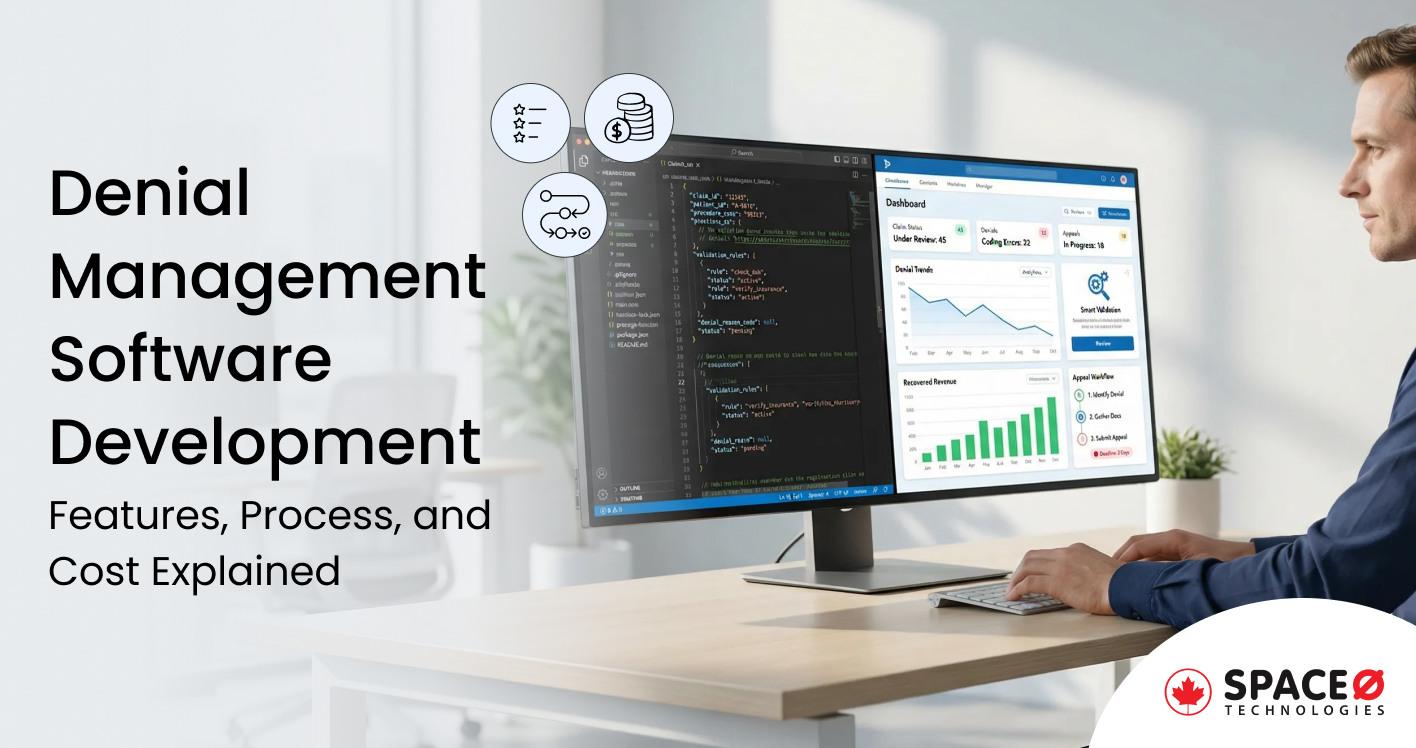
Healthcare organizations lose billions of dollars annually to claim denials. According to the American Hospital Association, hospitals and health systems spent nearly $19.7 billion in 2022 just on administrative costs related to claim denials.
Manual denial management processes are slow, error-prone, and resource-intensive. Billing teams spend countless hours tracking denials, identifying root causes, and preparing appeals, often missing critical deadlines that result in permanent revenue loss. That gap between denied claims and recovered revenue is exactly why healthcare organizations are investing in denial management software development.
This guide explains everything you need to know about building denial management software. You’ll learn what it is, why it matters, the essential features to include, the step-by-step development process, realistic cost expectations, and how to overcome common implementation challenges.
Whether you’re a hospital administrator, revenue cycle director, or healthcare IT leader exploring healthcare software development, this guide provides the practical insights you need to make informed decisions.
What is Denial Management Software?
Denial management software is a specialized healthcare application that automates the identification, tracking, analysis, and resolution of rejected or denied insurance claims. It helps healthcare organizations recover lost revenue by streamlining the appeals process, identifying denial patterns, and preventing future claim rejections through proactive validation.
Within the broader Revenue Cycle Management (RCM) ecosystem, denial management sits at a critical junction between claims submission and payment collection. While medical billing software handles claim creation and clearinghouses manage transmission, denial management software takes over when claims are rejected or underpaid, ensuring no revenue falls through the cracks.
For Canadian healthcare organizations, denial management software must address unique requirements. Solutions must comply with PHIPA (Personal Health Information Protection Act) and PIPEDA regulations while accommodating provincial billing variations across Ontario, British Columbia, Alberta, and other provinces.
Whether you choose custom software development or enterprise software development approaches, regulatory compliance must be built into the foundation.
With the fundamentals established, let’s explore why healthcare organizations are prioritizing denial management software investments.
Why Do Healthcare Organizations Need Denial Management Software?
Claim denials represent one of the most significant revenue threats facing healthcare organizations today.
1. The financial impact extends beyond lost claims
When denials aren’t managed effectively, the consequences cascade throughout the organization. Delayed reimbursements strain cash flow, forcing organizations to maintain larger credit lines. Staff overtime increases as billing teams scramble to meet appeal deadlines. And the opportunity cost of experienced staff manually tracking denials instead of focusing on higher-value activities compounds the financial burden.
2. Manual processes simply cannot keep pace
Traditional denial management relies on spreadsheets, email threads, and tribal knowledge. Billing staff manually review explanation of benefits (EOB) documents, cross-reference denial codes, research payer policies, and prepare appeals. This approach creates several problems:
- Missed deadlines: Each payer has different appeal timelines, some as short as 30 days. Manual tracking inevitably leads to missed windows.
- Inconsistent categorization: Without standardized workflows, similar denials get handled differently depending on which staff member processes them.
- Limited visibility: Leadership lacks real-time insight into denial volumes, aging, and resolution rates.
- No pattern recognition: Manual processes can’t easily identify that 40% of denials from a specific payer relate to authorization issues.
3. Regulatory compliance adds complexity
Healthcare organizations in Canada must navigate PHIPA and PIPEDA requirements when handling patient billing data. In the US, HIPAA governs protected health information. Denial management involves accessing sensitive patient data, making compliance a non-negotiable requirement that manual processes struggle to consistently enforce.
4. Value-based care increases the stakes
As healthcare shifts from fee-for-service to value-based models, clean claims and efficient revenue cycles become competitive advantages. Organizations that master healthcare software development for their revenue cycle operations can redirect recovered revenue toward patient care improvements, technology investments, and staff development.
Space-O Canada has worked with healthcare organizations facing these exact challenges, helping them transform manual, error-prone denial workflows into streamlined, automated systems that recover revenue and free staff for higher-value work.
Build Denial Management Software That Recovers Lost Revenue
Design a denial management system that surfaces root causes early, prioritizes high-impact denials, and streamlines resolution and appeal workflows.
Understanding the need is just the first step. Now let’s examine the essential features your denial management software must include.
What are the Key Features of Denial Management Software?
Building effective denial management software requires a comprehensive feature set that addresses the entire denial lifecycle, from initial detection through final resolution. Here are the essential capabilities your solution must include.
1. Automated denial detection and categorization
The system should automatically ingest denial data from clearinghouses, payer portals, and ERA (Electronic Remittance Advice) files. Using standardized CARC (Claim Adjustment Reason Codes) and RARC (Remittance Advice Remark Codes), the software categorizes each denial by type: eligibility issues, authorization problems, coding errors, duplicate claims, or medical necessity disputes. This automated categorization eliminates manual sorting and ensures consistent handling.
2. Claims tracking and workflow management
Once categorized, denials enter configurable workflows that route work items to appropriate staff based on denial type, payer, dollar amount, or other criteria. The system tracks each denial through investigation, appeal preparation, submission, and resolution. Automated escalation triggers when items approach deadline thresholds, ensuring no appeal window closes without action.
3. Analytics and reporting dashboard
Real-time dashboards display key performance indicators: denial rates by payer, category, and provider; average days to resolution; appeal success rates; and revenue at risk. Trend analysis reveals whether denial rates are improving or deteriorating over time. Executive summaries help leadership understand the financial impact and prioritize improvement initiatives.
4. Integration with EHR/EMR and billing systems
Denial management doesn’t exist in isolation. The software must integrate with EHR software development systems to access clinical documentation supporting appeals. Connections to practice management and billing systems ensure denial data flows seamlessly without manual re-entry. HL7 FHIR standards enable interoperability across diverse healthcare IT ecosystems.
5. AI-powered predictive denial prevention
Advanced denial management solutions use machine learning to predict which claims will likely be denied before submission. By analyzing historical denial patterns, the system flags high-risk claims for pre-submission review. This proactive approach prevents denials rather than just managing them. Organizations investing in artificial intelligence software development can achieve significant denial rate reductions through predictive capabilities.
Pro Tip: Start with core denial tracking and analytics before adding AI-powered prediction. Foundational features must work flawlessly before layering advanced capabilities. Crawl, walk, then run.
Features alone don’t guarantee success. Implementation approach determines whether your software delivers measurable ROI.
How to Develop Denial Management Software: Step-by-Step Process
Developing denial management software requires a structured approach that balances healthcare domain expertise with modern software engineering practices. Here’s the step-by-step process that leads to successful implementations.
1. Define business objectives and denial categories
Start by documenting specific, measurable goals. Rather than “improve denial management,” define targets like “reduce denial rate from 8% to 5% within 12 months” or “decrease average days to appeal submission from 14 to 3 days.” Identify which denial categories represent the highest revenue impact and prioritize accordingly.
2. Gather requirements and workflow mapping
Work with billing managers, denial specialists, and revenue cycle leaders to document current workflows. Map the journey of a denied claim from initial receipt through final resolution. Identify pain points, bottlenecks, and manual steps that automation can eliminate. Document integration requirements with existing EHR, billing, and clearinghouse systems.
3. Choose technology stack and architecture
Select technologies that support healthcare compliance requirements, scalability needs, and integration capabilities. Cloud-native architectures on AWS, Azure, or Google Cloud provide flexibility and security. Consider whether a monolithic application or microservices architecture best fits your organization’s technical capabilities and growth plans.
4. UI/UX design for billing teams
Denial management software users are billing specialists, not IT professionals. Design intuitive interfaces that minimize clicks, surface critical information prominently, and guide users through complex workflows. Dashboard layouts should prioritize actionable items while providing drill-down capabilities for detailed analysis. Mobile-responsive design enables supervisors to monitor operations remotely.
5. Development and integration with existing systems
Following agile software development methodology, build the software in iterative sprints that deliver working functionality every two to three weeks. Prioritize core denial tracking and workflow features before advanced analytics and AI capabilities. Integration development often requires significant effort, so allocate adequate time for connecting with legacy systems.
Space-O Canada follows a transparent software development life cycle that keeps stakeholders informed throughout the process. Regular demos ensure the solution evolves according to actual user needs rather than assumptions.
6. Testing (functional, integration, compliance)
Healthcare software demands rigorous testing. Functional testing validates that features work as designed. Integration testing confirms data flows correctly between systems. Security testing identifies vulnerabilities before deployment. Compliance testing verifies HIPAA, PHIPA, and PIPEDA requirements are met. User acceptance testing (UAT) ensures the solution meets real-world operational needs.
7. Deployment and training
Plan deployment carefully to minimize disruption to revenue cycle operations. Consider phased rollouts starting with a single payer or department before enterprise-wide deployment. Comprehensive training programs should include role-specific content for denial specialists, supervisors, and administrators. Provide ongoing support during the transition period.
8. Ongoing maintenance and optimization
Denial management software requires continuous improvement. Payer rules change, new denial patterns emerge, and user feedback reveals enhancement opportunities. Establish governance processes for prioritizing updates, monitoring system performance, and measuring ROI against initial objectives.
Replace Manual Denial Tracking With a Structured Digital System
Create denial management software that links denial reasons, payer responses, appeal timelines, and outcomes into a single operational view.
Development is a significant investment. Here’s what you should expect in terms of cost and timeline.
How Much Does Denial Management Software Development Cost?
Development costs range from $50,000-$80,000 for basic solutions with standard features to $200,000-$400,000+ for enterprise implementations with AI-powered prediction, multiple integrations, and advanced analytics.
Understanding these factors helps you budget appropriately and evaluate vendor proposals.
1. Factors affecting development cost
- Feature scope: Each additional feature increases development time. Prioritize must-have capabilities for the initial release and plan subsequent phases for nice-to-have features.
- Integration complexity: Connecting with legacy EHR systems lacking modern APIs requires custom middleware development. Budget 30-40% of the total project cost for integration work when dealing with older systems.
- Compliance requirements: HIPAA, PHIPA, and PIPEDA compliance require security architecture, audit logging, encryption, and access controls that add development overhead.
- Team location: North American development teams typically charge $150-250/hour, while offshore software development teams range from $30-80/hour. Space-O Canada offers competitive rates with the advantage of Canadian timezone alignment and regulatory understanding.
- Customization level: Off-the-shelf solutions cost less upfront but may require expensive customization to fit your workflows. Custom development costs more initially but delivers exactly what you need.
2. Cost breakdown by complexity level
| Complexity | Features Included | Timeline | Cost Range (USD) |
|---|---|---|---|
| Basic | Denial tracking, basic workflows, standard reporting, single payer integration | 3-4 months | $50,000 – $80,000 |
| Mid-Range | Automated categorization, multi-payer integration, analytics dashboard, appeal templates, EHR integration | 5-8 months | $100,000 – $180,000 |
| Enterprise | AI-powered prediction, advanced analytics, custom rules engine, multiple system integrations, mobile access, audit trails | 9-14 months | $200,000 – $400,000+ |
3. Build vs. buy vs. partner considerations
- Buy (SaaS solutions): Fastest deployment, lowest initial cost, but limited customization and ongoing subscription fees that compound over time.
- Build in-house: Maximum control and customization, but requires hiring specialized healthcare IT talent and ongoing maintenance responsibility.
- Partner with a development firm: Combines custom development benefits with external expertise. Organizations exploring the benefits of custom software development often find partnering delivers an optimal balance of cost, quality, and speed. Space-O Canada offers flexible engagement models, including dedicated teams and fixed-price projects, that align with various budget structures.
4. ROI analysis
Consider the return on investment when evaluating costs. If your organization has $2 million in annual denied claims and effective denial management recovers 60% of that revenue, you gain $1.2 million annually. A $150,000 software investment pays for itself within months.
For organizations with budget constraints, offshore software development approaches can reduce costs while maintaining quality through experienced global teams.
Pro Tip: Factor in integration costs early. Connecting with existing EHR, billing, and clearinghouse systems often accounts for 30-40% of total project budget. Underestimating integration complexity is the most common cause of budget overruns.
Cost considerations extend beyond development. But successful implementation requires navigating key challenges and knowing how to overcome them.
What are the Challenges in Denial Management Software Development (and How to Overcome Them)
Building denial management software involves navigating healthcare-specific complexities that don’t exist in other industries. Understanding these challenges and their solutions helps you plan realistically and avoid common pitfalls.
1. Data quality and interoperability issues
Challenge:
Healthcare data is notoriously messy. Denial information arrives in inconsistent formats from different payers. Missing fields, duplicate records, and coding variations make automated processing difficult. Legacy systems store data in proprietary formats that resist extraction.
Solution:
Implement robust data validation layers that clean and standardize incoming data before processing. Use HL7 FHIR standards wherever possible to ensure interoperability. Build ETL (Extract, Transform, Load) pipelines that handle format variations gracefully. Invest in data quality monitoring that alerts when anomalies exceed thresholds.
2. Complex payer rules and constant updates
Challenge:
Every payer has different requirements for timely filing limits, appeal procedures, documentation standards, and coding guidelines. These rules change frequently, sometimes without advance notice. Keeping software current with hundreds of payer-specific requirements is an ongoing burden.
Solution:
Build a configurable rules engine that stores payer requirements in a database rather than hard-coding them. Implement version control so you can track when rules changed and audit historical decisions. Consider subscribing to payer rule update services or building automated monitoring of payer policy portals. Design the architecture so rule updates don’t require code deployments.
3. Integration with legacy systems
Challenge:
Many healthcare organizations run EHR and billing systems that are 10-20 years old. These legacy platforms often lack modern APIs, requiring custom integration approaches. Some systems have limited documentation, and vendor support may be minimal.
Solution:
Use middleware platforms or integration engines (like MuleSoft or Microsoft Azure Integration Services) that specialize in healthcare connectivity. Work with developers experienced in legacy healthcare systems who understand HL7 v2, CCDA, and older EDI formats. Plan adequate time and budget for integration. Consider phased approaches that start with newer systems and tackle legacy connections later.
4. User adoption and change management
Challenge:
Billing teams develop workflows and shortcuts over years of experience. New software disrupts familiar processes, creating resistance even when the new approach is objectively better. Poor adoption undermines ROI regardless of how good the software is.
Solution:
Involve end-users in requirements gathering and design reviews. Their input creates ownership and ensures the solution addresses real pain points. Provide comprehensive, role-specific training that emphasizes benefits rather than just features. Designate super-users who can support colleagues during transition. Celebrate early wins and share success metrics that demonstrate value.
5. Compliance with PHIPA and PIPEDA
Challenge:
Denial management involves accessing protected health information (PHI) including diagnoses, procedures, and treatment details. Violations carry severe penalties, including fines up to $1.5 million per incident under HIPAA and significant penalties under Canadian provincial regulations.
Solution:
Build compliance into architecture from day one rather than retrofitting later. Implement encryption for data at rest and in transit. Deploy role-based access controls that limit PHI exposure to staff who need it. Maintain comprehensive audit logs tracking who accessed what data and when. Conduct regular security assessments and penetration testing. Work with development partners who understand healthcare compliance requirements.
6. Maintaining accuracy in AI models
Challenge:
Predictive models trained on historical data degrade over time as payer rules evolve, coding guidelines change, and denial patterns shift. A model that accurately predicted denials last year may perform poorly today if not maintained.
Solution:
Establish continuous monitoring that tracks model performance metrics. Set thresholds that trigger alerts when accuracy declines. Plan for quarterly model retraining using recent data. Implement feedback loops where billing staff can flag incorrect predictions, creating training data for improvements. Consider A/B testing when deploying updated models to validate improvements before full rollout.
Working with experienced healthcare software development companies helps navigate these challenges. Space-O Canada brings 14+ years of software development experience, including healthcare projects requiring PIPEDA compliance and complex system integrations. Our team understands both the technical and domain-specific aspects of healthcare software development.
For organizations also building patient-facing applications, expertise in telemedicine app development and related healthcare solutions ensures consistent architecture across your technology portfolio.
Take Control of Denials With Custom-Built Software
Develop denial management software that centralizes denial data, standardizes follow-up actions, and reduces preventable revenue leakage over time.
Denial Management Software Development with Space-O Technologies
Denial management software development presents a critical opportunity for healthcare organizations to protect revenue, improve reimbursement outcomes, and strengthen operational efficiency. As denial volumes increase across Canada and the US, healthcare providers must move beyond manual processes and adopt automated, insight-driven systems.
Space-O Technologies has delivered healthcare software solutions for hospitals, medical billing companies, and multi-specialty practices across North America. Our development team specializes in PIPEDA and HIPAA-compliant denial management systems that integrate with existing EHR, practice management, and billing platforms.
Our denial management solutions deliver:
- Automated denial detection and categorization using standardized CARC and RARC codes
- Configurable workflows that route denials to appropriate billing specialists based on type, payer, and priority
- Real-time analytics dashboards tracking denial rates by payer, provider, and category
- Predictive analytics that identify high-risk claims before submission
- Seamless integration with Epic, Cerner, Meditech, and other major EHR systems
- Appeal template libraries with payer-specific documentation requirements
We handle the complete development lifecycle from requirements gathering and workflow mapping through system design, development, integration, testing, deployment, and ongoing support.
Our agile approach includes regular sprint demos and transparent communication to ensure your denial management system meets operational needs and regulatory standards.
Ready to transform your denial management operations? Schedule a free consultation with Space-O Canada’s healthcare development experts to discuss your requirements, analyze your current denial patterns, and receive a detailed project estimate with ROI projections.
Frequently Asked Questions About Denial Management Software
How much does denial management software cost to develop?
Development costs range from $50,000-$80,000 for basic solutions with standard features to $200,000-$400,000+ for enterprise implementations with AI-powered prediction, multiple integrations, and advanced analytics. Factors affecting cost include feature scope, integration complexity, compliance requirements, and team location.
How long does it take to develop denial management software?
Timeline depends on complexity. Basic solutions take 3-4 months, mid-range implementations require 5-8 months, and enterprise solutions need 9-14 months. Integration with legacy systems often extends timelines, so accurate scoping during planning prevents surprises.
What integrations are essential for denial management software?
Essential integrations include EHR/EMR systems for clinical documentation access, practice management and billing systems for claim data, clearinghouses for denial receipt and appeal submission, and payer portals for status updates. HL7 FHIR and X12 EDI standards enable these connections.
Can denial management software work with Canadian healthcare systems?
Yes. Denial management software can be built to accommodate Canadian healthcare requirements, including PHIPA and PIPEDA compliance, provincial billing variations, and integration with Canadian EHR systems. Cloud deployment in Canadian data centres ensures data residency compliance.
What is the difference between denial management and claims management software?
Claims management software handles the entire claim lifecycle from creation through submission and payment posting. Denial management software focuses specifically on claims that are rejected or underpaid, managing the investigation, appeal, and resolution process. Many organizations use both, either as separate systems or integrated modules.
How does AI improve denial management?
AI enhances denial management through predictive analytics that flag high-risk claims before submission, automated categorization that sorts denials faster than manual review, pattern recognition that identifies systemic issues across thousands of claims, and intelligent appeal generation that customizes content based on denial type and payer requirements.


Take Control of Denials With Custom-Built Software
What to read next

 All our projects are secured by NDA
100% Secure. Zero Spam
*All your data will remain strictly confidential.
Trusted by


Bashar Anabtawi 
Canada
“I was mostly happy with the high level of experience and professionalism of the various teams that worked on my project. Not only they clearly understood my exact technical requirements but even suggested better ways in doing them. The Communication tools that were used were excellent and easy. And finally and most importantly, the interaction, follow up and support from the top management was great. Space-O not delivered a high quality product but exceeded my expectations! I would definitely hire them again for future jobs!”

Canada Office
2 County Court Blvd., Suite 400,
Brampton, Ontario L6W 3W8
Phone: +1 (602) 737-0187
Email: sales@spaceo.ca