

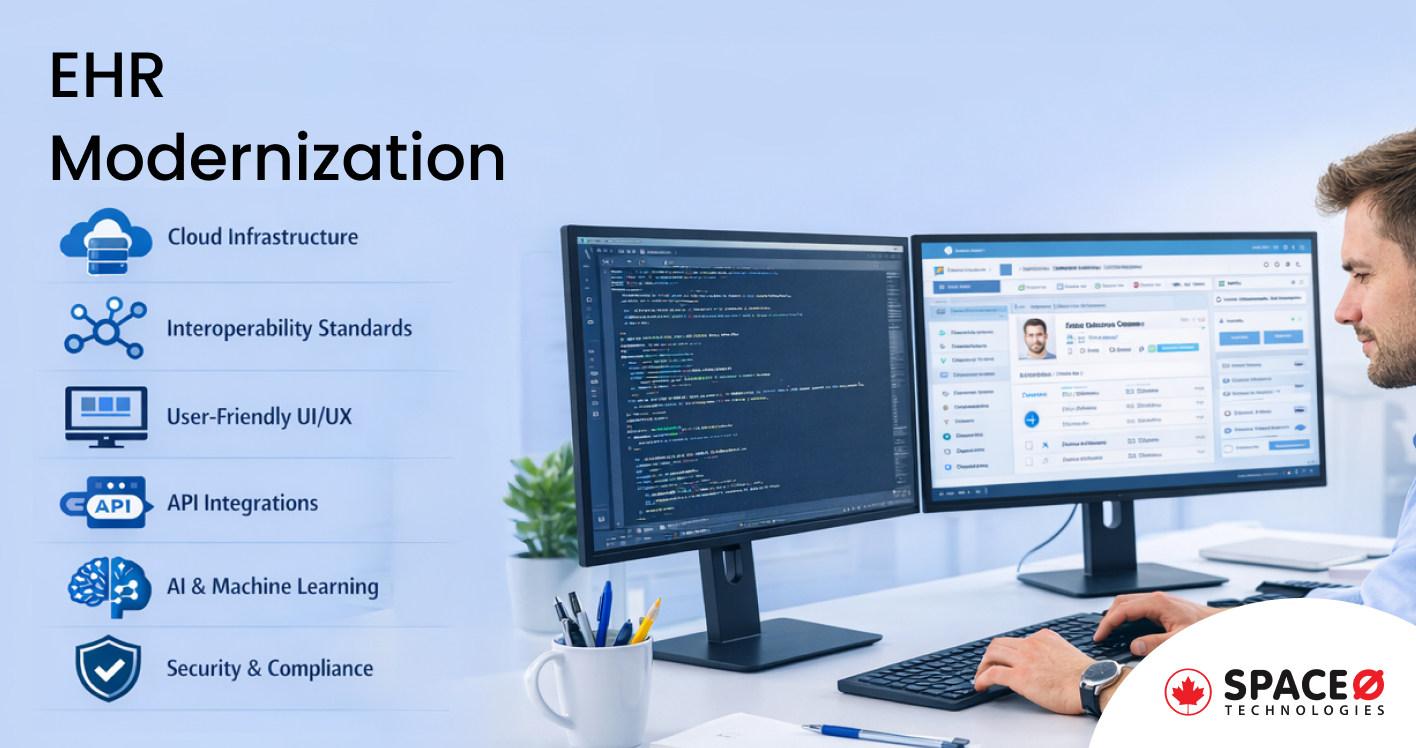
EHR Modernization: Benefits, Challenges, and Implementation Guide
Is your healthcare organization struggling with an EHR system that feels more like a barrier than a tool? You’re not alone. Many hospitals, clinics, and healthcare networks across Canada operate on legacy electronic health record systems that create data silos, slow down clinical workflows, and fail to meet today’s interoperability demands.
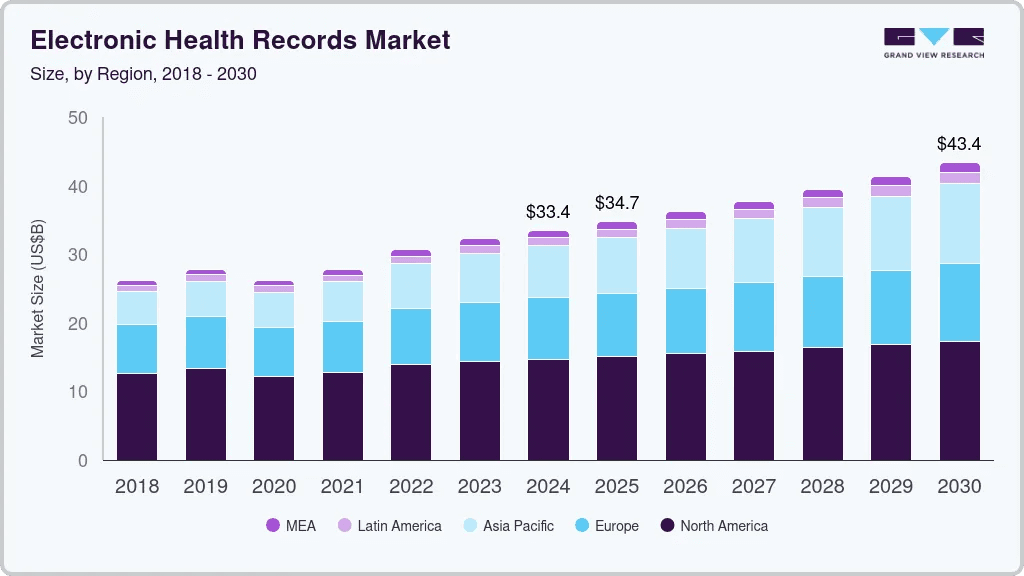
According to Grand View Research, the global electronic health records market size was estimated at USD 33.43 billion in 2024 and is projected to reach USD 43.36 billion by 2030, growing at a CAGR of 4.54%. This growth is driven by healthcare organizations recognizing that outdated EHR systems cannot support modern care delivery, AI integration, or patient expectations for digital experiences.
EHR modernization addresses these challenges by transforming legacy systems into agile, cloud-based platforms that improve patient outcomes, streamline operations, and ensure regulatory compliance.
At Space-O Technologies, we provide EHR software development services to modernize legacy EHR systems for better interoperability, compliance, and clinical efficiency.
This guide breaks down what EHR modernization involves, its key benefits, common challenges with practical solutions, implementation steps, and what it takes to choose the right healthcare software modernization partner.
What is EHR Modernization?
EHR modernization is the process of upgrading, replacing, or transforming legacy electronic health record systems into modern, cloud-based platforms that meet current healthcare delivery demands, interoperability standards, and regulatory requirements. Unlike simple software updates that patch existing functionality, EHR modernization involves rethinking how patient data is stored, accessed, shared, and used across the healthcare ecosystem.
Traditional EHR systems were built decades ago when healthcare workflows looked vastly different. These legacy systems often run on outdated infrastructure, use proprietary data formats, and lack the flexibility to integrate with modern technologies like artificial intelligence, telemedicine platforms, or mobile health applications.
EHR modernization takes several forms depending on organizational needs:
- System replacement: Completely replacing the legacy EHR with a modern platform
- Incremental modernization: Upgrading components piece by piece while maintaining core functionality
- Cloud migration: Moving on-premise EHR systems to cloud infrastructure
- Interface modernization: Redesigning user interfaces while preserving backend systems
- Integration enhancement: Adding APIs and interoperability layers to connect with external systems
Healthcare organizations pursuing EHR software development must evaluate which approach aligns with their operational requirements, budget constraints, and long-term digital health strategy.
Organizations can also explore EHR MVP development to validate modernization approaches before full-scale implementation.
For organizations starting from scratch or replacing legacy systems entirely, understanding how to build an EHR system provides foundational knowledge for successful modernization.”
With the concept established, let’s explore why EHR modernization has become essential for healthcare organizations today.
Why is EHR Modernization Important for Healthcare Organizations?
Healthcare delivery has transformed dramatically over the past decade, yet many EHR systems remain frozen in time. The gap between what modern healthcare requires and what legacy systems deliver creates operational inefficiencies, compliance risks, and missed opportunities for better patient care.
1. Regulatory compliance pressures
Canadian healthcare organizations must comply with PIPEDA, provincial regulations like Ontario’s PHIPA, and increasingly stringent data protection requirements. Legacy EHR systems often lack the security controls, audit capabilities, and data governance features needed to demonstrate compliance. Modernized systems build these requirements into their architecture from the ground up.
For organizations serving patients across borders, HIPAA compliance adds another layer of complexity that legacy systems struggle to address.
2. Rising patient expectations for digital experiences
Patients now expect the same digital convenience from healthcare that they receive from banking, retail, and other industries. They want to access their health records on mobile devices, communicate with providers through secure messaging, schedule appointments online, and receive test results instantly.
Legacy EHR systems rarely support these patient-facing capabilities without extensive customization or third-party integrations that create maintenance headaches.
For healthcare organizations with specialized care delivery models, modernization extends beyond general EHR capabilities. Specialty-specific EHR systems address unique clinical workflows: paediatric EHR development incorporates growth charts and immunization tracking, cardiology EHR development integrates cardiac imaging and diagnostic tools, while mental health EHR development supports behavioral health documentation and treatment planning.”
3. Need for real-time data access and interoperability
Care coordination across multiple providers, hospitals, and clinics requires seamless data exchange. Legacy systems built on proprietary data formats create information silos where critical patient data remains trapped within individual organizations.
Modern EHR systems adopt interoperability standards like HL7 FHIR (Fast Healthcare Interoperability Resources) that enable secure, standardized data sharing across the healthcare ecosystem.
4. Integration with emerging technologies
Artificial intelligence, machine learning, predictive analytics, and telemedicine represent the future of healthcare delivery. Legacy EHR systems lack the APIs, data structures, and computational capabilities needed to leverage these technologies effectively.
Organizations that delay modernization find themselves unable to adopt innovations that competitors use to improve patient outcomes and operational efficiency.
5. Reducing healthcare delivery costs
Inefficient workflows, duplicate data entry, manual processes, and system workarounds drain resources. Studies consistently show that clinicians spend significant portions of their workday navigating EHR systems rather than caring for patients.
Modernized systems streamline clinical workflows, automate routine tasks, and reduce the administrative burden that drives physician burnout.
Pro Tip: Healthcare organizations that delay EHR modernization often face exponentially higher costs when legacy systems become completely unsupported. Vendors eventually discontinue maintenance for outdated platforms, forcing emergency migrations under time pressure.
These driving factors translate into tangible advantages. Here are the major benefits EHR modernization delivers.
What are the Key Benefits of EHR Modernization?
EHR modernization delivers measurable improvements across clinical, operational, and financial dimensions. Organizations that successfully modernize their electronic health record systems report significant gains in patient care quality, staff productivity, and regulatory compliance.
1. Improved patient care and outcomes
Modern EHR systems provide clinicians with comprehensive, real-time access to patient information at the point of care. Complete medication histories, allergy alerts, lab results, imaging studies, and care plans from across providers appear in unified views that support better clinical decision-making.
Clinical decision support tools embedded in modern systems flag potential drug interactions, remind providers about preventive screenings, and surface relevant clinical guidelines based on patient conditions.
2. Enhanced interoperability and data exchange
Modernized EHR platforms built on FHIR and other interoperability standards enable seamless information sharing with other healthcare organizations, laboratories, pharmacies, and public health agencies.
This interoperability eliminates the manual faxing, phone calls, and duplicate data entry that plague organizations using legacy systems. Patient information follows patients as they move between care settings, reducing gaps in care continuity.
3. Streamlined clinical workflows
User interface redesigns reduce the clicks, screens, and navigation steps required to complete common tasks. Voice recognition, smart templates, and automated documentation tools decrease the time clinicians spend on administrative work.
Workflow optimization studies during modernization projects identify inefficiencies in current processes and design streamlined alternatives that better match how clinicians actually work.
4. Better data security and compliance
Modern EHR platforms incorporate security controls that legacy systems lack: encryption at rest and in transit, multi-factor authentication, role-based access controls, comprehensive audit logging, and automated threat detection.
These capabilities simplify compliance with PIPEDA, PHIPA, HIPAA, and other regulations while reducing the risk of data breaches that damage organizational reputation and trigger costly penalties.
5. Cost reduction through operational efficiency
Automation of routine administrative tasks, reduction in duplicate testing, decreased reliance on paper processes, and improved staff productivity generate measurable cost savings.
Organizations also reduce IT maintenance costs by moving from aging on-premise infrastructure to cloud-based platforms where vendors handle updates, security patches, and system management.
6. Advanced analytics and predictive insights
Modernized systems collect and structure data in formats that support advanced analytics. Healthcare organizations can identify high-risk patients, predict readmissions, optimize resource allocation, and measure quality outcomes using data previously locked in unusable formats.
Integration with predictive analytics in healthcare solutions enables proactive interventions that improve patient outcomes while reducing costs.
Modernize Your EHR Without Disrupting Clinical Operations
Upgrade legacy EHR systems with improved usability, faster performance, and interoperability while keeping day-to-day clinical workflows uninterrupted.
While the benefits are substantial, organizations must navigate significant obstacles. Learn the key challenges and how to address them.
What are the Common Challenges in EHR Modernization and How to Overcome Them?
EHR modernization projects carry inherent risks that have derailed many healthcare organizations. Understanding these challenges upfront and planning mitigation strategies dramatically improves success rates.
1. Data migration complexity
The Challenge:
Legacy EHR systems store decades of patient data in proprietary formats, inconsistent structures, and sometimes degraded quality. Migrating this data to modern systems without losing critical information or introducing errors requires meticulous planning and execution.
The Solution:
Conduct comprehensive data audits before migration to identify quality issues, duplicate records, and data that requires cleansing. Use automated migration tools with validation checkpoints that verify data integrity at each stage. Implement phased migration approaches that move data incrementally rather than attempting “big bang” conversions.
2. Integration with existing systems
The Challenge:
Healthcare organizations operate numerous clinical and administrative systems that must connect with the EHR: laboratory information systems, radiology PACS, pharmacy systems, billing platforms, and medical devices. Legacy integration interfaces may not work with modern platforms.
The Solution:
Adopt interoperability standards (HL7 FHIR) from the outset and design API-first architectures that simplify current and future integrations.
Work with experienced integration specialists who understand healthcare-specific protocols. Create an integration inventory early in the project and allocate sufficient time for interface development and testing.
Organizations modernizing complex healthcare IT environments should consider comprehensive EHR integration strategies that address not only current systems but also future connectivity requirements with emerging health technologies.”
3. User adoption and training requirements
The Challenge:
Clinicians and staff develop deep familiarity with existing systems, even inefficient ones. New interfaces, workflows, and processes create friction that slows productivity during transition periods. Resistance to change can undermine even technically successful implementations.
The Solution:
Involve end-users early in the modernization process, from requirements gathering through design validation. Provide role-specific training that focuses on workflows relevant to each user group. Implement robust change management programs that communicate benefits, address concerns, and celebrate early wins. Identify clinical champions who can support peers through the transition.
4. Budget constraints and cost overruns
The Challenge:
EHR modernization projects frequently exceed initial budgets due to scope expansion, unforeseen technical complications, extended timelines, and underestimated training requirements.
The Solution:
Define clear scope boundaries with documented change control processes. Build contingency buffers (typically 15-25%) into budgets to absorb unexpected costs. Consider phased implementation approaches that spread investment over time and allow course corrections between phases. Engage experienced partners who can provide realistic cost estimates based on similar projects.
5. Downtime and workflow disruption
The Challenge:
Healthcare organizations cannot simply shut down operations during EHR transitions. Patient care must continue uninterrupted while systems change beneath clinical workflows.
The Solution:
Plan parallel running periods where old and new systems operate simultaneously. Schedule major migrations during historically low-activity periods. Maintain rollback capabilities that allow rapid reversion to legacy systems if critical issues emerge. Develop detailed contingency plans for various failure scenarios.
6. Vendor lock-in concerns
The Challenge:
Proprietary EHR platforms can create dependencies that make future changes expensive or impossible. Organizations fear committing to vendors who may not meet evolving needs.
The Solution:
Prioritize platforms built on open standards that preserve data portability. Negotiate contractual provisions that guarantee access to your data in standard formats. Ensure intellectual property agreements clearly establish organizational ownership of clinical data. Evaluate vendor track records for supporting data exports and system transitions.
7. Maintaining compliance during transition
The Challenge:
Regulatory requirements don’t pause during EHR transitions. Organizations must maintain PIPEDA, PHIPA, and other compliance obligations throughout modernization while managing the complexity of parallel systems and data migration.
The Solution:
Engage compliance officers and privacy teams from project inception. Document all processes, decisions, and data handling procedures to demonstrate due diligence. Conduct regular compliance audits during migration phases. Ensure both legacy and modern systems maintain required security controls throughout the transition period.
Understanding what makes up a modern EHR system helps organizations plan effectively. Explore the essential components of EHR modernization.
What are the Core Components of EHR Modernization?
Successful EHR modernization addresses multiple technical and operational dimensions. Understanding these core components helps healthcare organizations evaluate vendor solutions and plan comprehensive modernization strategies.
1. Cloud infrastructure and architecture
Modern EHR systems increasingly leverage cloud infrastructure that offers scalability, reliability, and reduced maintenance burden compared to on-premise deployments. Cloud architectures support elastic scaling during demand spikes, automatic failover for high availability, and geographic redundancy for disaster recovery.
Canadian healthcare organizations must ensure cloud deployments meet data residency requirements, with patient data stored within Canadian borders where required by provincial regulations.
2. Interoperability standards (HL7, FHIR)
FHIR (Fast Healthcare Interoperability Resources) has emerged as the dominant standard for healthcare data exchange. Modern EHR platforms build FHIR capabilities into their core architecture rather than bolting them on as afterthoughts.
HL7 v2 messaging remains important for legacy system integration, while CDA (Clinical Document Architecture) supports document-based exchanges. Comprehensive modernization addresses all relevant interoperability standards.
3. User interface and user experience (UI/UX) redesign
Legacy EHR interfaces often reflect outdated design paradigms that increase cognitive load and slow clinical workflows. Modern systems apply contemporary UX principles: intuitive navigation, contextual information display, minimal clicks to complete tasks, and responsive designs that work across devices.
Clinical workflow analysis informs interface design, ensuring screens and processes align with how providers actually deliver care.
4. API-driven integrations
Modern EHR platforms expose functionality through well-documented APIs (Application Programming Interfaces) that enable integration with third-party applications, patient-facing tools, analytics platforms, and emerging technologies.
API-first design principles ensure the EHR can serve as a platform for innovation rather than a closed system that limits organizational agility.
5. AI and machine learning capabilities
Modernized EHR systems support artificial intelligence applications: clinical decision support, natural language processing for unstructured data, predictive analytics, automated coding assistance, and intelligent workflow automation.
These capabilities require structured data, computational resources, and integration interfaces that legacy systems typically cannot provide.
Integration with telemedicine software development solutions enables virtual care delivery models that extend organizational reach.
6. Security and compliance frameworks
Modern EHR architectures build security into every layer: encrypted data storage, secure communication protocols, comprehensive identity management, granular access controls, and continuous monitoring for threats.
Compliance frameworks address Canadian requirements (PIPEDA, provincial health information acts) as well as international standards relevant to organizations serving diverse patient populations.
Turn Your EHR Into a Scalable, Data-Driven Clinical Platform
Space-O helps healthcare organizations modernize EHRs to improve data accessibility, system reliability, and long-term technology alignment.
These components form the foundation. Follow this step-by-step guide to implement EHR modernization successfully.
Step-by-Step Guide: How to Implement EHR Modernization Successfully
EHR modernization success requires systematic planning and execution. This proven framework helps healthcare organizations navigate the complexity while minimizing risks.
Step 1: Assess the current EHR system and identify gaps
Begin with a comprehensive assessment of your existing EHR environment. Document current functionality, integration points, data volumes, user workflows, and pain points. Identify specific gaps between what your legacy system provides and what modern healthcare delivery requires.
Engage clinicians, administrators, IT staff, and compliance officers in this assessment. Their diverse perspectives reveal issues that technical audits alone miss.
Step 2: Define modernization goals and success metrics
Establish clear, measurable objectives for your modernization initiative. Goals might include reducing documentation time by specific percentages, achieving certain interoperability capabilities, improving patient satisfaction scores, or reaching compliance milestones.
Define key performance indicators (KPIs) that will demonstrate success. Without measurable goals, organizations struggle to evaluate whether modernization delivered expected value.
Step 3: Choose the right modernization approach
Select an approach that matches organizational risk tolerance, budget constraints, and operational requirements:
- Rip-and-replace: Complete replacement with a new EHR platform. Higher risk but delivers comprehensive modernization.
- Phased migration: Incremental transition that moves functionality to modern platforms over time. Lower risk but longer timeline.
- Hybrid approach: Replace core components while maintaining certain legacy elements during transition.
Each approach carries different risk profiles, cost structures, and timeline implications.
Step 4: Select technology stack and vendors
Select EHR technologies and vendors that align with organizational needs, support interoperability standards, meet data residency requirements, demonstrate healthcare expertise, and offer transparent total cost of ownership covering implementation, licensing, support, and long-term scalability.
Organizations investing in healthcare software development should prioritize partners who understand both technical requirements and clinical workflows.
For organizations lacking internal technical resources, learning how to hire EHR software developers or exploring outsource EHR development options ensures access to specialized expertise without building permanent internal teams.”
Step 5: Plan data migration strategy
Plan data migration by defining extraction processes, cleansing legacy data, mapping structures to modern formats, validating accuracy, preparing rollback procedures, and archiving non-critical historical records to ensure continuity, data integrity, and minimal operational disruption.
Step 6: Ensure compliance and security throughout
Ensure continuous compliance by documenting data handling processes, applying security controls across environments, conducting privacy impact assessments, involving compliance teams in design decisions, and establishing ongoing monitoring to meet regulatory and security requirements post-implementation.
Step 7: Train staff and manage change
Develop comprehensive training programs tailored to different user roles. Clinicians need workflow-focused training; administrators need different functionality; IT staff need technical training.
Implement change management strategies that address resistance, communicate benefits, and support users through the transition. Identify super-users who can provide peer support after go-live.
Step 8: Test, deploy, and iterate
Test thoroughly through functional, integration, performance, user acceptance, and security testing. Deploy in a controlled manner, gather clinician feedback, and iterate continuously to improve system reliability, usability, compliance, and overall clinical adoption.
Plan for post-deployment iteration. No EHR implementation is perfect at launch. Establish processes for collecting feedback, prioritizing improvements, and delivering ongoing enhancements.
Pro Tip: Involve end-users, clinicians and administrative staff, early in the process. Their input ensures the modernized system aligns with real-world workflows and increases adoption success.
Implementation planning requires realistic budgeting. Here’s what EHR modernization typically costs.
How Much Does EHR Modernization Cost?
EHR modernization costs range from $50K-$150K CAD for small clinics to $2M-$10M+ for multi-province systems, with mid-size hospitals at $200K-$750K and networks at $750K-$3M+. Costs vary dramatically based on organizational size, scope, and approach.
1. Factors affecting EHR modernization costs
Several variables influence total investment:
- Organization size and complexity: Large healthcare networks with multiple facilities, diverse specialties, and complex workflows require more extensive modernization efforts than single-site clinics.
- Scope of modernization: Complete system replacement costs more than targeted upgrades. The breadth of functionality being modernized directly impacts budget requirements.
- Data migration complexity: Organizations with decades of legacy data, multiple source systems, and significant data quality issues face higher migration costs.
- Integration requirements: The number and complexity of systems requiring integration with the modernized EHR affects development and testing costs.
- Customization needs: Standard platform configurations cost less than heavily customized implementations tailored to unique organizational workflows.
- Training and change management: Comprehensive training programs and change management initiatives add to project costs but significantly improve adoption outcomes.
2. Cost breakdown by organization type
| Organization Type | Scope | Estimated Cost Range (CAD) |
|---|---|---|
| Small Clinic (1-5 providers) | Basic modernization, cloud migration | $50,000 – $150,000 |
| Mid-Size Hospital (50-200 beds) | Comprehensive platform upgrade | $200,000 – $750,000 |
| Large Healthcare Network | Enterprise-wide transformation | $750,000 – $3,000,000+ |
| Multi-Province Health System | Complex multi-site modernization | $2,000,000 – $10,000,000+ |
3. Hidden costs to consider
Budget planning should account for costs often underestimated:
- Productivity loss during transition: Clinician efficiency typically drops during learning curves
- Extended parallel operations: Running legacy and modern systems simultaneously
- Third-party integration development: Connecting ancillary systems may require custom work
- Post-go-live optimization: Ongoing refinement after initial deployment
- Additional hardware or infrastructure: Network upgrades, devices, or cloud capacity
- Consulting and advisory services: External expertise for specialized requirements
4. ROI and long-term savings
Despite significant upfront investment, EHR modernization typically delivers positive returns through:
- Reduced IT maintenance and support costs
- Improved clinician productivity and reduced overtime
- Decreased duplicate testing and unnecessary procedures
- Better coding accuracy improves reimbursement
- Reduced compliance penalties and audit remediation
- Lower costs for future system enhancements
Organizations should develop business cases that quantify expected benefits and track actual returns post-implementation.
For detailed healthcare technology budgeting guidance, explore ehr software development cost considerations that apply to broader amodernization initiatives.
Cost clarity enables informed decisions. Here’s how to select the right partner for your EHR modernization project.
How to Choose the Right EHR Modernization Partner?
Selecting the right implementation partner significantly influences EHR modernization success. Technical capabilities matter, but healthcare domain expertise and cultural fit prove equally important.
1. Key criteria for evaluating vendors
Assess potential partners across multiple dimensions:
- Healthcare domain expertise: Partners should understand clinical workflows, healthcare regulations, and industry-specific challenges. Generic software developers often struggle with healthcare complexity.
- Technical capabilities: Evaluate experience with relevant technologies, interoperability standards, cloud platforms, and security frameworks.
- Implementation methodology: Look for structured approaches with clear phases, milestones, and deliverables. Proven methodologies reduce risk.
- Reference customers: Request references from similar organizations and verify claimed experience through direct conversations with past clients.
- Team composition: Understand who will actually work on your project. Senior architects should be involved, not just junior developers.
- Canadian compliance expertise: Partners should demonstrate understanding of PIPEDA, PHIPA, and provincial requirements specific to Canadian healthcare.
2. Questions to ask potential partners
During evaluation, explore:
- What EHR modernization projects have you completed for similar organizations?
- How do you handle data migration from legacy systems?
- What is your approach to maintaining compliance during transitions?
- How do you manage scope changes and budget impacts?
- What post-implementation support do you provide?
- Can you provide references from Canadian healthcare clients?
- How do you ensure knowledge transfer to our internal teams?
3. Build vs. buy vs. partner considerations
Organizations face fundamental choices about how to approach modernization:
- Build internally: Maximum control but requires significant internal expertise and resources. Rarely practical for complete EHR modernization.
- Buy commercial platform: Faster implementation with proven solutions but may require workflow adaptations to fit platform constraints.
- Partner for custom development: Tailored solutions that match organizational needs but require careful partner selection and ongoing relationships.
Most healthcare organizations benefit from hybrid approaches, selecting commercial platforms where appropriate while partnering for customization, integration, and implementation.
4. Importance of healthcare domain expertise
EHR systems touch every aspect of healthcare delivery. Partners without healthcare experience often underestimate complexity, overlook regulatory requirements, or design solutions that don’t align with clinical realities.
Look for partners who can discuss clinical workflows knowledgeably, understand healthcare data standards, and demonstrate familiarity with regulatory frameworks governing health information.
5. Compliance and security track record
Given the sensitivity of health information, partner security practices demand scrutiny:
- What security certifications do they hold?
- How do they protect client data during development?
- What is their breach history and incident response capability?
- How do they ensure code security and vulnerability management?
- Can they demonstrate compliance with relevant regulations?
For comprehensive vendor evaluation guidance, review our top EHR software development companies selection criteria that apply to EHR modernization partnerships.
Deliver Secure and Interoperable EHR Modernization With Space-O
Partner with Space-O to modernize EHR systems using HL7 and FHIR standards while maintaining HIPAA and PIPEDA compliance.
Among the top solutions, Space-O Technologies delivers results. Discover how we transform EHR modernization into measurable healthcare impact.
Transform Your Healthcare Operations with Space-O Technologies
EHR modernization is no longer optional for Canadian healthcare organizations seeking to deliver efficient, patient-centred care while meeting evolving regulatory requirements. By upgrading legacy systems to modern, interoperable platforms, healthcare providers improve clinical outcomes, streamline operations, and position themselves for future innovation.
Space-O Technologies helps healthcare organizations across Canada navigate EHR modernization complexity with confidence. Our healthcare software experts bring years of experience and 300+ successful software solutions to every engagement.
We understand Canadian healthcare requirements, including PIPEDA, PHIPA, and provincial regulations that govern health information. Our team designs EHR solutions that meet compliance requirements while delivering the functionality healthcare organizations need.
We work as your strategic technology partner, not just a vendor executing specifications.
Our consultative approach ensures modernization initiatives align with organizational goals and deliver measurable value.Ready to modernize your EHR system? Schedule a Free Consultation with our healthcare technology experts.
Frequently Asked Questions about EHR Modernization
What is the difference between EHR upgrade and EHR modernization?
An EHR upgrade typically involves installing newer versions of existing software, patching security vulnerabilities, or adding incremental features within the same platform. EHR modernization is more comprehensive, potentially involving platform replacement, architecture transformation, cloud migration, and fundamental changes to how health information is managed and exchanged. Modernization addresses systemic limitations that upgrades cannot resolve.
How long does EHR modernization take?
Timelines vary significantly based on organizational size, scope, and approach. Small clinics implementing cloud-based EHR solutions may complete modernization in 3-6 months. Mid-size hospitals typically require 9-18 months for comprehensive modernization. Large healthcare networks undertaking enterprise-wide transformations may need 2-4 years, often proceeding in phases. Realistic timeline planning accounts for data migration, integration development, testing, training, and change management activities.
What regulations govern EHR modernization in Canada?
Canadian EHR modernization must comply with federal PIPEDA (Personal Information Protection and Electronic Documents Act) and applicable provincial legislation. Ontario organizations must follow PHIPA (Personal Health Information Protection Act). Other provinces have similar health information privacy laws. Organizations serving patients across borders may also need to address HIPAA requirements. Health Canada provides guidance on digital health solutions that may apply to certain EHR capabilities.
Can legacy EHR data be migrated to a new system?
Yes, legacy data can be migrated, though the process requires careful planning. Data extraction tools pull information from legacy systems. Data mapping translates legacy structures into modern formats. Data cleansing addresses quality issues accumulated over years of use. Validation procedures verify migration accuracy. Some historical data may be archived rather than actively migrated if it lacks ongoing clinical relevance. Successful migration preserves data integrity while improving accessibility.
What is the role of AI in EHR modernization?
AI enhances modernized EHR systems in multiple ways: clinical decision support that surfaces relevant information and alerts; natural language processing that extracts structured data from unstructured notes; predictive analytics that identify high-risk patients; automated coding assistance that improves billing accuracy; and intelligent workflow automation that reduces administrative burden. Modern EHR architectures provide the data structures and computational capabilities that AI applications require.
How do you ensure minimal downtime during EHR modernization?
Minimizing downtime requires careful planning: parallel running periods where legacy and modern systems operate simultaneously; phased migration approaches that transition functionality incrementally; scheduled transitions during historically low-activity periods; robust rollback capabilities if critical issues emerge; comprehensive testing before production deployment; and contingency plans for various failure scenarios. Zero-downtime modernization is achievable with proper planning and experienced implementation partners.
Is EHR modernization suitable for small clinics?
EHR modernization benefits organizations of all sizes. Small clinics often gain significant advantages from cloud-based EHR platforms that reduce IT infrastructure requirements, provide automatic updates, and offer subscription pricing that spreads costs over time. Modern systems designed for smaller practices deliver sophisticated functionality without the complexity of enterprise solutions. The key is selecting modernization approaches and platforms appropriately scaled to organizational needs and resources.


Deliver Secure and Interoperable EHR Modernization With Space-O
 All our projects are secured by NDA
100% Secure. Zero Spam
*All your data will remain strictly confidential.
Trusted by


Bashar Anabtawi 
Canada
“I was mostly happy with the high level of experience and professionalism of the various teams that worked on my project. Not only they clearly understood my exact technical requirements but even suggested better ways in doing them. The Communication tools that were used were excellent and easy. And finally and most importantly, the interaction, follow up and support from the top management was great. Space-O not delivered a high quality product but exceeded my expectations! I would definitely hire them again for future jobs!”

Canada Office
2 County Court Blvd., Suite 400,
Brampton, Ontario L6W 3W8
Phone: +1 (602) 737-0187
Email: sales@spaceo.ca