
- The Healthcare IT Outsourcing Market: Current Trends and Growth
- Why Healthcare Organizations Outsource IT Services?
- What are the Benefits of Outsourcing Healthcare IT
- What are the Challenges and Risks of Healthcare IT Outsourcing (And How to Overcome Them)
- How Much Does It Cost to Outsource Healthcare IT Services? [4 Key Factors to Consider]
- How to Choose the Right Healthcare IT Outsourcing Partner
- Why Choose Space-O Technologies for Healthcare IT Outsourcing?
- Making Healthcare IT Outsourcing Work for Your Organization
- Frequently Asked Questions about Healthcare IT Outsourcing
Healthcare IT Outsourcing: The Complete Guide for Hospitals, Clinics, and Healthtech Startups in 2026

 Last Updated: January, 13 2026
Are you struggling to improve patient care while modernizing your technology stack, hiring skilled healthcare IT talent, controlling rising costs, and staying compliant with PIPEDA and GDPR?
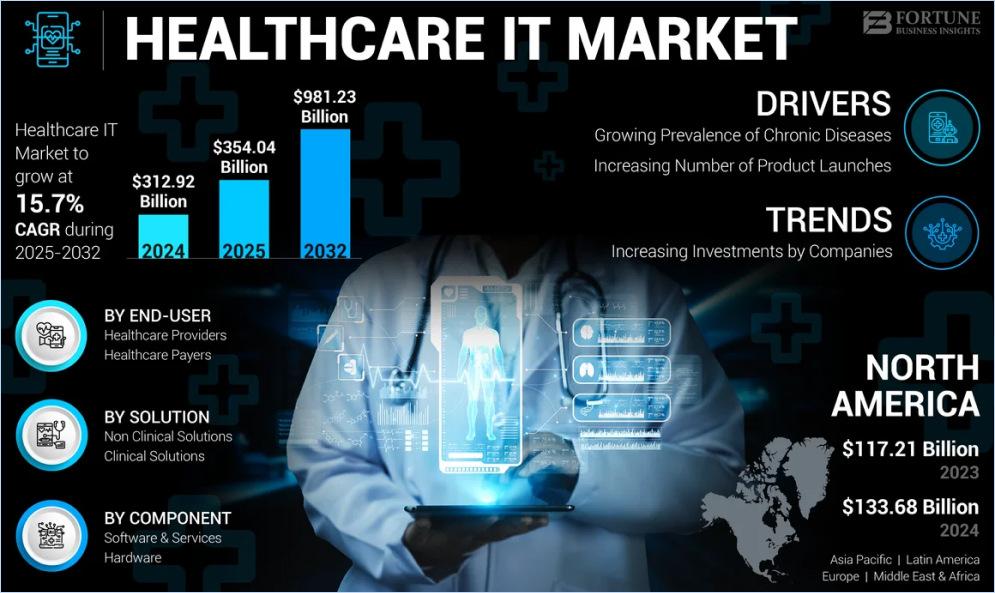
The challenge is growing fast. According to Fortune Business Insights, the global healthcare IT market was valued at USD 312.92 billion in 2024 and is projected to reach USD 981.23 billion by 2032, growing at a 15.7% CAGR. Yet many healthcare organizations still lack the in-house expertise needed to keep pace.
Healthcare IT outsourcing offers a practical solution. By partnering with specialized healthcare IT providers experienced in healthcare software development, you gain immediate access to domain-experienced engineers, streamline development workflows, and deliver secure, regulation-ready digital solutions with greater speed and control.
This guide shows you how to use healthcare IT outsourcing to modernize systems, stay compliant, and improve patient outcomes.
What is Healthcare IT Outsourcing?
Healthcare IT outsourcing is the practice of delegating technology functions, projects, or services to external specialized vendors rather than handling them in-house. Instead of hiring and managing internal IT teams, healthcare organizations partner with experienced technology companies to outsource healthcare software development, manage infrastructure, ensure cybersecurity, and maintain regulatory compliance.
Outsourcing can take several forms:
1. Project-Based Outsourcing: Hire an external team to complete a specific project with defined scope, timeline, and deliverables—ideal for building a telemedicine platform or migrating to a new EHR system.
2. Dedicated Team Model: Engage developers, designers, and engineers through a dedicated development team who work exclusively on your projects long-term, offering greater control for ongoing development needs.
3. Staff Augmentation: Temporarily expand your in-house team with external specialists who fill skill gaps, providing flexibility to scale resources based on demand.
4. Managed Services: Outsource complete management of IT functions like infrastructure, cybersecurity monitoring, or help desk support to a vendor who handles everything end-to-end.
Healthcare IT outsourcing differs from staff augmentation (adding external talent to existing teams) and managed IT services (ongoing operational support rather than project development).
With the basics covered, let’s examine the booming market driving this trend—current statistics and growth projections that show why healthcare IT outsourcing is accelerating.
The Healthcare IT Outsourcing Market: Current Trends and Growth
The global healthcare IT outsourcing market is expanding steadily as healthcare organizations increasingly rely on external partners for technology services. In 2024, the healthcare IT outsourcing market size was valued at USD 70.40 billion and is forecasted to grow at a CAGR of 5.70% from 2026 to 2033, reaching USD 677.69 billion by 2033.
Key trends driving expansion:
Digital transformation acceleration
Nearly 90% of health system executives now consider digital and AI transformation a high or top priority for their organizations. COVID-19 fundamentally shifted healthcare delivery, creating urgent demand for telemedicine, remote patient monitoring, and digital health solutions aligned with the future of healthcare technology.
AI and analytics adoption
AI is projected to generate $200-360 billion in healthcare savings, according to National Bureau of Economic Research findings. In 2025, Health Management Solutions surged ahead with $2.05 billion in funding, a 42% year-on-year increase, reflecting surging demand for AI-powered diagnostics, patient engagement, and operational automation.
These dynamics make outsourcing healthcare IT increasingly strategic for organizations wanting to innovate rapidly while controlling costs and maintaining compliance.
Why Healthcare Organizations Outsource IT Services?
When managing a healthcare organization, every decision ultimately comes down to delivering better patient care while maintaining financial sustainability.
Healthcare IT outsourcing addresses both imperatives by providing access to specialized expertise, reducing costs, and accelerating innovation—all without the burden of building and maintaining large internal IT departments.
1. Access to specialized healthcare IT expertise
Finding developers who understand both technology and healthcare regulations can take months through traditional hiring. When you outsource healthcare software development, you gain immediate access to pre-vetted professionals experienced in PIPEDA compliance, HL7/FHIR interoperability, and healthcare-specific security protocols. These specialists bring deep knowledge of EHR systems, telemedicine platforms, medical device integration, and regulatory frameworks—expertise that would take years to build internally.
2. Significant cost savings and capital efficiency
Outsourcing healthcare IT typically reduces costs when compared to maintaining equivalent in-house teams. Beyond salary differences, you avoid expenses for recruitment, benefits, office infrastructure, hardware, training, and management overhead. A senior developer in the U.S. costs $150,000-250,000 annually with benefits. Outsourcing the same role to India or Eastern Europe costs $40,000-80,000 for equivalent or superior expertise—savings that multiply across entire project teams.
3. Faster time-to-market for digital health solutions
Hospital IT outsourcing can reduce your time-to-market by months compared to building in-house teams from scratch. While you’d spend 3-6 months recruiting and onboarding developers, an outsourcing partner can assemble a qualified team and begin development within 1-2 weeks. Experienced vendors bring pre-built healthcare components, such as patient portals, appointment scheduling, and secure messaging, that accelerate delivery and get you to revenue faster.
4. Regulatory compliance support
Healthcare apps must comply with PIPEDA and applicable provincial health data laws such as PHIPA or HIA. Experienced healthcare IT partners embed compliance from day one by implementing encryption, access controls, audit logs, consent management, and data residency safeguards. They also support HL7 and FHIR standards to ensure secure interoperability with EHR systems and audit readiness.
5. Enhanced focus on core healthcare delivery
Outsourcing healthcare IT lets your organization concentrate on patient care rather than technology management. Your clinical staff focuses on care delivery, leadership pursues strategic growth initiatives, and resources go toward improving patient outcomes instead of managing developers, resolving technical disputes, or troubleshooting infrastructure.
6. Scalability and flexibility
The dedicated team model provides flexibility to scale resources up or down without hiring complications or layoffs. Need AI specialists for a proof-of-concept or additional developers for an EHR integration? Quality outsourcing partners can provide these specialists within days. This elastic capacity is particularly valuable for healthtech startups, where you can build an MVP with a small team, scale for beta testing, then adjust based on market response.
Outsource Healthcare IT to Experts Who Deliver Compliant, Secure Systems
Partner with healthcare IT specialists who understand PIPEDA, HL7, FHIR, and clinical workflows. Accelerate development while maintaining data security and regulatory compliance.
These motivations deliver concrete advantages—discover the key benefits that make healthcare IT outsourcing a strategic imperative.
What are the Benefits of Outsourcing Healthcare IT
Beyond the fundamental reasons to outsource, healthcare organizations experience additional strategic and operational advantages that compound over time. Understanding these benefits helps you make informed decisions about which IT functions to outsource and how to structure partnerships for maximum value.
1. Lower operational costs
The cost savings from outsourcing healthcare IT extend far beyond developer salaries. You eliminate recruitment expenses, onboarding and training costs for new hires, employee benefits including health insurance, retirement contributions, and paid time off, office space, equipment, and software licenses for development teams, and turnover costs when developers leave for better opportunities.
2. Access to cutting-edge resources and technology
Quality outsourcing partners invest heavily in the latest development tools, frameworks, and infrastructure—investments that would cost your organization hundreds of thousands annually. You gain access to enterprise-grade development environments and CI/CD pipelines, advanced testing and quality assurance tools, cloud infrastructure and DevOps automation platforms, security scanning and compliance monitoring systems, and AI/ML development frameworks and data analytics tools.
3. 24/7 support and operational continuity
Healthcare never stops, and neither should your IT operations. Outsourcing partners, especially those in different time zones, provide round-the-clock monitoring and incident response, continuous development across time zones (effectively doubling productivity), immediate response to critical issues regardless of local business hours, and backup coverage when team members are unavailable.
4. Risk mitigation and quality assurance
Professional outsourcing partners implement rigorous quality processes that many internal teams lack the resources to establish. You benefit from structured QA methodologies including automated testing, manual testing, and security testing, code review processes that catch issues before production, established security protocols and penetration testing, comprehensive documentation for knowledge transfer and compliance, and proven project management frameworks that reduce scope creep and budget overruns.
5. Full-proof security and compliance
Healthcare data security requires constant vigilance and specialized expertise. Outsourcing partners provide enterprise-grade encryption for data at rest and in transit, multi-factor authentication and role-based access controls, regular penetration testing and vulnerability assessments, 24/7 security monitoring and incident response, and automated compliance monitoring for PIPEDA, GDPR, and other regulations.
While the rewards are substantial, success requires navigating potential obstacles—here’s how to address the common challenges and risks effectively.
What are the Challenges and Risks of Healthcare IT Outsourcing (And How to Overcome Them)
While outsourcing healthcare IT offers substantial benefits, it’s not without challenges. Understanding these risks upfront—and implementing proven mitigation strategies—ensures successful partnerships that deliver value without compromising security, quality, or control.
1. Data security and privacy concerns
The Challenge: Healthcare data breaches can expose millions of patient records, trigger PIPEDA violations costing up to $1.5 million annually per violation category, and cause irreparable reputation damage. When you outsource, you’re entrusting sensitive patient data to external teams, creating additional risk points for unauthorized access, data leaks, or cyberattacks.
How to Overcome It: Execute a strong Business Associate Agreement (BAA) defining PIPEDA responsibilities. Verify ISO 27001, SOC 2 Type II, and PIPEDA compliance certifications. Enforce AES-256 encryption for data at rest and in transit, apply role-based access with MFA, conduct regular security audits, ensure data residency compliance, and monitor PHI access through detailed audit logs.
2. Loss of control over critical systems
The Challenge: When external teams manage your IT infrastructure or applications, you may feel disconnected from day-to-day development decisions, struggle to enforce priorities when competing demands arise, lack visibility into progress and technical decisions, and face dependency on vendors for system knowledge and maintenance.
How to Overcome It: Define clear governance and escalation paths. Require regular progress reports with KPIs, use tools like Jira and Confluence for visibility, and hold recurring standups, demos, and reviews. Maintain shared documentation and include knowledge transfer clauses to avoid long-term dependency.
3. Communication and Time Zone Barriers
The Challenge: Offshore outsourcing often involves 8-12 hour time zone differences, creating delayed responses to urgent questions, difficulty scheduling real-time collaboration meetings, cultural differences affecting communication styles and expectations, and potential misunderstandings about requirements or priorities.
How to Overcome It: Create 2–4 hours of daily overlap, appoint a dedicated project manager, and rely on structured asynchronous communication using Slack, Loom, and detailed documentation. Rotate meeting times, write precise requirements, and invest in basic cultural alignment to reduce misunderstandings.
4. Vendor Lock-In and Knowledge Drain
The Challenge: Over time, outsourcing partners accumulate deep knowledge about your systems, architecture decisions, and business logic. If the relationship ends—whether due to performance issues, budget constraints, or strategic shifts—you may struggle to transition to new vendors or in-house teams, face significant costs to reverse-engineer undocumented systems, lose access to critical tribal knowledge when developers leave, or discover the codebase is tightly coupled to vendor-specific tools or frameworks.
How to Overcome It: Mandate up-to-date documentation, use standard technologies, retain full source code ownership, and host repositories in your environment. Schedule formal knowledge transfer sessions and plan gradual transitions instead of abrupt handoffs to preserve system knowledge.
5. Integration with Existing Systems
The Challenge: Healthcare organizations typically operate legacy systems built on outdated technologies with limited documentation, proprietary data formats that resist standardization, complex interdependencies between systems, and limited or no APIs for data exchange. New outsourced solutions must integrate with these systems without disrupting operations.
How to Overcome It: Conduct early technical assessments, adopt API-first development with HL7 and FHIR, and use middleware to decouple legacy systems. Roll out changes in phases, run parallel systems during transitions, and budget 30–40% effort for integration complexity.
6. Hidden Costs and Budget Overruns
The Challenge: Initial outsourcing quotes may seem attractive, but projects can experience scope creep as new requirements emerge, change requests that weren’t anticipated in original estimates, integration complexity that exceeds initial assessments, compliance requirements discovered mid-project, and extended timelines that increase total project costs.
How to Overcome It: Use fixed-price models for defined scopes and capped time-and-materials for evolving needs. Create detailed SOWs, tie payments to milestones, maintain a 15–20% contingency buffer, enforce formal change requests, and review budgets monthly to catch overruns early.
Overcoming hurdles leads to the practical question of investment—understand the 4 key factors that determine your healthcare IT outsourcing costs.
How Much Does It Cost to Outsource Healthcare IT Services? [4 Key Factors to Consider]
Outsourcing healthcare IT services typically costs $30,000 to $500,000+, depending on solution complexity, compliance requirements, engagement model, and vendor location.
Hourly rates usually range between $25 and $180 per hour, while mid-sized healthcare IT projects—such as EHR integrations, patient portals, or clinical workflow automation—often fall between $60,000 and $150,000 for end-to-end delivery.
To plan budgets accurately, healthcare organizations must evaluate total project investment, not just hourly rates. Development, compliance management, infrastructure, interoperability, and post-launch support significantly influence the final cost.
1. Regional cost differences in healthcare IT outsourcing
Geography plays a major role in healthcare IT outsourcing costs due to labor rates, regulatory expertise, and talent availability.
- Canada: Healthcare IT outsourcing typically ranges from CAD 90 to CAD 200+, which translates to approximately $65 to $150 USD per hour depending on the city, consultant experience, and project complexity.
- North America: Healthcare IT specialists charge $80 to $180 per hour, driven by PIPEDA expertise, advanced interoperability knowledge, and high operational costs. This region suits organizations needing close collaboration and deep regulatory alignment.
- Eastern Europe: Vendors charge $40 to $90 per hour, offering strong engineering skills, HL7/FHIR experience, and EU healthcare compliance familiarity at moderate costs.
- Asia (India, Philippines): Rates range from $25 to $50 per hour, making this region highly cost-effective for healthcare software development, QA, data engineering, and support services, especially when paired with strong PIPEDA-compliant processes.
- Latin America: Providers charge $45 to $85 per hour, offering nearshore time-zone alignment for U.S. healthcare organizations with growing experience in healthcare interoperability and cloud-based systems.
2. Pricing models and engagement types for healthcare IT projects
The right engagement model directly affects cost control, delivery speed, and compliance outcomes.
- Use fixed-price contracts for well-defined healthcare IT projects such as patient portals, telemedicine platforms, or compliance-driven reporting tools where scope and workflows remain stable.
- Adopt time and materials models for evolving healthcare initiatives like AI-driven diagnostics, analytics dashboards, or interoperability upgrades where requirements change frequently.
- Leverage dedicated healthcare IT teams for long-term digital transformation programs, including EHR modernization, population health platforms, and enterprise-wide data integration.
- Combine hybrid pricing models to lock costs for compliance-critical milestones while maintaining flexibility for innovation and optimization phases.
3. Hidden costs to account for in healthcare IT outsourcing
Healthcare IT outsourcing involves additional cost layers that organizations often underestimate.
- Account for project management and compliance oversight, which typically add 15–25% to development costs due to documentation, audits, and cross-functional coordination.
- Plan infrastructure and security expenses, including cloud hosting, encryption tools, monitoring systems, and third-party healthcare APIs, which can add $300 to $1,000 per developer annually.
- Allocate budget for knowledge transfer and documentation, often 10–15% of development costs, as healthcare systems require detailed clinical workflows, audit trails, and user training materials.
- Prepare for post-launch maintenance, as healthcare applications typically require 15–25% of the initial development cost per year for regulatory updates, security patches, and performance optimization.
4. Calculating ROI on outsourced healthcare IT services
Accurate ROI calculation requires a long-term perspective on value, not just upfront savings.
- Evaluate the total cost of ownership over 3–5 years, including development, infrastructure, compliance updates, and support, and compare it against in-house costs such as salaries, benefits, recruitment, and retention.
- Accelerate time-to-market by outsourcing healthcare IT, enabling faster deployment of digital health solutions that improve patient engagement, operational efficiency, and reimbursement cycles.
- Redirect internal resources toward clinical innovation and strategic initiatives instead of managing complex IT execution.
- Reduce operational risk by avoiding hiring delays, minimizing compliance gaps, and scaling healthcare IT teams up or down based on regulatory and business demands.
Prevent Costly Failures in Healthcare IT Outsourcing Projects
Avoid common pitfalls such as non-compliant architectures, security gaps, and scalability issues. Our healthcare-focused delivery framework ensures reliable, regulation-ready solutions from day one.
Cost clarity guides partner selection—here’s your roadmap to finding the ideal healthcare IT outsourcing provider for your needs.
If AI adoption is part of your digital health roadmap, reviewing the cost of implementing AI in your healthcare solution will help you set realistic expectations and avoid budget overruns.
How to Choose the Right Healthcare IT Outsourcing Partner
Choosing the right healthcare IT outsourcing partner directly impacts project success, data security, compliance, and long-term ROI. A structured and methodical evaluation process helps healthcare organizations avoid costly mistakes, reduce risk, and build reliable technology partnerships.
1. Define non-negotiable requirements first
Start by setting clear minimum requirements before shortlisting vendors. This step filters out unsuitable partners early and saves time and budget.
- Verify PIPEDA compliance by requesting valid documentation, SOC 2 Type II reports, and proof of regular security audits. Never rely on verbal claims.
- Confirm healthcare IT experience by demanding at least 3–5 years of proven healthcare project delivery. Healthcare regulations require specialized expertise, not generic development skills.
- Validate technical capabilities by checking hands-on experience with your technology stack, cloud platforms, and healthcare standards like HL7 and FHIR.
- Assess communication readiness by conducting video interviews to evaluate English proficiency, reporting clarity, and collaboration workflows.
2. Review healthcare case studies and past work
Examine real healthcare projects to understand how vendors perform beyond marketing claims.
- Look for relevant project types, such as hospital systems, clinics, or healthtech platforms similar to your organization.
- Check problem alignment, including EHR integration, telemedicine platforms, patient engagement tools, or analytics systems.
- Confirm compliance success, including PIPEDA, GDPR, or FDA-related implementations.
- Evaluate measurable outcomes, such as adoption rates, workflow efficiency improvements, or operational cost reductions.
Watch for red flags, including vague case studies, lack of healthcare specifics, limited project scale, missing compliance evidence, or refusal to share client references.
3. Verify security standards and certifications
Strong security practices protect patient data and ensure regulatory compliance. Always validate certifications instead of accepting surface-level assurances.
- Confirm essential certifications, including ISO 27001, SOC 2 Type II, PIPEDA compliance attestations, and HITRUST where applicable.
- Request security documentation, such as penetration testing reports, vulnerability assessments, and remediation plans.
- Validate technical safeguards, including AES-256 data encryption, role-based access controls, multi-factor authentication, and secure DevOps practices.
- Review incident response plans, including breach handling procedures and response SLAs.
4. Validate client reviews and references
Independent feedback reveals how vendors behave during real projects, especially under pressure.
- Check trusted review platforms, such as Clutch, GoodFirms, LinkedIn recommendations, and healthcare technology communities.
- Speak directly with references from recent healthcare clients whenever possible.
Ask reference questions like:
- Did the vendor meet deadlines and budgets?
- How did they handle scope changes or challenges?
- Was communication consistent and proactive?
- Did they manage compliance effectively?
- Would you work with them again?
Be cautious of vendors who avoid sharing recent references, rely only on outdated testimonials, or show recurring complaints across multiple reviews.
5. Start with a pilot project
A pilot project minimizes risk and validates the partnership before long-term commitment.
- Test real capabilities by running a 4–8 week pilot focused on a critical feature or proof-of-concept.
- Measure collaboration quality, including response times, clarity, and problem-solving approach.
- Evaluate healthcare understanding, ensuring minimal hand-holding is required for compliance and workflows.
- Assess delivery discipline, including documentation quality, code standards, and milestone adherence.
Select pilot features that mirror future needs—such as EHR integrations, patient authentication modules, or secure scheduling workflows—and use clear success criteria to guide final vendor selection.
A structured pilot-driven approach ensures you choose a healthcare IT outsourcing partner that delivers securely, compliantly, and at scale.
Among qualified partners, Space-O Technologies stands out—discover why healthcare organizations trust us for their critical IT outsourcing needs.
Why Choose Space-O Technologies for Healthcare IT Outsourcing?
Since 2018, Space-O Technologies has experience in building PIPEDA-compliant healthcare solutions for hospitals, clinics, and healthtech startups worldwide.
Our dedicated healthcare practice understands the unique challenges you face and delivers solutions that drive patient engagement, operational efficiency, and business growth.
1. Proven healthcare IT expertise
We’ve partnered with healthcare organizations across the U.S., Canada, Europe, and Australia to deliver 150+ successful healthcare projects. Our portfolio includes EHR systems, telemedicine platforms, patient engagement apps, RPM solutions, and AI-powered diagnostic tools. We understand healthcare workflows, regulatory requirements, and the technical challenges of integrating with existing healthcare infrastructure.
2. Full PIPEDA, GDPR, and HL7/FHIR compliance
Security and compliance aren’t afterthoughts—they’re built into our development process from day one. We maintain ISO 27001 and SOC 2 Type II certifications, conduct regular security audits and penetration testing, implement comprehensive encryption and access controls, and maintain detailed audit trails for regulatory compliance. Our developers receive ongoing PIPEDA training and understand the technical requirements for protecting patient data throughout the development lifecycle.
3. End-to-end development and support
We manage complete project lifecycles from initial consultation and requirements analysis through design, development, testing, and deployment to ongoing maintenance, updates, and support. You get a single partner for the entire journey, eliminating coordination overhead and ensuring accountability. Our project managers serve as your single point of contact, providing daily updates and proactive communication.
4. Transparent and collaborative engagement model
We believe successful outsourcing requires true partnership. Our engagement model emphasizes daily standup meetings, keeping everyone aligned, weekly demos showcasing progress and gathering feedback, shared project management tools (Jira, Slack, Confluence) providing real-time visibility, detailed sprint planning and retrospectives, and flexible contract terms adapting to changing needs.
Build Secure, Scalable Healthcare Software Without Expanding In-House Teams
Access experienced healthcare IT engineers who integrate seamlessly with your organization and deliver compliant solutions faster and more cost-effectively than internal hiring.
Making Healthcare IT Outsourcing Work for Your Organization
Healthcare IT outsourcing now plays a critical role in helping organizations access specialized expertise, control costs, accelerate digital health initiatives, and manage complex regulations like and GDPR. When executed strategically, outsourcing strengthens patient care delivery, improves operational efficiency, and removes internal development bottlenecks.
Looking to Outsource Healthcare IT with Confidence? Space-O Technologies supports healthcare organizations with compliance-focused development, transparent delivery processes, and experienced healthcare IT teams. Since 2018, we have helped hospitals, clinics, and healthtech companies build secure, scalable solutions that meet real-world clinical and regulatory demands.Our teams emphasize clear communication, rigorous security practices, and consistent delivery outcomes. Book a free consultation to explore how a structured healthcare IT outsourcing approach can support your organization’s growth and digital transformation.
Frequently Asked Questions about Healthcare IT Outsourcing
What are the most commonly outsourced healthcare IT services?
Commonly outsourced services include healthcare software development, EHR/EMR integration, telemedicine platforms, patient engagement apps, cybersecurity services, cloud infrastructure management, AI-driven analytics, and revenue cycle management systems requiring specialized expertise.
How do I maintain regulatory compliance in Canada while outsourcing?
Maintain compliance by ensuring your outsourcing partner follows PIPEDA and relevant provincial health data laws such as PHIPA (Ontario) or HIA (Alberta). Verify vendor security practices, enforce encryption for health data at rest and in transit, implement role-based access with MFA, maintain detailed audit logs, conduct regular security testing, and define clear breach detection, response, and notification procedures in line with Canadian regulatory requirements.
Can I outsource to India or Eastern Europe safely?
Yes, you can safely outsource to India or Eastern Europe by selecting vendors with proven PIPEDA experience, executing BAAs and SLAs, enforcing encryption and access controls, auditing security practices, and maintaining oversight. Many global healthcare enterprises successfully outsource to these regions.
What’s the average project timeline for outsourced healthcare IT?
Project timelines vary by complexity: simple apps take 2–4 months, telemedicine platforms 3–6 months, patient portals 4–8 months, EHR integrations 6–12 months, and full EHR systems 12–18 months. Compliance and integrations often extend timelines by 20–30%.
Is outsourcing suitable for healthcare startups?
Outsourcing suits healthcare startups by enabling rapid MVP development, reducing burn rate by 40–60%, accessing specialized healthcare IT skills, and scaling teams flexibly. It allows founders to focus on strategy, compliance readiness, and market validation instead of hiring.
What are common mistakes to avoid in healthcare IT outsourcing?
Avoid choosing vendors based only on price, skipping security audits and references, starting with unclear requirements, treating compliance as an afterthought, neglecting communication protocols, ignoring pilot projects, and underestimating integration complexity with existing healthcare systems.
What is the difference between healthcare IT outsourcing and managed IT services?
Healthcare IT outsourcing focuses on project-based development, like building software or integrations. Managed IT services provide ongoing operational support such as infrastructure monitoring, security management, and help desk services. Many organizations use both models together.
What are the main risks of healthcare IT outsourcing?
Key risks include data breaches, PIPEDA violations, communication gaps, vendor lock-in, integration challenges, hidden costs, and quality issues. Reduce risk through healthcare-focused vendor selection, strong contracts, pilot projects, security audits, and continuous performance monitoring.


What to read next


 All our projects are secured by NDA
100% Secure. Zero Spam
*All your data will remain strictly confidential.
Trusted by


Bashar Anabtawi 
Canada
“I was mostly happy with the high level of experience and professionalism of the various teams that worked on my project. Not only they clearly understood my exact technical requirements but even suggested better ways in doing them. The Communication tools that were used were excellent and easy. And finally and most importantly, the interaction, follow up and support from the top management was great. Space-O not delivered a high quality product but exceeded my expectations! I would definitely hire them again for future jobs!”

Canada Office
2 County Court Blvd., Suite 400,
Brampton, Ontario L6W 3W8
Phone: +1 (602) 737-0187
Email: sales@spaceo.ca