
- What is Medical Coding Software?
- What are the Key Features of Medical Coding Software?
- What are the Benefits of Medical Coding Software Development?
- How Does Medical Coding Software Work?
- How to Develop Medical Coding Software? [Step-By-Step Guide]
- 1. Define business objectives and use cases
- 2. Conduct compliance and regulatory assessment
- 3. Choose the technology stack
- 4. Design the architecture and user experience
- 5. Build and train AI/ML models
- 6. Integrate with existing healthcare systems
- 7. Testing, compliance validation, and deployment
- 8. Training and ongoing support
- What are the Challenges in Medical Coding Software Development and How to Overcome Them?
- What is the Cost and Timeline for Medical Coding Software Development?
- Custom Medical Coding Software Development with Space-O Technologies
- Frequently Asked Questions about Medical Coding Software Development
Medical Coding Software Development: Features, Benefits, and Implementation Guide

 Last Updated: February, 2 2026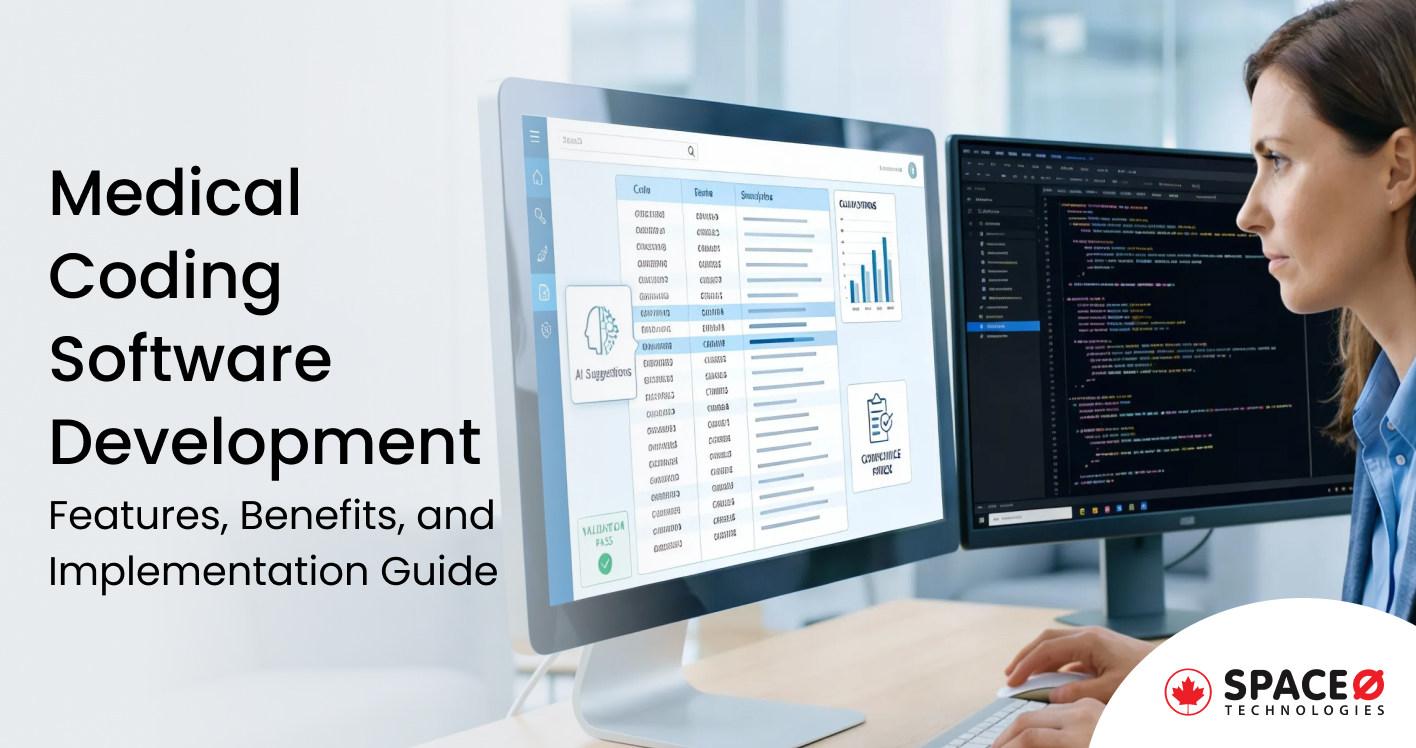
Is your healthcare organization losing revenue due to claim denials and coding errors? You’re facing a challenge that affects providers across Canada. According to Medical Billers and Coders, More than 60% of claim issues stem from preventable mistakes like mistyped codes, outdated insurance information, or missing documentation.
Medical coding software development addresses this critical gap by automating the translation of clinical documentation into standardized billing codes. Instead of relying solely on manual coding processes prone to human error, modern AI-powered solutions analyze clinical notes, suggest accurate codes, and validate claims before submission.
As a healthcare software development company, Space-O Technologies specializes in building secure, scalable, and compliance-ready medical coding solutions tailored to the Canadian healthcare ecosystem. Our custom platforms help hospitals, clinics, and healthcare networks streamline coding workflows, improve accuracy, and accelerate reimbursement cycles.
This guide explains everything you need to know about medical coding software—from core features and benefits to development processes and implementation challenges. Whether you’re a hospital administrator, clinic owner, or healthcare IT leader, you’ll learn how to build a solution that reduces denials, speeds up revenue cycles, and ensures compliance with Canadian regulations.
What is Medical Coding Software?
Medical coding software is a specialized healthcare application that translates clinical diagnoses, medical procedures, and healthcare services into standardized alphanumeric codes used for billing, claims submission, and reimbursement. These codes serve as the universal language between healthcare providers, insurance companies, and government health programs.
The software processes clinical documentation from patient encounters and assigns appropriate codes from established classification systems. The primary coding standards include:
- ICD-10-CM/ICD-10-CA: Diagnosis codes describing patient conditions and diseases (Canadian healthcare uses ICD-10-CA)
- ICD-10-PCS: Procedure codes for inpatient hospital services
- CPT (Current Procedural Terminology): Codes for medical, surgical, and diagnostic procedures
- HCPCS Level II: Codes for products, supplies, and services not covered by CPT
For Canadian healthcare organizations, medical coding solutions must support provincial billing requirements. Each province operates its own health insurance plan—OHIP in Ontario, MSP in British Columbia, Alberta Health Care Insurance Plan—with specific billing codes and submission formats.
Organizations exploring healthcare software development should consider medical coding automation as a foundational component that impacts revenue cycle efficiency across all clinical operations.
Understanding the fundamentals of medical coding software sets the stage—let’s explore the essential features that drive accuracy, compliance, and operational efficiency.
What are the Key Features of Medical Coding Software?
Effective medical coding software combines automation, intelligence, and integration capabilities to transform how healthcare organizations manage their coding workflows. Here are the essential features that distinguish high-performing solutions.
1. Automated code suggestion and assignment
The core functionality of modern medical coding software lies in its ability to automatically suggest and assign codes based on clinical documentation. AI-powered algorithms analyze physician notes, lab results, and procedure reports to identify billable services and recommend appropriate codes.
Organizations looking to understand how to develop artificial intelligence software will find medical coding an ideal application for AI capabilities, where automation delivers immediate, measurable value.
2. Compliance and audit support
Healthcare coding operates under strict regulatory requirements. Medical coding software must include built-in compliance checks that validate code assignments against current guidelines and payer-specific rules.
Key compliance features include:
- Real-time validation against ICD-10, CPT, and HCPCS coding guidelines
- Automatic detection of coding errors, including unbundling issues and medical necessity gaps
- Comprehensive audit trails documenting code selection rationale
- Alerts for potential compliance risks before claim submission
- Support for PIPEDA, PHIPA, and HIPAA requirements
3. EHR/EMR integration
Seamless integration with Electronic Health Record systems is non-negotiable for medical coding software. The solution must pull clinical documentation directly from the EHR, eliminating manual data entry and ensuring coders work with complete patient information.
Bi-directional integration allows coded encounters to flow back into the EHR and downstream to billing systems. This connectivity creates a unified workflow where clinical documentation, coding, and billing operate as a connected ecosystem rather than isolated silos.
Understanding EHR software development principles helps organizations plan integrations that maintain data integrity while enabling efficient coding workflows.
4. Claims scrubbing and denial management
Before claims reach payers, medical coding software should validate submissions against known rejection triggers. Claims scrubbing identifies errors, missing information, and coding combinations likely to cause denials.
Advanced denial management features include:
- Pre-submission validation against payer-specific edits
- Identification of claims requiring additional documentation
- Tracking and analytics for denial patterns
- Automated suggestions for correcting rejected claims
- Root cause analysis to prevent recurring issues
These capabilities directly support medical billing software development initiatives by ensuring clean claims reach billing systems.
5. Reporting and analytics dashboard
Data-driven insights help coding managers optimize team performance and identify improvement opportunities. Comprehensive dashboards display:
- Coding accuracy rates and error trends
- Coder productivity metrics and workload distribution
- Denial rates by code category, payer, and provider
- Revenue impact analysis and reimbursement trends
- Compliance audit results and risk indicators
These analytics capabilities align with broader predictive analytics in healthcare strategies, enabling organizations to forecast revenue and identify operational improvements.
6. Multi-payer support
Canadian healthcare involves multiple payers—provincial health insurance plans, private insurers, workers’ compensation boards, and out-of-country billing. Medical coding software must accommodate this complexity with:
- Configuration for provincial billing codes and submission formats
- Support for OHIP, MSP, Alberta Health Care, and other provincial plans
- Private insurance billing capabilities
- Flexible rule engines adaptable to payer-specific requirements
Space-O Canada builds medical coding platforms with modular architecture, allowing healthcare organizations to start with core features and scale functionality as needs evolve. This approach ensures you invest in capabilities that match your current requirements while maintaining flexibility for future growth.
Automate Medical Coding Without Compromising Control
Develop custom coding software that standardizes code selection, supports clinical documentation review, and accelerates billing workflows without sacrificing accuracy.
With these core features in mind, let’s examine the measurable benefits that medical coding software delivers to healthcare organizations.
What are the Benefits of Medical Coding Software Development?
Investing in medical coding software development delivers tangible returns across clinical, operational, and financial dimensions. Here’s how automated coding transforms healthcare revenue cycle management.
1. Improved coding accuracy and reduced claim denials
AI-driven code suggestions significantly reduce human error in the coding process. Where manual coding typically achieves 85-90% accuracy, automated systems with human oversight consistently exceed 95% accuracy rates.
This improvement translates directly to reduced claim denials. Organizations implementing medical coding automation report denial rate reductions from 25-30% to under 10%. Each prevented denial eliminates rework costs, accelerates payment, and improves cash flow predictability.
2. Faster revenue cycle and cash flow
Automated coding dramatically accelerates the time from patient encounter to claim submission. Tasks that required hours of manual review complete in minutes, enabling same-day or next-day billing for most encounters.
Faster claim submission means faster reimbursement. Organizations typically see 15-25% reduction in days in accounts receivable after implementing coding automation. For healthcare providers operating on thin margins, this cash flow improvement provides significant operational flexibility.
3. Enhanced compliance and reduced audit risk
Built-in compliance validation ensures every coded claim meets regulatory requirements before submission. This proactive approach reduces audit risk and potential penalties associated with coding errors.
Comprehensive audit trails document the rationale behind code selections, providing defensible documentation if claims face review. Organizations pursuing healthcare software modernization often prioritize coding automation as a compliance improvement initiative.
4. Cost savings and operational efficiency
Medical coding software reduces the labour hours required for coding operations. While human coders remain essential for complex cases and quality oversight, automation handles routine coding tasks that previously consumed significant staff time.
Additional cost savings come from:
- Reduced claim rework and resubmission costs
- Lower denial management overhead
- Decreased reliance on outsourced coding services
- Improved coder productivity enabling higher throughput
These efficiency gains demonstrate the benefits of custom software development when solutions address specific operational pain points.
5. Better resource allocation
By automating routine coding tasks, medical coding software frees certified coders to focus on complex cases requiring specialized expertise. High-acuity encounters, surgical procedures, and specialty services receive appropriate attention while routine visits process automatically.
This resource optimization improves job satisfaction for coding professionals, who spend more time on challenging work that leverages their training rather than repetitive data entry.
Pro Tip: Organizations implementing AI-powered medical coding software report up to 40% improvement in first-pass claim acceptance rates and a significant reduction in days to reimbursement. Track these metrics from day one to demonstrate ROI to stakeholders.
These benefits make a compelling case—but successful implementation requires understanding the technical components that power modern medical coding solutions.
How Does Medical Coding Software Work?
Understanding the technical architecture behind medical coding software helps organizations make informed decisions about development approaches and integration requirements. Here’s how modern systems transform clinical documentation into accurate billing codes.
1. Data ingestion and clinical documentation analysis
The coding process begins with capturing clinical documentation from source systems. Medical coding software connects to EHR/EMR platforms, practice management systems, and document repositories to access:
- Physician progress notes and encounter documentation
- Operative reports and procedure notes
- Laboratory and diagnostic test results
- Radiology reports and imaging documentation
- Discharge summaries and clinical assessments
The software must handle both structured data (diagnosis fields, procedure codes, vital signs) and unstructured text (narrative clinical notes, dictated reports). This data aggregation creates a comprehensive view of each patient encounter.
Organizations with complex patient management needs often integrate coding software with healthcare CRM development initiatives to maintain unified patient records across clinical and administrative systems.
2. Natural Language Processing (NLP) engine
The NLP engine forms the intelligence core of medical coding software. This component analyzes unstructured clinical text to extract medically relevant information, including:
- Entity recognition: Identifying diagnoses, symptoms, medications, and procedures mentioned in clinical notes
- Relationship extraction: Understanding connections between clinical concepts (which diagnosis prompted which procedure)
- Negation detection: Recognizing when conditions are ruled out rather than confirmed
- Temporal analysis: Understanding when clinical events occurred relative to the encounter
Advanced NLP engines leverage transformer-based models similar to those powering modern AI assistants. Healthcare organizations exploring OpenAI in healthcare applications find medical coding a practical use case for large language model capabilities.
3. AI/ML-powered code recommendation
Machine learning models trained on millions of coded encounters power the code recommendation engine. These models learn patterns associating clinical documentation with appropriate codes, enabling accurate suggestions for new encounters.
The recommendation process involves:
- Analyzing extracted clinical concepts from NLP processing
- Matching concepts against code definitions and guidelines
- Evaluating coding rules and payer-specific requirements
- Generating ranked code suggestions with confidence scores
- Identifying potential coding opportunities that might be missed
Confidence scoring helps coders prioritize review efforts. High-confidence suggestions (above 95%) may require only quick validation, while lower-confidence recommendations warrant detailed review.
Quick Tip: Start with simpler, interpretable models like logistic regression before advancing to complex deep learning. Clinicians and coders trust predictions they can understand and validate against their expertise.
4. Validation and compliance checks
Before presenting recommendations, the software validates proposed codes against coding guidelines and payer rules. This validation layer catches errors that would trigger claim denials:
- Bundling/unbundling checks: Ensuring procedure codes are appropriately combined or separated
- Medical necessity validation: Confirming diagnosis codes support billed procedures
- Modifier requirements: Identifying when modifiers are needed for accurate billing
- Frequency limitations: Checking against payer rules for service frequency
- Age and gender appropriateness: Validating codes against patient demographics
5. Integration with billing and claims systems
Coded encounters flow from the coding system to billing and claims management platforms. Integration using healthcare interoperability standards ensures accurate data transfer:
- HL7 messaging: Standard protocol for healthcare data exchange
- FHIR APIs: Modern RESTful interfaces for healthcare interoperability
- X12 EDI: Electronic data interchange formats for claims submission
This connectivity supports custom software development strategies where medical coding integrates with broader revenue cycle management ecosystems.
Space-O Canada’s healthcare development team specializes in building NLP engines that understand Canadian clinical terminology and integrate seamlessly with provincial health systems. Our solutions process both English and French clinical documentation for organizations serving bilingual populations.
With the technical foundation clear, let’s walk through the step-by-step process of building a medical coding software solution tailored to your organization’s needs.
How to Develop Medical Coding Software? [Step-By-Step Guide]
Developing medical coding software requires careful planning, healthcare domain expertise, and rigorous attention to compliance requirements. Here’s a structured approach to building a solution that delivers lasting value.
1. Define business objectives and use cases
Begin by identifying specific problems your medical coding software will solve. Organizations typically pursue objectives such as reducing claim denial rates below a target threshold, accelerating coding turnaround time for specific encounter types, and improving coding accuracy for high-complexity specialties.
Clear goals guide development priorities throughout the project lifecycle and provide benchmarks for evaluating return on investment once the system goes live. Creating a comprehensive software requirement specification ensures all stakeholders align on project scope before development begins, preventing costly scope changes later in the process.
Creating a comprehensive software requirement specification ensures all stakeholders align on the project scope before development begins.
2. Conduct compliance and regulatory assessment
Healthcare software operates under strict regulatory frameworks that vary by jurisdiction and use case. Your compliance assessment should address PIPEDA requirements for personal information protection governing Canadian healthcare data, along with PHIPA compliance for Ontario’s health information privacy requirements or equivalent provincial legislation in other regions.
Data residency requirements mandate that Canadian patient data remain stored within Canada, influencing your infrastructure decisions significantly. Health Canada guidance affects AI-enabled medical software classification and may impose additional regulatory obligations depending on your system’s capabilities.
3. Choose the technology stack
Select technologies that support healthcare-specific requirements while enabling robust AI and machine learning capabilities. For backend development, Python serves as the primary language for machine learning model development due to its extensive library ecosystem. Node.js or Java provide reliable options for API services, while Django or FastAPI offer web framework capabilities suited to healthcare applications requiring high performance.
Frontend technologies should prioritize responsive user interfaces that perform well across devices. React or Angular deliver the interactivity coders need, and TypeScript adds type safety that reduces runtime errors in complex applications.
AI and ML frameworks form the core of intelligent coding capabilities. TensorFlow or PyTorch enable deep learning model development, while spaCy or Hugging Face transformers provide natural language processing capabilities essential for clinical text analysis. Traditional ML algorithms from scikit-learn complement deep learning approaches for specific classification tasks.
Understanding web application development best practices ensures your coding software delivers responsive, reliable user experiences.
4. Design the architecture and user experience
Architecture decisions made early in development impact scalability, security, and long-term maintainability. Evaluate deployment models carefully, considering cloud-based SaaS for rapid deployment and lower infrastructure overhead, on-premises installation for organizations requiring complete data control, or hybrid approaches that balance both priorities.
User experience design should prioritize coder productivity above all else. Interfaces must minimize clicks required for common tasks, present code suggestions clearly with confidence indicators that help coders evaluate recommendations quickly, and support efficient workflows for reviewing and validating AI-generated suggestions.
Solid software development architecture foundations ensure your system scales effectively as coding volumes grow.
5. Build and train AI/ML models
Developing accurate coding models requires substantial data preparation and iterative refinement. Training data preparation involves curating anonymized datasets of coded encounters representing the full spectrum of cases your system will handle. Model selection requires choosing appropriate algorithms for multi-label classification tasks, where a single encounter may require multiple codes across different categories.
Model accuracy should exceed 90% for production deployment, with higher thresholds for high-risk code categories where errors carry significant financial or compliance implications. Continuous monitoring detects performance degradation over time, triggering retraining when accuracy falls below acceptable thresholds due to coding guideline changes or shifts in patient population characteristics.
6. Integrate with existing healthcare systems
Healthcare integration requires deep expertise in industry standards that have evolved over decades. HL7 v2. x messaging remains the traditional interface for clinical data exchange in many healthcare organizations, requiring careful attention to message parsing and error handling. HL7 FHIR represents the modern RESTful API approach for healthcare interoperability, offering more flexible integration patterns but requiring systems that support this newer standard.
CCDA documents provide clinical document architecture for care summaries, enabling the structured exchange of patient information across organizational boundaries. Provincial interfaces connect your system to OHIP, MSP, and other provincial billing and health information systems, each with unique technical requirements and certification processes.
Enterprise software development experience proves valuable when integrating coding software with complex healthcare IT ecosystems.
7. Testing, compliance validation, and deployment
Rigorous testing ensures quality and compliance before production deployment. Functional testing validates that all features work as specified in the requirements documentation, covering both common workflows and edge cases that could cause system failures. Integration testing confirms EHR and billing system connectivity functions correctly under realistic conditions, including error scenarios and high-volume periods.
Performance testing ensures response times meet user expectations during peak usage, preventing productivity losses when coding volumes surge. Security testing through penetration testing and vulnerability assessment identifies weaknesses before malicious actors can exploit them. Compliance validation audits your system against PIPEDA, PHIPA, and other applicable requirements, documenting conformance for regulatory review.
Following agile software development practices enables iterative delivery with continuous feedback integration.
8. Training and ongoing support
Successful deployment requires comprehensive user enablement that addresses different roles and skill levels. Role-specific training ensures coders understand AI-assisted workflows, supervisors can effectively monitor quality and productivity, and IT staff can maintain integrations and troubleshoot technical issues. Documentation and knowledge base resources provide self-service support for common questions, reducing support burden while empowering users.
Go-live support with rapid issue resolution builds user confidence during the critical adoption period when frustrations can undermine long-term success. Ongoing model monitoring tracks accuracy metrics and triggers retraining when performance degrades. Regular updates address coding guideline changes from ICD, CPT, and other classification systems, ensuring your software remains current with evolving industry standards.
Space-O Canada follows a structured 8-phase development process, ensuring your medical coding software meets both clinical requirements and Canadian regulatory standards from day one. Our healthcare team brings domain expertise that accelerates development while avoiding common pitfalls.
Build Medical Coding Software That Improves Accuracy and Compliance
Design medical coding software that applies coding rules consistently, validates documentation in real time, and reduces errors that lead to audits or claim denials.
Building medical coding software is just the beginning—understanding potential challenges and their solutions helps organizations plan for successful, long-term implementation.
What are the Challenges in Medical Coding Software Development and How to Overcome Them?
Every medical coding software project faces obstacles that can derail timelines, inflate budgets, or compromise outcomes. Here are the most common challenges and proven strategies to address them.
1. Data privacy and security concerns
Challenge: Medical coding software processes sensitive patient health information, making it a target for cyberattacks. Data breaches result in regulatory penalties, lawsuits, and reputational damage that can devastate healthcare organizations.
Solution: Implement security measures throughout the development lifecycle:
- End-to-end encryption for data in transit and at rest
- Role-based access controls limiting data exposure to authorized users
- Comprehensive audit logging tracking all data access and modifications
- Regular security assessments and penetration testing
- Incident response procedures for potential breaches
Space-O Canada builds healthcare solutions with PIPEDA and PHIPA compliance embedded in the architecture. Our security-first approach ensures data residency requirements are met while maintaining the accessibility coders need for efficient workflows.
Organizations considering outsourcing healthcare software development should prioritize partners with demonstrated healthcare security expertise and compliance track records.
2. Integration complexity with legacy systems
Challenge: Many healthcare organizations operate EHR systems implemented decades ago. These legacy platforms often lack modern API capabilities, making integration challenging and expensive.
Solution: Employ integration strategies appropriate for legacy environments:
- Middleware solutions that bridge legacy and modern systems
- HL7 v2.x interfaces for older systems lacking FHIR support
- Database-level integration where APIs are unavailable
- Phased migration approaches that modernize incrementally
Space-O Canada specializes in healthcare system integrations, connecting modern solutions with existing infrastructure without disrupting clinical workflows. Our team has experience integrating with major EHR platforms across Canadian healthcare.
Healthcare software modernization initiatives often include coding automation as part of broader legacy system transformation programs.
3. Maintaining coding accuracy across updates
Challenge: Medical coding standards evolve continuously. ICD-10 codes update annually, CPT codes change quarterly, and payer rules shift frequently. Software must adapt to these changes while maintaining accuracy.
Solution: Build update mechanisms into the system architecture:
- Automated ingestion of coding guideline updates from authoritative sources
- Version-controlled rule engines that can roll back problematic changes
- Model retraining pipelines triggered by significant guideline changes
- Validation testing protocols that verify accuracy after updates
- Monitoring dashboards that detect accuracy degradation early
4. Regulatory compliance across jurisdictions
Challenge: Canadian healthcare involves provincial variations in billing requirements. Organizations serving patients across provinces or across the US-Canada border face complex multi-jurisdictional compliance requirements.
Solution: Design for jurisdictional flexibility:
- Modular compliance engines configurable for different regulatory frameworks
- Province-specific rule sets for OHIP, MSP, Alberta Health Care, and others
- Cross-border considerations for HIPAA alongside Canadian requirements
- Regular compliance audits validating adherence to current regulations
Space-O Canada’s healthcare team understands Canadian provincial nuances and builds solutions that accommodate multi-jurisdictional billing while maintaining compliance across all applicable frameworks.
When building development capacity, organizations can hire software developers with healthcare domain expertise to accelerate projects while ensuring regulatory requirements are met.
5. User adoption and change management
Challenge: Medical coders may resist AI-assisted recommendations, viewing automation as threatening their expertise or questioning their judgment. Poor adoption undermines the ROI of coding software investments.
Solution: Design for human-AI collaboration rather than replacement:
- Confidence scoring that explains why specific codes are recommended
- Transparent model reasoning that coders can validate against their expertise
- Gradual rollout starting with supportive suggestions before automating decisions
- Comprehensive training programs addressing both technical operation and workflow changes
- Feedback mechanisms allowing coders to improve model recommendations
Involving coding staff in requirements definition and user testing builds ownership and accelerates adoption. Successful implementations position automation as augmenting coder capabilities rather than replacing human judgment.
Selecting the right development partner is critical. Evaluating healthcare app development companies based on their change management approach helps ensure successful organizational adoption.
Pro Tip: Start with a pilot project focusing on high-volume procedure codes where automation delivers immediate value. Quick wins build organizational confidence before expanding to complex specialty coding. Space-O Canada recommends phased implementations that demonstrate ROI within the first 3-6 months.
Overcoming these challenges positions your organization for success—let’s look at the factors that influence development costs and timelines.
What is the Cost and Timeline for Medical Coding Software Development?
Development costs range from $50,000-$100,000 CAD for basic solutions to $200,000-$400,000+ CAD for advanced AI-powered platforms.
Understanding cost and timeline expectations helps healthcare organizations budget appropriately and set realistic project milestones. Here’s what to expect when developing medical coding software.
1. Factors affecting development cost
Several variables influence total project investment:
- Feature complexity: Basic coding assistance versus full AI-powered automation
- Integration scope: Number of EHR systems, billing platforms, and payers requiring connectivity
- Compliance requirements: Certifications and audits needed for regulatory approval
- Customization level: Off-the-shelf configuration versus custom development
- AI/ML sophistication: Rule-based systems versus deep learning NLP engines
- Deployment model: Cloud-hosted SaaS versus on-premises installation
2. Estimated cost ranges
| Complexity | Features | Timeline | Cost Range (CAD) |
|---|---|---|---|
| Basic | Manual coding assistance, basic reporting, single EHR integration | 3-5 months | $50,000 – $100,000 |
| Mid-Level | AI code suggestions, multi-system integration, compliance checks, analytics | 6-9 months | $100,000 – $200,000 |
| Advanced | Full NLP/AI engine, multi-payer support, predictive analytics, comprehensive automation | 9-12+ months | $200,000 – $400,000+ |
These ranges represent development costs. Additional budget considerations include:
- Infrastructure and hosting costs
- Third-party software licenses
- Training and change management
- Ongoing maintenance and support
Understanding healthcare app development cost factors helps organizations build comprehensive project budgets.
3. Ongoing maintenance and support costs
Medical coding software requires continuous investment beyond initial development:
- Annual coding updates: Incorporating ICD-10, CPT, and HCPCS changes
- Model retraining: Maintaining AI accuracy as coding patterns evolve
- Security updates: Addressing vulnerabilities and maintaining compliance
- Feature enhancements: Adding capabilities based on user feedback
- Technical support: Resolving issues and answering user questions
Typical ongoing costs range from 15-25% of initial development investment annually.
Space-O Canada offers flexible engagement models—from fixed-price projects for well-defined scopes to dedicated team arrangements for ongoing development. Our transparent pricing ensures you understand costs upfront with no hidden surprises.
Organizations seeking ongoing development capacity can hire a dedicated software development team that becomes an extension of their internal IT organization.
Develop Compliance-Ready Medical Coding Software With Space-O
Partner with Space-O to build secure coding systems aligned with ICD-10, CPT, HCPCS, and evolving healthcare regulatory requirements.
With cost clarity in hand, here’s how Space-O Canada delivers compliant, accurate, and scalable medical coding solutions for Canadian healthcare organizations.
Custom Medical Coding Software Development with Space-O Technologies
Medical coding software development offers healthcare organizations a direct path to improving coding accuracy, accelerating reimbursements, reducing compliance risk, and strengthening operational efficiency.
Space-O Technologies brings focused healthcare software development expertise to medical coding solutions, including PIPEDA- and PHIPA-compliant systems built for Canadian healthcare organizations. Since 2018, our team has delivered 300+ successful software projects across healthcare and other regulated industries, building secure, scalable platforms that integrate seamlessly with EHR systems and provincial healthcare interfaces.
We leverage AI, machine learning, and NLP technologies trained on medical terminology and coding patterns to support intelligent, accurate, and efficient coding workflows.Whether you are modernizing legacy coding tools, embedding automated coding within existing healthcare systems, or developing a comprehensive medical coding platform from the ground up, Space-O Technologies helps you move efficiently from concept to deployment.
Ready to enhance your medical coding operations? Schedule a free consultation to explore how custom medical coding software can support your organization’s goals.
Frequently Asked Questions about Medical Coding Software Development
How does AI improve medical coding accuracy?
AI-powered medical coding software uses Natural Language Processing (NLP) to analyze clinical notes and extract medically relevant information. Machine learning models trained on millions of coded encounters suggest appropriate codes with confidence scores. This automation reduces human error and improves first-pass claim acceptance rates by up to 40% compared to manual coding processes.
Is medical coding software compliant with Canadian regulations?
Yes, custom medical coding solutions can be built to comply with PIPEDA, PHIPA, and provincial health data requirements. Space-O Canada develops healthcare software with Canadian compliance embedded in the architecture, including data residency controls, encryption, access management, and comprehensive audit logging.
How long does it take to develop medical coding software?
Development timelines range from 3-5 months for basic solutions to 9-12+ months for advanced AI-powered platforms with comprehensive EHR integration. Factors affecting timeline include feature complexity, integration requirements, compliance certifications, and customization needs. Space-O Canada follows agile methodology, delivering working features in 2-week sprints.
Can medical coding software integrate with existing EHR systems?
Yes, modern medical coding software integrates with EHR/EMR systems using HL7 and FHIR interoperability standards. Space-O Canada has experience integrating with major EHR platforms and provincial health information systems across Canada, ensuring seamless data flow between clinical documentation and coding workflows.
What is the cost of developing custom medical coding software?
Development costs range from $50,000-$100,000 CAD for basic solutions to $200,000-$400,000+ CAD for advanced AI-powered platforms. Key cost factors include feature complexity, number of system integrations, compliance requirements, and customization level. Contact Space-O Canada for a detailed estimate based on your specific requirements.
Which healthcare use cases deliver the fastest ROI with medical coding software?
Use cases such as high-volume outpatient coding, denial management automation, and compliance validation deliver the fastest ROI. These areas reduce avoidable costs while improving revenue capture, making them high-impact starting points for Canadian healthcare organizations operating under budget constraints.


Develop Compliance-Ready Medical Coding Software With Space-O
What to read next
 All our projects are secured by NDA
100% Secure. Zero Spam
*All your data will remain strictly confidential.
Trusted by


Bashar Anabtawi 
Canada
“I was mostly happy with the high level of experience and professionalism of the various teams that worked on my project. Not only they clearly understood my exact technical requirements but even suggested better ways in doing them. The Communication tools that were used were excellent and easy. And finally and most importantly, the interaction, follow up and support from the top management was great. Space-O not delivered a high quality product but exceeded my expectations! I would definitely hire them again for future jobs!”

Canada Office
2 County Court Blvd., Suite 400,
Brampton, Ontario L6W 3W8
Phone: +1 (602) 737-0187
Email: sales@spaceo.ca