

Medical Scribe Software Development: Features, Benefits, and Implementation Guide
Physicians spend two hours on documentation for every hour of direct patient care, creating inefficiencies that fuel burnout and detract from patient outcomes. To reduce this administrative load while improving documentation accuracy, many healthcare organizations now invest in medical scribe software development.
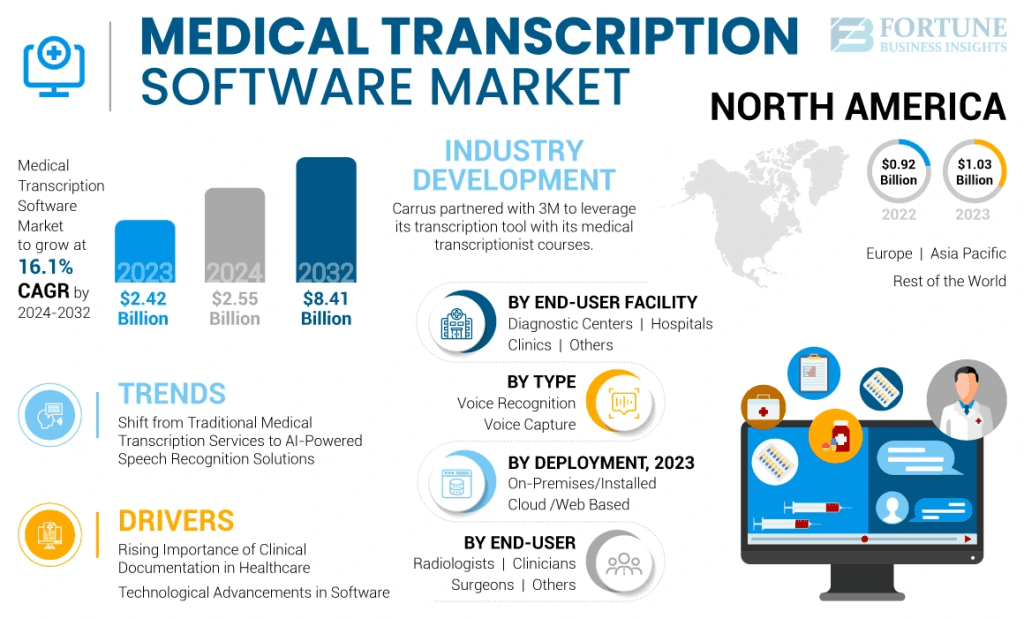
Market data supports this shift. According to Fortune Business Insights,the global medical transcription software market size was valued at USD 2.55 billion in 2024. The market is projected to grow from USD 2.92 billion in 2025 to USD 8.41 billion by 2032, exhibiting a CAGR of 16.3% during the forecast period.
Modern medical scribe software uses artificial intelligence, natural language processing, and speech recognition to capture clinical conversations and automatically generate structured documentation. For Canadian healthcare providers investing in healthcare software development company, these solutions must meet PHIPA and PIPEDA requirements while integrating seamlessly with existing EHR systems.
This guide covers everything you need to know about medical scribe software development, from core features and benefits to technology stack, costs, and implementation challenges.
What is Medical Scribe Software?
Medical scribe software is an AI-powered application that captures, transcribes, and structures physician–patient conversations into accurate clinical documentation. The software uses speech recognition and natural language processing to generate notes such as SOAP notes, HPI, assessments, and treatment plans in real time or near real time, then integrates them directly into EHR systems, removing manual data entry.
For Canadian healthcare providers, medical scribe software must comply with PHIPA and federal PIPEDA requirements, which require strong encryption, role-based access controls, audit logs, and appropriate data residency practices to protect patient health information.
Space-O Technologies develops medical scribe software that helps Canadian healthcare providers document patient encounters efficiently while meeting PHIPA compliance requirements.
With the foundational concept established, let’s explore the technical mechanics—discover how medical scribe software transforms spoken conversations into structured clinical documentation.
How Does Medical Scribe Software Work?
Medical scribe software operates through a sophisticated pipeline that transforms natural speech into clinically accurate, structured documentation. Understanding this workflow helps healthcare organizations evaluate solutions and plan implementations effectively.
1. Voice capture and ambient listening
The process begins with capturing audio from clinical encounters. Ambient AI scribes use microphones to passively listen to conversations between physicians and patients without requiring the physician to dictate directly.
Alternatively, dictation-based systems capture speech when the physician actively speaks into a device or application. Modern solutions handle both approaches, adapting to different clinical workflows and physician preferences.
2. Speech-to-text conversion using AI
Captured audio passes through advanced speech recognition engines trained specifically on medical vocabulary.
These AI models convert spoken words into text with high accuracy, handling medical terminology, drug names, anatomical references, and clinical abbreviations that general-purpose speech recognition would miss. The best systems achieve 95-98% accuracy on medical speech.
3. Medical terminology recognition and context understanding
Raw transcription isn’t enough—the software must understand clinical context.
Natural language processing (NLP) models identify medical entities (symptoms, diagnoses, medications, procedures), understand relationships between them, and distinguish between what the physician says versus what the patient reports.
This contextual understanding enables accurate documentation that reflects clinical intent.
4. Clinical note structuring
The system organizes extracted information into appropriate clinical formats. A typical encounter might generate SOAP notes (Subjective, Objective, Assessment, Plan), history of present illness narratives, review of systems, physical exam findings, and treatment plans.
The software maps spoken content to the correct sections based on clinical context and organizational templates.
5. EHR/EMR integration and auto-population
Structured notes integrate directly into electronic health record systems through standard protocols like HL7 FHIR or vendor-specific APIs.
The software populates appropriate fields in the EHR, linking documentation to the correct patient record and encounter.
Organizations building comprehensive clinical systems often combine scribe functionality with EHR software development to create unified documentation workflows.
This integration eliminates copy-paste workflows and reduces transcription errors.
6. Physician review and approval workflow
Before finalization, physicians review generated documentation for accuracy and completeness.
The software presents notes for editing, allowing quick corrections or additions. Once approved, notes become part of the permanent medical record. This human-in-the-loop approach maintains physician oversight while dramatically reducing documentation time.
Understanding the workflow reveals what makes Scribe software effective—explore the essential features that drive clinical documentation efficiency.
At Space-O Technologies, we build medical scribe solutions that convert clinical conversations into structured notes and integrate them directly into EHR systems used by Canadian healthcare providers.
What are the Key Features of Medical Scribe Software?
Building effective medical scribe software requires a comprehensive feature set that balances AI capabilities with clinical usability and regulatory compliance. Here are the essential features to include in your development roadmap.
1. AI-powered speech recognition
The foundation of any scribe solution is accurate speech-to-text conversion. Medical-grade speech recognition must handle complex terminology, varied accents, background noise in clinical environments, and natural conversational speech patterns.
Look for recognition engines trained specifically on healthcare data with continuous learning capabilities.
2. Natural language processing for medical terminology
Beyond transcription, NLP engines must understand medical language semantically.
This includes recognizing clinical entities, understanding negation (“patient denies chest pain”), temporal references (“started symptoms three days ago”), and contextual meaning. Medical NLP requires training on clinical corpora and ongoing refinement.
3. Real-time transcription and ambient listening
Physicians need documentation generated during or immediately after encounters—not hours later. Real-time processing with sub-second latency keeps scribe software integrated into clinical workflows rather than creating additional review tasks.
4. Customizable clinical templates
Different specialties and organizations use different documentation formats. Scribe software must support customizable templates for SOAP notes, procedure notes, consultation letters, and specialty-specific formats. Template flexibility ensures the software adapts to existing workflows rather than forcing workflow changes.
5. EHR/EMR integration
Seamless integration with major EHR systems is non-negotiable. For Canadian healthcare, this includes Epic, Cerner, Meditech, OSCAR, and provincial systems. Integration should support bidirectional data flow—pulling patient context and pushing completed documentation.
Pro Tip: When prioritizing features, start with core transcription and EHR integration before adding advanced capabilities like predictive documentation or specialty-specific modules. Clinicians will adopt software that solves their primary pain point first.
6. Secure data encryption and compliance
Healthcare data requires robust security. Implement end-to-end encryption for audio and text, secure authentication, role-based access controls, and comprehensive audit logging. For Canadian deployments, ensure PHIPA and PIPEDA compliance with appropriate data residency configurations.
These features deliver tangible advantages—discover the major benefits driving healthcare organizations to adopt medical scribe software. Space-O Technologies develops medical scribe software with customizable templates for different medical specialties and secure integration with major EHR platforms.
What are the Benefits of Medical Scribe Software?
The adoption of medical scribe software delivers measurable improvements across clinical, operational, and financial dimensions. Here’s what healthcare organizations consistently report after implementation.
1. Reduced physician documentation time
The most immediate benefit is time savings. Physicians using AI scribe software typically reduce documentation time by 50-70%, reclaiming one to two hours daily. That time shifts from administrative tasks back to patient care, professional development, or work-life balance. Studies show physicians can see 2-3 additional patients daily when freed from documentation burden.
2. Lower physician burnout and improved satisfaction
Documentation burden ranks among the top contributors to physician burnout.
By automating the most tedious aspects of clinical work, scribe software directly addresses burnout drivers. Organizations report improved physician satisfaction scores and reduced turnover after implementing AI documentation solutions.
3. Enhanced patient engagement
When physicians aren’t typing during encounters, they maintain eye contact and focus on patients.
This improves the patient experience, strengthens therapeutic relationships, and often leads to more thorough history-taking. Patients notice when their physician is fully present versus distracted by a computer screen.
4. Improved documentation accuracy and completeness
AI scribes capture details that busy physicians might forget to document later. Real-time transcription ensures nothing gets lost between encounter and documentation.
The result is more complete, accurate records that support better continuity of care and reduce medicolegal risk.
5. Faster clinical workflows
Documentation bottlenecks slow patient throughput. When notes complete automatically during encounters, physicians finish charts before patients leave the exam room.
This eliminates end-of-day documentation backlogs and enables faster transitions between patients.
6. Cost savings compared to human scribes
Human scribes cost $3,000-$4,500 monthly per scribe, plus training, benefits, and management overhead.
Software solutions scale across unlimited providers at a fraction of this cost.
Organizations replacing human scribes with AI typically see 60-80% cost reduction while maintaining or improving documentation quality.
Automate Clinical Documentation With Custom Medical Scribe Software
Create medical scribe solutions that streamline note creation, improve documentation accuracy, and fit seamlessly into provider workflows.
Benefits vary by implementation approach—explore the different types of medical scribe software to identify which fits your clinical environment.Space-O Technologies helps healthcare organizations implement medical scribe solutions that reduce documentation time and improve clinical workflow efficiency.
What are the Different Types of Medical Scribe Software?
Medical scribe software comes in several forms, each suited to different clinical contexts and organizational preferences. Understanding these categories helps you specify the right solution for your needs.
1. Ambient AI scribes
Ambient scribes passively listen to patient encounters without requiring active dictation. Microphones capture natural conversation, and AI processes the dialogue to extract clinically relevant information. This approach requires no behaviour change from physicians—they simply conduct encounters normally while the software documents in the background.
2. Voice-to-text dictation software
Dictation solutions require physicians to actively speak their notes, typically after patient encounters. The software transcribes dictated content into structured documentation. This approach offers more physician control over content but requires dedicated dictation time separate from patient interaction.
3. Real-time transcription with live editing
Some solutions display transcription in real time, allowing physicians or support staff to edit documentation during encounters. This hybrid approach combines automation with immediate human oversight, useful for complex encounters requiring careful documentation.
4. Specialty-specific scribe solutions
Certain specialties have unique documentation requirements that general-purpose scribes handle poorly. Specialty-specific solutions are trained on relevant terminology, common presentations, and documentation formats for areas like radiology, dermatology, psychiatry, or surgery.
5. Mobile scribe applications
Mobile-first scribe applications support documentation from smartphones or tablets. These solutions suit providers who move between locations, conduct home visits, or work in settings without fixed workstations. Mobile apps often include offline capabilities for connectivity-challenged environments.
Space-O Technologies builds different types of medical scribe software based on your clinical needs and workflow requirements. Healthcare organizations often integrate scribe functionality with other clinical tools.
For example, combining scribe software with telemedicine software development creates unified virtual care platforms where documentation happens automatically during video consultations.
Choosing the right type leads to the development phase—follow this step-by-step guide to building medical scribe software from concept to deployment.
How to Develop Medical Scribe Software? [A Step-by-Step Guide]
Building medical scribe software requires a structured approach that balances AI capabilities with clinical requirements and regulatory compliance. Here’s the development process we recommend.
Step 1: Define clinical requirements and target specialties
Begin by identifying which clinical workflows and specialties your software will serve. Document specific use cases including ambulatory visits, inpatient rounds, telehealth encounters, and procedural documentation. Engage physicians early to understand their pain points, workflow preferences, and documentation standards that will shape subsequent development decisions.
Step 2: Design UX/UI for clinical workflows
Create interfaces that integrate seamlessly into existing clinical workflows without disrupting patient encounters.
Design screens requiring minimal physician interaction during appointments while ensuring efficient review and editing capabilities.
Consider how generated notes will integrate with existing EHR workflows, as user experience directly determines adoption rates. Our healthcare app design team at Space-O, specializes in creating intuitive clinical interfaces.
Step 3: Build speech recognition and NLP engine
The technical core of scribe software is the AI pipeline. Options include leveraging pre-trained medical speech recognition APIs (Google Healthcare, AWS Transcribe Medical, Nuance) or training custom models.
NLP components extract clinical entities, understand context, and map content to documentation structures. For organizations exploring broader AI capabilities, understanding how to create an AI app using AI covers foundational approaches to implementing machine learning in healthcare applications.
Step 4: Train AI models on medical terminology
Fine-tune your AI models using clinical transcripts, medical dictionaries, specialty-specific vocabularies, and comprehensive drug databases.
Include diverse speaker samples to handle accent variations across your target user base. Plan for iterative refinement cycles, as model training requires multiple adjustments before achieving production-level transcription accuracy.
Pro Tip: Start with a pilot deployment in a single department before organization-wide rollout. This allows you to refine AI models based on real clinical feedback and build internal champions who support broader adoption.
Step 5: Integrate with EHR/EMR systems
Connect your scribe software with existing electronic health record systems using vendor-specific APIs and healthcare interoperability standards. Implement HL7 FHIR protocols for modern healthcare data exchange. Work directly with EHR vendors or leverage established integration platforms to ensure scribe output flows securely into patient records.
Organizations considering outsourcing healthcare software development should prioritize partners with proven EHR integration experience across major platforms.
Step 6: Implement security and compliance measures
Build comprehensive security into your architecture from the initial development phase. Implement encryption for data in transit and at rest, secure authentication mechanisms, role-based access controls, and detailed audit logging.
For Canadian deployments, ensure data residency options keep patient information within Canadian borders when regulations require.
Step 7: Conduct clinical testing and validation
Validate your software’s accuracy and usability through testing with real clinical users before deployment.
Measure transcription accuracy rates, documentation completeness, and actual time savings achieved.
Gather detailed physician feedback on workflow integration and iterate based on testing results until performance consistently meets established clinical standards.
Step 8: Deploy and provide ongoing training
Roll out production deployment in phases, starting with enthusiastic early adopters before expanding organization-wide.
Provide comprehensive training covering software operation, editing workflows, and documentation best practices. Establish dedicated support channels to address questions and resolve issues quickly during the critical transition period.
Space-O Technologies follows agile software development methodologies for healthcare projects, enabling iterative delivery and continuous refinement based on clinical feedback throughout the development process.
Modernize Clinical Documentation With AI-Ready Scribe Solutions
Design medical scribe software that supports real-time documentation, specialty-specific templates, and scalable healthcare operations.
Development decisions depend on technology choices, here’s what medical scribe software development realistically costs across different complexity levels.
How Much Does Medical Scribe Software Development Cost?
AI clinical documentation costs in Canada: $50K-$100K for basic MVP (speech-to-text, 4-6 months), $100K-$250K mid-tier (NLP, mobile, 6-9 months), $250K-$500K+ enterprise (advanced AI, 9-15 months).
Understanding development costs helps healthcare organizations budget appropriately and evaluate build-versus-buy decisions. Here’s what to expect at different complexity levels.
1. Factors impacting development cost
Several variables influence total investment:
- Complexity and feature scope: Basic transcription costs less than ambient listening with multi-speaker diarization. Each additional feature (custom templates, analytics dashboards, mobile apps) adds development effort.
- AI/ML model training: Custom-trained models require substantial data science investment. Leveraging pre-trained APIs reduces costs but may limit customization. Specialty-specific training adds complexity.
- Number of specialty modules: Supporting multiple specialties requires additional template development, terminology training, and validation across clinical contexts.
- EHR integrations: Each EHR integration requires development effort. Epic, Cerner, and Meditech each have different integration approaches. Plan for 2-4 weeks per integration.
- Compliance certifications: HIPAA audits, SOC 2 certification, and Canadian privacy assessments add costs but build trust with healthcare buyers.
2. Cost breakdown by project type
| Tier | Key Features | Platform | Timeline | Cost Range |
|---|---|---|---|---|
| Basic MVP(Core functionality) | – Speech-to-text transcription- Basic clinical note formatting- Single EHR integration | Web application | 4-6 months | $50,000 – $100,000 |
| Mid-complexity | – Ambient listening capabilities- NLP-powered entity extraction- Customizable templates- Multiple EHR integrations- Analytics dashboard | Mobile application | 6-9 months | $100,000 – $250,000 |
| Enterprise-grade | – Advanced AI with continuous learning- Multi-specialty support- Real-time collaboration- Comprehensive EHR ecosystem integration- Enterprise security & compliance- White-label capabilities | Full platform | 9-15 months | $250,000 – $500,000+ |
3. Ongoing costs
Development is just the beginning. Budget for:
- Maintenance and updates: 15-20% of initial development annually
- AI model retraining: Continuous improvement based on production data
- Cloud infrastructure: Scales with usage and storage requirements
- Compliance audits: Annual assessments to maintain certifications
- Support and training: Ongoing user support and new feature training
For detailed healthcare project budgeting guidance, understanding software development cost factors helps organizations plan realistic budgets.
Budget planning requires awareness of potential obstacles—learn the key challenges in medical scribe software development and strategies to overcome them.
What are the Challenges in Medical Scribe Software Development and [How to Overcome Them]?
Building effective medical scribe software involves navigating significant technical and operational challenges. Understanding these obstacles upfront enables proactive planning and risk mitigation.
1. Medical terminology accuracy
Healthcare language is complex—thousands of drug names, anatomical terms, abbreviations, and specialty-specific vocabulary. Generic speech recognition fails on medical content. Solutions require extensive medical vocabulary training and continuous refinement based on production errors.
Solution: Invest in medical-specific speech recognition models and build feedback loops that capture and correct terminology errors for ongoing model improvement.
2. Ambient noise in clinical environments
Exam rooms aren’t quiet recording studios. HVAC systems, hallway conversations, equipment sounds, and patient movement create challenging audio conditions. Software must isolate relevant speech from background noise.
Solution: Implement noise cancellation algorithms, use directional microphones, and train models on noisy clinical audio samples.
3. Multi-speaker diarization
Distinguishing physician speech from patient speech is essential for accurate documentation. The software must identify who said what to correctly attribute symptoms (patient-reported) versus assessments (physician-stated).
Solution: Train speaker diarization models that identify speaker transitions and attribute content accordingly. Some solutions use separate microphones for each speaker.
4. EHR integration complexity
Healthcare organizations use diverse EHR systems with varying integration capabilities. Some vendors restrict API access or charge significant integration fees. Legacy systems may lack modern integration standards entirely.
Solution: Prioritize EHR vendors with open APIs and FHIR support. Build integration middleware that abstracts vendor differences. Budget adequate time and resources for integration development and testing.
5. Regulatory compliance requirements
HIPAA, PHIPA, PIPEDA, and provincial regulations impose strict requirements on health data handling. Non-compliance risks significant penalties and reputational damage. Compliance must be built into architecture, not bolted on later.
Solution: Engage compliance experts early in development. Implement security controls by design. Plan for certification audits as part of the development timeline.
6. Continuous AI model improvement
AI models degrade over time as language patterns, medical terminology, and clinical practices evolve. Initial accuracy doesn’t guarantee long-term performance. Models require ongoing monitoring and retraining.
Solution: Implement model performance monitoring. Establish retraining pipelines using production data. Create feedback mechanisms for physicians to flag errors.
For insights on leveraging AI effectively in healthcare contexts, explore our guide on predictive analytics in healthcare. Space-O Technologies has experience building healthcare software that addresses these technical and compliance challenges for Canadian healthcare organizations.
Replace Manual Note-Taking With Intelligent Medical Scribe Software
Implement medical scribe solutions that integrate with EHR systems and reduce physician burnout caused by documentation overload.
Overcoming these challenges requires experienced partners—discover why healthcare organizations trust Space-O Technologies for medical scribe software development.
Building the Future of Clinical Documentation With Space-O Technologies
Medical scribe software represents a fundamental shift in how healthcare organizations handle clinical documentation. By automating the most time-consuming aspects of physician workflows, AI-powered scribes reduce burnout, improve patient engagement, and deliver measurable operational efficiencies.
Building effective medical scribe software requires expertise spanning AI/ML, healthcare workflows, regulatory compliance, and enterprise integration. The technology stack must handle complex medical speech, integrate with diverse EHR systems, and meet stringent security requirements.
Space-O Technologies helps healthcare organizations navigate this complexity. Our teams combine deep healthcare software experience with proven AI capabilities to build scribe solutions that clinicians actually adopt, and organizations can trust.
Ready to reduce documentation burden and improve clinical workflows? Schedule a free consultation to discuss your medical scribe software requirements, or explore our healthcare software development services to see how we can help.
Frequently Asked Questions About Medical Scribe Software Development
What is the difference between AI medical scribe software and traditional transcription?
Traditional transcription converts dictated audio into text without understanding clinical context. AI medical scribe software uses natural language processing to understand clinical conversations, extract relevant information, and automatically structure documentation into appropriate formats like SOAP notes. Scribes also integrate directly with EHR systems, eliminating manual data entry.
How long does it take to develop medical scribe software?
Development timelines vary by complexity. A basic MVP with core transcription and single EHR integration typically takes 4-6 months. Mid-complexity solutions with ambient listening, NLP, and multiple integrations require 6-9 months. Enterprise platforms with advanced AI and comprehensive features may take 9-15 months or longer.
Can medical scribe software integrate with existing EHR systems?
Yes, modern medical scribe software integrates with major EHR platforms including Epic, Cerner, Meditech, OSCAR, and others. Integration typically uses HL7 FHIR standards or vendor-specific APIs to push completed documentation into patient records. Integration complexity varies by EHR vendor and required data flows.
What specialties benefit most from medical scribe software?
Specialties with high documentation burden see the greatest benefits. Primary care, internal medicine, and family medicine handle high patient volumes with detailed documentation requirements. Specialties like psychiatry, neurology, and rheumatology with complex histories also benefit significantly. Procedural specialties benefit from automated procedure note generation.
How accurate is AI-powered medical transcription?
Modern medical speech recognition achieves 95-98% accuracy on clinical speech when properly trained on medical vocabulary. Accuracy depends on audio quality, speaker clarity, accent familiarity, and medical terminology coverage. Ambient listening in noisy environments typically has lower accuracy than direct dictation. All solutions should include physician review before finalizing documentation.


Want to Develop a Medical Scribe Software?
 All our projects are secured by NDA
100% Secure. Zero Spam
*All your data will remain strictly confidential.
Trusted by


Bashar Anabtawi 
Canada
“I was mostly happy with the high level of experience and professionalism of the various teams that worked on my project. Not only they clearly understood my exact technical requirements but even suggested better ways in doing them. The Communication tools that were used were excellent and easy. And finally and most importantly, the interaction, follow up and support from the top management was great. Space-O not delivered a high quality product but exceeded my expectations! I would definitely hire them again for future jobs!”

Canada Office
2 County Court Blvd., Suite 400,
Brampton, Ontario L6W 3W8
Phone: +1 (602) 737-0187
Email: sales@spaceo.ca