
- What Is an Offshore Development Team?
- Why Hire an Offshore Software Development Team?
- What Does an Offshore Development Team Do?
- Who Are the Key Members of an Offshore Development Team?
- What Are the Challenges of Hiring an Offshore Software Development Team? (With Solutions)
- When Should You Hire Offshore Developers?
- Which Offshore Software Development Services Should You Consider?
- Which Businesses Hire Offshore Development Teams And Why?
- Frequently Asked Questions
- Hire an Offshore Development Team
Offshore Development Team: Importance, Values and Operations

 Last Updated: July, 9 2025
Companies of all sizes and across various industries hire offshore development teams for different purposes. Some common reasons are efficiency, cost savings, and access to a global talent pool and specialized skills. (Source: Statista) This strategic approach allows businesses to optimize their resources and focus on core goals.
For example, enterprises can hire offshore developers to scale quickly, avoiding high recruitment costs and a lengthy hiring process. Similarly, small and medium-sized businesses can use offshore developers to accelerate development and achieve faster time-to-market.
In this blog post, we’ll cover what an offshore development team is, why and when to hire one, their roles and responsibilities, and the types of services and businesses involved.
What Is an Offshore Development Team?
An offshore development team is a collective of technology professionals who work from a location outside the geographic boundaries as that of the client company. They engage in a range of offshore software development activities, including software designing, development, testing, and maintenance.
Such remote teams are assembled in various countries known for their strong tech talent pools and cost-effective operational structures. For example, a company based in the USA might choose to hire an offshore team from a software development company in Canada. This decision could be motivated by Canada’s highly qualified tech talent pool, competitive pricing, and similar time zones that facilitate smooth communication and collaboration.
These teams consist of individuals such as software developers, project managers, quality assurance testers, and UI/UX (User Interface/User Experience)designers. Each member of the team brings specialized technical expertise and experience, contributing to the overall success of the projects.
Why Hire an Offshore Software Development Team?
Simply put — to resolve technology struggles and achieve business goals.
Let’s see how hiring an offshore development team can benefit you in detail.
1. Cost efficiency
One of the primary reasons companies are hiring offshore developers is cost savings. Offshore teams often operate in regions with lower labor costs, allowing your business to access highly skilled professionals at a fraction of the price you would pay to the local developers. This can significantly reduce overall project expenses without compromising quality.
2. Access to specialized skills
Hiring dedicated offshore developers provide access to a wide range of specialized skills and expertise that may be scarce or unavailable locally. Whether your company needs advanced technical capabilities, niche industry knowledge, or cutting-edge technology skills, offshore teams can offer the necessary talent to meet these requirements.
3. Scalability and flexibility
An offshore development team helps you scale resources up or down quickly based on project demands. This flexibility allows your business to adapt to changing needs without the long-term commitment associated with hiring permanent staff. It’s particularly useful for handling peak workloads or for short-term projects.
4. Faster time-to-market
With offshore development teams working across different time zones, development processes can continue around the clock. This leads to faster project completion times and quicker delivery of products or services to the market. The ability to utilize different working hours enhances productivity and accelerates time-to-market.
5. Focus on core business
By delegating development tasks to an offshore team, you can focus on your core business activities and strategic goals. This delegation keeps you from being bogged down by technical challenges and allows you to concentrate on areas that drive competitive advantage.
6. Global Perspective and Innovation
Offshore teams bring diverse perspectives and approaches to problem-solving. Exposure to various cultural and business environments can lead to innovative solutions and unique insights that might not be readily available within a single geographic region. This diversity can enhance creativity and improve the overall quality of the work.
7. Risk Management
Offshore developers can help mitigate risks associated with sudden changes in the local labor market or economic conditions. By spreading development efforts across multiple regions, you can reduce dependence on a single location and manage risks more effectively.
Hire an Offshore Development Team
Start building your digital solution with a team of technology professionals who have developed solutions for award-winning and Fortune 500 companies.

What Does an Offshore Development Team Do?
Offshore development team handles various aspects of software development, including design, coding, testing, and maintenance.
Let’s look at their operations in detail.
| Project Management | |
|---|---|
| Planning and Scheduling | Offshore teams often handle the project planning and scheduling to ensure timely delivery. They create detailed project roadmaps and timelines to keep the project on track. |
| Coordination | They coordinate between different stakeholders, including the onshore team, to align project goals. Effective communication ensures that everyone is on the same page and that any potential issues are addressed promptly. |
| Risk Management | They identify potential risks and devise strategies to mitigate them. They continuously monitor the project’s progress to address risks early. |
| Design and Architecture | |
|---|---|
| Requirement Analysis | Offshore development teams understand and analyze project requirements to create a blueprint. This involves collaborating closely with stakeholders to ensure all requirements are captured accurately. |
| System Design | They also design the overall system architecture, including databases, UI/UX, and back-end infrastructure. The design phase includes creating detailed diagrams and models to represent the system’s structure and flow. |
| Prototyping | The team creates prototypes or wireframes to visualize the end product before actual development begins. Prototyping helps get early feedback and adjustments, reducing the risk of costly changes later on. |
| Development and Coding | |
|---|---|
| Frontend Development | The team builds the application, ensuring a responsive and intuitive user interface. This involves using frameworks like React, Angular, or Vue.js to create dynamic user experiences. |
| System Design | They also design the overall system architecture, including databases, UI/UX, and back-end infrastructure. The design phase includes creating detailed diagrams and models to represent the system’s structure and flow. |
| Prototyping | The team creates prototypes or wireframes to visualize the end product before actual development begins. Prototyping helps get early feedback and adjustments, reducing the risk of costly changes later on. |
| Quality Assurance and Testing | |
|---|---|
| Unit Testing | Individual components are tested to ensure they function correctly. Automated unit tests help in catching bugs early in the software development process. |
| Integration Testing | The team checks the interactions between different modules. Integration testing ensures that combined components work together as expected. |
| System Testing | They verify the entire system for compliance with requirements. System check involves end-to-end testing of the application in a production-like environment. |
| User Acceptance Testing (UAT) | The team ensures the software meets the end-users’ needs and expectations. UAT is when real users test the application to gauge if it meets their requirements and is ready for deployment. |
| Deployment and Maintenance | |
|---|---|
| Deployment | This involves managing the release process, including environment setup and configuration. They use continuous integration/continuous deployment (CI/CD) pipelines to automate the deployment process. |
| Monitoring | The team continuously monitors the application’s performance and health. Monitoring tools and dashboards provide real-time insights into the application’s status. |
| Maintenance | They provide ongoing support, fixing bugs, and implementing updates or enhancements. Regular maintenance ensures the software remains up-to-date and performs optimally. |
| Communication and Collaboration | |
|---|---|
| Regular Updates | The team provides regular updates on the project’s progress. These updates can include daily stand-ups, weekly reports, and sprint reviews. |
| Feedback Loop | This involves gathering feedback from the onshore team and stakeholders to make necessary adjustments. A robust feedback loop helps in continuously improving the product and addressing any concerns. |
| Collaboration Tools | The team utilizes tools like Jira, Trello, Slack, and Zoom for effective communication and project management. These tools facilitate real-time collaboration and streamline the workflow. |
| Security Management | |
|---|---|
| Data Security | Robust security measures are implemented to protect sensitive data. Encryption, secure coding practices, and regular security audits are part of the team’s security protocols. |
| Compliance | They ensure compliance with relevant regulations and standards, such as GDPR or HIPAA. They stay updated with the latest regulatory changes and ensure that the software adheres to all legal requirements. |
| Incident Response | The team prepares for and manages security incidents, including breaches and attacks. They develop incident response plans and conduct regular drills to ensure readiness. |
| Documentation | |
|---|---|
| Technical Documentation | This involves creating detailed documentation for code, APIs, and system architecture. Good documentation ensures that the code is understandable and maintainable by other developers. |
| User Manuals | User guides and manuals for end-users and administrators are provided. These manuals help users understand how to use the software effectively and troubleshoot common issues. |
| Knowledge Transfer | The offshore partner ensures knowledge transfer to the onshore team or other stakeholders. Regular training sessions and workshops facilitate smooth knowledge transfer and onboarding. |
Who Are the Key Members of an Offshore Development Team?
There are eight offshore team members who ensure comprehensive coverage of all aspects of software development, from initial planning to final deployment and support.
Let’s learn about their roles and responsibilities.
1. Project Manager
- Role: Acts as the primary point of contact between the client and the development team, ensuring that the project is delivered on time, within scope, and within budget.
- Responsibilities: Planning, scheduling, risk management, and client communication.
2. Software Developers
- Role: Offshore software developers/software engineers are the core members who translate the project requirements into functional software by writing and maintaining code.
- Responsibilities: Developing features, fixing bugs, and optimizing performance.
3. Quality Assurance (QA) Engineers
- Role: They safeguard the quality of the software by identifying defects and ensuring that the product meets all specified requirements.
- Responsibilities: Conducting manual and automated testing, identifying defects, and ensuring functionality.
4. UI/UX Designers
- Role: They focus on creating a visually appealing and user-friendly interface that enhances the overall user experience.
- Responsibilities: Creating wireframes, prototypes, and visual designs that enhance usability and user satisfaction.
5. Business Analysts
- Role: Serve as the intermediary between the business stakeholders and the technical team to ensure that the project aligns with business goals.
- Responsibilities: Gathering requirements, analyzing business processes, and defining project scope.
6. System Architects
- Role: Design the overarching structure of the software system, making key decisions related to technologies and frameworks to ensure scalability and performance.
- Responsibilities: Creating high-level design choices, selecting technical standards, and ensuring scalability.
7. Database Administrators (DBAs)
- Role: Manage and maintain database systems to ensure data integrity, security, and optimal performance.
- Responsibilities: Ensuring data integrity, optimizing database performance, and implementing security measures.
8. Support and Maintenance Staff
- Role: Provide ongoing technical support and address any issues that arise post-deployment to ensure the software continues to function smoothly.
- Responsibilities: Troubleshooting, implementing updates, and providing technical assistance to users.
What Are the Challenges of Hiring an Offshore Software Development Team? (With Solutions)
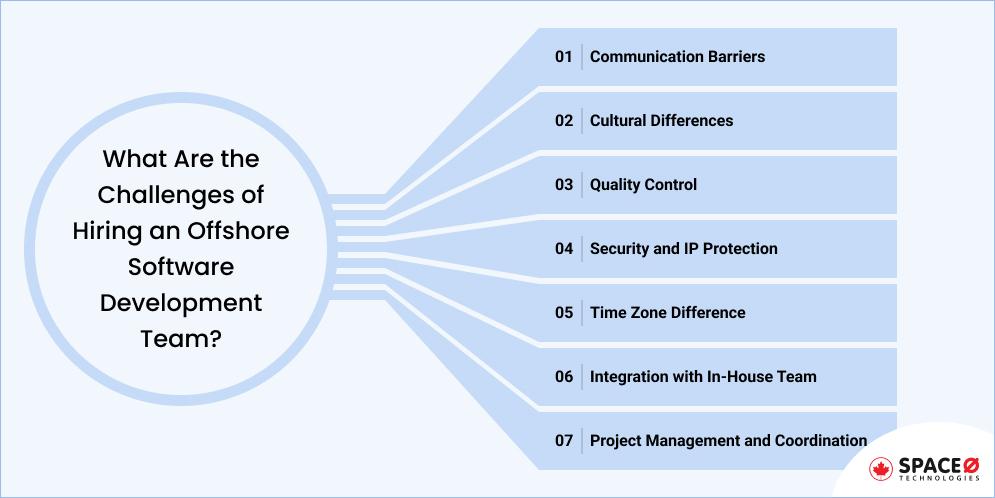
There are a few operational and managerial challenges when it comes to working with offshore development companies. However, at Space-O Technologies, we have developed models and practices for smooth operations, over 14+ years of working with different businesses across the globe.
1. Communication Barriers
- Challenge: Differences in language and communication styles can lead to misunderstandings and inefficiencies between offshore software development teams and clients.
- Solution: We implement regular communication protocols such as daily stand-ups, weekly meetings, and the use of collaboration tools like Slack or Microsoft Teams. We have already trained our development teams for easy communication for clear and concise language.
2. Cultural Differences
- Challenge: Variations in work culture, holidays, and practices can affect teamwork and project timelines.
- Solution: We foster cultural awareness and sensitivity through training programs. By establishing common ground, we set clear expectations and align work practices accordingly. We often celebrate key cultural events to build rapport and mutual respect between both the teams.
3. Quality Control
- Challenge: Ensuring consistent quality and standards across different locations can be difficult.
- Solution: We have defined clear quality standards and established robust quality assurance processes. Our development teams also use automated testing tools and regular code reviews to maintain high standards. Additionally, you can also appoint local team leads to collaborate with us so that we stay on the same page when it comes to quality.
4. Security and IP Protection
- Challenge: Maintaining data security and protecting intellectual property when working with remote teams is crucial.
- Solution: We have implemented stringent security measures such as VPNs, encryption, and access controls. Also, we have created comprehensive non-disclosure agreements (NDAs) along with regular security audits. Our team members have undertaken multiple training sessions on data protection best practices too.
5. Time Zone Difference
- Challenge: Coordinating work across different time zones can lead to delays and reduce overlap time for collaboration.
- Solution: We establish overlapping working hours for real-time collaboration. In addition, we utilize asynchronous communication tools like email and project management software to keep everyone informed and aligned. We also plan meetings and deadlines considering time zone differences to maximize productivity.
6. Integration with In-House Team
- Challenge: Seamlessly integrating the offshore team with the in-house team can be challenging.
- Solution: We encourage team-building activities to create a sense of unity along with implementing unified project management and version control tools. Depending upon the engagement models, we also regularly exchange team members between locations to build trust and understanding.
7. Project Management and Coordination
- Challenge: Coordinating complex projects across multiple locations can be cumbersome.
- Solution: We use robust project management tools like Jira or Trello to track tasks and progress. On your part, you can also assign dedicated project managers to oversee coordination and communication. We believe that establishing clear project milestones and streamlined management can help achieve the goals more efficiently.
When Should You Hire Offshore Developers?
There are multiple scenarios in which you should hire the best offshore software developers so that you can achieve your goals.
Let’s learn about them in detail.
1. Tight budget
If you have a budget constraint, then it is wise to outsource software development requirements to a country where developers tend to charge less. You can consider a country like Canada, where the average salary of a software developer is CAD 72,470/year.
2. Targeted time-to-market
Your offshore development company is most likely experienced in working on various software development projects, and they have mastered delivering projects within the estimated timeline.
In addition, the remote developers ensure that they help you meet your project requirements and offer the best quality of software development results. As a result, you will be faster in the market to meet the demand of your target audience and ahead of your industry competition.
3. Need for specific skillset
Hiring offshore developers is a good option when you need to build a niche product. For instance, if you’re developing fintech software to reinvent how people lend, borrow, and invest money, you might need to hire Flutter developers.
Hiring local developers having the necessary experience might be challenging, especially if you are constrained by time and budget. In such cases, you can either appoint a dedicated development team and have them learn the required skills or hire an offshore software developer.
The right offshore developers with specific skill sets can save you costs, as they already possess the expertise needed for your project. If you are unsure how to proceed, check our blog for tips on hiring software developers for startups.
4. Need resources for short-term projects
Hiring local developers for a short-term project can be a costly investment, especially if you only need the team’s services for a limited period. Once the project concludes, you may no longer require their expertise.
In such cases, hiring an offshore development team is a more cost-effective solution. Offshore developers offer the flexibility to hire them for the specific duration of your project and release them once the work is completed.
5. Business scaling
To stay in competition, expanding your business is essential. This involves adopting the latest technology stacks, using advanced software development tools, maintaining the performance of existing software, and implementing strategies to boost sales.
Leveraging the services of your established offshore development partner can significantly support your business expansion. Such a team provides operational flexibility, helps integrate new and advanced technologies, and grants access to new markets.
Want to Hire an Offshore Software Development Team?
We have a team of skilled technology professionals who have worked with clients such as names
Which Offshore Software Development Services Should You Consider?
There are nine offshore development services that are in demand today.
Let’s understand them in brief.
Custom Software Development
Tailor-made solutions designed to address the unique requirements of a business. This can encompass a wide range of applications, including web-based platforms, mobile apps, and comprehensive enterprise systems.Software Maintenance and Support
Ongoing assistance to keep software functional, secure, and up-to-date. This includes activities such as bug fixes, system updates, performance enhancements, and security patches.Web Development
Services that cover the creation, design, and management of websites. This includes both front-end development (design and user interface) and back-end development (server-side functionality and database management).Mobile App Development
Development of mobile applications for different platforms such as iOS and Android. This can include native apps (built for a specific platform), hybrid apps (combining native and web elements), and cross-platform apps (using a single codebase for multiple platforms).UI/UX Design
UI and UX design services focus on improving the usability and visual appeal of software or websites. This includes designing intuitive interfaces, optimizing user flows, and enhancing the overall user experience.Quality Assurance and Testing
Comprehensive testing services to identify and resolve defects, performance issues, and security vulnerabilities. This includes functional testing, performance testing, security testing, and more.Data Analytics and Business Intelligence
Services for data collection and visualization to support informed decision-making. This includes data mining, statistical analysis, dashboard creation, and reporting.Artificial Intelligence and Machine Learning
Implementation of advanced algorithms and models to enhance automation, data analysis, and predictive capabilities. This includes developing intelligent systems that can learn from data and make predictions or decisions.Consulting Services
Consulting services provide expert advice on various aspects of technology, including strategy development, software architecture, and project management. Consultants offer insights and recommendations to help businesses navigate complex technical challenges and optimize their software projects.
Which Businesses Hire Offshore Development Teams And Why?
There are multiple reasons why different companies hire offshore development teams to build digital solutions.
Let’s learn more in detail.
| Reasons to Hire Offshore Developers | Companies |
|---|---|
| Tech Startups | To quickly build and scale their products while managing costs. |
| Small and Medium Enterprises (SMEs) | To utilize specialized skills and reduce operational expenses. |
| Large Corporations | For scaling development efforts, accessing niche expertise, and managing costs efficiently. |
| Software Development Companies | To augment their in-house teams and handle overflow work. |
| eCommerce Businesses | To develop and maintain their platforms, enhance user experience, and integrate new features. |
| Fintech Companies | To develop secure and compliant financial solutions and innovate rapidly. |
| Healthcare Organizations | To develop health tech applications, patient management systems, and telehealth solutions. |
| Manufacturing Firms | To utilize specialized skills and reduce operational expenses. |
| Marketing Agencies | To create custom marketing software, manage campaigns, and analyze data. |
| Educational Institutions | To develop e-learning platforms, virtual classrooms, and other educational technologies. |
Ready to Hire an Offshore Development Team?
Space-O has a team of technology professionals who are highly skilled, experienced, and dedicated to solving challenges with cutting-edge solutions and a collaborative approach.
Frequently Asked Questions
Where to find an offshore development team?
You can find offshore development teams through online platforms like Upwork, Toptal, Clutch, and LinkedIn. You can also reach out directly to outsourcing companies specializing in software development. Popular countries for offshore teams include Canada, India, China, and Malaysia.
What is the difference between an offshore team and an onshore team?
An offshore team operates from a different country, offering cost-effective solutions, access to a larger talent pool, and round-the-clock productivity due to time zone differences. In contrast, an onshore team is locally based but often more expensive. If you’re weighing the pros and cons of both models, this detailed comparison of offshore vs onshore software development can help you make an informed decision based on cost, communication, and project needs.
How should a development team be structured?
A development team should include roles such as project manager, developers, QA testers, UI/UX designers, and DevOps engineers, ensuring a balanced mix of skills and responsibilities. Each role should be clearly defined to avoid overlaps and ensure accountability.
How do you get maximum productivity from an offshore team?
To maximize productivity, establish clear communication, set realistic deadlines, use project management tools, provide regular feedback, and build a strong team culture. Regular video calls and team-building activities can help strengthen remote collaboration.
What is offshore team management?
Offshore team management involves overseeing a remote team located in another country, ensuring effective communication, task delegation, progress tracking, and fostering team collaboration to achieve project goals. It requires understanding cultural differences and adapting management styles accordingly.
Hire an Offshore Development Team
Now that you understand when and why you should hire an offshore development team for your software project, let’s talk about the process of hiring offshore software developers.
Start with clearly defining your requirements, research potential teams, evaluate communication skills, and check for cultural fit. You can also start with a pilot project to assess the team’s capabilities.
You can Contact Spaceo-O technlogies to enhance your project’s success with a dedicated offshore development team that combines technical expertise, efficient workflows, and clear communication to deliver high-quality solutions. Our tailored approach ensures seamless collaboration, cultural alignment, and faster project completion, allowing you to focus on scaling business while we take care of your development needs.


Hire Offshore Software Developers
What to read next



 All our projects are secured by NDA
100% Secure. Zero Spam
*All your data will remain strictly confidential.
Trusted by


Bashar Anabtawi 
Canada
“I was mostly happy with the high level of experience and professionalism of the various teams that worked on my project. Not only they clearly understood my exact technical requirements but even suggested better ways in doing them. The Communication tools that were used were excellent and easy. And finally and most importantly, the interaction, follow up and support from the top management was great. Space-O not delivered a high quality product but exceeded my expectations! I would definitely hire them again for future jobs!”

Canada Office
2 County Court Blvd., Suite 400,
Brampton, Ontario L6W 3W8
Phone: +1 (602) 737-0187
Email: sales@spaceo.ca