
- What is Predictive Analytics in Healthcare?
- How Does Predictive Analytics Work?
- What are the Key Applications of Predictive Analytics in Healthcare
- What are the Major Benefits of Predictive Analytics in Healthcare?
- Real-World Examples of Predictive Analytics in Healthcare
- How to Build a Predictive Analytics System in Healthcare?
- 1. Define business-critical objectives first
- 2. Evaluate data readiness and governance
- 3. Choose the right implementation approach
- 4. Prioritize workflow integration over model complexity
- 5. Embed compliance and security from day one
- 6. Enable adoption through training and change management
- 7. Monitor performance and continuously optimize
- What are the Challenges and Limitations of Predictive Analytics in Healthcare
- What is the Future of Predictive Analytics in Healthcare?
- How to Choose a Predictive Analytics Solution for Healthcare?
- Turning Predictive Analytics Into Real-World Healthcare Impact With Space-O Technologies
- Frequently Asked Questions (FAQ) about Predictive Analytics in Healthcare
Predictive Analytics in Healthcare: Use Cases, Benefits, and Implementation Explained

 Last Updated: January, 9 2026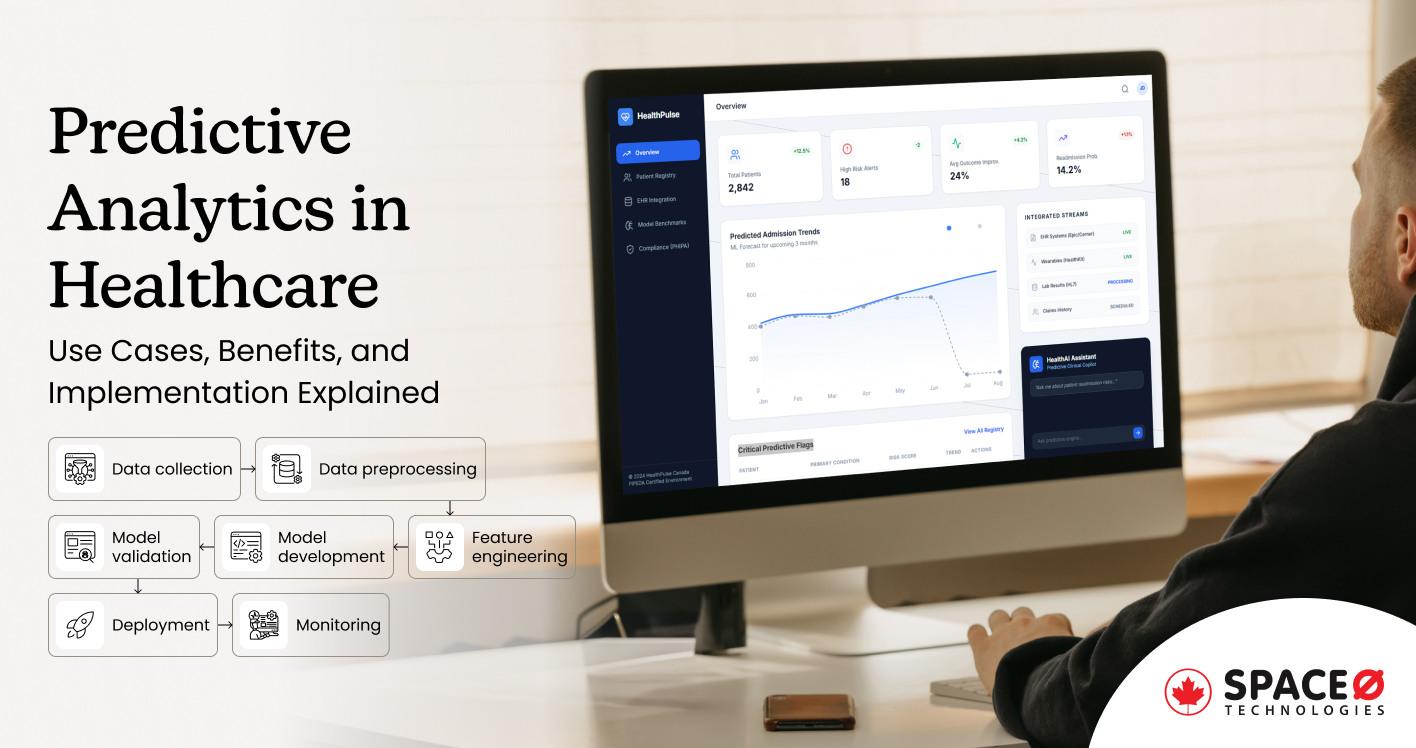
Are you sitting on years of patient, clinical, and operational data—but still reacting to problems after they occur? You’re not alone. Many healthcare organizations collect vast amounts of data every day, yet struggle to use it when decisions matter most. That gap is why predictive analytics in healthcare is gaining rapid adoption.
According to Global Wire, the global healthcare predictive analytics market was valued at USD 17.61 billion in 2024 and is projected to grow from USD 21.78 billion in 2025 to USD 119.56 billion by 2033, at a CAGR of 23.72%. Predictive analytics helps providers identify risks early, anticipate patient needs, optimize resources, reduce readmissions, and control rising operational costs.
This guide breaks predictive analytics in healthcare down in clear, practical terms. You’ll learn how it works, where it delivers the most value, real-world healthcare use cases, and what it takes to implement predictive analytics across clinical and operational workflows.
What is Predictive Analytics in Healthcare?
Predictive analytics in healthcare uses statistical models, machine learning, and AI to forecast future health outcomes using current and historical patient data. Unlike traditional analytics that explain past events, predictive analytics anticipates what may happen next—allowing clinicians to intervene earlier and prevent complications.
This approach analyzes data from EHRs, lab results, medical imaging, insurance claims, wearables, and social determinants of health. Predictive analytics software uncovers hidden patterns and delivers actionable insights at the point of care. For Canadian providers, these solutions must meet PHIPA and PIPEDA requirements while integrating seamlessly with existing health systems.
Organizations investing in healthcare software development must prioritize analytics capabilities from the outset, as retrofitting predictive features into existing systems proves significantly more complex and costly than building them into the foundation.
Pro Tip: When evaluating healthcare predictive analytics software, ensure it offers both robust modeling capabilities and seamless integration with clinical workflows. The best predictions are worthless if clinicians can’t easily access and act on them.
With the core concept established, let’s examine the technical foundation—how predictive analytics actually processes healthcare data to deliver actionable insights.
How Does Predictive Analytics Work?
The mechanics of healthcare predictive analytics involve a sophisticated multi-stage process that transforms raw patient data into actionable clinical insights. Understanding this workflow helps healthcare organizations appreciate both the complexity and value of predictive systems while planning successful implementations.
1. Data collection from multiple healthcare sources
The foundation of AI predictive analytics in healthcare begins with comprehensive data aggregation from EHRs, including demographics, diagnoses, medications, and vital signs. Systems also gather unstructured data like clinical notes and radiology report,s requiring natural language processing. Modern predictive healthcare integrates laboratory information, pharmacy databases, medical imaging, patient portals, remote monitoring devices, and social determinants of health data. Canadian organizations aggregate data across provincial health information exchanges while respecting jurisdictional governance requirements.
2. Data preprocessing and cleaning
Raw healthcare data requires cleaning and standardization before predictive modeling can occur. This involves removing duplicates, correcting errors, addressing missing values, and standardizing terminologies across systems. Data normalization ensures consistency—converting measurements to the same units, standardizing medication names to RxNorm codes, or mapping diagnoses to ICD-10-CA codes. This preprocessing typically consumes 60-70% of project effort but determines prediction accuracy.
3. Feature engineering and selection
Feature engineering transforms raw data into predictive variables. Data scientists identify which patient characteristics, clinical measurements, and historical patterns most strongly correlate with outcomes. For predicting hospital readmissions, relevant features include prior admission frequency, medication adherence, social support indicators, and chronic conditions. Dimensionality reduction techniques manage complexity when dealing with thousands of potential variables.
4. Model development and training
Data scientists select algorithms based on the prediction task. Supervised learning algorithms like random forests and neural networks excel at classification (will this patient be readmitted?) and regression (what will this patient’s HbA1c be?). Models train on historical data where outcomes are known, learning patterns that distinguish patients who experienced events from those who didn’t.
Quick Tip: Start with simpler, interpretable models like logistic regression before advancing to complex deep learning. Clinicians trust predictions they can understand and validate against clinical judgment.
5. Model validation and testing
Rigorous validation ensures predictions are accurate and clinically meaningful. Data scientists split historical data into training and testing sets, evaluating performance on data models that they haven’t seen. This prevents overfitting. Performance metrics assess accuracy, sensitivity (identifying true positives), and specificity (avoiding false alarms). For sepsis prediction, high sensitivity is critical—missing a case could be fatal. Canadian organizations should validate models against provincial benchmarks before deployment.
6. Deployment and integration
Validated models integrate into clinical workflows through EHR interfaces, dashboards, and care management platforms. Real-time predictions appear at the point of care—flagging high-risk patients during appointments or alerting nurses to early sepsis indicators. Batch predictions process patient panels overnight, generating prioritized lists for proactive outreach.
7. Monitoring and continuous improvement
Predictive models require ongoing monitoring and refinement. Performance degrades as populations evolve or treatment protocols change. Organizations track prediction accuracy, investigate declines, and retrain models with recent data. Feedback loops capture clinician observations about prediction usefulness, and bias audits ensure fairness across demographic groups.
Build PIPEDA-Compliant Predictive Analytics Solutions
Partner with Space-O Technologies to develop secure healthcare analytics platforms that meet data privacy standards while delivering accurate predictions
Understanding the mechanics reveals real-world potential—discover the primary applications transforming healthcare delivery today.
What are the Key Applications of Predictive Analytics in Healthcare
Predictive analytics healthcare applications span clinical care, operational management, population health, and financial optimization.
These diverse use cases demonstrate how predictive health analytics delivers value across every aspect of healthcare delivery, from individual patient encounters to system-wide resource planning.
1. Risk stratification and patient identification
Healthcare predictive modeling enables proactive identification of high-risk patients before symptoms manifest. Algorithms calculate individualized risk scores for heart failure exacerbation, diabetic complications, or medication non-adherence. These scores help care teams prioritize resources toward patients who benefit most from intervention. A predictive model might identify a diabetes patient with an 85% hospitalization probability within 90 days, enabling proactive engagement to prevent costly admission.
2. Personalized medicine and treatment planning
Predictive health analytics enables precision medicine by forecasting how individual patients respond to specific treatments. Rather than one-size-fits-all protocols, providers tailor interventions to genetic profiles, medical history, and social context. Pharmacogenomic predictions identify which medications will be most effective while minimizing adverse reactions. Cancer predictions help select chemotherapy regimens most likely to succeed based on tumor characteristics.
3. Operational efficiency and resource management
Predictive analytics healthcare optimizes operational performance. Hospitals forecast patient volumes, emergency arrivals, and bed occupancy—enabling proactive staffing adjustments balancing cost with quality. Predictive models anticipate surgical durations, improving operating room scheduling. Equipment predictions identify when devices will likely fail, enabling preventive maintenance during scheduled downtime. For Canadian hospitals under provincial budgets, efficiency gains translate to more patients served with existing resources.
4. Population health management
Public health organizations leverage predictive analytics to monitor disease patterns and anticipate outbreaks. By analyzing symptoms, lab results, pharmacy claims, and social trends, authorities detect emerging disease clusters weeks before traditional surveillance. Predictions of regional flu severity help allocate vaccines and staff. Population-level predictions identify communities with high chronic disease prevalence requiring targeted prevention programs.
5. Clinical decision support at the point of care
Predictive health diagnostics provide real-time clinical decision support. As providers document patient encounters, algorithms analyze data to suggest diagnoses, flag potential drug interactions, or recommend evidence-based treatments. Sepsis alerts notify clinicians when patients show early warning signs hours before traditional recognition. Fall risk predictions identify patients requiring enhanced monitoring and safety interventions during hospital stays.
Pro Tip: Implement clinical decision support gradually, starting with high-stakes, time-sensitive scenarios like sepsis detection where prediction value is immediately apparent to frontline staff.
These applications deliver measurable impact—here are the major benefits driving healthcare organizations to adopt predictive analytics.
What are the Major Benefits of Predictive Analytics in Healthcare?
The benefits of predictive analytics extend far beyond technological innovation—they translate directly into improved patient outcomes, reduced costs, and more efficient healthcare delivery.
Organizations implementing predictive analytics healthcare solutions consistently report measurable improvements across clinical, operational, and financial metrics.
1. Improved patient outcomes through early intervention
The most significant benefit of predictive analytics in healthcare is enabling early disease detection and preventive care. Algorithms identify health risks before escalation—catching cancer at treatable stages, predicting diabetic complications before organ damage, or detecting heart failure exacerbations before emergency admission. Proactive interventions significantly reduce complications and mortality rates while improving quality of life for patients with chronic conditions.
2. Significant healthcare cost reduction
Predictive analytics health care delivers substantial cost savings by avoiding unnecessary hospitalizations, reducing readmission rates, and optimizing resource allocation. Preventing one hospital readmission saves $15,000-$20,000. Across Canada’s healthcare system, even modest readmission reductions translate to millions in savings redirected toward preventive care. Operational predictions optimize staffing, reduce supply waste, and improve asset utilization—maximizing value from constrained provincial budgets.
3. Enhanced chronic disease management
Predictive healthcare analytics transforms chronic disease management by continuously monitoring patients and intervening when risk scores indicate deterioration. Diabetic patients receive medication adjustments before glucose spirals out of control. COPD patients get pulmonary rehabilitation referrals before exacerbations require hospitalization. This proactive approach improves outcomes while reducing emergency care costs.
4. Reduced hospital readmission rates
Predictive models identify high-risk patients at discharge, enabling targeted interventions—medication reconciliation, home health visits, care coordination, social support—that prevent returns.
Organizations implementing readmission prediction reduce rates, improving patient outcomes while avoiding penalties under value-based care models.
Behind these outcomes is significant investment in interoperable data pipelines, model governance, and clinical oversight—key factors that directly influence the overall cost of implementing AI in healthcare.
5. Fraud detection in health insurance
Predictive analytics in health insurance identifies suspicious claims patterns, reducing financial losses. Machine learning algorithms detect anomalies indicating fraudulent behavior: billing for unnecessary services, modifying medical records, or prescribing medications for black market resale. Early detection protects healthcare system integrity and ensures resources fund legitimate patient care.
6. Better patient engagement and satisfaction
Predictive health analytics enables personalized communication improving patient engagement. Algorithms identify optimal outreach timing, preferred communication channels, and messaging likely to resonate with individual patients. Automated reminders reduce no-shows. Personalized health coaching encourages preventive screenings and medication adherence. Patients appreciate proactive care addressing their specific needs rather than generic protocols, improving satisfaction scores.
Pro Tip: Combine predictive analytics with patient engagement platforms that automate personalized outreach at scale, ensuring high-risk patients receive timely interventions without overwhelming care management teams.
These advantages aren’t theoretical—explore proven case studies demonstrating predictive analytics success across healthcare organizations.
Real-World Examples of Predictive Analytics in Healthcare
Predictive analytics in healthcare examples demonstrate how theoretical capabilities translate into tangible clinical and operational improvements. These 3 healthcare predictive analytics case study examples showcase successful implementations across Canadian healthcare organizations.
1. North York General Hospital
North York General Hospital (NYGH) in Toronto implemented IBM Cognos Analytics and SPSS Modeler for predictive analytics during the COVID-19 response. The system integrated data from clinical systems (Cerner), external sources (Ontario Health), and geospatial datasets to track emergency department (ED) performance.
Predictive models identified service bottlenecks, enabling optimized staffing that improved KPIs, reduced wait times, and secured CAD 3 million in additional annual government funding. This dashboard solution has since been shared with other Ontario hospitals.
2. Saskatchewan Health Authority (Saskatchewan Hospital)
The Saskatchewan Health Authority developed digital twin simulation models using AnyLogic software, starting with their emergency department 10 years ago. Predictive analytics improved patient flow and reduced wait times significantly. The success led to hiring a full-time modeler and expanding to multi-layered models connecting patient-level data to regional decisions, enhancing overall clinical processes across the province.
3. BlueDot
BlueDot, a Canadian AI company headquartered in Toronto, uses predictive analytics to forecast disease outbreaks. Their platform analyzes global data sources to predict and track infectious disease spread, famously identifying COVID-19 nine days before official WHO alerts. This demonstrates predictive analytics’ role in public health preparedness and rapid response.
Build Predictive Healthcare Models You Can Trust
Leverage Space-O’s expertise in AI, machine learning, and healthcare data to develop accurate, secure, and regulation-ready predictive analytics solutions.
Success stories provide the blueprint—follow this step-by-step guide to building your own healthcare predictive analytics system.
How to Build a Predictive Analytics System in Healthcare?
Implementing predictive analytics in healthcare requires far more than building accurate models. Successful deployments balance data readiness, clinical adoption, compliance, and system integration to deliver measurable outcomes at scale.
1. Define business-critical objectives first
Start by tying predictive analytics initiatives to clear, measurable goals—such as reducing readmissions, improving ED throughput, or lowering no-show rates. Avoid generic analytics programs. Well-defined use cases ensure stakeholder alignment, faster adoption, and easier ROI measurement.
2. Evaluate data readiness and governance
Assess whether your clinical, operational, and claims data are complete, accurate, and accessible across systems. Address gaps in data quality, interoperability, and ownership before model development begins. Establish strong data governance frameworks that meet PHIPA, PIPEDA, and provincial health data requirements.
3. Choose the right implementation approach
Decide whether to build, buy, or partner based on internal capabilities and timelines.
- Accelerate time-to-value by using proven healthcare analytics platforms
- Gain customization and control through tailored model development
- Reduce risk by partnering with healthcare-focused analytics teams that understand compliance, workflows, and EHR environments
Most healthcare organizations succeed with hybrid approaches—combining platforms with custom development and integration. Many organizations partner with specialized healthcare app development companies, combining technical expertise with healthcare domain knowledge.
4. Prioritize workflow integration over model complexity
Predictions only create impact when clinicians can act on them easily. Integrate risk scores, alerts, and insights directly into existing EHR workflows and dashboards. Avoid standalone tools that require extra logins or disrupt clinical routines.
5. Embed compliance and security from day one
Protect sensitive healthcare data with encryption, role-based access controls, audit logging, and breach response protocols. For Canadian providers, ensure full alignment with PHIPA, PIPEDA, and Health Canada guidance, especially when predictive models influence clinical decision-making or cross-border data flows.
Organizations considering outsourcing healthcare software development should prioritize vendors with proven EHR integration experience and strong PHIPA compliance track records.
6. Enable adoption through training and change management
Support clinicians and care teams with role-specific training that explains how predictions are generated and how they support—not replace—clinical judgment. Clear communication and feedback loops reduce resistance and increase trust in analytics-driven insights.
When planning healthcare software modernization initiatives, prioritize security architecture that supports predictive analytics while maintaining strict data governance and regulatory compliance.
7. Monitor performance and continuously optimize
Track both technical metrics (accuracy, model drift) and clinical outcomes (readmissions prevented, costs reduced). Establish governance processes to review results, retrain models as populations evolve, and expand analytics to new use cases once early wins are proven.
Quick Insight: Healthcare organizations that treat predictive analytics as an ongoing capability—not a one-time project—achieve faster adoption, stronger clinician trust, and sustained ROI.
Implementation requires realistic expectations—learn the key challenges and limitations plus strategies to address them effectively.
What are the Challenges and Limitations of Predictive Analytics in Healthcare
While the benefits of predictive analytics in healthcare are substantial, organizations must navigate significant challenges to realize this value. Understanding these obstacles—from data quality issues to regulatory compliance—enables proactive planning and risk mitigation, increasing the likelihood of successful implementation.
1. Data quality and availability issues
Incomplete, inaccurate, or inconsistent data undermines prediction accuracy. Missing lab values, outdated medication lists, or incomplete social history create blind spots. Data silos fragmenting information across disconnected systems prevent comprehensive patient views. Organizations must invest in data quality improvement, master data management, and interoperability standards before expecting reliable predictions.
2. Data privacy and security concerns
Healthcare data breaches have severe consequences—regulatory penalties, lawsuits, and reputational damage. Predictive analytics requires aggregating vast amounts of sensitive information, expanding attack surfaces. Organizations must implement robust cybersecurity, encrypt data, restrict access, and maintain audit trails. Canadian providers must balance analytics value with privacy obligations under PHIPA and PIPEDA, obtaining appropriate consents and anonymizing data when possible.
3. Algorithmic bias and health equity issues
Predictive models trained on historical data perpetuate existing biases. If marginalized populations received lower-quality care historically, models may underestimate their risks or needs. Algorithms must be regularly audited for fairness across demographics—age, gender, ethnicity, socioeconomic status. Organizations should oversample underrepresented groups, use bias-correction techniques, and validate performance across population segments ensuring equitable care.
4. Model accuracy and reliability concerns
No predictive model is perfect. False positives waste resources investigating low-risk patients flagged incorrectly. False negatives miss high-risk patients requiring intervention. Organizations must carefully calibrate prediction thresholds balancing sensitivity and specificity based on clinical priorities and resource constraints. Regular validation ensures models maintain accuracy as populations and practices evolve.
5. Provider resistance and adoption barriers
Clinicians may distrust “black box” algorithms or resent technology perceived as questioning their judgment. Alert fatigue from excessive false alarms leads providers to ignore predictions. Organizations must demonstrate prediction accuracy, explain model reasoning, integrate seamlessly into workflows, and respect clinical expertise. Predictions should augment rather than replace provider decision-making, serving as decision support rather than mandates.
6. Integration complexity with legacy systems
Many healthcare organizations operate decades-old legacy systems lacking modern integration capabilities. Connecting predictive analytics platforms requires custom development, middleware, or wholesale system replacements—expensive, time-consuming endeavors. Phased implementation focusing on highest-value use cases with existing data availability enables demonstrating value before major infrastructure investments.
Pro Tip: Start with use cases requiring minimal new data collection or system integration. Quick wins build organizational support for larger infrastructure investments enabling more sophisticated analytics.
Overcoming current hurdles points to exciting possibilities—explore where predictive analytics in healthcare is headed next.
What is the Future of Predictive Analytics in Healthcare?
The future of predictive healthcare promises even more transformative capabilities as emerging technologies converge with evolving care delivery models.
From generative AI to quantum computing, these advancements will expand what’s possible in predictive health diagnostics while making analytics more accessible and actionable for frontline providers.
1. Emerging trends shaping the future
Generative AI enables conversational interfaces, making predictions more accessible to non-technical users. Federated learning trains models across multiple organizations without sharing raw data, addressing privacy concerns while leveraging larger datasets, improving accuracy. Explainable AI techniques make prediction reasoning transparent, increasing clinician trust. Real-time analytics processing streaming data from wearables and sensors enables continuous monitoring and instant intervention when risk scores spike.
2. Integration with telemedicine and remote care
Telemedicine adoption accelerated by COVID-19 continues post-pandemic. Predictive analytics integrated with virtual care platforms enables remote patient monitoring at scale. Algorithms analyze data from home monitoring devices, patient-reported outcomes, and virtual visit transcripts to identify patients requiring urgent attention. Care teams prioritize telehealth outreach to the highest-risk patients, optimizing limited resources while extending care beyond facility walls.
3. Predictions for the next 5-10 years
Predictive analytics will become a standard care delivery infrastructure rather than experimental initiatives. Models will integrate genomic data, enabling true precision medicine tailored to individual genetic profiles. Quantum computing may enable processing vastly larger datasets with more complex models.
Wearable and implantable devices providing continuous physiological monitoring will shift healthcare from episodic interventions to continuous optimization. Canada’s healthcare’s evolution toward value-based care will make predictive analytics essential for managing population health within provincial budgets.
Future vision guides today’s decisions—here’s your framework for selecting the right predictive analytics solution for your healthcare needs.
How to Choose a Predictive Analytics Solution for Healthcare?
Selecting the right healthcare predictive analytics software requires evaluating technical capabilities, organizational fit, vendor support, and long-term scalability.
Organizations making informed decisions based on comprehensive evaluation criteria position themselves for successful implementation and sustainable value realization.
1. Key features to look for
Evaluate solutions based on scalability supporting organizational growth, integration capabilities with existing EHR and clinical systems, user-friendliness ensuring adoption by non-technical users, compliance features addressing HIPAA/PHIPA requirements, and comprehensive analytics covering multiple use cases rather than single-purpose tools. Look for solutions offering both pre-built models and customization capabilities, adapting to unique organizational needs.
2. Build vs. buy vs. partner considerations
Building in-house provides maximum customization but requires significant data science expertise and ongoing maintenance. Buying off-the-shelf solutions enables faster implementation with proven capabilities, but limits customization.
Partnering with specialized healthcare app development firms combines custom solutions with external expertise—you get tailored systems without building entire data science teams. Most organizations benefit from hybrid approaches—purchasing platforms while partnering for customization and integration.
Understanding the benefits of custom software development helps organizations make informed decisions about when custom predictive analytics solutions deliver superior value compared to off-the-shelf alternatives.
3. Questions to ask potential vendors
Key evaluation questions include: What healthcare-specific use cases does your solution support? Can you provide references from similar organizations? How do you handle model validation and bias testing? What integration capabilities exist with our current EHR?
How do you ensure HIPAA/PHIPA compliance? What training and support do you provide? What’s your approach to model monitoring and updates? How do you price—subscription, per-prediction, or custom? Understanding vendor capabilities, support quality, and cost structures helps identify best-fit partners.
Strengthen Clinical Decisions With Predictive Insights
Collaborate with Space-O Technologies to design predictive analytics systems that support diagnosis, resource planning, and proactive patient care.
Among top solutions, Space-O Technologies delivers results—discover how we transform predictive analytics into measurable healthcare impact.
Turning Predictive Analytics Into Real-World Healthcare Impact With Space-O Technologies
Predictive analytics in healthcare is no longer optional for Canadian providers—it’s essential for delivering proactive, efficient, and outcome-driven care. By predicting risks early, personalizing treatment paths, and optimizing clinical and operational resources, healthcare organizations achieve better patient outcomes while controlling costs across provincial systems.Space-O Technologies helps healthcare organizations turn complex data into clear, actionable intelligence. Our healthcare analytics experts design PHIPA- and HIPAA-compliant predictive analytics solutions that align with Canadian regulatory requirements and provincial healthcare systems.
We build custom predictive models, ensure seamless integration with EHRs and existing platforms, and support end-to-end implementation—so you can improve clinical outcomes, optimize operations, and confidently scale data-driven care initiatives.
Want to know more? Schedule a Free Consultation.
Frequently Asked Questions (FAQ) about Predictive Analytics in Healthcare
How much does predictive analytics cost in healthcare?
Off-the-shelf solutions range from $50,000-$500,000 annually, depending on organization size. Custom development costs $200,000-$2 million for comprehensive systems. However, ROI is typically positive within 1-2 years through readmission prevention, operational efficiency, and improved outcomes.
What regulations govern predictive analytics in healthcare?
In Canada, PHIPA and PIPEDA govern health data privacy and use. Health Canada regulates AI-enabled medical devices. HIPAA applies to cross-border data flows. Organizations must ensure appropriate patient consent, data security, algorithm transparency, and clinical validation. Some predictive algorithms may require regulatory approval as medical devices before clinical deployment.
What types of healthcare data are required for predictive analytics?
Predictive analytics relies on structured and unstructured data, including EHRs, lab results, medical imaging, insurance claims, pharmacy records, wearables, and social determinants of health. Data quality, consistency, and completeness directly affect model accuracy. Canadian providers must also ensure data residency, access controls, and consent management when using patient data.
How long does it take to implement predictive analytics in healthcare?
Implementation timelines vary by scope and complexity. Pilot projects typically take 3–6 months, while enterprise-wide deployments may require 9–18 months. Timelines include data preparation, model development, system integration, compliance validation, and clinician training to ensure adoption and accuracy.
Which healthcare use cases deliver the fastest ROI with predictive analytics?
Use cases such as hospital readmission prediction, emergency department demand forecasting, no-show reduction, and sepsis risk detection deliver the fastest ROI. These areas reduce avoidable costs while improving patient outcomes, making them high-impact starting points for Canadian healthcare organizations operating under budget constraints.
Is predictive analytics suitable for smaller hospitals or clinics?
Yes. Predictive analytics scales to organizations of all sizes. Smaller providers often start with focused pilots targeting a single use case, such as appointment no-shows or chronic care management, before expanding across departments as value is proven.
How do organizations measure success after implementing predictive analytics?
Success metrics include reduced readmission rates, improved clinical outcomes, shorter hospital stays, lower operational costs, and higher clinician adoption rates. Establishing KPIs before deployment ensures predictive analytics delivers measurable value rather than isolated insights.


What to read next


 All our projects are secured by NDA
100% Secure. Zero Spam
*All your data will remain strictly confidential.
Trusted by


Bashar Anabtawi 
Canada
“I was mostly happy with the high level of experience and professionalism of the various teams that worked on my project. Not only they clearly understood my exact technical requirements but even suggested better ways in doing them. The Communication tools that were used were excellent and easy. And finally and most importantly, the interaction, follow up and support from the top management was great. Space-O not delivered a high quality product but exceeded my expectations! I would definitely hire them again for future jobs!”

Canada Office
2 County Court Blvd., Suite 400,
Brampton, Ontario L6W 3W8
Phone: +1 (602) 737-0187
Email: sales@spaceo.ca