
- What is Real Estate Website Development?
- What are the Different Types of Real Estate Websites?
- What are the Essential Features of a Real Estate Website?
- What is the Real Estate Website Development Process? A Step-by-Step Guide
- How Much Does Real Estate Website Development Cost?
- What are the Challenges in Real Estate Website Development and How to Overcome Them?
- What are the Benefits of Custom Real Estate Website Development?
- Build High-Performance Real Estate Platforms with Space-O Technologies
- Frequently Asked Questions About Real Estate Website Development
Real Estate Website Development: A Complete Guide to Building Your Property Platform

 Last Updated: February, 13 2026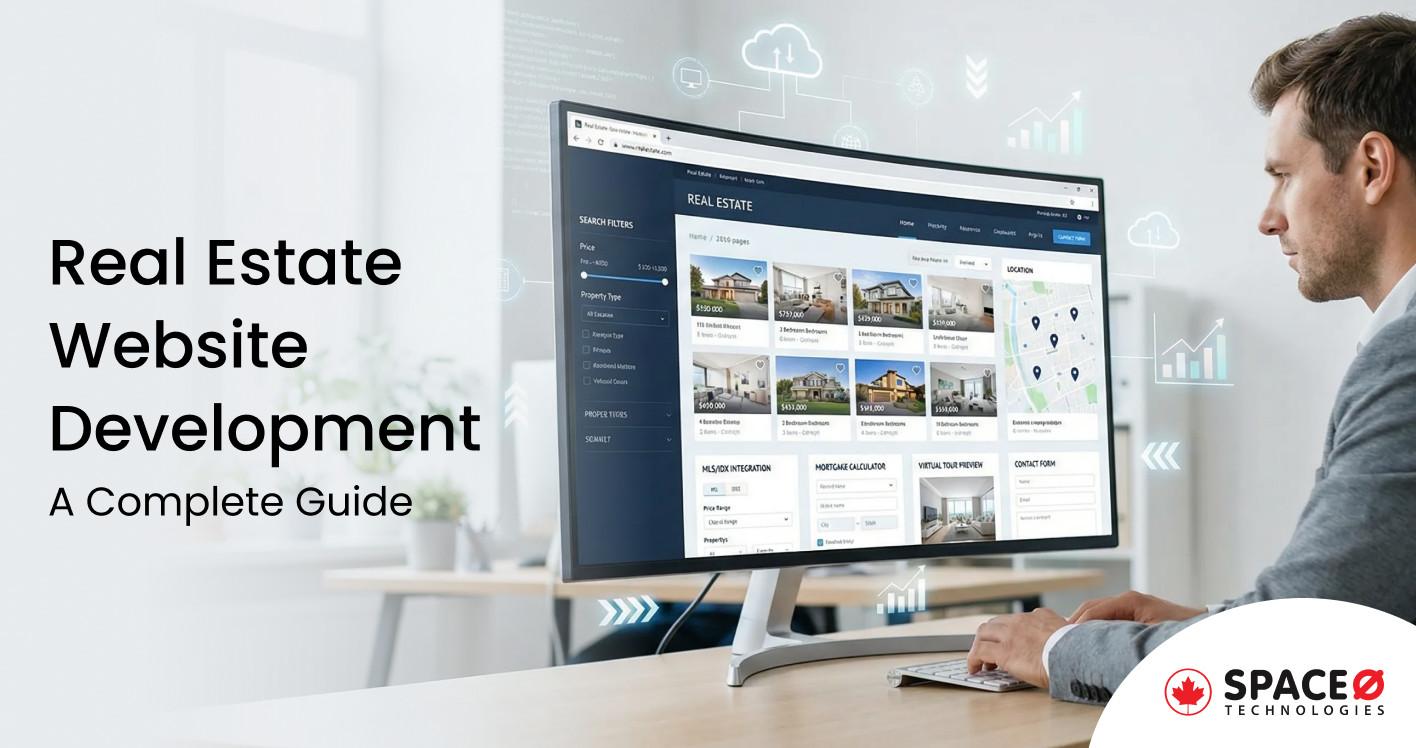
Is your real estate business still relying on third-party listing platforms that charge hefty commissions while limiting your brand visibility? You’re not alone. Many real estate agencies, brokers, and property developers struggle with outdated websites that fail to capture leads, lack MLS integration, and offer poor user experiences that drive potential buyers to competitors.
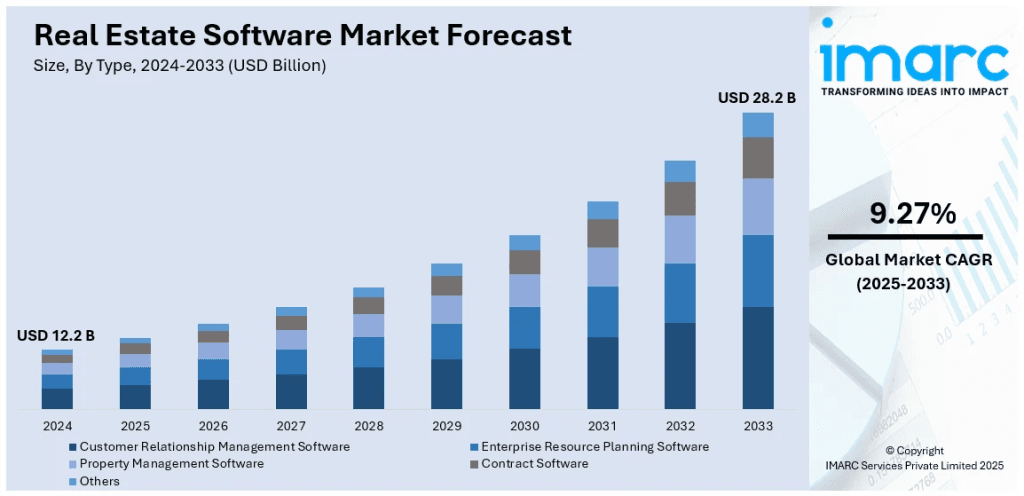
According to IMARC Group, the global real estate software market was valued at USD 12.2 billion in 2024 and is projected to reach USD 28.2 billion by 2033, growing at a CAGR of 9.27%. This growth reflects the increasing demand for sophisticated digital platforms that streamline property transactions and enhance customer engagement.
This guide covers everything you need to know about real estate website development—from essential features and development processes to costs, integrations, and common challenges. Whether you’re building a property listing portal, a real estate marketplace, or an agent website, investing in professional website development services ensures your platform is scalable, SEO-friendly, and built to generate consistent leads and conversions.
What is Real Estate Website Development?
Real estate website development is the process of designing, building, and deploying a digital platform that enables property listing, search, lead generation, and transaction management for real estate businesses. Unlike generic business websites, real estate platforms require specialized features such as MLS/IDX integration, advanced property search filters, virtual tour capabilities, and mortgage calculators.
A professional real estate website serves multiple purposes. For buyers, it provides a convenient way to search properties, compare listings, schedule viewings, and connect with agents. For sellers, it offers exposure to qualified leads and tools to showcase properties effectively. For agents and brokers, it functions as a lead generation engine and client management platform.
For Canadian real estate businesses, development must account for specific requirements, including CREA DDF (Data Distribution Facility) integration for MLS listings, PIPEDA compliance for handling personal information, and bilingual capabilities for French-speaking markets.
Pro Tip: Before starting development, define your primary business goals—lead generation, property transactions, or brand building—as this determines the features and integrations your platform requires.
With the foundation established, let’s explore the different types of real estate websites you can build based on your business model.
What are the Different Types of Real Estate Websites?
Real estate website development varies significantly based on business objectives and target audiences. Understanding these categories helps you identify the right platform type for your needs and plan features accordingly.
1. Real estate marketplace platforms
Marketplace platforms connect multiple buyers, sellers, agents, and property managers on a single platform. Examples include Zillow, Realtor.com, and Redfin. These platforms aggregate listings from various sources, offer advanced search functionality, and generate revenue through advertising, premium listings, and lead referrals.
Building a marketplace requires robust web portal infrastructure to handle large property databases, multi-vendor management, payment processing for subscriptions, and sophisticated search algorithms. Development complexity is highest for this category, typically requiring 6-12 months and significant investment.
2. Property listing portals
Property listing portals focus on displaying properties from a single brokerage, agency, or developer. Unlike marketplaces, these platforms showcase exclusive inventory and direct all leads to the owning organization. They integrate with MLS/IDX feeds to display additional listings while prioritizing featured properties.
These portals are ideal for established brokerages wanting to reduce dependency on third-party platforms and capture leads directly. Development typically takes 3-6 months depending on feature complexity.
3. Real estate agent and brokerage websites
Agent websites serve as personal branding platforms for individual realtors or small teams. They showcase the agent’s expertise, listings, testimonials, and local market knowledge. Key features include IDX search integration, contact forms, property alerts, and built-in compatibility with custom real estate CRM software development strategies to enable centralized lead management and automated follow-ups.
Brokerage websites expand this concept to represent entire organizations with multiple agents, office locations, and larger property portfolios. These require agent profile management, lead distribution systems, and performance tracking dashboards.
4. Property management platforms
Property management platforms serve landlords, property managers, and tenants. Core functionality includes tenant portals for rent payment and maintenance requests, landlord dashboards for financial tracking, lease management, and vacancy advertising.
These platforms often integrate with accounting software, background check services, and payment processors. Organizations exploring this direction can benefit from real estate property management platforms with comprehensive feature sets.
5. Real estate crowdfunding platforms
Crowdfunding platforms enable multiple investors to pool funds for property investments. These require sophisticated compliance features, including investor verification, regulatory documentation, financial reporting, and secure payment processing.
Development must address securities regulations, KYC/AML requirements, and investment tracking. Due to regulatory complexity, these platforms require specialized legal and technical expertise.
Transform Your Real Estate Business With a Custom Platform
Space-O Technologies builds feature-rich real estate websites with MLS integration, advanced search, and lead generation tools tailored to your market.
Now that you understand the platform types, let’s examine the essential features that make real estate websites effective.
What are the Essential Features of a Real Estate Website?
The features you include determine whether your real estate website becomes a lead generation powerhouse or another forgettable listing page. Here are the core capabilities every successful real estate platform needs.
1. Property listing and search features
Advanced search functionality is the backbone of any real estate website. Users expect to filter properties by location, price range, property type, bedrooms, bathrooms, square footage, lot size, and amenities. Implementing faceted search with Elasticsearch or Algolia ensures fast, accurate results even with large property databases.
2. MLS and IDX integration
MLS (Multiple Listing Service) integration is essential for displaying a comprehensive property inventory. IDX (Internet Data Exchange) provides the framework for displaying MLS listings on third-party websites while complying with data-sharing rules. Proper MLS integration ensures your website displays accurate, up-to-date listings while maintaining compliance with board regulations. This technical complexity is why many businesses partner with experienced web developers who understand real estate data systems.
3. Virtual tours and media
With over 50% of buyers starting their home search online, rich media significantly impacts engagement. High-resolution photo galleries with lazy loading ensure fast page performance while showcasing properties effectively. Virtual tour integration through platforms like Matterport provides immersive 3D walkthroughs that let buyers explore properties remotely.
4. Lead generation tools
Effective lead capture separates successful real estate websites from digital brochures. Contact forms should be strategically placed throughout the site—on listing pages, search results, and dedicated landing pages. Mortgage calculators and affordability tools engage users while capturing contact information for follow-up. These interactive elements provide value while qualifying leads based on budget and purchase timeline.
5. Agent and broker management
For brokerages, agent profile pages showcase team members’ expertise, specializations, listings, and testimonials. Performance dashboards track metrics including leads generated, properties sold, and client satisfaction ratings. Lead distribution systems automatically route inquiries to appropriate agents based on location, property type, or round-robin assignment. Administrative interfaces enable listing management, content updates, and user permissions without developer involvement.
6. User account features
User registration and authentication systems enable personalized experiences. Saved properties, search preferences, and viewing history create value that encourages return visits. Appointment scheduling integration allows users to book property viewings directly, syncing with agent calendars. Secure messaging systems facilitate communication between buyers, sellers, and agents within the platform.
With features defined, understanding the development process helps you plan timelines and resources effectively.
What is the Real Estate Website Development Process? A Step-by-Step Guide
Building a successful real estate website requires a structured approach that balances technical requirements with business objectives. Here’s the process that Space-O Technologies follows for real estate web development projects.
Step 1: Requirement analysis and planning
Every project begins with understanding your business goals, target audience, and competitive landscape. This phase involves stakeholder interviews, competitor analysis, and feature prioritization based on budget and timeline constraints.
Deliverables include a detailed project scope document, feature specifications, technical requirements, and project timeline. This foundation prevents scope creep and ensures alignment between development teams and business stakeholders.
For real estate projects, this phase also identifies MLS board requirements, compliance needs, and third-party integrations that impact architecture decisions.
Step 2: UI/UX design
Design begins with wireframing—creating low-fidelity layouts that establish information architecture and user flows. This stage focuses on functionality rather than aesthetics, ensuring the interface supports user goals efficiently.
High-fidelity mockups add visual design elements including typography, colors, imagery, and branding. For real estate websites, design must accommodate property photos, maps, and data-heavy pages while maintaining fast load times.
Prototyping creates interactive versions for user testing, identifying usability issues before development begins. Mobile-first design ensures the experience works seamlessly across devices.
Step 3: Frontend development
Frontend development transforms designs into functional interfaces using technologies like React.js, Vue.js, or Next.js. Developers implement responsive layouts, interactive elements, and animations that enhance user experience.
For real estate websites, frontend work includes property galleries, map integrations, search interfaces, and form validation. Performance optimization ensures pages load quickly despite image-heavy content.
Accessibility compliance (WCAG 2.1) ensures the website works for users with disabilities, expanding your audience and meeting legal requirements in jurisdictions like Ontario under AODA.
Step 4: Backend development
Backend development creates the server-side logic that powers your platform. This includes database architecture for storing property listings, user accounts, and transaction data.
API development enables communication between frontend interfaces, mobile apps, and third-party services. For real estate platforms, APIs handle MLS data synchronization, payment processing, and CRM integration.
Security implementation protects sensitive data including user credentials, financial information, and personal details. Encryption, authentication systems, and access controls form the security foundation.
Step 5: Third-party integrations
Real estate websites require numerous external service connections. MLS/IDX integration pulls property data from listing services. CRM integration (Salesforce, HubSpot, or custom systems) manages leads and client relationships.
Payment gateway integration enables transaction processing for premium listings, subscriptions, or property deposits. Email service providers power automated alerts and marketing campaigns.
Map services, virtual tour platforms, and analytics tools round out the integration ecosystem. Each connection requires careful implementation to ensure reliability and data consistency.
Step 6: Testing and quality assurance
Comprehensive testing validates functionality, performance, security, and usability. Functional testing verifies every feature works as specified across browsers and devices.
Performance testing identifies bottlenecks under realistic load conditions—particularly important for platforms with large property databases and high traffic volumes. Security testing uncovers vulnerabilities before malicious actors can exploit them.
User acceptance testing involves stakeholders validating the platform meets business requirements. Bug fixes and refinements address issues discovered during testing phases.
Step 7: Deployment and launch
Deployment involves configuring production servers, databases, and infrastructure. Cloud platforms like AWS or Google Cloud provide scalability, reliability, and global reach.
SSL certification ensures secure connections. DNS configuration points your domain to the new platform. Migration plans transfer existing data and redirect old URLs to maintain SEO value.
Launch checklists verify that all systems function correctly in production. Monitoring tools track performance, errors, and user behavior from day one.
Step 8: Post-launch support and maintenance
Successful websites require ongoing attention. Bug fixes address issues discovered after launch. Security updates protect against emerging threats. Performance optimization maintains fast load times as content grows.
Feature enhancements respond to user feedback and market changes. Analytics review identifies opportunities for conversion optimization. Regular backups and disaster recovery planning protect against data loss.
Understanding the web development life cycle helps you appreciate how each phase contributes to project success and what to expect throughout the engagement.
Pro Tip: Plan for post-launch iteration from the start. The best real estate websites continuously improve based on user behavior data and market feedback rather than launching as “finished” products.
Now let’s address the question every business owner asks—what does real estate website development actually cost?
How Much Does Real Estate Website Development Cost?
Real estate website development costs vary widely based on complexity, from $15,000–$30,000 for basic sites to $100,000–$250,000+ for enterprise platforms with advanced features like AI and custom CRMs.
Real estate website development costs vary significantly based on platform complexity, features, and development approach. Here’s a realistic breakdown to help you budget appropriately.
1. Development cost by platform type
| Website Type | Cost Range (USD) | Timeline | Features Included |
|---|---|---|---|
| Basic Real Estate Website | $15K-$30K | 8-12 weeks | Listings, contact forms, basic search, mobile-responsive |
| MLS/IDX Integrated Platform | $30K-$50K | 12-16 weeks | MLS integration, adv. search, user accounts, alerts |
| Custom Marketplace | $50K-$100K+ | 16-24 weeks | Multi-vendor, payments, agent mgmt, analytics |
| Enterprise Platform | $100K-$250K+ | 24-40 weeks | Custom CRM, mobile apps, AI recs, adv. analytics, APIs |
2. Factors affecting development cost
Design complexity significantly impacts cost. Template customization costs less than fully custom design, but limits differentiation. Custom UI/UX design for real estate requires specialized expertise in presenting property information effectively.
The number of features directly correlates with development time and cost. Start with core features and plan future enhancements rather than attempting to build everything at once.
Third-party integrations add complexity. MLS/IDX integration alone can cost $5,000-$15,000, depending on data sources and synchronization requirements. Each additional integration (CRM, payment gateway, virtual tours) adds development time.
Content volume affects both development and ongoing costs. Migrating thousands of existing listings requires data mapping and validation. Creating original content (property descriptions, neighborhood guides, blog posts) adds to project investment.
Development team location influences hourly rates. Toronto-based web development companies typically charge $80-$150/hour. Offshore teams offer lower rates but may introduce communication challenges and quality variations.
3. Ongoing costs to consider
Beyond initial development, real estate websites incur recurring expenses:
- MLS data feed subscriptions: $500-$2,000/month, depending on boards and data volume
- Hosting and infrastructure: $200-$1,000/month based on traffic and storage needs
- Maintenance and updates: $1,000-$3,000/month for bug fixes, security updates, and minor enhancements
- SSL certificates and security: $100-$500/year
- Third-party service fees: Variable based on CRM, email, and analytics tool subscriptions
4. Cost optimization strategies
Phased development spreads investment over time. Launch with core features, then add capabilities based on user feedback and revenue growth. This approach reduces initial risk while allowing the platform to evolve.
MVP approach identifies the minimum feature set needed to validate your business model. Learn from early users before investing in advanced functionality.
Choosing the right partner matters more than finding the lowest price. Experienced developers deliver faster, produce fewer bugs, and build scalable foundations. The benefits of working with trusted web development companies become apparent when comparing long-term total cost of ownership versus initial savings from cheaper alternatives.
Get Accurate Cost Estimates for Your Real Estate Platform
Space-O Technologies provides detailed project scoping and transparent pricing. Understand exactly what your investment includes before development begins.
Every development project faces obstacles. Understanding common challenges helps you plan mitigation strategies.
What are the Challenges in Real Estate Website Development and How to Overcome Them?
Real estate website development presents unique technical and business challenges. Here’s how to address the most common obstacles.
1. MLS data integration complexity
Challenge: MLS systems vary significantly across regions. Data formats, update frequencies, and access methods differ between boards. Some provide modern APIs; others offer only flat file exports. Mapping fields across sources while maintaining data integrity requires careful planning.
Solution: Work with developers experienced in MLS integration who understand RETS, RESO Web API, and CREA DDF standards. Build abstraction layers that normalize data from multiple sources into consistent internal formats. Implement robust error handling and monitoring to catch synchronization failures quickly.
2. Performance with large property databases
Challenge: Real estate platforms often contain hundreds of thousands of listings with multiple images each. Search queries against large datasets can become slow, and image-heavy pages impact load times.
Solution: Implement a dedicated search infrastructure using Elasticsearch or Algolia rather than relying on database queries. Use Content Delivery Networks (CDNs) to serve images from edge locations near users. Implement lazy loading so images load as users scroll rather than all at once. Database indexing and query optimization address backend performance.
3. Mobile optimization
Challenge: Over 60% of real estate searches occur on mobile devices, yet property listings with multiple images, maps, and detailed information are inherently complex to display on small screens.
Solution: Adopt mobile-first design principles, designing for smartphones before scaling up to desktop. Optimize images for mobile bandwidth while maintaining quality. Implement touch-friendly interfaces for maps and galleries. Test extensively on actual devices, not just browser emulators.
4. PIPEDA and privacy compliance (Canadian market)
Challenge: Canadian privacy legislation requires proper handling of personal information collected through contact forms, user registrations, and transaction records. Non-compliance risks, penalties, and reputation damage.
Solution: Implement privacy-by-design principles from project inception. Collect only necessary information and clearly disclose its use. Provide mechanisms for users to access, correct, and delete their data. Establish data retention policies and secure storage practices. Partner with developers who understand Canadian privacy requirements.
Space-O Technologies brings expertise in building PIPEDA-compliant platforms for Canadian businesses, ensuring your real estate website meets regulatory obligations while delivering excellent user experiences.
5. SEO for competitive real estate keywords
Challenge: Real estate keywords are highly competitive, with established portals dominating search results. New platforms struggle to gain visibility against Zillow, Realtor.com, and local competitors.
Solution: Focus on local SEO targeting specific neighborhoods, cities, or property types rather than competing for broad national terms. Create valuable content addressing buyer and seller questions. Implement technical SEO best practices, including schema markup for real estate listings. Build authority through consistent content marketing and legitimate link building.
Pro Tip: Implement property listing schema markup (schema.org/RealEstateListing) to enhance search result appearances with rich snippets showing price, location, and photos directly in Google results.
Understanding challenges helps justify the investment. Let’s examine the benefits that make custom development worthwhile.
What are the Benefits of Custom Real Estate Website Development?
Investing in custom real estate website development delivers advantages that template solutions cannot match. Here’s what you gain from a purpose-built platform.
No worries! Here’s the full section with sentence case headings and real estate-specific inner content:
1. Capture more qualified property leads
Custom real estate platforms optimize every touchpoint for lead conversion. Strategic placement of inquiry forms on listing pages, neighborhood guides, and mortgage calculators ensures you capture buyer and seller information at key decision moments. A/B testing lets you refine property CTAs, open house sign-ups, and alert opt-ins based on actual visitor behavior.
Unlike template platforms used by thousands of competing agents, your custom site can offer unique tools like home valuation estimators, investment ROI calculators, and personalized property match quizzes that attract and qualify serious prospects.
2. Stand out in a crowded real estate market
Template websites make every brokerage look the same. Buyers and sellers notice generic designs and associate them with less established agencies. Custom design lets you reflect your brand identity, market expertise, and local authority through every visual element and interaction.
For luxury real estate firms or niche specialists like commercial or vacation properties, a tailored brand presentation directly impacts perceived value and client trust.
3. Scale as your property portfolio grows
Custom architecture supports your growth without platform restrictions. Expand into new markets, add property categories like rentals or commercial listings, onboard new agent teams, or introduce features like auction modules as your business evolves. Template platforms eventually hit limitations, forcing costly and disruptive migrations.
Planning scalability from the start through proper database design, modular architecture, and cloud infrastructure ensures your platform handles increasing listing volumes and traffic without performance issues.
4. Own your listing data and client relationships
On third-party portals like Zillow or Realtor.com, you’re a tenant. Algorithm changes, fee increases, or policy updates can reduce your visibility overnight. Custom development gives you complete ownership of your property data, lead pipelines, and client relationships.
This ownership enables deeper analytics on buyer search patterns, personalized property recommendations, targeted email campaigns, and business intelligence that leverages your unique market data to drive more closings.
5. Deliver a seamless property search experience
Custom development tailors every interaction to how your specific buyers search for properties. Understanding whether your audience prioritizes school districts, commute times, investment potential, or neighborhood amenities allows you to design search filters and interfaces built for their needs rather than generic defaults.
Performance optimization ensures listing pages with high-resolution photos and virtual tours load quickly. Accessibility compliance expands your reach to all buyers. Intuitive map-based navigation and saved search functionality reduce friction throughout the property discovery journey.
6. Gain a lasting edge over competing brokerages
Unique features tailored to your market create differentiation that competitors using off-the-shelf solutions cannot replicate. Whether through AI-powered property recommendations, interactive neighborhood comparison tools, or exclusive market report dashboards, custom development enables strategic advantages that strengthen your market position over time.
Organizations exploring enterprise web development approaches gain platforms that support long-term competitive positioning rather than short-term cost savings.
Launch a Real Estate Website Designed for Buyers, Sellers, and Agents
Develop a responsive website with Space-O’s team that delivers smooth property discovery, inquiry management, and performance across devices.
With benefits clear, let’s discuss how Space-O Technologies can bring your real estate platform vision to reality.
Build High-Performance Real Estate Platforms with Space-O Technologies
Real estate website development requires balancing technical complexity with business objectives. From MLS integration and advanced search functionality to mobile optimization and lead generation tools, every element must work together to convert visitors into clients.
Space-O Technologies specializes in building custom real estate web applications for businesses across North America. Our team has a proven track record of delivering scalable, high-performing platforms for real estate agencies, brokerages, and property developers.
Our real estate website development services include:
- MLS and IDX integration expertise, including CREA DDF for Canadian markets
- Custom property search engines with advanced filtering and map-based browsing
- Lead generation systems with CRM integration and automated follow-ups
- PIPEDA-compliant data handling for Canadian real estate businesses
- Mobile-first, responsive design optimized for property discovery on any device
- Scalable architecture built to handle growing listing volumes and traffic
Whether you’re launching a property listing portal, a multi-vendor marketplace, or a brokerage platform, we tailor every feature to your business model and target market.Ready to discuss your real estate website project? Schedule a free consultation to explore how Space-O Technologies can build the platform your business needs.
Frequently Asked Questions About Real Estate Website Development
How long does it take to develop a real estate website?
Development timelines range from 8-12 weeks for basic real estate websites to 16-24 weeks for custom marketplaces with advanced features. Factors affecting the timeline include design complexity, number of integrations, content volume, and testing requirements. MLS integration alone typically adds 2-4 weeks, depending on data source complexity.
What is IDX and why is it important for real estate websites?
IDX (Internet Data Exchange) is a system that allows real estate professionals to display MLS listings on their websites. It’s important because it provides access to a comprehensive property inventory beyond your own listings, increasing the value your website offers to property searchers. IDX compliance ensures you display listings according to MLS rules while capturing leads from visitors browsing those properties.
Can I integrate MLS listings into my real estate website in Canada?
Yes, Canadian real estate websites can integrate MLS listings through CREA DDF (Data Distribution Facility). This system provides standardized access to listings from participating real estate boards. Integration requires board membership and compliance with display rules. Development partners experienced with CREA DDF can implement proper synchronization and compliance features.
How much does MLS/IDX integration cost?
MLS/IDX integration typically costs $5,000-$15,000 for development, depending on data sources and complexity. Ongoing costs include MLS data feed subscriptions ranging from $500-$2,000 per month, depending on boards and listing volume. Some IDX providers offer hosted solutions with lower upfront costs but monthly fees and less customization flexibility.
Should I choose WordPress or custom development for my real estate website?
WordPress suits smaller agencies seeking cost-effective solutions with standard features. It offers numerous real estate themes and IDX plugins, enabling faster launch at a lower cost. Custom development is preferable for larger operations requiring unique features, complex integrations, high performance with large listing volumes, or specific compliance requirements. Consider your growth plans—migrating from WordPress to custom platforms later involves significant effort.


Transform Your Real Estate Business With a Custom Platform
What to read next

 All our projects are secured by NDA
100% Secure. Zero Spam
*All your data will remain strictly confidential.
Trusted by


Bashar Anabtawi 
Canada
“I was mostly happy with the high level of experience and professionalism of the various teams that worked on my project. Not only they clearly understood my exact technical requirements but even suggested better ways in doing them. The Communication tools that were used were excellent and easy. And finally and most importantly, the interaction, follow up and support from the top management was great. Space-O not delivered a high quality product but exceeded my expectations! I would definitely hire them again for future jobs!”

Canada Office
2 County Court Blvd., Suite 400,
Brampton, Ontario L6W 3W8
Phone: +1 (602) 737-0187
Email: sales@spaceo.ca