

Remote Patient Monitoring Software Development: Features, Benefits, and Implementation Guide
Is your healthcare organization still relying on periodic check-ups to manage chronic conditions? This reactive approach limits visibility between visits, delays intervention, and increases costs, making remote patient monitoring software development a strategic priority across North America.
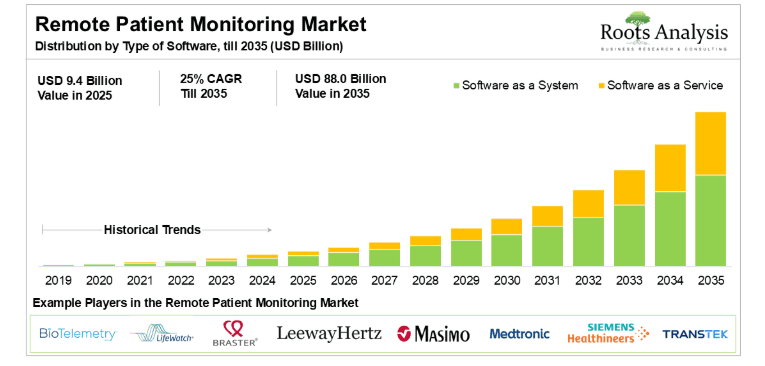
According to Roots Analysis, the remote patient monitoring market is estimated to grow from USD 7.2 billion in 2024 to reach USD 9.4 billion in 2025 and USD 88.0 billion by 2035, representing a higher CAGR of 25% during the forecast period. For Canadian healthcare providers operating under provincial budgets, RPM software offers a proven path to reduce hospital readmissions, improve chronic disease management, and extend care beyond facility walls.
Space-O Technologies provides healthcare software development services, helping organizations build secure, compliant, and scalable remote patient monitoring solutions.
This guide covers everything you need to know about building RPM software. You’ll learn the essential features, step-by-step development process, compliance requirements, cost breakdown, and how to overcome common challenges.
What is Remote Patient Monitoring Software?
Remote patient monitoring (RPM) software is a digital health solution that collects, transmits, and analyzes patient health data from connected medical devices outside traditional clinical settings. Unlike conventional telemedicine that focuses on video consultations, RPM enables continuous or scheduled health data collection from patients in their homes, providing clinicians with real-time visibility into patient conditions between office visits.
RPM systems typically consist of three core components working together.
- Connected medical devices capture patient vitals, including blood pressure, glucose levels, oxygen saturation, weight, and activity data.
- A patient-facing mobile app manages device pairing, data synchronization, medication reminders, and care team communication.
- A provider dashboard aggregates patient data, monitors trends, triggers alerts for abnormal readings, and integrates with electronic health records.
For Canadian healthcare organizations, RPM software must comply with PIPEDA (Personal Information Protection and Electronic Documents Act) at the federal level and provincial regulations like PHIPA (Personal Health Information Protection Act) in Ontario.
These requirements govern how patient health information is collected, stored, transmitted, and accessed.
Pro Tip: When selecting medical devices for your RPM platform, prioritize FDA-cleared or Health Canada-approved devices. Regulatory approval ensures measurement accuracy and clinical reliability, which directly impacts the quality of care decisions based on RPM data.
Understanding what RPM software does is the first step. Now let’s explore the essential features your platform needs to deliver real clinical value.
What are the Key Features of Remote Patient Monitoring Software?
Building effective RPM software requires carefully designed features that serve three distinct user groups: patients managing their health at home, clinicians monitoring patient populations, and administrators overseeing program operations.
Each feature set must balance functionality with usability, ensuring adoption across technically diverse user bases.
Patient-facing features
The patient mobile application serves as the primary touchpoint for RPM engagement. Success depends on making daily health monitoring simple enough for elderly patients while comprehensive enough to capture clinically meaningful data.
1. Device pairing and automatic data synchronization
form the foundation of patient experience. Patients connect Bluetooth-enabled medical devices to the mobile app through guided setup wizards.
Once paired, devices automatically transmit readings to the cloud without manual intervention.
Supporting multiple device types and manufacturers requires a flexible integration architecture, something experienced mobile app development teams build into the core platform design.
2. Medication reminders and adherence tracking
help patients follow prescribed treatment regimens. The app sends push notifications at scheduled times, and patients confirm when medications are taken.
Adherence data flows to provider dashboards, enabling care teams to identify patients struggling with complex medication schedules before complications arise.
3. Symptom logging and daily check-ins
Capture subjective health information that devices cannot measure. Patients answer brief questionnaires about pain levels, energy, mood, shortness of breath, or condition-specific symptoms.
These patient-reported outcomes provide context for objective device readings and often reveal early warning signs of deterioration.
Provider and clinician features
The provider dashboard transforms raw patient data into actionable clinical intelligence. Effective dashboards reduce cognitive load while ensuring high-risk patients receive timely attention.
1. Real-time patient monitoring dashboard
displays enrolled patients with their most recent readings, trends, and alert status.
Clinicians see at-a-glance views of their patient panel, with visual indicators highlighting patients requiring immediate attention versus those with stable readings.
Dashboard design significantly impacts clinical workflow efficiency.
2. Customizable alert thresholds
Allow providers to set patient-specific parameters triggering notifications.
A cardiologist might set tighter blood pressure limits for a post-MI patient than for someone with mild hypertension. Smart alerting reduces false alarms while ensuring critical changes don’t go unnoticed.
Organizations building RPM platforms should study how leading healthcare software development projects implement intelligent alerting.
3. Trend analysis and data visualization
Present patient data through charts, graphs, and statistical summaries.
Providers identify patterns invisible in individual readings, such as gradually rising blood pressure over weeks or morning glucose spikes suggesting dawn phenomenon.
Visual trend displays support clinical decision-making and patient education during virtual visits.
Administrative features
Administrative capabilities support program operations, financial sustainability, and regulatory compliance.
1. Device inventory management
Tracks hardware assets across the patient population. Administrators monitor which devices are assigned to patients, identify devices requiring replacement or calibration, and manage logistics for device distribution and return.
Effective inventory management reduces costs and ensures patients have functioning equipment.
2. Patient enrollment workflows
Streamline the process of onboarding new RPM participants. Workflows guide staff through eligibility verification, consent collection, device assignment, app installation, and initial training.
Automated workflows reduce enrollment time and ensure consistent onboarding experiences.
3. Billing and coding for RPM services
Supports revenue cycle management. The platform tracks qualifying activities against CPT codes 99453 (device setup), 99454 (device supply and daily monitoring), 99457 (first 20 minutes of clinical staff time), and 99458 (additional 20-minute increments). Accurate time tracking and documentation ensure compliant billing.
Build Remote Patient Monitoring Software That Enables Continuous Care
Develop RPM software that securely captures real-time patient data, supports timely clinical interventions, and improves care beyond in-person visits.
With features defined, let’s walk through how to build your RPM software from concept to launch.
How to Build Remote Patient Monitoring Software: Step-by-Step?
Developing remote patient monitoring software requires systematic planning, clinical expertise, technical execution, and rigorous compliance validation.
The following step-by-step process guides healthcare organizations from initial concept through successful deployment and ongoing optimization.
Step 1: Define clinical use case and objectives
Every successful RPM initiative starts with clearly defined clinical and business objectives that align with organizational priorities and patient care goals.
Generic “remote monitoring” goals lead to unfocused platforms that fail to deliver measurable value or demonstrate meaningful return on investment.
Healthcare organizations must identify specific patient populations, determine which chronic conditions to target, and establish quantifiable success metrics before beginning any development work.
This foundational planning ensures development resources focus on features that directly impact patient outcomes and organizational performance. Without clear objectives established upfront, teams risk building technology that clinicians won’t adopt and patients won’t consistently engage with.
Step 2: Conduct discovery and requirements gathering
Thorough discovery prevents costly rework and ensures the final product meets actual user needs across all stakeholder groups involved in remote patient monitoring initiatives.
This phase typically requires 3-6 weeks, depending on project complexity, organizational size, and integration requirements with existing healthcare systems.
During discovery, development teams must engage with clinical staff, IT departments, compliance officers, and representative patients to understand workflows and key success criteria.
Skipping or rushing this phase almost always results in expensive changes during development or a finished product that fails to achieve adoption. Investment in comprehensive requirements gathering pays dividends throughout the entire project lifecycle.
Step 3: Design UI/UX for clinical workflows
User experience design determines whether clinicians and patients actually adopt your RPM platform or abandon it after initial training sessions conclude.
Poor design leads to abandonment regardless of technical capabilities, wasting development investment and failing to improve patient outcomes. Effective RPM interfaces must serve two distinct user groups with vastly different needs, technical abilities, and usage contexts.
Patients need simple, accessible experiences they can manage independently at home, often while managing chronic illness symptoms.
Clinical staff need efficient dashboards that support rapid triage and decision-making across large patient panels without contributing to the burnout or alert fatigue plaguing healthcare today.
Step 4: Develop MVP with core features
Development transforms validated designs into functional software through iterative building, testing, and refinement cycles that maintain alignment with clinical requirements throughout the process.
Agile methodology enables incremental delivery and continuous stakeholder feedback, reducing the risk of building features that miss the mark or fail to integrate with clinical workflows.
The minimum viable product should focus on core monitoring capabilities that demonstrate value quickly while establishing the technical foundation for future expansion.
Rushing to include advanced features before core functionality works reliably leads to unstable platforms that frustrate users and undermine confidence in the RPM program. Start simple, prove value, expand.
Step 5: Integrate with EHR/EMR systems
EHR integration determines whether RPM becomes part of clinical workflow or remains a siloed tool that providers ignore in favor of their primary documentation system.
Integration complexity varies significantly based on EHR vendors, organizational IT environments, and the depth of data exchange required for effective care coordination.
Successful integration means clinicians can view RPM data within familiar EHR interfaces, reducing context switching and improving the likelihood that remote monitoring insights influence clinical decisions.
Failed or incomplete integration creates duplicate documentation burdens and workflow friction that drives user abandonment. Plan your integration strategy early and budget adequate time for comprehensive testing.
Step 6: Implement security and compliance
Healthcare data breaches carry severe consequences including regulatory penalties, lawsuits, reputational damage, and violation of patient trust that undermines the therapeutic relationship essential to effective patient care.
Security must be foundational to RPM platform architecture, not an afterthought addressed through patches after core development completes.
Remote patient monitoring creates unique security challenges because data flows through patient smartphones, home networks, cloud infrastructure, and clinical systems, expanding the attack surface compared to traditional healthcare IT.
Every component in this chain requires appropriate protection, and the overall system must maintain compliance with healthcare privacy regulations in all jurisdictions where patients receive care.
Organizations considering outsourcing healthcare software development should verify that development partners maintain appropriate security certifications and demonstrate healthcare compliance expertise.
Step 7: Testing, deployment, and launch
Rigorous testing validates that the platform functions correctly, securely, and reliably before any patient depends on it for health monitoring and clinical communication.
Testing in healthcare applications goes beyond typical software quality assurance because failures can directly impact patient safety and clinical decision-making.
RPM platforms must work reliably across diverse devices, network conditions, and user scenarios while maintaining data integrity throughout.
Deployment strategy must balance the desire for rapid value realization against the risks of introducing new technology into clinical workflows without adequate preparation.
Staged rollouts with careful monitoring allow organizations to identify issues before they affect large patient populations.
For healthcare organizations without in-house technical teams, partnering with specialized healthcare software developers ensures RPM platforms meet clinical, regulatory, and technical requirements throughout the development lifecycle.
Step 8: Monitor, iterate, and scale
Launch marks the beginning of ongoing platform evolution, not the end of the project or the development team’s involvement with the RPM program. Successful remote patient monitoring requires continuous attention to system performance, user feedback, clinical outcomes, and evolving regulatory requirements.
Organizations that treat launch as a finish line rather than a milestone typically see declining engagement and missed opportunities to expand program value.
Establish monitoring systems, feedback channels, and governance processes that support long-term platform health and continuous improvement.
Budget for ongoing development resources to address issues, implement enhancements, and adapt to changing clinical needs and technologies over time.
Pro Tip: Partner with a healthcare-focused development team that understands both technical implementation and clinical workflows. Teams like Space-O Technologies combine software engineering expertise with healthcare domain knowledge, accelerating development while reducing compliance risk
Every development journey has obstacles. Here are common challenges and proven solutions to keep your project on track.
What are the Common Challenges of RPM Software Development [How to Overcome Them]
Building remote patient monitoring software involves navigating technical, clinical, and regulatory complexities. Understanding common challenges and proven solutions helps organizations plan effectively and avoid costly missteps.
1. Device interoperability
Challenge:
Multiple device manufacturers use different protocols, communication standards, and data formats. Bluetooth compatibility issues cause pairing failures. Lack of standardization complicates integration.
Solutions:
Build a device abstraction layer that normalizes data from multiple sources. Use FDA-cleared devices with documented APIs. Implement Bluetooth troubleshooting within the patient app. Partner with device vendors for integration support. Consider device-agnostic platforms supporting future additions.
2. Data quality and accuracy
Challenge:
Missing readings when patients skip monitoring. Erroneous data from improper device use or calibration issues. Inconsistent measurement timing affects trend analysis.
Solutions:
Implement data validation rules flagging physiologically implausible values. Send automated reminders encouraging consistent monitoring. Provide patient education on proper device use. Use FDA/Health Canada-approved devices, ensuring measurement accuracy. Build missing data handling into clinical protocols.
3. Regulatory complexity
Challenge:
Navigating overlapping requirements across HIPAA, PIPEDA, provincial acts, and FDA/Health Canada guidelines. Uncertainty about Software as Medical Device (SaMD) classification. Evolving telehealth regulations across jurisdictions.
Solutions:
Engage compliance experts during requirements gathering. Build privacy-by-design and security-by-design principles into architecture. Document compliance decisions and rationale. Monitor regulatory developments and maintain update processes. Consider regulatory affairs consultation for SaMD questions.
4. Clinical adoption and alert fatigue
Challenge:
Providers resist technology perceived as adding workload. Excessive false alarms lead clinicians to ignore alerts. Workflow disruption reduces engagement.
Solutions:
Involve clinicians throughout design and development. Implement smart alerting with adjustable thresholds reducing false positives. Integrate into existing EHR workflows minimizing context switching. Start with high-value use cases demonstrating clear clinical benefit. Provide training emphasizing workflow efficiency gains.
5. Patient engagement and digital literacy
Challenge:
Elderly patients struggle with technology. Consistent daily monitoring requires sustained motivation. Caregivers need involvement for dependent patients.
Solutions:
Design simple, accessible interfaces with large touch targets and minimal complexity. Provide multiple training modalities (video, print, live support). Implement gamification and positive reinforcement for adherence. Enable caregiver access and proxy monitoring. Offer technical support through preferred channels.
6. EHR integration complexity
Challenge:
Legacy EHR systems lack modern APIs. Custom integration development is expensive and time-consuming. Data mapping between systems requires clinical expertise.
Solutions:
Prioritize EHR vendors with mature FHIR APIs. Use integration platforms and middleware where direct integration is impractical. Start with unidirectional data flow before implementing bidirectional sync. Budget adequate time and resources for integration, developmen,t and testing.
Organizations planning RPM initiatives benefit from working with experienced development partners who have solved these challenges previously. Space-O Technologies brings healthcare domain expertise and technical capabilities together, helping clients navigate complexity while maintaining focus on clinical outcomes.
Pro Tip: Address device interoperability challenges early by defining supported devices during requirements gathering. Starting with a curated device list from proven manufacturers reduces integration complexity while ensuring reliable data quality.
With challenges addressed, compliance becomes your next priority. Let’s examine the regulatory landscape for RPM software.
What are the Compliance Requirements for RPM Software?
Remote patient monitoring software handles sensitive health information subject to strict regulatory requirements. Non-compliance carries severe penalties, including fines exceeding $1 million, legal liability, and reputational damage.
Understanding applicable regulations and building compliance into platform architecture protects organizations and patients.
1. HIPAA compliance (United States)
- Privacy Rule: Establishes patient rights and limits on PHI use, requiring consent management, patient access fulfillment, and minimum necessary data access standards.
- Security Rule: Mandates technical safeguards, including unique user identification, audit logging, integrity controls, and encryption for data in transit and at rest.
- Breach Notification Rule: Requires notification within 60 days when unsecured PHI is compromised; media notification is required for breaches affecting 500+ individuals.
- Business Associate Agreements (BAAs): Must be executed with all third parties accessing PHI, including cloud providers, device manufacturers, and analytics vendors.
2. Canadian regulations (PIPEDA and PHIPA)
- PIPEDA: Governs private sector organizations through 10 Fair Information Principles covering accountability, consent, data minimization, safeguards, transparency, and individual access rights.
- Provincial Health Acts: Ontario’s PHIPA and Alberta’s HIA create additional obligations based on patient location and data storage.
- Data Residency: Some provinces mandate Canadian patient data remain within Canada, requiring compliant cloud provider regions and data flow architectures.
Organizations developing RPM software for Canadian markets should consider partnering with development teams familiar with the Canadian regulatory landscape. Space-O Technologies understands both US and Canadian compliance requirements, helping clients build platforms that serve cross-border patient populations.
Pro Tip: Build compliance into your RPM platform foundation from day one. Retrofitting security controls and privacy features into existing systems costs significantly more than incorporating them during initial development. Space-O Technologies integrates compliance requirements into our healthcare software development process from the earliest design phases.
Extend Care Beyond the Clinic With Intelligent Monitoring Software
Space-O helps healthcare organizations develop RPM software that improves patient engagement, adherence, and continuity of care.
Compliance ensures legal operation. Now let’s explore the tangible benefits RPM delivers for patients, providers, and healthcare systems.
What are the Benefits of Remote Patient Monitoring Software?
Remote patient monitoring delivers measurable value across the healthcare ecosystem. Understanding these benefits helps organizations build business cases, secure stakeholder support, and measure program success.
1. Convenience of home-based monitoring
RPM eliminates travel burden for routine health tracking. Patients with mobility limitations, transportation challenges, or demanding schedules maintain consistent monitoring without clinic visits. For Canadian patients in rural and remote communities, RPM extends specialist oversight that previously required long-distance travel.
2. Reduced hospital visits and emergency care
Early detection and intervention prevent conditions from deteriorating into emergencies. When care teams identify concerning trends early, they intervene before hospitalization becomes necessary. Patients spend less time in hospitals and emergency departments, reducing stress and exposure to healthcare-associated infections.
3. Better engagement in personal health
Daily visibility into health metrics helps patients develop deeper understanding of how lifestyle choices affect their conditions. Patients seeing their blood pressure trends or glucose patterns become more aware of their health status, motivating healthier behaviors and improving self-management skills over time.
4. Continuous visibility into patient health
RPM provides 24/7 oversight extending beyond office hours. Providers see how patients manage their conditions during daily life, not just during periodic clinic visits. This continuous visibility reveals patterns and problems that remain invisible in traditional episodic care models.
5. Proactive care delivery
Providers can intervene when they see problems developing rather than treating complications after they occur. A weight gain trend in a heart failure patient triggers medication adjustment before hospitalization becomes necessary, shifting care teams from reactive treatment to preventive intervention strategies.
6. Reduced hospital readmissions and cost savings
RPM enables early detection and timely intervention, preventing conditions from worsening to the point of requiring hospitalization. Care teams can identify concerning health trends and adjust treatment plans proactively. This approach keeps patients healthier at home while reducing the burden on hospital resources and emergency departments.
The benefits are clear, but how much investment is required? Let’s break down the costs.
What is the Cost of Remote Patient Monitoring Software Development?
RPM software development costs range from $50,000-$100,000 for basic MVP platforms to $200,000-$500,000+ for enterprise solutions.
Understanding RPM software development costs helps organizations budget appropriately and evaluate build versus buy decisions. Costs vary significantly based on feature scope, compliance requirements, integration complexity, and development approach.
1. Cost by project complexity
| Tier | Cost Range | Timeline | Key Features | Compliance | Best For |
|---|---|---|---|---|---|
| Basic MVP | $50,000-$100,000 | 3-5 months | Basic monitoring, 2-3 devices, app/dashboard, alerts, messaging | Basic HIPAA/PIPEDA | Startups, pilots |
| Mid-Range | $100,000-$200,000 | 6-9 months | Multi-condition, 5-8 devices, advanced alerts, analytics, care plans | Comprehensive HIPAA/PIPEDA, audits | Production RPM, telehealth |
| Enterprise | $200,000-$500,000+ | 12-18 months | Full suite, AI analytics, population health, multi-tenant | Full compliance, SOC 2 prep | Health systems, large providers |
2. Cost breakdown by component
Understanding where costs accumulate helps prioritize features and identify potential savings.
| Component | Cost Range | Key Considerations |
|---|---|---|
| UI/UX Design | $15,000-$35,000 | Patient app design, provider dashboard, accessibility compliance, usability testing |
| Patient Mobile App | $30,000-$80,000 | iOS/Android dev, device pairing, offline capability, push notifications |
| Provider Web Dashboard | $25,000-$60,000 | Real-time monitoring, alerting interfaces, reporting, admin tools |
| Backend Development | $40,000-$100,000 | APIs, database design, business logic, alert processing, data analytics |
| Device Integration | $20,000-$50,000 | Bluetooth connectivity, manufacturer APIs, data normalization, device management |
| EHR/EMR Integration | $25,000-$60,000 | FHIR implementation, data mapping, workflow integration, EHR vendor testing |
| Compliance Implementation | $20,000-$50,000 | Security controls, encryption, access management, audit logging, documentation |
| Testing and QA | $15,000-$40,000 | Functional, security, performance testing, clinical validation |
| Project Management | 10-15% of total | Requirements mgmt, sprint coordination, stakeholder comms, risk management |
3. Factors affecting development cost
Several variables significantly impact total project investment.
- Device support scope: Limit initial integrations to 2–3 proven medical devices to reduce Bluetooth, data parsing, and normalization costs.
- EHR integration complexity: Favor EHRs with mature FHIR APIs, as legacy and multi-vendor integrations require higher development effort.
- AI and ML capabilities: Start with rule-based alerts and add predictive analytics and ML features in later phases to control costs.
- Development team location: Choose cost-effective offshore teams with healthcare compliance expertise, such as Space-O Technologies, to optimize development investment.
4. Ongoing operational costs
Budget for recurring expenses beyond initial development.
| Cost Category | Monthly/Annual Range | Notes |
|---|---|---|
| Cloud Hosting | $500-$5,000/month | Scales with users/data; HIPAA-eligible configs required |
| Maintenance & Updates | 15-20% of dev cost/year | Bug fixes, security patches, OS updates, minor enhancements |
| Security Audits | $5,000-$15,000/year | Pen testing, vulnerability assessments, compliance reviews |
| Device Costs | $50-$500 per patient | Hardware if org supplies devices to patients |
| Support Staff | $3,000-$10,000/month | Tech support, patient onboarding, clinical assistance |
| Third-Party Services | $500-$3,000/month | SMS, video integration, analytics tools |
Organizations evaluating RPM development should consider the total cost of ownership over 3-5 years rather than the initial development cost alone. Ongoing operational costs often exceed initial development investment over the platform lifecycle.
With costs understood, let’s look at what the future holds for RPM technology.
What are the Future Trends in Remote Patient Monitoring?
Remote patient monitoring continues evolving rapidly as emerging technologies expand what’s possible in connected healthcare. Understanding these trends helps organizations make technology investments that remain relevant as the market matures.
1. Artificial intelligence and machine learning
AI will transform RPM from passive monitoring to predictive intervention. Algorithms analyzing patient data will identify deterioration patterns before clinical symptoms appear. Machine learning models will personalize alert thresholds based on individual baselines rather than population averages. Organizations investing in AI software development capabilities position themselves to leverage these advances.
2. Voice-activated monitoring and conversational AI
Voice assistants will guide patients through daily check-ins, answer health questions, provide medication reminders, and escalate concerns to care teams. Conversational interfaces reduce technology barriers for patients struggling with smartphone interfaces while maintaining consistent engagement.
3. Advanced wearables and biosensors
Emerging sensors will track hydration, medication levels, stress hormones, and cardiac biomarkers through non-invasive means. Continuous glucose monitors already eliminate finger-stick testing for diabetics. Wearable patches and smart clothing will make monitoring seamless and unobtrusive.
4. 5G-enabled real-time monitoring
5G networks will support bandwidth-intensive applications currently impractical on mobile networks. High-definition video consultations, real-time transmission of medical imaging, and continuous streaming of high-frequency sensor data become feasible with reduced latency.
5. Integration with smart home devices
Smart scales, connected pill dispensers, motion sensors, and environmental monitors will contribute to comprehensive patient health pictures. Ambient intelligence will detect changes in activity patterns, sleep quality, and daily routines, indicating health changes.
6. Expansion beyond chronic disease
RPM will extend to new clinical applications, including post-surgical recovery tracking, high-risk pregnancy monitoring between prenatal visits, mental health monitoring using smartphone sensors, and pediatric RPM helping parents manage children’s chronic conditions.
Space-O Technologies stays current with emerging healthcare technologies, helping clients build platforms that leverage today’s proven capabilities while architecting for tomorrow’s innovations. Our healthcare development team continuously evaluates new technologies for practical clinical application.
Develop Secure and Compliant RPM Software With Space-O
Partner with Space-O to build PIPEDA-compliant remote patient monitoring software aligned with device integrations and clinical workflows.
The future is promising. Here’s how Space-O Technologies can help you build your RPM solution.
Build Your Remote Patient Monitoring Software with Space-O Technologies
Remote patient monitoring software development represents a significant opportunity for healthcare organizations ready to transform chronic disease management, reduce costly hospitalizations, and extend care beyond traditional clinical settings.
Space-O Technologies helps healthcare organizations turn RPM concepts into production platforms delivering real clinical value. With years of software development experience and deep healthcare domain expertise, we understand both the technical requirements and clinical workflows that determine RPM success.
Our healthcare development team builds HIPAA and PIPEDA-compliant RPM solutions tailored to your specific patient populations, clinical workflows, and integration requirements.
Whether you’re launching a pilot program to validate RPM concepts or scaling an enterprise platform across multiple facilities, Space-O Technologies provides the technical expertise and healthcare knowledge to accelerate your initiative.
Ready to build your remote patient monitoring platform? Schedule a Free Consultation to discuss your requirements with our healthcare software development experts.
Frequently Asked Questions about Remote Patient Monitoring Software Development
How much does it cost to develop remote patient monitoring software?
RPM software development costs range from $50,000-$100,000 for basic MVP platforms to $200,000-$500,000+ for enterprise solutions. Key cost factors include the number of supported medical devices, compliance requirements (HIPAA/PIPEDA adds 30-40%), EHR integration complexity, AI/ML features, and development team location. Ongoing costs for hosting, maintenance, security audits, and support typically add 20-30% of initial development cost annually.
What medical devices can be integrated with RPM software?
RPM platforms commonly integrate blood pressure monitors, glucose meters, pulse oximeters, weight scales, thermometers, ECG monitors, spirometers, and activity trackers. Integration occurs through Bluetooth Low Energy (BLE) for direct device communication or REST APIs connecting to manufacturer cloud platforms. The number of supported devices significantly impacts development complexity and cost. Starting with 2-3 proven, FDA-cleared devices is recommended for initial deployments.
Is RPM software considered a medical device requiring regulatory approval?
RPM software may require regulatory approval depending on its functionality. Software simply displaying patient-reported data typically doesn’t require FDA clearance or Health Canada approval. However, software applying algorithms to diagnose conditions, recommend treatments, or predict clinical events may be classified as Software as a Medical Device (SaMD) requiring premarket review. Organizations should consult regulatory guidance documents and consider regulatory affairs expertise for platforms with clinical decision support features.
How long does it take to build remote patient monitoring software?
Development timelines vary based on scope and complexity. Basic MVP platforms require 3-5 months, mid-range platforms with comprehensive features need 6-9 months, and enterprise solutions with advanced analytics and extensive integrations take 12-18 months. Timeline factors include design complexity, number of device integrations, EHR integration requirements, compliance validation, and clinical workflow customization. Agile development with phased releases can deliver initial functionality faster while continuing feature expansion.
What is the ROI of implementing remote patient monitoring?
RPM ROI comes from multiple sources: reduced hospital readmissions (savings of $15,000-$20,000 per prevented readmission), decreased emergency department visits, improved chronic disease outcomes reducing long-term complications, revenue from RPM billing codes (CPT 99453, 99454, 99457, 99458), and operational efficiencies from automated monitoring. Studies show RPM can reduce readmissions by up to 76% for appropriate patient populations. Most organizations achieve positive ROI within 12-24 months of program launch.


Build Remote Patient Monitoring Software With Space-O
 All our projects are secured by NDA
100% Secure. Zero Spam
*All your data will remain strictly confidential.
Trusted by


Bashar Anabtawi 
Canada
“I was mostly happy with the high level of experience and professionalism of the various teams that worked on my project. Not only they clearly understood my exact technical requirements but even suggested better ways in doing them. The Communication tools that were used were excellent and easy. And finally and most importantly, the interaction, follow up and support from the top management was great. Space-O not delivered a high quality product but exceeded my expectations! I would definitely hire them again for future jobs!”
Canada Office
2 County Court Blvd., Suite 400,
Brampton, Ontario L6W 3W8
Phone: +1 (602) 737-0187
Email: sales@spaceo.ca