
- What is Retail ERP Software?
- Why Do Retailers Need ERP Software?
- 1. Managing inventory across multiple sales channels
- 2. Delivering seamless omnichannel customer experiences
- 3. Gaining real-time visibility into sales and operations
- 4. Streamlining supply chain and vendor management
- 5. Handling complex pricing, promotions, and loyalty programs
- 6. Supporting multi-store and multi-location operations
- What is the Process of Retail ERP Software Development: Step-by-Step Guide
- 1. Discovery and requirements gathering
- 2. System architecture and design
- 3. Module development and customization
- 4. Third-party integrations (POS, eCommerce, payment gateways)
- 5. Testing and quality assurance
- 6. Data migration from legacy systems
- 7. Deployment and go-live
- 8. Training and change management
- 9. Ongoing maintenance and support
- What are the Core Modules of Retail ERP Software?
- 1. Inventory management
- 2. Point of sale integration
- 3. Order management and fulfillment
- 4. Customer relationship management
- 5. Supply chain and procurement
- 6. Financial management and accounting
- 7. eCommerce platform integration
- 8. Warehouse and distribution management
- 9. Human resources and workforce scheduling
- What are the Key Features of Retail ERP Software?
- 1. Real-time inventory tracking across all channels
- 2. AI-powered demand forecasting and automated replenishment
- 3. Omnichannel order fulfillment and returns management
- 4. Customer segmentation and personalized marketing
- 5. Barcode and RFID integration for stock accuracy
- 6. Multi-currency and multi-tax compliance
- What are the Benefits of Retail ERP Software?
- How Much Does Retail ERP Software Development Cost?
- Custom Retail ERP vs. Off-the-Shelf Solutions: Which One is For You?
- Transform Retail Operations With ERP Solutions by Space-O Technologies
- Frequently Asked Questions about Retail ERP Software
Retail ERP Software Development: A Complete Guide to Inventory and Sales Management

 Last Updated: March, 26 2026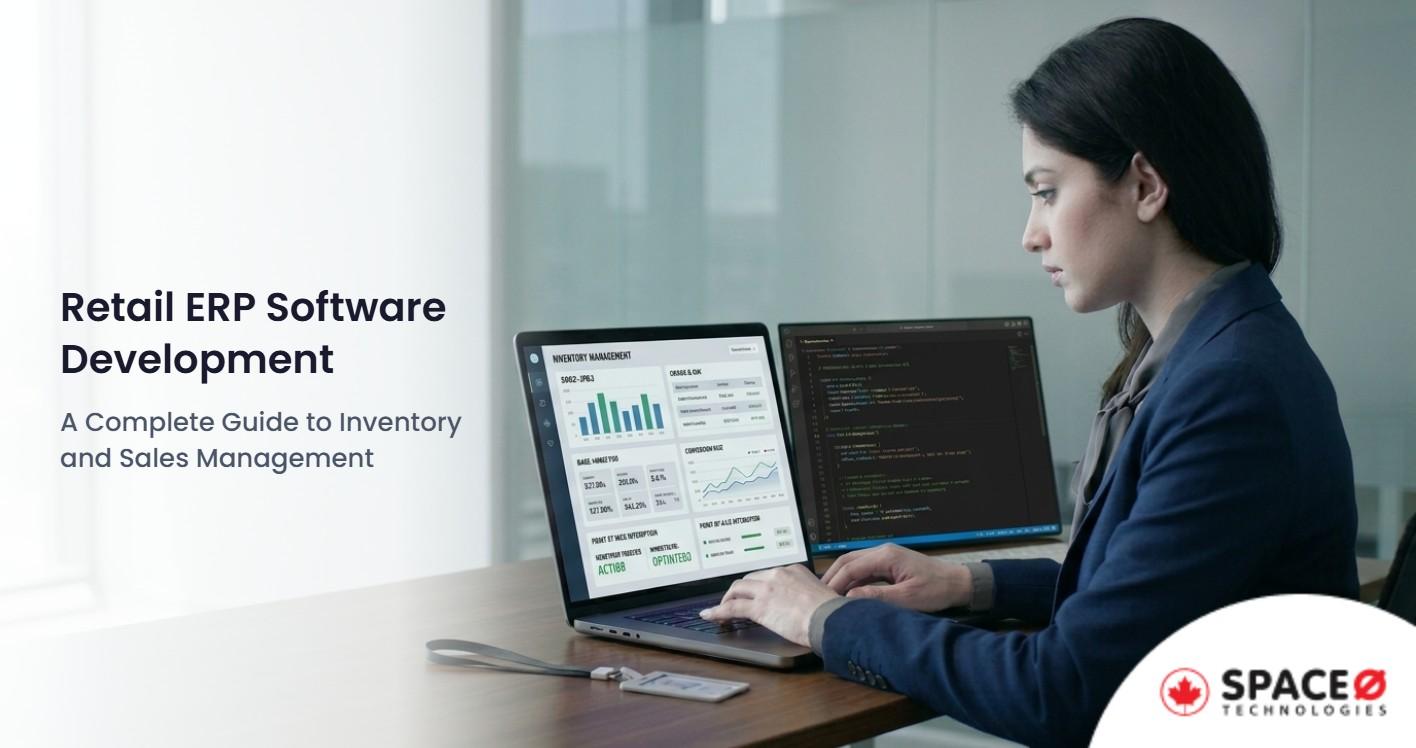
Modern retail operates across physical stores, online marketplaces, mobile apps, and social commerce simultaneously. Retail teams must coordinate inventory, pricing, promotions, orders, and returns across all channels while delivering a consistent customer experience.
Even a single breakdown, such as inaccurate stock levels, pricing inconsistencies, or delayed fulfillment, can result in lost sales, reduced customer trust, and margin erosion.
This level of operational complexity is driving retailers toward integrated software systems at an unprecedented pace. According to Market Report Analytics, the retail ERP market is valued at USD 25 billion in 2025 and is projected to reach USD 70 billion by 2033, growing at a 12% CAGR. Cloud-based retail ERP solutions are leading this growth at a 15% CAGR, fueled by omnichannel demands and the need for real-time data across every customer touchpoint.
Whether you operate a chain of brick-and-mortar stores, a growing eCommerce brand, or a multi-channel retail business, the right ERP software development approach can transform how your business operates.
This guide covers everything you need to know about retail ERP software development, from core modules and key features to the development process, costs, and how to choose between custom and off-the-shelf solutions.
What is Retail ERP Software?
Retail ERP software is an enterprise resource planning system designed specifically for the retail industry, integrating core business functions — from inventory management and point of sale (POS) to order fulfillment, customer relationship management, supply chain operations, and financials — into a single unified platform.
Unlike generic ERP systems, retail ERP is built to handle the unique complexities of omnichannel commerce, real-time stock synchronization across multiple locations, seasonal demand fluctuations, and the fast-paced pricing and promotions cycles that define retail operations.
What makes retail ERP different from standard enterprise software development solutions? The answer lies in industry-specific requirements. Retailers manage high transaction volumes, seasonal inventory, complex pricing and promotions, multi-channel interactions, and high return rates, challenges that a generic ERP cannot handle without heavy customization.
Retail ERP software supports brick-and-mortar, eCommerce, omnichannel, multi-store, D2C, and wholesale retail models, enabling centralized operations across sales, pricing, and fulfillment.
Understanding what retail ERP is leads to a critical question: why is this specialized software essential for today’s retailers?
Why Do Retailers Need ERP Software?
The retail industry faces operational challenges that simply cannot be managed with disconnected spreadsheets and standalone systems. Here are the key reasons why retailers invest in specialized ERP software.
1. Managing inventory across multiple sales channels
Modern retailers sell through physical stores, websites, mobile apps, and third-party marketplaces like Amazon and eBay — often simultaneously. Without a centralized system, inventory counts go out of sync within minutes.
A product showing “in stock” online may already be sold in-store, leading to overselling and cancelled orders. Retail ERP provides a single source of truth for inventory across every channel and location, updating stock levels in real-time with every sale, return, transfer, and receipt.
2. Delivering seamless omnichannel customer experiences
Today’s customers expect to browse online and buy in-store, order online and pick up curbside, purchase in-store and have items shipped home, or return an online purchase at a physical location.
Delivering these experiences requires real-time data sharing between all channels. Retail ERP connects the dots, ensuring that pricing, promotions, loyalty points, and customer preferences are consistent no matter where the customer interacts with the brand.
3. Gaining real-time visibility into sales and operations
Decision-makers need instant access to what is happening across the retail operation — which products are selling fastest, which stores are underperforming, where margins are shrinking, and whether promotions are driving profitable growth.
Retail ERP consolidates data from every channel into real-time dashboards and reports. Instead of waiting for end-of-day reports compiled manually, retail managers can monitor KPIs continuously and respond to trends as they happen.
4. Streamlining supply chain and vendor management
Retailers depend on reliable suppliers for merchandise, packaging, and logistics. Managing dozens or hundreds of vendor relationships, purchase orders, and delivery schedules without integration leads to communication gaps, duplicate orders, and missed delivery windows.
Retail ERP centralizes procurement, automates purchase order generation based on sales velocity and stock levels, and provides vendor performance tracking. Space-O Technologies builds custom supply chain management software that integrates seamlessly with ERP platforms to give retailers end-to-end supply chain visibility.
5. Handling complex pricing, promotions, and loyalty programs
Retail pricing is far from simple. Retailers manage regular prices, promotional prices, clearance markdowns, volume discounts, loyalty member pricing, and channel-specific pricing — often for thousands of SKUs simultaneously. Manual pricing management leads to errors, margin leakage, and inconsistent customer experiences.
Retail ERP automates pricing rules, schedules promotions across channels, manages loyalty point accrual and redemption, and provides margin analysis to ensure promotions drive profitable growth.
6. Supporting multi-store and multi-location operations
Retailers operating multiple stores face coordination challenges that multiply with each new location. Each store needs its own inventory, staffing schedules, and sales tracking, while corporate headquarters needs consolidated reporting, centralized purchasing, and standardized processes.
Retail ERP balances store-level autonomy with corporate oversight, enabling inter-store transfers, centralized assortment planning, and location-specific performance analysis.
For Canadian retailers, additional complexity comes from GST/HST/PST tax variations across provinces, bilingual requirements for Quebec operations, and cross-border logistics with the United States.
Develop a Retail ERP Aligned With Omnichannel Business Models
Space-O Technologies designs ERP platforms that connect online stores, physical locations, warehouses, and marketplaces into a single system.
These business needs translate into a structured development approach — here is how Space-O Technologies builds retail ERP systems from concept to deployment.
What is the Process of Retail ERP Software Development: Step-by-Step Guide
Building retail ERP software requires a structured approach that accounts for the industry’s fast pace, high transaction volumes, and omnichannel complexity. Here is how Space-O Technologies approaches custom software development for retail ERP projects.
1. Discovery and requirements gathering
The development process begins with comprehensive discovery. This phase involves stakeholder interviews across departments — merchandising, store operations, eCommerce, marketing, finance, warehouse, and management. The team documents current processes and pain points, analyzes existing systems and data flows, and defines functional and non-functional requirements.
For retail ERP, requirements gathering must address industry-specific needs including sales channel complexity (in-store, online, marketplace, mobile), inventory management methodology, POS system requirements and hardware integration, customer data management and privacy compliance, promotional and pricing rule complexity, and multi-location operational models.
Space-O Canada recommends involving store managers, buyers, and customer service teams in discovery alongside leadership to ensure the system reflects actual retail workflows.
2. System architecture and design
Based on requirements, the development team designs the system architecture. Key decisions include deployment model (cloud, on-premise, or hybrid), database design and data model optimized for high-volume retail transactions, integration architecture for connecting with POS hardware, eCommerce platforms, and payment gateways, security framework and PCI-DSS compliance model, and scalability considerations for handling seasonal traffic spikes like Black Friday and holiday sales.
Modern retail ERP typically uses a microservices architecture, allowing modules to be developed, deployed, and scaled independently. This approach aligns with software development life cycle best practices for enterprise systems. Database design must accommodate retail-specific data structures, including multi-level product hierarchies, size/colour/style matrix items, pricing tiers, and customer purchase history.
User experience design creates role-specific interfaces — store associates need fast POS screens, merchandisers need assortment planning tools, warehouse staff need picking and packing interfaces, and executives need high-level analytics views.
3. Module development and customization
Development proceeds in iterative sprints, building core modules first and adding functionality progressively. Retail ERP development typically prioritizes:
- Core transactional modules (inventory, purchasing, sales orders)
- POS integration and order management
- Customer relationship management and loyalty features
- Supply chain and procurement automation
- Reporting and analytics dashboards
- User interface and experience optimization
Space-O follows agile software development methodology, delivering working software in regular increments and incorporating feedback throughout the process. This iterative approach allows retailers to validate functionality against real store operations and sales scenarios early and often.
4. Third-party integrations (POS, eCommerce, payment gateways)
Retail ERP rarely operates in isolation. Integration development connects the ERP with POS hardware and software for in-store transactions, eCommerce platforms (Shopify, WooCommerce, Magento) for online sales, payment gateways (Stripe, Square, Moneris) for transaction processing, marketplace APIs (Amazon, eBay, Walmart Marketplace) for multi-channel selling, shipping carriers (Canada Post, UPS, FedEx) for logistics, and accounting software for financial consolidation.
Each integration requires careful API development, data mapping, and testing to ensure reliable, real-time data exchange between systems. Space-O’s integration approach ensures retail data flows seamlessly across the entire technology ecosystem.
5. Testing and quality assurance
Retail ERP demands rigorous testing given the transaction-critical nature of the system. The testing strategy includes unit testing for individual components, integration testing for module interactions, performance testing under peak-load conditions (simulating Black Friday volumes), security testing and PCI-DSS vulnerability assessment, user acceptance testing (UAT) with key stakeholders, and multi-channel transaction testing across POS, web, and mobile.
Load testing is particularly important for retail ERP — the system must handle transaction spikes during sales events without performance degradation or data inconsistency.
6. Data migration from legacy systems
Most retailers have years of historical data in existing systems — product catalogues, customer records, transaction history, vendor information, and pricing rules. Data migration involves extracting data from legacy systems, cleansing and transforming data to match new formats, loading data into the new ERP, and validating data integrity and completeness.
Data migration is often the most challenging phase of ERP implementation. Careful planning and multiple migration rehearsals prevent data quality issues that can undermine the new system from day one.
7. Deployment and go-live
Deployment strategy for retail ERP typically uses a phased approach rather than big-bang implementation. This might mean deploying by module (inventory first, then POS, then eCommerce), by store location (pilot store first, then rollout to remaining locations), or by channel (in-store first, then online integration).
Phased deployment reduces risk and allows lessons learned from early phases to improve later rollouts. For retailers, timing deployment around the sales calendar is critical — avoiding go-live during Black Friday, the holiday season, or major sales events.
8. Training and change management
ERP success depends on user adoption. Training programs cover system navigation and common transactions, role-specific workflows and reports, troubleshooting and support resources, and change management to address process changes.
Effective training uses multiple formats, including instructor-led sessions, hands-on practice in training environments, quick reference guides, and ongoing support resources. Store associates in particular benefit from practical, hands-on POS training rather than classroom instruction.
9. Ongoing maintenance and support
Post-launch support includes bug fixes and issue resolution, system updates and security patches, performance monitoring and optimization, feature enhancements based on user feedback, and compliance updates as regulations change.
Space-O provides dedicated software development team arrangements to ensure retail ERP systems continue performing optimally after deployment, with support available during your business hours.
Following a structured development process ensures the right modules are built — here are the core components that make retail ERP systems effective.
What are the Core Modules of Retail ERP Software?
Retail ERP systems are built around functional modules that address specific retail processes and business functions. While the exact configuration varies based on company needs, these are the essential modules found in comprehensive retail ERP solutions.
1. Inventory management
Our retail ERP provides real-time stock visibility across every store, warehouse, and sales channel. It includes multi-location tracking with inter-store transfers, automated replenishment triggered by reorder points and sales velocity, matrix item support for size and colour variants, batch tracking, cycle counting programs, and shelf life management for perishables.
2. Point of sale integration
The POS module handles payment processing, receipt generation, discount application, and sales recording as a core ERP function. It enables real-time inventory updates with every transaction, unified customer identification across channels, seamless promotion and loyalty point application, employee sales tracking, and multiple payment method support including mobile wallets.
3. Order management and fulfillment
Our order management module handles orders from POS, website, mobile app, and marketplaces, routing them to optimal fulfillment locations. Capabilities include distributed order management across stores and warehouses, ship-from-store and BOPIS workflows, returns processing with automated restocking, backorder management, and intelligent split shipment handling for multi-item orders.
4. Customer relationship management
The CRM module captures complete customer relationships with 360-degree profiles including purchase history across all channels. It includes loyalty program management with point accrual and tier progression, customer segmentation based on purchase behaviour, personalized marketing triggers, customer lifetime value analysis, and returns pattern tracking for unified experiences.
5. Supply chain and procurement
Beyond basic purchasing, this module manages vendor qualification, contract terms, pricing agreements, and supplier scorecards for retail operations. It handles seasonal buying cycles, fashion and trend-driven purchasing timelines, volume discounts, and vendor compliance standards. Supplier portals allow vendors to view orders, confirm deliveries, and submit invoices.
6. Financial management and accounting
The financial module handles general ledger, accounts payable, accounts receivable, and reporting with retail-specific capabilities. It includes multi-location revenue tracking, COGS calculation across product categories, margin analysis by channel and location, multi-currency payment processing, and tax compliance across Canadian provinces handling GST/HST/PST complexity.
7. eCommerce platform integration
This module connects your ERP with online sales channels, synchronizing product catalogues, pricing, inventory, and orders seamlessly. Key capabilities include Shopify, WooCommerce, and Magento integration, marketplace connectivity with Amazon and eBay, product information management with rich content syndication, online pricing management, and digital order routing.
8. Warehouse and distribution management
Retail warehouse management handles receiving and put-away optimization, pick-pack-ship workflows with barcode scanning, wave planning for high-volume operations, cross-docking for fast-moving merchandise, and returns processing with quality inspection. Integration with shipping carriers automates label generation, tracking number assignment, and delivery status updates from the warehouse to the doorstep.
9. Human resources and workforce scheduling
Retail stores require sophisticated workforce scheduling across part-time, full-time, and seasonal employees. Our HR module handles shift scheduling based on sales forecasts, time and attendance tracking, payroll processing with commission calculations, employee performance metrics, training management, and compliance with provincial employment standards while optimizing labour costs against revenue.
Beyond core modules, retail ERP systems include specialized features that address the unique demands of modern commerce environments.
What are the Key Features of Retail ERP Software?
While modules define functional areas, features determine how effectively the software handles retail-specific requirements. Here are the key features that differentiate retail ERP from generic solutions.
1. Real-time inventory tracking across all channels
Live inventory dashboards display stock levels across every store, warehouse, and online channel in real-time. Colour-coded visual indicators highlight products approaching reorder points, items at risk of stockout, and overstock situations requiring markdown attention. Managers can drill down from company-level views to individual store and SKU-level detail with a click. Real-time tracking enables immediate response to inventory issues, preventing lost sales from stockouts and reducing the carrying costs of excess inventory.
2. AI-powered demand forecasting and automated replenishment
Advanced retail ERP leverages AI and machine learning to improve demand forecasting accuracy. By analyzing historical sales data, seasonal patterns, weather data, promotional calendars, and market trends, these systems generate more accurate replenishment plans and buying recommendations. Better forecasting reduces both excess inventory and stockout situations.
3. Omnichannel order fulfillment and returns management
Modern retail ERP orchestrates order fulfillment across all channels — ship-from-warehouse, ship-from-store, BOPIS, curbside pickup, and same-day delivery. The system determines the optimal fulfillment method based on inventory availability, customer proximity, shipping costs, and delivery speed requirements.
Returns management is equally critical. The system handles returns across channels (buy online, return in-store), automates restocking decisions, processes refunds and exchanges, and tracks return reasons to identify product quality or listing issues.
4. Customer segmentation and personalized marketing
Retail ERP captures rich customer data from every interaction — purchases, returns, loyalty program activity, browsing behaviour, and service interactions. Advanced segmentation capabilities group customers by purchase frequency, average order value, product preferences, channel affinity, and lifetime value. This segmentation powers targeted marketing campaigns, personalized promotions, and tailored product recommendations.
5. Barcode and RFID integration for stock accuracy
Barcode scanning and RFID technology dramatically improve inventory accuracy and speed. Store associates scan items during receiving, transfers, and cycle counts. RFID enables bulk scanning of entire inventory areas in minutes rather than hours. Integration with the ERP ensures every scan immediately updates the central inventory database.
6. Multi-currency and multi-tax compliance
Retailers operating across jurisdictions need automated tax calculation and multi-currency support. For Canadian retailers, this means handling GST/HST/PST variations across provinces, duty-free zones, and cross-border commerce with the United States. The system calculates applicable taxes automatically based on transaction location, product category, and customer type.
Scale Retail Operations With Flexible ERP Architecture
Space-O Technologies plans ERP systems that support new stores, product lines, regions, and customer growth without performance bottlenecks.
These features deliver tangible business outcomes. Here is how retail ERP software impacts operational performance and profitability.
What are the Benefits of Retail ERP Software?
Implementing retail ERP delivers measurable improvements across multiple dimensions of retail performance and business results.
1. Reduced stockouts and overstock situations
Retail ERP enables data-driven inventory management that balances stock levels against actual demand. By integrating sales data, demand forecasts, and supplier lead times, the system calculates optimal reorder points and quantities for every product at every location. Retailers using ERP-driven inventory management typically reduce stockouts by 20–30% while simultaneously lowering excess inventory by 15–25%.
2. Improved customer experience across channels
Unified customer data and omnichannel inventory visibility enable seamless shopping experiences. Customers see accurate stock availability online, receive consistent pricing across channels, earn and redeem loyalty points everywhere, and enjoy flexible fulfillment options. These capabilities directly improve customer satisfaction scores and repeat purchase rates.
3. Lower operational costs through automation
Retail ERP automates repetitive tasks across the business — purchase order generation, invoice processing, inventory replenishment, report generation, and inter-store transfers. This automation reduces the labour required for administrative tasks, allowing staff to focus on customer-facing activities and strategic decisions. Retailers typically report 20–35% reduction in administrative overhead after ERP implementation.
4. Faster and more accurate financial reporting
Consolidated financial data from every channel and location enables real-time financial reporting without manual data compilation. Month-end close cycles that previously took weeks can be completed in days. Real-time margin visibility enables immediate response to pricing and cost issues rather than discovering problems after the fact.
5. Enhanced supply chain visibility and vendor performance
Integrated procurement and supplier management provide complete visibility into the supply chain — from purchase order placement through delivery and quality inspection. Vendor scorecards track delivery reliability, quality compliance, and pricing competitiveness. This visibility enables proactive management of supply chain risks and data-driven vendor negotiations.
6. Better decision-making with real-time analytics
Consolidated data and real-time reporting enable evidence-based decisions at all levels. Executives see strategic KPIs, merchandisers monitor product performance, and store managers access the information needed for daily operational decisions. This data availability improves decision quality and speed throughout the organization.
These benefits come with an investment. What does it actually cost to build retail ERP software?
How Much Does Retail ERP Software Development Cost?
Retail ERP development in Canada costs CAD 75,000–CAD 150,000 for basic, CAD 200,000–CAD 400,000 for mid-level complexity, and CAD 400,000–CAD 1,000,000+ for enterprise-level functionality.
It is essential to know that costs may vary significantly based on scope, complexity, and customization requirements. Here is a realistic breakdown to help with budget planning.
1. Cost ranges by complexity level
| ERP Complexity | Typical Cost Range(CAD) | Timeline | Modules Included |
|---|---|---|---|
| Basic | CAD 75,000–CAD 150,000 | 4–6 months | Core inventory, POS integration, basic financials, purchasing |
| Mid-Complexity | CAD 200,000–CAD 400,000 | 6–12 months | Above + omnichannel order management, CRM, analytics, and eCommerce integration |
| Enterprise-Grade | CAD 400,000–CAD 1,000,000+ | 12–18 months | Full suite + multi-store, marketplace integration, AI forecasting, advanced analytics, warehouse management |
2. Factors affecting development cost
Several variables influence the total investment required for retail ERP:
Number of modules: Each functional module adds development effort. Starting with core modules and adding others in phases can spread costs over time while delivering value incrementally.
Channel complexity: A single-channel retailer (brick-and-mortar only or eCommerce only) requires less integration effort than a full omnichannel operation connecting POS, website, mobile app, and marketplace channels.
Integration complexity: Connecting ERP with existing POS hardware, eCommerce platforms (Shopify, Magento), payment gateways, and marketplace APIs requires integration development. Complex legacy system integration can significantly increase costs.
Store count and locations: More stores and multiple warehouse locations increase infrastructure requirements, training needs, and potential customization for location-specific processes.
Compliance requirements: Canadian tax complexity (GST/HST/PST across provinces), PCI-DSS for payment processing, PIPEDA for customer data privacy, and bilingual requirements for Quebec add development scope.
3. Cost by module complexity
| Module Category | Development Cost Range | Notes |
|---|---|---|
| Inventory Management | CAD 25,000–CAD 65,000 | Multi-location, matrix items add complexity |
| POS Integration | CAD 30,000–CAD 80,000 | Hardware integration and payment processing |
| Order Management | CAD 25,000–CAD 70,000 | Omnichannel fulfillment increases cost |
| CRM & Loyalty | CAD 20,000–CAD 60,000 | Advanced segmentation and loyalty tiers add scope |
| Supply Chain/Procurement | CAD 25,000–CAD 65,000 | Supplier portal increases cost |
| Financial Management | CAD 25,000–CAD 65,000 | Multi-currency, multi-tax adds complexity |
| eCommerce Integration | CAD 20,000–CAD 55,000 | Multiple platform connections increase cost |
| Warehouse Management | CAD 25,000–CAD 65,000 | Barcode/RFID integration adds cost |
| Analytics/Reporting | CAD 20,000–CAD 50,000 | Advanced dashboards and AI features increase cost |
4. Custom development vs. licensing comparison
| Cost Factor | Custom Development | Off-the-Shelf Licensing |
|---|---|---|
| Initial investment | Higher (CAD 150,000–CAD 750,000+)) | Lower to moderate (CAD 50,000–CAD 200,000) |
| Ongoing licensing | None | CAD 50,000–CAD 500,000 annually |
| Customization | Unlimited | Limited or expensive |
| Time to implement | Longer (6–18 months) | Shorter (3–12 months) |
| 5-year TCO | Often lower | Often higher due to licensing |
| Code ownership | Full ownership | Vendor retains ownership |
For retailers planning long-term use, custom development often provides better total cost of ownership despite higher initial investment. Working with an experienced ERP software development partner like Space-O ensures focused expertise throughout the project.
5. Hidden costs to plan for
Beyond core development, budget for these commonly overlooked costs:
- Data migration: CAD 15,000–CAD 50,000, depending on data volume and legacy system complexity
- Training: CAD 10,000–CAD 30,000 for comprehensive role-based training programs across store staff, managers, and headquarters teams
- Change management: Internal resources for process redesign and adoption support
- Infrastructure: Cloud hosting or on-premise hardware (if not using SaaS)
- Post-launch support: Ongoing maintenance typically 15–20% of initial development cost annually
6. ROI considerations for retailers
ERP investment should be evaluated against expected returns. Common ROI drivers include inventory optimization (typically 15–25% reduction in carrying costs and fewer lost sales from stockouts), productivity improvements (20–35% reduction in administrative tasks), shrinkage reduction (better inventory accuracy reduces loss), and faster decision-making (real-time data enables immediate response to sales trends and margin issues).
Most retailers achieve positive ROI within 18–30 months of successful ERP implementation. For mid-sized retailers, the combination of inventory savings and operational efficiency gains alone often justifies the investment within the first two years.
Cost understanding naturally leads to the build vs. buy decision. Let’s compare custom development against ready-made ERP platforms.
Custom Retail ERP vs. Off-the-Shelf Solutions: Which One is For You?
Choosing between custom development and commercial ERP products is a critical decision. Each approach has distinct advantages depending on company size, retail complexity, and long-term strategy.
| Factor | Custom Retail ERP | Off-the-Shelf (NetSuite, SAP, Brightpearl) |
|---|---|---|
| Customization | Fully tailored to your exact retail workflows, processes, and business logic | Limited modifications out of the box; any custom changes are time-consuming and expensive |
| Cost Structure | One-time development investment plus ongoing maintenance costs — no recurring licensing fees | Recurring subscription or licensing fees that grow as your user base or feature needs expand |
| Implementation Time | Typically takes 6–18 months depending on complexity and scope of requirements | Generally faster to deploy at 3–12 months, since core features are pre-built |
| Ownership | You retain full source code ownership and control over the entire system | Vendor-dependent — you access the software but have no ownership of or access to the underlying code |
| Scalability | Built around your specific growth roadmap, scaling exactly as your business evolves | Scalability is constrained by what the vendor prioritizes in their own product roadmap |
| Industry Fit | Designed to match the exact requirements of your retail model, from inventory to POS to fulfillment | Ships with general retail features that may not align with niche or specialized retail operations |
| Upgrade Control | You decide when to upgrade, what changes to make, and how to roll them out | Upgrades are vendor-driven, meaning changes happen on their schedule — sometimes disrupting your workflows |
| Integration Flexibility | Can integrate with virtually any third-party tool, platform, or legacy system you need | Integrations are limited to those officially supported or approved by the vendor |
When to choose custom retail ERP development
Custom development makes sense when:
- Unique retail model: Your business operates with a distinctive approach — hybrid B2B/B2C, subscription commerce, rental models, or specialized fulfillment processes — that cannot be adapted to fit generic software
- Competitive advantage: Your operational approach is a differentiator you want to protect and optimize through purpose-built tools
- Long-term commitment: You plan to use the system for 10+ years and want to avoid escalating licensing costs
- Integration complexity: You need deep integration with specialized POS hardware, proprietary eCommerce platforms, or industry-specific systems not well-supported by commercial ERP
- Control requirements: You want full control over the system roadmap, upgrades, and customization schedule
Custom ERP development through Space-O ensures the system matches your exact retail needs. You can hire software developers with retail domain expertise to build a solution tailored to your operations.
When off-the-shelf solutions make sense
Commercial ERP products may be appropriate when:
- Standard retail processes: Your operations follow industry-standard practices without significant differentiation
- Speed to implement: You need a working system quickly and can adapt processes to fit the software
- Limited IT resources: You prefer vendor-managed updates and maintenance
- Industry validation: You want proven solutions used by other retailers in your sector
- Lower initial investment: Budget constraints favour lower upfront costs despite ongoing licensing
Major commercial options for retail include NetSuite (cloud-native, multi-store management, real-time analytics), SAP Business One (SME-focused, integrated financials and inventory), Microsoft Dynamics 365 (AI-driven insights, Power BI integration), Brightpearl (retail-focused, AI-powered automation), Epicor (industry-specific, scalable for growth), and Acumatica (cloud-first, usage-based pricing for growing retailers).
Hybrid approach: Odoo as a middle ground
Odoo offers a compelling middle path between full custom development and rigid commercial products. As an open-source ERP platform, Odoo provides pre-built retail modules including POS, inventory, sales, and accounting that can be extensively customized, no licensing fees for the community edition, an active developer community and marketplace with retail-specific apps, and modern architecture that supports deep customization.
Space-O Technologies has deep expertise in Odoo development. Retailers can hire Odoo developers to build retail-specific functionality on the Odoo platform, combining the speed of using existing modules with the flexibility of custom development.
Improve Inventory Accuracy With Retail ERP Software
Space-O Technologies builds ERP solutions that provide real-time visibility into stock levels, replenishment, and demand across locations.
Transform Retail Operations With ERP Solutions by Space-O Technologies
Retail ERP software has become essential for retailers navigating today’s omnichannel complexity — from managing inventory across physical stores and online marketplaces to delivering seamless customer experiences and making data-driven merchandising decisions.
Since 2018, Space-O Canada has brought years of software development experience with 300+ successful projects delivered, 100+ happy clients, and a 65% repeat and referral business rate that reflects our commitment to client success. We understand the Canadian retail landscape — from multi-province tax complexity and bilingual requirements to Shopify integration and omnichannel commerce.
With Fortune 500 experience and a 4.9 Clutch rating, our team delivers custom ERP solutions that match your exact retail requirements, with full source code ownership, transparent pricing, and dedicated support during your business hours.
Ready to discuss your retail ERP project? Contact Space-O Technologies to schedule a free consultation and explore how a custom ERP can transform your retail operations.
Frequently Asked Questions about Retail ERP Software
What is the difference between retail ERP and general ERP?
Retail ERP is a specialized subset of general ERP designed for commerce environments. While general ERP handles standard business functions like accounting, HR, and procurement, retail ERP adds industry-specific capabilities, including point of sale (POS) integration, omnichannel inventory management, customer loyalty program management, merchandise planning, promotion and markdown management, and multi-store operations support.
How long does it take to develop retail ERP software?
Development timelines depend on scope and complexity. Basic retail ERP with core modules (inventory, POS, financials) typically requires 4–6 months. Mid-complexity systems with omnichannel order management, CRM, and eCommerce integration take 6–12 months. Enterprise-grade solutions with full functionality, multi-store support, marketplace integration, and AI-powered analytics require 12–18 months or longer.
Can retail ERP integrate with Shopify and other eCommerce platforms?
Yes, integration with eCommerce platforms is a standard capability of retail ERP. These integrations enable real-time inventory synchronization between the ERP and online store, automatic order import and fulfillment status updates, product catalogue and pricing synchronization, customer data unification across online and offline channels, and marketplace connectivity for Amazon, eBay, and other platforms.
Is cloud-based or on-premise retail ERP better?
Both deployment models have valid use cases. Cloud-based ERP offers lower upfront investment, automatic updates, accessibility from any location, and easier scalability for seasonal traffic spikes. On-premise ERP provides more control over data and security, no dependency on internet connectivity for critical POS operations, potentially lower long-term costs for large implementations, and the ability to meet specific data residency requirements.
How does AI improve retail ERP functionality?
AI enhances retail ERP across multiple functions. It powers demand forecasting by analyzing historical sales data, weather patterns, social trends, and economic indicators to predict product demand with greater accuracy. AI drives personalized marketing by segmenting customers and recommending products based on purchase behaviour. It enables dynamic pricing that adjusts based on demand, competition, and inventory levels.


Want Better Control Over Your Retail Operations?
What to read next
 All our projects are secured by NDA
100% Secure. Zero Spam
*All your data will remain strictly confidential.
Trusted by


Bashar Anabtawi 
Canada
“I was mostly happy with the high level of experience and professionalism of the various teams that worked on my project. Not only they clearly understood my exact technical requirements but even suggested better ways in doing them. The Communication tools that were used were excellent and easy. And finally and most importantly, the interaction, follow up and support from the top management was great. Space-O not delivered a high quality product but exceeded my expectations! I would definitely hire them again for future jobs!”

Canada Office
2 County Court Blvd., Suite 400,
Brampton, Ontario L6W 3W8
Phone: +1 (602) 737-0187
Email: sales@spaceo.ca