
- A Quick Overview of the Software Development Process
- Software Development Process: Step-By-Step Guide
- Significance of Following a Standard Software Development Process
- A Quick Overview of Software Development Lifecycle
- Difference Between Software Development Life Cycle and Software Development Process
- Top Software Development Methodologies
- FAQ About Software Development Process
- Develop Your Software With the Right Process
A Complete Guide on Software Development Process

 Last Updated: August, 19 2025
Do you know what makes any software flawless and efficient? The most comprehensive and ideal answer to this question is a well-defined software development process.
Software development isn’t just a compilation of codebases written by a team of software developers, but a well-strategized iterative process where a group of professionals collaborate to turn a raw idea into reality.
Much like constructing a skyscraper, building great software requires meticulous planning, a structured development approach, and continuous testing. Being a leading custom software development company with experience delivering 300+ software solutions, we’ve created this guide that highlights the importance of a strategic development process. Here’s what you will learn:
- Software development process steps
- Benefits of a well-defined software development process
- Brief overview of the software development cycle (SDLC)
- Top software development methodologies
So, let’s begin with a quick overview of the software development process and ideal steps.
A Quick Overview of the Software Development Process
The software development process is a well-structured plan where each step must be followed in sequence to ensure optimal outcomes. To help you better understand this process, let’s discuss the skyscraper analogy we discussed earlier.
Imagine the inception of the skyscraper: an architect carefully plans and drafts blueprints, followed by building a scale model for initial design approval. Similarly, software development necessitates a careful assessment of requirements and planning, followed by building wireframes and prototypes to gather early feedback.
Just as a skyscraper needs a solid foundation, software requires a neat architecture with a clean codebase that facilitates easy iterations and future maintenance. And finally, just like a skyscraper needs finishing touches before it’s ready to use, software requires thorough usability and security testing before final deployment.
With this analogy, we wanted to underline the importance of a nicely planned software development project plan. Just as poor planning can lead to a structurally poor skyscraper, an improper or poorly strategized development process can lead to substandard software.Now, steering our software development process guide in the right direction, let’s quickly go over its step-by-step procedure.
Software Development Process: Step-By-Step Guide
Let’s take a closer look and discuss all the software development process steps that help you develop software solutions within the estimated timeline and budget.
Business Requirement Analysis & Planning
This is the first stepping stone that the software development team takes in order to set the requirements for the project. The team will coordinate with you to know your business needs and help you validate your idea.
In this stage, business analysts conduct thorough market research to determine the market potential for your idea. Also, the market demands need to align with your business objectives. Here is how they check for the feasibility of your idea and plan further phases ahead.
- Identify your target audience based on their demographics, such as age, gender, occupation, and location
- Now look for the challenges that are faced by the target audience and if their solutions are available on the market or not
- Make a plan and design a road map of how you have planned to address the pain points of the potential customers
Wireframing and Prototyping
Once the team gather the project requirements, the business analyst starts to work on the project. Mainly, they are responsible for creating the wireframes and prototypes to give you a rough idea of how your project will look like.
Apart from this, a business analyst is responsible for the following:
- Creating a document that records all the requirements that are specified initially
- Writing the software requirement specifications to show the software will function
- Backlog refinement, where a BA will help the team to make software development project estimates
- Defining the tasks which should be addressed first in the software development process
Software development
In this phase, the software developers start to write code for all the designs, software architecture, and product functionality. Then, with the help of the latest tech stack, the developers work on the front-end and back-end of the project and accommodate the evolving market needs.
However, if you are not sure what functionality to include in your software, then building an MVP version is the preferable choice. Moreover, you can learn about MVP in software development from this post.
The team ensures that they are following coding guidelines and best practices to ensure that you get a safe, reliable, maintainable, high-quality software solution. The developers will be responsible for releasing regular builds so that you keep of the progress and make necessary changes if required.
Moreover, the development team will also set up the infrastructure and document how the software solution will work. Once the software is developed, it will be forwarded to the QA team to find and remove bugs.
Software testing
The quality assurance team will start to test your software product. Firstly, they will test the back end and front end separately. Once it is done, the team will test the software functionality as a whole.
Quality Control
- Testing documentation will be prepared
- A testing plan for each user story is included
- Checklists are prepared to test software tasks
Rigorous Testing
- QA team performs manual and automated tests
- Identify bugs, system glitches, or defects
- The manual test helps in handling complex
- The automated test helps in save time with greater test coverage
A QA Team is Responsible to Perform
- Regression Testing
- Usability Testing
- Accessibility Testing
- Performance Testing
- Functional Testing
- Content Testing
- Compatibility Testing
- Responsive Testing
- Link Checking
- Load or stress Testing
- Security Testing
- W3C Validation
After making the software 100% bug-free, the software is ready to be deployed.
Deployment
This is one of the most crucial stages of the software development process, where the team is responsible for deploying the software that meets all specific requirements.
At this stage, the team also creates release notes which are technical documents that carry some critical information about the software. With this, you get information on technological advancements or fixing bug issues and use it for internal purposes.
Ongoing maintenance
Your or the team’s responsibilities don’t end with the launch of the software solution. Just like any other software requiring constant maintenance, your software would require the same.
You need to maintain the software to remove the bugs and stay competitive in the market by integrating essential features that are the ever-growing needs of the target audience.
Have a Unique Software Development Idea?
Our technical consultants will discuss your idea and help you validate it to take it to the next level.

Through this discussion, we aimed to give you a thorough software development process understanding. Now, let’s clarify things further by highlighting the advantages of having a streamlined process.
Curious to know? Find out in the next section.
Significance of Following a Standard Software Development Process
Without a full-proof process, it is not possible to carry out a successful project. Therefore, defining the standard process in software development is also necessary. Here is how defining the process will add significant value to your project.
- Planning and designing the process properly will help you develop and deploy the software solution faster in the market by shortening the turnaround time.
- The process will lead you to follow synchronous steps that will streamline the development phase, from ideation to deployment, without inconsistencies.
- You get high-quality software if you have planned to follow a streamlined process, as there will be no room for bugs and defects.
- With proper planning, you get complete control over the project to utilize the resources efficiently and track development progress.
Having a clear and transparent process is never a bad idea. Instead, a streamlined process opens scope for continuous integration and enhances software quality.
Now, let’s proceed to discuss the most important step that gives direction to software development—software development lifecycle
A Quick Overview of Software Development Lifecycle
Software development lifecycle (SDLC) serves as a strategic roadmap to building the final software within the broader software development process. It acts as the backbone of the entire software development process, outlining concrete steps or phases to be followed. Some of the most common activities that are a part of a software development lifecycle are:
- Planning: This phase involves analyzing project requirements and user pain points through in-depth market research. It includes defining feature requirements, selecting the tech stack, assessing technical feasibility, and determining the overall project scope.
- Design: This stage involves creating the wireframe and prototype to give stakeholders an early preview of how the system will look and perform. It includes designing software architecture and UI/UX designs.
- Implement: Once the designs are approved, the team moves to the implementation stage, where they write the final codebase to program the system.
- Test: In this stagequality assurance and security testing experts conduct comprehensive testing, including unit testing, integration testing, security, and penetration testing. This ensures the software is free of loopholes and inefficiencies before final deployment.
- Deploy: Once tested, the software is moved to the production environment and released in stages to ensure it is deployed with minimal disruption.
- Maintain: This phase includes software maintenance experts addressing system inefficiencies and loopholes. They also deploy necessary system and security updates to ensure the software keeps running smoothly over time.
This was a brief overview of the software development lifecycle. Now it’s time we highlight the differences between SDLC and the software development process.
Difference Between Software Development Life Cycle and Software Development Process
If you are also one of those who consider that the software development process and the software development lifecycle are the same, then you are highly mistaken.
To debunk this myth, we have penned this section with essential factors that contradict these 2 terminologies. Have a look at the below table.
| Fact | Software Development Process | Software Development Life Cycle |
|---|---|---|
| Definition | In the software development process, you define certain actions which are performed to bring your idea to life. | SDLC helps you define all the phases which are essential in software development. |
| Phases | The phases in the software development process will vary from project to project. That means you can include or exclude some phases according to requirements. | Even though the process may be the same, the sequence of SDLC could vary according to the software development model. |
| Fundamental Processes | There are 4 fundamental processes in the software development process:
| Here are the phases that are part of the software development life cycle:
|
| Timeframes | A linear process is followed where all the phases take a predetermined time to complete a project. | All the phases are completed in a certain time. However, time will vary for each phase in SDLC. |
| Focus | The software development process focuses on the business requirements and objectives of the project. | The main focus of SDLC is the technical aspect of software development. |
If you are worried about choosing the right development methodology for your project, then have a look at the next section and find the best fit for your project.
Top Software Development Methodologies
We know that every software development process differs because of the distinct project requirements. Hence, you must know different types of software development methods to choose one that perfectly fits your requirements.
1. Agile Model
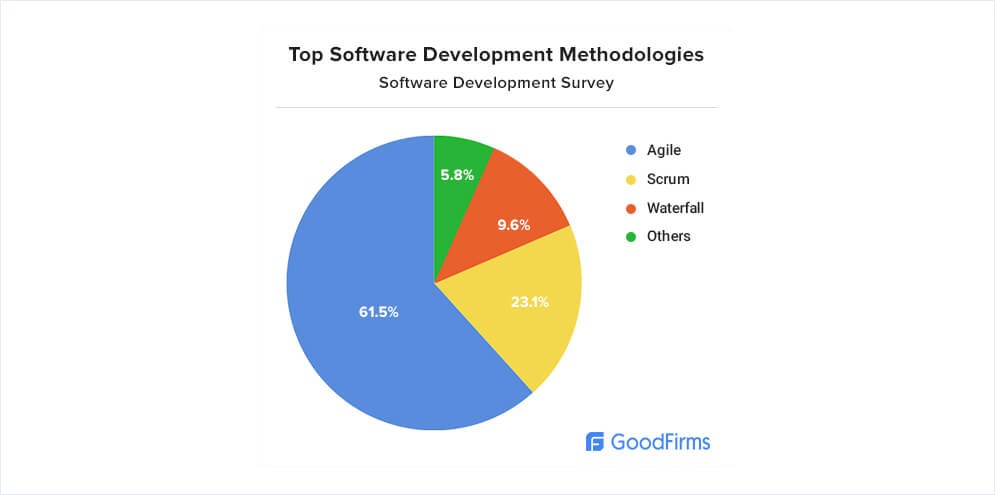
The Agile development model is one of the most commonly used software development methodologies due to its highly dynamic and iterative nature, which helps build high-quality, error-free software products.
Here is the pie chart report shared by GoodFirms, where you can see the agile software development method has topped the chart with 61.5%.
Source: GoodFirms
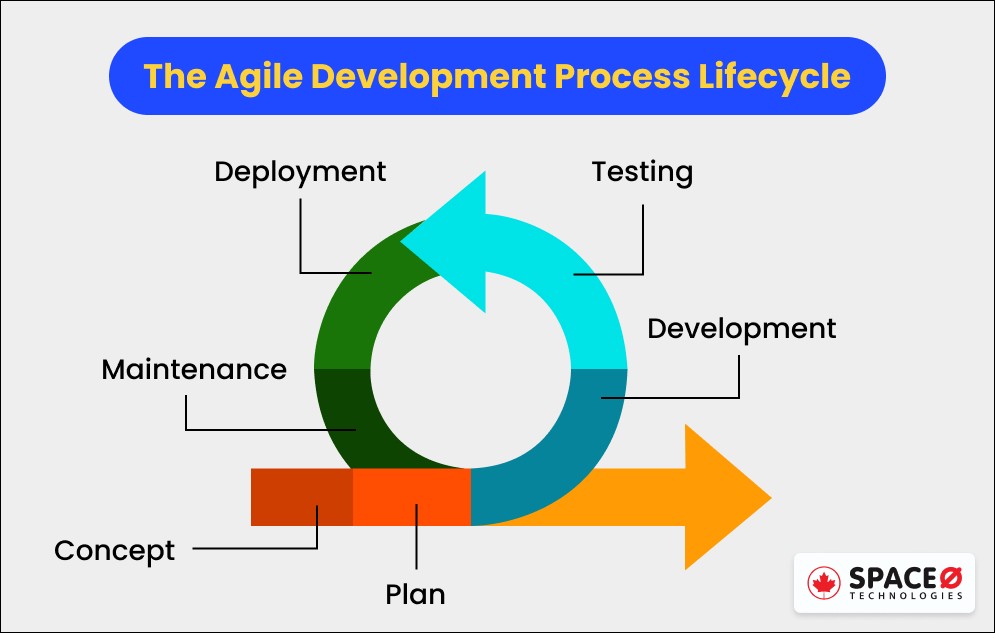
The best part of agile methodology is that even if you don’t have a complete list of requirements at the beginning of the project, you may find out as you go along.
Look at the below to see how agile methodology works.
Who Shall Use Agile Methodology?
Even though agile development methods are popular, one should only use them when the software development process, budget, and timeline are flexible. Also, if your project has frequent updates, then this model is highly recommended for you.
Take a look at the below image to learn how agile methodology works.
Pros and Cons of Agile Methodology
| Pros | Cons |
|---|---|
|
|
2. Waterfall Model
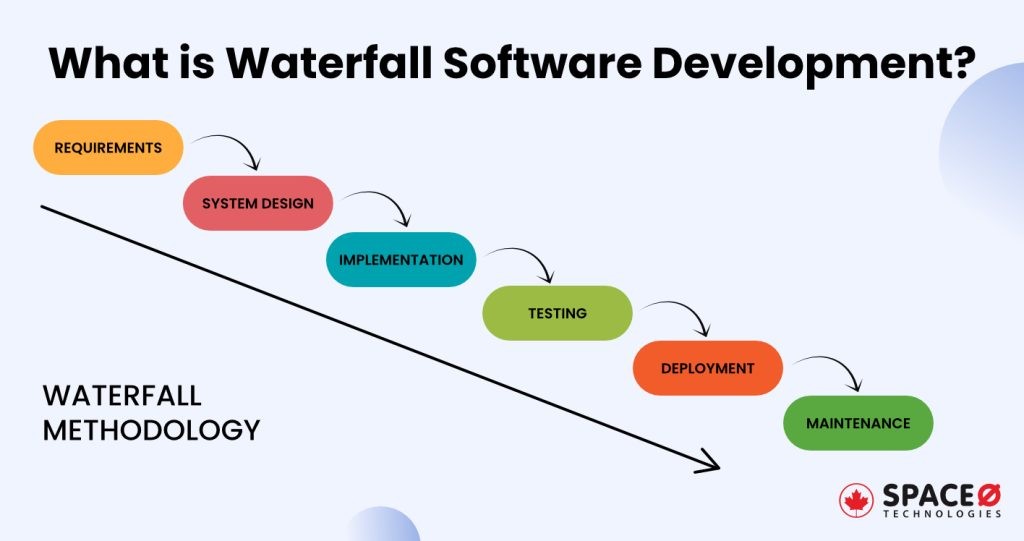
In the waterfall model, it is a must that you complete one stage to jump into the next stage because the result of the previous phase is the input for the next development phase. This is the reason it is also known as the linear-sequential life cycle model, where there is no chance of overlapping in stages.
Have a look at the below image to understand how the waterfall model works.
Who Shall Use Waterfall Methodology?
One who knows and has fixed requirements from the beginning and wants to build software within the estimated timeline should use the waterfall methodology.
Pros and Cons of Waterfall Methodology
| Pros | Cons |
|---|---|
|
|
3. Iterative Method
This model is all about developing different versions of software with the required features and functionalities from time to time. In short, with each release of the version, you try to enhance the features, user experience, and performance of the software by implementing customer feedback.
Check the following image to see how you can develop different software versions from time to time.
Who Shall Use Iterative Methodology?
As it gives you the flexibility to change or update the requirements of the software, you can go for this iterative model. Also, if you have complex needs that require heavy planning and architecture-building beforehand, then it is ideal for you.
| Pros | Cons |
|---|---|
|
|
4. Incremental Method
In the incremental model, the software development process is divided into multiple standalone modules, consisting of requirements, design, implementation, and testing phases. This model promotes continuous integration. Hence, each module builds on the foundation of the previous one, and this process continues until the complete software is developed.
Check how the incremental development model works through the below image.
Who Shall Use Incremental Methodology?
If you have a lot of flexibility in your project and want to know the user’s perspective on the product’s core feature, then use the incremental model for your software project. However, if you have a rigid technology plan, then you should avoid using the incremental methodology.
Pros and Cons of Incremental Methodology
| Pros | Cons |
|---|---|
|
|
5. Spiral Method
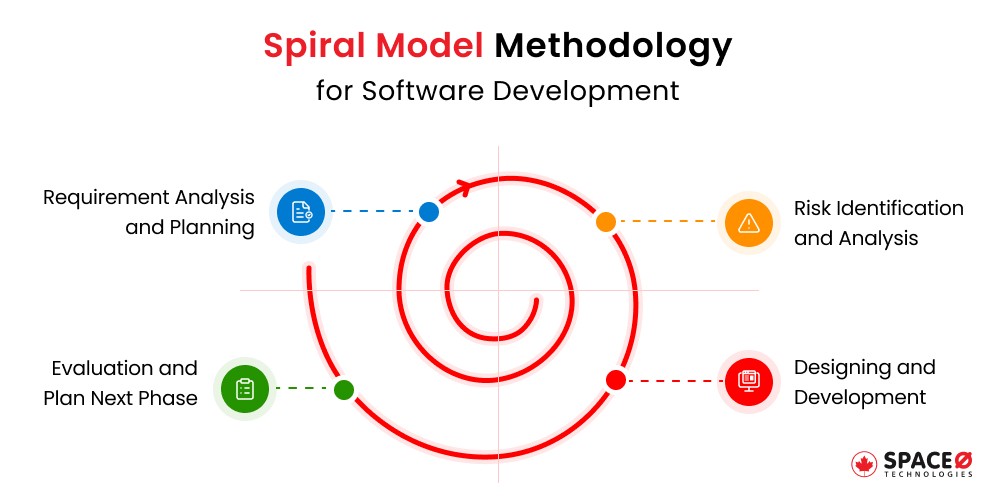
The spiral model combines iterative and waterfall methods in software engineering to develop large and high-risk projects. This model follows an iterative process, enabling you to update features at any stage of the development process.
Look at the below image to see how the spiral software development process works.
Who Shall Use Spiral Methodology?
The spiral methodology works best for people with large and complex projects where there is no room for mistakes. However, as this is a time-consuming model, you need to be patient when it comes to the estimated timeline and also have a high budget to choose this model.
Pros and Cons of Spiral Methodology
| Pros | Cons |
|---|---|
|
|
Want to Hire Experienced Software Developers?
Space-O has an experienced software development team that has built top software solutions like meat processing software, aviation maintenance solution, and event management solution.
Want to know how much it costs to build a software solution or more answers based on the software development process? Check the next FAQ section, where we have addressed 3 questions based on this topic. Have a look at them one by one.
FAQ About Software Development Process
What are some of the best software development strategies?
Here are the 5 strategies that you can implement in the development process to build a software solution within the estimated budget and timeline.
- Define your software project requirements clearly to the development team
- Follow the agile development methodology for a quicker process
- Prioritize your requirements but always focus on the end goal of the project
- Outsource your needs to a reliable software development company like Space-O
- Embrace the DevOps culture that enhances the communication and collaboration between the teams and project managers
What are the best practices for developing software?
The following are the top 5 software development best practices that you can consider for your project.
- Use the right software development process models
- Keep your code simple so that it is easy to update or modify the software in future
- Keep documenting your progress on the software project
- Conduct regular meetings with the team and keep them on the same page
- Test your software before deploying it to the live environment
How much does it cost to create software?
Building a software solution would cost you $10,000 – $1,50,000.
However, this cost range completely depends on several factors, which may increase or decrease the software development cost. The factors which influence the cost range are the features and functionalities of the software, the UX/UI design, the usage of the third-party APIs, the complexity of the software developed, and the location of the software developers.
Develop Your Software With the Right Process
Now that you know the right software development process, it will be easy for you to proceed with your project. However, you ensure that you are choosing a suitable software development methodology based on its characteristics, advantages, and disadvantages.
In case you need any guidance in selecting the ideal methodology and tech stacks or defining


 All our projects are secured by NDA
100% Secure. Zero Spam
*All your data will remain strictly confidential.
Trusted by


Bashar Anabtawi 
Canada
“I was mostly happy with the high level of experience and professionalism of the various teams that worked on my project. Not only they clearly understood my exact technical requirements but even suggested better ways in doing them. The Communication tools that were used were excellent and easy. And finally and most importantly, the interaction, follow up and support from the top management was great. Space-O not delivered a high quality product but exceeded my expectations! I would definitely hire them again for future jobs!”

Canada Office
2 County Court Blvd., Suite 400,
Brampton, Ontario L6W 3W8
Phone: +1 (602) 737-0187
Email: sales@spaceo.ca