
- What is a Telemedicine Development Team?
- What are the Key Roles in a Telemedicine Development Team?
- How Telemedicine Development Teams Scale with Project Size?
- What are the Essential Skills Required for a Telemedicine Development team?
- How to Build Your Telemedicine Development Team
- What are the Best Practices for Managing a Telemedicine Development Team?
- What are the Common Mistakes to Avoid When Building a Telemedicine Development Team?
- Build a Compliance-Ready Telemedicine Team with Space-O Technologies
- Frequently Asked Questions about the Telemedicine Development Team
Telemedicine Development Team: Roles, Skills, and How to Build the Right Team for Your Project

 Last Updated: February, 5 2026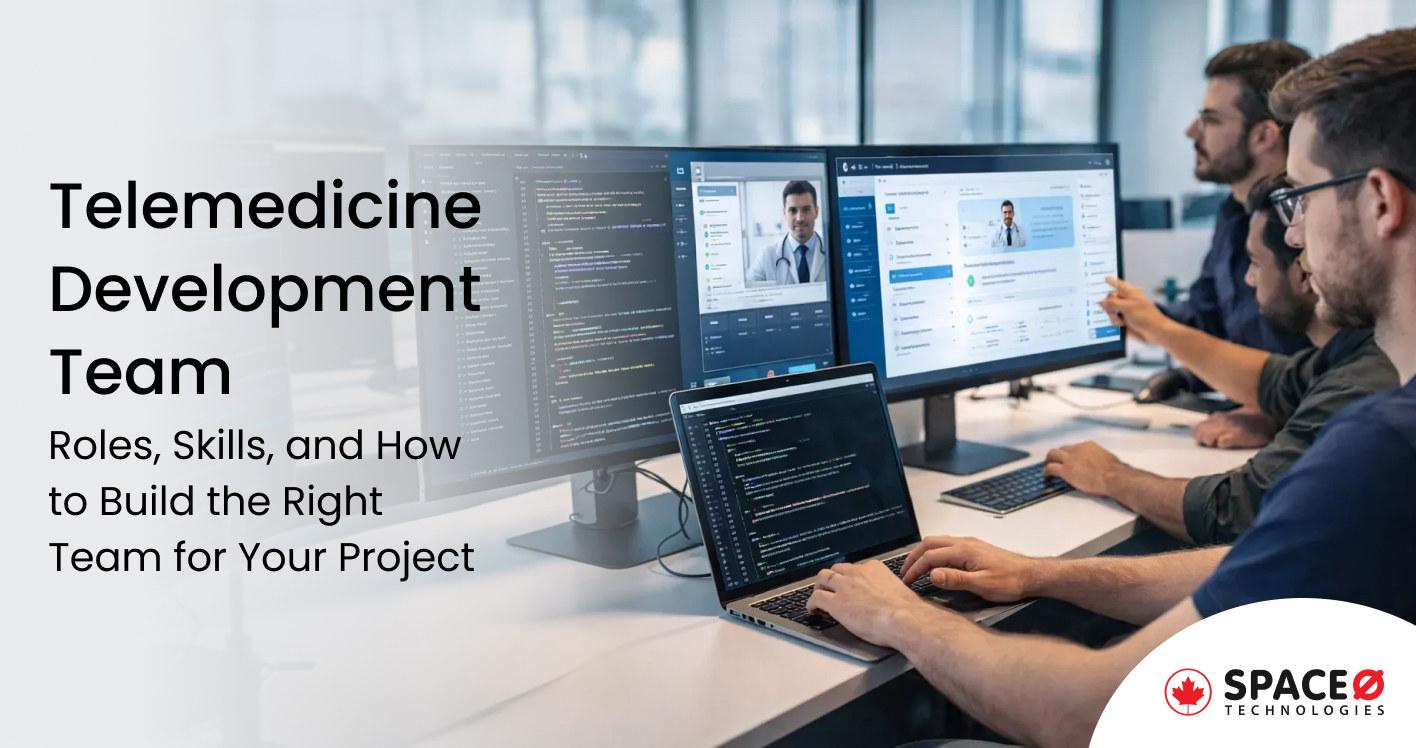
You can have the best technology stack, an unlimited budget, and a brilliant telehealth idea. But without the right telemedicine development team or the support of an experienced healthcare software development company, your project will struggle to deliver results. Team composition remains the single most critical factor that determines whether a telemedicine initiative succeeds or fails.
According to Grand View Research, the global telemedicine market size was estimated at USD 141.19 billion in 2024 and is projected to reach USD 380.33 billion by 2030, growing at a CAGR of 17.55% from 2025 to 2030.
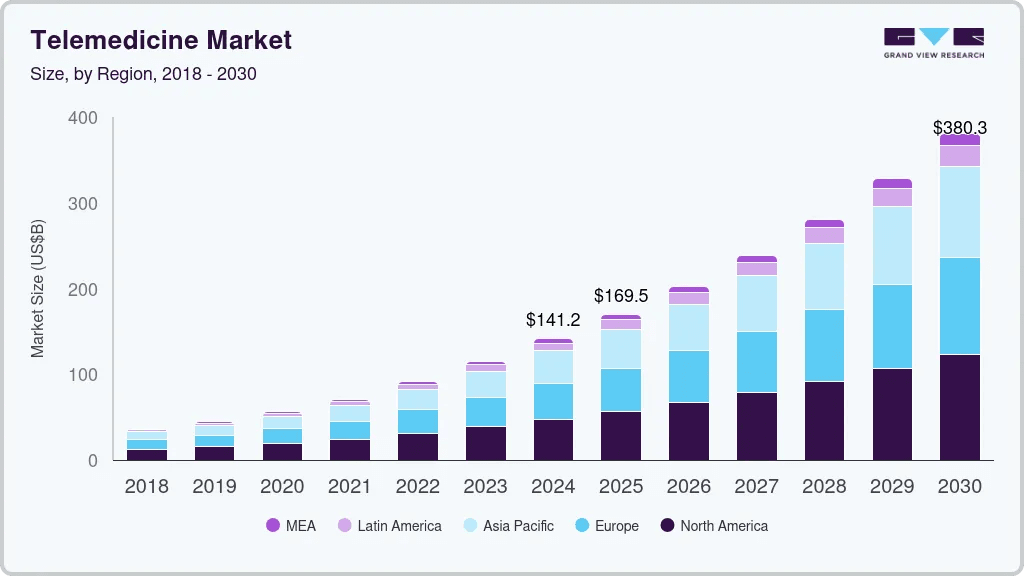
This explosive growth has created a massive demand for skilled telemedicine development teams. Yet many healthcare startups and organizations struggle to understand what roles they need, which skills matter most, and how to structure their teams effectively.
The result? Project delays, compliance failures, budget overruns, and telehealth platforms that never reach their potential.
This guide covers everything you need to know about building a telemedicine development team. Whether you’re building an MVP or an enterprise telehealth platform, understanding telemedicine app development team dynamics is essential for success.
What is a Telemedicine Development Team?
A telemedicine development team is a cross-functional group of specialists who design, build, test, and deploy telehealth software within the constraints of the healthcare industry. The team typically includes software engineers, UX designers, QA engineers, cloud architects, and healthcare domain experts who understand clinical workflows, patient needs, and regulatory requirements.
Unlike general software teams, telemedicine developers work in a highly regulated environment where PIPEDA, data security, and patient privacy shape every technical decision.
This team approaches healthcare software with a security-first and compliance-driven mindset. Every architecture choice, data flow, and user interaction accounts for protected health information, system reliability, and patient safety.
Organizations investing in healthcare software development must prioritize team composition from the outset. The cost of assembling the wrong team—whether through project delays, compliance violations, security breaches, or products that providers and patients won’t use—far exceeds the investment required to build the right one from the beginning.
Pro Tip: Healthcare domain knowledge cannot be learned overnight. When building your telemedicine development team, prioritize candidates with prior healthcare IT experience. A developer who already understands PIPEDA requirements, clinical workflows, and patient privacy expectations will save you months of compliance remediation and costly architectural rework later in the project.
With the foundational understanding established, let’s explore the specific roles that make up an effective telemedicine development team.
What are the Key Roles in a Telemedicine Development Team?
Every successful telemedicine project depends on clearly defined roles working in close coordination. While team size varies by scope, certain roles remain essential for both MVPs and enterprise platforms.
Understanding these roles helps you identify skill gaps, make informed hiring decisions, and set realistic expectations for your telehealth development team.
1. Project manager (Healthcare)
The project manager coordinates your telemedicine development team, managing timelines, budgets, and stakeholder communication. In healthcare projects, they track compliance milestones, coordinate with clinical advisors, and manage BAA timelines with vendors. They ensure PIPEDA checkpoints are integrated into sprints and push back when compliance requirements risk being deprioritized.
2. Business analyst (Healthcare Domain)
The business analyst bridges clinical requirements and technical implementation, translating healthcare workflows into functional specifications. They gather requirements from physicians, nurses, patients, and compliance officers, then create user stories capturing both functional and regulatory constraints. They map clinical workflows to application functionality and document compliance requirements for each feature.
3. UI/UX designer (Medical Apps)
Healthcare UI/UX designers create interfaces for patients who may be stressed, elderly, or technically inexperienced, and providers who need efficient workflows. They conduct user research with actual patients and providers, ensure WCAG accessibility compliance, and design patient-centric interfaces that work for diverse populations. Space-O Technologies emphasizes healthcare app design as a critical success factor in every telemedicine project.
4. Backend developers
Backend developers build server architecture, databases, and APIs powering your telemedicine platform. They implement PHI encryption at rest and in transit, build audit logging systems, and integrate with EHR systems using HL7 FHIR standards. Technology stacks typically include Node.js, Python, or Laravel with PostgreSQL or MongoDB on PIPEDA-eligible cloud platforms.
5. Frontend/mobile developers
Frontend developers create patient and provider applications with secure data handling and accessibility features. They build mobile apps using React Native or Flutter, implement session timeouts, and integrate video consultation interfaces that handle variable network conditions.
6. QA engineers (PIPEDA Testing)
Healthcare QA engineers verify applications meet compliance requirements and security standards beyond functional testing. They conduct PIPEDA compliance testing, coordinate penetration testing, verify PHI access controls, and test encryption implementation. They approach testing from a “could this expose patient data” perspective, combining traditional testing skills with an understanding of PIPEDA technical safeguards and security methodologies.
7. Compliance/security specialist
Compliance specialists ensure your platform meets HIPAA, PIPEDA, and PHIPA regulatory requirements. They conduct security risk assessments, develop compliance policies, manage vendor BAA agreements, and prepare audit documentation. Organizations should understand HIPAA telehealth compliance requirements before development begins. Having compliance expertise from the start prevents costly remediation later.
Hire a Telemedicine Development Team That Understands Healthcare
Work with a specialized team experienced in virtual care workflows, regulatory compliance, and building scalable telemedicine solutions.
Understanding individual roles is important, but knowing how to structure these roles into a cohesive team is equally critical for project success.
How Telemedicine Development Teams Scale with Project Size?
The ideal telemedicine development team structure depends heavily on your project scope, available budget, and timeline constraints. Understanding how to structure your team based on project size helps you allocate resources effectively and set realistic expectations for what can be accomplished.
1. Small/MVP Team (5-7 Members)
Small teams include one project manager (doubling as BA), one UI/UX designer, two full-stack developers, one QA engineer, and a part-time DevOps engineer. This structure suits healthcare startups validating market fit, MVP development, and single-specialty applications. Budget ranges $40,000-$80,000 with 3-5 month timelines.
Space-O’s guide on telemedicine MVP development covers feature prioritization and compliance strategies for validation-focused projects.
Quick Tip: For MVP teams, prioritize developers with full-stack capabilities who can work comfortably across frontend and backend responsibilities. This flexibility reduces coordination overhead and accelerates development.
2. Medium Team (8-12 Members)
Medium teams include a dedicated project manager, a business analyst, two UI/UX designers, two backend developers, two frontend developers, two QA engineers, a full-time DevOps engineer, and a part-time compliance specialist. This structure suits funded startups scaling beyond MVP, multi-feature platforms, and EHR integration projects. Budget ranges $100,000-$200,000 with 6-9 month timelines, enabling parallel development streams.
3. Large/Enterprise Team (15+ Members)
Enterprise teams include a project manager, a technical architect, 1-2 business analysts, 2-3 designers, 3-4 backend developers, 3-4 frontend developers, 2-3 QA engineers, 1-2 DevOps engineers, a security engineer, a compliance specialist, and a data engineer. This suits hospital systems, multi-provider platforms, and complex integrations.
Budget ranges $200,000-$500,000+ with 9-18 month timelines. Explore Space-O’s telemedicine software development resources for enterprise guidance.
Space-O Technologies offers flexible dedicated software development teams that can scale based on your project requirements. Whether you need a small MVP team to validate your concept or a comprehensive enterprise squad to build a mission-critical platform, we assemble the right expertise for your telemedicine project and scale the team as your needs evolve.
Beyond roles and structure, the specific skills your team possesses will ultimately determine whether your project succeeds. Here’s what to look for when evaluating candidates and partners.
What are the Essential Skills Required for a Telemedicine Development team?
Building a successful telemedicine platform requires a carefully balanced combination of technical expertise, healthcare domain knowledge, and soft skills that enable effective collaboration.
1. Technical Skills
Technical foundations include backend development (Node.js, Python, Laravel), frontend/mobile frameworks (React Native, Flutter, Swift, Kotlin), and database management (PostgreSQL, MongoDB with encryption). Critical healthcare-specific skills include WebRTC video integration, HL7 FHIR standards for EHR interoperability, PIPEDA-eligible cloud configuration (AWS, Azure, GCP), and security implementation including AES-256 encryption, OAuth 2.0, RBAC, and comprehensive audit logging.
2. Healthcare Domain Skills
Teams need regulatory compliance knowledge spanning PIPEDA Privacy and Security Rules, PIPEDA, and provincial health laws like PHIPA. Clinical workflow understanding covers patient intake, consultation workflows, prescriptions, referrals, and emergency protocols. Healthcare data management includes PHI handling, minimum necessary standards, consent management, and retention requirements. Organizations that understand healthcare app development comprehensively build better products. Space-O’s team brings this expertise to every project.
3. Soft Skills
Essential soft skills include clear documentation, effective stakeholder communication, and cross-functional collaboration. Problem-solving requires navigating regulatory constraints creatively and balancing compliance with user experience. Attention to detail ensures security-conscious development and accurate compliance documentation. A patient-centric mindset keeps teams focused on empathy for patient needs and provider workflow pressures, ensuring telemedicine platforms serve all users effectively.
Pro Tip: During interviews, ask candidates to describe a situation where compliance requirements conflicted with user experience goals. Their answer reveals whether they understand the nuanced balance healthcare applications require and how they approach trade-offs.
Now that you know what skills to seek, let’s explore your options for building or hiring your telemedicine development team and which approach makes sense for your situation.
How to Build Your Telemedicine Development Team
Organizations have several options for assembling telemedicine development teams, each with distinct advantages and trade-offs. The right choice depends on your budget, timeline, existing capabilities, and long-term product strategy. Understanding these options helps you make informed decisions that align with your organizational context and goals.
Option 1: Hire an In-House team
In-house teams provide full control over composition, priorities, and product knowledge retention. However, fixed costs run $500,000-$1,500,000+ annually in North America, recruitment takes 3-6 months, and finding healthcare-specialized talent is challenging. This works best for well-funded organizations with long-term roadmaps where telehealth is core business.
Option 2: Outsourcing to a development company
Outsourcing provides immediate access to healthcare expertise, built-in compliance knowledge, and faster time-to-market with variable costs aligned to project phases. Trade-offs include less direct control and a need for effective communication frameworks. This suits startups validating concepts, organizations without internal capabilities, and time-sensitive projects. Space-O Technologies offers dedicated telemedicine teams with proven healthcare expertise.
Option 3: Select hybrid model
Hybrid models combine internal core teams with outsourced specialists, maintaining strategic control while accessing specialized skills without full-time commitment.
Challenges include coordination complexity across internal and external teams. This suits growing companies needing to augment capabilities.
Many organizations successfully outsource healthcare software development for specialized components while maintaining internal product leadership.
Option 4: Staff Augmentation
Staff augmentation adds external developers to existing teams, filling specific skill gaps while maintaining your processes and tools.
It requires existing team structure for effective integration. This suits organizations with established teams needing healthcare expertise for short-term capacity or specific skills like compliance or EHR integration.
Organizations can hire offshore developers through Space-O for healthcare-specialized augmentation.
Strengthen Your Telemedicine Roadmap With the Right Development Team
Collaborate with a telemedicine development team that supports MVP builds, platform scaling, and long-term product evolution.
Assembling the team is just the beginning of the journey. Effective collaboration frameworks and management practices ensure your telemedicine development team delivers the results you need.
What are the Best Practices for Managing a Telemedicine Development Team?
Even the most talented telemedicine development team needs effective management practices to deliver successful outcomes. These proven approaches help telemedicine development teams work effectively while meeting the regulatory and quality standards of healthcare demands.
1. Agile/Scrum methodology for healthcare projects
Adapt agile for healthcare by including compliance tasks in sprint backlogs and allocating time for security reviews. Daily standups should surface compliance-related blockers. Sprint reviews benefit from clinical stakeholder involvement to validate workflow alignment. Retrospectives should address compliance process effectiveness.
2. Communication frameworks
Use project management platforms (Jira, Asana), documentation systems (Confluence, Notion), and communication tools (Slack, Teams) with appropriate enterprise security. Never share actual PHI in development communications—use anonymized data. Establish core overlap hours for distributed teams and document decisions asynchronously for team members across time zones.
3. Compliance integration in the development process
Integrate compliance throughout development rather than treating it as a final gate. Include security assessment in code reviews, run automated security scanning in CI/CD pipelines, and address vulnerabilities immediately. Conduct pre-deployment compliance verification, documentation reviews before releases, and continuous penetration testing. Dependency monitoring alerts teams to security updates in third-party libraries.
4. Knowledge transfer and documentation
Healthcare projects require extensive documentation for compliance and maintenance. Technical documentation includes architecture decisions, API docs, and security implementation details. Compliance documentation covers risk assessments, policies, audit logs, and incident response procedures. Onboarding documentation should include environment setup, coding standards, compliance training, and healthcare domain context.
Pro Tip: Include your compliance specialist in sprint planning meetings from the project’s start. They can identify regulatory implications of proposed features early, preventing costly rework when compliance issues are discovered after features are built.
Avoid common pitfalls by learning from mistakes that other organizations have made when building telemedicine development teams. These lessons can save you significant time, money, and frustration.
What are the Common Mistakes to Avoid When Building a Telemedicine Development Team?
Learning from others’ mistakes helps you build a more effective telemedicine development team while avoiding the expensive detours that have derailed other projects. These are the most common pitfalls we’ve observed and how to avoid them.
1. Underestimating healthcare compliance expertise
Hiring general developers assuming compliance can be “added later” leads to expensive architectural rework when fundamental decisions—database schemas, API designs, logging approaches—don’t meet requirements. Avoid this by prioritizing healthcare experience in hiring, including compliance requirements in specifications from day one, and engaging compliance expertise before development begins.
2. Skipping dedicated QA resources
Relying on developers to test their own code results in bugs affecting patient safety, undetected compliance gaps, and rapid technical debt accumulation.
Include dedicated QA engineers from project start, implement automated testing early, conduct security-focused testing throughout development, and ensure QA understands healthcare compliance requirements specifically.
3. Ignoring UX design for healthcare
Generic UI patterns cause patients to struggle with confusing interfaces and providers to find workflows inefficient, reducing adoption.
Hire designers with healthcare experience, conduct user research with actual patients and providers, test with diverse user groups including elderly and disabled users, and design accessibility as a core requirement.
4. Poor communication frameworks
Failing to establish clear protocols causes misaligned work streams, duplicated efforts, lost information, and slow decision-making.
Establish communication tools and protocols early, document decisions broadly, create regular synchronization points appropriate to team distribution, and invest in communication as a project activity.
5. Insufficient security expertise
Treating security as a checklist item rather than a foundational requirement risks data breaches, regulatory penalties, and reputational damage that can take years to recover from. Include security expertise from the start, conduct regular assessments throughout development, implement continuous security testing in CI/CD, and treat security architecture with the same importance as functional architecture.
6. Choosing the wrong technology stack
Selecting technologies based on developer preference rather than healthcare requirements leads to compliance workarounds, integration challenges with healthcare systems, and difficult long-term maintenance.
Evaluate choices against healthcare requirements, consider ecosystem support for HL7 FHIR and EHR APIs, and choose technologies with proven PIPEDA implementations.
For organizations evaluating development partners, Space-O’s guide on healthcare app development companies helps identify partners with the expertise and track record to avoid these common mistakes.
Work With a Secure and Compliant Telemedicine Development Team at Space-O
Partner with Space-O’s telemedicine experts to build PIPEDA-compliant solutions supported by structured processes and proven delivery models.
Space-O Technologies has assembled experienced telemedicine development teams for healthcare clients across North America. Here’s how we can help you build the right team for your project.
Build a Compliance-Ready Telemedicine Team with Space-O Technologies
Building the right telemedicine development team is critical to the success of any telehealth initiative. Beyond technology choices, budgets, and timelines, the right mix of healthcare expertise, technical skills, and collaboration practices determines compliance, usability, and patient outcomes. A strong telemedicine team combines software engineering with deep knowledge of healthcare regulations, clinical workflows, and security requirements to support real-world care delivery.
Since 2018, Space-O Technologies has been building secure and compliant healthcare software. Our teams embed HIPAA and PIPEDA compliance into the development process from day one and have delivered telemedicine platforms such as video consultation apps, patient portals, remote patient monitoring systems, and provider management solutions. We offer flexible engagement models for MVPs, full-scale platforms, and ongoing maintenance, scaling teams based on project needs.
Our teams have successfully delivered:
- Video consultation and virtual care platforms
- Secure patient portals and provider dashboards
- Remote patient monitoring (RPM) systems
- Care coordination and provider management solutions
Each solution is designed to align with real clinical workflows, protect sensitive patient data, and support seamless communication between patients and care providers.
To match your business goals, Space-O Technologies offers flexible engagement models—whether you’re building an MVP to validate a telehealth concept, launching a full-scale virtual care platform, or scaling an existing solution with ongoing enhancements and support. Our teams can scale up or down based on your project scope, timelines, and regulatory requirements.
Whether you’re validating a telehealth concept or expanding virtual care services, Space-O Technologies provides dedicated, compliance-ready development teams that help you move faster without compromising quality. Schedule a free consultation to get started.
Frequently Asked Questions about the Telemedicine Development Team
What is the ideal team size for a telemedicine MVP?
The ideal MVP team size is 5-7 members: one project manager, one UI/UX designer, 2-3 full-stack developers, and one QA engineer. This lean structure enables fast development in 3-5 months while maintaining compliance standards.
How much does it cost to hire a telemedicine development team?
Outsourced telemedicine teams cost $40,000-$80,000 for MVPs, $100,000-$200,000 for medium projects, and $200,000-$500,000+ for enterprise platforms. In-house teams in North America cost $500,000-$1,500,000+ annually including salaries, benefits, and overhead.
Should I build an in-house team or outsource telemedicine development?
Outsourcing suits startups validating concepts and time-sensitive projects needing faster market entry. In-house works for well-funded organizations with telehealth as core business. Many use hybrid approaches—internal product leadership with outsourced development expertise.
What compliance expertise should a telemedicine development team have?
Teams need HIPAA expertise (Privacy Rule, Security Rule, Breach Notification) for US markets and PIPEDA/PHIPA knowledge for Canada. Technical requirements include PHI handling, AES-256 encryption, audit logging, access controls, and BAA management. At minimum, engage a compliance specialist throughout development.
How long does it take to build a telemedicine development team?
In-house recruitment takes 3-6 months for hiring and onboarding. Outsourcing partners like Space-O Technologies provide ready-to-start teams within 2-4 weeks with built-in healthcare expertise. Staff augmentation fills specific roles in similar 2-4 week timeframes.
Can a general software development team build a telemedicine app?
Not recommended. General teams lack healthcare domain knowledge, PIPEDA understanding, and clinical workflow expertise. Common outcomes include compliance failures, poor user experiences, and security vulnerabilities. Healthcare-specialized teams deliver better outcomes faster without learning costly lessons during your project.


Hire a Telemedicine Development Team That Understands Healthcare
What to read next
 All our projects are secured by NDA
100% Secure. Zero Spam
*All your data will remain strictly confidential.
Trusted by


Bashar Anabtawi 
Canada
“I was mostly happy with the high level of experience and professionalism of the various teams that worked on my project. Not only they clearly understood my exact technical requirements but even suggested better ways in doing them. The Communication tools that were used were excellent and easy. And finally and most importantly, the interaction, follow up and support from the top management was great. Space-O not delivered a high quality product but exceeded my expectations! I would definitely hire them again for future jobs!”

Canada Office
2 County Court Blvd., Suite 400,
Brampton, Ontario L6W 3W8
Phone: +1 (602) 737-0187
Email: sales@spaceo.ca