


Education App Development: A Complete Guide
Education app development has become one of the biggest opportunities in the software industry. What started as a response to remote learning needs has matured into a mainstream market — where students, professionals, and institutions rely on mobile platforms for everyday learning.
The numbers reflect this shift. According to Straits Research, the global education apps market was valued at USD 6.01 billion in 2024 and is projected to reach USD 33.51 billion by 2033, growing at a CAGR of 21.04%.

From K-12 and higher education to corporate training and professional development, the demand for custom learning apps is rising across every segment.
Whether you’re an educational institution looking to expand your digital reach or an entrepreneur exploring how to create your own educational app, this guide covers everything you need to know.
We’ll walk you through the types, features, development process, cost, and monetization strategies — along with the mobile app development expertise needed to bring your vision to life.
Table of Contents
While moving further, let’s understand the education app.
What is Education App?
An educational app is a mobile or web-based application designed to help students, professionals, and educators access learning resources anytime, anywhere. These apps range from basic knowledge platforms for kids to advanced professional development tools for adults.The category of education apps varies widely.
For children, the focus is on interactive lessons, visual learning, and foundational skills. For adults and professionals, the focus shifts to certifications, specialized courses, and skill-building. This versatility is what makes education apps one of the most popular categories of apps across both the App Store and Google Play.
What are the Popular Types of Educational Apps?
Before diving into the development process, let’s explore the different types of educational app development services that are in demand today.
Learning Apps for Kids
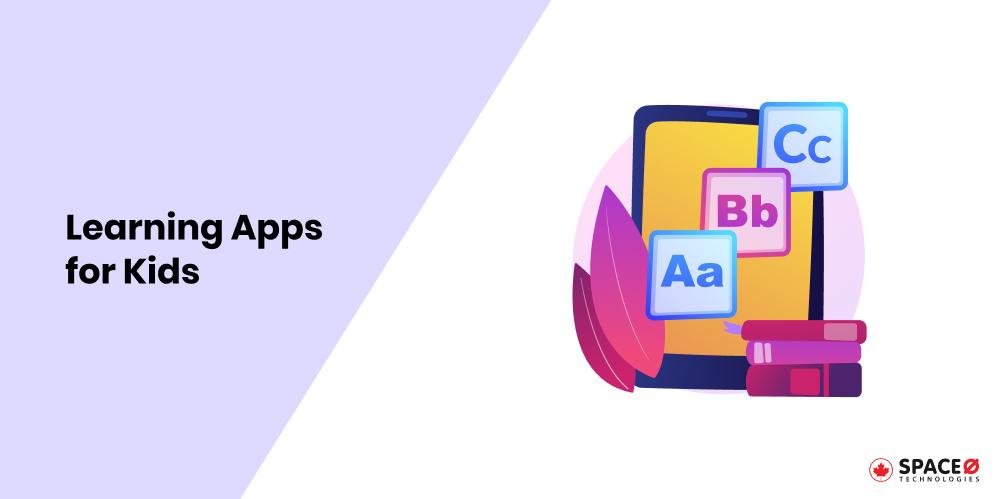
Mobile learning apps for the kids are designed to offer easy understanding concepts to kids. These apps include the best perceptible learning for an exclusive learning experience for kids. It helps to develop the creativity level of kids, creating education more interesting for kids. Personalization in the apps provides the specific content as per the ability or level of understanding. Additionally, students are also awarded certificates and virtual trophies in an educational app for encouraging them to study.
Apps for Apprenticeship Courses
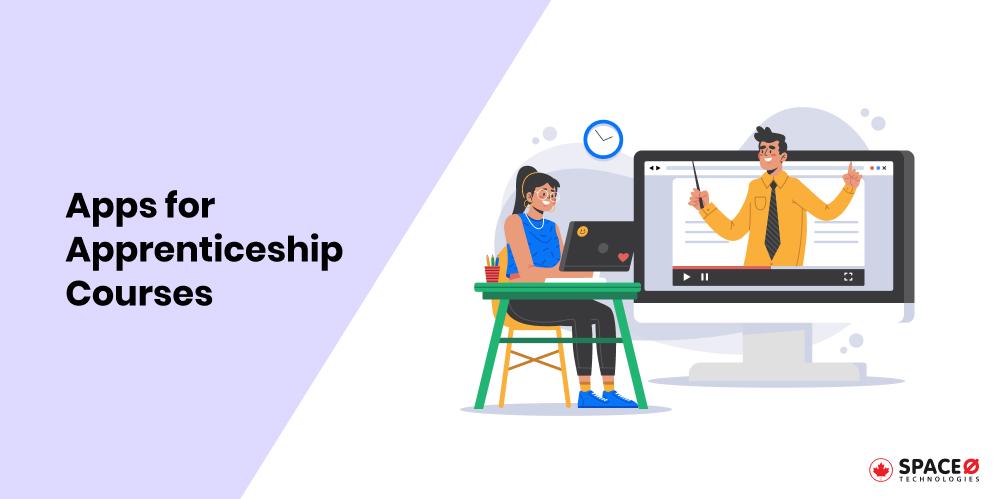
Online course platforms are one of the most widespread types of e-learning apps. They deliver content through video lectures, e-books, assignments, and interactive quizzes — covering everything from marketing and programming to creative skills.
These platforms function as full-fledged web applications where experts offer structured courses to global audiences. Popular examples include Udemy and Coursera, both of which have set the benchmark for on-demand education delivery.
Supportive Apps for Learning

Some educational mobile applications help in making your learning activities better. The online learning app deals with solving mathematical equations and helps you to improve your grammar. Supportive educational apps offer you a platform where you can clear your doubts and bring improvements to your children’s studies. It can even offer you the step by step guide to solve every problem.
Gamification Learning Apps
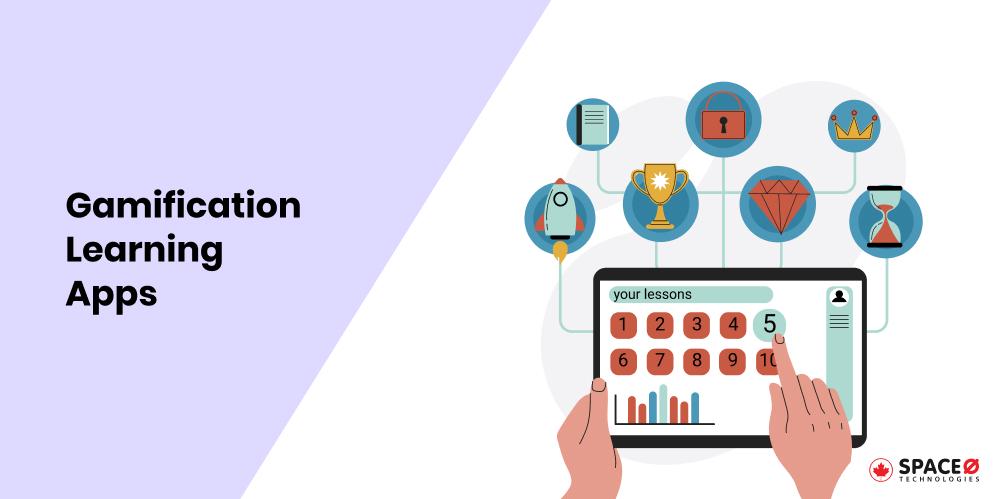
Mobile gamification is one of the most trending educational app features. It makes learning enjoyable by including quizzes, puzzles, and achievement-based challenges that motivate students to keep progressing.
In gamified learning apps, people of any age group can participate in quizzes tailored to their choice, difficulty level, and category. These apps often use techniques like points, badges, and leaderboards to drive engagement — a proven strategy in cross-platform mobile app development designed for wide audiences.
Exam Preparation Apps

These types of educational applications are specially designed to provide several practice exercises to students. It contains numerous databases on various subjects that help students in scheduling tests and self-assessment. The effectiveness of assessment helps students to know their weak points and they can improve accordingly to perform better in the actual exam.
Confused to choose which type of education app is best for your students?
Discuss with us we have the best app developer team to guide you.

What are the Benefits of Developing Education Apps?
Education apps develop interests, increase engagement, and attract users from across the globe. For businesses and institutions, building a custom education app offers clear advantages over off-the-shelf solutions. Here are the key benefits of having a mobile app for the education sector.
- You can target a huge number of users from across the globe.
- It makes students tech-savvy by accessing the materials, submitting assignments, researching, and preparing guides.
- Students aren’t required to buy separate books, guides, and other materials. They can access all the educational information in just one handy device at their fingertips.
- Students can access all the material and ebooks at any time round the clock.
- It offers the flexibility of time, students can attend the lecture as per convenience.
- It’s easy to track the progress of each student and get proper effective progress reports.
- Students learn well with the help of visual graphics and interactive content that helps to solve their doubts easily.
- Students can record the lectures and repeat them at their convenience.
- With the help of an education app, students can now learn things in a better way by getting involved in the live session of practicals and projects.
- Through apps, students can have real-time interaction with teachers for asking doubts and queries and it makes the teaching process easier.
- Students can find the information easily by just searching it on the app, they don’t need to go to the library and search the books until they find the information.
- Learners can opt for a course of their choice as they are free from the predefined structure of the education system.
- The best solution for parents is to utilize the free time of their kids by providing them with an education mobile app.
- Students can gain the approach of the systematic learning advantage that not only craves but enhances their knowledge.
What are the Unique Features of the Education App?
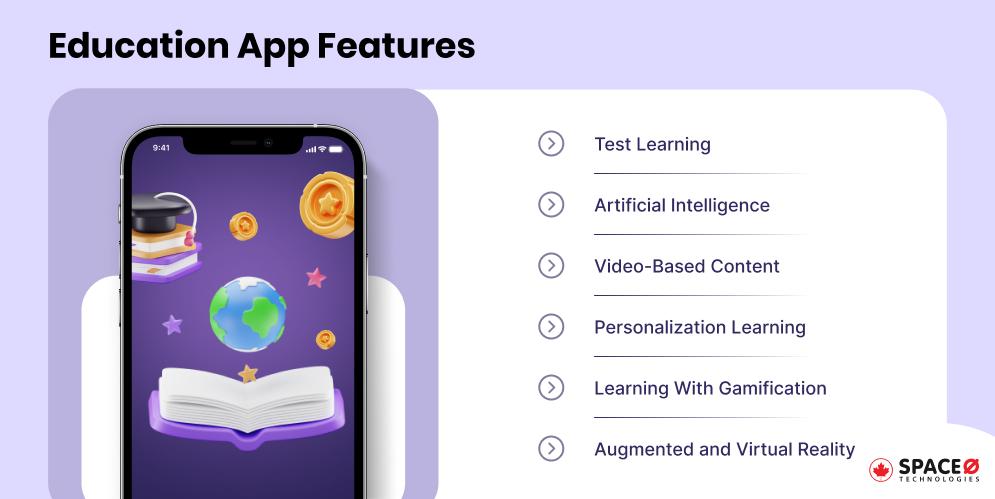
Augmented and Virtual Reality
This is the most impactful technology in educational apps. As students will be able to perform experiments that are unreal and difficult to conduct in reality. AR VR will help them to understand complex issues more quickly. It will not only increase the interactivity with the mobile application but, they will gain new skills and knowledge with a better visualization.
Artificial Intelligence
Artificial intelligence is reshaping the education technology landscape. In educational apps, AI automates routine tasks and delivers personalization by analyzing each user’s learning patterns and identifying weaker areas.
AI also powers intelligent recommendations that help students overcome problem areas more efficiently. Voice assistants — another application of AI — can narrate educational material, making content more accessible for auditory learners and students with disabilities.
Video-Based Content
Video-based content is a cornerstone of any education app. Students expect live sessions, recorded lectures, and chapter-wise video libraries that they can access on demand.
The ability to rewind, fast-forward, pause, and zoom into specific parts of a lecture gives learners full control over their pace. For institutions developing an educational app, investing in high-quality video infrastructure is non-negotiable.
Test Learning
The test is an essential part of learning, it helps you to know your capabilities by checking the level of your knowledge. Thus, offering a mock test and quizzes on various topics helps students to conduct mocks and evaluate themselves.
One of the important additions here is you can provide them with interactive solutions which include a step-by-step process of solutions to their questions. This feature can include video tips, important tricks, and other suggestions that can help them to perform well in the exams.
Learning With Gamification
Research consistently shows that students learn better when the process is engaging and fun. Gamification in education apps — through points, rewards, and interactive challenges — is one of the most effective methods for keeping students motivated.
You can offer encouraging activities or game sessions once students accomplish a learning stage as a reward. This approach not only increases retention but also enhances their ability to grasp complex concepts in a more natural way.
Personalization Learning
Personalization keeps users engaged by tailoring the learning experience to their individual needs, pace, and preferences. When an education app adapts to each learner’s progress, it builds trust and encourages consistent usage.
A well-designed UI/UX that simplifies navigation and makes every feature easily accessible is the foundation of effective personalization. The easier it is for students to interact with your app, the longer they stay.
Turn Your Education Concept Into a Structured Mobile Product
Space-O translates learning objectives and user journeys into phased development roadmaps with clear milestones.
How to Build Education App?
Now, this is the most essential step for building an education mobile app. We’ve provided you detailed step process as below,
Market Research
One of the crucial steps to be in the market and compete with your competitors. How can you start the market research? We’ve some questions to help you out.
- How will your e-learning app solve the pain points of students?
- How will you reach and attract a large audience?
- How do you improve customer satisfaction?
Additionally, some points on how you can conduct well market research.
- Search your target audience and know their needs.
- Create a proper customer journey map for your users that drives them to each perfect stage in your application.
- Find out the trends that help you to increase the engagement of your targeted group users for your learning platforms.
Knowing the market needs will help you in e-learning app development with better educational content. It is quite challenging to overcome the real problems, but staying current with trends in mobile app development and preparing a focused design module could be the best solution.
Interactive Content
Content is the most valuable asset for your educational app development. The training programs which you are including should have the latest source of data. Your content should be engaging and interesting to drive outcomes. Because it’s the only thing users come for. Providing generics content as similarly available on youtube won’t make your stand different! Remember, your training course should deliver the knowledge as per their expectations that will make your efforts worthy.
Feasible UI UX
The appearance of your app matters just as much as the content. A simple and elegant design is the best approach to engage students, teachers, and children. The right combination of themes, layout, and navigation can make or break the user experience.
The educational app design should balance visual appeal with the core purpose of learning. A smooth flow of user interaction with every feature leads to higher satisfaction, better retention, and stronger learning outcomes.
MVP for Education Mobile App Development
Building a full-scale solution with advanced technology is a great idea, but launching with everything at once can be risky. The smarter approach to educational mobile app development is to start with the most essential features through MVP development, allowing you to test the market with a lean version before investing in additional capabilities.
Testing Mobile App Development
After preparing a prototype of your learning app you can perform its testing through various aspects. Testing helps in identifying the lacking gaps in your application. You can bring improvements to make your app better for your targeted audience.
Even, you can share your MVP version of your app with your friends and family to test the user journey as it is properly satisfied or not. If you manage to conquer complexity in the educational app then you can stand out from your competitors and bring a better engagement for your users.
Choosing the right education app developers is essential at this stage. You need a team that understands your requirements, your target learners, and the technical complexities of building a scalable education platform — from the backend architecture to the user-facing experience.
Want to estimate the cost before you start building?
Use our free app cost calculator for an instant ballpark figure.
How Much Does it Cost to Make an Educational App?
The cost of developing an education app starts from $30000 and depends on several factors — features, complexity, technology stack, platform choice, and the level of design required. Animation, real-time video, and AI-powered features will push the cost higher, while a simpler MVP can be delivered at a fraction of the investment.
Here’s a general cost breakdown based on app complexity:
| App Complexity | Estimated Cost (USD) | Timeline |
|---|---|---|
| Basic (MVP with core features) | $30,000 – $60,000 | 3–4 months |
| Mid-Level (multi-platform, gamification, video) | $60,000 – $150,000 | 4–6 months |
| Advanced (AI, AR/VR, LMS integration) | $150,000 – $300,000+ | 6–12 months |
These estimates cover the full cycle — platform selection (Android, iOS, or cross-platform), UI/UX design, backend development, testing, and deployment. In North America, education app development companies typically charge between $50 and $150 per hour depending on the team’s expertise and project scope.
Security is another critical consideration. Education apps often store sensitive student data, particularly for children, making compliance with data privacy regulations like COPPA, FERPA, and PIPEDA essential. For a deeper breakdown, read our guide on app development cost.
How to Monetize Your Education App
Once your education app is live, the next step is generating revenue. The right monetization model depends on your target audience, content type, and long-term business goals. Here are the most common strategies used by successful education apps today.
Freemium Model
The freemium approach offers a basic version of the app for free with limited features or content. Users who want access to premium features, advanced courses, or an ad-free experience pay a one-time fee or subscribe. This is one of the most popular models in the education space — apps like Duolingo and Khan Academy use variations of it to scale their user base before converting to paid plans.
Subscription Model
A subscription model charges users a recurring fee — monthly or annually — for continuous access to content and features. Offering multiple tiers (basic, pro, enterprise) allows you to serve different audience segments. This model works especially well for SaaS-based education platforms that deliver regularly updated course libraries.
In-App Purchases
In-app purchases let users buy additional courses, study materials, or premium tools within the app. This model works when your core app is free but offers high-value add-ons that learners are willing to pay for — such as certification prep packages or advanced subject modules.
In-App Advertising
Placing advertisements within your app is a common revenue source, especially for free education apps. However, ad placement must be carefully managed so it doesn’t disrupt the learning experience. Interstitial ads between lessons or banner ads in non-learning screens tend to perform best without hurting retention.
Certification and Exam Fees
Charging users for verified certificates or official exam access is a high-value monetization strategy. Learners are often willing to pay for certifications that carry professional credibility. This approach is particularly effective for corporate training apps and professional development platforms.
What are the Most Popular Technology Stacks for Education App Development?
Choosing the right technology stack is one of the most important decisions in education app development. The stack you select affects everything — performance, scalability, time-to-market, and long-term maintenance costs.
1. Mobile app development
For native performance, Swift remains the standard for iOS and Kotlin for Android. However, most education app projects today benefit from cross-platform frameworks. React Native allows you to build for both iOS and Android from a single codebase — reducing development time and cost without sacrificing quality.
2. Cross-platform development
Flutter is another strong option for education apps that need to reach the widest possible audience. Its fast rendering engine and expressive UI toolkit make it ideal for building visually rich, interactive learning interfaces that perform consistently across devices.
3. Backend technologies
The backend handles data storage, user authentication, content delivery, and API integrations. Popular choices include Node.js for real-time features (such as live classes and chat), Python for AI and machine learning integrations, and Ruby on Rails for rapid development. Cloud platforms like AWS and Google Cloud provide the scalable infrastructure needed to handle growing user bases.
4. AI and machine learning
AI powers some of the most valuable features in modern education apps — adaptive learning paths, intelligent recommendations, automated assessments, and chatbot-based tutoring. TensorFlow, PyTorch, and OpenAI APIs are commonly used to build these capabilities.
5. Content management
A robust content management system (CMS) is essential for education apps that frequently update course materials. Headless CMS solutions like Strapi or custom-built systems give content teams the flexibility to manage lessons, quizzes, and multimedia assets without depending on mobile application developers for every update.
Build an Education App Designed for Engaging Learning Experiences
Space-O develops education mobile apps that support interactive lessons, assessments, and seamless communication between learners and instructors.
Frequently Asked Questions
Do educational apps make money?
Yes. The education app market generated over $6 billion in revenue in 2024 and continues to grow rapidly. Most successful education apps monetize through subscription models, freemium plans, in-app purchases, or certification fees. The key is delivering consistent value that justifies recurring payments from students, parents, or institutions.
Why are apps good for learning?
Learning management apps are built to improve the education system, it helps students to learn things easily and remember it for a longer duration. Education app makes the study simpler as compared to textbooks because of visual and graphical representation.
How can mobile apps help education?
Education apps bring multiple benefits — from automated attendance tracking and assessment reports to personalized feedback for each student. Teachers can monitor progress remotely, parents can stay updated on their child’s performance, and students get a structured learning environment accessible from any device.
Why do schools, colleges, and universities need a mobile app?
Mobile apps help to make the connection strong, teachers or professors can easily get connected with students anytime and anywhere. Mobile applications allow them to get instant updates from their educational institutes to take appropriate actions at the right time. It becomes easier for students to download the materials from a centralized point by using an application.
How long does it take to develop an educational app?
A basic education app with core features typically takes 3 to 4 months to develop. Mid-complexity apps with gamification, video streaming, and multi-platform support can take 4 to 6 months. Advanced education platforms with AI-driven personalization, AR/VR features, or LMS integration may require 6 to 12 months depending on the scope and team size.
How much does it cost to develop an educational app?
The cost ranges from $30,000 for a basic MVP to $300,000+ for a feature-rich platform with AI, video streaming, and cross-platform deployment. The exact cost depends on the app’s complexity, the technology stack, the number of platforms (iOS, Android, or both), and the development team’s location and hourly rates.
How Space-O Technologies Can Help You Build Your Education App
Education apps are reshaping how students, professionals, and institutions across Toronto approach learning — from K-12 classrooms and universities to corporate training and professional upskilling. With Canada’s EdTech market growing rapidly, building a successful education app requires the right mix of strategy, design, and scalable technology.
Since 2018, Space-O Technologies has been helping organizations in Toronto and across North America build custom education apps tailored to local compliance, user expectations, and growth goals. Our team of 50+ experienced developers works with modern technologies such as React Native, Flutter, Swift, and Kotlin to deliver secure, high-performance education apps designed for long-term engagement.
Whether you’re a Toronto-based startup, an educational institution, or an enterprise looking to launch:
- a Learning Management System (LMS),
- a gamified K-12 learning app,
- a university companion app, or
- a corporate training platform
We provide end-to-end education app development services — from product ideation and UI/UX design to mobile app development, QA testing, deployment, and ongoing support.
Every project also includes 3 months of free post-launch maintenance.
Ready to turn your education app idea into a market-ready product for Toronto and beyond? Fill out the form below to get a free consultation and project estimate from our EdTech experts.


Want to Develop an Education App?
 All our projects are secured by NDA
100% Secure. Zero Spam
*All your data will remain strictly confidential.
Trusted by


Bashar Anabtawi 
Canada
“I was mostly happy with the high level of experience and professionalism of the various teams that worked on my project. Not only they clearly understood my exact technical requirements but even suggested better ways in doing them. The Communication tools that were used were excellent and easy. And finally and most importantly, the interaction, follow up and support from the top management was great. Space-O not delivered a high quality product but exceeded my expectations! I would definitely hire them again for future jobs!”

Canada Office
2 County Court Blvd., Suite 400,
Brampton, Ontario L6W 3W8
Phone: +1 (602) 737-0187
Email: sales@spaceo.ca