
- What is B2B Website Development?
- What are the Essential Features of a Successful B2B Website?
- What is the Process of B2B Website Development? A Step-by-Step Guide
- Step 1: Discovery and business requirement analysis
- Step 2: Information architecture and content planning
- Step 3: UI/UX design and interactive prototyping
- Step 4: Frontend and backend development
- Step 5: Third-party system integrations
- Step 6: Quality assurance and performance testing
- Step 7: Deployment, training, and post-launch optimization
- What is the Cost of B2B Website Development?
- What are the Best B2B Website Design Practices?
- 1. Build credibility through client success stories
- 2. Design for multiple decision-makers simultaneously
- 3. Prioritize mobile responsiveness for modern buyers
- 4. Optimize core web vitals for better rankings
- 5. Ensure accessibility compliance across your site
- 6. Align content with the buyer journey stages
- Partner with Space-O Technologies for Custom B2B Website Development
- Frequently Asked Questions About B2B Website Development
B2B Website Development: A Complete Guide to Building High-Converting Business Websites

 Last Updated: March, 24 2026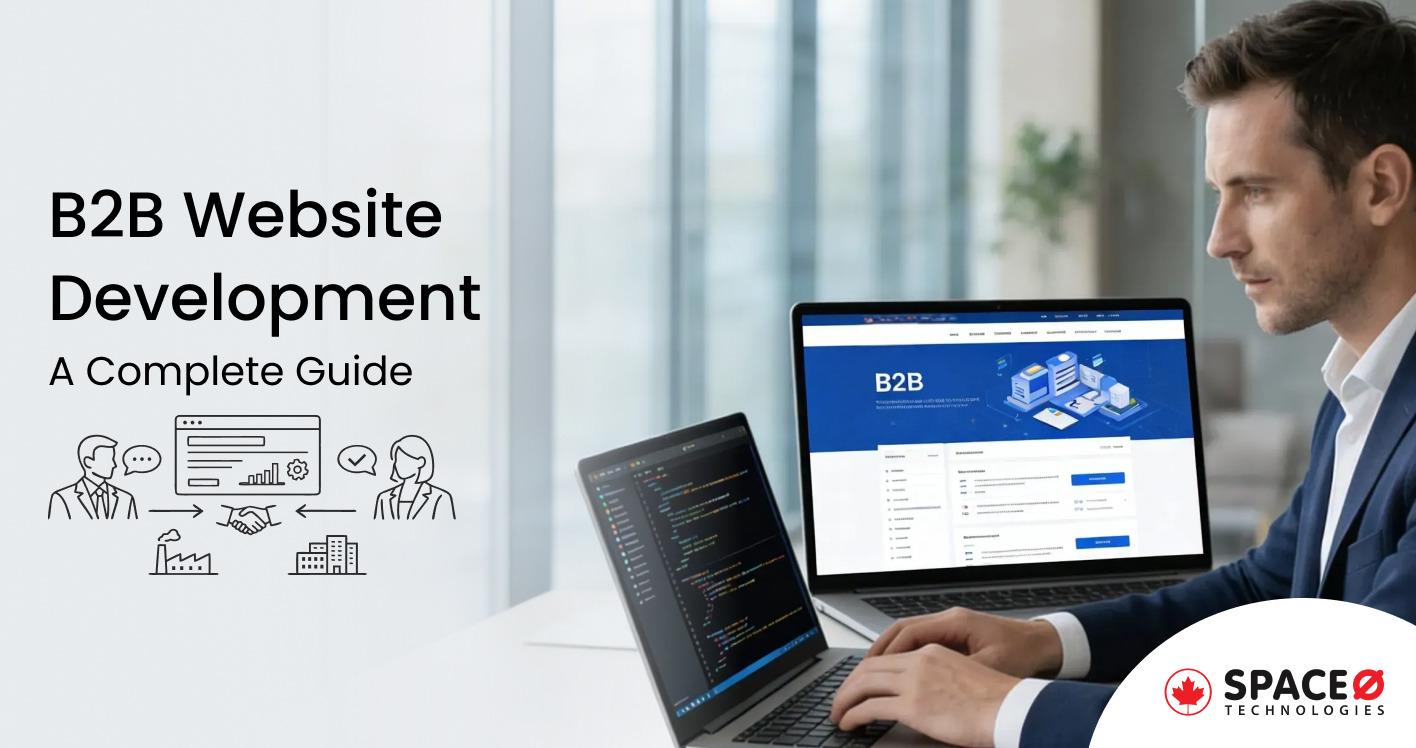
Are you looking to build a B2B website that actually generates qualified leads and drives revenue? In today’s digital-first buying environment, your website is often the first interaction potential clients have with your business.
According to Gartner research, B2B buyers spend only 17% of their time meeting with potential suppliers. The rest? They are researching online, comparing solutions, and making decisions before ever speaking to your sales team.
This shift makes investing in professional website development services more critical than ever, especially when building platforms that must support complex B2B decision-making.
Unlike B2C websites focused on quick transactions, B2B websites must nurture longer buying cycles involving multiple stakeholders, layered approvals, and higher-value contracts. Whether you are building a corporate website, SaaS platform, or wholesale portal, understanding the website development process for business clients requires specialized expertise and a conversion-driven approach.
What is B2B Website Development?
B2B website development is the process of creating digital platforms specifically designed for business-to-business transactions, lead generation, and relationship building. Unlike consumer-focused websites, B2B platforms must address the unique needs of business buyers who require detailed information, multiple touchpoints, and seamless integration with enterprise systems.
A well-developed B2B website serves as your digital headquarters, supporting every stage of the buyer journey from initial awareness to post-purchase support.
Different B2B business models require tailored website approaches to support their sales and operational goals. Developing your Corporate B2B websites help service-based companies showcase expertise, case studies, and thought leadership to attract enterprise clients, while B2B SaaS platforms focus on subscriptions, demos, free trials, and self-service onboarding.
Businesses with online sales channels should also factor in e-commerce website development cost when planning their B2B platform, while vendor or supplier portals streamline procurement, inventory management, and ongoing supplier relationships.
Each type requires specific features and functionality, which brings us to the essential components of successful B2B websites.
What are the Essential Features of a Successful B2B Website?
The features you include directly impact your website’s ability to generate leads and support sales. Based on our experience with web development projects, here are the must-have features organized by function:
1. Multi-step lead capture forms
Breaking complex forms into smaller steps improves completion rates significantly. Progressive profiling allows you to gather more information over time without overwhelming first-time visitors, making the lead capture process feel manageable and user-friendly.
2. Gated content for qualified leads
Offering valuable resources like whitepapers, case studies, and industry reports in exchange for contact information attracts qualified leads who are actively researching solutions and ready to engage with your business.
3. ROI calculators and assessment tools
Interactive tools help prospects understand your solution’s value while providing your sales team with qualification data. These calculators engage visitors meaningfully and demonstrate tangible benefits before any sales conversation begins.
4. CRM integration for seamless follow-up
Connecting your website with platforms like Salesforce, HubSpot, or Pipedrive ensures leads sync automatically. This enables timely sales follow-up and maintains consistent data across your marketing and sales operations.
5. Live chat and chatbot integration
Real-time engagement through human agents or AI-powered chatbots qualifies leads instantly and answers common questions. This immediate interaction keeps visitors engaged and moves them through the buyer journey faster.
6. Self-service client portal capabilities
Secure portals with role-based access let existing customers manage accounts, track orders, submit support tickets, and handle billing independently. This reduces support burden while improving customer satisfaction and retention.
At Space-O Canada, we build client portals that reduce support costs while improving customer satisfaction. If you need developers for your portal project, you can hire web developers with enterprise experience.
Build a B2B Website That Supports How Buyers Actually Decide
Space-O helps B2B companies design websites that educate stakeholders, build credibility, and support complex, multi-touch sales cycles.
With your feature requirements defined, the next step is understanding the development process that brings your B2B website to life.
What is the Process of B2B Website Development? A Step-by-Step Guide
Building a successful B2B website requires a structured approach. Here are 7 H3 pointers based on your B2B website development process:
Step 1: Discovery and business requirement analysis
Understanding your business before design begins ensures every decision aligns with your goals. This phase involves defining your target audience, mapping the B2B buyer journey, and identifying key stakeholders.
We analyze competitor websites and document technical requirements, including CRM integrations and security compliance. Detailed project roadmaps aligned with the web development life cycle keep all teams informed on milestones, success metrics, and communication protocols throughout development.
Step 2: Information architecture and content planning
B2B websites contain extensive content requiring careful organization for a seamless user experience. We develop comprehensive sitemaps with logical hierarchy so visitors find critical information quickly.
User flow mapping addresses different buyer personas, while wireframes visualize page layouts before design begins. Content strategy frameworks guide messaging consistency, and navigation optimization reduces friction across the decision-making journey.
Step 3: UI/UX design and interactive prototyping
B2B design must convey professionalism while maintaining visual interest that captures attention. We create designs aligned with your brand guidelines and ensure responsive layouts deliver optimal experiences across all devices.
Accessibility compliance meeting WCAG 2.1 AA standards ensures inclusivity for all users. Interactive prototypes allow stakeholder review before development, and design systems maintain visual consistency throughout the website.
Step 4: Frontend and backend development
Frontend development transforms approved designs into responsive, interactive interfaces. Engaging elements and animations enhance usability without compromising performance, while form functionality with proper validation captures lead information effectively.
Backend development establishes a robust CMS architecture and secure database infrastructure. API development enables critical integrations using modern web development technologies, and performance optimization ensures fast loading times that satisfy both users and search engines.
Step 5: Third-party system integrations
B2B websites perform best when connected to your existing business infrastructure. CRM integrations with platforms like Salesforce and HubSpot streamline lead management and sales tracking.
Marketing automation connections through tools like Marketo or Pardot enable sophisticated lead-nurturing campaigns. Analytics integrations provide performance tracking, while ERP connections with SAP or NetSuite handle order fulfillment and inventory synchronization.
Step 6: Quality assurance and performance testing
Rigorous testing eliminates issues before your audience encounters them. Functional testing verifies all features work as intended, and cross-browser testing confirms consistent experiences across devices.
Performance and load testing ensure your website handles traffic spikes during campaigns without slowdowns. Security vulnerability assessments protect against threats, and user acceptance testing validates the final product against business requirements.
Step 7: Deployment, training, and post-launch optimization
Staged deployment with real-time monitoring catches issues early while minimizing launch risk. DNS configuration and SSL setup ensure secure, reliable access for all visitors from day one.
Team training empowers your staff to manage content independently through the CMS. Post-launch optimization uses performance data to continuously refine user experience and improve conversion rates.
Move Beyond Marketing Pages to a Revenue-Focused B2B Website
Space-O helps companies create B2B websites that support demand generation, sales enablement, and long-term growth goals.
Understanding timelines helps with planning, but cost is often the deciding factor for many businesses.
What is the Cost of B2B Website Development?
B2B website projects in CAD start at $20,000–$50,000 for basic sites and scale to $100,000–$150,000+ for enterprise solutions with custom integrations and portals.
But sometimes, this amount may change based on various reasons, project type, its complexity, and time required. Enterprise web development projects with advanced integrations typically fall on the higher end. Here is a realistic breakdown based on our experience:
1. Cost breakdown by project type
| Project Complexity | Features Included | Timeline | Cost Range (CAD) |
|---|---|---|---|
| Basic B2B Website | 10-15 pages, forms, blog, CMS, mobile-responsive | 8-12 weeks | $20K–$50K |
| Enhanced Platform | 20-30 pages, CRM, lead tracking, gated content, analytics | 12-16 weeks | $50K–$100K |
| Enterprise Solution | Custom funcs, client portal, integrations, multi-lang, APIs | 16-24 weeks | $100K–$150K+ |
2. Factors affecting B2B website development cost
Design Complexity
Design Complexity Custom illustrations, animations, and interactive elements increase design costs. A template-based approach can reduce website design costs by 30-40%.
Number of Integrations
Each third-party integration (CRM, ERP, payment gateway) adds $5,000-$20,000 depending on complexity. Integration-heavy projects tend to increase both B2B and corporate website development cost.
Client Portal Development
Secure portals with user management, document storage, and account features add $15,000-$40,000 to project costs.
Content Creation
Professional copywriting, photography, and video production can add $5,000-$20,000 or more.
Multi-Language Support
Each additional language adds $5,000-$15,000 for translation and implementation.
3. Ongoing costs to budget
| Cost Category | Monthly Range (CAD) | Annual Range (CAD) |
|---|---|---|
| Hosting & Infrastructure | $200–$1K | $2.4K–$12K |
| Maintenance & Updates | $1.5K–$5K | $18K–$60K |
| CRM/Marketing Licenses | $500–$5K | $6K–$60K |
| Content & SEO | $2K–$10K | $24K–$120K |
4. Cost optimization strategies
Start with MVP Approach
Launch with essential features and add complexity based on user feedback and business needs.
Use Proven Frameworks
Leverage established CMS platforms like WordPress or Drupal rather than building from scratch for standard functionality.
Prioritize Ruthlessly
Focus on features that directly impact lead generation and sales support. Nice-to-have features can wait for phase two.
Choose the Right Partner
Working with an experienced website development company like Space-O Canada reduces costly mistakes and rework.
With budget considerations addressed, let us explore the design principles that make B2B websites effective.
What are the Best B2B Website Design Practices?
Design plays a crucial role in B2B website success. Unlike B2C where emotional appeal drives purchases, B2B design must build trust, demonstrate expertise, and support complex decision-making.
1. Build credibility through client success stories
B2B buyers need proof before committing to any purchase decision. Display recognizable client logos prominently on your homepage and throughout your site. Include detailed testimonials featuring real names, job titles, and company affiliations. Create comprehensive case studies showcasing measurable results like percentage improvements in efficiency, revenue growth, or cost savings that prospects can relate to.
2. Design for multiple decision-makers simultaneously
B2B purchases involve various stakeholders with distinct priorities and concerns. Executives seek ROI and strategic value while technical teams want integration specifications and security details. Department managers focus on functionality and team impact, whereas procurement evaluates pricing and compliance. Structure your navigation and content architecture to serve each audience segment with the relevant information they need.
3. Prioritize mobile responsiveness for modern buyers
Over forty percent of B2B research now happens on mobile devices, with executives frequently reviewing proposals on tablets during meetings or travel. Mobile-responsive design has become essential for establishing credibility with sophisticated buyers. Ensure fast load times for mobile users since slow performance creates immediate negative impressions about your company’s technical capabilities and attention to detail.
4. Optimize core web vitals for better rankings
Google’s performance metrics directly impact your search visibility and lead generation potential. Aim for Largest Contentful Paint under 2.5 seconds, First Input Delay below 100 milliseconds, and Cumulative Layout Shift under 0.1. Poor performance frustrates visitors and signals to search engines that your site provides subpar user experience, ultimately hurting your ability to attract qualified prospects.
5. Ensure accessibility compliance across your site
For Canadian businesses, accessibility represents both an ethical responsibility and legal requirement. Meet WCAG 2.1 Level AA standards as your minimum benchmark. Ontario businesses must comply with AODA regulations specifically. Implement keyboard navigation support, screen reader compatibility, adequate color contrast, and appropriate text sizing to ensure all potential customers can engage with your content regardless of ability.
6. Align content with the buyer journey stages
Create targeted content for each phase of the decision-making process. During awareness, provide educational blog posts and industry trend reports. For consideration, develop comparison guides, case studies, and detailed webinars. At the decision stage, offer transparent pricing information, implementation guides, customer testimonials, and opportunities for free trials or consultations that reduce perceived risk.
If you need guidance on how to create a website from scratch that follows these best practices, our team can help you navigate the process.
Move Beyond Marketing Pages to a Revenue-Focused B2B Website
Space-O helps companies create B2B websites that support demand generation, sales enablement, and long-term growth goals.
Partner with Space-O Technologies for Custom B2B Website Development
B2B website development is a strategic investment that directly impacts your ability to attract, engage, and convert business customers. When buyers complete most of their research before contacting sales, your website must guide prospects through complex decision-making processes with the right content, tools, and trust signals.
Space-O Technologies specializes in building B2B platforms that shorten sales cycles and integrate seamlessly with enterprise tools like Salesforce, HubSpot, and custom ERPs.
Our B2B website development services include custom lead generation systems with multi-step forms, gated content, and lead scoring; client portals and self-service dashboards for post-sale engagement; CRM and marketing automation integration for lead-to-close workflows; PIPEDA-compliant data handling with Canadian payment support including Moneris and Interac; and scalable architecture for growing product catalogs, partner ecosystems, and multi-location operations.
Whether you’re launching a new B2B platform, redesigning an outdated corporate site, or building a self-service portal for enterprise clients, we tailor every feature to your sales process and buyer journey.
Ready to build a B2B website that generates leads, builds trust, and drives business growth? Schedule a free consultation with Space-O Technologies to discuss your requirements and receive a detailed proposal tailored to your specific needs.
Frequently Asked Questions About B2B Website Development
How long does it take to develop a B2B website?
Development typically takes 8-24 weeks, depending on complexity. A basic corporate B2B website with lead generation features can be completed in 8-12 weeks. Enhanced platforms with CRM integration and client portals require 12-16 weeks. Enterprise solutions with custom functionality and multiple integrations may take 16-24 weeks or longer.
What is the difference between B2B and B2C website development?
B2B websites focus on lead generation, relationship building, and supporting complex buying decisions involving multiple stakeholders. B2C websites prioritize quick transactions and emotional purchasing decisions. B2B sites typically require CRM integration, detailed content, and features like client portals, while B2C sites emphasize shopping carts and checkout optimization.
Should I use WordPress or custom development for a B2B site?
WordPress works well for many B2B websites, offering cost-effective development, easy content management, and extensive plugin options. Custom development is better when you need unique functionality, complex integrations, or features that WordPress cannot support. Many businesses start with WordPress and migrate to custom solutions as they scale.
How can I integrate my B2B website with Salesforce or HubSpot?
Integration typically involves API connections between your website and CRM platform. Forms capture leads and sync them automatically to your CRM. More advanced integrations can include two-way data sync, personalized content based on CRM data, and automated lead scoring. At Space-O Canada, we have extensive experience with CRM integrations for B2B platforms.
What ongoing maintenance does a B2B website need?
B2B websites require regular maintenance, including security updates, plugin/software updates, performance monitoring, content updates, backup management, and analytics review. Budget $1,500-$5,000 monthly for maintenance, depending on platform complexity. Regular updates also include SEO optimization, website redesign planning, and conversion rate improvements based on performance data.
How do I measure B2B website success?
Key metrics include lead generation volume, lead quality (conversion to opportunity), website traffic and engagement, form completion rates, content downloads, demo requests, and ultimately revenue attributed to website leads. Implement proper tracking with Google Analytics 4 and CRM integration to measure the full buyer journey.


Want to develop a B2B website?
What to read next
 All our projects are secured by NDA
100% Secure. Zero Spam
*All your data will remain strictly confidential.
Trusted by


Bashar Anabtawi 
Canada
“I was mostly happy with the high level of experience and professionalism of the various teams that worked on my project. Not only they clearly understood my exact technical requirements but even suggested better ways in doing them. The Communication tools that were used were excellent and easy. And finally and most importantly, the interaction, follow up and support from the top management was great. Space-O not delivered a high quality product but exceeded my expectations! I would definitely hire them again for future jobs!”

Canada Office
2 County Court Blvd., Suite 400,
Brampton, Ontario L6W 3W8
Phone: +1 (602) 737-0187
Email: sales@spaceo.ca