

Cardiology EHR Development: A Complete Guide for Healthcare Organizations
Are you looking to build a cardiology EHR system that actually fits the way your cardiac care practice operates? If you have searched for “cardiology EHR development” or “cardiac EMR software” and found us, you have come to the right place.
The challenge most cardiologists face is clear: generic EHR systems were not built for the complexities of cardiac care. They lack native ECG integration, struggle with echocardiogram management, and force clinicians to work around the software rather than with it.
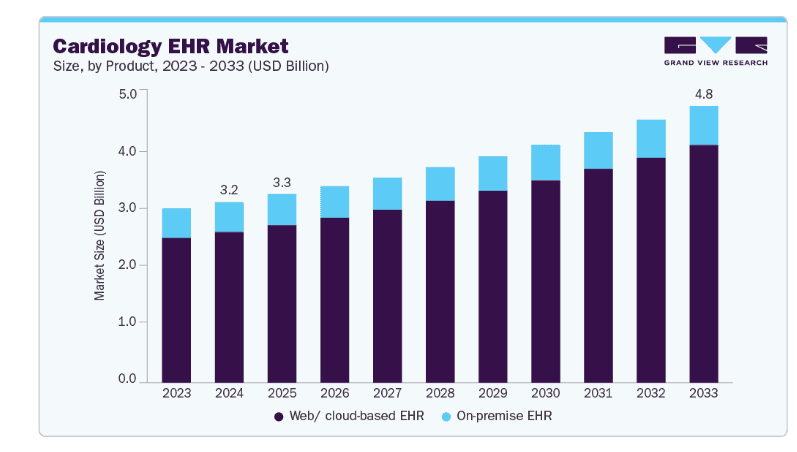
According to the Grand View Research, the global cardiology EHR market size was estimated at USD 3.16 billion in 2024, and is projected to reach USD 4.83 billion by 2033, growing at a CAGR of 4.9% from 2025 to 2033.
This guide covers everything you need to know about cardiology EHR development. From essential features and compliance requirements to development costs and implementation strategies, you’ll learn how to build or commission a cardiology EHR system that truly serves your practice. If you’re new to EHR software development, this comprehensive guide will walk you through the entire process.
Let’s get started.
What is Cardiology EHR Software?
Cardiology EHR (Electronic Health Record) software is a specialized digital system designed specifically for cardiovascular care practices. Unlike general-purpose EHR platforms that attempt to serve all medical specialties, cardiology EHR systems are built from the ground up to handle the unique workflows, data types, and clinical requirements of cardiac care.
The key difference lies in specialisation. A general EHR might allow you to attach an ECG report as a PDF. When you build an EHR system for cardiology, the approach differs significantly from generic platforms. A general EHR might allow you to attach an ECG report as a PDF.
A cardiology-specific EHR integrates directly with your ECG machine, automatically imports waveform data, enables side-by-side comparison of historical readings, and flags abnormalities based on clinical decision support algorithms.
Key statistics on cardiology software adoption
The healthcare software market in Canada continues to grow rapidly. Consider these figures:
- The global cardiology EHR market size was estimated at USD 3.52 billion in 2026 and is projected to reach USD 5.44 billion by 2035, growing at a CAGR of 4.95%. Source: Towards Healthcare
- 93% of Canadian primary care physicians now use EMRs in their practice, up from 87% in 2021. Source: Statista
- Cardiovascular disease remains the second leading cause of death in Canada, accounting for 17.2% of all deaths and affecting approximately 2.6 million Canadian adults. Source: Statista
Cardiology EHR foundation requires specialized functionality. Discover essential features optimized for cardiac care workflows. Understanding healthcare software development fundamentals helps you appreciate why cardiology EHR requires specialized functionality. Discover essential features optimized for cardiac care workflows.
What are the Benefits of cardiology-specific EHR systems?
Purpose-built cardiology EHR software addresses these limitations while delivering measurable benefits.
1. Improved clinical documentation accuracy
Specialty-specific templates guide clinicians through comprehensive cardiac assessments, reducing documentation gaps and ensuring critical findings aren’t missed. Structured data capture also enables better reporting and quality measure tracking.
Unlike generic EHR systems that use one-size-fits-all templates, cardiology-specific documentation includes pre-built fields for ejection fraction, valve assessments, rhythm analysis, and risk stratification scores. This structured approach reduces transcription errors and ensures consistent documentation across your entire cardiology team. Clinicians can complete detailed cardiac notes in less time while capturing more clinically relevant data points required for quality reporting and reimbursement.
2. Faster diagnosis with integrated cardiac imaging
When echocardiograms, stress tests, and cardiac catheterization images are accessible directly within the EHR, cardiologists spend less time switching between systems and more time analyzing clinical data. This integration supports faster, more informed decision-making.
Native DICOM integration eliminates the need to toggle between separate PACS viewers and your documentation system. Cardiologists can review prior echocardiograms, compare ejection fraction trends over time, and annotate findings directly within the patient record. This seamless workflow reduces diagnostic delays, particularly for urgent cases where every minute matters. At Space-O Canada, we build direct integrations with leading cardiac imaging systems, ensuring your team has instant access to the visual data they need at the point of care.
3. Better patient outcomes through specialized workflows
Cardiology EHR systems can embed clinical decision support specific to cardiovascular care. Alerts for drug interactions with anticoagulants, reminders for guideline-recommended therapies, and prompts for overdue cardiac testing all contribute to improved care quality.
Cardiovascular patients often manage complex medication regimens including anticoagulants, antiarrhythmics, and multiple blood pressure medications. A cardiology-specific EHR automatically flags dangerous drug combinations, calculates CHA₂DS₂-VASc scores for stroke risk, and reminds clinicians when patients are due for INR monitoring or device interrogations. These automated safety checks reduce adverse events and help your practice adhere to ACC/AHA clinical guidelines without adding cognitive burden to busy cardiologists.
4. Streamlined device management
Integrated device management modules track all implanted cardiac devices, store interrogation reports, and flag patients who are overdue for device checks. Remote monitoring integration allows practices to receive and act on device alerts without manual data entry.
Managing pacemakers, ICDs, and loop recorders across hundreds of patients creates significant administrative burden. A purpose-built cardiology EHR centralizes all device data, automatically imports remote monitoring transmissions from Medtronic, Abbott, and Boston Scientific systems, and generates alerts when device parameters fall outside normal ranges. Your team can quickly identify patients requiring urgent follow-up while maintaining complete audit trails for every device interaction. This level of integration is difficult to achieve with generic EHR platforms that lack native cardiac device support.
Organizations investing in healthcare software development increasingly recognize that specialty-specific solutions deliver better ROI than forcing generic systems to accommodate specialized workflows.
These advantages translate into tangible features. Here’s what a comprehensive cardiology EHR system should include.
What are the Essential Features of Cardiology EHR Systems?
Building an effective cardiology EHR requires understanding the specific workflows and data requirements of cardiac care. Here are the essential features your system needs to include.
1. ECG/EKG integration
Your EHR should connect directly to 12-lead ECG machines from manufacturers like GE, Philips, and Mortara. It must capture waveforms automatically in FDA XML or SCP-ECG formats, enable side-by-side historical comparisons, and calculate measurements like QT interval and heart rate variability.
2. Echocardiogram management
Seamless integration with echo machines and PACS systems is essential. The EHR should include structured reporting templates for transthoracic and transesophageal studies, track ejection fraction trends over time, and support video clip storage with in-system playback capabilities.
3. Remote patient monitoring (RPM)
Support integration with home blood pressure monitors, weight scales for heart failure management, and medication adherence tools. The system should allow configurable alert thresholds that notify care teams when patient metrics indicate concerning changes requiring intervention.
4. Standards support
Ensure compatibility with HL7 FHIR R4 for modern API integrations, HL7 v2.x for legacy systems, CDA documents for clinical summaries, and Direct messaging for secure provider communication. These standards enable seamless data exchange across the healthcare ecosystem.
5. Provincial health network integration
Connect with provincial health information exchanges including Ontario Health (ConnectingOntario), Alberta Netcare, and eHealth Saskatchewan. This integration enables access to patient records across care settings and supports coordinated care delivery within Canadian healthcare networks.
Features demand structured execution. Follow a proven development process tailored for cardiology-specific requirements.
What is the Cardiology EHR Development Process?
Developing a cardiology EHR system requires a structured approach that balances clinical requirements with technical implementation. Here is the step-by-step process we follow at Space-O Canada.
Step 1: Requirements analysis and cardiac workflow mapping
Before writing any code, we conduct thorough discovery sessions with your clinical team. This phase involves shadowing cardiologists and staff to understand current workflows, documenting pain points with existing systems, and identifying integration requirements with current equipment.
We also map data flows between departments and external providers, define user roles and access requirements, and establish compliance requirements based on your province. Deliverables include a requirements specification document, workflow diagrams, and integration inventory.
Step 2: Compliance assessment (PIPEDA, provincial health acts)
Healthcare software in Canada must meet strict privacy requirements. We conduct a comprehensive compliance assessment covering PIPEDA requirements for personal health information and provincial regulations such as PHIPA in Ontario, HIA in Alberta, and FIPPA in BC.
This assessment also addresses Health Canada digital health guidelines, data residency requirements for Canadian hosting, security control requirements, and audit and logging specifications. Deliverables include a compliance checklist, security requirements document, and data handling procedures.
Step 3: UI/UX design for clinical efficiency
Healthcare software must be intuitive enough for busy clinicians to use without disrupting patient care. Our design process includes user persona development for each role such as cardiologist, nurse, and admin, along with task flow optimization for common workflows.
We create wireframes for review, develop interactive prototypes, conduct usability testing with actual clinical staff, and ensure accessibility compliance with WCAG 2.1 standards. Deliverables include wireframes, interactive prototypes, design specifications, and a style guide.
Step 4: Core development and integration
With requirements defined and designs approved, development begins. This phase covers database architecture for clinical data, core EHR functionality including patient records, scheduling, and documentation, plus cardiology-specific modules like ECG viewer, risk calculators, and templates.
We also handle integration development for lab systems, imaging, and devices, API development for third-party connections, and mobile application development if required. Deliverables include working software builds delivered in 2-week sprint cycles.
Step 5: Security implementation and testing
Healthcare software requires rigorous security and quality assurance. Security testing includes penetration testing by certified professionals, vulnerability scanning, access control verification, encryption validation at rest and in transit, and audit trail testing.
Functional testing covers unit testing for individual components, integration testing for connected systems, user acceptance testing with clinical staff, performance testing under expected load, and regression testing for updates. Deliverables include a security assessment report, test results documentation, and remediation verification.
Step 6: Deployment and training
Go-live requires careful planning to minimize disruption. This phase involves production environment setup in Canadian data centres, data migration from existing systems, role-based staff training programs, and superuser training for internal support.
We also manage parallel running periods if required and provide go-live support with on-site presence. Deliverables include a deployment plan, training materials, and a go-live checklist.
Step 7: Ongoing maintenance and updates
Healthcare software requires continuous attention after launch. This includes bug fixes and issue resolution, security patches and updates, regulatory compliance updates, and feature enhancements based on user feedback.
We at Space-O Technologies provide performance optimization and integration updates for connected systems to ensure your cardiology EHR remains secure, compliant, and aligned with evolving clinical needs.
Ready to build a cardiology EHR system for your practice?
Discuss your requirements with our healthcare software team. We provide free consultations to understand your needs and recommend the right approach for your cardiology practice.
Process guides realistic budgeting. Understand investment ranges for Canadian-compliant cardiology EHR systems.
What is the Cost of Cardiology EHR Development?
In Canada, cardiology EHR apps cost $75,000–$300,000+ CAD, tailored to complexity. Basic setups with core EHR, ECG viewing, and patient portals range from $75K–$120K (4-6 months). Enterprise versions featuring AI diagnostics and full integrations hit $180K–$300K+ (9-12+ months), ensuring PIPEDA compliance via React Native/Node.js development.
For a broader perspective on EHR software development cost, these figures align with industry standards for specialty-specific systems
Let’s have a look at the costing in detail and the factors affecting it.
Cost by complexity level
| Complexity | Features Included | Timeline | Cost Range (CAD) |
|---|---|---|---|
| Basic | Core EHR, cardiology templates, basic ECG viewing, patient portal | 4-6 months | $75,000 – $120,000 |
| Mid-Level | Above + ECG integration, clinical decision support, RPM basics, mobile app | 6-9 months | $120,000 – $180,000 |
| Enterprise | Above + full device integration, AI diagnostics, advanced analytics, multi-location | 9-12+ months | $180,000 – $300,000+ |
Factors affecting development costs
Feature complexity: Basic documentation and scheduling cost less, while advanced ECG integration with waveform analysis increases expenses. AI-powered diagnostic support requires significantly higher investment due to complex algorithm development and validation requirements.
Integration requirements: Costs vary based on the number of diagnostic devices to integrate, the complexity of existing system connections, and provincial health network integration requirements. More integrations mean higher development investment.
Compliance level: Basic PIPEDA compliance carries standard costs, while additional provincial requirements add moderate increases. Health Canada certification requirements significantly raise expenses due to rigorous documentation and validation processes.
Cost comparison: Build vs. buy vs. customize
| Approach | Initial Cost (CAD) | Annual Cost (CAD) | Pros | Cons |
|---|---|---|---|---|
| Off-the-Shelf | $15,000–$50,000 setup | $500–$1,500/user/month | Fast deployment, vendor support | Limited customization, ongoing fees |
| Customize Existing | $50,000–$150,000 | $200–$500/user/month | Faster than custom, proven base | Platform constraints remain |
| Build Custom | $75,000–$300,000+ | $2,000–$8,000/month maintenance | Full control, no per-user fees | High upfront cost, longer timeline |
Hidden costs to consider
Beyond development, budget for these additional expenses:
- Infrastructure: Canadian cloud hosting runs $500-$2,000/month, depending on scale
- Compliance audits: Annual security assessments cost $5,000-$15,000
- Training: Initial staff training typically costs $5,000-$20,000
- Data migration: Moving from existing systems adds $10,000-$50,000
- Ongoing maintenance: Plan for 15-20% ofthe initial development cost annually
This guide on healthcare app development cost provides further insights into budgeting for medical software projects:Costs include mandatory regulations. Explore PIPEDA and cardiac data standards essential for Canadian deployment.
What are the Compliance Requirements for Cardiology EHR in Canada?
Building healthcare software in Canada requires strict attention to privacy and security regulations. Here is what your cardiology EHR must address.
1. PIPEDA (Personal Information Protection and Electronic Documents Act)
PIPEDA is Canada’s federal privacy law governing how private sector organizations collect, use, and disclose personal information. For healthcare software, this means patients must consent to the collection and use of health information, and organizations should only collect information necessary for identified purposes.
Appropriate security safeguards must protect personal health information, patients have the right to access their health records, and a designated privacy officer must be accountable for compliance.
2. Provincial health information acts
In addition to PIPEDA, provincial laws add specific requirements. Ontario’s Personal Health Information Protection Act (PHIPA) applies specifically to health information custodians with stricter requirements for consent and disclosure, mandatory breach notification, and Health Information Network Provider requirements.
Alberta’s Health Information Act (HIA) governs health information in the public health system with specific rules for electronic health records and Alberta Netcare integration requirements. British Columbia’s Freedom of Information and Protection of Privacy Act (FIPPA) applies to public bodies including health authorities and includes data residency requirements for storage in Canada.
3. Data residency requirements
For healthcare applications serving Canadian patients, data should be stored in Canada. This means hosting with Canadian data centres such as AWS Canada, Azure Canada, or Google Cloud Montreal while ensuring backups remain within Canadian borders. Organizations must verify that any third-party services also maintain Canadian data residency and document data flows for compliance audits.
Compliance enables seamless connectivity. Understand the reasons behind choosing a custom cardiology system.
Why Choose Custom Cardiology EHR Software Development?
With numerous off-the-shelf EHR options available, why would a cardiology practice choose custom development? Here is a detailed comparison.
Custom vs off-the-shelf EHR
| Factor | Off-the-Shelf EHR | Custom Cardiology EHR |
|---|---|---|
| Cardiac workflows | Limited; needs workarounds | Fully tailored to your practice |
| ECG integration | Basic PDF attachments | Native waveform analysis and integration |
| Risk calculators | Standard only | Custom-built for your protocols |
| Integration flexibility | Vendor partnerships only | Seamless with any system |
| Canadian compliance | Generic standards | Built for PIPEDA and provincial rules |
| Long-term costs | Ongoing per-user fees | One-time build; lower maintenance |
| Scalability | Vendor limits apply | Designed to your exact growth needs |
| Data ownership | Vendor retains control | 100% yours, full portability |
When off-the-shelf makes sense
Off-the-shelf solutions may be appropriate if:
- Your practice has standard workflows without unique requirements
- You need to be operational within weeks rather than months
- Your budget is under $75,000 for initial implementation
- You are comfortable with per-user monthly fees long-term
- You do not require deep integration with specialized equipment
When custom development is the right choice
Custom development delivers better value when:
- Your practice has developed unique protocols that differentiate your care
- You need integration with specific diagnostic equipment
- Per-user licensing fees would exceed development costs over 3-5 years
- You require complete control over patient data and hosting
- You plan to expand to multiple locations with consistent systems
- You want to eliminate vendor lock-in risk
If you’re considering external development partners, this guide on healthcare IT outsourcing explains how to evaluate and select the right team. Now, it is time to know how Space-O Technologies can be of great help in developing cardiac-specific software.
What to Look for in a Development Partner for Healthcare Software Development?
At Space-O Technologies, we bring extensive experience in building PIPEDA-compliant healthcare solutions for Canadian medical practices.
1. Healthcare software expertise
Look for a partner who specializes in building telemedicine platforms for remote cardiac consultations and patient portals with secure messaging and appointment booking. Your development team should have experience creating healthcare CRM systems for patient engagement and follow-up, EHR integration with existing hospital and clinic systems, and mobile health apps for patient monitoring and education.
At Space-O, we’ve delivered 300+ healthcare software projects, including custom EHR systems, remote patient monitoring platforms, and HIPAA/PIPEDA-compliant telemedicine solutions. Our team understands the unique technical requirements of cardiology practices, from ECG device integration to secure cardiac imaging workflows.
2. Canadian compliance expertise
Choose a partner who understands PIPEDA, provincial health information acts, and the specific requirements of Canadian healthcare. The right team will have implemented compliance controls for healthcare clients across Ontario and other provinces.
Our Toronto-based compliance specialists have hands-on experience with PHIPA in Ontario, HIA in Alberta, and FIPPA in British Columbia. We build privacy-by-design principles into every cardiology EHR project, ensuring your system meets regulatory requirements from day one—not as an afterthought. Every solution we deliver includes comprehensive audit logging, role-based access controls, and encrypted data storage in Canadian data centres.
3. Local presence and support
Prioritize a development partner with local presence who can provide support during your business hours. In-person meetings throughout the GTA and understanding of Canadian healthcare culture and workflows make collaboration smoother.
4. Healthcare development experience
Seek a development team that includes specialists with healthcare software experience who understand clinical workflows, medical data standards, and the importance of system reliability in healthcare settings.
5. End-to-end service
Select a partner offering complete development services from initial requirements gathering through deployment and ongoing maintenance. Working with a dedicated team that understands your project from start to finish ensures continuity and accountability.
Space-O Canada every phase of your cardiology EHR project: discovery and compliance assessment, UI/UX design tailored for clinical efficiency, core development and integration, rigorous testing, deployment, staff training, and ongoing support. We offer 3 months of free maintenance post-launch, plus flexible long-term support plans so your system stays secure, compliant, and optimized as your practice grows. You get a single accountable partner from concept to launch—and beyond.
Want to Develop a Cardiology EHR System for Your Practice?/p>
Discuss your requirements with us. We are an experienced healthcare software development company in Canada with expertise in PIPEDA-compliant solutions. Let’s talk.
Turning Custom Cardiology EHR Development Into Real Clinical Value With Space-O Technologies
Building a cardiology EHR system is a strategic investment that directly improves cardiac documentation, diagnostic accuracy, and care coordination while ensuring compliance with Canadian regulations such as PIPEDA and provincial health requirements. A purpose-built cardiology EHR supports complex cardiac workflows and integrates seamlessly with ECG systems, cardiac devices, and provincial health networks.
Space-O Technologies designs and delivers custom cardiology EHR solutions that align with your practice’s workflows, data security needs, and long-term growth plans. Our healthcare software experts manage the entire development lifecycle, giving you full control over features, integrations, and scalability without recurring per-user licensing constraints.
Looking to build a compliant, future-ready cardiology EHR? Hire EHR software developers from Space-O Canada or schedule a free consultation with Space-O Technologies to get started. Schedule a free consultation with Space-O Technologies to get started.
Frequently Asked Questions About Cardiology EHR Development
How much does it cost to develop a cardiology EHR system?
The cost of developing a cardiology EHR system ranges from $75,000 for a basic system to $300,000+ for enterprise-level solutions with advanced features. Basic systems include core EHR functionality and cardiology templates. Mid-level systems ($120,000-$180,000) add ECG integration and clinical decision support. Enterprise systems include full device integration, AI diagnostics, and multi-location support. Contact us for a detailed estimate based on your specific requirements.
How long does cardiology EHR development take?
Cardiology EHR development typically takes 6-10 months from initial requirements to deployment. This includes 2-4 weeks for discovery, 4-6 weeks for design, 16-24 weeks for development, 4-6 weeks for testing, and 2-4 weeks for deployment and training. Timeline varies based on feature complexity and integration requirements. Phased approaches through our MVP development services can deliver core functionality faster with additional features added over time.
What compliance standards must cardiology EHR software meet in Canada?
Canadian cardiology EHR software must comply with PIPEDA (federal privacy law) and applicable provincial health information acts such as PHIPA in Ontario or HIA in Alberta. Requirements include appropriate consent mechanisms, security safeguards, audit logging, data residency in Canada, breach notification procedures, and patient access rights. Healthcare software should also follow Health Canada digital health guidelines and implement industry-standard security controls including encryption and access controls.
Can you integrate existing cardiac devices with a custom EHR?
Yes, custom EHR development allows integration with virtually any cardiac device that provides data output. This includes ECG/EKG machines (GE, Philips, Mortara), echocardiogram systems, Holter monitors, implantable device remote monitoring (Medtronic, Abbott, Boston Scientific), and consumer wearables (Apple Watch, Fitbit). Integration complexity varies by device and manufacturer, affecting development timeline and cost.
What is the difference between EHR and EMR for cardiology?
EMR (Electronic Medical Record) refers to a digital version of a patient’s chart within a single practice. EHR (Electronic Health Record) is a broader term encompassing records designed to be shared across healthcare organizations. In practice, the terms are often used interchangeably. For cardiology, the key consideration is whether your system needs to share data with hospitals, referring physicians, and provincial health networks, which requires EHR-level interoperability capabilities.


Ready to build a cardiology EHR system for your practice?
 All our projects are secured by NDA
100% Secure. Zero Spam
*All your data will remain strictly confidential.
Trusted by


Bashar Anabtawi 
Canada
“I was mostly happy with the high level of experience and professionalism of the various teams that worked on my project. Not only they clearly understood my exact technical requirements but even suggested better ways in doing them. The Communication tools that were used were excellent and easy. And finally and most importantly, the interaction, follow up and support from the top management was great. Space-O not delivered a high quality product but exceeded my expectations! I would definitely hire them again for future jobs!”

Canada Office
2 County Court Blvd., Suite 400,
Brampton, Ontario L6W 3W8
Phone: +1 (602) 737-0187
Email: sales@spaceo.ca