
- Why Your Dental Practice Needs a Professional Website?
- What are the Essential Features Every Dental Website Must Have?
- Dental Website Development Cost: What to Expect?
- A Step-by-Step Dental Website Development Process
- What are the Common Dental Website Development Mistakes to Avoid?
- What are the Benefits of Hiring Professional Developers?
- What to Look for in a Dental Website Development Company?
- How Space-O Technologies Can Help Build Your Dental Website
- A Smarter Approach to Dental Website Development With Space-O Technologies
- Frequently Asked Questions About Dental Website Development
Dental Website Development: A Complete Guide for Dentists

 Last Updated: March, 31 2026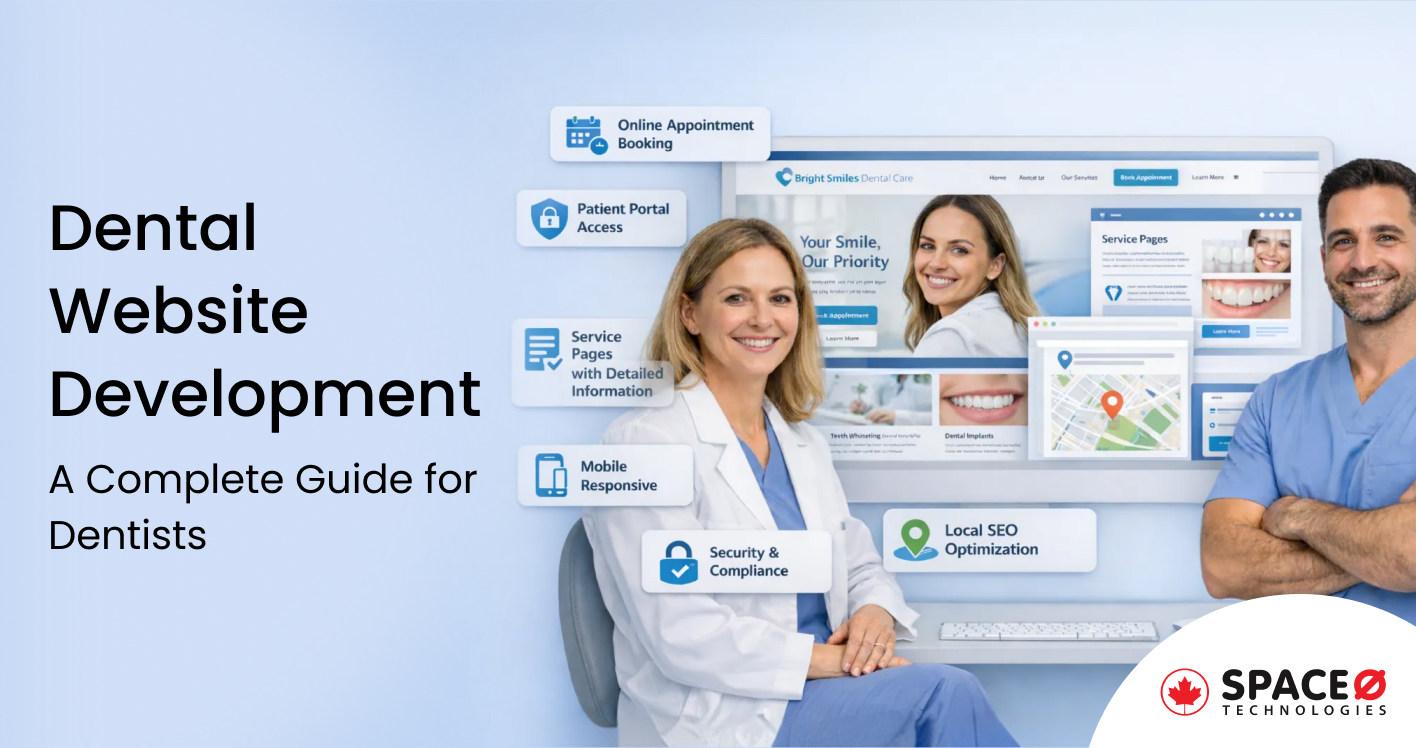
When a patient searches ‘dentist near me’ at 9 PM with a throbbing toothache, your website becomes your front desk, receptionist, and first impression—all at once. What they find in those first few seconds determines whether they book with you or scroll to your competitor
According to the National Library of Medicine, nearly two-thirds of patients search online before booking a doctor, so your website often answers their questions before your front desk ever does. If the site feels confusing, slow, or outdated, patients move on—usually within seconds.
If your dental website looks outdated, loads slowly, or makes booking difficult, patients leave within seconds without contacting your office. Whether you are opening a new dental practice, redesigning an existing website, or exploring a custom dental website for stronger results, this guide helps you make informed decisions.
It breaks down dental website costs, essential features, and development approaches that support real practice growth.
At Space-O Technologies, we’ve helped healthcare providers transform their digital presence with custom healthcare website design solutions tailored to their unique needs.
Why Your Dental Practice Needs a Professional Website?
The digital landscape has fundamentally changed how patients choose their healthcare providers. A professional website isn’t just about having an online presence—it’s about creating meaningful connections with patients before they ever step into your office.
1. Patients search online before booking appointments
Today’s patients are research-driven consumers who evaluate multiple dental practices before making appointment decisions. They compare services, read reviews, check credentials, and assess the overall professionalism of your practice—all through your website. Your dental web design creates that crucial first impression that determines whether a potential patient picks up the phone or moves on to a competitor. Studies show that practices with well-designed websites receive 3x more appointment requests than those with outdated or poorly maintained sites.
2. A website builds credibility and trust
Professional dental website development signals quality care and attention to detail. When patients land on a polished, informative website, they immediately associate those qualities with your clinical practice. Features like patient testimonials, staff credentials, before-and-after galleries, and educational content demonstrate expertise and transparency. This credibility becomes even more important for new practices trying to establish themselves or experienced practitioners looking to expand their patient base in competitive markets.
3. Competitive advantage in your local market
While many dental practices have websites, surprisingly few have truly effective ones. Generic templates, outdated content, and poor user experience plague the industry, creating opportunities for practices that invest in quality dental web design. A modern, functional website helps you stand out in local search results, captures the attention of discerning patients, and positions your practice as a forward-thinking leader in dental care. This competitive edge translates directly into higher patient acquisition and retention rates.
4. 24/7 accessibility for patient information
Unlike your reception desk, your website never closes. Patients can explore your services, learn about procedures, check insurance information, and even book appointments outside of office hours. This convenience factor has become a deciding element for busy professionals and families who need flexibility. Your website serves as a tireless team member, answering common questions and guiding potential patients through their decision-making process without requiring staff intervention.
Pro Tip: When evaluating your current website, consider this: if a patient lands on your site at 10 PM with a dental emergency, can they easily find your contact information, understand your services, and know what to do next? If not, you’re losing patients to competitors who make this information readily accessible.
The business imperative is clear, but success requires specialized functionality. Discover the essential features that drive dental patient bookings.
What are the Essential Features Every Dental Website Must Have?
A successful dental website goes beyond attractive visuals—it must function as a patient acquisition and retention tool. Here are the non-negotiable features that separate effective dental websites from digital brochures.
1. Online appointment booking system
Modern patients expect the convenience of online scheduling. An integrated booking system reduces phone call volume during peak hours, allows patients to book at their convenience, and significantly increases conversion rates. The best systems sync with your practice management software, send automatic reminders, and reduce no-show rates. When evaluating dental website development options, prioritize seamless integration with your existing workflow rather than forcing your team to adapt to new systems.
2. Patient portal access
A secure patient portal enhances the patient experience by providing access to health records, treatment plans, billing information, and communication tools. In Canada, these portals must comply with PIPEDA regulations for protecting personal health information. Features should include secure messaging with your office, document sharing for consent forms and post-treatment instructions, and the ability to update personal information. This self-service functionality reduces administrative burden while improving patient satisfaction.
3. Service pages with detailed information
Each dental service you offer deserves its own dedicated page with comprehensive information. Patients searching for “teeth whitening” or “dental implants” should find detailed explanations of procedures, expected outcomes, costs, and recovery times. Include before-and-after galleries where appropriate, FAQs specific to each service, and clear calls-to-action for booking consultations. Well-developed service pages also improve your search engine visibility for specific treatment searches.
4. Mobile-responsive design
Over 60% of healthcare-related searches now happen on mobile devices. Your dental website design must provide flawless experiences across smartphones, tablets, and desktops. This means touch-friendly navigation buttons, readable text without zooming, fast loading times on cellular connections, and forms that are easy to complete on small screens. Google prioritizes mobile-friendly websites in search rankings, making responsive design both a user experience and SEO necessity.
5. Local SEO optimization
Local search optimization helps your practice appear when patients search for “dentist near me” or “dental clinic in [your city].” This requires optimizing your Google Business Profile, incorporating location-based keywords naturally throughout your content, implementing schema markup for dental practices, and building citations in local directories. Custom dental websites built with local SEO in mind capture patients actively searching for dental services in your area.
6. Security and PIPEDA compliance features
Patient data protection isn’t optional, it’s a legal requirement. Your website needs SSL certificates for encrypted data transmission, secure forms that protect patient information, privacy policies that comply with PIPEDA and provincial regulations, and regular security updates and monitoring. When discussing dental website hosting with potential providers, verify their understanding of healthcare data security requirements and their commitment to maintaining compliance.
Attract More Patients With a High-Performance Dental Website
Build a fast, mobile-optimized dental website that improves local visibility, builds trust, and turns website visitors into booked appointments.
With features defined, budgeting becomes realistic, here’s what Canadian dental practices should expect for professional website development.
Dental Website Development Cost: What to Expect?
A custom dental website typically costs between $3,500 and $30,000, depending on the complexity, features, and design. Any professional marketing agency often charge $6,000–$25,000 for high-end, fully customized sites.
Understanding the financial investment required for professional dental website development helps you make informed decisions and set realistic expectations.
1. Template-based websites ($3,500 – $5,000)
Template-based solutions use pre-designed themes customized with your branding, content, and images. These platforms, like WordPress with dental themes or website builders with healthcare templates, offer the fastest time to launch, typically 2-4 weeks, and include basic features like contact forms, service pages, and photo galleries. This approach works best for new practices with limited budgets, single-location practices with straightforward needs, or practices needing a quick online presence. However, customization options are limited, and you may encounter functionality restrictions as your practice grows.
2. Custom dental website development ($6,000 – $25,000)
Custom development creates unique websites tailored specifically to your practice’s brand and workflow. This investment includes original design concepts that reflect your practice identity, advanced features like integrated booking systems and patient portals, seamless integration with practice management software, and optimized performance and security. Custom dental websites suit established practices wanting to differentiate themselves, multi-location practices needing centralized management, and practices with specific workflow requirements. Development typically takes 8-12 weeks from concept to launch.
3. Enterprise dental website solutions ($25,000+)
Enterprise solutions serve large practices or dental groups with complex needs. These comprehensive platforms include multi-location practice management, advanced patient relationship management systems, custom application development for unique workflows, and robust analytics and reporting capabilities. Large dental groups with 5+ locations, practices offering specialized services requiring custom functionality, and organizations needing extensive third-party integrations benefit most from enterprise solutions. Development timelines extend to 12-16 weeks or longer, depending on complexity. For a detailed breakdown of investment considerations, our guide on website development cost provides comprehensive insights across different project scales.
Ongoing costs to consider: Beyond initial development, budget for recurring expenses including domain registration and renewal, typically $15-50 annually, dental website hosting ranging from $100-500 annually depending on traffic and security needs, SSL certificates and security monitoring at $100-300 per year, content updates and maintenance from $500-2,000 annually, and SEO services starting at $500-2,000 monthly for competitive markets. Factor these ongoing costs into your total investment to avoid surprises.
Cost clarity sets expectations for execution. Follow this proven step-by-step process tailored for dental website development.
A Step-by-Step Dental Website Development Process
Building a dental website requires careful planning and execution across multiple phases. Understanding the website development process helps you make informed decisions, set realistic timelines, and ensure your final product meets both your business goals and guest expectations.
For those exploring healthcare web development more broadly, understanding these steps provides valuable insights into creating patient-centered digital experiences.
1. Planning your website strategy
Successful dental web design begins with strategic planning. Define your target patient demographics, whether young families, seniors, or specific treatment seekers. Analyze competitor websites in your area to identify gaps and opportunities. Set measurable goals like increasing appointment bookings by 30%, reducing phone inquiries about basic information, or improving patient education. Document your must-have features versus nice-to-have additions, and establish your budget range and timeline expectations for launch.
2. Choosing between DIY builders and professional developers
Website builders offer simplicity and lower costs but come with significant limitations. Platforms like Wix or Squarespace provide drag-and-drop interfaces, basic templates, and affordable monthly fees, suitable for practices with minimal budgets. Professional development delivers custom functionality, superior design quality, better security and compliance, seamless integrations with existing systems, and ongoing expert support. Consider professional developers when patient acquisition is critical, your practice has unique workflow requirements, compliance and security are priorities, or you want a distinctive brand presence.
3. Selecting the right domain name
Your domain name creates lasting impressions and affects search visibility. Consider including your practice name plus location for local SEO benefits, like torontodental.ca or vancouversmiles.com. Keep names short, memorable, and easy to spell. Choose .ca domains for Canadian practices to build local trust, though .com alternatives provide backup options. Verify availability across social media platforms for consistent branding, and avoid hyphens, numbers, or complex spellings that confuse potential patients.
4. Designing for user experience (UX)
Professional dental website design prioritizes patient needs over aesthetic preferences. Create clean, uncluttered layouts that guide visitors toward booking actions. Implement intuitive navigation with clear menu structures and prominent contact information. Ensure accessibility compliance with WCAG standards for patients with disabilities. Use high-quality, authentic photos of your actual office and team rather than generic stock images. Design with conversion in mind, strategically placing calls-to-action throughout the patient journey.
5. Creating compelling content
Content quality directly impacts both search rankings and patient conversion. Develop detailed service pages explaining procedures, benefits, costs, and what patients can expect. Craft an authentic “About” section introducing your team, qualifications, and practice philosophy. Include educational blog content addressing common dental concerns and questions. Write in plain language, avoiding excessive dental jargon that intimidates or confuses patients. Incorporate patient testimonials and success stories with proper consent and privacy considerations.
6. Implementing technical SEO
Technical optimization ensures search engines can find, crawl, and rank your website effectively. Optimize page loading speeds through image compression, code optimization, and efficient hosting. Ensure mobile responsiveness across all devices and screen sizes. Implement structured data markup for dental practices, helping search engines understand your services. Create XML sitemaps and submit to search engines. Optimize title tags, meta descriptions, and headers with relevant keywords naturally integrated into helpful content.
7. Testing before launch
Comprehensive testing prevents embarrassing errors and poor patient experiences. Test functionality across major browsers, including Chrome, Safari, Firefox, and Edge. Verify mobile responsiveness on various devices and screen sizes. Complete all forms and booking processes as a patient would. Check loading speeds using tools like Google PageSpeed Insights. Review all content for spelling, grammar, and factual accuracy. Verify contact information, office hours, and location details are correct. Test security features and SSL certificate installation.
8. Launch and post-launch monitoring
Strategic launches include coordinating with your team, so staff understand new website features, announcing to existing patients through email newsletters and social media, submitting your sitemap to Google Search Console, and setting up Google Analytics for traffic monitoring. After launch, monitor user behavior through analytics, tracking popular pages, bounce rates, and conversion paths. Collect feedback from staff and patients, identify technical issues requiring fixes, and plan ongoing content updates and optimization strategies.
Build a Dental Website That Supports Long-Term Practice Growth
Partner with Space-O to design a scalable, SEO-ready dental website aligned with patient behavior and business goals.
Even with a solid roadmap, pitfalls await, learn the most common mistakes Canadian dental practices make and how to avoid them.
What are the Common Dental Website Development Mistakes to Avoid?
Even with good intentions, many dental practices make preventable mistakes that undermine their website’s effectiveness. Recognizing these pitfalls helps you build a stronger digital presence from the start.
1. Using generic stock photos
Nothing signals “generic practice” faster than obvious stock photos of impossibly perfect smiles and sterile environments. Patients want to see your actual office, your real team, and authentic patient interactions. Invest in professional photography of your facility, staff, and equipment. Capture genuine moments that reflect your practice culture and environment. Include team photos with names and roles, helping patients feel connected before their first visit.
2. Ignoring mobile optimization
With mobile searches dominating healthcare queries, neglecting mobile optimization costs you patients, daily. Common mobile mistakes include tiny text requiring zooming, buttons too small for finger tapping, forms that are frustrating to complete on phones, slow loading times on cellular connections, and horizontal scrolling requirements. Test your site extensively on multiple mobile devices or lose potential patients to competitors with better mobile experiences.
3. Outdated content and design
An outdated website suggests outdated care. Dental website design trends evolve rapidly, and sites more than 3-4 years old often look dated. Update your website when you notice outdated design elements, staff photos from years ago, old service information or pricing, broken links and missing images, or references to discontinued technologies or procedures. Schedule regular content audits quarterly to keep information fresh and relevant. If your current site needs a complete overhaul, understanding website redesign cost helps you plan your budget effectively.
4. Poor page load speeds
Patients won’t wait for slow websites—40% abandon sites taking more than 3 seconds to load. Optimize images before uploading using compression tools, minimize unnecessary plugins and scripts, leverage browser caching for returning visitors, use content delivery networks for faster asset delivery, and choose quality dental website hosting with adequate resources. Run speed tests regularly and address issues immediately.
5. Weak or hidden contact information
If patients can’t easily find how to reach you, they’ll contact someone else. Display phone numbers prominently in headers on every page, include click-to-call functionality for mobile users, provide online booking options above the fold, show office hours clearly on contact pages, and embed Google Maps for easy directions. Make contacting you the easiest action patients can take on your site.
6. Not having clear calls-to-action
Websites without clear next steps leave patients unsure how to proceed. Every page should guide visitors toward desired actions like booking appointments, calling your office, or exploring specific services. Use contrasting colors for CTA buttons making them visually prominent, write action-oriented button copy like “Book Your Smile Consultation,” place CTAs strategically throughout content, and create urgency when appropriate without being pushy.
Pro Tip: Review your website quarterly from a new patient’s perspective. Can you easily find information about services, costs, insurance, and location? Is booking an appointment obvious and simple? If you struggle, so do potential patients. Address these friction points immediately to improve conversion rates.
Avoiding errors highlights the value of expertise, discover the key benefits professional developers bring to dental website projects.
What are the Benefits of Hiring Professional Developers?
While DIY website builders may seem cost-effective initially, professional dental website development delivers significant advantages that justify the investment for serious practices focused on growth. When researching potential partners, reviewing leading website development companies helps you identify firms with proven healthcare expertise.
1. Custom functionality tailored to your practice
Professional developers create solutions matching your exact workflow rather than forcing you to adapt to template limitations. This includes custom appointment booking systems integrated with your practice management software, patient portals designed around your specific documentation needs, treatment planning tools that reflect your service offerings, and unique features competitors can’t easily replicate. Custom dental websites become strategic assets rather than generic online brochures.
2. Professional design that builds trust
First impressions matter tremendously in healthcare, where trust determines patient acquisition. Professional designers understand visual hierarchy, creating intuitive layouts guiding patients toward conversion actions. They develop brand-consistent designs reflecting your practice personality and values, implement psychological principles that build credibility and trust, and ensure accessibility for all patients regardless of abilities. Quality dental web design differentiates your practice in crowded markets where many competitors rely on similar templates.
3. Ongoing support and maintenance
Professional relationships extend beyond launch day. Reputable development companies provide technical troubleshooting when issues arise, regular updates maintaining security and functionality, performance optimization as traffic grows, and strategic guidance for future enhancements. This ongoing partnership ensures your website remains an effective business tool rather than becoming outdated and problematic. At Space-O Technologies, we include 3 months of free maintenance with every project and offer comprehensive support packages thereafter.
4. Better ROI in the long term
While professional development costs more upfront, the return on investment significantly exceeds template solutions. Benefits include higher conversion rates turning visitors into patients, improved search rankings, driving more qualified traffic, reduced bounce rates keeping visitors engaged longer, faster loading speeds, improving user experience, and time savings for your administrative team. Calculate potential patient lifetime value when evaluating dental website cost—acquiring just 2-3 additional patients monthly typically covers your website investment within the first year.
Professional benefits require partner vetting. Here’s your checklist for selecting the right dental website development company.
What to Look for in a Dental Website Development Company?
Choosing the right development partner dramatically affects your website’s success. Evaluate potential companies carefully using these criteria to find the best match for your practice.
1. Healthcare industry experience
Not all web developers understand healthcare’s unique requirements. Look for companies with portfolios showcasing dental and medical websites, demonstrating knowledge of patient behavior patterns and decision-making processes, understanding healthcare compliance requirements, and experience integrating with practice management systems. Review case studies showing measurable results for healthcare clients.
2. Understanding of Canadian healthcare regulations
Your website must comply with privacy laws protecting patient information. Verify developers understand PIPEDA requirements for collecting and storing personal health data, provincial healthcare regulations affecting your specific location, secure form submissions and data encryption standards, and privacy policy requirements for healthcare websites. Best dental website design companies proactively address compliance rather than treating it as an afterthought. Request documentation of their security protocols and compliance measures.
3. Comprehensive service offerings
Choose partners providing end-to-end solutions rather than just coding services. This includes strategic planning and goal setting, UX/UI design expertise, front-end and back-end development, content strategy and creation support, SEO implementation and optimization, training for your team, and post-launch support and maintenance. Comprehensive services ensure cohesive execution and single-point accountability rather than coordinating multiple vendors with competing priorities.
4. Proven track record and client testimonials
Research potential partners thoroughly before committing. Review detailed case studies showing specific results achieved, read client testimonials and ratings on independent platforms, check their own website quality and functionality, ask for references from similar-sized healthcare practices, and verify how long they’ve been in business and their team’s expertise. Be cautious of developers who can’t provide verifiable references or show examples of successful dental website projects they’ve completed.
5. Post-launch support offerings
Your relationship with developers shouldn’t end at launch. Evaluate their maintenance packages covering security updates and bug fixes, content update services and pricing, technical support availability and response times, website hosting options and reliability, and ongoing optimization and enhancement services. Understanding long-term support options prevents situations where you’re left with a broken website and no help available. Ask about their average client relationship duration—short tenures may indicate poor support quality.
Among qualified providers, Space-O Technologies specializes in healthcare. Learn how we help Canadian dental practices succeed online.
How Space-O Technologies Can Help Build Your Dental Website
Partnering with the right development company transforms your website from a necessary expense into a strategic growth tool. Space-O Technologies brings specialized expertise to help dental practices succeed online.
1. Custom healthcare website development expertise
Space-O Technologies has provided custom software and healthcare solutions since 2018, serving Fortune 500 companies and healthcare providers globally. Our healthcare software development experience includes building PIPEDA-compliant patient portals, integrating with practice management systems, developing custom booking and scheduling solutions, and creating secure healthcare web applications.
We’ve also successfully delivered custom dental appointment scheduling solutions designed to streamline bookings and reduce front-desk workload, as seen in our Dental Appointment Scheduling Software Development case study.
2. End-to-end development services
We handle every aspect of your project from concept to ongoing optimization. Our comprehensive services include strategic planning and goal-setting sessions, professional UX/UI design to create intuitive patient experiences, full-stack development using modern technologies, rigorous testing and quality assurance processes, smooth launches with minimal disruption to your practice, and dedicated ongoing support and optimization. This complete approach ensures cohesive execution and accountability throughout your project.
3. Canada-focused solutions
As a Toronto-based development company, we understand Canadian healthcare requirements and patient expectations. Our local expertise includes knowledge of PIPEDA and provincial privacy regulations, familiarity with Canadian practice management software, understanding of .ca domain benefits for local SEO, and awareness of Canadian patient behavior and preferences.
4. Technology stack for modern dental websites
We build custom dental websites using proven, scalable technologies. Our development stack includes Laravel and PHP for robust, secure backend systems, ReactJS for interactive, responsive frontend experiences, mobile-first frameworks ensuring flawless cross-device performance, and secure hosting solutions with healthcare-grade security. These technologies provide the foundation for fast, reliable websites that grow with your practice.
5. Post-launch support and maintenance
Our commitment extends well beyond launch day. Every dental website development project includes 3 months of free maintenance covering bug fixes and minor adjustments. Our ongoing optimization services improve conversion rates and search rankings. Technical support remains available, helping you manage and update content. We proactively monitor performance and security, identifying issues before they impact patients. This partnership approach ensures your website remains an effective practice-building tool for years to come.
Modernize Your Dental Website Without Disrupting Daily Operations
Upgrade your dental website with improved UX, faster load times, and secure infrastructure while your practice stays fully operational.
A Smarter Approach to Dental Website Development With Space-O Technologies
Building a high-performing dental website requires more than an attractive design; it demands a deep understanding of patient behavior, healthcare compliance, and practice operations.
Space-O Technologies specializes in dental website development that aligns with HIPAA-compliant data handling, accessibility standards, and modern UX best practices.
Since 2018, our Toronto-based team has helped healthcare providers and Fortune 500 companies build secure, conversion-focused digital platforms.
From dental-focused UX strategy and responsive design to secure development, performance optimization, and ongoing support, Space-O manages the entire website lifecycle.
We build custom dental websites that integrate with appointment systems, highlight treatments, improve local search visibility, and turn website visitors into booked patients—without disrupting your daily operations.
Ready to transform your practice’s digital presence? Connect with Space-O Technologies today for a and discover how a custom website can drive practice growth.
Frequently Asked Questions About Dental Website Development
How much does a dental website design cost?
A template-based solutions range from $3,500-$5,000 and works for practices needing a basic online presence quickly. Custom dental website development typically costs $6,000-$25,000, providing unique designs tailored to your practice and advanced functionality. Enterprise solutions for multi-location practices or complex requirements exceed $25,000.
Do dentists need a website?
Yes, a professional website establishes credibility, showcases your services and expertise, provides convenient appointment booking options, answers common patient questions, and improves visibility in local search results. Practices without quality websites lose patients to competitors offering better digital experiences. Your website functions as a 24/7 marketing tool and patient resource, making it essential for growth in today’s competitive landscape.
How long does it take to build a dental website?
Timeline depends on complexity and approach. Template-based websites using builders like WordPress take 2-4 weeks, including customization and content creation. Custom dental website development typically requires 8-12 weeks from initial planning through design, development, testing, and launch. Enterprise solutions for multi-location practices or complex integrations may take 12-16+ weeks.
Can I redesign my dental website instead of starting from scratch?
Redesigning existing websites often makes sense depending on the current foundation and requirements. Consider redesigns when your current platform remains solid, but the design looks outdated, core functionality works but needs modernization, an SEO foundation exists requiring optimization, or budget constraints prevent complete rebuilds. Start from scratch when current technology is severely outdated, security vulnerabilities can’t be patched, mobile responsiveness is fundamentally broken, or practice needs have changed dramatically.
Do I need a PIPEDA-compliant website for my practice?
In Canada, you must comply with PIPEDA and provincial privacy legislation protecting personal health information. Your website requires SSL certificates to encrypt data transmission, secure forms to protect patient information, privacy policies explaining data collection and usage, consent mechanisms for testimonials and photos, and secure hosting meeting healthcare data standards.
How often should I update my dental website?
Update content monthly at a minimum, adding blog posts addressing common questions and seasonal topics. Refresh service information immediately when adding treatments or changing procedures. Update team photos and bios when hiring or staff changes occur. Review and refresh homepage content quarterly, maintaining interest. Conduct comprehensive content audits annually, ensuring all information remains accurate and relevant. Perform technical maintenance monthly, applying security patches and updates.


Is Your Dental Website Failing to Attract and Convert Patients?
 All our projects are secured by NDA
100% Secure. Zero Spam
*All your data will remain strictly confidential.
Trusted by


Bashar Anabtawi 
Canada
“I was mostly happy with the high level of experience and professionalism of the various teams that worked on my project. Not only they clearly understood my exact technical requirements but even suggested better ways in doing them. The Communication tools that were used were excellent and easy. And finally and most importantly, the interaction, follow up and support from the top management was great. Space-O not delivered a high quality product but exceeded my expectations! I would definitely hire them again for future jobs!”

Canada Office
2 County Court Blvd., Suite 400,
Brampton, Ontario L6W 3W8
Phone: +1 (602) 737-0187
Email: sales@spaceo.ca