
- What is the EHR Development Process and Why Does It Matter?
- What are the Challenges With Current EHR System? How to Overcome Them?
- What are the Key Phases of the EHR Development Process?
- What Features Should a Custom EHR System Include?
- How Long Does the EHR Development Process Take?
- What are the Critical Compliance Requirements for EHR Development?
- How Do You Choose the Right Technology Stack for EHR Development?
- What are the Common Mistakes to Avoid in EHR Development?
- Which Option to Choose Between In-House or Outsource EHR Development?
- How Can Space-O Technologies Help With Your EHR Development Process?
- Launch a Compliant, Scalable EHR System With Space-O Technologies
- Frequently Asked Questions About EHR Development
EHR Development Process: A Complete Step-by-Step Guide

 Last Updated: April, 6 2026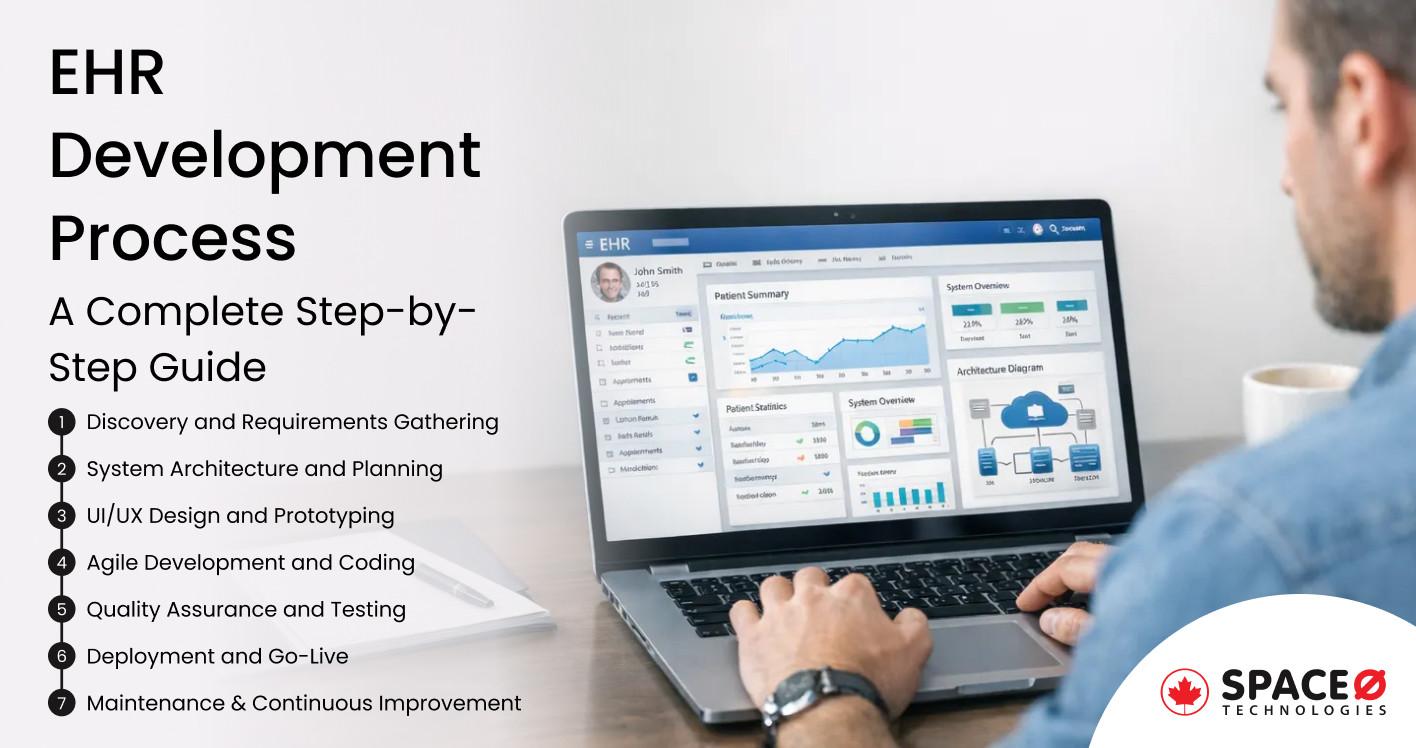
A hospital in Ontario spent 14 months building a custom EHR system—only to discover during go-live that it couldn’t submit claims to OHIP through MCEDT. The development team had focused on clinical features while overlooking provincial billing integration, forcing a costly 6-month rebuild.
This scenario plays out across Canadian healthcare organizations that underestimate the complexity of EHR software development. Understanding the complete EHR development process—from discovery through deployment—is the difference between a system that transforms patient care and one that creates more problems than it solves.
Partnering with an experienced EHR software development company ensures you avoid common pitfalls.
According to Grand View Research, the global EHR market continues to grow rapidly, reaching USD 33.43 billion in 2024 and projected to hit USD 43.36 billion by 2030. Despite this growth, nearly 75% of healthcare providers report dissatisfaction with existing EHR systems due to poor planning, limited customization, or compliance gaps.

At Space-O Canada, we’ve guided healthcare organizations across the country through successful EHR implementations—helping clinics, hospitals, and health networks build EHR systems that meet both clinical needs and Canadian regulatory requirements.
This guide walks you through each phase of the EHR development process, covering timelines, compliance requirements, technology decisions, and the critical mistakes that derail projects.
What is the EHR Development Process and Why Does It Matter?
The EHR development process refers to the systematic approach of designing, building, testing, and deploying electronic health record software that captures, stores, and manages patient health information digitally.
Unlike off-the-shelf EHR solutions that offer generic features, custom software development allows healthcare organizations to build systems tailored to their specific clinical workflows, specialty requirements, and operational needs.
It is important to distinguish between related terms that are often confused. An Electronic Health Record (EHR) is a comprehensive digital record designed for sharing across multiple healthcare settings and providers—fundamentally different from an Electronic Medical Record (EMR), which typically serves a single practice.
What are the Challenges With Current EHR System? How to Overcome Them?
Healthcare organizations pursuing custom EHR development typically face significant pain points with their current systems:
1. Challenge: Legacy System Integration Failures
Many Canadian healthcare facilities run on legacy EHR systems built on outdated technology stacks that cannot integrate with modern healthcare APIs like HL7 FHIR. EHR software modernization addresses these integration gaps.Systems like OSCAR EMR or older MEDITECH installations often require custom middleware to communicate with newer clinical applications.
Solution: Custom EHR development enables native FHIR integration, eliminating middleware complexity and enabling direct connections to provincial health information exchanges, laboratory networks, and pharmacy systems like PrescribeIT.
2. Challenge: Expensive On-Premise Infrastructure
On-premise servers require expensive maintenance, often costing $50,000 to $200,000 annually in infrastructure and IT support. These older systems lack cloud capabilities, limiting remote access and scalability while creating disaster recovery vulnerabilities.
Solution: Cloud-native EHR architecture reduces infrastructure costs by 40-60%, enables secure remote access for telemedicine app development integration, and provides built-in disaster recovery through redundant data centres.
3. Challenge: Physician Documentation Burden
Physicians using poorly designed systems spend an average of 2 hours on documentation for every 1 hour of patient face time. This documentation burden contributes to burnout and reduces quality of care.
Solution: AI-powered ambient clinical documentation—a key 2026 EHR trend—can reduce documentation time by up to 50% by automatically converting physician-patient conversations into structured clinical notes.
Custom EHR development addresses these challenges by creating systems optimized for your specific environment. A well-executed EHR development process delivers software that reduces documentation time, improves clinical decision-making through integrated alerts and analytics, and positions your organization for future healthcare technology trends including artificial intelligence and predictive analytics.
Now that we understand the fundamentals, let us explore the specific phases that comprise a comprehensive EHR development process.
What are the Key Phases of the EHR Development Process?
Here, you will discover the 7 essential phases that transform your EHR concept into a fully functional, compliant healthcare solution. This follows the proven software development life cycle methodology adapted for healthcare requirements.
Phase 1: Discovery and requirements gathering
The discovery phase establishes the foundation for your entire EHR development process. Your development team conducts extensive stakeholder interviews to understand clinical workflows, administrative processes, and technical requirements. This involves shadowing physicians during patient encounters, observing front desk operations, and documenting the complete patient journey.
Requirements gathering in healthcare differs from other industries due to regulatory complexity. Your team must map PIPEDA technical safeguards, provincial requirements (PHIPA in Ontario, HIA in Alberta, PIPA in BC), and documentation obligations from the outset.
Canadian-Specific Discovery Requirements:
- Provincial billing system integration needs (OHIP/MCEDT, MSP/Teleplan, AHCIP)
- Existing EHR platform compatibility (OSCAR EMR, Telus Health, MEDITECH)
- Provincial health information exchange connections
- French language requirements for Quebec (Law 25 compliance)
The discovery phase typically requires 2 to 4 weeks for small to mid-size implementations. The deliverable is a comprehensive requirements document that serves as the blueprint for all subsequent development work.
We offer a free discovery call before any paid engagement to understand your clinical environment. Our healthcare analysts ask the right questions—about patient volumes, specialty workflows, provincial billing requirements, and integration pain points—that generic developers miss. This upfront investment prevents costly mid-project pivots.
Phase 2: System architecture and planning
With requirements documented, the architecture phase defines the technical foundation of your EHR system. This includes selecting the technology stack, designing the database schema, planning integration architecture, and establishing security frameworks.
Technology stack selection requires careful consideration of long-term viability. Your development team evaluates frontend frameworks like React, Angular, or Vue.js based on performance and healthcare-specific component libraries. Backend decisions involve choosing between Node.js, Python, .NET, or other frameworks based on your integration requirements.
Integration Architecture for Canadian Healthcare:
- Laboratory information systems (LifeLabs, Dynacare connections)
- Pharmacy management networks through PrescribeIT and Surescripts
- Imaging systems via DICOM standards
- Provincial billing platforms (MCEDT for Ontario, Teleplan for BC)
- Health information exchanges (ConnectingOntario, eHealth Saskatchewan)
Following agile software development principles, the architecture phase produces a detailed technical specification that guides development while remaining flexible for iterative improvements.
Phase 3: UI/UX design and prototyping
The design phase creates the visual and interactive elements that clinicians and staff will use daily. Healthcare UI/UX design must balance information density with usability, presenting comprehensive patient data while minimizing cognitive load and click fatigue.
Clinical workflow optimization drives design decisions throughout this phase. Designers work with actual clinicians to understand how information should be organized for different encounter types and specialties. The goal is reducing the average 4,000+ mouse clicks per shift that physicians currently experience.
2026 Design Trends for EHR Systems:
- Ambient clinical documentation interfaces that display AI-transcribed notes in real-time
- Voice-first navigation for hands-free clinical workflows
- Specialty-specific dashboards (mental health, cardiology, primary care)
- Mobile-responsive designs for tablet-based rounding
Prototyping allows stakeholders to interact with the proposed interface before development begins. Interactive prototypes demonstrate patient chart layouts, documentation workflows, and order entry processes—catching usability issues before code is written.
Our designers observe how physicians, nurses, and front desk staff actually work, then build interfaces that match their mental models. For AI-powered features, we design intuitive interfaces showing transcription confidence scores and easy override options—so your team stays in control while benefiting from automation.
Phase 4: Agile development and coding
The development phase transforms designs and requirements into functional software through iterative coding sprints. Agile methodology is the standard approach for EHR development, delivering working software in 2-week increments that stakeholders can review. This iterative approach allows course corrections throughout development.
Core module development typically begins with:
- Patient registration and demographic management
- Clinical documentation and SOAP notes
- Order entry and results management
- E-prescribing integration (PrescribeIT for Canada)
- Scheduling and patient portal
Each module undergoes code review and unit testing before integration. For healthcare app development, security reviews are conducted at each sprint to ensure PIPEDA compliance is maintained throughout.
Integration Development Priorities:
- Laboratory interfaces for automated result import
- E-prescribing connections through PrescribeIT
- PACS integration for radiology images via DICOM
- Provincial billing submission (MCEDT, Teleplan, AHCIP claims)
You’ll receive sprint demos every two weeks showing exactly what’s been built. Our project managers provide weekly status reports, and you’ll have direct Slack/Teams access to your development team.
No surprises, no black-box development. Whether you’re building complex healthcare integrations or expanding your internal team, it’s essential to work with the right technical talent.
If you need to hire healthcare software developers — including specialists in EHR systems, interoperability standards, and clinical workflows — our team integrates seamlessly with your existing staff. Learn more about how to find and hire expert EHR software developers in our detailed guide.
Phase 5: Quality assurance and testing
Quality assurance in healthcare software development goes beyond standard functional testing to include rigorous security validation and compliance verification. The QA phase ensures your EHR performs correctly under real-world conditions while meeting all regulatory requirements.
Testing Categories for EHR Systems:
| Test Type | Purpose | Canadian Considerations |
|---|---|---|
| Functional Testing | Validates features work as specified | Provincial billing claim validation |
| Integration Testing | Confirms system connections | PrescribeIT, MCEDT, lab interfaces |
| Security Testing | Penetration testing, vulnerability scans | PIPEDA/PHIPA compliance validation |
| Load Testing | Simulates concurrent users | Peak clinic hours simulation |
| User Acceptance | Clinician validation | Specialty-specific workflow testing |
Security and penetration testing attempts to breach your system before malicious actors can. PIPEDA compliance validation confirms that audit logging captures all required events, encryption meets standards, and access controls function correctly.
Every EHR feature undergoes security review before deployment. We conduct third-party penetration testing on all healthcare projects and provide compliance documentation for your auditors. Our QA team tests with real-world clinical scenarios—not just happy-path testing. We’ve helped clients pass PHIPA audits, PIPEDA compliance reviews, and provincial health authority security assessments.
Phase 6: Deployment and go-live
The deployment phase transitions your EHR from development to production use. This phase requires careful planning to minimize disruption to patient care while ensuring successful adoption.
Data Migration Considerations:
- Historical patient records from legacy systems (OSCAR, MEDITECH, paper charts)
- Medication histories and allergy documentation
- Lab results and imaging reports
- Appointment histories and billing records
Migration planning should begin months before go-live, with meticulous mapping of data fields between systems and validation of migrated records.
Training Requirements by Role:
- Physicians: 20 to 40 hours depending on EHR experience
- Nurses: 15 to 25 hours for clinical documentation
- Front desk staff: 10 to 15 hours for scheduling and registration
- Billing personnel: 15 to 20 hours for claims submission
A phased rollout approach—starting with a pilot clinic or department—reduces risk and allows real-world validation before organization-wide deployment.
We run new and old systems in parallel for 1-2 weeks, allowing staff to verify data accuracy before fully transitioning. Our training covers all user roles with hands-on sessions—physicians learn clinical documentation, nurses learn order entry, and billing staff learn claims submission. We provide video tutorials, quick reference guides, and on-site support during the critical first weeks of operation.
Phase 7: Maintenance and continuous improvement
Go-live is not the end of the EHR development process but rather the beginning of ongoing system evolution. Post-launch support addresses bugs and usability issues identified during real-world use.
Ongoing Maintenance Requirements:
- Security patching and vulnerability remediation
- Regulatory updates (PIPEDA amendments, provincial law changes)
- Provincial billing code updates (ICD-10-CA, CCI procedure codes)
- Performance optimization as data volumes grow
- Feature enhancements based on user feedback
Most EHR development partners provide an initial support period, typically 3 months, following go-live. After the initial period, ongoing maintenance agreements provide continued support, security patching, and regulatory updates.
Ready to Start Your EHR Development Project?
Building a custom EHR system requires healthcare expertise and a proven methodology. Space-O Canada supports organizations across North America from requirements to deployment.
Phases provide structure for functionality. Learn the critical features modern EHR systems must incorporate for clinical success.
What Features Should a Custom EHR System Include?
Let’s explore the must-have features that make custom EHR systems effective for clinical workflows and regulatory compliance.
1. Patient data management
Patient data management forms the core of any EHR system, providing a comprehensive longitudinal record of each patient’s health information.
This includes demographic data, insurance information, emergency contacts, problem lists, allergy documentation, immunization records, and family history. The system maintains data provenance for clinical accuracy and regulatory compliance.
2. Clinical documentation (SOAP notes, templates)
Clinical documentation capabilities enable providers to record patient encounters efficiently while capturing detail required for quality care and appropriate billing.
Customizable templates adapted to your specialty and encounter types dramatically improve documentation efficiency.
Smart phrases and macros allow providers to insert frequently used text blocks with minimal keystrokes.
3. E-prescribing and medication management
E-prescribing integration connects your EHR to pharmacy networks through Surescripts, enabling electronic transmission of prescriptions directly to the patient’s pharmacy.
This eliminates handwriting legibility issues and enables automatic drug interaction checking.
Medication management features track current medications, document reconciliation, and alert providers to potential interactions or contraindications.
4. Lab and imaging integration
Laboratory integration automates the flow of orders to laboratory information systems and returns results directly to the patient chart.
This eliminates manual result entry and enables faster clinical decision-making. Imaging integration connects your EHR to PACS via DICOM standards, allowing providers to view radiology images and reports within the EHR workflow.
5. Appointment scheduling and patient portal
Scheduling functionality manages provider calendars, appointment types, and patient bookings. Advanced features include online self-scheduling through patient portal development and automated appointment reminders via SMS and email. Patient portal capabilities enable secure messaging with providers, access to test results, online bill payment, and completion of intake forms before appointments.
6. Billing and revenue cycle management integration
Medical billing integration connects clinical documentation to revenue cycle management, enabling charge capture from documented services. The system supports ICD-10 diagnosis coding and CPT procedure coding with code suggestion capabilities. Claims management features prepare and submit electronic claims to payers, track claim status, and manage denial workflows.
7. Interoperability features (FHIR, HL7)
Interoperability enables your EHR to exchange data with other healthcare systems, supporting care coordination across providers. HL7 FHIR has emerged as the modern standard for healthcare data exchange, offering RESTful APIs. FHIR implementation enables connections to health information exchanges and allows third-party applications to integrate with your EHR securely.
Canadian Interoperability Requirements:
- Provincial health information exchanges (ConnectingOntario, Netcare Alberta)
- Pan-Canadian standards (CA: FeX for FHIR)
- Cross-provincial patient matching for snowbird populations
FHIR implementation enables connections to health information exchanges and allows third-party applications to integrate with your EHR securely.
Building on these feature requirements, let us examine realistic timelines for your EHR development process.
How Long Does the EHR Development Process Take?
Understanding realistic timelines helps you plan resources and set stakeholder expectations for your EHR project.
1. Factors affecting development timeline
Multiple variables influence your EHR development timeline. Project scope and feature complexity represent the primary drivers. EHR Integration requirements often extend timelines more than anticipated, as each external system connection requires specification review, development, testing, and vendor coordination. Compliance certification requirements also impact timeline, potentially adding 9 to 18 months.
2. Typical timeline breakdown by project type
MVP EHR development typically requires 3 to 6 months, with costs ranging from $50,000 to $150,000.
For detailed pricing, see our guide on EHR software development cost. Mid-complexity projects encompassing full clinical workflows and multiple integrations require 6 to 12 months, with budgets of $150,000 to $350,000.
Enterprise implementations for hospitals or health systems may require 12 to 18 months or longer, with investments starting at $350,000.
3. Timeline optimization strategies
Phased rollout approaches accelerate time to initial value while managing risk. Prioritizing features for MVP delivery focuses initial development on capabilities addressing your most pressing pain points.
Parallel development tracks can compress overall timeline when sufficient development resources are available, with separate team members working on core modules, integrations, and user interface refinements simultaneously.
Timelines must align with regulations. Explore mandatory compliance standards essential for healthcare software deployment.
What are the Critical Compliance Requirements for EHR Development?
Compliance is non-negotiable in healthcare software. Here is what you need to know about PIPEDA, HL7, FHIR, and Canadian regulations.
1. Interoperability standards (HL7 and FHIR)
HL7 FHIR represents the modern standard for healthcare interoperability and should be prioritized for new EHR development. FHIR uses RESTful APIs and modern web standards that simplify integration compared to older messaging approaches. Building your EHR with FHIR-native data models positions you for seamless integration with the growing ecosystem of FHIR-enabled systems and applications.
2. Canadian healthcare compliance (PIPEDA, PHIPA)
Canadian healthcare organizations must comply with PIPEDA at the federal level and applicable provincial legislation. PIPEDA establishes principles for collecting, using, and disclosing personal information including health records. Provincial health information acts impose additional requirements in several jurisdictions. Data residency requirements may mandate that personal health information remain within Canada or specific provinces.
3. ONC certification considerations
ONC certification verifies that EHR systems meet specific functional, interoperability, and security criteria established by federal regulations. The certification process involves testing by an ONC-Authorized Certification Body and typically requires 9 to 18 months. Not all EHR implementations require ONC certification—if your system serves a specific niche, you may follow certification criteria as best practices without pursuing formal certification.
Need Help Navigating Healthcare Compliance?
Healthcare regulations evolve constantly. Space-O Canada’s compliance specialists ensure your healthcare software meets all applicable regulatory requirements without compromising security or usability.
Compliance guides technical decisions. Discover optimal technology stacks that balance security, scalability, and performance.
How Do You Choose the Right Technology Stack for EHR Development?
Your technology choices today will impact your EHR’s performance, scalability, and maintenance costs for years to come.
1. Frontend technologies for EHR development
| Technology | Strengths | Best For |
|---|---|---|
| React | Component reusability, large ecosystem | Complex clinical interfaces |
| Angular | Enterprise features, TypeScript native | Large healthcare organizations |
| Vue.js | Gentle learning curve, flexibility | Rapid prototyping, smaller teams |
Mobile access requirements influence frontend decisions—cross-platform frameworks like React Native reduce development and maintenance effort compared to native iOS/Android development.
2. Backend technologies and frameworks
| Technology | Strengths | Canadian Healthcare Use Cases |
|---|---|---|
| Node.js | Real-time performance, JavaScript ecosystem | Patient portals, async messaging |
| Python/Django | Rapid development, ML/AI libraries | Clinical decision support, analytics |
| .NET | Enterprise integration, Microsoft ecosystem | Hospital systems, legacy integration |
| Java/Spring | Proven reliability, security features | Enterprise EHR platforms |
3. Database selection for healthcare data
PostgreSQL has become a preferred choice for healthcare applications, offering robust relational capabilities, excellent JSON support for semi-structured clinical data, and strong security features. Document databases like MongoDB offer flexibility for clinical data that doesn’t fit traditional relational schemas.
Regardless of database selection, healthcare data storage requires:
- Encryption at rest (AES-256)
- Access auditing and logging
- PIPEDA-compliant hosting environments
- Canadian data residency
4. Cloud platforms for healthcare
| Platform | Canadian Healthcare Services |
|---|---|
| AWS Canada | HealthLake (FHIR), Montreal region, PIPEDA compliance |
| Microsoft Azure | Health Data Services, Toronto/Quebec regions |
| Google Cloud Canada | Healthcare API, Montreal region |
Right choices prevent costly errors. Learn frequent pitfalls that derail EHR projects and proven prevention strategies.
What are the Common Mistakes to Avoid in EHR Development?
Learning from others’ failures can save you months of delays and hundreds of thousands of dollars in rework costs.
1. Underestimating compliance requirements
The most costly mistake in EHR development is treating compliance as an afterthought rather than a foundational requirement. Organizations that begin development without thorough regulatory analysis frequently discover mid-project that their architecture cannot support required audit logging or their security framework lacks essential controls. Compliance requirements should be documented during discovery and validated with qualified healthcare compliance experts.
2. Insufficient stakeholder involvement
EHR systems that don’t reflect actual clinical workflows fail regardless of their technical sophistication. Development teams without access to practicing clinicians build systems optimized for imagined rather than actual use cases. Successful EHR development requires ongoing clinician involvement from requirements through deployment. Clinical advisory committees should review designs, provide feedback on prototypes, and participate in user acceptance testing.
3. Skipping user testing with real clinicians
Prototypes reviewed in conference rooms don’t reveal how software performs during actual patient care. Time pressures, interruptions, and cognitive demands create conditions that only real-world testing can simulate. Usability testing with actual clinicians performing realistic tasks should occur before code is finalized. Pilot deployments in limited clinical areas allow real-world validation before organization-wide rollout.
4. Building without an integration strategy
EHR systems that cannot exchange data with laboratories, pharmacies, imaging systems, and other providers deliver limited value. Organizations that defer integration planning often discover that their architecture doesn’t accommodate needed connections or that integration costs exceed original project budgets. Integration requirements should be defined during discovery and architecture should be designed with integration in mind from the start.
5. Ignoring scalability from the start
EHR systems that perform well with 10 users may fail with 100 concurrent users. Database designs that work for 10,000 patient records may struggle with 1,000,000 records. Organizations that don’t consider scalability during initial development face expensive rearchitecting when they outgrow their systems. Scalability requirements should be defined based on realistic growth projections and validated through load testing.
6. Poor change management planning
Even well-designed EHR systems fail when organizations don’t prepare their workforce for change. Clinicians accustomed to existing workflows resist new systems, particularly when training is inadequate or go-live support is insufficient. Change management planning should begin months before go-live and include communication strategies, training programs, super-user identification, and support models with on-site assistance during initial weeks.
Avoiding mistakes clarifies the sourcing strategy. Compare in-house vs outsourcing to determine your optimal EHR development path.
Which Option to Choose Between In-House or Outsource EHR Development?
This critical decision impacts your budget, timeline, and long-term success. Here is a framework for making the right choice.
1. In-house development – pros and cons
Building an in-house EHR development team provides maximum control over priorities, timelines, and intellectual property. However, EHR developers with healthcare experience command salaries of $120,000 to $180,000, which is 20 to 30 percent above general software engineers. As an alternative, you can hire EHR software developers through experienced partners. Training developers on healthcare regulations and clinical workflows requires 3 to 6 months before they become productive.
2. Outsourcing – benefits for EHR projects
Choosing to outsource EHR development to experienced partners like Space-O Canada provides:
- Specialized Healthcare IT Talent: Developers with existing PIPEDA, PHIPA, and HL7 FHIR experience
- Established Methodologies: Proven EHR development processes refined across multiple projects
- Compliance Expertise: Built-in knowledge of Canadian healthcare regulations
- Cost Efficiency: 40-60% cost savings compared to building equivalent in-house capabilities
- Scalable Resources: Team size adjusts to project phase requirements
3. Hybrid approach advantages
Many organizations achieve optimal results through hybrid approaches:
- Internal: Product ownership, stakeholder management, long-term vision
- External: Specialized development, compliance expertise, scalable capacity
This model preserves institutional knowledge and strategic control while accessing specialized expertise that would take years to build internally. Learn more about healthcare IT outsourcing to find the right engagement model for your organization.
Strategic decisions require execution partners. Discover how Space-O streamlines complex EHR development projects.
How Can Space-O Technologies Help With Your EHR Development Process?
Discover how our healthcare-focused development team delivers compliant, scalable EHR solutions for Canadian healthcare organizations.
1. Our healthcare software development expertise
Space-O Technologies brings over 8 years of healthcare software solutions experience, with a track record spanning 300+ successful projects.Our healthcare development team includes specialists in clinical workflow optimization, regulatory compliance, and interoperability standards. You can also hire healthcare software developers as dedicated resources for your project.
Canadian Healthcare Capabilities:
- PIPEDA and provincial privacy law compliance (PHIPA, HIA, PIPA)
- Provincial billing integration (OHIP/MCEDT, MSP/Teleplan, AHCIP)
- Canadian EHR platform experience (OSCAR EMR, Telus Health, MEDITECH)
- HL7 FHIR and Canadian interoperability standards
- PrescribeIT e-prescribing integration
2. End-to-end EHR development services
We provide comprehensive EHR development services spanning the complete project lifecycle:
- Discovery: Stakeholder interviews, workflow documentation, regulatory mapping
- Architecture: Technology selection, integration planning, security design
- Design: Clinical UI/UX, prototyping, usability testing
- Development: Agile sprints, continuous integration, security reviews
- Quality Assurance: Functional, security, compliance, and load testing
- Deployment: Data migration, training, go-live support
3. Our proven EHR development process
Every project receives:
- Dedicated project manager with healthcare domain experience
- Weekly progress updates and stakeholder reviews
- Comprehensive documentation and knowledge transfer
- 3 months of free maintenance support following go-live
- Ongoing support and enhancement options
Space-O Technologies’ work improved the client’s online presence with an informative layout and easy access to resources. The team managed the project well, delivered on time, and responded promptly.
Project: Website Design & Development for HealthTech Company Rating: ⭐⭐⭐⭐⭐ 5.0 on Clutch Industry: Medical | Location: San Francisco, California
Ready to Build Your Custom EHR System?
Let’s discuss your healthcare software vision. Our EHR experts assess your requirements and deliver a tailored development approach with a clear, detailed proposal.
Partnership capabilities translate to results. See proven approaches for launching compliant, scalable EHR systems successfully.
Launch a Compliant, Scalable EHR System With Space-O Technologies
Building an EHR system requires more than software development—it demands strict regulatory compliance, healthcare-specific workflows, and long-term scalability. Canadian healthcare organizations must address PIPEDA, provincial privacy laws, and interoperability standards from day one to protect patient data, support clinicians, and avoid costly rework or delays.
At Space-O Technologies, we build healthcare-ready EHR solutions designed for real-world clinical environments. Our team embeds compliance into every phase of the EHR development process while aligning technology choices with your operational, security, and growth requirements.
Our healthcare experts deliver systems optimized for clinical efficiency, secure data exchange, and future-ready scalability—so your EHR supports better patient care, regulatory confidence, and sustainable digital transformation.
to validate your EHR vision and receive a clear, practical development roadmap tailored to Canadian and North American healthcare needs.
Frequently Asked Questions About EHR Development
How much does EHR development cost in Canada?
Custom EHR development costs in Canada typically range from $50,000 to $150,000 for MVP implementations, $150,000 to $350,000 for mid-complexity systems, and $350,000 to over $1 million for enterprise deployments. For broader healthcare project budgeting, review our healthcare app development cost guide. Costs vary based on feature scope, integration requirements, compliance needs, and development team location. Space-O Canada provides detailed estimates following discovery sessions that define your specific requirements.
What is the typical EHR development timeline?
MVP EHR development typically requires 3 to 6 months following the discovery phase. Mid-complexity projects require 6 to 12 months, while enterprise implementations may take 12 to 18 months or longer. Timeline factors include feature scope, integration complexity, and certification requirements. Phased approaches can accelerate time to initial value while continuing development of advanced features.
What compliance certifications are required for EHR software?
Canadian organizations must comply with PIPEDA and applicable provincial laws like Ontario’s PHIPA. ONC certification may be required for participation in certain government programs. HL7 FHIR compliance is increasingly important for interoperability. Your specific compliance requirements depend on your location, patient population, and program participation.
Can you integrate a custom EHR with existing hospital systems?
Yes, custom EHR systems can integrate with existing hospital management systems including laboratory information systems, pharmacy systems, imaging systems (PACS), healthcare crm system, billing platforms, and health information exchanges. Integration typically uses HL7 v2 messaging, HL7 FHIR APIs, or direct database connections depending on the target system’s capabilities. Integration scope and complexity significantly impact project timeline and cost.
How do we protect our patient data when working with an offshore development team?
Implement a multi-layered approach: use only de-identified or synthetic data for development/testing, require VPN access with multi-factor authentication, establish strict data access controls, sign comprehensive Business Associate Agreements, and conduct regular security audits. Ensure your partner maintains PIPEDA-compliant infrastructure and processes.
How do we ensure the outsourced EHR integrates with our existing healthcare systems?
Require detailed integration planning during the proposal phase. Your outsourcing partner should assess your current systems (lab, pharmacy, imaging), document required integration points, and demonstrate experience with relevant standards like HL7, FHIR, and Direct messaging. Request integration architecture diagrams before signing contracts.
What ongoing support should be included in an EHR outsourcing contract?
Standard contracts should include 3-6 months of post-launch warranty support, bug fixes, system monitoring, and user training. For long-term maintenance, negotiate separate annual support agreements covering software updates, security patches, regulatory compliance updates, help desk support, and system optimization with defined SLAs.


Ready to Start Your EHR Development Project?
 All our projects are secured by NDA
100% Secure. Zero Spam
*All your data will remain strictly confidential.
Trusted by


Bashar Anabtawi 
Canada
“I was mostly happy with the high level of experience and professionalism of the various teams that worked on my project. Not only they clearly understood my exact technical requirements but even suggested better ways in doing them. The Communication tools that were used were excellent and easy. And finally and most importantly, the interaction, follow up and support from the top management was great. Space-O not delivered a high quality product but exceeded my expectations! I would definitely hire them again for future jobs!”

Canada Office
2 County Court Blvd., Suite 400,
Brampton, Ontario L6W 3W8
Phone: +1 (602) 737-0187
Email: sales@spaceo.ca