
- What is HIPAA Compliant Software Development?
- What are the Key HIPAA Compliance Rules for Software Development?
- What are the Technical Requirements for HIPAA Compliant Software?
- How to Develop HIPAA Compliant Software: Step-by-Step Process
- Step 1. Define scope and identify PHI data flows
- Step 2. Conduct a risk assessment
- Step 3. Design security architecture
- Step 4. Implement technical safeguards
- Step 5. Establish administrative policies
- Step 6. Integrate audit and monitoring systems
- Step 7. Conduct security testing and vulnerability assessments
- Step 8. Complete documentation and training
- Step 9. Establish Business Associate Agreements (BAAs)
- Step 10. Plan for ongoing compliance monitoring
- How Much Does HIPAA Compliant Software Development Cost?
- What are the Common Types of HIPAA Compliant Software Applications?
- What are the Common HIPAA Compliance Mistakes to Avoid in Software Development?
- What are the Penalties for HIPAA Non-Compliance?
- Build HIPAA Compliant Healthcare Software with Space-O Canada
- Frequently Asked Questions About HIPAA Compliant Software Development
HIPAA Compliant Software Development: Requirements, Checklist, and Best Practices

 Last Updated: January, 27 2026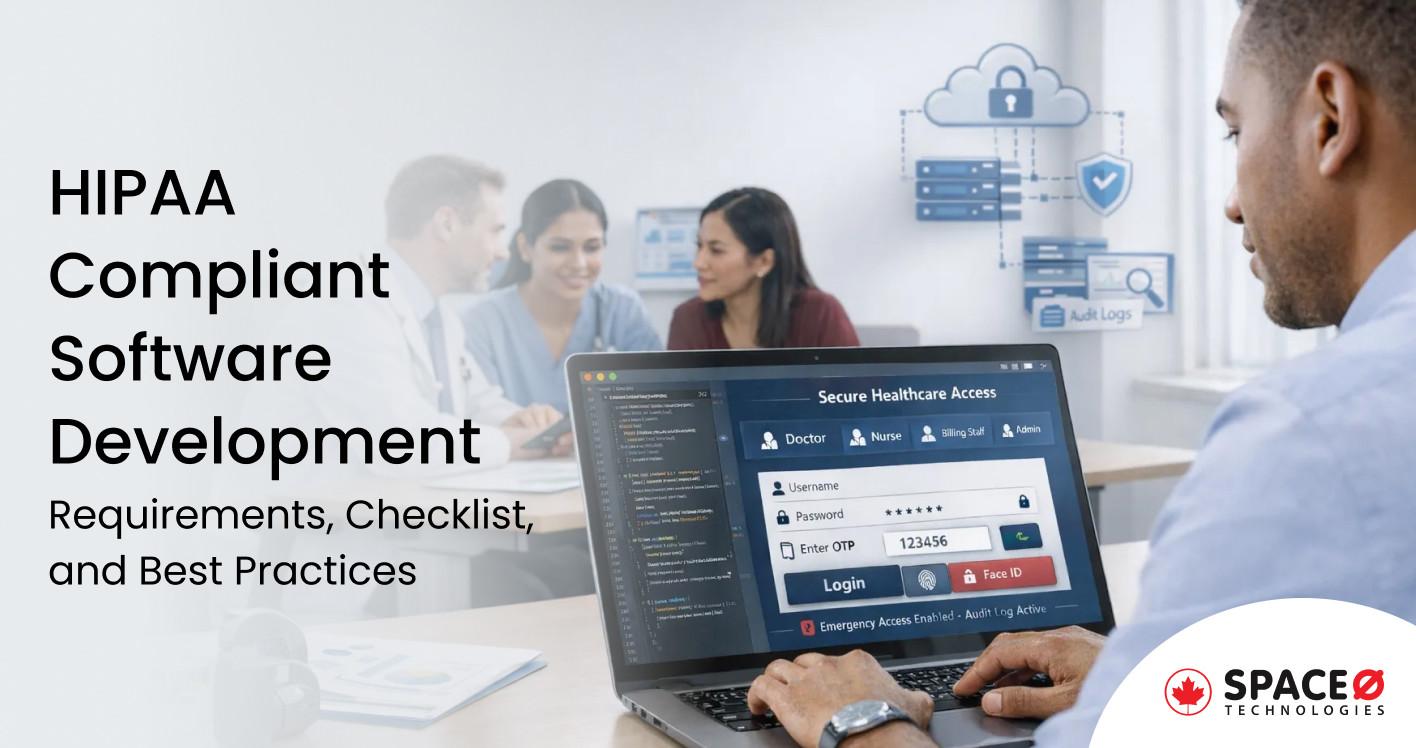
Building healthcare software without HIPAA compliance is like constructing a hospital without locks on the doors. Patient data remains exposed, and your organization faces devastating consequences. According to the HIPAA Journal, healthcare data breaches exposed over 133 million records in 2023 alone, with the average cost of a healthcare data breach reaching $10.93 million.
As a leading healthcare software development company, Space-O Technologies helps healthcare providers, startups, and healthtech innovators build secure, compliant, and scalable digital solutions.
From telemedicine platforms and patient portals to EHR systems and remote patient monitoring software, HIPAA compliance must be embedded into architecture, development workflows, and ongoing operations—not added as an afterthought.
This guide breaks down HIPAA-compliant software development in practical terms. You will learn what HIPAA compliance actually requires, the technical safeguards your development team must implement, a step-by-step process for building compliant applications, cost considerations, and common mistakes that lead to violations.
What is HIPAA Compliant Software Development?
HIPAA compliant software development is the process of designing, building, and maintaining software applications that meet the security, privacy, and administrative requirements established by the Health Insurance Portability and Accountability Act (HIPAA). This federal law sets strict standards for protecting sensitive patient health information from unauthorized access, breaches, and misuse.
At the core of HIPAA compliance is the concept of Protected Health Information (PHI). PHI includes any individually identifiable health information that relates to a patient’s past, present, or future physical or mental health condition, healthcare services provided, or payment for healthcare services.
If your organization develops software that handles PHI for covered entities, you are considered a business associate and must comply with HIPAA requirements. This applies whether you are building a custom healthcare software or a SaaS platform serving multiple healthcare clients.
HIPAA compliance is not a one-time certification but an ongoing commitment to maintaining security standards, conducting regular risk assessments, and updating safeguards as threats evolve.
With the foundation established, let’s explore the specific HIPAA rules your software must address to achieve compliance.
What are the Key HIPAA Compliance Rules for Software Development?
HIPAA establishes several interconnected rules that govern how healthcare information must be protected. Understanding each rule helps development teams implement the right safeguards and avoid compliance gaps.
1. The HIPAA privacy rule
The Privacy Rule establishes national standards for protecting individuals’ medical records and personal health information. It defines what constitutes PHI, sets limits on how PHI can be used and disclosed, and grants patients rights over their health information.
For software development, the Privacy Rule requires applications to implement controls that limit PHI access to authorized users only. Your software must support the “minimum necessary” principle, meaning users should only access the PHI required for their specific job function. Patient portals must provide individuals with access to their own health records, and your system must track and honor patient requests regarding their data.
2. The HIPAA security rule
The Security Rule specifically addresses electronic Protected Health Information (ePHI) and establishes three categories of safeguards that software must implement.
- Administrative safeguards include policies and procedures for managing security. This covers security management processes, workforce security training, information access management, and contingency planning. Your development organization must designate a security official responsible for HIPAA compliance.
- Physical safeguards protect the physical infrastructure where ePHI is stored or accessed. This includes facility access controls, workstation security policies, and device and media controls. For cloud-based software, your hosting provider must maintain compliant physical security.
- Technical safeguards are the technology-based protections built into your software. These include access controls, audit controls, integrity controls, and transmission security. The technical safeguards form the core of what developers must implement directly in the application.
3. The Breach notification rule
The Breach Notification Rule requires covered entities and business associates to notify affected individuals, the Department of Health and Human Services (HHS), and in some cases the media, following a breach of unsecured PHI.
For software development, this rule means your application must include robust logging and monitoring capabilities to detect potential breaches. You need mechanisms to identify what data was accessed, when, and by whom. Your incident response procedures must support notification within 60 days of discovering a breach affecting 500 or more individuals.
4. The omnibus rule
The Omnibus Rule, enacted in 2013, strengthened HIPAA enforcement and expanded requirements for business associates. It clarified that business associates are directly liable for HIPAA compliance and must enter into Business Associate Agreements (BAAs) with covered entities.
For software development companies, the Omnibus Rule means you cannot simply rely on your healthcare clients to maintain compliance. Your organization is independently responsible for implementing HIPAA safeguards and can face direct penalties for violations.
Understanding these rules reveals the technical requirements. Here is what your development team must implement.
What are the Technical Requirements for HIPAA Compliant Software?
The HIPAA Security Rule defines specific technical safeguards that software handling ePHI must implement. While HIPAA does not mandate specific technologies, it establishes functional requirements that your development team must address through appropriate technical solutions.
1. Access controls and user authentication
HIPAA requires that only authorized users can access ePHI, and your software must verify user identity before granting access.
- Unique user identification means every user must have a distinct identifier. Shared accounts are not permitted because they make it impossible to track who accessed specific records. Your system must assign unique usernames or IDs to every individual who accesses PHI.
- Role-based access control (RBAC) implements the minimum necessary principle. Different user roles (physicians, nurses, billing staff, administrators) should have access only to the PHI required for their job functions. A billing clerk should not see clinical notes, and a nurse may not need access to detailed payment information.
- Multi-factor authentication (MFA) adds an additional layer of verification beyond passwords. While not explicitly required by HIPAA, MFA is considered a best practice and is increasingly expected by auditors. Implement MFA using combinations of something users know (password), something they have (mobile device or security token), and something they are (biometric verification).
- Emergency access procedures must allow authorized personnel to access ePHI during emergencies when normal access methods may not be available. Document these procedures and implement technical controls that support emergency access while maintaining audit trails.
2. Data encryption (at rest and in transit)
Encryption renders PHI unreadable to unauthorized users, even if they gain access to the underlying data. HIPAA considers encryption an “addressable” safeguard, meaning organizations must implement it or document why an equivalent alternative is appropriate. In practice, encryption is essential for any modern healthcare application.
- Encryption at rest protects stored data. Use AES-256 encryption for databases, file storage, and backups containing ePHI. Encryption keys must be stored separately from encrypted data and managed through secure key management practices.
- Encryption in transit protects data moving between systems. Implement TLS 1.2 or higher for all data transmissions. This applies to API communications, web interfaces, mobile app connections, and any data exchange between your application and external systems.
- End-to-end encryption ensures data remains encrypted from the point of origin to the final destination, with decryption only possible by authorized endpoints. This is particularly important for messaging features, telehealth video calls, and file sharing within healthcare applications.
3. Audit controls and logging
HIPAA requires mechanisms to record and examine activity in systems containing ePHI. Comprehensive audit logging enables breach detection, investigation, and compliance verification.
Your software must log all access to ePHI, including who accessed records, what data was viewed or modified, when access occurred, and from what location or device. Log authentication attempts (successful and failed), administrative actions, and system events that could indicate security incidents.
- Log retention policies should maintain audit records for at least six years, aligning with HIPAA’s documentation retention requirements. Store logs in tamper-evident formats and protect them from unauthorized modification or deletion.
- Real-time monitoring helps detect potential breaches as they occur. Implement alerting mechanisms for suspicious activities such as unusual access patterns, failed authentication attempts, or access from unexpected locations.
4. Automatic logoff and session management
HIPAA requires procedures for terminating electronic sessions after a period of inactivity. This prevents unauthorized access when users step away from workstations without logging out.
Implement automatic session timeouts that log users out after a defined period of inactivity. The appropriate timeout duration depends on the clinical environment. Emergency departments may need longer timeouts than administrative offices. Typical implementations range from 5 to 15 minutes.
Session management should also include secure session token handling, protection against session hijacking, and proper session termination when users log out explicitly.
5. Data backup and disaster recovery
HIPAA requires contingency plans that ensure ePHI remains available and recoverable following emergencies or system failures.
- Backup procedures must create exact copies of ePHI that can be used to restore data if the original is lost or corrupted. Backups must be encrypted and stored in secure locations, ideally geographically separate from primary systems.
- Disaster recovery plans define how your organization will restore access to ePHI within acceptable timeframes following a disaster. Document recovery time objectives (RTO) and recovery point objectives (RPO) appropriate for your healthcare clients’ needs.
- Testing requirements mean backup and recovery procedures must be tested regularly to verify they work as expected. Document testing results and address any gaps identified.
6. Transmission security
Beyond encryption, transmission security encompasses all controls that protect ePHI during electronic transmission.
- Secure APIs must authenticate all requests, validate input data, and protect against common vulnerabilities such as injection attacks and unauthorized data exposure. Implement API rate limiting to prevent abuse and denial-of-service attacks.
- Network security for on-premises components includes firewalls, intrusion detection systems, and network segmentation that isolates systems handling ePHI from general network traffic.
Organizations developing EHR software must pay particular attention to transmission security, as these systems frequently exchange data with external laboratories, pharmacies, and other healthcare providers.
Turn HIPAA Compliance Into a Foundation for Scalable Healthcare Software
Design software that meets HIPAA requirements while supporting performance, usability, and long-term product growth.
Technical requirements form the foundation. Now follow this step-by-step process to build HIPAA compliant software from scratch.
How to Develop HIPAA Compliant Software: Step-by-Step Process
Building HIPAA compliant software requires a systematic approach that integrates security and compliance throughout the development lifecycle. Followin`g this structured process helps ensure nothing is overlooked and creates documentation that demonstrates your compliance efforts.
Step 1. Define scope and identify PHI data flows
Before writing any code, clearly define what PHI your application will handle and how it will flow through your system.
Document every type of PHI your software will create, receive, store, process, or transmit. Map data flows from entry points (user input, API integrations, file uploads) through processing and storage to output points (displays, reports, data exports, integrations with other systems).
This data flow mapping becomes the foundation for your security architecture. It identifies where encryption is needed, what access controls are required, and where potential vulnerabilities may exist.
Step 2. Conduct a risk assessment
HIPAA requires covered entities and business associates to conduct regular risk assessments. This analysis identifies potential threats to ePHI and evaluates the likelihood and impact of each threat.
Evaluate risks across all three safeguard categories: administrative, physical, and technical. Consider threats such as unauthorized access, data breaches, system failures, natural disasters, and human error. Document identified risks, their potential impact, and the likelihood of occurrence.
Risk assessment is not a one-time activity. HIPAA requires ongoing risk management, with assessments conducted whenever significant changes occur to your systems or environment.
Step 3. Design security architecture
Based on your data flow analysis and risk assessment, design a security architecture that addresses identified risks and implements required safeguards.
Define your authentication and authorization model, encryption strategy, audit logging approach, and network security design. Specify which technologies and frameworks you will use to implement each requirement. Consider how your architecture will support scalability and future compliance needs.
Document your security architecture decisions, including the rationale for choosing specific approaches. This documentation demonstrates due diligence and supports future audits.
Step 4. Implement technical safeguards
With your architecture defined, implement the technical safeguards in your application code and infrastructure.
Build access controls, encryption, audit logging, session management, and transmission security as discussed in the technical requirements section. Follow secure coding practices to prevent common vulnerabilities such as SQL injection, cross-site scripting, and insecure direct object references.
Use established security libraries and frameworks rather than building custom cryptographic implementations. Well-tested libraries reduce the risk of implementation errors that could compromise security.
Step 5. Establish administrative policies
Technical safeguards alone do not achieve HIPAA compliance. Your organization must establish administrative policies and procedures that govern how ePHI is handled.
Develop policies covering information access management, workforce security, security incident procedures, contingency planning, and business associate management. These policies must be documented, communicated to all workforce members, and enforced consistently.
If you are developing software for healthcare clients, your policies must address both your internal handling of PHI during development and the controls built into the software for end users.
Step 6. Integrate audit and monitoring systems
Implement the audit controls and monitoring systems designed in your security architecture.
Configure logging to capture all required events, establish log storage and retention systems, and implement monitoring dashboards and alerting. Test that logs accurately capture the information needed for security investigations and compliance audits.
Consider using security information and event management (SIEM) solutions for complex applications. SIEM tools aggregate logs from multiple sources, apply correlation rules to detect suspicious patterns, and provide centralized monitoring capabilities.
Step 7. Conduct security testing and vulnerability assessments
Before deploying HIPAA compliant software, conduct thorough security testing to identify and remediate vulnerabilities.
- Penetration testing simulates real-world attacks against your application to identify exploitable vulnerabilities. Engage qualified security professionals to conduct penetration tests, and address all critical and high-severity findings before launch.
- Vulnerability scanning uses automated tools to identify known vulnerabilities in your application and infrastructure. Conduct scans regularly throughout development and after any significant changes.
- Code review examines source code for security vulnerabilities, compliance gaps, and adherence to secure coding standards. Include security-focused code reviews in your development process.
Step 8. Complete documentation and training
HIPAA requires extensive documentation of policies, procedures, and compliance activities. This documentation must be maintained for at least six years.
Document your risk assessments, security policies, technical safeguards, incident response procedures, and business associate agreements. Create user documentation that explains how to use your software in a HIPAA compliant manner.
Train all workforce members who will access PHI on HIPAA requirements and your organization’s policies. Training must occur at onboarding and regularly thereafter, with documentation of who was trained and when.
Step 9. Establish Business Associate Agreements (BAAs)
If you are developing software for healthcare clients, you must enter into Business Associate Agreements with each covered entity client before accessing their PHI.
BAAs define the permitted uses of PHI, require you to implement appropriate safeguards, establish breach notification procedures, and confirm your compliance obligations. Work with legal counsel experienced in healthcare regulations to develop BAA templates.
You must also establish BAAs with your own subcontractors who may access PHI. This includes cloud hosting providers, third-party integrations, and any other vendors involved in storing or processing ePHI.
Step 10. Plan for ongoing compliance monitoring
HIPAA compliance is not achieved at launch and forgotten. Establish processes for ongoing compliance monitoring and continuous improvement.
Schedule regular risk assessments, security testing, and policy reviews. Monitor audit logs for security incidents. Stay informed about changes to HIPAA regulations and guidance. Update your safeguards as new threats emerge and technologies evolve.
Working with experienced healthcare software development companies can help organizations navigate the complexities of ongoing HIPAA compliance while maintaining focus on their core healthcare mission.
Following the development process is essential, but you will also need a compliance checklist. Use this to verify every requirement.
Understanding healthcare app development cost factors helps organizations budget appropriately for compliance requirements that add complexity and development effort.
The checklist ensures nothing is missed. But what does compliant software actually cost? Here is a detailed breakdown.
How Much Does HIPAA Compliant Software Development Cost?
HIPAA compliant software development typically costs between $75,000 and $500,000 or more, depending on application complexity, the volume of PHI handled, and required integrations. Compliance requirements add 20-40% to baseline development costs due to additional security features, testing, documentation, and ongoing monitoring requirements.
1. Factors affecting cost
Several variables determine the total investment required for HIPAA compliant software.
- Application complexity is the primary cost driver. A simple patient scheduling app requires fewer safeguards than a comprehensive EHR system with multiple integrations, complex workflows, and extensive PHI handling.
- Volume and sensitivity of PHI affects security requirements. Applications handling large volumes of sensitive clinical data require more robust encryption, access controls, and monitoring than those with limited PHI exposure.
- Integration requirements add complexity and cost. Connecting with EHR systems, laboratory information systems, pharmacy systems, or health information exchanges requires secure API development and often additional compliance considerations.
- Infrastructure choices impact both development and ongoing costs. Cloud-based deployments using HIPAA-compliant hosting providers may have lower upfront costs but ongoing subscription fees. On-premises deployments require greater initial investment but provide more control.
- Compliance documentation and training represent significant effort beyond code development. Creating required policies, procedures, risk assessments, and training materials requires dedicated resources.
2. Cost breakdown by project type
Here is what different types of HIPAA compliant healthcare applications typically cost.
| Project Type | Examples | Key Features | Timeline | Cost Range (USD) |
|---|---|---|---|---|
| Simple | Patient scheduling, appointment reminders, basic health tracking | User authentication, basic encryption, audit logging, limited PHI | 3-5 months | $75,000 – $150,000 |
| Medium Complexity | Telemedicine platforms, patient portals, medical billing systems | Video conferencing, payment processing, document management, multiple user roles, HL7/FHIR integrations | 5-9 months | $150,000 – $300,000 |
| Complex Enterprise | Full EHR systems, hospital management platforms, health information exchanges | Comprehensive clinical workflows, multiple system integrations, advanced analytics, complex access controls, high availability | 9-18 months | $300,000 – $750,000+ |
For specific pricing on telehealth solutions, see our detailed guide on telemedicine app development cost.
3. Additional compliance costs
Beyond development, HIPAA compliance requires ongoing investment.
- Security audits and assessments should be conducted annually at minimum. Third-party security audits cost $10,000-$50,000 depending on scope and complexity.
- Penetration testing by qualified security professionals typically costs $5,000-$25,000 per engagement. Most organizations conduct penetration tests annually and after major releases.
- Compliance consulting may be needed to interpret requirements, develop policies, or prepare for audits. Healthcare compliance consultants charge $150-$400 per hour.
- HIPAA-compliant hosting adds premiums to standard cloud hosting costs. Expect to pay 20-50% more for hosting providers that sign BAAs and maintain HIPAA compliance programs.
- Ongoing monitoring and maintenance includes security updates, vulnerability patching, log monitoring, and compliance documentation updates. Budget 15-25% of initial development costs annually for maintenance.
Important: The cheapest development option rarely delivers the best value for HIPAA compliant software. Cutting corners on security creates technical debt that becomes exponentially more expensive to address after launch, and potential breach costs dwarf any development savings.
Cost considerations lead to understanding what you are building. Here are the most common types of HIPAA compliant applications.
What are the Common Types of HIPAA Compliant Software Applications?
Healthcare organizations deploy various software applications that must comply with HIPAA requirements. Understanding the specific compliance considerations for each application type helps development teams focus on the most critical safeguards.
1. Electronic Health Record (EHR) systems
EHR systems are the backbone of modern healthcare IT, managing comprehensive patient medical records including diagnoses, medications, allergies, lab results, and clinical notes. These systems require the most stringent HIPAA safeguards due to the volume and sensitivity of PHI they handle.
Key compliance considerations include complex role-based access controls supporting dozens of user types, extensive audit logging for clinical and legal requirements, interoperability with external systems through HL7 and FHIR standards, and high availability requirements for 24/7 clinical operations.
2. Telemedicine and telehealth platforms
Telemedicine applications enable remote patient consultations through video conferencing, secure messaging, and virtual examination tools. These platforms experienced explosive growth and face unique compliance challenges.
Video streaming must be encrypted end-to-end. Session recordings, if retained, require secure storage. Patient identity verification presents challenges in remote settings. Integration with EHR systems for documentation creates additional data flow considerations.
3. Patient portals
Patient portals provide individuals with secure access to their health records, appointment scheduling, prescription refills, and communication with providers. These applications must balance security with usability for patients who may have limited technical skills.
Access control is critical since patients should see only their own records. Authentication must be strong enough to prevent unauthorized access but not so complex that it prevents legitimate use. The portal must support patient rights under HIPAA, including access to records and accounting of disclosures.
Organizations can learn more about building these solutions in our guide to patient portal development.
4. Medical billing software
Medical billing applications handle claims processing, payment posting, accounts receivable management, and financial reporting. While the PHI exposure may seem limited to demographic and insurance information, billing systems typically connect to clinical systems and may access diagnosis codes and procedure details.
Compliance considerations include secure integration with clearinghouses and payers, protection of financial information alongside health data, audit trails for billing activities, and access controls that separate clinical and financial functions appropriately.
5. Healthcare CRM systems
Healthcare Customer Relationship Management systems manage patient communications, marketing campaigns, referral tracking, and patient satisfaction programs. These systems handle PHI including contact information, appointment history, and sometimes clinical summaries.
Marketing communications must comply with HIPAA restrictions on using PHI for marketing purposes. Patient consent management becomes critical. Integration with clinical systems requires careful data flow design to limit PHI exposure.
6. Mental health and therapy applications
Mental health applications, including therapy platforms, mood tracking apps, and substance abuse treatment tools, handle particularly sensitive PHI. Mental health records receive additional protections under many state laws.
Stricter access controls may be required for mental health information. Psychotherapy notes have special protection under HIPAA. Substance abuse treatment records are governed by additional federal regulations (42 CFR Part 2). User privacy concerns may be heightened, requiring careful UX design.
7. Remote patient monitoring applications
Remote monitoring applications collect health data from wearable devices, home medical equipment, and patient-reported outcomes. These systems generate large volumes of data requiring efficient processing and storage.
IoT device security extends compliance considerations to hardware. Data transmission from devices must be encrypted. Alert systems must balance sensitivity with false alarm rates. Integration with clinical workflows enables action on monitoring data.
8. Medical imaging and diagnostic software
Medical imaging applications manage radiology images, pathology slides, and other diagnostic media. These systems handle large files requiring specialized storage and transmission approaches.
Image data constitutes PHI and requires full protection. DICOM standards govern medical imaging but do not address all HIPAA requirements. Viewing applications must implement access controls. Image sharing with external providers requires secure transmission.
For comprehensive telemedicine software development, organizations need partners who understand both the technical complexity and compliance requirements of healthcare applications.
Build HIPAA-Compliant Software Without Guesswork or Risk
Develop secure healthcare applications with privacy-by-design architecture, audited workflows, and safeguards that protect ePHI at every stage.
Different applications have unique requirements, but all must avoid these common compliance pitfalls.
What are the Common HIPAA Compliance Mistakes to Avoid in Software Development?
Even well-intentioned development teams make mistakes that compromise HIPAA compliance. Understanding these common pitfalls helps you avoid costly remediation and potential violations.
1. Inadequate encryption implementation
Encryption failures are among the most common HIPAA violations. Mistakes include using outdated encryption algorithms, failing to encrypt data at rest while focusing only on transmission, storing encryption keys alongside encrypted data, and not encrypting backups and development/test environments containing real PHI.
Always use current encryption standards (AES-256 for data at rest, TLS 1.2+ for transmission). Implement proper key management with keys stored separately from data. Ensure encryption covers all PHI locations including backups, logs, and non-production environments.
2. Insufficient access controls
Access control failures expose PHI to unauthorized users. Common mistakes include overly broad role definitions that grant more access than necessary, failure to implement the minimum necessary principle, shared accounts that prevent individual accountability, and not revoking access promptly when users leave or change roles.
Design granular roles aligned with job functions. Implement automated access reviews and prompt deprovisioning. Never allow shared accounts for accessing PHI.
3. Missing or incomplete audit logs
Audit failures make it impossible to detect breaches or demonstrate compliance. Problems include not logging all PHI access events, failing to protect logs from tampering, inadequate log retention, and not monitoring logs for suspicious activity.
Log all access to PHI with sufficient detail for investigations. Protect log integrity through write-once storage or cryptographic verification. Retain logs for at least six years. Implement active monitoring and alerting.
4. Neglecting Business Associate Agreements
BAA failures create liability exposure and compliance gaps. Mistakes include working with healthcare clients without executed BAAs, using third-party services (cloud providers, analytics tools, communication platforms) without BAAs, and not flowing down requirements to subcontractors who access PHI.
Execute BAAs before accessing any client PHI. Verify that all vendors who may access PHI will sign BAAs. Maintain a complete inventory of business associate relationships.
5. Poor employee training
Training failures leave workforce members unaware of their compliance responsibilities. Problems include one-time training without ongoing reinforcement, generic training not tailored to specific job functions, failure to document training completion, and not training contractors and temporary workers.
Implement role-specific training programs. Conduct training at onboarding and at least annually thereafter. Document all training activities. Include all workforce members regardless of employment status.
6. Lack of incident response planning
Incident response failures lead to botched breach responses that compound initial problems. Mistakes include having no documented incident response plan, not testing response procedures, unclear roles and responsibilities during incidents, and failure to meet breach notification timelines.
Develop comprehensive incident response procedures. Conduct tabletop exercises to test plans. Clearly define roles and communication chains. Build notification timeline compliance into your procedures.
7. Using non-compliant third-party services
Third-party failures introduce compliance gaps outside your direct control. Problems include using consumer-grade services (personal email, standard cloud storage) for PHI, not verifying vendor compliance claims, and integrating tools without understanding their data handling practices.
Verify that every service touching PHI is HIPAA compliant and will sign a BAA. Use healthcare-specific or enterprise versions of services rather than consumer products. Conduct vendor security assessments.
8. Overlooking mobile device security
Mobile security failures create vulnerabilities in an increasingly mobile healthcare environment. Mistakes include not encrypting data on mobile devices, allowing PHI access from unmanaged personal devices, inadequate mobile device management, and not implementing remote wipe capabilities.
Require device encryption and passcodes. Implement mobile device management for devices accessing PHI. Enable remote wipe for lost or stolen devices. Consider containerization to separate PHI from personal data on BYOD devices.
Avoiding mistakes is critical because violations carry severe penalties. Here is what non-compliance can cost your organization.
What are the Penalties for HIPAA Non-Compliance?
HIPAA violations carry significant financial penalties that can devastate healthcare organizations and their business associates. Understanding the penalty structure reinforces the importance of robust compliance programs.
1. Tier structure of civil penalties
The Department of Health and Human Services Office for Civil Rights (OCR) enforces HIPAA and assesses penalties based on the level of culpability.
| Tier | Culpability Level | Penalty Per Violation | Annual Maximum |
|---|---|---|---|
| Tier 1 | Did not know and could not have known | $100 – $50,000 | $25,000 |
| Tier 2 | Reasonable cause, not willful neglect | $1,000 – $50,000 | $100,000 |
| Tier 3 | Willful neglect, corrected within 30 days | $10,000 – $50,000 | $250,000 |
| Tier 4 | Willful neglect, not corrected | $50,000 | $1,500,000 |
Each violation can be assessed independently, meaning a single breach affecting thousands of patients can result in millions of dollars in penalties. The maximum penalty across all tiers is $1.5 million per violation category per year.
2. Criminal penalties
In addition to civil penalties, HIPAA violations can result in criminal prosecution. Criminal penalties apply to individuals who knowingly obtain or disclose PHI in violation of HIPAA.
- Wrongful disclosure: Up to $50,000 fine and one year imprisonment
- Offenses committed under false pretenses: Up to $100,000 fine and five years imprisonment
- Offenses with intent to sell or use PHI for personal gain: Up to $250,000 fine and ten years imprisonment
3. Real-world enforcement examples
Recent HIPAA enforcement actions demonstrate the significant financial impact of non-compliance.
In 2023, a healthcare provider paid $4.75 million to settle allegations that it failed to conduct proper risk analysis and implement appropriate security measures, resulting in a breach affecting over 9 million patients. A business associate was fined $1.5 million for failing to have a proper business associate agreement in place and for security failures that led to unauthorized disclosure.
Beyond direct penalties, HIPAA violations result in reputational damage that can cost healthcare organizations patient trust and business relationships. Class action lawsuits following breaches add to financial exposure. The average total cost of a healthcare data breach exceeds $10 million when accounting for investigation, remediation, notification, legal fees, and business impact.
Develop Secure, HIPAA-Compliant Software With Space-O
Partner with Space-O to build healthcare software aligned with HIPAA, security best practices, and real-world clinical workflows.
The stakes are high, which is why choosing the right development partner matters. Here is how Space-O Canada ensures HIPAA compliance.
Build HIPAA Compliant Healthcare Software with Space-O Canada
Developing HIPAA-compliant software requires specialized expertise that combines deep healthcare domain knowledge with rigorous security engineering practices. Space-O Canada helps healthcare organizations and health tech startups build compliant applications that protect patient data while delivering exceptional user experiences.
Our healthcare development team brings years of experience building secure applications for clients across North America. We understand that HIPAA compliance is not a checkbox exercise but an ongoing commitment that must be designed into every aspect of your application.
Space-O Canada also brings expertise in Canadian healthcare compliance requirements, including PHIPA (Ontario), PIPEDA, and provincial health information regulations. For organizations operating across borders, we ensure applications meet both US HIPAA and Canadian privacy requirements.
With 300+ successful projects and 100+ satisfied clients, including Fortune 500 companies, we have the experience to handle complex healthcare applications while maintaining the agility to work effectively with startups and growing organizations.
Ready to build HIPAA-compliant healthcare software? Schedule a free consultation to discuss your project requirements and compliance needs.
Frequently Asked Questions About HIPAA Compliant Software Development
Does HIPAA apply to mobile apps?
Yes, HIPAA applies to mobile apps that create, receive, store, or transmit Protected Health Information on behalf of covered entities. Mobile health apps must implement the same safeguards as other healthcare software, with additional considerations for device security, data encryption on mobile devices, and secure transmission over potentially insecure networks. Consumer health apps that are not connected to covered entities may not be subject to HIPAA but should still follow security best practices.
How long does it take to develop HIPAA compliant software?
Development timelines vary based on application complexity. Simple HIPAA compliant applications typically require 3-5 months. Medium complexity applications like telemedicine platforms or patient portals take 5-9 months. Complex enterprise healthcare platforms may require 9-18 months or longer. These timelines include security architecture design, implementation of required safeguards, security testing, and compliance documentation.
Can cloud-based software be HIPAA compliant?
Yes, cloud-based software can be HIPAA compliant when hosted on infrastructure that meets HIPAA requirements. Major cloud providers including AWS, Google Cloud, and Microsoft Azure offer HIPAA-eligible services and will sign Business Associate Agreements. However, not all services from these providers are HIPAA compliant. Organizations must verify that specific services used are covered under the BAA and implement appropriate configuration and access controls.
How often should HIPAA compliance be reviewed?
HIPAA requires ongoing compliance monitoring rather than one-time certification. Risk assessments should be conducted at least annually and whenever significant changes occur to systems, processes, or the threat environment. Security policies should be reviewed annually. Penetration testing and vulnerability assessments should be conducted at least annually. Workforce training must be provided at onboarding and reinforced regularly. Audit logs should be monitored continuously.
What is the difference between HIPAA and PHIPA compliance?
HIPAA (Health Insurance Portability and Accountability Act) is US federal law governing protected health information. PHIPA (Personal Health Information Protection Act) is Ontario provincial law with similar but not identical requirements. Key differences include scope (PHIPA applies to health information custodians in Ontario; HIPAA applies to covered entities in the US), specific requirements for consent and disclosure, and enforcement mechanisms. Organizations operating in both jurisdictions must comply with both regulatory frameworks.


Develop Secure, HIPAA-Compliant Software With Space-O
What to read next

 All our projects are secured by NDA
100% Secure. Zero Spam
*All your data will remain strictly confidential.
Trusted by


Bashar Anabtawi 
Canada
“I was mostly happy with the high level of experience and professionalism of the various teams that worked on my project. Not only they clearly understood my exact technical requirements but even suggested better ways in doing them. The Communication tools that were used were excellent and easy. And finally and most importantly, the interaction, follow up and support from the top management was great. Space-O not delivered a high quality product but exceeded my expectations! I would definitely hire them again for future jobs!”

Canada Office
2 County Court Blvd., Suite 400,
Brampton, Ontario L6W 3W8
Phone: +1 (602) 737-0187
Email: sales@spaceo.ca