
- What is HIPAA Compliant Telehealth Platform Development?
- What are the Five HIPAA Rules for Telehealth Platform Development?
- A Step-by-Step Process to Build HIPAA Compliant Telehealth Platform
- Step 1: Compliance requirements analysis
- Step 2: Security architecture design
- Step 3: Vendor selection and BAA execution
- Step 4: Secure development practices
- Step 5: Security feature implementation
- Step 6: Compliance testing and validation
- Step 7: Documentation and training
- Step 8: Deployment and continuous monitoring
- What are the Essential Features for HIPAA Compliant Telehealth Platforms?
- What is the Cost of Developing HIPAA Compliant Telehealth Platform?
- What are the Common HIPAA Compliance Challenges and How to Overcome Them?
- What are the Consequences of HIPAA Violation?
- Building Secure Telehealth Platforms With Space-O Technologies
- Frequently Asked Questions About HIPAA Compliant Telehealth Platform Development
HIPAA Compliant Telehealth Platform Development: Complete Guide to Building Secure Virtual Care Solutions

 Last Updated: January, 27 2026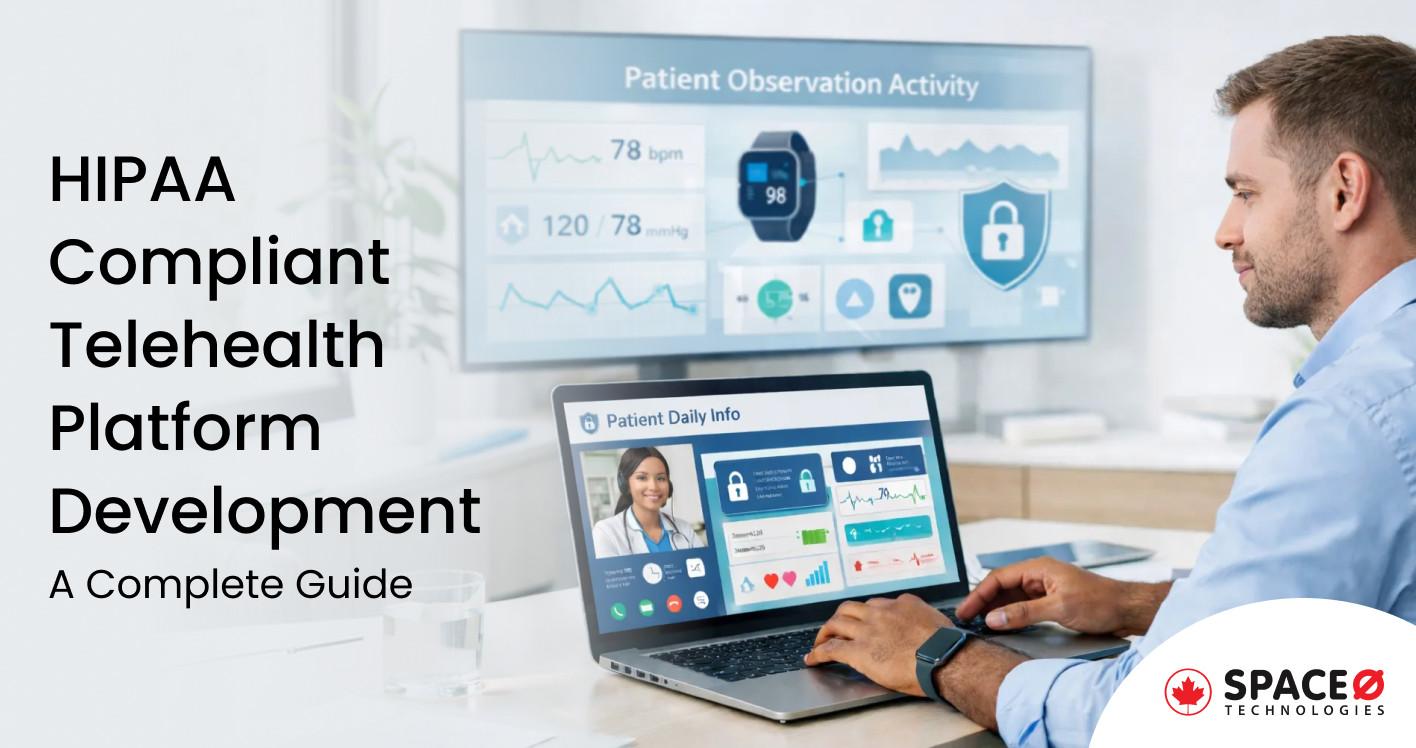
Are you planning to build a telehealth platform but worried about the complex web of HIPAA compliance requirements? You’re facing a legitimate concern, as healthcare organizations continue to experience rising data breaches and increasing regulatory scrutiny around the protection of sensitive patient information.
The stakes couldn’t be higher. According to IBM, Healthcare data breaches cost an average of $10.93 million per incident, the highest across all industries. Yet the opportunity is equally compelling.
For organizations building telemedicine apps that serve Canadian patients, HIPAA compliance isn’t just a checkbox—it’s the foundation that determines whether your platform can operate legally, maintain patient trust, and avoid penalties. The challenge is understanding what compliance actually requires and how to build it into your platform from day one.
This guide breaks down HIPAA compliant telehealth platform development in practical terms. You’ll learn the five HIPAA rules governing telehealth, the step-by-step development process, technical requirements, essential features, cost considerations, and how to overcome common compliance challenges.
What is HIPAA Compliant Telehealth Platform Development?
HIPAA compliant telehealth platform development is the process of building enterprise-grade virtual healthcare systems with a security-first architecture that protects Protected Health Information (PHI) at every layer while meeting all regulatory requirements established by the Health Insurance Portability and Accountability Act.
This differs significantly from building a standard telehealth application. While a basic telemedicine app might focus on video consultation features and user experience, a HIPAA-compliant telehealth platform encompasses a comprehensive infrastructure designed for multi-provider environments, scalable compliance frameworks, and enterprise-level security controls.
Think of it as the difference between building a single clinic and constructing an entire hospital network digitally. Platforms serve multiple healthcare providers, handle complex data flows between systems, and require robust administrative controls that individual applications don’t need.
Organizations investing in healthcare software development must understand that HIPAA compliance shapes every architectural decision—from database design to API structure to user interface workflows.
Pro Tip: When evaluating whether you need a platform versus an application, consider your scaling requirements. If you anticipate serving multiple provider organizations, requiring tenant isolation, or integrating with various EHR systems, platform architecture with built-in compliance is the right approach.
With the foundational understanding established, let’s examine the specific HIPAA rules that govern telehealth platform development.
What are the Five HIPAA Rules for Telehealth Platform Development?
HIPAA establishes five interconnected rules that collectively govern how healthcare organizations must protect patient information. Understanding each rule is essential for building compliant telehealth platforms.
1. Privacy rule
The Privacy Rule establishes national standards for protecting individuals’ medical records and personal health information. For telehealth platforms, this means implementing comprehensive data protection measures while ensuring patients maintain control over their health information.
PHI protection requirements
All patient data must be protected from unauthorized access, use, or disclosure through robust security measures. Patients must have the ability to access their own medical records, and organizations must respond to data requests within 30 days. Additionally, only the minimum necessary information should be used for any given purpose.
Patient rights under the privacy rule
Patients have the right to access their health information and request corrections to their records when inaccuracies exist. They can know who has accessed their information and request restrictions on certain disclosures. Your telehealth platform must include functionality supporting these rights, including secure patient portals, audit trail access, and data export capabilities.
Your telehealth platform must include functionality that supports these patient rights, including secure patient portals, audit trail access, and data export capabilities.
2. Security rule
The Security Rule mandates specific safeguards for electronic Protected Health Information (ePHI). These requirements form the technical backbone of HIPAA compliant telehealth platform development and encompass administrative, physical, and technical measures.
Administrative safeguards
Organizations must designate a security officer responsible for compliance and provide workforce training on security procedures. Information access management policies must be established alongside contingency planning for emergencies. Regular security evaluations are required to identify vulnerabilities and ensure ongoing compliance with evolving threats and regulatory requirements throughout the organization.
Physical safeguards
Facility access controls must limit physical entry to areas containing ePHI to authorized personnel only. Workstation use policies govern how devices accessing patient information are positioned and utilized. Device and media controls ensure proper handling of equipment, while secure disposal procedures prevent data recovery from decommissioned hardware containing protected health information.
Technical safeguards
Access controls require unique user identification and automatic logoff features to prevent unauthorized system access. Audit controls enable comprehensive activity logging for accountability purposes. Integrity controls include data validation and authentication mechanisms, while transmission security ensures encryption protects all data in transit between systems and endpoints throughout your telehealth platform.
3. Breach notification rule
When security incidents occur, the Breach Notification Rule dictates how organizations must respond to protect affected individuals and maintain transparency with regulatory authorities.
Notification requirements
Affected individuals must be notified within 60 days of breach discovery, with notifications including breach descriptions, information types involved, recommended protective steps, and organizational response measures. Breaches affecting 500 or more individuals require immediate notification to HHS and prominent media outlets. All breaches must be logged and reported to HHS annually.
Your telehealth platform should include incident response tools that help identify, contain, and report breaches within required timeframes.
4. Enforcement rule
The Enforcement Rule establishes investigation procedures and penalties for HIPAA violations:
| Violation Level | Description | Penalty Per Violation | Annual Maximum |
|---|---|---|---|
| Tier 1 | Unknowing violation | $100 – $50,000 | $25,000 |
| Tier 2 | Reasonable cause (not willful neglect) | $1,000 – $50,000 | $100,000 |
| Tier 3 | Willful neglect, corrected within 30 days | $10,000 – $50,000 | $250,000 |
| Tier 4 | Willful neglect, not corrected | $50,000 | $2.1 million |
Criminal penalties can also apply for knowing violations, ranging from $50,000 and one year imprisonment to $250,000 and ten years imprisonment for violations involving intent to sell PHI.
5. Omnibus rule
The Omnibus Rule, enacted in 2013, strengthened HIPAA in several important ways that directly impact telehealth platform development and third-party vendor relationships.
Business associate requirements
Business associates are now directly liable for HIPAA compliance, extending accountability beyond covered entities. Subcontractors of business associates must also comply with all applicable requirements. Business Associate Agreements are mandatory for all vendors handling PHI, creating a chain of compliance responsibility that extends throughout the entire healthcare technology ecosystem and service provider network.
Enhanced protections
The Omnibus Rule introduced stricter breach notification requirements and expanded patient rights regarding electronic records. Increased penalties for non-compliance provide stronger enforcement mechanisms, while marketing and fundraising restrictions limit how PHI can be used. Every third-party service integrated into your platform requires a signed BAA and must meet HIPAA standards.
Turn Compliance Requirements Into a Secure Telehealth Advantage
Space-O helps healthcare organizations design telehealth platforms that pass audits, protect ePHI, and support reliable virtual care delivery.
Understanding the rules provides the foundation—now let’s walk through the practical process of building a HIPAA compliant telehealth platform.
A Step-by-Step Process to Build HIPAA Compliant Telehealth Platform
Building a HIPAA compliant telehealth platform requires a structured approach that integrates compliance considerations at every phase of development. Below is the proven process Space-O Technologies, a telemedicine app development company, follows when building secure and compliant healthcare platforms.
Step 1: Compliance requirements analysis
Begin by identifying all applicable regulations, including HIPAA, state-specific requirements, and international laws for global patients. Determine your organization’s role as a covered entity or business associate and document specific compliance requirements for your telehealth use case.
Conduct formal risk analysis identifying systems handling ePHI, documenting potential threats and vulnerabilities, and prioritizing mitigation strategies. Define your PHI scope, map complete data flows from collection through deletion, and document user roles and access requirements for audit preparation.
Step 2: Security architecture design
Design your platform architecture with security as the primary consideration using defense-in-depth principles. Minimize attack surface by limiting exposed services and implementing multiple security layers, assuming breach attempts will occur. Conduct threat modeling to identify potential attackers, map telehealth-specific attack vectors like account takeover and video interception, and design appropriate countermeasures.
Select HIPAA-eligible cloud infrastructure with signed BAAs, design network segmentation isolating PHI systems, plan encryption key management, and establish a comprehensive logging and monitoring architecture.
Organizations following a structured software development life cycle with security integrated throughout build more resilient healthcare platforms.
Step 3: Vendor selection and BAA execution
Every third-party service handling PHI requires careful evaluation and contractual agreements before integration. Evaluate vendors based on HIPAA compliance capabilities, certifications, security practices, SOC 2 audit reports, and data residency options.
Execute Business Associate Agreements before any PHI touches vendor systems, ensuring agreements include permitted uses, safeguard requirements, and breach notification obligations. Maintain centralized BAA registry with renewal tracking for cloud providers, video APIs, payment processors, messaging services, analytics platforms, and customer support tools.
Step 4: Secure development practices
Implement secure coding standards throughout development, following OWASP guidelines for input validation, parameterized queries, and output encoding. Establish security-focused code review protocols using automated static analysis tools and dynamic application security testing to catch vulnerabilities early.
Maintain a comprehensive inventory of third-party libraries and monitor for known vulnerabilities using tools like Snyk or Dependabot. Establish rapid patching processes when security issues are discovered and avoid dependencies with poor security track records to minimize risk exposure.
Step 5: Security feature implementation
Configure TLS 1.2 or higher for all data in transit and implement AES-256 encryption for data at rest with secure key management. Implement multi-factor authentication, role-based access controls, appropriate session timeouts, and secure password policies for all users. Consider biometric authentication for mobile applications.
Configure comprehensive audit logging for all PHI access with tamper-evident storage, real-time alerting for suspicious activity, and ensure log retention meets the six-year HIPAA requirement for compliance reviews.
Step 6: Compliance testing and validation
Engage qualified security professionals for penetration testing covering external and internal attack scenarios, including social engineering vectors. Perform automated vulnerability scanning regularly, testing for OWASP Top 10 vulnerabilities, and verify encryption implementations are correctly configured.
Validate that access controls function properly across all user roles. Conduct formal gap analysis against HIPAA requirements, documenting compliance evidence for each requirement. Address all identified deficiencies before launch and prepare comprehensive documentation for potential Office for Civil Rights audits.
Step 7: Documentation and training
Develop comprehensive policy documentation, including privacy procedures, security policies covering all safeguard requirements, incident response plans, business continuity strategies, and workforce sanction policies. Implement HIPAA awareness training for all staff with role-specific security training and incident reporting procedures.
Conduct regular refresher training annually at a minimum and maintain documentation of all training completions. This documentation demonstrates compliance commitment and prepares your organization for regulatory audits while ensuring the workforce understands their compliance responsibilities.
Step 8: Deployment and continuous monitoring
Use infrastructure-as-code for consistent, auditable deployments with proper secrets management for credentials and keys. Configure security groups, network policies, and verify all production security controls before launch. Deploy security information and event management tools to monitor for anomalous access patterns, failed authentication attempts, and potential data exfiltration.
Establish ongoing compliance processes, including annual risk assessments, regular policy reviews, continuous vulnerability management, periodic third-party audits, and staying current with regulatory changes affecting telehealth platforms.
Organizations considering outsourcing healthcare software development should ensure their development partner follows this comprehensive process.
The development process establishes compliance foundations. Let’s examine the features your platform needs to deliver compliant virtual care.
What are the Essential Features for HIPAA Compliant Telehealth Platforms?
HIPAA compliant telehealth platforms require specific features for patients, providers, and administrators. Each feature must be implemented with security and compliance considerations at the forefront.
1. Patient-side features
Secure registration and authentication
Patients verify identity during registration and set up multi-factor authentication with secure passwords, biometric login options, and protected account recovery processes.
HIPAA-compliant video consultations
End-to-end encrypted video calls include virtual waiting rooms, connection quality indicators, and automatic audio fallback without recording unless patients provide explicit consent.
Encrypted messaging
Secure provider-patient messaging supports encrypted file attachments, delivery and read receipts, automated message expiration, and emergency escalation pathways when needed.
Appointment management
Online scheduling displays provider availability with automated reminders, easy rescheduling and cancellation options, waitlist management, and automatic time zone handling.
2. Provider-side features
Clinical dashboard
Providers manage patient queues, view appointment schedules, receive pending task notifications and clinical alerts, and access performance analytics from one interface.
Patient record access
Comprehensive medical history includes integrated lab results, DICOM-compliant imaging viewer, allergy and medication lists, and problem list management capabilities.
EHR/EMR integration
HL7 FHIR interoperability enables bi-directional data sync, single sign-on, clinical decision support integration, and workflow continuity between virtual and office visits.
Organizations requiring EHR connectivity should explore EHR software development best practices for seamless integration.
E-prescribing
EPCS-compliant prescribing includes drug interaction checking, formulary integration, pharmacy network connectivity, and complete prescription history access for informed decisions.
3. Administrative features
User and role management
Administrators handle user provisioning, role assignment and modification, access certification reviews, deprovisioning procedures, and bulk user management efficiently.
Compliance dashboard
Real-time compliance status monitoring includes audit log oversight, policy acknowledgment tracking, training completion status, and risk assessment integration.
Audit log management
Searchable audit history enables custom report generation, anomaly detection alerts, export capabilities for external audits, and retention policy enforcement.
Consent management
Electronic consent capture tracks consent versions, handles withdrawals, maintains audit trails for all consent activities, and supports multiple languages.
Pro Tip: Start with essential features for your MVP, but design your architecture to accommodate advanced features. Adding compliance capabilities to an existing platform is significantly more expensive than building them into the foundation.
Design Telehealth Platforms That Meet HIPAA From Day One
Create telehealth software that embeds compliance into architecture, data handling, and user access while supporting seamless virtual care.
Features require infrastructure support from compliant vendors. Let’s examine the investment required for HIPAA compliant platform development.
What is the Cost of Developing HIPAA Compliant Telehealth Platform?
HIPAA-compliant telehealth platforms cost $45,000-$80,000 for a basic MVP with encrypted video and core features, $100,000-$200,000 for mid-range with advanced compliance and integrations, and $200,000-$400,000+ for enterprise solutions including AI and multi-tenant architecture.
Understanding cost factors helps organizations budget appropriately and make informed decisions.
1. Cost breakdown by platform complexity
| Complexity Level | Features Included | Timeline | Cost Range (USD) |
|---|---|---|---|
| Basic HIPAA-Compliant MVP | Core compliance, encrypted video/messaging, basic auth, audit logs, single EHR | 3-4 months | $45K-$80K |
| Mid-Range Compliant Platform | Full HIPAA, adv. RBAC, audit trails, e-prescribing, payments, multi-integrations | 5-8 months | $100K-$200K |
| Enterprise Telehealth Platform | Adv. security, AI, multi-tenant, full compliance, custom integrations, white-label | 9-12+ months | $200K-$400K+ |
2. Factors affecting development cost
Compliance Requirements:
Adding HIPAA compliance to telehealth development typically increases costs by 30-40% compared to non-compliant applications. This reflects:
- Implementation of all required security safeguards
- Comprehensive documentation and policies
- Security testing and validation
- Ongoing compliance maintenance infrastructure
Integration Complexity:
- Single EHR integration: $15,000 – $40,000
- Multiple EHR support: $40,000 – $100,000+
- Pharmacy network integration: $10,000 – $25,000
- Lab system integration: $15,000 – $35,000
- Payment gateway with healthcare compliance: $5,000 – $15,000
Security Testing Requirements:
- Initial penetration testing: $5,000 – $15,000
- Annual penetration testing: $5,000 – $15,000
- Vulnerability assessments: $3,000 – $8,000 per assessment
- Compliance audits: $5,000 – $20,000 depending on scope
Development Team Location:
| Region | Hourly Rate Range | Considerations |
|---|---|---|
| United States | $150-$250/hour | Highest rates, local compliance knowledge |
| Canada | $100-$180/hour | Strong compliance expertise, favorable rates |
| Western Europe | $80-$150/hour | GDPR expertise, quality development |
| Eastern Europe | $50-$100/hour | Good quality, moderate rates |
| India | $25-$60/hour | Cost-effective, verify healthcare exp. |
For detailed cost breakdowns, review our comprehensive guide on telemedicine app development cost.
3. Ongoing compliance costs
HIPAA compliance is not a one-time expense. Budget for ongoing requirements:
| Cost Category | Annual Estimate |
|---|---|
| Compliance maintenance | $4K-$12K |
| Annual risk assessments | $3K-$10K |
| Penetration testing | $5K-$15K |
| Security monitoring | $6K-$24K |
| Staff training | $1K-$5K |
| Policy review & updates | $2K-$6K |
| Incident response planning | $2K-$8K |
| Total Annual Compliance | $23K-$80K |
4. ROI perspective
While HIPAA compliant development costs more upfront, consider the alternative:
- Single HIPAA violation: $100 – $50,000 per incident
- Major violation category: Up to $2.1 million annually
- Average healthcare data breach cost: $10.93 million
- Reputational damage: Immeasurable patient trust loss
Investing in compliance during development costs a fraction of addressing failures after launch.
Important note: The cheapest option isn’t always the best value. A development partner who cuts corners on security creates technical debt that costs significantly more to remediate later. Focus on value, not just hourly rates.
Understanding costs helps with planning—now let’s examine common challenges organizations face and how to overcome them.
What are the Common HIPAA Compliance Challenges and How to Overcome Them?
Building HIPAA compliant telehealth platforms presents specific challenges. Understanding these obstacles and their solutions helps organizations navigate compliance successfully.
1. Data security and encryption complexity
Challenge: Implementing proper encryption across all data states (transit, rest, processing) while maintaining system performance and usability.
Solution:
- Partner with development teams experienced in healthcare security
- Use established encryption libraries rather than custom implementations
- Leverage cloud provider encryption services (AWS KMS, Azure Key Vault)
- Conduct thorough testing to ensure encryption doesn’t impact user experience
- Implement encryption at the infrastructure level where possible
2. Third-party vendor compliance management
Challenge: Managing multiple vendors, ensuring all have signed BAAs, and verifying ongoing compliance.
Solution:
- Create a centralized vendor management system
- Establish vendor onboarding procedures requiring BAA execution before any PHI access
- Conduct annual vendor compliance reviews
- Maintain documentation of each vendor’s compliance status
- Have contingency plans for replacing non-compliant vendors
3. Comprehensive audit trail implementation
Challenge: Logging all required activities without impacting performance, storing logs for 6+ years, and making them searchable for compliance reviews.
Solution:
- Implement asynchronous logging to minimize performance impact
- Use scalable log storage solutions (cloud-based log management)
- Design log schema for efficient searching from the start
- Automate log retention policies
- Implement log integrity verification
4. Multi-state regulatory variations
Challenge: Different states have varying telehealth regulations regarding provider licensing, prescribing, and privacy requirements beyond HIPAA.
Solution:
- Build flexible architecture accommodating regional compliance variations
- Implement configurable compliance rules by jurisdiction
- Partner with legal experts specializing in multi-state telehealth
- Stay current on regulatory changes through industry associations
- Consider compliance-as-a-service solutions for complex scenarios
5. Balancing security with user experience
Challenge: Strong security measures (MFA, session timeouts, complex passwords) can frustrate users and reduce adoption.
Solution:
- Implement risk-based authentication (stronger requirements for sensitive actions)
- Use biometric authentication options for mobile
- Design intuitive security flows with clear user guidance
- Conduct usability testing with actual healthcare users
- Optimize timeout settings based on clinical workflow requirements
6. Legacy system integration
Challenge: Many healthcare organizations use legacy EHR systems with limited integration capabilities and potential security vulnerabilities.
Solution:
- Use integration middleware to bridge legacy systems securely
- Implement FHIR APIs where possible for modern interoperability
- Create secure data synchronization processes
- Consider gradual migration strategies
- Ensure legacy integrations don’t compromise overall platform security
For organizations lacking internal expertise, partnering with experienced healthcare software development companies can help navigate these challenges effectively.
Quick Tip: Document every compliance challenge encountered and its solution. This creates institutional knowledge that speeds future development and helps during compliance audits.
Understanding challenges prepares you for success—but it’s equally important to understand what’s at stake if compliance fails.
What are the Consequences of HIPAA Violation?
HIPAA violations carry severe consequences that can threaten an organization’s financial stability and reputation. Understanding these stakes reinforces the importance of compliance investment.
1. Financial penalties
The Office for Civil Rights (OCR) enforces HIPAA with a tiered penalty structure. Tier 1 covers unknowing violations with penalties ranging from $100 to $50,000 and an annual cap of $25,000. Tier 2 addresses reasonable cause violations with penalties from $1,000 to $50,000 and a $100,000 annual cap.
Tier 3 applies to willful neglect that gets corrected, carrying penalties from $10,000 to $50,000 with a $250,000 annual cap. Tier 4 covers willful neglect that remains uncorrected, with a flat $50,000 penalty per violation and an annual cap of $2.1 million.
These penalties apply per violation category. A single breach affecting multiple patients and involving multiple compliance failures can result in penalties across multiple categories, quickly reaching millions of dollars.
2. Criminal penalties
Individuals who knowingly violate HIPAA face criminal prosecution with escalating consequences based on intent and severity.
- Knowing violation: Up to $50,000 fine and one year imprisonment
- Violation under false pretenses: Up to $100,000 fine and five years imprisonment
- Violation with intent to sell or use PHI: Up to $250,000 fine and ten years imprisonment
Real-world enforcement statistics
Recent OCR enforcement demonstrates the agency’s commitment to HIPAA compliance through aggressive investigation and substantial penalties.
- 2024 Healthcare Breaches: 729 reported breaches affecting 185.8 million individuals
- Average Breach Cost: $10.93 million per incident (highest across all industries)
- Largest HIPAA Settlement: $16 million (Anthem Inc., 2018)
- Most Common Violation: Failure to conduct risk assessments
3. Beyond financial penalties
HIPAA violations create consequences extending far beyond regulatory fines, affecting organizational reputation, operations, and long-term viability.
Reputational damage
Healthcare depends on patient trust. A publicized breach can drive patients to competitors, damage relationships with referring providers, create negative media coverage lasting years, and impact recruitment of healthcare professionals.
Operational disruption
Breach response consumes significant resources including investigation and forensics, patient notification, credit monitoring services for affected individuals, regulatory reporting, and legal defense costs.
Class action litigation
Large breaches frequently trigger class action lawsuits resulting in defense costs regardless of outcome, potential settlements reaching millions, years of legal proceedings, and ongoing compliance monitoring requirements.
4. The investment perspective
Consider the math: comprehensive HIPAA compliant development costs $100,000 to $400,000, annual compliance maintenance runs $25,000 to $80,000, while a single major breach averages $10.93 million.
Pro Tip: Use breach cost statistics when building business cases for compliance investment. Decision-makers often underestimate risks until they see quantified potential impacts.
Develop HIPAA-Compliant Telehealth Platforms With Space-O
Partner with Space-O to build secure telehealth platforms aligned with HIPAA safeguards, privacy rules, and real-world clinical workflows.
With the stakes clear, let’s discuss how Space-O Technologies can help you build a HIPAA compliant telehealth platform that protects your organization and your patients.
Building Secure Telehealth Platforms With Space-O Technologies
HIPAA compliant telehealth platform development is no longer optional for healthcare organizations serving US patients; it’s the foundation for legal operation, patient trust, and sustainable growth.
A successful HIPAA compliant telehealth development requires understanding and implementing all five HIPAA rules, meeting technical requirements for encryption, access controls, and audit logging, managing Business Associate Agreements with all third-party vendors, and budgeting appropriately for both initial development and ongoing compliance
Space-O Technologies helps healthcare organizations turn these requirements into secure, compliant telehealth platforms. With years of software development experience and 300+ projects delivered, our healthcare development teams understand HIPAA, PIPEDA, PHIPA, and the nuances of cross-border compliance.
Whether you’re launching a new telehealth platform, expanding virtual care capabilities, or modernizing legacy healthcare systems, Space-O Technologies provides the expertise needed for HIPAA compliant success.
Ready to build your HIPAA compliant telehealth platform. Schedule a Free Consultation to discuss your requirements with our healthcare development experts.
Frequently Asked Questions About HIPAA Compliant Telehealth Platform Development
How much does HIPAA compliant telehealth platform development cost?
Costs range from $45,000-$80,000 for a basic compliant MVP to $200,000-$400,000+ for enterprise platforms. HIPAA compliance typically adds 30-40% to base development costs. Ongoing annual compliance maintenance costs $23,000-$80,000 including risk assessments, security testing, and training programs.
How long does it take to build a HIPAA compliant telehealth platform?
Development timelines vary by complexity. Basic compliant MVPs require 3-4 months, mid-range platforms take 5-8 months, and enterprise solutions require 9-12+ months. Compliance requirements add time for security implementation, testing, documentation, and validation that non-compliant applications don’t require.
Do I need a BAA with my cloud provider?
Yes. Any cloud provider storing, processing, or transmitting PHI requires a signed Business Associate Agreement. Major providers (AWS, Azure, Google Cloud) offer HIPAA-eligible services with BAAs, but you must specifically request and execute the agreement before any PHI touches their systems.
What happens if my telehealth platform violates HIPAA?
Violations trigger penalties ranging from $100 to $50,000 per incident, with annual caps up to $2.1 million per violation category. Severe violations can result in criminal prosecution with imprisonment. Beyond penalties, violations cause reputational damage, patient trust loss, and potential class action litigation—the average healthcare breach costs $10.93 million.
Is HIPAA compliance required for telehealth apps serving Canadian patients?
HIPAA specifically applies to US patients and healthcare entities. Canadian telehealth platforms must comply with PIPEDA and provincial health privacy laws (PHIPA in Ontario, HIA in Alberta, etc.). However, if your platform serves both US and Canadian patients, you must comply with both regulatory frameworks simultaneously.
What are the most common HIPAA violations in telehealth?
The most common violations include failure to conduct risk assessments, inadequate access controls, lack of encryption for PHI, missing or incomplete audit trails, failure to execute BAAs with vendors, and insufficient workforce training. Many violations result from treating compliance as an afterthought rather than building it into platform architecture from the start.


What to read next

 All our projects are secured by NDA
100% Secure. Zero Spam
*All your data will remain strictly confidential.
Trusted by


Bashar Anabtawi 
Canada
“I was mostly happy with the high level of experience and professionalism of the various teams that worked on my project. Not only they clearly understood my exact technical requirements but even suggested better ways in doing them. The Communication tools that were used were excellent and easy. And finally and most importantly, the interaction, follow up and support from the top management was great. Space-O not delivered a high quality product but exceeded my expectations! I would definitely hire them again for future jobs!”

Canada Office
2 County Court Blvd., Suite 400,
Brampton, Ontario L6W 3W8
Phone: +1 (602) 737-0187
Email: sales@spaceo.ca