
- What is HIPAA Compliance in Telehealth?
- Who Must Comply with HIPAA Telehealth Requirements?
- What are the Five HIPAA Rules for Telehealth Compliance?
- What are the Technical Safeguards for HIPAA Compliant Telehealth?
- What are the Common HIPAA Compliance Mistakes to Avoid?
- What are the HIPAA Violation Penalties and Consequences?
- Achieving HIPAA Telehealth Compliance with Space-O Technologies
- Frequently Asked Questions About HIPAA Telehealth Compliance Requirements
HIPAA Telehealth Compliance Requirements: Complete Guide to Protecting Patient Data in Virtual Care

 Last Updated: January, 28 2026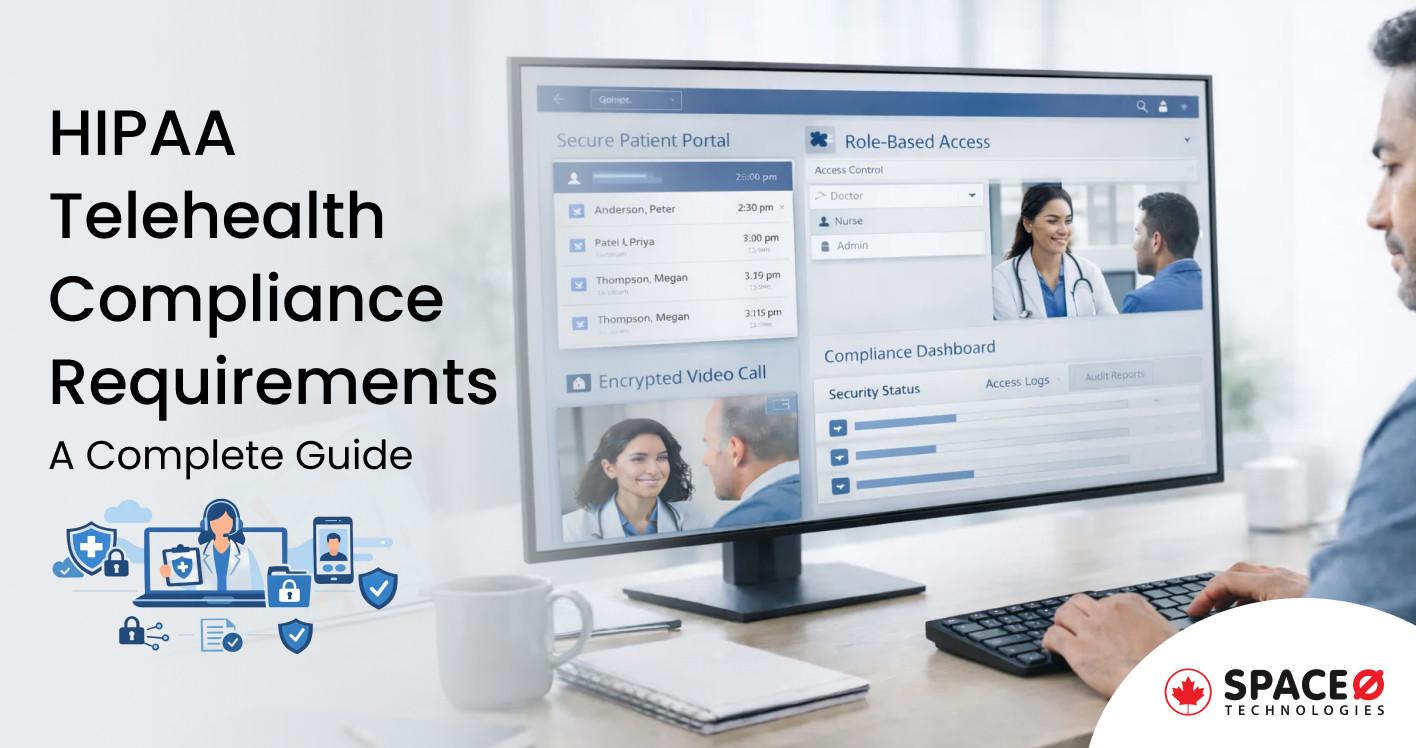
Is your telehealth platform truly protecting patient data—or are you one security gap away from a costly violation? This question keeps healthcare administrators awake at night, and for good reason. According to the Security Week, about 700 healthcare data breaches affected a total of over 180 million user records.
The stakes couldn’t be higher. Healthcare data breaches bring severe financial penalties, regulatory scrutiny, and long-term reputational damage. At the same time, the telehealth market continues to grow rapidly, with providers and patients increasingly depending on digital platforms to deliver and access care. This combination of growth and risk leaves little room for compliance missteps.
At Space-O Technologies’ telehealth app development services, we work with healthcare organizations to build secure, scalable telemedicine applications where HIPAA compliance is addressed from the ground up—not patched in later. From our experience, HIPAA compliance in telehealth isn’t optional or theoretical. It is the baseline requirement for legal operation, patient trust, and sustainable platform growth.
This guide provides a complete breakdown of HIPAA telehealth compliance requirements in practical terms. You’ll learn exactly what HIPAA mandates for virtual care, the five rules governing telehealth platforms, technical and physical safeguards you must implement, a comprehensive compliance checklist, common mistakes that trigger violations, and the penalties for non-compliance.
What is HIPAA Compliance in Telehealth?
HIPAA compliance in telehealth refers to meeting all requirements established by the Health Insurance Portability and Accountability Act when delivering healthcare services through digital communication technologies—including video consultations, secure messaging, remote patient monitoring, and mobile health applications.
Think of HIPAA as the rulebook that governs how patient information must be protected in the digital age. Originally enacted in 1996, HIPAA established national standards for protecting sensitive patient health information from unauthorized disclosure. When applied to telehealth, these protections extend to every digital touchpoint where patient data is created, received, stored, or transmitted.
But here’s where many organizations get confused: HIPAA compliance isn’t a single checkbox you tick off. It’s a comprehensive framework covering everything from how your video calls are encrypted to who can access patient records to what happens when (not if) a security incident occurs.
This is especially important for startups and innovation teams working on early-stage products. During telemedicine MVP development, compliance decisions made too late often lead to expensive rework—rewriting data flows, changing vendors, or rebuilding access controls that should have been defined from day one.
Organizations investing in healthcare app development must understand that HIPAA compliance shapes every architectural decision. From database design to user interface workflows to third-party integrations—every component that touches patient data falls under HIPAA jurisdiction.
Pro Tip: HIPAA compliance isn’t a one-time certification or a destination you reach. It’s an ongoing process requiring continuous monitoring, assessment, and updates as threats evolve and regulations change. Organizations that treat compliance as a project rather than a program inevitably fall behind.
With the foundational concepts established, let’s examine exactly who must comply with these HIPAA telehealth requirements—and when they apply to your organization.
Who Must Comply with HIPAA Telehealth Requirements?
HIPAA doesn’t apply universally to every organization handling health-related data. Understanding whether your organization falls under HIPAA jurisdiction—and in what capacity—determines your compliance obligations and potential liability.
1. Covered entities
Covered entities are organizations directly involved in healthcare delivery and payment that must comply with all HIPAA rules. Three categories qualify:
Healthcare providers
Any provider who transmits health information electronically in connection with covered transactions falls under HIPAA. This includes:
- Physicians and medical practices of all sizes
- Hospitals and health systems
- Clinics, urgent care centers, and ambulatory surgery centers
- Nursing homes and long-term care facilities
- Pharmacies (retail and mail-order)
- Dentists, chiropractors, optometrists, and other licensed practitioners
- Mental health professionals and substance abuse treatment centers
- Telehealth-only providers and virtual clinics
- Home health agencies
Here’s the key point many organizations miss: if you’re a healthcare provider who conducts any electronic transactions (billing, claims, eligibility checks), you’re a covered entity regardless of your size. A solo practitioner running a small telehealth practice has the same fundamental HIPAA obligations as a large hospital system.
Health plans
Organizations that provide or pay for medical care, including:
- Health insurance companies
- HMOs, PPOs, and managed care organizations
- Government programs (Medicare, Medicaid, TRICARE, Veterans Administration)
- Employer-sponsored health plans
- Church and multiemployer health plans
- Health maintenance organizations
Healthcare clearinghouses
Entities that process nonstandard health information into standard formats:
- Billing services and repricing companies
- Community health management information systems
- Value-added networks facilitating data exchange
2. Business associates
Here’s where telehealth compliance gets interesting—and where many organizations stumble. The HIPAA Omnibus Rule of 2013 extended compliance requirements to business associates: any organization that creates, receives, maintains, or transmits PHI on behalf of a covered entity.
For telehealth platforms, business associates typically include:
Technology vendors and developers
If you’re building telemedicine applications that handle PHI, you’re a business associate. This applies to:
- Healthcare software development companies building custom telehealth solutions
- SaaS providers offering telehealth platforms
- Mobile app developers creating patient-facing applications
- IT consultants with access to systems containing PHI
Cloud service providers
Any cloud infrastructure hosting patient data qualifies:
- AWS, Microsoft Azure, Google Cloud Platform
- Database hosting services
- Backup and disaster recovery providers
- Content delivery networks caching patient-related content
Communication platforms
Services facilitating patient-provider communication:
- Video conferencing APIs and platforms
- Secure messaging services
- Voice over IP providers handling patient calls
- SMS/notification services sending appointment reminders
Other service providers
- Payment processors handling patient billing
- Analytics companies processing health data
- Customer support platforms where agents may view patient information
- Document management and e-signature services
- Email services used for patient communications
Business associates must sign Business Associate Agreements (BAAs) with covered entities and implement their own HIPAA compliance programs. They’re directly liable for HIPAA violations—not just contractually liable to the covered entity, but directly subject to OCR enforcement and penalties.
3. When HIPAA applies to your telehealth platform
Your telehealth platform must comply with HIPAA if any of these conditions apply:
- You serve patients located in the United States
- Your platform handles PHI originating from US healthcare entities
- You operate as a covered entity (healthcare provider, health plan, clearinghouse)
- You function as a business associate for covered entities
- Your services involve creating, receiving, storing, or transmitting ePHI
Cross-border considerations
HIPAA applies based on the location of patients served, not your organization’s location. This creates important implications:
- A Canadian telehealth company serving US patients must comply with HIPAA
- A European cloud provider hosting US patient data requires HIPAA compliance
- Organizations serving both US and Canadian patients must simultaneously comply with HIPAA, PIPEDA, and applicable provincial health privacy laws
Many healthcare organizations choose to outsource telemedicine app development to specialized vendors. In these cases, development partners automatically become business associates and must meet full HIPAA obligations—including executing BAAs, implementing security safeguards, and supporting audit readiness throughout the engagement.
Space-O Technologies helps organizations navigate these complex multi-jurisdictional requirements, ensuring telehealth platforms meet compliance standards across all markets served. Our teams understand both healthcare software development requirements and the regulatory landscape across North America.
Unclear Which HIPAA Rules Apply to Your Telehealth Product?
Get clarity from Space-O’s HIPAA compliance experts, who help interpret telehealth-specific requirements across privacy, security, and access controls.
Understanding who must comply leads to the critical question: what exactly does HIPAA require? Let’s examine the five rules that form the compliance framework.
What are the Five HIPAA Rules for Telehealth Compliance?
HIPAA isn’t a single regulation—it’s a framework built from five interconnected rules. Each addresses specific aspects of patient data protection, and together they create comprehensive requirements for securing health information in virtual care environments. Understanding how these rules apply to telehealth is essential for building compliant platforms.
1. Privacy rule
The Privacy Rule establishes national standards for protecting individuals’ medical records and personal health information. For telehealth platforms, this rule governs how patient data can be used, disclosed, and accessed.
Core Privacy Rule Requirements:
Minimum Necessary Standard: This principle requires using or disclosing only the minimum PHI necessary to accomplish the intended purpose. In practice, this means:
- A billing department shouldn’t access clinical notes unless required for their function
- Customer support staff should only see information relevant to resolving patient issues
- Analytics systems should use de-identified data when possible
- Role-based access controls must limit each user to necessary information
Patient Rights: The Privacy Rule grants patients specific rights that your telehealth platform must support:
- Access Rights: Patients can request access to their health information, and you must respond within 30 days
- Amendment Rights: Patients can request corrections to their records
- Accounting of Disclosures: Patients can request a list of who has accessed their information and why
- Restriction Requests: Patients can ask you to limit certain uses of their information
- Confidential Communications: Patients can request communications through alternative means (different email, phone number, etc.)
Notice of Privacy Practices: Every covered entity must provide patients with clear notice explaining:
- How their information may be used and disclosed
- Their rights regarding their health information
- Your organization’s privacy practices and policies
- How to file complaints about privacy violations
Your telehealth platform must include functionality supporting these patient rights. This means building secure patient portals that allow patients to access records, request amendments, and manage communication preferences.
2. Security rule
The Security Rule mandates specific safeguards for electronic Protected Health Information (ePHI). This is the technical backbone of HIPAA compliance and requires three categories of safeguards:
Administrative Safeguards (Policies and Procedures):
- Designate a security officer responsible for compliance
- Conduct regular risk assessments identifying vulnerabilities
- Develop and implement security policies and procedures
- Provide workforce training on security awareness
- Establish access authorization and termination procedures
- Create contingency plans for emergencies and data recovery
- Implement sanction policies for workforce members who violate policies
Physical Safeguards (Facility and Device Security):
- Control physical access to facilities housing ePHI
- Implement workstation use and security policies
- Establish device and media controls (including disposal procedures)
- Secure portable devices and implement remote wipe capabilities
Technical Safeguards (Technology Controls):
- Implement access controls (unique user IDs, automatic logoff, encryption)
- Establish audit controls logging all ePHI access
- Ensure integrity controls preventing unauthorized data modification
- Configure transmission security (encryption for data in transit)
Organizations following a structured software development life cycle with security integrated throughout build more resilient healthcare platforms. Security can’t be an afterthought—it must be embedded from the initial architecture through deployment and maintenance.
3. Breach notification rule
When security incidents occur—and they will—the Breach Notification Rule dictates exactly how organizations must respond. This rule establishes strict timelines and requirements that your organization must be prepared to meet.
Notification Timeline:
- Individual notifications must be sent within 60 days of discovering a breach
- Breaches affecting 500+ individuals in a state require immediate notification to prominent media outlets
- Large breaches (500+ individuals) must be reported to HHS within 60 days
- Smaller breaches must be logged and reported to HHS annually
Notification Content Must Include:
- A brief description of what happened, including the date of the breach and date of discovery
- The types of unsecured PHI involved (names, Social Security numbers, diagnoses, etc.)
- Steps individuals should take to protect themselves from potential harm
- A brief description of what your organization is doing to investigate, mitigate harm, and prevent future breaches
- Contact procedures for individuals to ask questions or get additional information
Documentation Requirements:
Even if you determine a security incident doesn’t qualify as a reportable breach, you must document:
- The incident details and your investigation
- Your risk assessment determining whether breach notification is required
- The basis for your determination
- Any corrective actions taken
Your telehealth platform should include incident response capabilities—audit trails that help identify what happened, when, and what data was affected. Many organizations partner with healthcare app development companies experienced in building these monitoring and response capabilities.
4. Enforcement rule
The Enforcement Rule establishes how the Office for Civil Rights (OCR) investigates complaints, conducts compliance reviews, and imposes penalties. Understanding this rule helps you appreciate what’s at stake.
Tiered Penalty Structure:
| Violation Tier | Description | Penalty Per Violation | Annual Maximum |
|---|---|---|---|
| Tier 1 | Unknowing—unaware and couldn’t reasonably have known | $100-$50K | $25K |
| Tier 2 | Reasonable cause—knew/should have known, not willful neglect | $1K-$50K | $100K |
| Tier 3 | Willful neglect—conscious disregard, corrected within 30 days | $10K-$50K | $250K |
| Tier 4 | Willful neglect—conscious disregard, not corrected | $50K | $2.1M |
Investigation process: The Office for Civil Rights may initiate investigations in response to complaints filed by individuals, media reports of potential violations, random compliance audits, or referrals from other government agencies.
Resolution options: Outcomes range from technical assistance and voluntary compliance for minor issues to formal resolution agreements with corrective action plans. In more serious cases, organizations may face civil monetary penalties or referral to the Department of Justice for criminal prosecution.
5. Omnibus rule
The Omnibus Rule, enacted in 2013, strengthened HIPAA in several critical ways particularly relevant to telehealth platforms:
Business Associate Accountability:
Before the Omnibus Rule, business associates were only contractually liable to covered entities. Now:
- Business associates are directly liable to OCR for HIPAA violations
- Subcontractors of business associates must also comply with HIPAA
- Business Associate Agreements are mandatory—not optional—for all vendors handling PHI
- Business associates face the same penalty structure as covered entities
Enhanced Protections:
- The harm threshold for breach notification was removed—most breaches now require notification
- Patient rights regarding electronic records were expanded
- Penalties for non-compliance were significantly increased
- Restrictions were placed on marketing and fundraising uses of PHI
For telehealth platform development, the Omnibus Rule means every third-party service integrated into your platform requires a signed BAA and must meet HIPAA standards. Cloud hosting, video APIs, payment processors, analytics tools, customer support platforms—all require BAAs before any PHI touches their systems.
Organizations building EHR software or telehealth platforms must maintain a complete inventory of all vendors with PHI access and ensure BAAs are in place before integration begins.
Quick Tip: Create a compliance matrix mapping each HIPAA rule to specific platform features, policies, and procedures. This documentation proves invaluable during OCR audits and helps development teams understand why certain requirements exist. Update it whenever regulations change or new features are added.
The five rules establish the regulatory framework—but how do you actually implement them? Let’s examine the specific technical safeguards your telehealth platform must include.
What are the Technical Safeguards for HIPAA Compliant Telehealth?
Technical safeguards represent the technology and policies protecting ePHI in your telehealth systems. These aren’t suggestions or best practices—they’re requirements that OCR evaluates during investigations and audits. Getting them right is essential for HIPAA compliant telehealth operations.
1. Encryption requirements
Encryption transforms readable patient data into unreadable code, protecting information even if intercepted. HIPAA requires encryption that renders data “unusable, unreadable, or indecipherable” to unauthorized individuals.
For data in transit, implement TLS 1.2 minimum (TLS 1.3 recommended) for all data transmission between users, servers, and third-party services. For data at rest, use AES-256 encryption for all stored PHI including databases, backups, and file storage. Video consultations require secure WebRTC protocols with end-to-end encryption where feasible.
Store encryption keys separately from encrypted data using Hardware Security Modules or cloud Key Management Services, and rotate keys at least annually.
2. Choosing a compliant video platform
Several providers offer HIPAA-compliant telehealth solutions with Business Associate Agreements: Twilio, Agora, Vonage, Zoom for Healthcare, Daily.co, and Doxy.me.
Critical warning: Standard consumer platforms are NOT compliant. Regular Zoom, Microsoft Teams, Google Meet, Skype, FaceTime, and WhatsApp cannot be used for patient consultations. You must use healthcare-specific versions with signed BAAs.
3. Access control requirements
Every user needs a unique identifier—shared accounts violate HIPAA and make audit trails meaningless. Require multi-factor authentication for all users accessing PHI, using authenticator apps or hardware keys rather than SMS verification.
Implement role-based access so staff only see information necessary for their job function. Patients access only their own records, providers see assigned patients, administrative staff handle scheduling without clinical notes access, and billing staff process claims without viewing clinical information.
Configure automatic session timeouts between 2-15 minutes depending on the environment, with shorter timeouts for workstations in patient care areas.
4. Audit logging requirements
If you can’t prove who accessed what and when, you can’t demonstrate compliance. Log all authentication events, PHI access, data modifications, exports, and administrative actions. Store logs in tamper-evident systems, retain for minimum six years, and configure real-time alerts for suspicious patterns like multiple failed logins or unusual access activity.
Space-O Technologies has extensive experience integrating HIPAA-compliant video solutions into telehealth platforms. Our custom software development teams understand both the technical implementation and compliance requirements for secure video consultations.
Most Telehealth Platforms Become Non-Compliant as They Scale
Space-O’s telehealth experts help teams design compliance that holds up through growth, integrations, and feature expansion.
Technical safeguards protect your digital assets but, even with thorough checklists, organizations commonly make compliance mistakes. Understanding these pitfalls helps you avoid them—let’s examine the most frequent errors.
What are the Common HIPAA Compliance Mistakes to Avoid?
Understanding common compliance failures helps you avoid costly mistakes. These errors frequently appear in OCR investigations and breach reports. Learning from others’ mistakes is far cheaper than making your own.
1. Failing to Conduct Risk Assessments
The Problem: The single most cited HIPAA violation is failure to perform comprehensive risk analysis. Many organizations either skip this requirement entirely, conduct superficial assessments that don’t identify real vulnerabilities, or perform one assessment and never update it.
OCR has repeatedly emphasized that risk assessment isn’t optional—it’s the foundation of HIPAA compliance. You can’t implement appropriate safeguards if you don’t know what you’re protecting against.
How to Avoid It:
- Conduct thorough initial risk assessments covering all systems that create, receive, maintain, or transmit ePHI
- Document the assessment process, findings, and remediation plans
- Update risk assessments annually and whenever significant changes occur (new systems, new vendors, organizational changes, security incidents)
- Consider engaging third-party security firms for objective assessments
- Use established frameworks (NIST, HITRUST) to ensure comprehensive coverage
2. Using Non-Compliant Communication Platforms
The Problem: Organizations frequently use consumer video tools like standard Zoom, Skype, Google Meet, or FaceTime for telehealth consultations. These platforms lack required security features, don’t offer Business Associate Agreements, and can’t be made HIPAA compliant regardless of your settings.
During the pandemic, OCR announced enforcement discretion for telehealth platforms. That flexibility has ended. Organizations using non-compliant platforms now face full enforcement.
How to Avoid It:
- Only use video platforms specifically designed for healthcare or with HIPAA-compliant tiers
- Verify compliance claims directly with vendors—don’t assume marketing claims are accurate
- Execute BAAs before conducting any patient consultations
- Train staff on approved platforms and prohibit use of consumer alternatives
- Regularly verify your configuration meets compliance requirements
3. Missing Business Associate Agreements
The Problem: Sharing PHI with vendors without executed BAAs violates HIPAA regardless of the vendor’s actual security practices. This includes cloud providers, payment processors, analytics tools, and even customer support platforms where agents might view patient information.
Many organizations don’t realize they’re sharing PHI with vendors, don’t understand which vendors qualify as business associates, or simply forget to execute BAAs before integration.
How to Avoid It:
- Maintain a complete inventory of all vendors that receive, create, maintain, or transmit PHI
- Map data flows to identify where PHI goes—you may be surprised how many systems touch patient data
- Execute BAAs before any PHI touches vendor systems—not after
- Establish vendor onboarding procedures that require BAA execution as a mandatory step
- Review and update BAAs when regulations change or vendor relationships evolve
4. Inadequate Audit Trail Implementation
The Problem: Some organizations enable minimal logging that fails to capture who accessed what PHI and when. Others log appropriately but don’t retain logs for the required six years, don’t protect logs from tampering, or never actually review them.
Without comprehensive audit trails, you can’t investigate incidents, demonstrate compliance to auditors, or detect unauthorized access patterns.
How to Avoid It:
- Implement comprehensive logging capturing all PHI access—not just authentication events
- Configure tamper-evident storage for audit logs
- Verify 6-year retention is configured and working (test by confirming old logs are accessible)
- Establish regular log review procedures—not just incident-triggered review
- Configure real-time alerting for suspicious patterns
- Test your ability to search and export logs for incident investigations
5. Insufficient Workforce Training
The Problem: HIPAA requires training for all workforce members who handle PHI, yet many organizations provide only cursory initial training without ongoing education. Staff who don’t understand HIPAA requirements can’t comply with them.
Training gaps lead to:
- Employees sharing PHI inappropriately
- Weak password practices
- Failure to recognize and report security incidents
- Accidental disclosures through improper disposal or careless conversations
How to Avoid It:
- Implement comprehensive initial training covering HIPAA requirements, organizational policies, and role-specific responsibilities
- Provide annual refresher training—not just initial onboarding
- Document all training completion and maintain records for 6 years
- Update training when policies or regulations change
- Make training role-specific—clinicians, billing staff, IT, and administrators have different responsibilities
- Test comprehension and address gaps
6. Weak Access Controls
The Problem: Shared accounts, excessive permissions, lack of multi-factor authentication, and failure to revoke access when employees leave or change roles create significant vulnerabilities. These issues appear in breach after breach.
How to Avoid It:
- Eliminate shared accounts—every user needs unique identification
- Implement MFA for all users accessing PHI
- Apply minimum necessary access—users should only access PHI required for their job functions
- Conduct regular access reviews (quarterly recommended) to identify and remove excessive permissions
- Implement immediate access revocation procedures for terminated employees
- Review and adjust access when employees change roles
Organizations that partner with Space-O Technologies benefit from our experience helping healthcare organizations identify and address compliance gaps before they become costly violations. Our healthcare software development approach builds compliance into platform architecture from the initial design phase.
Avoiding mistakes is important, but fully understanding the consequences of violations provides additional context for compliance investment. Let’s examine what’s truly at stake.
What are the HIPAA Violation Penalties and Consequences?
HIPAA violations carry severe consequences that can threaten an organization’s financial stability, reputation, and ability to operate. Understanding these stakes helps justify compliance investment and motivates ongoing vigilance.
1. Civil penalties
The Office for Civil Rights (OCR) enforces HIPAA with a tiered penalty structure based on the level of culpability involved:
| Tier | Culpability Level | Per Violation | Annual Maximum | Description |
|---|---|---|---|---|
| Tier 1 | Unknowing | $100-$50K | $25K | Unaware; reasonable diligence wouldn’t have known of violation |
| Tier 2 | Reasonable Cause | $1K-$50K | $100K | Knew/should have known, but not willful neglect |
| Tier 3 | Willful Neglect (Corrected) | $10K-$50K | $250K | Conscious disregard, corrected within 30 days |
| Tier 4 | Willful Neglect (Not Corrected) | $50K | $2.1M | Conscious disregard, not corrected within 30 days |
Critical Understanding: These penalties apply per violation category, not per breach. A single breach involving multiple compliance failures—missing risk assessment, inadequate encryption, no BAA with cloud provider, insufficient access controls—can trigger penalties across multiple categories.
2. Criminal penalties
Beyond civil penalties, individuals who knowingly violate HIPAA face criminal prosecution by the Department of Justice:
| Violation Type | Maximum Fine | Maximum Imprisonment |
|---|---|---|
| Knowing violation (obtain/disclose PHI) | $50,000 | 1 year |
| Under false pretenses | $100,000 | 5 years |
| Intent to sell/transfer/use PHI (commercial/malicious) | $250,000 | 10 years |
Criminal penalties apply to individuals—executives, IT administrators, healthcare providers, and employees can face personal criminal liability, not just organizational liability.
3. Beyond financial penalties
Monetary penalties represent only part of the total cost of HIPAA violations.
Reputational Damage
Healthcare depends on patient trust. A publicized breach can:
- Drive patients to competitors—many patients will switch providers after breaches
- Damage relationships with referring providers who question your security practices
- Generate negative media coverage that persists for years in search results
- Impact recruitment of healthcare professionals who don’t want association with breach-prone organizations
- Affect partnerships, payer relationships, and vendor negotiations
- Reduce valuation if seeking investment or acquisition
Operational Disruption
Breach response consumes massive organizational resources:
- Investigation and forensics: Major breaches often require $100,000+ in forensic investigation
- Patient notification: Potentially millions of letters at $1-5 each for printing, mailing, and handling
- Credit monitoring services: Typically offered for 1-2 years to affected individuals at $100-200 per person
- Regulatory reporting and cooperation: Staff time responding to OCR investigations
- Remediation: Fixing security gaps that allowed the breach
- Legal defense: Attorneys specializing in HIPAA defense charge premium rates
- Public relations: Managing media inquiries and public perception
- Lost productivity: Staff diverted from normal operations to breach response
Class Action Litigation
Large breaches frequently trigger class action lawsuits from affected patients:
- Defense costs accumulate regardless of outcome
- Settlements can reach tens of millions of dollars
- Legal proceedings extend for years, consuming ongoing resources
- Courts may impose additional compliance monitoring requirements
- Settlement terms often become public, extending reputational damage
Compliance gaps also impact budgeting accuracy. Organizations that underestimate telemedicine app development cost often overlook security architecture, audit logging, vendor compliance, and ongoing risk assessments—only to absorb far higher expenses later through remediation, penalties, and delayed product launches.
Quick Tip: Use breach cost statistics when building business cases for compliance investment. Decision-makers often underestimate risks until they see quantified potential impacts. Frame compliance as risk mitigation, not regulatory burden.
Applying HIPAA Telehealth Rules Is Harder Than Reading Them
Space-O’s telehealth experts help teams convert compliance requirements into practical product and engineering decisions.
With the stakes clearly understood, let’s discuss how Space-O Technologies can help you build a HIPAA compliant telehealth platform that protects both your patients and your organization.
Achieving HIPAA Telehealth Compliance with Space-O Technologies
HIPAA telehealth compliance requirements are comprehensive, but navigating them successfully is achievable with the right approach and development partner. This guide has covered the essential elements you need to understand for enhanced compliance.
Space-O Technologies helps healthcare organizations transform these requirements into secure, compliant telehealth platforms. Our mobile app development teams build HIPAA-ready telemedicine solutions with secure APIs, role-based access controls, encrypted data flows, and compliance-first architecture across iOS, Android, and web platforms.
Whether you’re launching a new telehealth platform, expanding virtual care capabilities, or modernizing legacy healthcare systems, Space-O Technologies provides the expertise needed for HIPAA compliant success.
Ready to build your HIPAA-compliant telehealth platform? Schedule a Free Consultation to discuss your requirements with our healthcare development experts.
Frequently Asked Questions About HIPAA Telehealth Compliance Requirements
How much does HIPAA compliance cost for telehealth platforms?
HIPAA compliance typically increases telehealth development costs by 30–40%. Ongoing expenses include risk assessments, penetration testing, security monitoring, staff training, and policy updates. Annual compliance maintenance usually ranges from $23,000 to $75,000, depending on platform complexity.
Do I need a BAA with my cloud provider?
Yes. Any cloud provider that stores, processes, or transmits PHI must sign a Business Associate Agreement. This includes infrastructure, databases, backups, and CDNs. Without a BAA, PHI cannot be hosted, regardless of the provider’s security features.
How often should HIPAA risk assessments be conducted?
HIPAA does not mandate frequency, but best practice requires annual risk assessments. Additional assessments should occur after system changes, new vendors, mergers, security incidents, or major regulatory updates. All assessments must be documented and retained for six years.
What encryption is required for HIPAA compliance?
HIPAA requires encryption that makes data unreadable to unauthorized users. Industry standards include TLS 1.2+ for data in transit and AES-256 for data at rest. Strong key management, rotation, and separation of keys from data are equally critical.
Does HIPAA apply to telehealth apps serving Canadian patients?
HIPAA applies only to US patients and entities. Canadian-only platforms must comply with PIPEDA and provincial laws. Platforms serving both US and Canadian patients must meet both frameworks, typically by implementing the stricter requirement across consent, security, and data handling.


Want to build a HIPAA-compliant telehealth platform?
What to read next

 All our projects are secured by NDA
100% Secure. Zero Spam
*All your data will remain strictly confidential.
Trusted by


Bashar Anabtawi 
Canada
“I was mostly happy with the high level of experience and professionalism of the various teams that worked on my project. Not only they clearly understood my exact technical requirements but even suggested better ways in doing them. The Communication tools that were used were excellent and easy. And finally and most importantly, the interaction, follow up and support from the top management was great. Space-O not delivered a high quality product but exceeded my expectations! I would definitely hire them again for future jobs!”

Canada Office
2 County Court Blvd., Suite 400,
Brampton, Ontario L6W 3W8
Phone: +1 (602) 737-0187
Email: sales@spaceo.ca