
- What is an Insurance Portal?
- What are the Different Types of Insurance Portals?
- What are the Essential Features of an Insurance Portal?
- What is the Insurance Portal Development Process: Step-by-Step
- What are the Benefits of Insurance Portal Development?
- How Much Does Insurance Portal Development Cost?
- What are the Security and Compliance Considerations for Insurance Portal Development?
- What are the Technology Trends Shaping Insurance Portal Development?
- Frequently Asked Questions about Insurance Portal Development
Insurance Portal Development: A Complete Guide to Building Secure & Scalable Insurance Solutions

 Last Updated: February, 3 2026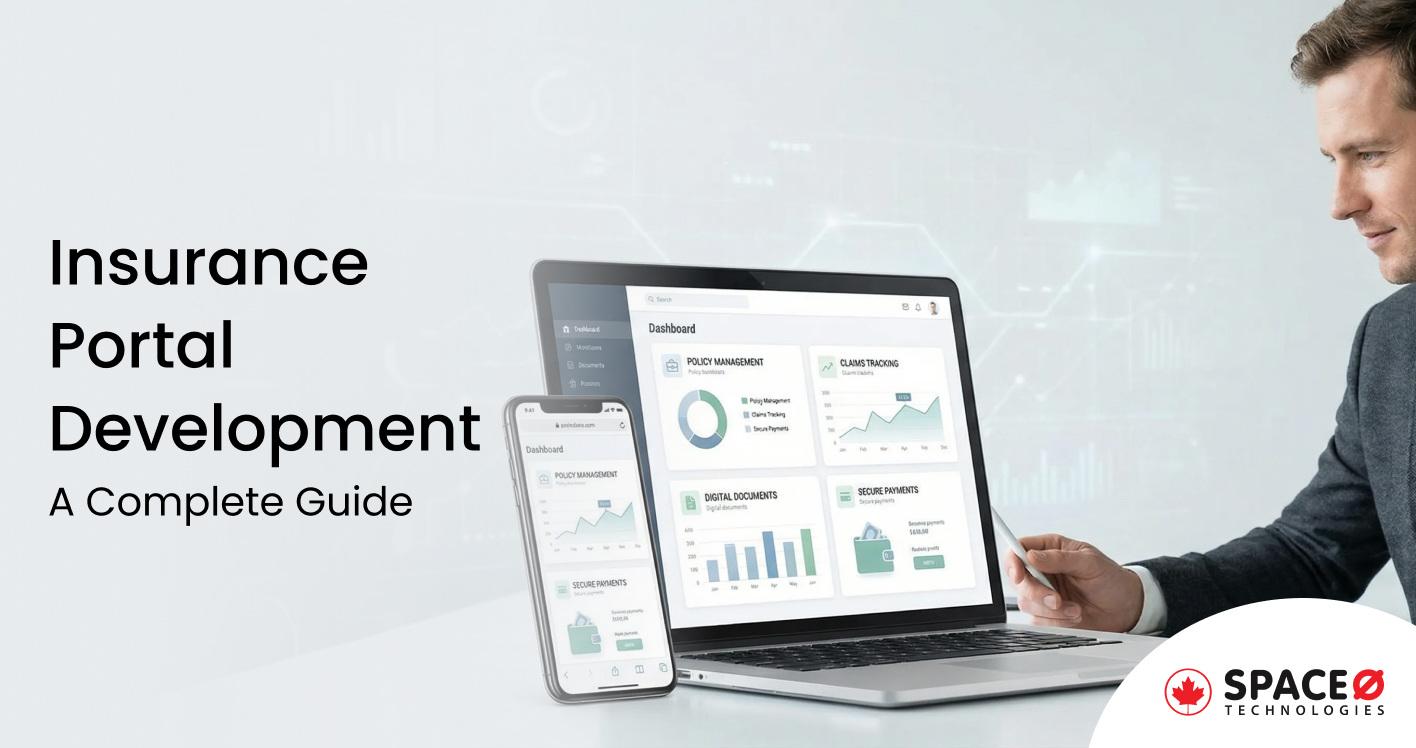
The insurance industry is undergoing a massive digital shift. Customers now expect instant quotes, seamless claims processing, and 24/7 access to their policies—all from their smartphones. Yet many insurance companies still rely on legacy systems, manual paperwork, and fragmented processes that frustrate both customers and agents.
This gap between customer expectations and operational reality is exactly why insurance portal development has become a strategic priority.
According to Grand View Research, the insurtech market in the United States is expected to reach a projected revenue of US$ 42,154.6 million by 2030. A compound annual growth rate of 51.6% is expected of the United States insurtech market from 2024 to 2030.
Whether you’re an insurance carrier looking to modernize operations, an agency wanting to improve agent productivity, or a startup building the next insurtech solution, a well-designed insurance portal can transform how you serve customers and manage policies. At Space-O Technologies, we’ve helped businesses across industries build healthcare development portals that streamline operations and enhance user experiences.
This guide covers everything you need to know about insurance portal development—from essential features and development process to costs, technology trends, and compliance requirements.
What is an Insurance Portal?
An insurance portal is a secure digital platform that enables insurers, agents, brokers, and policyholders to manage insurance-related activities online. It serves as a centralized hub where users can access policies, submit claims, generate quotes, process payments, and communicate—all without manual paperwork or phone calls.
Think of it as the digital front door to your insurance business. Instead of customers calling your office to check claim status or agents digging through spreadsheets for commission data, everything happens through a unified, self-service platform.
Unlike traditional insurance management systems that operate in silos, modern insurance portals integrate multiple functions into one seamless experience. They connect policy administration, claims management, customer relationship management (CRM), and payment processing into a single ecosystem. Many organizations also integrate their insurance portals with CRM software to centralize customer data and communication history.
With a clear understanding of what an insurance portal is, let’s explore the different types of insurance portals and their specific use cases.
What are the Different Types of Insurance Portals?
Insurance portal development isn’t one-size-fits-all. Different user groups have different needs, which is why most insurance organizations require multiple portal types working together. Here’s a breakdown of the main categories.
1. Customer self-service portal
Customer portals put policyholders in control of their insurance experience. These platforms allow customers to view policy details, download insurance cards, update personal information, and submit claims without contacting customer service.
Similar to healthcare patient portals, insurance customer portals prioritize self-service and reduce administrative burden on staff.
Key functionalities include online premium payments, policy renewal management, claims submission with document uploads, and access to policy documents.
2. Agent/broker portal
Agent portals are designed for insurance sales professionals who need quick access to quoting tools, client information, and performance data.
These platforms streamline the sales process and help agents serve clients more efficiently.
Core features include commission tracking, client management dashboards, quote generation tools, policy comparison capabilities, and sales performance analytics.
The best agent portals integrate with carrier systems to provide real-time policy and commission data.
3. Claims management portal
Claims portals serve adjusters, claims processors, and sometimes customers throughout the claims lifecycle.
They automate workflows from first notice of loss (FNOL) through settlement, reducing processing time and improving accuracy.
Key capabilities include claim intake and assignment, document management, damage assessment tools, fraud detection integration, payment processing, and communication tracking.
4. Underwriting portal
Underwriting portals support the risk assessment and policy pricing process.
They provide underwriters with the data and tools needed to evaluate applications, assess risk factors, and make informed decisions.
Features typically include automated risk scoring, integration with third-party data sources, dynamic pricing engines, approval workflows, and exception handling for complex cases.
Each portal type requires specific features tailored to its users—let’s examine the essential features that make insurance portals effective.
What are the Essential Features of an Insurance Portal?
Building a successful insurance management portal requires careful feature planning. The right features depend on your portal type and target users, but certain capabilities are fundamental to any insurance platform. Here’s what you need to consider.
1. Policy management
Policy management forms the backbone of any insurance portal. This module handles the entire policy lifecycle from initial quote to renewal or cancellation.
Essential capabilities include quote generation and comparison tools, policy issuance with digital document delivery, renewal management with automated reminders, policy modifications and endorsements, and secure document storage with e-signature integration.
2. Claims processing
Efficient claims processing directly impacts customer satisfaction and operational costs. Your claims portal should simplify submission while providing the controls needed for accurate processing.
Key features include online claim submission with guided workflows, document and photo upload capabilities, real-time status tracking for claimants, automated routing and assignment, integration with fraud detection systems, and payment processing for claim settlements.
3. Payment processing
Insurance involves complex payment flows—premium collection, commission payments, claim settlements, and more. Your portal needs robust payment capabilities.
Core requirements include multiple payment method support (credit cards, ACH, digital wallets), recurring payment and installment plan management, payment history and statement access, integration with accounting systems, and PCI-DSS compliant payment processing.
For Canadian insurance companies, integration with local payment processors like Moneris and Interac is essential for serving domestic customers effectively.
Organizations should evaluate the best payment gateways in Canada based on transaction fees, integration complexity, and supported payment methods.
4. Agent dashboard
Agent-facing portals need dashboards that provide quick access to the most important information and actions.
Critical dashboard elements include commission tracking and payment history, book of business overview, pending tasks and renewals, performance metrics and goals, client communication history, and quick-access quoting tools.
5. Reporting & analytics
Data-driven decision making requires comprehensive reporting capabilities built into your insurance portal.
Essential analytics features include risk assessment dashboards, customer behavior and engagement metrics, claims frequency and severity analysis, agent performance comparisons, regulatory compliance reporting, and customizable report builders.
Modernize Insurance Operations With a Secure Digital Portal
Space-O designs portals that support role-based access, data security, and compliance requirements critical to insurance workflows.
These features form the foundation of a robust insurance portal—now let’s walk through the step-by-step process to build one.
What is the Insurance Portal Development Process: Step-by-Step
Building an insurance portal requires a structured approach that addresses the unique complexities of insurance operations. Here’s the proven development process that Space-O Technologies follows for insurance software development projects.
Step 1 – Discovery and requirement analysis
Every successful insurance portal development project starts with thorough discovery. This phase defines what you’re building and why.
Key activities include stakeholder interviews with underwriters, agents, claims processors, and customers to understand pain points and requirements.
You’ll need to define user personas for each portal user type, map existing workflows and identify automation opportunities, document integration requirements with legacy systems, and identify regulatory compliance requirements specific to your insurance lines.
The discovery phase typically takes 2-4 weeks and produces a detailed requirements document that guides all subsequent development decisions. Skipping or rushing this phase leads to costly changes later.
Step 2 – UI/UX design
Insurance portals serve diverse users with varying technical abilities. Design must balance functionality with usability.
The design process includes creating wireframes for key user flows, developing interactive prototypes for stakeholder review, designing responsive interfaces that work across devices, ensuring accessibility compliance (WCAG guidelines), and conducting usability testing with representative users.
Good design reduces training requirements, decreases support calls, and improves user adoption. For insurance portals specifically, clear navigation and intuitive claims submission flows are critical success factors.
Step 3 – Technology stack selection
The right technology foundation ensures your portal can scale, perform, and integrate with your existing systems.
Frontend technologies like React, Angular, or Vue.js provide responsive, dynamic user interfaces. Backend frameworks, including Node.js, Python (Django/Flask), .NET, or Java handle business logic and integrations.
Database options such as PostgreSQL or MongoDB store policy, claims, and customer data securely. Cloud platforms like AWS, Microsoft Azure, or Google Cloud provide scalable infrastructure.
Technology selection should consider your existing IT environment, team expertise, and long-term maintenance requirements. If you’re looking to hire software developers with insurance domain experience, ensure they have expertise in your chosen stack.
Step 4 – Development and integration
With requirements defined and technology selected, development begins. Agile methodology works well for insurance portal projects, allowing iterative delivery and continuous feedback.
Development activities include building core portal functionality module by module, integrating with policy administration and claims management systems, connecting payment gateways and third-party services, developing APIs for ecosystem connectivity, and implementing security controls throughout the codebase.
Integration is often the most challenging aspect of insurance portal development.
Legacy systems may use outdated protocols, and data formats may require transformation. Organizations dealing with outdated infrastructure should consider application modernization strategies alongside portal development to ensure long-term sustainability.
Experienced web developers who understand enterprise integration patterns are essential.
Step 5 – Testing and quality assurance
Insurance portals handle sensitive data and financial transactions, making thorough testing non-negotiable.
Testing requirements include functional testing of all features and workflows, security testing including penetration testing and vulnerability assessments, performance testing under expected load conditions, compliance validation against regulatory requirements, integration testing with connected systems, and user acceptance testing with actual stakeholders.
Automated testing accelerates the process and catches regressions as new features are added.
However, manual testing remains important for complex scenarios and usability validation.
Step 6 – Deployment and launch
Moving from development to production requires careful planning to minimize disruption.
Deployment activities include setting up production infrastructure with appropriate security controls, migrating data from legacy systems (if applicable), configuring monitoring and alerting, conducting final security reviews, training users and administrators, and executing phased rollout to manage risk.
Many organizations opt for a soft launch with a limited user group before full deployment. This approach allows you to identify and resolve issues before they impact your entire user base.
Step 7 – Maintenance and updates
Insurance portal development doesn’t end at launch. Ongoing maintenance ensures your portal remains secure, performant, and aligned with evolving business needs.
Maintenance activities include applying security patches and updates, monitoring performance and addressing issues, adding new features based on user feedback, updating integrations as connected systems change, and ensuring continued compliance with regulatory changes.
Understanding the types of software maintenance helps organizations budget appropriately for different maintenance categories.
Space-O Technologies provides 3 months of free maintenance support after launch, helping clients transition smoothly to ongoing operations.
A structured development process ensures quality. Let’s explore the business benefits that justify the investment in insurance portal development.
What are the Benefits of Insurance Portal Development?
Investing in insurance portal development delivers measurable returns across customer experience, operational efficiency, and competitive positioning.
1. Enhanced customer experience
Modern customers expect digital self-service. Insurance portals deliver 24/7 access to policy information and services, instant quotes without waiting for agent callbacks, real-time claims status visibility, convenient payment options and automatic renewals, and reduced friction throughout the customer journey.
2. Reduced operational costs
Automation and self-service significantly reduce operational expenses. Key savings come from reduced call center volume as customers self-serve, automated claims processing for straightforward cases, eliminated paper handling and manual data entry, streamlined agent workflows and reduced administrative burden, and lower customer acquisition costs (up to 75% reduction with embedded insurance models).
These savings compound over time as portal adoption increases and processes are further optimized.
3. Improved agent productivity
Agent portals transform how insurance professionals work. Instead of toggling between systems and chasing paperwork, agents access everything through a unified interface.
Productivity improvements include faster quote generation with integrated rating engines, instant access to client information and policy details, automated commission tracking and reporting, streamlined renewal management with proactive alerts, and more time for relationship-building and sales activities.
4. Better data-driven decisions
Insurance portals capture valuable data about customer behavior, claims patterns, and operational performance. Analytics capabilities transform this data into actionable insights.
Decision-making improvements include more accurate risk assessment and pricing, early identification of fraud patterns, customer segment analysis for targeted marketing, operational bottleneck identification and resolution, and predictive analytics for proactive customer service.
5. Competitive advantage
In an increasingly digital insurance market, portal capabilities differentiate carriers and agencies. Organizations with modern portals attract tech-savvy customers who expect digital experiences, younger agents who prefer digital tools, partnership opportunities with insurtechs and distribution platforms, and faster speed-to-market for new products and features.
The insurance companies investing in digital capabilities today are positioning themselves for success in tomorrow’s market.
Automate Claims and Policy Workflows Through a Centralized Portal
Space-O builds insurance portals that reduce manual processing by automating submissions, approvals, and status updates.
Now that we understand the benefits of insurance portals, let’s get to know how much does it costs to create one for your business.
How Much Does Insurance Portal Development Cost?
Insurance portal development costs in CAD range from $40,000–$80,000 for basic customer portals to $150,000–$350,000+ for full enterprise solutions.
Understanding insurance portal development costs helps you plan budgets and evaluate proposals effectively. Costs vary significantly based on portal complexity, feature requirements, and integration needs.
1. Cost breakdown by portal type
Here’s what you can expect to invest based on the portal scope:
| Portal Type | Estimated Cost Range | Timeline | Key Features |
|---|---|---|---|
| Basic Customer Portal | $40,000 – $80,000 | 3-4 months | Policy viewing, basic claims, and payments |
| Agent/Broker Portal | $60,000 – $120,000 | 4-6 months | Quoting, commissions, and client management |
| Claims Management Portal | $80,000 – $150,000 | 5-7 months | Full claims workflow, fraud detection |
| Full-Featured Enterprise Portal | $150,000 – $350,000+ | 6-12 months | Multi-portal, advanced analytics, AI features |
2. Factors affecting cost
Several variables influence your total investment:
Portal complexity and scope is the primary cost driver. A simple customer self-service portal costs far less than a comprehensive platform serving customers, agents, and underwriters with advanced analytics.
Integration requirements add complexity and cost. Connecting with legacy policy administration systems, payment gateways, third-party data providers, and CRM platforms requires specialized development effort.
Compliance requirements vary by insurance line. Health insurance portals require HIPAA compliance. Canadian insurers need PIPEDA-compliant solutions. These requirements add development and ongoing maintenance costs.
Technology choices affect both initial development and long-term maintenance costs. Custom development provides maximum flexibility but costs more than platform-based approaches.
These estimates assume a North American development partner. Costs may vary based on specific requirements and chosen technology approach.
3. Ongoing costs
Beyond initial development, plan for hosting and infrastructure (typically $500-$5,000+ monthly depending on scale), maintenance and support (15-20% of initial development cost annually), security updates and compliance maintenance, and feature enhancements based on user feedback.
Building a realistic budget that accounts for both development and ongoing costs ensures your insurance portal remains sustainable long-term.
Investment decisions also depend on security and compliance—critical factors in insurance portal development.
What are the Security and Compliance Considerations for Insurance Portal Development?
Insurance portals handle sensitive personal information, financial data, and protected health information. Security and compliance aren’t optional—they’re fundamental requirements that must be built into every aspect of your portal.
1. Data protection standards
Different insurance lines face different regulatory requirements:
PIPEDA governs how Canadian organizations collect, use, and disclose personal information. Insurance portals serving Canadian customers must implement appropriate consent mechanisms and data protection measures.
GDPR affects insurers serving European customers, requiring data minimization, right to erasure, and explicit consent for data processing.
PCI-DSS applies to any portal processing payment card data. Compliance requires specific security controls around cardholder data storage and transmission.
Understanding which regulations apply to your portal is the first step. Building compliance into your architecture from the start is far easier than retrofitting later.
2. Security best practices
Beyond regulatory compliance, insurance portals should implement industry security best practices:
End-to-end encryption protects data in transit and at rest. All communications should use TLS 1.3, and sensitive data should be encrypted in your database.
Multi-factor authentication (MFA) adds a critical security layer beyond passwords. Consider requiring MFA for all users, not just administrators.
Role-based access control (RBAC) ensures users only access data and functions appropriate to their role. An agent shouldn’t see another agent’s commissions. A customer shouldn’t access other customers’ policies.
Regular security audits identify vulnerabilities before attackers do. Conduct penetration testing at least annually, and after any major changes.
Security monitoring detects and responds to threats in real-time. Implement logging, alerting, and incident response procedures.
3. SOC 2 compliance
For enterprise insurance clients, SOC 2 compliance demonstrates your portal meets rigorous security standards. SOC 2 audits evaluate controls across five trust service criteria: security, availability, processing integrity, confidentiality, and privacy.
Achieving SOC 2 compliance requires documented policies, implemented controls, and third-party audit verification. While the process requires investment, SOC 2 certification often becomes a requirement for enterprise contracts.
With security in place, let’s explore the technology trends that will be shaping the future of insurance portal development.
What are the Technology Trends Shaping Insurance Portal Development?
The insurtech landscape is evolving rapidly. Building a future-ready insurance portal means incorporating emerging technologies that will define the industry in the coming years.
1. AI and machine learning
Artificial intelligence is transforming every aspect of insurance operations. Currently, 59% of insurance companies are using generative AI in some capacity, and adoption is accelerating.
In insurance portals, AI powers predictive risk assessment that improves underwriting accuracy, fraud detection that identifies suspicious claims patterns, personalized pricing based on individual risk factors, chatbots that handle routine customer inquiries (projected to manage 75% of customer interactions by 2025), and automated claims processing for straightforward cases.
If you’re planning to integrate AI capabilities, consider working with developers who specialize in AI application development and understand insurance use cases.
2. Low-code/no-code platforms
The demand for faster development has driven the adoption of low-code and no-code platforms. Industry analysts predict that 70% of new applications will use these technologies by 2025.
For insurance portals, low-code approaches enable faster development cycles for new features, business user empowerment to modify workflows without IT involvement, reduced development costs for standard functionality, and easier maintenance and updates.
However, complex integrations and custom business logic often still require traditional development. The best approach typically combines low-code platforms for standard features with custom development for differentiated capabilities.
However, complex integrations and custom business logic often still require traditional development. Organizations evaluating this approach should understand the differences between custom software vs off-the-shelf solutions to make informed build-versus-buy decisions.
3. IoT and telematics
Connected devices are creating new data streams that transform insurance products and pricing.
Insurance portal applications include usage-based auto insurance with telematics data integration, connected home sensors for property insurance, wearable device data for health and life insurance, and real-time risk monitoring and alerts.
Portals need to ingest, process, and display IoT data effectively while maintaining privacy and security.
4. Embedded insurance
Embedded insurance—offering coverage at the point of sale within non-insurance platforms—is projected to represent 15% of gross written premiums ($1.1 trillion) by 2033.
Insurance portals supporting embedded distribution need robust API capabilities, partner management features, and real-time policy issuance. This trend is creating new opportunities for insurers willing to integrate with e-commerce, travel, and financial platforms.
5. Cloud adoption
Cloud infrastructure has become the default for new insurance portal development. The hybrid cloud market is expected to reach $128 billion by 2025.
Cloud benefits for insurance portals include scalability to handle traffic spikes during catastrophic events, disaster recovery and business continuity, reduced infrastructure management overhead, easier compliance with data residency requirements, and cost optimization through pay-as-you-go models.
Design an Insurance Portal Aligned With Real Business Workflows
Space-O works closely with insurance teams to map actual processes before translating them into intuitive digital portal experiences.
Leveraging these technologies requires proper investment planning—here’s what you can expect in terms of cost.
Building Future-Ready Insurance Portals with Space-O Technologies
Insurance portal development has become essential as insurers adapt to rising expectations for digital self-service, faster interactions, and greater transparency. Modern insurance portals enable policyholders, agents, and internal teams to access information, manage policies, process claims, and track updates through a secure, centralized platform.
Space-O Technologies specializes in custom insurance portal development for carriers, agencies, and MGAs across North America. Our development team builds PIPEDA and HIPAA-compliant portals that integrate with existing policy administration systems, claims management platforms, and payment processors without disrupting current operations.
Our insurance portal solutions include:
- Customer self-service portals with policy viewing, claims submission, and payment processing
- Agent and broker portals with quoting tools, commission tracking, and client management
- Claims management portals with automated workflows and document handling
- Underwriting portals with risk assessment tools and approval workflows
- Multi-portal ecosystems that serve all stakeholder groups through unified architecture
We handle the complete development lifecycle from requirements analysis and system design through integration, testing, deployment, and three months of free post-launch support. Our agile approach includes regular sprint demos and transparent communication to ensure your portal meets operational requirements and regulatory standards.
Whether you’re replacing legacy systems, modernizing customer experience, or building specialized portals for specific insurance lines, Space-O delivers solutions that reduce operational costs while improving service quality.
Ready to transform your insurance operations with a modern, secure portal? Contact Space-O Technologies for a free consultation to discuss your requirements and receive a detailed project roadmap.
Frequently Asked Questions about Insurance Portal Development
How long does it take to develop an insurance portal?
Development timelines vary based on portal complexity. A basic customer self-service portal typically takes 3-4 months. Agent portals with quoting and commission features require 4-6 months. Full-featured enterprise portals with multiple user types, advanced analytics, and extensive integrations may take 6-12 months or longer. The discovery and planning phase adds 2-4 weeks at the start of any project.
What technologies are best for building an insurance portal?
The optimal technology stack depends on your specific requirements and existing infrastructure. Common choices include React or Angular for frontend development, Node.js or .NET for backend services, PostgreSQL or MongoDB for data storage, and AWS or Azure for cloud hosting. The best choice considers your team’s expertise, integration requirements, and long-term maintenance capabilities. Space-O Technologies helps clients evaluate options based on their custom software development needs.
How do you ensure compliance with insurance regulations?
Compliance starts in the discovery phase with thorough regulatory requirement analysis. During development, we implement required controls including encryption, access controls, audit logging, and consent management. Before launch, compliance validation testing confirms all requirements are met. Ongoing maintenance includes monitoring regulatory changes and updating the portal accordingly.
Can existing systems be integrated with a new insurance portal?
Yes, integration with existing policy administration, claims management, CRM, and other systems is a core requirement for most insurance portal projects. We use APIs, web services, and where necessary, custom integration adapters to connect your portal with legacy systems. The integration approach is defined during discovery based on your current technology landscape.
What is the cost of maintaining an insurance portal?
Ongoing maintenance typically costs 15-20% of the initial development investment annually. This covers security updates, bug fixes, performance optimization, and minor enhancements. Major feature additions or significant changes are typically scoped and budgeted separately. Space-O Technologies provides 3 months of free maintenance support after launch to ensure a smooth transition to production operations.


Want to Develop a Secure Insurance Portal?
What to read next

 All our projects are secured by NDA
100% Secure. Zero Spam
*All your data will remain strictly confidential.
Trusted by


Bashar Anabtawi 
Canada
“I was mostly happy with the high level of experience and professionalism of the various teams that worked on my project. Not only they clearly understood my exact technical requirements but even suggested better ways in doing them. The Communication tools that were used were excellent and easy. And finally and most importantly, the interaction, follow up and support from the top management was great. Space-O not delivered a high quality product but exceeded my expectations! I would definitely hire them again for future jobs!”

Canada Office
2 County Court Blvd., Suite 400,
Brampton, Ontario L6W 3W8
Phone: +1 (602) 737-0187
Email: sales@spaceo.ca