
- What is Mental Health EHR Software and Why Does it Matter?
- Common Mental Health EHR Challenges (And How Custom Software Solves Them)
- What are the Essential Features of a Mental Health EHR System?
- How Do You Ensure PIPEDA Compliance in Mental Health EHR Development?
- What are the Key Benefits of Custom Mental Health EHR Development?
- 1. Eliminate documentation burden with workflow optimization
- 2. Connect all your systems with seamless integration
- 3. Grow without limits through built-in scalability
- 4. Stand out in competitive markets with a differentiated patient experience
- 5. Reduce the total cost of ownership over time
- 6. Maintain complete control with full platform ownership
- How Much Does Mental Health EHR Development Cost?
- What is the Development Process for Mental Health EHR Software?
- Step 1: Requirements analysis and discovery
- Step 2: System architecture and technical design
- Step 3: UI/UX design for clinical workflows
- Step 4: Agile development with iterative delivery
- Step 5: System integration and interoperability
- Step 6: Comprehensive testing and quality assurance
- Step 7: Deployment, data migration, and training
- Step 8: Ongoing maintenance and continuous improvement
- How to Choose the Right Mental Health EHR Development Partner
- Create a Scalable Mental Health EHR with Space-O Technologies
- Frequently Asked Questions About Mental Health EHR Development
Mental Health EHR Development: Complete Guide for Canadian Healthcare Providers

 Last Updated: March, 27 2026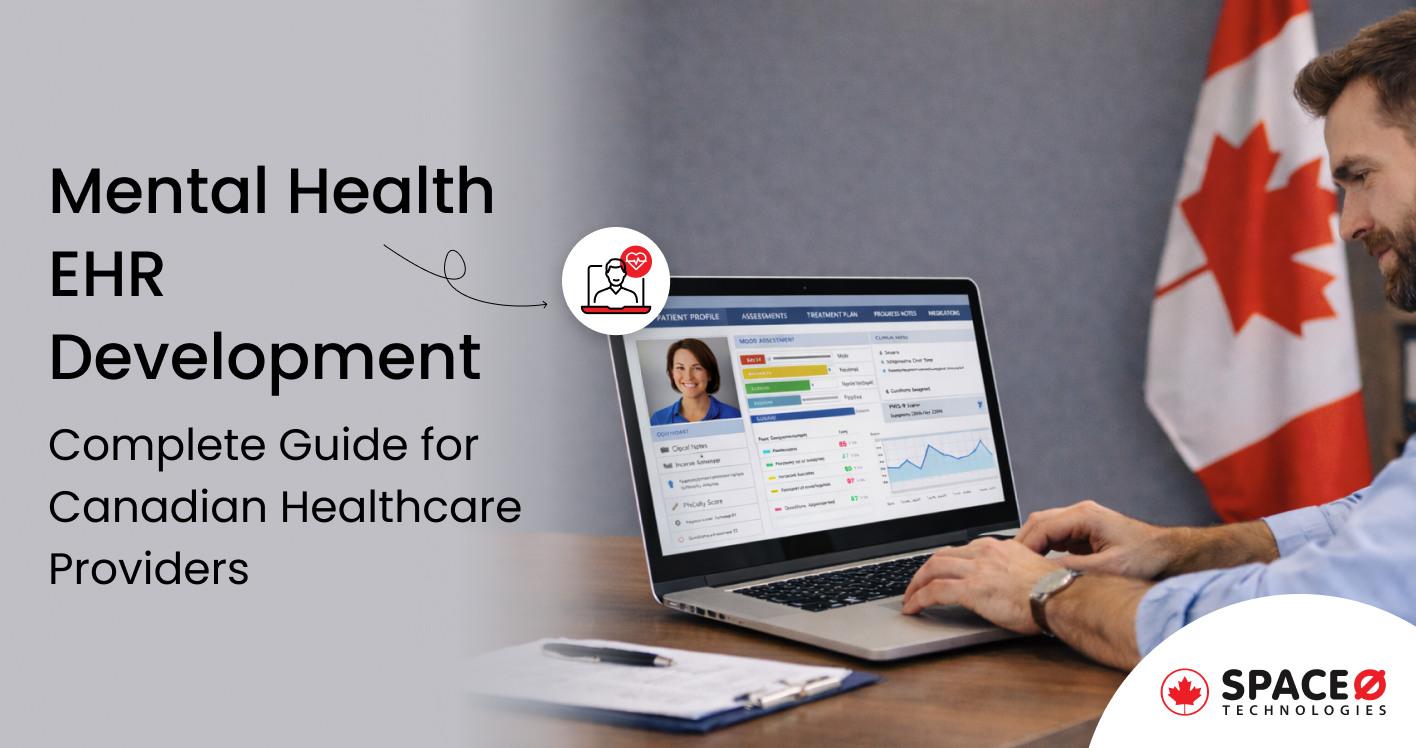
Are you looking to build a mental health EHR system tailored to the unique demands of behavioural healthcare? Mental health practices across Canada face a critical challenge: generic EHR platforms fail to support psychiatric workflows, therapy documentation, and the heightened sensitivity of mental health data.
Whether you’re a solo therapist outgrowing spreadsheets, a group practice owner managing 10+ clinicians, a psychiatrist needing secure e-prescribing, or an addiction treatment centre requiring specialized documentation, this guide covers what you need
According to the Canadian Mental Health Association, one in five Canadians experiences a mental health condition each year, increasing the need for specialized mental health EHR software. A purpose-built EHR helps mental health professionals deliver better care, track treatment progress accurately, and maintain compliance with Canadian privacy laws such as PIPEDA.
In this comprehensive guide, you will learn what makes mental health EHR development unique, understand essential features, ensure PIPEDA and provincial compliance, review costs, follow the development process, and choose the right development partner.
At Space-O Canada, we have provided EHR development services for mental health providers across the country.
Let us walk you through everything you need to know about building a mental health EHR that serves your practice and your patients.
What is Mental Health EHR Software and Why Does it Matter?
Mental health EHR (Electronic Health Record) software is a specialized digital system designed specifically for behavioural health practices, psychiatric clinics, and mental health treatment centres. Unlike general-approach to build an EHR systems, mental health EHR software addresses the unique documentation, privacy, and workflow requirements of psychological and psychiatric care.
Here is why specialised mental health EHR development matters for Canadian healthcare providers:
1. Unique documentation requirements
Mental health treatment involves detailed progress notes, therapy session documentation, treatment plans spanning months or years, and outcome tracking that general EHR systems cannot adequately handle. A properly designed mental health EHR captures the nuanced aspects of psychiatric care.
Key documentation needs:
- Flexible note formats (SOAP, DAP, BIRP, narrative)
- DSM-5 criteria integration for diagnosis
- Treatment plan templates for various modalities
- Group therapy session documentation
- Outcome measurement tracking over time
2. Enhanced privacy protections
Mental health records carry additional stigma and sensitivity. Patients require stronger privacy assurances, and Canadian regulations impose stricter controls on who can access behavioural health information. Substance use disorder records face even stricter protections under regulations similar to the US 42 CFR Part 2.
3. Treatment continuity
Mental health care often involves multiple providers, therapists, psychiatrists, and social workers collaborating on a single patient. Purpose-built EHR systems enable seamless care coordination while maintaining appropriate access controls for sensitive information.
4. Outcome measurement
Mental health treatment requires standardized assessment tools, symptom tracking, and outcome measurements that general EHR systems typically lack.
The mental health EHR market is experiencing significant growth. According to research from Grand View Research, the global behavioural health software market is expected to reach $5.1 billion by 2030, driven by increasing mental health awareness and the need for specialized digital solutions.
Why off-the-Shelf mental EHR software fall short
Popular platforms like Jane App, TherapyNotes, and SimplePractice serve standard use cases well. However, they cannot accommodate:
- Custom clinical workflows unique to your practice
- Deep integration with Canadian provincial health networks
- Specialized documentation for addiction treatment or forensic psychiatry
- AI-powered features tailored to your therapeutic approach
- Multi-site organizations with complex permission structures
Real-World Example: A 15-clinician group practice in Toronto was using Jane App but needed custom intake workflows for their specialized trauma program, integration with ConnectingOntario for hospital coordination, and AI-assisted documentation for their high-volume EMDR program. Off-the-shelf solutions could not deliver these requirements—custom development did.
Common Mental Health EHR Challenges (And How Custom Software Solves Them)
Before investing in EHR development, understand the specific problems custom software solves—and why generic platforms cannot address them.
1. Documentation burnout
The Challenge: Mental health professionals spend 2+ hours daily on progress notes. Therapists see 6-8 clients per day, and each session requires detailed documentation. This administrative burden leads to burnout, reduced client capacity, and incomplete records.
The Solution: Custom EHR systems with AI-powered documentation reduce note-writing time by up to 70%. Smart templates auto-populate based on session type, therapeutic modality, and previous notes. Voice-to-text transcription captures session content in real-time, generating structured notes that clinicians review and sign.
2. Generic templates that Do Not Fit
The Challenge: Most EHRs offer SOAP notes designed for medical visits—not therapy sessions. CBT therapists need thought record documentation. DBT practitioners need diary card tracking. Psychodynamic therapists need process notes. One-size-fits-all templates force clinicians to work around the system.
The Solution: Custom development creates templates specifically designed for your therapeutic approaches. Build CBT-specific interventions lists, DBT skills tracking, EMDR protocol documentation, and group therapy attendance with individual participation notes—all matching how your clinicians actually work.
3. Telehealth Integration Friction
The Challenge: Many practices use separate systems for video sessions and documentation. Without integrated telemedicine software, Clinicians toggle between Zoom, their EHR, and assessment tools—creating workflow friction and increasing the risk of documentation errors.
The Solution: Purpose-built EHR systems integrate telehealth natively. One platform handles scheduling, video sessions, session timers, screen sharing for assessments, and documentation. Session recordings (with consent) can feed AI documentation tools, further reducing administrative burden.
Discover the essential features tailored for behavioral health workflows and patient privacy.
What are the Essential Features of a Mental Health EHR System?
When developing a mental health EHR system, certain features are non-negotiable for effective patient care and practice management. Here is what your system needs to include.
1. Treatment planning
Enable clinicians to build detailed, individualized treatment plans with clearly defined goals, structured interventions, and continuous progress tracking. This feature should actively support evidence-based protocols for depression, anxiety, PTSD, and substance use disorders, ensuring consistent, outcome-driven mental healthcare delivery.
2. Therapy progress notes
Support flexible and customizable documentation that aligns with diverse therapeutic approaches such as CBT, DBT, psychodynamic therapy, and group counseling. This capability allows therapists to capture nuanced session insights, clinical observations, and evolving patient narratives without restrictive SOAP-style limitations.
3. Integrated assessment tools
Include clinically validated assessment instruments like PHQ-9, GAD-7, and AUDIT to measure symptom severity, monitor treatment effectiveness, and generate data-backed insights that guide ongoing care decisions and clinical evaluations.
4. Medication management
Provide secure e-prescribing with real-time drug interaction checks, controlled substance tracking, adherence monitoring, and side-effect documentation to help psychiatric providers manage medications safely, accurately, and in compliance with regulatory standards.
5. Appointment scheduling
Accommodate flexible session durations, recurring therapy appointments, multi-provider calendars, and group therapy scheduling. Advanced appointment scheduling features reduce administrative workload and improve patient attendance consistency.
6. Secure patient portal
Deliver a PIPEDA-compliant patient portal that allows clients to complete intake forms, review appointments, exchange secure messages, and access relevant documents while maintaining strict confidentiality of mental health data.
Ready to Build Your Mental Health EHR System?
Our team has extensive experience developing PIPEDA-compliant healthcare software for Canadian mental health providers. Get expert guidance on your project requirements and receive a detailed cost estimate.
Core features must meet strict Canadian regulations. Learn proven strategies for PIPEDA-compliant mental health EHR development.
How Do You Ensure PIPEDA Compliance in Mental Health EHR Development?
Compliance with the Personal Information Protection and Electronic Documents Act (PIPEDA) is mandatory for any mental health EHR system operating in Canada. Additionally, provincial health information acts may impose further requirements depending on your location.
Here, we will explore the key compliance considerations for your mental health EHR development project.
1. Data encryption requirements
All patient health information must be encrypted both in transit and at rest. This means implementing TLS 1.3 for data transmission and AES-256 encryption for stored data. Your development team must ensure that encryption keys are properly managed and stored separately from the encrypted data.
2. Access controls and authentication
Mental health records require role-based access controls (RBAC) that limit information access based on clinical necessity. Implement multi-factor authentication (MFA) for all users and maintain detailed audit logs of who accessed what information and when.
3. Consent management
PIPEDA requires organizations to obtain meaningful consent before collecting, using, or disclosing personal health information. Your EHR system needs robust consent management features that document patient authorization and allow patients to withdraw consent.
4. Data residency
For Canadian healthcare providers, patient data should remain within Canada. Choose cloud infrastructure providers with Canadian data centres, such as AWS Canada (Montreal), Microsoft Azure Canada, or Google Cloud’s Montreal region.
5. Breach notification procedures
Your system must include mechanisms to detect, document, and report data breaches. PIPEDA requires organizations to notify affected individuals and the Privacy Commissioner of Canada when breaches pose a real risk of significant harm.
Beyond federal PIPEDA requirements, healthcare and app development entities targeting Canada must address province-specific privacy laws, especially for health data handling. These regulations often supersede PIPEDA for intra-provincial activities in private sectors. The table below expands on key provincial rules with core obligations.
Provincial regulations table
| Province | Regulation | Key Requirements |
|---|---|---|
| Ontario | PHIPA | Governs personal health information custodians; mandates consent for collection/use/disclosure, breach notification within 30 days, privacy impact assessments, and patient access rights to records. Applies to health info custodians like clinics; PIPEDA may apply for interprovincial transfers. |
| Alberta | HIA | Requires custodians (e.g., healthcare providers) to protect health information via privacy impact assessments before new systems, mandatory breach reporting if risk of harm exists (to individuals, Commissioner, and Minister), secure handling, and fines up to $500,000 for violations like unauthorized access. |
| British Columbia | PIPA | Focuses on personal information (including health data) in private sector; demands reasonable security, consent for collection/use/disclosure, access/correction rights, and breach reporting if real risk of harm; substantially similar to PIPEDA for most intra-provincial commercial activities. |
| Quebec | Law 25 | Enforces strict privacy governance; requires privacy impact assessments, explicit consent, data protection officer appointment, breach notifications within 30 days, and enhanced rights like data portability; applies broadly with PIPEDA overlap for cross-border data. |
Working with a custom software development partner experienced in Canadian healthcare regulations ensures your mental health EHR meets all applicable compliance standards.
PIPEDA compliance unlocks custom solution advantages. Explore how tailored EHR systems transform mental health practice efficiency.
What are the Key Benefits of Custom Mental Health EHR Development?
Custom mental health EHR development delivers six key advantages over off-the-shelf solutions: workflow optimization that reduces documentation time by 30-40%, seamless integration with provincial health networks, unlimited scalability as your practice grows, differentiated patient experience for competitive advantage, lower total cost of ownership over 5+ years, and complete platform ownership without vendor lock-in.
Here’s why Canadian healthcare providers choose purpose-built systems.
1. Eliminate documentation burden with workflow optimization
Custom EHR systems are designed around your specific clinical workflows rather than forcing you to adapt to generic processes. Your therapists document sessions using templates matching their therapeutic approach—CBT, DBT, EMDR, or psychodynamic—while intake coordinators follow clinic-specific screening protocols. The system eliminates unnecessary clicks and redundant data entry that plague generic solutions, reducing documentation time by 30-40% and allowing clinicians to focus on patient care.
2. Connect all your systems with seamless integration
A custom solution integrates with your existing practice management tools, healthcare CRM, provincial health networks, and laboratory systems without the limitations of pre-built connectors. Connect directly with Ontario’s ConnectingOntario ClinicalViewer, BC’s Provincial Laboratory Information Solution, or Alberta Netcare through purpose-built APIs. This eliminates data silos and ensures smooth information flow between scheduling, billing, and clinical documentation.
At Space-O, we’ve built integrations with Canadian provincial health networks and understand the specific requirements for mental health data exchange under PHIPA and provincial regulations.
3. Grow without limits through built-in scalability
As your practice grows, custom software scales with you. Expand from individual therapy to group sessions, add psychiatric services, or open satellite clinics without purchasing additional modules or hitting user caps. Your architecture grows organically—supporting single-provider practices today and multi-location organizations tomorrow. No migration headaches, no platform changes, no starting over.
4. Stand out in competitive markets with a differentiated patient experience
A well-designed EHR system becomes a competitive advantage, not just an operational tool. Offer patients secure messaging, online booking, and branded portal access that reflects your practice identity. Attract top clinicians with intuitive tools that reduce burnout and administrative frustration. These differentiators help you stand out when patients compare providers and when recruiting talent in competitive mental healthcare markets.
5. Reduce the total cost of ownership over time
While custom development requires higher initial investment, the total cost of ownership often proves lower than ongoing licensing fees, per-user charges, and module add-ons associated with commercial platforms. Eliminate annual subscription fees that increase 10-15% yearly. No separate charges for telehealth, patient portals, or advanced reporting. Over 5 years, custom development typically delivers 40-60% cost savings compared to commercial alternatives with equivalent functionality.
6. Maintain complete control with full platform ownership
With custom development, you own the source code and intellectual property outright. You’re not locked into a vendor relationship or subject to surprise price increases, feature removals, or platform discontinuation. Maintain complete control over system evolution, data security, and hosting decisions. If you ever change development partners, you retain full platform ownership—protecting your long-term investment and operational continuity.
Our Brampton-based team has delivered custom mental health EHR solutions for practices across Ontario, Alberta, and British Columbia. We understand the unique compliance requirements and clinical workflows that generic EHR vendors overlook.
Benefits justify investment, but budgeting requires clarity. Understand realistic costs for PIPEDA-compliant mental health EHR systems.
How Much Does Mental Health EHR Development Cost?
EHR development costs in Canada vary by project complexity and phases, typically ranging from $75,000 to $500,000+ CAD depending on features, compliance needs like PIPEDA/PHIPA, and team structure. For a broader overview, see our detailed guide on EHR software development cost.
Understanding the cost factors involved in mental health EHR development helps you budget appropriately and make informed decisions. Here is a detailed breakdown of what to expect.
Cost by project complexity
| EHR Type | Features | Timeline | Estimated Cost (CAD) |
|---|---|---|---|
| Basic EHR | Core documentation, scheduling, basic billing | 4-6 months | $75,000 – $120,000 |
| Standard EHR | Above + assessment tools, patient portal, e-prescribing | 6-9 months | $120,000 – $200,000 |
| Advanced EHR | Above + telehealth, AI features, analytics | 9-12 months | $200,000 – $350,000 |
| Enterprise EHR | Full suite, multi-facility, advanced integrations | 12-18 months | $350,000 – $500,000+ |
Cost by development phase
| Phase | Timeline | Cost Range (CAD) | Activities |
|---|---|---|---|
| Discovery & Planning | 2-4 weeks | $8,000 – $15,000 | Requirements gathering, compliance review |
| UI/UX Design | 4-6 weeks | $15,000 – $30,000 | Wireframes, prototypes, user testing |
| Development | 16-32 weeks | $80,000 – $250,000 | Frontend, backend, database, integrations |
| Testing & QA | 4-6 weeks | $15,000 – $35,000 | Security testing, performance optimization |
| Deployment | 2-3 weeks | $8,000 – $15,000 | Server setup, data migration, training |
| Maintenance | Ongoing | $3,000 – $8,000/month | Updates, support, compliance monitoring |
Factors affecting cost
Several variables influence your total development investment:
- Feature complexity: Advanced features like AI-powered clinical decision support significantly increase costs
- Integration requirements: Connecting to provincial health networks, pharmacies, and labs adds complexity
- Compliance level: Stringent security and audit requirements increase development effort
- User volume: Systems designed for large multi-site organizations require more robust architecture
- Development approach: In-house teams cost more than partnering with experienced software developers
Get an Accurate Cost Estimate for Your Mental Health EHR Project
Our experienced team analyzes your specific requirements, identifies technical challenges, and provides a detailed cost breakdown so you know exactly what to expect before committing.
Cost awareness guides effective execution. Follow this proven process for building compliant mental health EHR solutions.
What is the Development Process for Mental Health EHR Software?
Most software development companies follow a similar eight-step EHR development process for building EHR systems: requirements, design, development, testing, and deployment. The steps look identical on paper.
The difference lies in execution.
At Space-O, we’ve refined this process specifically for mental health practices over 14+ years and 300+ projects. Our team understands that a CBT therapist documents differently than a psychiatrist prescribing medications. We know PHIPA compliance requires more than checkbox security features. We’ve integrated with Ontario’s ConnectingOntario, Alberta Netcare, and provincial drug repositories—so we don’t learn on your project.
Step 1: Requirements analysis and discovery
We begin with comprehensive requirements gathering through stakeholder interviews with psychiatrists, therapists, administrative staff, and practice managers. This helps us understand your workflows, pain points, and documentation needs.
We analyze your current processes including appointment scheduling, billing procedures, and clinical documentation methods. For mental health practices, we focus on specialized requirements like crisis intervention protocols, substance abuse tracking, treatment plan templates, and outcome measurement tools (PHQ-9, GAD-7).
We also assess compliance requirements covering PHIPA, PIPEDA, provincial mental health legislation, and ethical standards from regulatory bodies.
Deliverables: Requirements document, user personas, compliance checklist, workflow diagrams.
Timeline: 2-3 weeks.
Step 2: System architecture and technical design
Our architects design the technical foundation including database schema, API structure, security framework, and integration approach. We implement a microservices architecture separating patient management, clinical documentation, billing, and scheduling as independent but connected services.
Database design incorporates role-based access controls and audit logging for compliance. The security framework includes encryption, multi-factor authentication, and automated monitoring designed to meet SOC 2 Type II standards.
We use AWS or Azure with Canadian data residency, ensuring patient data never leaves Canadian borders. Integration architecture includes HL7 FHIR APIs for interoperability with provincial health networks, pharmacy systems, and laboratory services.
Deliverables: Architecture diagrams, database schema, API specifications, security design, technology stack recommendations.
Timeline: 2-3 weeks.
Step 3: UI/UX design for clinical workflows
We create wireframes focusing on reducing clicks and cognitive load—clinicians should complete progress notes in under 5 minutes. Specialized interfaces are designed for different roles: therapists need treatment plans and session notes, psychiatrists require medication management tools, and billing staff need insurance verification interfaces.
Interactive prototypes undergo usability testing with actual clinicians. We observe how they navigate common tasks and incorporate feedback before development begins.
We design templates for various note types (intake assessments, progress notes, treatment plans) that meet regulatory requirements while remaining clinically useful.
Deliverables: Wireframes, design mockups, clickable prototypes, usability test reports.
Timeline: 3-4 weeks.
Step 4: Agile development with iterative delivery
Using agile methodology with 2-week sprints, our team builds the system incrementally. Each sprint delivers working features you can review and test.
Early sprints focus on core infrastructure, user authentication, and patient registration. Later sprints add clinical documentation, scheduling, billing integration, reporting, and advanced features like e-prescribing.
You receive sprint demonstrations every two weeks, providing feedback that shapes upcoming development. Our team includes full-stack developers, database specialists, security engineers, and QA testers. You can also hire EHR software developers as dedicated resources for your project.
Deliverables: Working software delivered every 2 weeks, sprint reports, release notes.
Timeline: 4-8 months depending on scope.
Space-O follows a transparent agile process where you’re never left wondering about progress. Every sprint includes working software you can test, detailed progress reports, and open communication channels with your dedicated project manager.
Step 5: System integration and interoperability
We connect your EHR with essential external systems. Integration with provincial health networks (like Ontario’s Digital Health Drug Repository) enables drug information lookup during prescribing. Pharmacy system integration allows electronic prescription transmission.
Laboratory integrations enable ordering tests electronically and automatically importing results. Medical billing software integration ensures clinical documentation flows directly to billing, reducing duplicate data entry.
Each integration undergoes thorough testing in sandbox environments before production deployment.
Deliverables: Tested integrations, API documentation, integration monitoring dashboards.
Timeline: 2-4 weeks running parallel to development.
Step 6: Comprehensive testing and quality assurance
The system undergoes rigorous testing covering functionality, security, performance, and compliance. Functional testing verifies every feature works as specified.
Security testing includes penetration testing by certified ethical hackers and vulnerability scanning. Performance testing simulates real-world usage with hundreds of concurrent users to ensure responsiveness during peak hours.
User acceptance testing (UAT) involves your staff using the system with test data to validate it meets clinical workflows. Compliance validation ensures the system meets PHIPA, PIPEDA, and provincial regulatory requirements.
Deliverables: Test reports, security assessment, performance benchmarks, UAT sign-off, compliance documentation.
Timeline: 3-4 weeks.
Step 7: Deployment, data migration, and training
We deploy the system to production infrastructure following a detailed cutover plan. For practices with existing EHR data, we migrate patient demographics, clinical notes, medication lists, and appointment history using secure ETL processes.
We run new and old systems in parallel for 1-2 weeks, allowing staff to verify data accuracy before fully transitioning.
Comprehensive training covers all user roles with hands-on sessions. Clinicians learn clinical documentation, psychiatrists learn e-prescribing, front desk staff learn scheduling, and billing staff learn claims submission. We provide video tutorials, quick reference guides, and workflow documentation.
Deliverables: Live system, migrated data with validation reports, training sessions, user guides, video tutorials.
Timeline: 2-3 weeks.
Step 8: Ongoing maintenance and continuous improvement
Post-launch support ensures your system remains secure, compliant, and effective. Monthly maintenance includes security patches, bug fixes, performance optimization, and feature enhancements based on user feedback.
We monitor system health 24/7 with automated alerts for performance issues or security threats. Quarterly business reviews assess system usage and plan improvements.
Compliance monitoring ensures the system remains certified as standards evolve. When new requirements emerge, we update the system to maintain compliance.
Deliverables: Monthly maintenance reports, quarterly reviews, security updates, feature enhancements, 24/7 support.
Timeline: Ongoing post-launch.
Process success depends on partner expertise. Discover key criteria for selecting mental health EHR development specialists.
How to Choose the Right Mental Health EHR Development Partner
Choosing the right mental health EHR development partner requires evaluating five key criteria: proven healthcare development experience with EHR and behavioral health systems, Canadian compliance expertise covering PIPEDA and provincial regulations like PHIPA, transparent communication with regular updates and accessible project managers, full lifecycle support including post-launch maintenance and 24/7 monitoring, and a verifiable portfolio with healthcare-specific references and case studies.
1. Verify proven healthcare development experience
Your partner should have proven experience building EHR software and understand healthcare-specific challenges including clinical workflows, regulatory compliance, and interoperability standards. If you’re considering external teams, learn how to outsource EHR development.
Look for developers who have worked on similar mental health or behavioral health systems, as these require specialized knowledge of psychiatric documentation, treatment planning workflows, and outcome measurement tools.
2. Confirm Canadian compliance expertise
Choose a partner familiar with PIPEDA, provincial health information acts (like Ontario’s PHIPA), and Canadian healthcare regulations. This expertise prevents costly compliance issues later. Your development partner should understand data residency requirements, consent management, breach notification procedures, and audit logging standards specific to Canadian healthcare. Partners experienced with certifications like SOC 2 Type II demonstrate commitment to security and compliance best practices.
Space-O holds certifications in healthcare security standards and maintains active knowledge of evolving Canadian privacy legislation. We’ve successfully guided clients through PHIPA audits, PIPEDA compliance reviews, and provincial health authority security assessments.
3. Evaluate communication and project management transparency
Regular updates, clear reporting, and accessible project managers ensure you stay informed throughout development. Look for partners who prioritize transparency with tools like shared project boards, weekly status meetings, and sprint demonstrations. Communication breakdown is a leading cause of project failure, so evaluate how potential partners handle questions, manage scope changes, and escalate issues. Ask about their communication cadence and who your main point of contact will be.
4. Ensure full lifecycle support beyond launch
From initial planning through post-launch maintenance, your partner should provide comprehensive support. Avoid partners who build and leave without ongoing maintenance plans. Mental health EHR systems require continuous updates for security patches, regulatory changes, feature enhancements, and technical support. Clarify what post-launch support includes—response times for critical issues, monthly maintenance packages, and how feature requests are handled. Partners offering 24/7 monitoring and support demonstrate long-term commitment to your success.
5. Review portfolio and request verifiable references
Review case studies and references from similar healthcare projects. Ask about challenges faced and how they were resolved. Request to speak with current clients about their experience, particularly regarding project timelines, budget adherence, and post-launch support quality. A strong portfolio should demonstrate not just technical capability but also understanding of clinical workflows and user experience design for healthcare professionals. Be cautious of partners who cannot provide healthcare-specific references or case studies.
Ready to Transform Your Mental Health Practice with Custom EHR Software?
Let us discuss your requirements and explore how a purpose-built EHR system can improve patient care, streamline operations, and ensure compliance.
Create a Scalable Mental Health EHR with Space-O Technologies
Mental health EHR development demands more than generic software skills—it requires deep understanding of psychiatric documentation workflows, behavioral health compliance requirements, and the clinical nuances that differentiate therapy notes from standard medical records.
Why Canadian mental health practices choose Space-O:
- 14+ years of healthcare software development with 300+ successful projects for startups and Fortune 500 companies
- Canadian compliance expertise covering PIPEDA, PHIPA, and provincial mental health legislation—we’ve guided clients through regulatory audits and security assessments
- Mental health workflow knowledge, including CBT, DBT, EMDR documentation templates, PHQ-9/GAD-7 outcome tracking, and crisis intervention protocols
- Brampton-based team operating in your timezone with clear communication and in-person meetings available
- End-to-end delivery from requirements analysis and UX design through compliant development, system integration, and post-launch support
- 3 months free maintenance covering bug fixes, security patches, and staff questions after go-live
We build mental health platforms that reduce clinician documentation burden, maintain airtight compliance, and scale as your practice grows. Need specialized talent? Learn how to hire EHR software developers for your project.
Frequently Asked Questions About Mental Health EHR Development
How long does it take to develop a mental health EHR system?
Development timelines typically range from 4 to 18 months depending on complexity. A basic EHR with core features takes 4-6 months, while a comprehensive enterprise system with advanced integrations may require 12-18 months. We recommend starting with an MVP approach to launch faster and iterate based on user feedback.
Can I integrate my mental health EHR with existing practice management software?
Yes, custom EHR development allows seamless integration with your existing tools. We build APIs and connectors to link with practice management systems, billing software, scheduling tools, and provincial health networks. Common integrations include OSCAR, Accuro, and provincial drug information systems.
What security measures should a mental health EHR include?
Essential security measures include end-to-end encryption, multi-factor authentication, role-based access controls, comprehensive audit logging, automatic session timeouts, and regular security updates. Your system should also undergo annual penetration testing and vulnerability assessments.
How do I ensure my EHR meets PIPEDA requirements?
PIPEDA compliance requires implementing proper consent management, data encryption, access controls, breach notification procedures, and data residency in Canada. Working with a development partner experienced in Canadian healthcare regulations ensures your mental health EHR meets all applicable compliance standards. Learn more about healthcare IT outsourcing to find the right engagement model.
What is the cost of maintaining a mental health EHR after launch?
Ongoing maintenance typically costs $3,000 to $8,000 CAD per month, covering server hosting, security updates, bug fixes, compliance monitoring, and technical support. Feature enhancements and major updates are priced separately based on scope.


Building a Mental Health EHR That Meets Canadian Compliance Standards?
 All our projects are secured by NDA
100% Secure. Zero Spam
*All your data will remain strictly confidential.
Trusted by


Bashar Anabtawi 
Canada
“I was mostly happy with the high level of experience and professionalism of the various teams that worked on my project. Not only they clearly understood my exact technical requirements but even suggested better ways in doing them. The Communication tools that were used were excellent and easy. And finally and most importantly, the interaction, follow up and support from the top management was great. Space-O not delivered a high quality product but exceeded my expectations! I would definitely hire them again for future jobs!”

Canada Office
2 County Court Blvd., Suite 400,
Brampton, Ontario L6W 3W8
Phone: +1 (602) 737-0187
Email: sales@spaceo.ca