
- What is Node Development Outsourcing?
- Why Businesses Choose Node Development Outsourcing?
- What are the Key Benefits of Node Development Outsourcing? (3 Core Advantages)
- How to Successfully Outsource Node.js Development in 5 Steps
- What are the Challenges of Outsourcing Node.js Development and How to Overcome Them?
- Challenge 1: APIs not matching the intended business logic
- Challenge 2: Inconsistent use of architecture and backend patterns
- Challenge 3: Performance bottlenecks from inefficient Node.js practices
- Challenge 4: Integration issues between backend and third-party services
- Challenge 5: Knowledge gaps and maintainability problems after outsourcing ends
- What to Look for in a Node Development Outsourcing Partner?
- How Much Does it Cost to Outsource Node.js Development? [4 Key Factors to Consider]
- Unlock Strategic Node.js Outsourcing with Space-O Technologies
- Frequently Asked Questions about Node Development Outsourcing
Node Development Outsourcing: A Complete Guide for Your Business

 Last Updated: December, 11 2025
Finding skilled Node.js developers who can deliver scalable, high-performance applications is one of the biggest challenges businesses face today. The global shortage of tech talent, combined with rising hiring costs, has pushed many companies to explore strategic alternatives.
Node development outsourcing has emerged as a powerful solution that gives businesses access to specialized expertise while maintaining cost efficiency and accelerating time-to-market.
According to a report by Precedence Research, the global IT services outsourcing market size was estimated at USD 611.80 billion in 2024, is projected to reach USD 661.96 billion in 2025, and is anticipated to reach around USD 1,345.48 billion by 2034, expanding at a CAGR of 8.20% from 2025 to 2034. The chart below shows this market forecast.
This comprehensive guide walks you through everything you need to know about node development outsourcing, from understanding the fundamentals to selecting the right development partner for your business needs.
What is Node Development Outsourcing?
Node development outsourcing is the practice of hiring external specialists or development teams to build, maintain, or enhance applications using Node.js technology. Instead of recruiting in-house developers, businesses partner with offshore, nearshore, or onshore service providers who offer dedicated Node.js expertise.
When you outsource Node.js development, you typically choose from several engagements of Node.js developers who work exclusively on your project. This model offers maximum control and is ideal for long-term projects requiring ongoing development and maintenance.
- Project-based outsourcing: The outsourcing partner handles the entire project from start to finish based on agreed specifications, timeline, and budget. This works well for projects with a clearly defined scope and requirements.
- Staff augmentation: You extend your existing team by adding specialized from an outsourcing partner. This provides flexibility to scale up or down based on project demands.
Understanding these development outsourcing models helps you choose the approach that best aligns with your project requirements, budget constraints, and organizational structure. If your application requires complex workflows, consider reviewing this full-stack web application guide to understand how Node.js fits into modern end-to-end architectures.
Pro Tip: Before selecting an outsourcing model, clearly define your project scope, technical requirements, and long-term maintenance needs. This ensures you choose the engagement model that provides maximum value and minimizes future complications.
Having understood what Node Development Outsourcing entails, it’s important to explore the key motivations driving businesses to adopt this approach for their software projects.
Why Businesses Choose Node Development Outsourcing?
The decision to outsource Node.js development goes beyond simple cost reduction. Businesses across industries are discovering strategic advantages that directly impact their competitive positioning. Partnering with an experienced Node.js development company like SpaceO ensures access to specialized talent, faster delivery cycles, and reliable engineering processes.
1. Access to specialized Node.js expertise
Finding developers with deep Node.js expertise can take months through traditional hiring channels. Node development outsourcing provides immediate access to pre-vetted professionals experienced in building scalable microservices architectures, real-time applications, and complex APIs. These specialists understand event-driven architectures, asynchronous programming patterns, and the complete Node.js ecosystem, including Express.js, NestJS, and Socket.io.
2. Cost savings without compromising quality
The cost of outsourcing software development is typically 40-60% lower than maintaining equivalent in-house teams. Beyond salary differences, you avoid costs for recruitment, benefits, office infrastructure, hardware, training, and management overhead.
To estimate cost differences accurately, many businesses compare outsourcing expenses with overall project budgets. Reviewing the cost of web application development helps you understand how backend complexity, integrations, and scalability requirements influence development costs.
3. Faster time-to-market
Node development outsourcing can reduce your time-to-market when compared to building an in-house team from scratch. While you’d spend months recruiting and onboarding developers, an outsourcing partner can assemble a qualified team and begin development within weeks.
4. Scalability and flexibility
The dedicated development team model provides flexibility to scale your team up or down without the complications of hiring or layoffs. Need a DevOps specialist or QA automation engineer? Quality outsourcing partners can provide these complementary specialists quickly.
5. Focus on core business operations
Outsourcing shifts team management responsibilities to your partner, freeing your leadership to focus on product strategy, market expansion, customer relationships, and revenue growth rather than recruitment and HR complexities.
For businesses looking for reliable partners, reviewing a list of experienced Node.js development companies helps ensure you choose a team that can handle end-to-end development, communication workflows, and long-term scalability.
With a structured approach like this, businesses can successfully outsource web development and unlock faster delivery, better scalability, and long-term product stability.
Pro Tip: Establish clear key performance indicators (KPIs) before outsourcing begins. Define metrics for code quality, sprint velocity, bug rates, and communication responsiveness. Regular monitoring ensures your outsourcing partner consistently delivers value aligned with your business objectives.
Maintain Full Control While We Handle Complex Node.js Engineering
Receive sprint plans, code reviews, API documentation, and detailed weekly progress reports. Stay informed at every step while our team delivers optimized backend components that work reliably in production.
With these motivations in mind, let’s take a closer look at the tangible benefits that make outsourcing Node.js development a strategic choice for companies worldwide.
What are the Key Benefits of Node Development Outsourcing? (3 Core Advantages)
Here are the three most important benefits you can expect when outsourcing Node.js development.
1. Technical Benefits: Build High-Performance, Scalable, and Future-Ready Applications
Outsourcing provides access to seasoned Node.js engineers who understand modern backend architecture and production-level scalability. These teams bring experience in:
- Designing microservices and event-driven architectures that support large-scale traffic
- Building secure, high-performance REST and GraphQL APIs
- Handling complex asynchronous logic, concurrency, and distributed systems
- Implementing best practices in logging, monitoring, DevOps automation, and CI/CD
- Maintaining unified JavaScript workflows across frontend and backend
With this depth of expertise, projects move forward with cleaner code, fewer bottlenecks, and faster system performance, especially critical for real-time applications, SaaS platforms, and enterprise solutions.
2. Business Benefits: Lower Costs, Faster Delivery, and Flexible Team Scaling
Node.js outsourcing helps businesses streamline operations while maximizing output. You benefit from:
- Predictable development costs with transparent pricing models
- Faster turnaround times thanks to ready-to-start web development expert teams
- Time-zone aligned workflows enabling near round-the-clock progress
- Reduced operational overhead, avoiding hiring, onboarding, benefits, and infrastructure expenses
- On-demand scaling, allowing you to add or remove developers based on project needs
This operational flexibility helps businesses control budgets, avoid delays caused by hiring shortages, and maintain steady development velocity—even during peak workloads.
3. Strategic Benefits: Strengthen Innovation, Product Growth, and Competitive Advantage
Beyond technical execution, outsourcing supports long-term product and business strategy. Companies gain:
- Access to global Node.js expertise in serverless architecture, containerization, cloud-native development, and GraphQL
- Faster release cycles, enabling quicker market entry and continuous innovation
- Stronger software foundations that support future features and scaling
- Reduced dependency on internal staffing, minimizing risk during growth or restructuring
- More leadership bandwidth to focus on product vision, market expansion, customer relationships, and revenue strategy
Recognizing the advantages is just the first step; the next challenge is ensuring a smooth and effective outsourcing process to maximize these benefits.
How to Successfully Outsource Node.js Development in 5 Steps
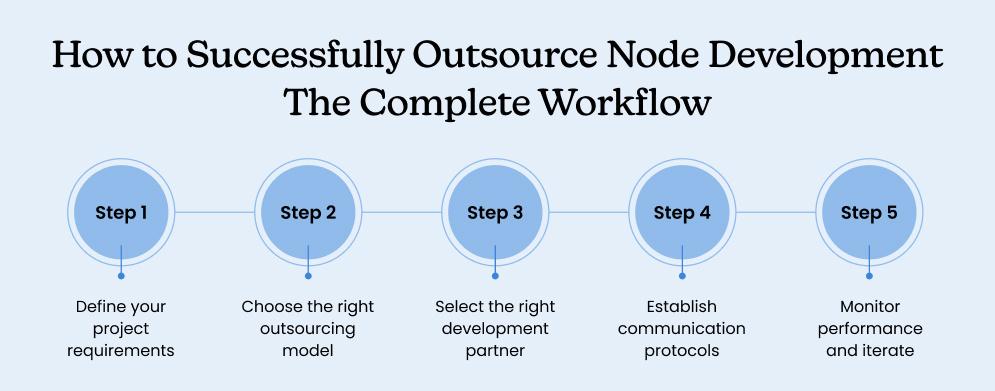
Success in node development outsourcing requires a structured approach that ensures you select the right partner, establish effective collaboration, and achieve your project objectives.
Step 1: Define your project requirements
Document comprehensive technical specifications covering functionality, user stories, and acceptance criteria. Establish a clear project scope, defining what’s included in initial development versus future enhancements. Identify specific skill sets required—developers experienced with particular Node.js frameworks, database expertise, DevOps capabilities, or real-time features.
Step 2: Choose the right outsourcing model
The dedicated team model works best for long-term projects with evolving requirements, providing maximum flexibility. Project-based outsourcing suits well-defined projects with a clear scope. Staff augmentation fills specific skill gaps in existing teams. A hybrid approach combines elements of multiple models, offering both stability and flexibility based on your project characteristics.
Step 3: Select the right development partner
Evaluate technical vetting processes—how rigorously does the partner assess developers before hiring them? Review portfolios and case studies for projects similar to yours. Assess communication and cultural fit through initial conversations. Verify security measures including NDAs, secure development environments, and clear intellectual property provisions.
Step 4: Establish communication protocols
Define meeting schedules that balance regular synchronization with productive work time. Configure project management tools providing transparency into task status and priorities. Implement code review processes, maintaining quality standards. Create reporting structures providing visibility without micromanagement. Understanding how to hire web developers through outsourcing means maintaining active involvement throughout the partnership.
Step 5: Monitor performance and iterate
Track relevant KPIs, including sprint velocity, code coverage, bug rates, and deployment frequency. Establish continuous feedback loops enabling quick corrections. Implement quality assurance measures beyond basic testing, including performance testing and security audits. Optimize continuously based on learnings, formalizing effective practices, and standardizing successful approaches.
Pro Tip: Integrate your outsourced Node.js team into your existing workflows from day one. Include them in company communications, celebrate their achievements, and treat them as valued team members rather than external contractors. This integration dramatically improves collaboration and project outcomes.
Prevent the Common Failures That Slow Down Node.js Outsourcing
Our execution framework addresses the issues that typically break backend projects—unoptimized queries, blocking code, poor API design, and inconsistent deployment workflows.
While success is achievable, it’s crucial to be aware of potential obstacles along the way and consider practical strategies to mitigate common outsourcing challenges.
What are the Challenges of Outsourcing Node.js Development and How to Overcome Them?
Outsourcing Node.js development accelerates backend delivery, but it also introduces server-side challenges that can impact performance, security, and long-term maintainability. Addressing these issues early ensures the backend remains reliable, scalable, and easy for internal teams to manage.
Challenge 1: APIs not matching the intended business logic
Outsourced developers may implement endpoints that behave differently from the intended logic—such as inconsistent validation, incorrect data transformations, or mismatched response structures. These gaps create broken flows on the frontend and introduce debugging delays.
Solution:
Provide clear API specifications using OpenAPI/Swagger, complete with request/response examples, validation rules, authentication requirements, and edge-case behaviors. Share sequence diagrams and business logic flows to remove ambiguity. Conduct weekly endpoint verification sessions to ensure the implemented APIs match expected outcomes.
Challenge 2: Inconsistent use of architecture and backend patterns
Node.js offers multiple architectural styles—MVC, layered, clean architecture, microservices—and outsourced teams may mix patterns or use frameworks (Express, NestJS, Fastify) inconsistently. This results in an unpredictable backend that becomes harder to extend and debug.
Solution:
Define a unified architecture and folder structure before development begins. Document conventions for services, controllers, middleware, error handling, and utilities. Standardize linting (ESLint), formatting (Prettier), and code review checklists. Enforce consistent patterns through CI pipelines and mandatory pull-request approvals.
Challenge 3: Performance bottlenecks from inefficient Node.js practices
External developers may introduce blocking operations, poorly structured async logic, or unoptimized database queries. These issues slow down response times and degrade scalability under load.
Solution:
Publish backend performance guidelines that cover async best practices, database indexing strategy, caching rules (e.g., Redis), connection pooling, and optimized query patterns. Use tools like Node.js Profiler, PM2 monitoring, and load-testing suites (k6, JMeter) in CI to detect and eliminate performance regressions early.
Challenge 4: Integration issues between backend and third-party services
Misinterpreted API documentation, missing error-handling paths, and inconsistent retry logic often lead to broken workflows when integrating with payment gateways, authentication providers, cloud services, or external APIs.
Solution:
Share end-to-end integration diagrams, sandbox credentials, detailed API references, and example failure scenarios. Create mock servers or stubs so developers can build integrations independently without waiting on vendor access. Schedule integration checkpoints to verify that external services behave as expected across success, failure, and timeout cases.
Challenge 5: Knowledge gaps and maintainability problems after outsourcing ends
Backends built by external teams often suffer from poor documentation, missing architectural explanations, and unfamiliar naming conventions—making it difficult for internal engineers to maintain or scale the system.
Solution:
Request detailed documentation for modules, business logic flows, custom middleware, authentication layers, cron jobs, and database schemas. Hold knowledge-transfer sessions at the end of every sprint rather than at project completion. Involve at least one internal backend engineer in reviews to maintain continuity and ensure long-term maintainability.
Overcoming these challenges often starts with choosing the right partner—one whose skills, experience, and communication style align with your project needs.
What to Look for in a Node Development Outsourcing Partner?
1. Technical expertise and proven track record
Look for partners with 5+ years focused specifically on Node.js. Review their portfolio for projects similar to yours in complexity and relevance.
Verify expertise with complementary technologies your project needs. If you’re evaluating external partners for your project, reviewing established web development companies offers a helpful benchmark for understanding what experience, skill sets, and delivery models top-performing firms provide.
2. Transparent communication and processes
Evaluate how clearly the partner explains their methodology. Assess their reporting structure and accessibility. Look for proactive communication where the partner anticipates issues and flags risks before they become problems.
3. Quality assurance practices
Strong partners have comprehensive testing protocols covering unit testing, integration testing, and performance testing. Code quality standards should be well-defined and enforced through style guides, linters, and peer reviews.
4. Security and compliance
Data protection measures must be comprehensive and documented. Intellectual property rights must be explicitly assigned to you in contracts. If you operate in regulated industries, verify your partner understands compliance requirements like HIPAA, PCI-DSS, or GDPR.
5. Post-development support
Quality partners offer ongoing support, bug fixes, and updates after launch. Clear bug fix procedures and scalability support become crucial as your application grows.
Ready to Strengthen Your Product With Scalable Node.js Architecture?
Partner with Space-O’s experienced Node.js engineers who build clean, modular, and future-ready backend systems. Accelerate your delivery timelines with a team trusted for enterprise-level reliability.
Selecting a suitable partner naturally leads to understanding the financial aspect—how much should you expect to invest in outsourcing Node.js development?
How Much Does it Cost to Outsource Node.js Development? [4 Key Factors to Consider]
Developer seniority drives significant cost variation. Project complexity naturally impacts costs. The engagement model affects pricing structure.
Geographic location creates substantial rate differences—offshore developers in Asia typically charge $25-50 per hour, nearshore developers in Latin America or Eastern Europe range from $40-80 per hour, while onshore developers in North America command $100-200+ per hour.
1. Pricing Models
Hourly rates provide maximum flexibility. Fixed-price projects provide budget certainty for a well-defined scope. Dedicated team monthly rates combine the advantages of both approaches. Staff augmentation costs vary based on developer skills and commitment level.
2. Hidden Costs to Consider
Communication tools and infrastructure often go unmentioned in initial estimates. Project management overhead includes time spent in meetings and coordination. Knowledge transfer time is required for outsourced teams to understand your business. Quality assurance costs extend beyond basic testing.
3. ROI Comparison
The total cost of ownership comparison must include all expenses. In-house developers cost far more than just salary when you add recruitment, benefits, office space, and management overhead. Understanding web development cost between in-house and outsourced approaches requires factoring in opportunity cost and time-to-market value.
Now that cost considerations are clear, let’s see how a trusted provider like Space-O Technologies can help you unlock the full strategic potential of Node.js outsourcing.
Unlock Strategic Node.js Outsourcing with Space-O Technologies
Node development outsourcing has evolved from a cost-saving tactic into a strategic advantage that enables businesses to access specialized expertise, accelerate time-to-market, and maintain flexibility in rapidly changing markets. Success requires the right partner who brings technical excellence, transparent processes, and genuine commitment to your success.
Ready to Build Your Node.js Application? Space-O Technologies brings the expertise, transparency, and commitment needed for successful node development outsourcing.
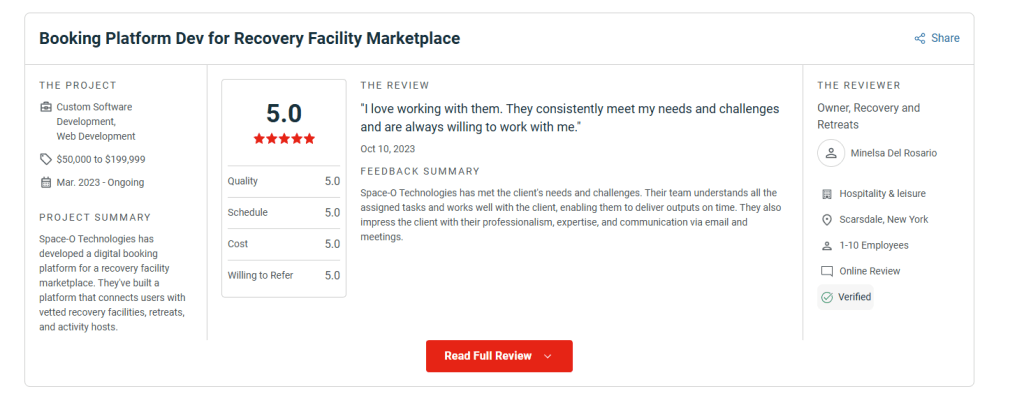
With experience since 2018, a proven track record with Fortune 500 companies, and 100+ happy clients worldwide, we’ve demonstrated our ability to deliver exceptional Node.js applications.
Our team of rigorously vetted developers combines deep technical expertise with clear communication and professional project management. Schedule a free consultation to discuss your Node project.
Frequently Asked Questions about Node Development Outsourcing
How do I choose the right Node development outsourcing company?
Evaluate potential partners based on several key criteria. Verify substantial Node.js-specific experience rather than general software development capabilities. Review their portfolio for projects similar to yours. Assess their technical vetting processes, communication practices, and project management methodology. Request and contact client references. Evaluate security measures, intellectual property protections, and post-development support offerings before making your decision.
How long does it take to outsource a Node.js project?
Timeline depends on project scope and complexity. Partner selection and team assembly typically take 1-3 weeks. Simple applications might be completed in 6-12 weeks, medium-complexity projects in 3-6 months, and complex enterprise applications in 6-12+ months. Outsourcing often accelerates timelines by 30-50% compared to building an in-house team, as you bypass lengthy recruitment and onboarding phases.
Can I outsource just Node.js backend development?
Absolutely. Many businesses outsource specific components while keeping other development in-house. You might outsource Node.js backend development while maintaining frontend development internally, or vice versa. Staff augmentation models are particularly well-suited for this approach, allowing you to add Node.js specialists to supplement your existing team’s capabilities.
What industries benefit most from Node.js development?
Node.js particularly excels in industries requiring real-time capabilities, high concurrency, or data-intensive applications. This includes fintech companies building trading platforms, healthcare organizations creating telemedicine applications, e-commerce platforms handling high traffic volumes, IoT companies processing sensor data streams, and SaaS providers building multi-tenant applications. However, Node.js’s versatility means it delivers value across virtually any industry needing scalable, efficient web applications.
How do I ensure quality when outsourcing Node.js development?
Implement multiple quality assurance measures throughout development. Require comprehensive code reviews before merging changes. Establish automated testing with minimum coverage requirements. Define clear coding standards and use automated linters to enforce them. Conduct regular architecture reviews to assess overall system design. Track quality metrics like bug rates, test coverage, and performance benchmarks. Choose partners with proven quality processes.
What is the difference between nearshore and offshore Node.js outsourcing?
Nearshore outsourcing involves partnering with development teams in neighboring countries with minimal time zone differences, enabling better real-time collaboration but typically costing more.
Offshore outsourcing reaches further geographically with significant time zone differences, offering maximum cost savings but requiring more structured communication. Nearshore provides easier communication and cultural alignment, while offshore delivers the lowest rates and largest talent pools. Choose based on your project’s communication requirements, budget constraints, and collaboration preferences.


What to read next



 All our projects are secured by NDA
100% Secure. Zero Spam
*All your data will remain strictly confidential.
Trusted by


Bashar Anabtawi 
Canada
“I was mostly happy with the high level of experience and professionalism of the various teams that worked on my project. Not only they clearly understood my exact technical requirements but even suggested better ways in doing them. The Communication tools that were used were excellent and easy. And finally and most importantly, the interaction, follow up and support from the top management was great. Space-O not delivered a high quality product but exceeded my expectations! I would definitely hire them again for future jobs!”

Canada Office
2 County Court Blvd., Suite 400,
Brampton, Ontario L6W 3W8
Phone: +1 (602) 737-0187
Email: sales@spaceo.ca