
- What is Offshore Outsourcing?
- What are the Different Types of Offshore Outsourcing Services?
- What are the Key Benefits of Offshore Outsourcing?
- 1. Significant cost reduction without compromising quality
- 2. Access to a global talent pool and specialized expertise
- 3. 24/7 business operations across time zones
- 4. Scalability and flexibility for growing businesses
- 5. Enhanced focus on core business functions
- 6. Faster time-to-market for products and services
- What are the Challenges and Risks of Offshore Outsourcing?
- How to Choose the Right Offshore Outsourcing Partner
- A Step-by-Step Guide to Implementing Offshore Outsourcing
- Step 1: Define your outsourcing goals and requirements
- Step 2: Research and shortlist potential offshore partners
- Step 3: Evaluate vendors and conduct due diligence
- Step 4: Start with a pilot project or trial period
- Step 5: Establish clear communication protocols and workflows
- Step 6: Monitor performance and optimize continuously
- What are the Best Offshore Outsourcing Practices for Success?
- Offshore vs. In-House Development: Which is Right for You?
- What are the Common Offshore Outsourcing Mistakes to Avoid?
- How Space-O Technologies Can Help with Your Offshore Development Needs
- Frequently Asked Questions About Offshore Outsourcing
Offshore Outsourcing: The Complete Guide for Businesses

 Last Updated: April, 6 2026
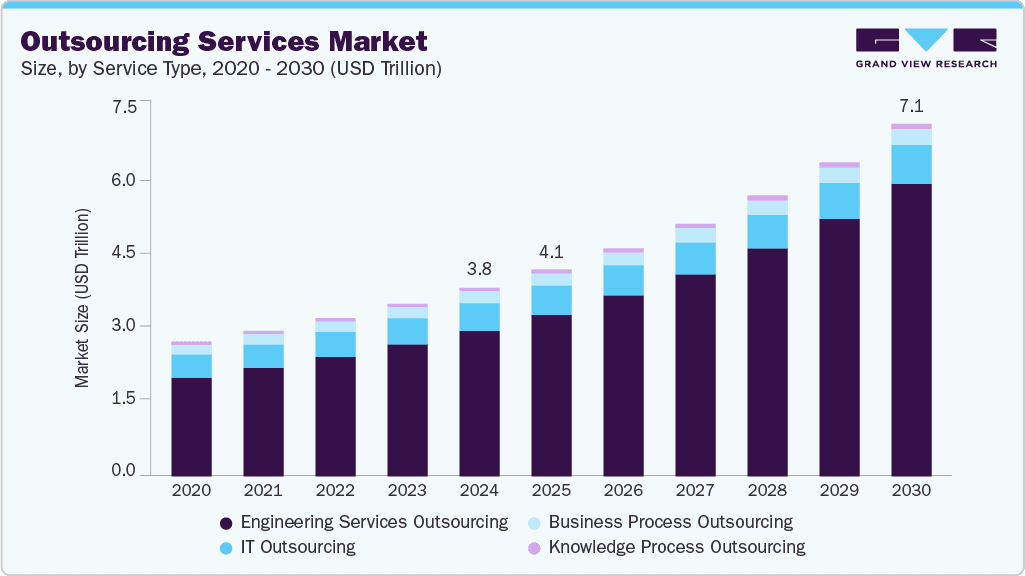
Are you feeling the pressure to innovate faster without letting costs spiral out of control? You’re not alone. Offshore outsourcing has become a go-to strategy for businesses that want to scale smartly, move quickly, and stay competitive. According to Grand View Research, the global outsourcing services market size was estimated at USD 3.8 trillion in 2024 and is projected to reach USD 7.11 trillion by 2030, growing at a CAGR of 11.3% from 2025 to 2030.
If you’re a startup preparing to launch your first product or an enterprise looking to expand development capacity, offshore software development companies can fundamentally change how you operate. It allows you to tap into specialized global talent, control operational expenses, and shorten time-to-market—without compromising on quality or performance.
This guide walks you through offshore outsourcing in clear, practical terms—from core concepts and benefits to execution strategies and vendor selection—so you can make confident decisions that align with your business goals and long-term growth plans.
What is Offshore Outsourcing?
Offshore outsourcing, also referred to as international outsourcing, is a business practice where companies delegate specific tasks, projects, or entire business processes to external service providers located in distant countries, typically with lower labor costs and favorable economic conditions. This strategic approach allows organizations to focus on core competencies while leveraging specialized expertise from global talent markets.
In offshore outsourcing, businesses partner with vendors in different geographical locations—often across continents and time zones—to perform functions ranging from software development and IT support to customer service and data processing. The primary distinction of offshore outsourcing lies in the geographical distance and cultural differences between the client organization and the service provider.
Offshore vs. nearshore vs. onshore outsourcing
Understanding the differences between these outsourcing models helps you choose the most suitable approach for your business needs.
| Feature | Offshore | Nearshore | Onshore |
| Location | Distant countries (different continents) | Neighboring or nearby countries | Same country, different city/region |
| Time Zone Difference | 6-12 hours | 1-3 hours | 0-2 hours |
| Cost Savings | 60-70% reduction | 30-50% reduction | 10-20% reduction |
| Communication | Moderate challenges | Minimal challenges | Easy |
| Cultural Alignment | Variable | High | Very high |
| Examples | India, Philippines, Ukraine | Mexico, Costa Rica for US/Canada | Same country locations |
| Best For | Cost-sensitive projects, large-scale development | Real-time collaboration needs | Compliance-heavy projects |
Offshore outsourcing offers maximum cost savings but requires robust communication protocols and project management. Companies typically partner with vendors in India, the Philippines, Eastern Europe, or Southeast Asia.
Nearshore software development provides a middle ground with easier collaboration due to similar time zones and cultural alignment. North American businesses often work with partners in Latin America or Mexico.
Onshore outsourcing minimizes communication barriers and cultural differences but offers limited cost advantages. Organizations choose this model for projects requiring frequent face-to-face meetings or strict regulatory compliance.
The choice between these models depends on factors like project complexity, budget constraints, communication requirements, and compliance needs. Many organizations adopt a hybrid approach, using offshore vs onshore software development strategies based on specific project requirements.
Pro Tip: Consider time zone differences as an advantage rather than a challenge. With proper planning, offshore teams can provide round-the-clock development cycles, significantly reducing time-to-market for your products.
With the core concept established, let’s explore the scope—discover the main types of offshore outsourcing services available across industries.
What are the Different Types of Offshore Outsourcing Services?
Offshore outsourcing encompasses various service categories, each addressing different business needs and operational requirements. Understanding these types helps you identify which functions to outsource for maximum impact.
1. Information technology outsourcing (ITO)
Information Technology Outsourcing involves delegating technology-related functions to external offshore providers. This remains the most popular offshore outsourcing category, with companies seeking specialized technical expertise and cost-effective development resources.
Common ITO services include:
Software development – Custom application development, system integration, and legacy modernization. Organizations partner with offshore teams to build enterprise software, mobile applications, and web platforms using modern technology stacks.
IT infrastructure management – Server maintenance, network administration, cloud infrastructure setup, and database management. Offshore providers handle day-to-day IT operations, allowing internal teams to focus on strategic initiatives.
Web and Mobile App Development – End-to-end development of responsive websites, progressive web apps, native mobile applications for iOS and Android, and cross-platform solutions using frameworks like React Native and Flutter.
Organizations often leverage IT staff augmentation to quickly scale their development capacity without the overhead of permanent hiring.
2. Business process outsourcing (BPO)
Business Process Outsourcing involves delegating non-core business functions to offshore service providers. BPO enables companies to reduce operational costs while maintaining or improving service quality.
Common BPO services include:
Customer Support – Call center operations, technical support, helpdesk services, and live chat support. Offshore BPO providers offer multilingual support teams available 24/7 to serve global customer bases.
Back-office Operations – Data entry, document processing, accounting and bookkeeping, payroll management, and invoice processing. These repetitive but essential tasks are efficiently handled by specialized offshore teams.
HR and Recruitment Services – Candidate sourcing, resume screening, initial interviews, onboarding support, and employee database management. Offshore HR teams support talent acquisition efforts across multiple markets.
3. Knowledge process outsourcing (KPO)
Knowledge Process Outsourcing involves delegating high-value, knowledge-intensive tasks requiring specialized expertise and analytical capabilities. KPO represents a more sophisticated form of outsourcing compared to traditional BPO.
Common KPO services include:
Research and Analytics – Market research, competitive analysis, business intelligence, data analytics, and statistical modeling. Offshore research teams provide insights that drive strategic decision-making.
Financial Services – Investment research, financial modeling, risk assessment, portfolio management support, and accounting services requiring specialized knowledge and certifications.
Legal Services – Legal research, contract review, patent filing support, compliance documentation, and regulatory analysis. Offshore legal process outsourcing helps law firms and corporate legal departments manage workload efficiently.
4. Creative services outsourcing
Creative services outsourcing involves delegating design, content, and marketing-related tasks to offshore creative agencies or freelance teams.
Common creative services include:
Design and Content Creation – Graphic design, UI/UX design, branding, illustration, video editing, and 3D modeling. Offshore creative teams provide cost-effective design solutions while maintaining quality standards.
Digital Marketing – Content writing, SEO optimization, social media management, email marketing campaigns, and marketing automation. Offshore marketing teams execute campaigns across multiple channels.
Video Production – Animation, video editing, motion graphics, explainer videos, and corporate video production. Offshore studios deliver professional video content at competitive rates.
Scale Development Capacity Without Expanding In-House Teams
Leverage offshore outsourcing to accelerate product delivery while maintaining clear visibility, communication control, and engineering standards.
These service categories deliver substantial advantages—here are the primary benefits driving companies to offshore outsourcing.
What are the Key Benefits of Offshore Outsourcing?
Offshore outsourcing delivers substantial advantages that extend beyond simple cost reduction. Understanding these benefits helps organizations maximize value from their offshore partnerships.
1. Significant cost reduction without compromising quality
Offshore outsourcing helps you control development costs by leveraging lower salary structures, reduced infrastructure expenses, and minimal employee overhead in offshore regions. Instead of funding recruitment, benefits, and long-term employment liabilities, you work with predictable engagement models. This approach frees capital for product innovation, marketing, or scaling initiatives while maintaining experienced, production-ready development teams.
For detailed cost analysis and budgeting guidelines, refer to our comprehensive guide on the cost of outsourcing software development.
2. Access to a global talent pool and specialized expertise
Offshore outsourcing unlocks access to diverse global talent pools with deep expertise across modern technologies. Offshore teams often bring hands-on experience in AI, cloud computing, blockchain, IoT, and data engineering—skills that may be scarce or expensive locally. Their exposure to multiple industries and projects introduces proven frameworks, technical best practices, and innovative problem-solving approaches to your development initiatives.
3. 24/7 business operations across time zones
Time zone differences, often perceived as challenges, actually create significant operational advantages when managed strategically. Organizations leverage round-the-clock productivity through the “follow-the-sun” model, where work continues seamlessly across different time zones. While your in-house team completes their workday, offshore teams in different time zones continue development, testing, and support activities. This continuous workflow accelerates project timelines and enables faster issue resolution.
4. Scalability and flexibility for growing businesses
Offshore outsourcing provides unprecedented flexibility to scale development capacity up or down based on project requirements and business conditions. Unlike traditional hiring, which involves lengthy recruitment cycles and long-term commitments, offshore partnerships enable rapid team expansion. Organizations can quickly onboard additional developers, designers, or specialists to meet project deadlines or handle seasonal workload fluctuations. This elasticity proves particularly valuable for startups and growing businesses experiencing rapid changes in resource needs.
5. Enhanced focus on core business functions
Delegating non-core technical functions to offshore partners allows internal teams to concentrate on strategic initiatives, customer relationships, and business development activities. This focus alignment improves organizational efficiency and accelerates growth. Instead of managing recruitment, training, and retention for large technical teams, leadership can direct energy toward product strategy, market expansion, and customer experience optimization.
6. Faster time-to-market for products and services
Offshore outsourcing speeds up product launches through immediate access to ready-to-deploy talent and parallel development workflows. Experienced offshore teams follow mature development processes that minimize rework and delays. With faster onboarding and continuous delivery cycles, you release features, test ideas, and respond to market demands far more quickly than relying solely on in-house hiring.
Understanding and maximizing these benefits requires strategic planning and effective partnership management. Organizations should explore the top benefits of outsourcing software development for comprehensive insights into value optimization.
Pro Tip: Maximize time zone advantages by establishing clear handoff procedures between your in-house and offshore teams. A well-documented daily standup summary ensures seamless continuation of work across time zones, eliminating delays and miscommunication.
While rewards are compelling, success requires risk awareness—learn the common challenges and how to mitigate them effectively.
What are the Challenges and Risks of Offshore Outsourcing?
While offshore outsourcing offers substantial benefits, organizations must navigate several challenges to ensure successful partnerships. Understanding these risks enables proactive mitigation strategies and realistic expectation setting.
1. Communication barriers and cultural differences
Language proficiency variations, accent differences, and cultural work style disparities can hinder effective collaboration between onshore and offshore teams. Misunderstandings in requirements, delayed responses due to communication hesitancy, and different interpretations of project priorities create friction.
Mitigation strategies:
Establish clear communication protocols with defined response time expectations. Use collaboration tools like Slack, Microsoft Teams, or Zoom for real-time interaction. Implement daily standup meetings to maintain alignment and address concerns promptly. Provide cultural sensitivity training for both onshore and offshore teams. Document all requirements, decisions, and discussions in writing to prevent misinterpretation.
2. Data security and intellectual property concerns
Offshore outsourcing exposes organizations to heightened data security risks, including unauthorized access, data breaches, and intellectual property theft. Different countries have varying data protection regulations and enforcement standards. Sharing sensitive business information, proprietary code, and customer data with offshore partners requires robust security measures and legal safeguards to prevent competitive disadvantages or regulatory violations.
Protection measures:
Implement comprehensive Non-Disclosure Agreements (NDAs) with strict confidentiality clauses. Verify offshore partner’s security certifications, including ISO 27001, SOC 2, and GDPR compliance. Use secure file transfer protocols and encrypted communication channels for sensitive data. Limit data access based on role requirements and project needs.
3. Quality control and management oversight
Physical distance complicates direct supervision and quality monitoring of offshore development activities. Organizations face challenges in ensuring code quality, adherence to architectural standards, and consistency with internal development practices. Limited visibility into daily operations, difficulty in assessing actual progress versus reported status, and challenges in maintaining documentation standards can compromise deliverable quality and project outcomes.
Quality assurance approaches:
Implement comprehensive code review processes with mandatory peer reviews before deployment. Establish clear quality metrics and key performance indicators (KPIs) for offshore teams. Use project management tools like Jira, Asana, or Monday.com for transparent task tracking. Conduct regular sprint reviews and demonstrations to verify progress.
4. Time zone coordination complexities
While time zone differences offer productivity advantages, they simultaneously create coordination challenges for real-time collaboration, urgent issue resolution, and synchronous decision-making. Scheduling meetings convenient for all stakeholders becomes difficult. Emergency situations requiring immediate attention may occur during the offshore team’s off-hours, delaying critical responses and potentially impacting business operations or customer experiences significantly.
Coordination solutions:
Designate overlapping work hours where both teams are available for real-time communication. Rotate meeting times to fairly distribute inconvenience across teams. Establish clear escalation procedures for urgent issues with emergency contact protocols. Document decisions and action items immediately after meetings for asynchronous reference.
5. Hidden costs and contract management issues
Organizations often underestimate total offshore outsourcing costs beyond quoted hourly rates. Hidden expenses include knowledge transfer time, additional project management overhead, travel costs for on-site visits, legal fees for contract negotiation, and potential rework due to miscommunication. Poorly structured contracts with ambiguous scope definitions, unclear deliverable criteria, and inadequate change management processes lead to disputes, budget overruns, and strained relationships.
Cost management strategies:
Conduct a comprehensive cost-benefit analysis, including all direct and indirect expenses. Negotiate detailed contracts with clearly defined scope, deliverables, timelines, and payment terms. Include provisions for scope changes, dispute resolution, and contract termination. Allocate budget for knowledge transfer and onboarding activities. Plan for periodic on-site visits or training sessions. Monitor actual costs against projections regularly and adjust resource allocation as needed.
Understanding these challenges enables organizations to develop comprehensive risk mitigation strategies. For a balanced perspective on offshore outsourcing advantages and limitations, review our guide on pros and cons of outsourcing software development.
Pro Tip: Establish clear communication protocols from day one. Create a comprehensive project communication plan that defines preferred channels for different types of interactions—Slack for quick questions, email for formal documentation, and video calls for complex discussions.
Overcoming hurdles starts with partner selection—here’s your comprehensive guide to finding the ideal offshore outsourcing provider.
How to Choose the Right Offshore Outsourcing Partner
Selecting an appropriate offshore outsourcing company determines project success, cost efficiency, and long-term collaboration viability. A systematic evaluation process helps identify vendors aligned with your technical requirements, business objectives, and organizational culture.
1. Evaluate technical expertise and industry experience
Assess the vendor’s technical depth by reviewing portfolios, case studies, and past projects similar to your requirements. Validate proficiency in your preferred tech stack, frameworks, and integrations. Examine team composition, experience levels, and certifications. Ask about continuous learning practices to ensure teams stay current with evolving technologies and proven development methodologies.
For comprehensive vendor evaluation guidelines, refer to our guide on offshore software development companies.
2. Assess communication capabilities and language proficiency
Strong communication determines offshore success. Evaluate spoken and written English clarity during initial discussions and confirm response times during your business hours. Review collaboration tools, project management platforms, and documentation samples. Ensure the team can clearly explain technical concepts, support agile workflows, and maintain consistent updates throughout development cycles.
3. Verify security standards and compliance certifications
Confirm the vendor follows recognized security standards such as ISO 27001, SOC 2, and GDPR, where applicable. Review data protection policies, access controls, encryption practices, and incident response plans. Assess employee background checks, facility security measures, and compliance with industry-specific regulations like HIPAA or PCI DSS to protect sensitive information.
4. Review pricing models and contract terms
Understand pricing structures such as fixed-price, time-and-materials, or dedicated team models. Evaluate total ownership cost beyond hourly rates, including management and communication overhead. Ensure contracts clearly define scope, milestones, deliverables, IP ownership, confidentiality, change management, and termination terms to avoid future disputes or unexpected costs.
5. Consider cultural fit and work methodology alignment
Evaluate cultural compatibility, communication style, and approach to feedback and decision-making. Confirm alignment with your preferred methodologies such as Agile or Scrum. Discuss time-zone overlap, deadline commitment, and flexibility during urgent situations. Assess long-term stability through employee retention, growth plans, and willingness to integrate with your internal teams.
Effective vendor selection requires thorough due diligence. Learn more about the selection process in our guide on how to hire offshore software developers.
Pro Tip: Start with a small pilot project or proof-of-concept before committing to long-term contracts. This trial period reveals the offshore partner’s actual capabilities, communication effectiveness, and cultural fit with minimal risk and investment. Space-O Technologies offers flexible trial engagement options to demonstrate capabilities before full project commitment.
Right partner in place, execution is key—follow this proven step-by-step roadmap for successful offshore outsourcing implementation.
A Step-by-Step Guide to Implementing Offshore Outsourcing
Successful offshore outsourcing implementation requires structured planning, thorough execution, and continuous optimization. Following a systematic approach minimizes risks and maximizes value realization from offshore partnerships.
Step 1: Define your outsourcing goals and requirements
Begin by clearly articulating business objectives driving the outsourcing decision. Identify specific functions, projects, or processes suitable for offshore delegation. Document technical specifications, quality standards, timeline expectations, and budget constraints. Establish measurable success criteria, including cost savings targets, quality metrics, and delivery timelines to evaluate partnership effectiveness throughout the engagement.
Step 2: Research and shortlist potential offshore partners
Conduct comprehensive market research to identify offshore destinations and vendors matching your requirements. Create a long list of potential partners based on geographic location, service offerings, and client portfolio. Request detailed information, including company profiles, team qualifications, and pricing structures. Check ratings on platforms like Clutch and GoodFirms for unbiased feedback.
Step 3: Evaluate vendors and conduct due diligence
Perform a thorough evaluation of shortlisted vendors through detailed discussions, technical assessments, and reference checks. Request proposals outlining their approach, team composition, timelines, and costs. Conduct technical interviews to assess team expertise and problem-solving capabilities. Verify certifications, security protocols, and compliance standards. Review contracts carefully for intellectual property clauses and termination terms.
Step 4: Start with a pilot project or trial period
Initiate collaboration with a small, well-defined project to evaluate the offshore partner’s capabilities with minimal risk. Define clear deliverables, success metrics, and timelines for the pilot phase. Assess communication effectiveness, code quality, adherence to timelines, and cultural compatibility. Use pilot results to refine processes and determine suitability for larger engagements.
Step 5: Establish clear communication protocols and workflows
Define communication channels for different interaction types, including daily standups, sprint planning, and emergency escalations. Set expectations for response times, availability windows, and reporting frequency. Implement collaboration tools like Slack, Jira, and Zoom for seamless interaction. Document workflows, approval processes, and handoff procedures. Schedule regular check-ins to maintain alignment and address concerns promptly.
Step 6: Monitor performance and optimize continuously
Track key performance indicators, including delivery timelines, code quality metrics, defect rates, and communication responsiveness. Conduct regular retrospectives to identify improvement opportunities and celebrate successes. Gather feedback from both onshore and offshore teams to refine processes. Adjust team size, skill mix, or engagement models based on evolving project needs and performance trends.
For comprehensive implementation guidance, review our detailed guide on how to outsource software development.
Reduce Development Costs Without Compromising Quality
Choose offshore outsourcing backed by secure workflows, performance tracking, and quality assurance practices across the development lifecycle.
Solid processes need optimization—discover the best practices that maximize offshore outsourcing ROI and minimize friction.
What are the Best Offshore Outsourcing Practices for Success?
Implementing proven best practices enhances offshore collaboration effectiveness, minimizes common pitfalls, and ensures sustainable partnerships that deliver consistent value.
1. Clear documentation and requirements
Create comprehensive project documentation, including functional specifications, technical architecture, user stories, and acceptance criteria. Maintain centralized knowledge repositories accessible to all team members. Document decisions, changes, and rationale to prevent information loss during transitions.
2. Regular communication and updates
Schedule consistent touchpoints, including daily standups, weekly progress reviews, and monthly strategic discussions. Provide timely feedback on deliverables to prevent rework. Celebrate milestones and acknowledge team contributions to build engagement. Foster an open communication culture where concerns are addressed proactively.
3. Use of collaboration tools
Leverage modern collaboration platforms, including Slack for instant messaging, Jira for project tracking, Confluence for documentation, GitHub for code management, and Zoom for video conferencing. Ensure all team members receive adequate training on adopted tools. Standardize tool usage to prevent information fragmentation.
4. Performance metrics and KPIs
Define clear metrics, including sprint velocity, code quality scores, defect density, customer satisfaction ratings, and on-time delivery percentages. Review metrics regularly to identify trends and improvement areas. Use data-driven insights for resource allocation and process optimization decisions.
5. Strong vendor relationship management
Treat offshore partners as strategic collaborators rather than mere service providers. Involve them in product planning and decision-making processes. Provide visibility into business context and strategic objectives. Address payment promptly and honor contract commitments. Invest in relationship building through periodic visits and team events.
Understanding effective team management approaches helps optimize offshore collaboration. Learn more about dedicated development team management practices.
Best practices help with the bigger decision—compare offshore outsourcing versus in-house development to find your optimal approach.
Offshore vs. In-House Development: Which is Right for You?
Choosing between offshore outsourcing and in-house development depends on multiple factors, including budget constraints, timeline urgency, required expertise, and long-term strategic objectives.
1. Cost comparison
In-house development involves significant overhead including salaries, benefits, infrastructure, equipment, office space, and ongoing training. Total annual cost per developer ranges from $120,000-$180,000 in North America. Offshore outsourcing reduces costs by 60-70% with typical rates of $25-$50 per hour, enabling budget reallocation to other strategic priorities.
2. Timeline considerations
In-house hiring takes 2-4 months, including recruitment, interviews, onboarding, and productivity ramp-up. Offshore partnerships provide immediate resource access with teams operational within 1-2 weeks. For time-sensitive projects requiring rapid deployment, offshore outsourcing offers significant advantages in speed-to-market.
3. Control and flexibility
In-house teams provide maximum control over development processes, direct supervision, and immediate accessibility. However, scaling requires lengthy hiring cycles. Offshore teams offer flexibility to adjust capacity quickly but require effective remote management practices. The choice depends on your comfort with distributed team management.
4. Scalability needs
Startups and growing businesses benefit from offshore outsourcing’s ability to scale rapidly without permanent hiring commitments. Established enterprises with stable, predictable workloads may prefer in-house teams. Many organizations adopt hybrid models using in-house teams for core products and offshore partners for supplementary projects.
For detailed comparison analysis, explore our comprehensive guide on in-house vs outsourcing software development.
A clear strategy requires avoiding pitfalls—learn the most frequent offshore outsourcing mistakes and how to sidestep them.
What are the Common Offshore Outsourcing Mistakes to Avoid?
Learning from common pitfalls helps organizations navigate offshore partnerships more effectively and achieve better outcomes from outsourcing initiatives.
1. Choosing based solely on cost
Selecting offshore partners exclusively on the lowest hourly rates often leads to poor quality, communication difficulties, and costly rework. Extremely low pricing indicates corner-cutting on talent quality, infrastructure, or processes. Focus on value—the combination of quality, reliability, and reasonable cost—rather than minimum price.
2. Inadequate vetting process
Rushing vendor selection without thorough due diligence creates a foundation for future problems. Skipping reference checks, technical assessments, or security audits exposes organizations to capability mismatches and compliance risks. Invest adequate time in evaluation phases, including pilot projects, to verify that actual capabilities match claimed expertise.
3. Poor communication planning
Failing to establish clear communication protocols from the outset leads to misunderstandings, delays, and frustration. Inadequate documentation of requirements, decisions, and changes creates confusion. Implement structured communication frameworks defining channels, frequencies, and response expectations before project commencement to prevent downstream issues.
4. Unclear contract terms
Ambiguous contracts without well-defined scope, deliverables, acceptance criteria, and change management procedures inevitably lead to disputes. Vague intellectual property clauses or incomplete confidentiality agreements create legal vulnerabilities. Engage legal counsel to draft comprehensive contracts protecting both parties’ interests and establishing clear operational frameworks.
5. Neglecting security concerns
Underestimating data security risks when sharing sensitive information with offshore partners can result in breaches, intellectual property theft, or compliance violations. Failure to verify security certifications, audit access controls, or implement encryption protocols exposes organizations to significant risks. Prioritize security evaluation during vendor selection and ongoing monitoring.
Understanding both advantages and potential pitfalls helps maintain balanced perspectives. Review the advantages of offshore software development to maximize benefits while avoiding common mistakes.
Outsource With Confidence Using Space-O’s Proven Delivery Model
Partner with Space-O to access vetted offshore teams, structured governance, and transparent processes that ensure predictable delivery and consistent quality.
Avoiding errors points to proven partners—discover how Space-O Technologies delivers reliable offshore development solutions.
How Space-O Technologies Can Help with Your Offshore Development Needs
Space-O Technologies offers comprehensive offshore outsourcing services combining Canadian business understanding with global technical expertise. With experience since 2018, Space-O has successfully delivered 300+ projects for clients worldwide, including Fortune 500 companies.
As a trusted offshore outsourcing company, we provide transparent development approaches, ensuring complete visibility into project progress through regular updates, milestone demonstrations, and open communication channels. We maintain strict security protocols with ISO certifications and comprehensive NDAs protecting your intellectual property and sensitive business information.
Based in Toronto with global delivery capabilities, Space-O understands Canadian business contexts while leveraging cost-effective offshore resources. Ready for offshore outsourcing with a partner that delivers measurable results? Let’s discuss your goals and map the right execution strategy. to discuss your project.
Frequently Asked Questions About Offshore Outsourcing
What is the average project duration for offshore software development?
Average project duration varies by complexity and scope. Simple applications take 2-3 months, medium-complexity projects require 4-6 months, while enterprise solutions need 8-12 months or longer. Factors affecting timeline include requirements clarity, team size, technology stack complexity, integration needs, and approval processes. Agile methodologies enable incremental delivery throughout development cycles.
Do offshore developers work exclusively on my project?
This depends on your chosen engagement model. Dedicated team arrangements ensure developers work exclusively on your project with full-time commitment. Time-and-materials or fixed-price models may involve shared resources across multiple projects. Clarify resource allocation expectations during contract negotiations and specify exclusivity requirements if critical for your project’s success.
How do offshore companies handle intellectual property rights?
Reputable offshore providers transfer complete intellectual property ownership to clients upon project completion and final payment. Contracts should explicitly state IP ownership terms, including code, documentation, designs, and deliverables. Developers typically sign IP assignment agreements. Verify jurisdictional laws governing IP rights and ensure contracts comply with your country’s legal requirements.
What happens if the offshore team doesn’t meet deadlines?
Professional contracts include penalty clauses for missed deadlines, milestone-based payments protecting clients, and clear escalation procedures for delays. Address delays immediately through formal communication, assess reasons objectively, and negotiate revised timelines if needed. Consider liquidated damages clauses for significant delays. Maintain documentation of all deadline commitments and performance issues.
How do offshore teams handle urgent bugs or production issues?
At Space-O AI, we know the importance of maintenance and support services after development. That’s why we provide 90 days of post-development maintenance to our clients. During this period, if any problem occurs in your software, our team of AI developers ensures to resolve the issues so end users don’t face any issues and you do not lose any of your customers.
Can offshore teams integrate with my existing in-house developers?
Yes, successful integration requires clear role definitions, unified communication channels, standardized development tools, and consistent coding standards. Use collaborative platforms like GitHub for code management and Jira for task coordination. Conduct joint planning sessions and retrospectives. Foster team cohesion through virtual team-building activities and inclusive communication practices.
How do offshore providers ensure code quality standards?
Professional offshore teams implement code review processes with peer reviews before deployment, automated testing frameworks including unit, integration, and regression tests, continuous integration/continuous deployment (CI/CD) pipelines, static code analysis tools detecting vulnerabilities, and adherence to industry-standard coding conventions. Request visibility into quality assurance processes and metrics during vendor evaluation.
What documentation should I expect from offshore developers?
Comprehensive documentation includes technical architecture documents describing system design, API documentation with endpoint specifications, database schema diagrams, deployment guides with environment setup instructions, user manuals explaining functionality, code comments for complex logic, and testing documentation with test cases and results. Specify documentation requirements clearly in the project scope.


Turn Offshore Outsourcing into a Competitive Edge
 All our projects are secured by NDA
100% Secure. Zero Spam
*All your data will remain strictly confidential.
Trusted by


Bashar Anabtawi 
Canada
“I was mostly happy with the high level of experience and professionalism of the various teams that worked on my project. Not only they clearly understood my exact technical requirements but even suggested better ways in doing them. The Communication tools that were used were excellent and easy. And finally and most importantly, the interaction, follow up and support from the top management was great. Space-O not delivered a high quality product but exceeded my expectations! I would definitely hire them again for future jobs!”

Canada Office
2 County Court Blvd., Suite 400,
Brampton, Ontario L6W 3W8
Phone: +1 (602) 737-0187
Email: sales@spaceo.ca