


Outsource React Development: A Step-by-Step Guide
Outsourcing React development gives companies a fast, flexible way to accelerate product delivery without stretching internal teams. According to Future Market Insights (FMI), the web development outsourcing services market at around USD 1.6 billion in 2025, projected to reach nearly USD 3.0 billion by 2035—a clear indication of how rapidly businesses are adopting outsourced frontend expertise.
As demand for high-performance web applications grows, businesses rely on external React experts to close skill gaps and keep release cycles on track. Hiring locally often takes months and increases development costs, while competitors continue launching features and improving their user experience.
Space-O Technologies has supported companies since 2018 by providing skilled React developers who deliver production-ready code and integrate smoothly with existing workflows. Our experience across SaaS, startups, and enterprise projects ensures strong technical execution and reliable collaboration.
This guide explains how React outsourcing works, what it costs, and how to choose the right development partner.
What is Outsource React Development?
Outsourcing React development refers to hiring an external company or team to build, maintain, or scale applications using React.js or React Native. Rather than recruiting full-time developers internally, you partner with a specialized agency that handles the technical work while you keep control over product direction.
Outsourcing React development approach differs from traditional hiring in a few key ways:
- No recruitment overhead: You skip months of job postings, interviews, and onboarding.
- Immediate expertise: External teams already have React specialists ready to start.
- Flexible commitment: You can scale the team up or down based on project phases.
- Bundled costs: Salaries, benefits, equipment, and management are wrapped into a single rate.
Outsourcing doesn’t mean handing off your project entirely. Most businesses maintain close collaboration through regular standups, code reviews, and shared project management tools. The external team becomes an extension of your organization rather than a separate entity working in isolation.
Canadian and US companies prefer to outsource to the top React Native development companies to access global talent, accelerate timelines, and manage costs, especially when internal teams lack frontend expertise or bandwidth.
Now that we understand what outsourcing React development entails, the next question is when it makes sense to consider this strategy for your project or business.
When Should You Consider Outsourcing React Development?
Outsourcing React development becomes a smart move when internal constraints start slowing down product delivery, increasing costs, or limiting your ability to ship high-quality frontend experiences.
Here are the most common scenarios where outsourcing makes a clear impact:
1. Your team lacks strong React expertise
If your developers aren’t deeply familiar with React’s component model, state management patterns, or performance best practices, progress naturally slows. Companies often try to hire software developers to bridge this gap, but the recruitment process for skilled React engineers is slow, competitive, and expensive.
Evaluating portfolios, conducting technical assessments, and identifying candidates who understand modern React patterns requires significant time and internal bandwidth. Outsourcing bypasses these hiring challenges by giving you immediate access to specialists who write clean, scalable code and help you avoid long-term technical debt.
2. Your product roadmap is falling behind
When deadlines slip because frontend tasks demand more time than your internal team can spare, outsourcing React development helps you regain momentum. External developers pick up UI-heavy features, close backlog gaps, and keep your release schedule on track without overburdening your existing team.
3. You need to scale development quickly
Growth phases, new feature demands, or competitive pressures often require rapid team expansion. Outsourcing lets you onboard pre-vetted, experienced React developers who start contributing almost immediately, allowing your team to scale without delays or the long recruitment cycle.
4. Hiring senior React talent exceeds your budget
Bringing in full-time senior React engineers can strain budgets due to high salaries, benefits, onboarding costs, and long hiring cycles. Outsourcing gives you predictable pricing and flexible engagement models, making it easier than absorbing the full cost of in-house hiring, especially when considering broader software outsourcing cost structures.
5. Your project demands advanced UI or technical complexity
Complex dashboards, dynamic interactions, performance issues, or architecture upgrades often require specialized React knowledge. Outsourced teams bring hands-on experience solving these challenges and help you deliver a polished, high-performing frontend.
Build React Applications With Developers Who Deliver Results
Partner with React engineers who understand modern architecture, component efficiency, and scalable UI engineering. Move your product forward with clean code and predictable delivery.
Once you’ve identified the right time to outsource, it’s important to explore the advantages that outsourcing React development can bring to your team and project outcomes.
What are the Benefits of Outsourcing React Development?
1. Access to specialized React talent
Finding experienced React developers in competitive markets like Toronto, Vancouver, or major US cities can take months. Outsourcing gives you immediate access to developers who already have deep experience with React.js, React Native, state management libraries, and modern frontend tooling.
You’re not limited to local candidates. The global talent pool includes developers with niche expertise, whether that’s complex animations, performance optimization, or integrating React with enterprise backends.
2. Faster time to market
External teams can often start within days or weeks, not months. They bring established workflows, reusable components, and experience delivering similar projects.
This speed matters when you’re racing to launch before competitors, meet investor milestones, or respond to market opportunities. An outsourced team can work in parallel with your internal staff, accelerating delivery without overloading existing resources.
3. Scalability and team flexibility
Project demands rarely stay constant. You might need five developers during a major feature push and only two during maintenance phases.
Outsourcing lets you scale the team based on actual needs. You avoid having expensive full-time developers sitting idle or scrambling to hire when deadlines approach.
4. Reduced development costs
Hiring a full-time React developer in North America involves salary, benefits, equipment, office space, and management overhead. Outsourcing bundles everything into a predictable rate. You pay for productive development time without absorbing the hidden costs of employment.
5. Focus on core business operations
Technical execution is essential, but it’s rarely your core competitive advantage. Outsourcing frees your internal team to focus on strategy, customer relationships, and business growth. Your product managers and executives spend less time managing developers and more time on decisions that directly impact revenue.
While the benefits are compelling, outsourcing React development also comes with challenges that you should be aware of and prepared to address.
What are the Challenges of Outsourcing React Development and How to Overcome Them?
Outsourcing React development offers speed, flexibility, and access to specialized frontend talent. Still, the process comes with challenges that teams must anticipate and manage proactively.
Understanding these 5 risks and their solutions helps you build smoother collaboration and higher-quality React applications.
Challenge 1: Misaligned UI/UX expectations
Frontend work is highly visual, and even small differences in interpretation can lead to mismatched components, layouts, or design behavior.
Solution:
Share detailed design systems, Figma prototypes, interaction notes, and responsive breakpoints. Conduct UI walkthroughs before development starts. Schedule visual reviews at every sprint milestone to ensure components match your design expectations.
Challenge 2: Inconsistent code quality and component structure
React projects suffer when developers use different patterns for components, hooks, or state management. This inconsistency creates technical debt, something companies often address through software development best practices to ensure long-term maintainability.
Solution:
Define coding conventions early, component structure, naming rules, folder organization, and preferred state management approach (Redux, Zustand, Context API). Use linters, Prettier, and CI pipelines. Require code reviews to maintain consistency across internal and outsourced teams.
Challenge 3: Slow integration with backend and APIs
External developers may struggle to align React components with your API logic, data contracts, or backend workflows.
Solution:
Document API endpoints, sample payloads, error states, and integration rules clearly. Host backend mocks or Swagger documentation to support parallel development. Conduct backend-frontend integration sessions to avoid mismatched data structures.
Challenge 4: Time zone and collaboration gaps
Frontend development requires frequent feedback loops. Large time differences can slow decisions and delay UI adjustments.
Solution:
Set overlapping working hours for daily syncs. Use collaboration tools like Jira, Slack, and Loom for async communication. Share clear acceptance criteria so developers can continue working even without real-time responses.
Challenge 5: Dependency on external knowledge
When outsourced teams handle major React modules, your in-house team may struggle to maintain or extend the code later.
Solution:
Request well-structured documentation, component libraries, and architecture notes. Schedule knowledge transfer sessions throughout development. Keep internal developers involved in reviews so knowledge remains distributed.
Outsource React Development With Zero Guesswork and Full Transparency
Our delivery framework provides clear communication, precise sprint planning, and measurable progress at every milestone. Stay fully informed while we handle the engineering heavy lifting.
After understanding the potential hurdles, let’s take a closer look at how the outsourcing process actually works to ensure a smooth collaboration.
How Does the Outsourcing React Development Process Work?
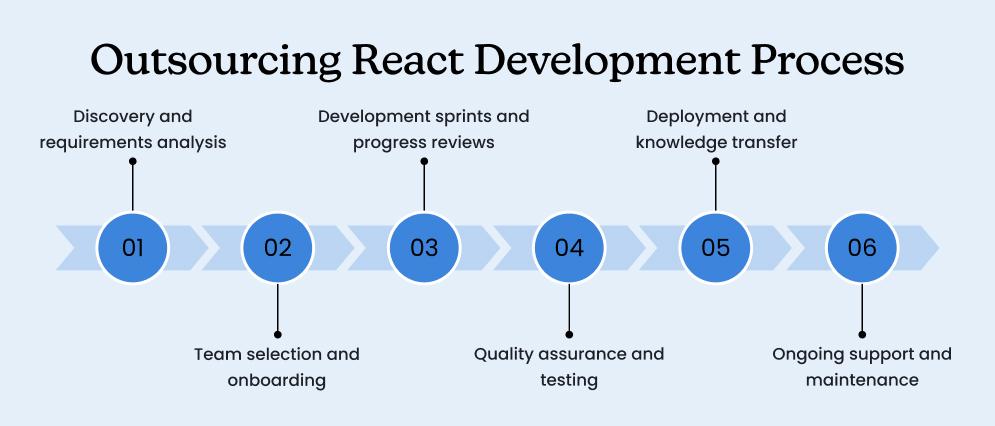
Step 1: Discovery and requirements analysis
The process begins with a detailed understanding of your product vision, user flows, and technical constraints. The vendor conducts workshops, discovery calls, and UI/UX discussions to identify your goals, expected interactions, performance needs, and integration requirements.
This stage defines your component architecture, state management strategy, API dependencies, and expected user experience. By the end of discovery, both teams share a clear roadmap, feature list, and success criteria.
Step 2: Team selection and onboarding
Based on your requirements, the vendor proposes React developers, UI engineers, and QA specialists with relevant experience in similar projects. You may interview or technically assess candidates to ensure skill alignment.
Once finalized, the team receives access to your repositories, design files, API documentation, communication channels, and coding standards. The onboarding phase establishes sprint cycles, review processes, branching strategies, and collaboration guidelines.
Step 3: Development sprints and progress reviews
Development proceeds through structured sprint cycles, typically two weeks long. The team builds reusable components, integrates APIs, and follows defined architecture and performance guidelines.
Progress stays transparent through daily standups, shared task boards, and version-controlled repositories. At the end of each sprint, Space-O conducts a demo to showcase completed features, gather your feedback, and refine upcoming priorities. This iterative rhythm ensures the UI behaves as intended across devices, breakpoints, and real-world user scenarios.
Step 4: Quality assurance and testing
The QA team performs functional testing, responsive testing, cross-browser checks, and performance validations. They verify component behavior, page loading speeds, accessibility compliance, and data accuracy, often relying on industry-standard software testing tools to maintain consistency.
Automated tests, unit tests, integration tests, and snapshot tests help maintain stability as the codebase grows. You review test results and approve releases before any code moves toward staging or production.
Step 5: Deployment and knowledge transfer
After successful testing, the application is deployed to your chosen environment. The team sets up CI/CD pipelines, environment variables, and build configurations to ensure smooth, repeatable deployments. This stage also involves aligning the release workflow with the Top Software Deployment Tools commonly used in modern engineering teams, ensuring the process remains stable and easy to maintain.
Knowledge transfer sessions cover component architecture, custom hooks, routing logic, state management patterns, and optimization decisions. You receive documentation outlining file structure, configuration details, deployment procedures, and long-term maintenance guidelines.
Step 6: Ongoing support and maintenance
Post-launch, the outsourced team continues to support your application through bug fixes, performance tuning, UI enhancements, and new feature development. This phase ensures your React application stays secure, up-to-date, and aligned with evolving user needs.
Regular monitoring, refactoring, and dependency updates keep the frontend fast and maintainable over time. You maintain full flexibility to scale the team up or down depending on your roadmap.
Knowing the process is crucial, but equally important is selecting the right partner to work with. Let’s explore the key factors to consider when choosing your outsourcing provider.
What Should You Consider When Choosing a React Development Outsourcing Partner?
Selecting the right React outsourcing partner determines how efficiently you build, scale, and maintain your frontend. A structured evaluation helps you identify vendors with the technical depth, collaboration style, and industry experience needed to deliver a high-quality React application.
The global outsourcing market is full of vendors claiming frontend expertise, but only a focused set will truly understand modern React practices, performance standards, and scalable UI engineering.
1. Technical expertise in the modern React ecosystem
Your evaluation should begin with a deep review of the partner’s capabilities across the full React stack. Look for vendors who demonstrate strong proficiency in:
- React Hooks, Context API, and advanced component patterns
- State management solutions like Redux Toolkit, Zustand, or React Query
- TypeScript for safer, scalable code
- Modern build tools (Vite, Webpack, Turbopack)
- Testing frameworks such as Jest, React Testing Library, and Cypress
- Performance optimization through memoization, lazy loading, and code-splitting
Industry experience matters as well.
A vendor building dashboards for SaaS products must understand component reusability, while an e-commerce project demands deep knowledge of UX, caching, and API handling. Domain familiarity speeds up planning and reduces design–development friction.
The ideal partner also has strong technical leadership—architects and senior engineers who guide component structure, coding principles, and performance decisions.
2. Portfolio depth and relevant case studies
Reviewing past work gives clear insight into a partner’s capabilities. Look for:
- Applications built with React in similar domains or complexity
- UI-heavy projects showcasing component libraries, dashboards, and dynamic layouts
- Case studies explaining architectural choices, performance challenges, and solutions
Client testimonials reveal how vendors collaborate under real deadlines. Request references to verify reliability, communication quality, and long-term support effectiveness.
Live demos or access to deployed applications show what code quality actually feels like: smooth interactions, fast load times, responsive layouts, and clean UI behavior.
Industry recognitions (e.g., Clutch, GoodFirms) add credibility, but always prioritize hands-on evidence over awards.
3. Communication style and project management approach
React development requires constant alignment between design, backend, and frontend. Strong communication practices are non-negotiable.
Evaluate whether the partner provides:
- A dedicated project manager as your single point of contact
- Clear English communication for accurate requirement understanding
- A consistent reporting structure, daily updates, sprint demos, and weekly summaries
- Transparency around blockers, estimates, and technical decisions
Time-zone overlap matters.
A minimum 3–4 hour overlap allows real-time discussions, UI reviews, and quick clarifications, critical for frontend projects that depend on rapid iteration.
Ensure the partner uses modern collaboration tools such as Jira, Slack, GitHub, and Figma to streamline communication and task tracking.
4. Security practices and intellectual property protection
React applications often interact with sensitive APIs, user data, and authentication layers.
A credible outsourcing partner must follow strong security practices, including:
- Comprehensive NDAs and clearly defined IP ownership terms
- Secure coding standards and input validation to prevent frontend vulnerabilities
- Protected repositories with role-based access and activity logs
- Encrypted communication and safe development environments
- Compliance with industry regulations where necessary (e.g., GDPR, PCI-DSS)
Ask how the partner protects API keys, manages environment variables, and handles sensitive configurations during development and deployment.
5. Common challenges and red flags to watch for
Identifying risks early prevents costly setbacks.
Be cautious of vendors that exhibit:
- Unusually low pricing, which often signals junior developers, missing quality controls, or future hidden costs
- High turnover, which disrupts continuity and slows progress
- Slow communication, especially during early discussions, is an indicator of future delays
- Reluctance to share code samples, case studies, or references
- Vague project scoping, which usually leads to ballooning timelines and budget surprises
A reliable partner will provide transparent pricing, clear deliverables, and a strong willingness to demonstrate their experience and processes.
Transform Your Frontend Vision With Dedicated React Expertise
Partner with Space-O’s battle-tested React developers who understand component-driven architecture, performance tuning, and long-term maintainability. Watch your product evolve faster with every release cycle.
With the ideal partner in mind, the final essential aspect to understand is the cost involved and the main factors that influence outsourcing expenses.
How Much Does it Cost to Outsource React Development? [4 Key Factors to Consider]
Outsourcing React development typically ranges between $25,000 and $400,000+, depending on project complexity, developer expertise, and location. Hourly rates generally vary from $20 to $200, with mid-sized React projects averaging $40,000 to $120,000 for end-to-end development.
To budget accurately, it’s essential to look beyond hourly rates and consider total project investment, including development, management, infrastructure, and hidden expenses.
Companies that carefully assess the cost of React Native development see up to 23% better budget adherence and fewer surprises during delivery.
1. Regional cost differences in React development
- North America: Rates range from $70 to $150 per hour for React developers, reflecting high living costs and competitive local markets.
- Eastern Europe: React developers charge $30 to $80 per hour, offering a balance of quality and affordability.
- Asia: Rates are $12 to $40 per hour, with India and the Philippines leading in volume and cost-effectiveness.
- Latin America: React developers charge $35 to $70 per hour, providing nearshore convenience for North American companies.
2. Pricing models and engagement types for React projects
- Fixed-price contracts are ideal for well-defined React apps with clear workflows and features, transferring delivery risk to the vendor.
- Time and materials contracts suit evolving projects, allowing flexibility and control over scope changes.
- Dedicated team models provide exclusive React development squads for long-term or complex projects.
- Hybrid models combine fixed-price milestones with time & materials phases to balance budget control with adaptability.
3. Hidden Costs to Account For in React Development
- Project management overhead typically adds 15–20% to development costs, with some reports indicating up to a 30% increase due to communication and documentation needs.
- Infrastructure expenses: Cloud hosting, development tools, and third-party services add recurring operational costs, ranging from $200 to $800 per developer annually.
- Knowledge transfer and documentation: Budget 10% of the development cost for documentation and training, with some projects requiring 40–80 hours of retroactive documentation.
- Post-launch support and maintenance: React apps typically need 15–20% of the initial development cost annually for bug fixes, updates, and upgrades.
4. Calculating ROI on Outsourced React Development
Factor in the total cost of ownership: initial coding, deployment infrastructure, and ongoing maintenance over 3 years. Compare this to in-house React development, including salaries, benefits, recruitment, and infrastructure.
Outsourcing often accelerates time-to-market, allowing your product to capture market share months earlier, potentially outweighing pure cost savings.
Consider opportunity costs: outsourcing React lets internal teams focus on core business strategies rather than development.Finally, evaluate risk mitigation benefits: avoid recruitment uncertainties, reduce technical debt through expert developers, and gain flexibility to scale React teams based on evolving project needs.
Outsource React Development With Space-O Technologies
At Space-O Technologies, we’ve delivered over 300 software solutions for businesses across Canada and the US since 2018. Our React development work spans web applications, React Native mobile apps, SaaS platforms, and enterprise integrations, supporting modern frontend initiatives often aligned with broader enterprise application development goals.
We make it easier for businesses to outsource React development without sacrificing quality, speed, or technical depth. Our team brings the expertise needed to build responsive interfaces, optimize performance, and support products that evolve quickly.
When you outsource React development to Space-O, you gain developers who write clean, scalable code and stay committed to delivering a polished user experience. We guide you through architecture decisions, UI engineering, testing, and ongoing improvements with a collaborative, transparent workflow. With us, you strengthen your frontend capabilities and ship React features that enhance your product’s long-term growth. Schedule a free React Native consultation to discuss your React project.
Frequently Asked Questions About Outsourced React Development
Can I outsource only part of my React project instead of the entire development?
Yes. Many companies outsource specific modules, UI components, refactoring tasks, or performance improvements while keeping core development in-house. This approach gives teams flexibility without losing project control.
How do time zone differences affect outsourced React development?
Time zone gaps can actually improve productivity by enabling near-continuous development. Outsourcing partners schedule overlapping hours for sprint planning, daily syncs, and feedback reviews to maintain smooth collaboration.
Can outsourced React developers work on sensitive or compliance-heavy products?
They can, provided the partner follows strict access controls, secure coding standards, and compliance requirements relevant to your industry. Clear data policies ensure your product remains protected.
What tools help manage communication with an outsourced React development team?
Teams commonly use Slack or Microsoft Teams for communication, Jira or Trello for task tracking, GitHub or GitLab for code reviews, and Figma for design handoffs. These tools keep collaboration organized and transparent.
Can I switch outsourcing partners midway through a React project?
Yes. If your project has structured documentation, clean repositories, and proper handover notes, a new team can take over without major disruption. The transition works best when the outgoing partner provides full access to project assets.
What should I prepare before approaching a React outsourcing partner?
You should prepare user flows, feature priorities, design references, API details, and your expected timelines. Clear requirements help the outsourcing partner estimate accurately and start development efficiently.

 All our projects are secured by NDA
100% Secure. Zero Spam
*All your data will remain strictly confidential.
Trusted by


Bashar Anabtawi 
Canada
“I was mostly happy with the high level of experience and professionalism of the various teams that worked on my project. Not only they clearly understood my exact technical requirements but even suggested better ways in doing them. The Communication tools that were used were excellent and easy. And finally and most importantly, the interaction, follow up and support from the top management was great. Space-O not delivered a high quality product but exceeded my expectations! I would definitely hire them again for future jobs!”

Canada Office
2 County Court Blvd., Suite 400,
Brampton, Ontario L6W 3W8
Phone: +1 (602) 737-0187
Email: sales@spaceo.ca