

Paediatric EHR Development: Features, Benefits, and Implementation Guide
Is your paediatric practice struggling with an EHR system designed for adult patients? You’re not alone. Many children’s healthcare providers find themselves manually calculating weight-based dosages, tracking immunizations on paper, or missing developmental milestones because their generic EHR simply wasn’t built for paediatric care.
According to Precedence Research, the global paediatric electronic health records software market was valued at USD 40.42 billion in 2024 and is projected to reach USD 82.15 billion by 2034, growing at a CAGR of 7.35%.
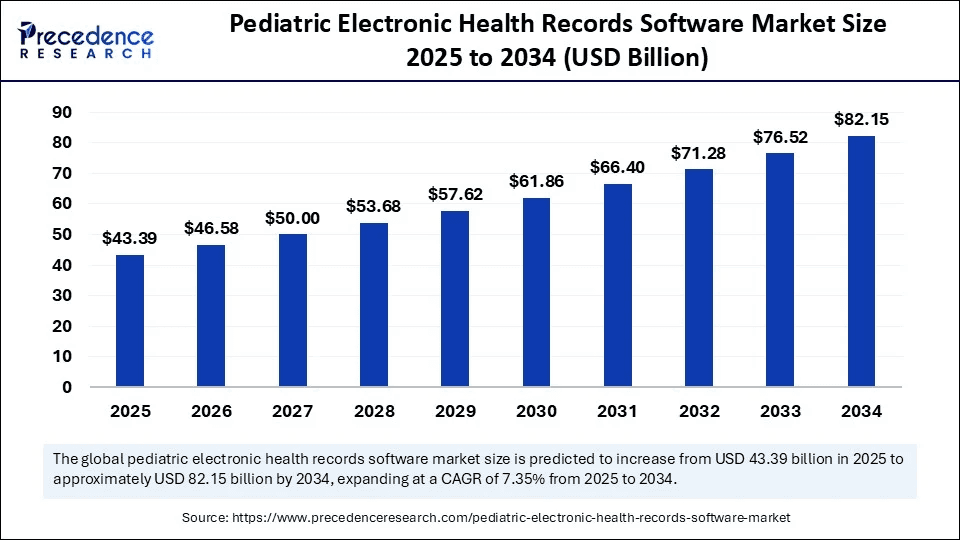
This rapid growth reflects the increasing demand for specialized children’s healthcare technology. Yet despite high overall EHR adoption rates in healthcare, paediatric practices report lower adoption due to the lack of child-specific functionality in generic systems.
This gap is driving healthcare organizations to invest in specialized EHR software development serives tailored specifically for paediatric workflows.
This guide covers everything you need to know about paediatric EHR development. You’ll learn the essential features that differentiate paediatric systems from general EHRs, the development process, compliance requirements for Canada, costs involved, and how to select the right development partner for your project.
What is Paediatric EHR Software?
Paediatric EHR (Electronic Health Record) software is a specialized digital health records system designed specifically to manage the unique clinical, administrative, and documentation needs of children’s healthcare from birth through adolescence.
Unlike general-purpose EHRs that treat patients as a uniform population, paediatric EHR systems account for the rapid physiological changes, developmental stages, and preventive care requirements unique to children.
A paediatric EHR captures and organizes patient data including growth measurements, immunization histories, developmental assessments, well-child visit documentation, and age-specific clinical findings.
Canadian paediatric practices must ensure their EHR systems comply with both PHIPA (Personal Health Information Protection Act) and PIPEDA while supporting provincial immunization registries and public health reporting requirements.
Working with experienced EHR software development companies ensures these compliance requirements are built into the system architecture from day one.
With the foundation established, let’s examine why generic EHR systems fall short for paediatric practices and what drives the need for specialized solutions.
Why Do Paediatric Practices Need Specialized EHR?
Generic EHR systems designed for adult medicine create significant workflow challenges when applied to paediatric care. When you build an EHR system without paediatric-specific considerations, these limitations impact clinical efficiency, patient safety, and the quality of documentation that paediatric providers can maintain
These limitations impact clinical efficiency, patient safety, and the quality of documentation that paediatric providers can maintain.
1. Age-specific clinical requirements
Children’s bodies change dramatically from infancy through adolescence. A medication dose appropriate for a 2-year-old differs substantially from one for a 12-year-old, even for the same condition. Generic EHRs lack the sophisticated age-based and weight-based dosing calculators that paediatric prescribing demands. Without these safeguards, clinicians must perform manual calculations, increasing error risk and documentation time.
2. Growth and developmental tracking limitations
Paediatric care centres on monitoring growth trajectories and developmental progress. Generic EHRs may offer basic height and weight fields, but they rarely include WHO or CDC growth chart integration, percentile calculations, or trend visualization across visits. Developmental milestone tracking such as gross motor, fine motor, language, and social-emotional markers, requires structured documentation that most general EHRs don’t support.
3. Complex immunization management
The paediatric immunization schedule involves dozens of vaccines administered across specific age windows with minimum intervals between doses. Generic EHRs often lack the logic to determine which vaccines are due, overdue, or contraindicated based on a child’s age and immunization history. This forces staff to reference immunization schedules manually and increases the risk of missed or incorrectly timed vaccinations.
4. Family-centered care model
Paediatric care involves parents, guardians, and sometimes multiple caregivers in treatment decisions. Generic EHRs built for individual adult patients struggle to accommodate family relationships, guardian consent tracking, and communication with multiple authorized contacts. Custody arrangements and divorced parents sharing medical decision-making add complexity that standard systems don’t address.
5. Preventive care emphasis
Well-child visits form the backbone of paediatric practice, focusing on prevention rather than treatment. These visits follow structured protocols based on age-specific screenings, anticipatory guidance topics, and developmental assessments. Generic EHRs designed around problem-oriented documentation don’t naturally support the wellness visit workflow that paediatric practices require.
Pro Tip: When evaluating your current EHR’s paediatric capabilities, document every workaround your staff uses daily, from manual growth chart plotting to immunization schedule lookups. These workarounds represent the functional gaps your specialized paediatric EHR must address.
Understanding these limitations clarifies what features a purpose-built paediatric EHR must include. Let’s explore the essential capabilities that define effective paediatric health record systems.
What are the Key Features of Paediatric EHR Systems?
Effective paediatric EHR systems combine standard health record functionality with specialized tools designed for children’s healthcare delivery. These features address the unique documentation, clinical decision support, and workflow requirements of paediatric practice.
1. Growth chart integration and percentile tracking
Growth monitoring forms a cornerstone of paediatric care. A paediatric EHR should integrate WHO growth standards for children under 2 years and CDC growth charts for ages 2-20. The system should automatically calculate and plot height, weight, head circumference, and BMI percentiles. Visual trend lines help clinicians quickly identify growth faltering, obesity concerns, or other patterns requiring intervention. The system should flag significant percentile crossings and calculate growth velocity between visits.
2. Immunization management and vaccine scheduling
Comprehensive vaccine management includes maintaining the complete immunization history, forecasting upcoming vaccines based on CDC or provincial schedules, identifying overdue immunizations, and tracking contraindications or deferrals. The system should support lot number and administration site documentation, generate immunization records for schools and daycare, and integrate with provincial immunization registries. Catch-up schedule calculation for children who missed vaccines is essential.
3. Developmental milestone documentation
Structured tools for documenting developmental assessments across motor, language, cognitive, and social-emotional domains enable consistent tracking. The EHR should incorporate validated screening instruments like the ASQ (Ages and Stages Questionnaire), M-CHAT for autism screening, and Edinburgh for postpartum depression screening in parents. Automatic prompts for age-appropriate screenings ensure providers don’t miss critical developmental windows.
4. Age-based clinical alerts and paediatric dosing
Clinical decision support must account for age-specific parameters. Weight-based medication dosing with maximum dose limits, age-appropriate vital sign ranges, and paediatric-specific drug interaction warnings protects patient safety. The system should alert providers when vital signs fall outside age-normal ranges and flag medications not approved for paediatric use.
5. Well-child visit templates
Pre-built templates aligned with Bright Futures or Rourke Baby Record guidelines streamline well-child documentation. These templates prompt providers through age-specific physical examination elements, anticipatory guidance topics, and screening requirements. Structured documentation ensures consistent, complete visits while reducing the time clinicians spend navigating free-form notes.
6. Paediatric-specific billing (EPSDT compliance)
For practices serving Medicaid populations, the EHR must support Early and Periodic Screening, Diagnostic, and Treatment (EPSDT) documentation requirements. This includes tracking eligible services, documenting completed screenings, and generating compliant claims. Paediatric-specific CPT codes and modifiers should be readily accessible during encounter documentation. Integration with medical billing software streamlines revenue cycle management for paediatric practices. This guide on healthcare software development covers how these integrations work across different clinical systems.
Build Paediatric EHR Software Designed for Child-Centric Care
Develop paediatric EHR systems that support growth charts, immunization tracking, and age-specific documentation across clinical workflows.
These features deliver tangible advantages for paediatric practices. Here’s how custom EHR development translates specialized functionality into measurable clinical and operational benefits.
What are the Benefits of Custom Paediatric EHR Development?
Investing in custom paediatric EHR development delivers advantages that off-the-shelf solutions modified for paediatric use cannot match. These benefits span clinical quality, operational efficiency, and patient engagement.
1. Improved clinical efficiency and workflow
Custom paediatric EHRs align documentation flows with how paediatricians actually practice. Well-child visits, sick visits, and adolescent encounters each follow distinct patterns. A custom system builds these workflows directly into the interface rather than forcing providers to adapt generic templates. Practices report 20-30% reductions in documentation time when using EHRs designed specifically for paediatric workflows.
At Space-O, we begin every paediatric EHR project by shadowing your clinical team to understand exactly how well-child visits, acute care appointments, and adolescent encounters flow through your practice. This discovery process ensures the final system mirrors your actual workflows—not a generic template you’re forced to work around.
2. Enhanced patient safety with age-based alerts
Medication errors represent a significant risk in paediatric care due to weight-based dosing complexity. Custom EHR development enables sophisticated clinical decision support calibrated for paediatric populations. Real-time alerts for dosing errors, age-inappropriate medications, and missed vaccinations catch potential safety issues before they reach patients. These systems can reduce paediatric medication errors by up to 50% compared to generic EHRs.
3. Better family engagement through parent portals
Custom patient portal development allows paediatric practices to design portal experiences suited for parents managing their children’s healthcare. Features like immunization record sharing with schools, developmental milestone education materials, and secure messaging with nursing staff increase parent engagement. Practices with well-designed parent portals see higher preventive visit completion rates and improved vaccination coverage.
4. Accurate growth and development tracking
Purpose-built growth monitoring tools generate clear visualizations that clinicians can review instantly and share with families. Automatic percentile calculations eliminate manual plotting errors. Developmental screening integration ensures appropriate assessments occur at each visit without relying on provider memory. This systematic approach improves early identification of growth disorders and developmental delays. Advanced systems can incorporate predictive analytics in healthcare to identify at-risk children before conditions become severe.
5. Streamlined immunization compliance
Automated vaccine forecasting and registry integration dramatically reduce the administrative burden of immunization management. The system identifies which vaccines each patient needs at every visit, flags overdue immunizations for outreach, and automatically reports administered vaccines to provincial registries. Practices using specialized immunization management tools achieve vaccination rates 15-20% higher than those relying on manual tracking.
6. Reduced documentation burden and provider burnout
Physician burnout correlates strongly with EHR usability issues. Custom paediatric EHRs reduce clicks, eliminate redundant data entry, and present information in clinically logical layouts. Smart templates and voice documentation options further decrease documentation time. When providers spend less time fighting their EHR, they have more time for patient care and report higher job satisfaction.
Pro Tip: Quantify your current EHR pain points before development begins. Track metrics like documentation time per encounter, immunization reminder call volume, and growth chart plotting time. These baselines help demonstrate ROI after your custom paediatric EHR launches.
Understanding the benefits clarifies the value proposition. Now let’s examine the step-by-step process for developing a paediatric EHR system that delivers these advantages.
A Step-by-Step Guide to Developing a Paediatric EHR System
Developing a paediatric EHR requires methodical planning, clinical input, and technical expertise. The following process ensures your system meets clinical needs while maintaining compliance and security standards.
Step 1: Requirements gathering and workflow analysis
Begin by documenting current clinical workflows across all encounter types: well-child visits, sick visits, mental health visits, and adolescent care. Shadow clinicians and staff to identify pain points with existing systems. Gather input from paediatricians, nurses, medical assistants, and billing staff. Define must-have features versus nice-to-have enhancements. This phase typically requires 4-6 weeks and produces detailed functional specifications.
At Space-O Canada, our business analysts conduct on-site discovery sessions with your clinical team. We observe actual patient encounters, interview staff across all roles, and document every workflow bottleneck. This hands-on approach ensures we capture requirements that generic questionnaires miss—like how your nurses handle vaccine hesitancy conversations or how front desk staff manage same-day sick visit requests.
Step 2: UI/UX design for paediatric workflows
Design interfaces that reflect how paediatric providers think and work. Growth charts should display prominently during well-child visits. Immunization status needs immediate visibility. Age-appropriate templates should load automatically based on patient demographics. Create wireframes and interactive prototypes for clinical review before development begins. Iterate based on provider feedback until workflows feel intuitive. Proper healthcare app design principles ensure clinicians can navigate the system efficiently without disrupting patient care.
Our UI/UX team specializes in clinical interface design. We create interactive prototypes that your paediatricians and nurses can test before we write a single line of code. This iterative design process reduces costly changes during development and ensures the final system feels natural to your team from day one.
Step 3: Core feature development
Build the foundational EHR components: patient demographics, encounter documentation, medication management, and scheduling. Layer paediatric-specific modules including growth tracking, immunization management, developmental screening tools, and age-based clinical decision support. Use modular architecture, allowing features to be updated independently. Organizations pursuing healthcare app development should prioritize scalable architecture from the outset.
Step 4: Integration with immunization registries
Connect your EHR to provincial immunization information systems. In Canada, this means integrating with systems like Ontario’s ICON (Immunization Connect Ontario), Alberta’s Imm/ARI, or BC’s Provincial Immunization Registry. These integrations require HL7 or FHIR messaging conformance and often involve provincial approval processes. Plan for 8-12 weeks of integration, developmen,t and testing.
Step 5: Compliance and security implementation
Implement security controls meeting HIPAA (US) and PHIPA/PIPEDA (Canada) requirements. This includes end-to-end encryption, role-based access controls, audit logging, automatic session timeouts, and secure backup procedures. Conduct a security risk assessment and document policies for workforce training, incident response, and breach notification. Compliance should be built into the architecture, not added afterward.
Step 6: Testing and quality assurance
Execute comprehensive testing across multiple dimensions. Functional testing verifies each feature works as specified. Integration testing confirms data flows correctly between modules and external systems. Security testing identifies vulnerabilities before deployment. User acceptance testing (UAT) involves actual paediatric providers using the system with realistic scenarios. Performance testing ensures the system handles expected patient volumes without degradation.
Our QA team executes rigorous testing protocols covering functionality, security, integration, and performance. We conduct penetration testing through certified professionals, validate clinical calculations for accuracy, and run user acceptance testing with your actual staff before deployment.
Step 7: Training and deployment
Develop role-specific training materials for providers, nurses, and administrative staff. Conduct hands-on training sessions before go-live. Plan for a phased deployment starting with a pilot group before full practice rollout. Provide intensive support during the first 30-60 days. Establish feedback channels to capture issues and improvement suggestions during the stabilization period.
What Our Healthcare Clients Say
Our approach to healthcare software development has earned recognition from medical practices across North America. Here’s what one of our healthtech clients shared:

This project involved designing a user-friendly healthtech website with engaging content and a secured patient portal—demonstrating our expertise in healthcare-focused digital solutions rated 5.0 across quality, schedule, cost, and willingness to refer.
Turn Complex Paediatric Workflows Into Streamlined Digital Records
Space-O helps healthcare organizations develop paediatric EHR solutions that improve data accuracy, continuity of care, and provider efficiency.
A compliant system requires understanding the regulatory landscape. Let’s examine the specific compliance requirements that paediatric EHR development must address.
What are the Compliance Requirements for Paediatric EHR?
Paediatric EHR systems must satisfy healthcare data protection regulations while addressing additional considerations unique to treating minor patients. Understanding these requirements ensures your development project produces a compliant, deployable system.
1. PHIPA and PIPEDA (Canadian requirements)
Canadian paediatric practices must comply with provincial health information legislation (PHIPA in Ontario, HIA in Alberta, etc.) and federal PIPEDA requirements. These regulations mandate consent for collection and use of personal health information, data security safeguards, breach notification procedures, and individual access rights. Paediatric EHRs serving Canadian patients need data residency within Canada and compliance with provincial health information custodian requirements.
2. EPSDT (Early and Periodic Screening) standards
Practices serving Medicaid-enrolled children must document services meeting EPSDT requirements. This federal program mandates comprehensive preventive care including physical examinations, immunizations, laboratory tests, and developmental assessments. Your paediatric EHR should track EPSDT-eligible patients, prompt for required screenings, and generate documentation supporting Medicaid claims for these services.
3. ONC certification requirements
If your paediatric EHR will participate in US federal programs, ONC (Office of the National Coordinator) certification may be required. This certification verifies the system meets technical standards for interoperability, security, and clinical functionality. The certification process involves testing by an accredited body and adds 3-6 months to development timelines. Many paediatric practices operate without ONC certification if they don’t participate in programs requiring it.
4. Data security for minor patient records
Protecting children’s health information carries particular sensitivity. Implement encryption at rest and in transit using AES-256 standards. Deploy multi-factor authentication for all users. Maintain comprehensive audit logs tracking every access to patient records. Establish data retention policies aligned with state and provincial requirements for medical records of minors (often longer than adult retention periods).
Quick Insight: Canadian paediatric practices should confirm whether their provincial immunization registry requires specific data formats or submission protocols. Registry integration often drives technical architecture decisions that affect overall system design.
Even well-planned projects encounter obstacles. Understanding common challenges helps development teams prepare solutions before these issues impact timelines or budgets.
What are the Common Challenges in Paediatric EHR Development?
Paediatric EHR development presents unique technical and clinical challenges beyond those encountered in general healthcare software projects. Anticipating these challenges enables better planning and risk mitigation.
1. Managing complex age-based logic implementation
Challenge:
Paediatric clinical rules vary continuously with patient age. Vaccine schedules change monthly during infancy, growth charts switch standards at age two, and vital sign ranges shift throughout childhood. Premature infants require additional gestational age corrections.
Solution:
Implement sophisticated rule engines that calculate patient age precisely and apply appropriate clinical parameters automatically. Build modular logic that accommodates edge cases and allows easy updates as clinical guidelines evolve.
2. Navigating immunization registry integration complexities
Challenge:
Provincial and territorial immunization registries use varying technical standards, data formats, and submission processes. Some support real-time bidirectional exchange while others only accept batch uploads. Registry specifications change frequently, requiring ongoing maintenance.
Solution:
Budget significant development and testing effort for registry integrations from the project outset. Build flexible interfaces that accommodate different exchange methods and create maintenance workflows for specification updates.
3. Supporting multi-guardian access management
Challenge:
Modern families present complex custody and guardianship situations. Divorced parents may share medical decision-making, grandparents may have legal guardianship, and foster children involve agency oversight. Incorrect access configurations cause both usability problems and privacy violations.
Solution:
Design relationship models supporting multiple authorized users per patient with configurable access levels, communication preferences, and consent authorities. Test thoroughly with complex family scenarios before deployment.
4. Facilitating transition of care to adult providers
Challenge:
Adolescent patients eventually age out of paediatric care and require comprehensive records for adult providers. This includes complete immunization histories, chronic condition documentation, and developmental health records. Managing record accessibility after transition presents additional complexity.
Solution:
Build functionality for generating comprehensive care summaries specifically designed for adult provider transitions. Establish clear policies for record retention and accessibility after patients age out of your system.
5. Addressing varying provincial reporting requirements
Challenge:
Public health reporting requirements differ significantly across Canadian jurisdictions. Reportable conditions, immunization registry formats, newborn screening protocols, and lead screening requirements vary by province. Practices serving patients across jurisdictions face compliance complexity.
Solution:
Design EHR architecture supporting multiple reporting configurations from the beginning. Create jurisdiction-specific modules that can be activated based on practice location and patient residence.
Organizations pursuing custom software development for healthcare should partner with developers experienced in navigating these paediatric-specific challenges.
Understanding the investment required helps practices plan appropriately. Here’s what paediatric EHR development typically costs across different project scopes.
How Much Does Paediatric EHR Development Cost?
Paediatric EHR development costs vary significantly based on project scope, feature complexity, integration requirements, and development team location. For a broader perspective on EHR software development cost, these figures align with industry standards for specialty-specific systems.
The following estimates provide realistic ranges for planning purposes.
1. Factors affecting paediatric EHR development cost
- Feature complexity: Sophisticated clinical decision support, AI-powered developmental screening, or advanced analytics increase costs substantially compared to basic documentation features. This detailed guide on healthcare app development cost provides additional insights into budgeting for medical software projects.
- Integration requirements: Each external system integration (immunization registries, lab interfaces, billing systems, provincial health networks) adds $15,000-$50,000 in development and testing effort.
- Compliance scope: ONC certification, provincial health authority approvals, or SOC 2 compliance audits add both cost and timeline to projects.
- Development team location: North American development teams typically charge $100-$200/hour while experienced offshore teams range from $40-$80/hour. Quality varies significantly, so evaluate healthcare-specific experience regardless of location.
- Customization depth: Highly customized workflows matching your exact practice patterns cost more than configuring pre-built templates. Balance customization against budget constraints.
2. Cost breakdown by project type
| Project Scope | Features Included | Estimated Cost (USD) | Timeline |
|---|---|---|---|
| MVP / Pilot | Core documentation, basic growth charts, immunization tracking, single provider | $80,000 – $150,000 | 4-6 months |
| Standard System | Full growth monitoring, developmental screening, immunization registry integration, multi-provider, parent portal | $200,000 – $400,000 | 8-12 months |
| Enterprise System | Advanced analytics, multiple location support, full interoperability, telehealth integration, mobile apps | $400,000 – $800,000+ | 12-18 months |
| Ongoing Maintenance | Bug fixes, security updates, minor enhancements, hosting | 15-20% of development cost annually | Ongoing |
Selecting the right development partner significantly impacts project success. Here’s how to evaluate potential vendors for your paediatric EHR project.
How to Choose a Paediatric EHR Development Partner?
The development partner you select determines whether your paediatric EHR project succeeds or struggles. Evaluate potential vendors across these critical dimensions before making commitments.
1. Healthcare domain expertise
General software developers often underestimate healthcare complexity. Look for partners with demonstrated healthcare IT experience including familiarity with clinical workflows, medical terminology, and the regulatory environment. Ask about their experience with paediatric-specific projects. A team that understands growth charts, immunization logic, and developmental screening will require far less clinical guidance than developers learning healthcare for the first time.
2. HIPAA/PHIPA compliance experience
Compliance isn’t something to figure out after development. Your partner should have established HIPAA and PHIPA compliance frameworks including security architecture patterns, audit logging implementations, and experience with Business Associate Agreements. Ask how they’ve handled compliance for previous healthcare clients. Request documentation of their security practices and any relevant certifications.
3. Portfolio of EHR projects
Review the vendor’s portfolio for EHR or clinical software projects. Ideally, they’ve built systems handling patient documentation, clinical decision support, and health data integrations. Ask for case studies detailing project scope, challenges overcome, and outcomes achieved. Speaking with references from healthcare clients provides valuable perspective on what working with this partner actually involves. Space-O Technologies has delivered hospital management systems and EHR solutions for healthcare organizations across North America.
4. Integration capabilities
Paediatric EHRs require connections to immunization registries, laboratory systems, billing platforms, and potentially provincial health networks. Assess your partner’s experience with HL7 v2, FHIR, and other healthcare interoperability standards. Integration work often determines project timelines, so partners with pre-built healthcare integration components accelerate delivery.
If you’re considering hiring software developers for your paediatric EHR project, prioritize candidates with healthcare domain knowledge alongside technical skills.
Develop Secure and Compliant Paediatric EHR Software With Space-O
Partner with Space-O to build PIPEDA-ready paediatric EHR systems aligned with child-health regulations and clinical needs.
Finding the right partner leads to successful implementation. Space-O Technologies brings the expertise your paediatric EHR project requires.
Transform Your Paediatric Practice with Space-O Technologies
Building a paediatric EHR that truly serves your practice requires more than technical skill. It demands understanding of paediatric clinical workflows, healthcare compliance requirements, and the integration landscape connecting modern health systems.
Since 2018, Space-O Technologies has years of expertise in software development with a specialized focus on healthcare solutions. Our team has delivered 300+ successful projects, including healthcare applications meeting HIPAA, PHIPA, and PIPEDA compliance standards.
Explore our healthcare software solutionsto see how we’ve helped other practices achieve similar goals.
We understand the unique requirements of paediatric care from growth monitoring and immunization management to developmental screening integration. If you’re exploring external development partners, our guide on healthcare IT outsourcing explains how to evaluate and select the right team for your project.
Our healthcare development expertise includes:
- Custom EHR development tailored to paediatric practice workflows
- PIPEDA and PHIPA-compliant architecture and security implementation
- Immunization registry integration with Canadian provincial systems
- HL7 and FHIR interoperability for seamless health data exchange
- Parent portal development supporting family-centered care models
- Ongoing maintenance and support, ensuring system reliability
Whether you’re building a new paediatric EHR from scratch, modernizing a legacy system, or adding paediatric modules to an existing platform, Space-O Technologies provides the technical expertise and healthcare domain knowledge your project needs.
Ready to discuss your paediatric EHR project? Schedule a Free Consultation with our healthcare software experts.
Frequently Asked Questions about Paediatric EHR Development
What is the difference between paediatric EHR and general EHR systems?
Paediatric EHRs include specialized features for children’s healthcare that general systems lack: growth chart integration with percentile tracking, immunization schedule management, developmental milestone documentation, age-based clinical alerts, weight-based medication dosing calculators, and well-child visit templates. These features address the unique clinical requirements of treating patients from birth through adolescence.
How long does it take to develop a custom paediatric EHR?
Development timelines range from 4-6 months for a minimum viable product (MVP) with core features through our mvp development services to 12-18 months for a comprehensive enterprise system with full interoperability, advanced analytics, and mobile applications. Most standard paediatric EHR projects complete within 8-12 months including requirements gathering, development, testing, and deployment.
Can a paediatric EHR integrate with immunization registries?
Yes, paediatric EHRs can and should integrate with provincial immunization information systems. In Canada, this includes systems like Ontario’s ICON, Alberta’s Imm/ARI, and BC’s Provincial Immunization Registry. Integration enables automatic vaccine forecasting, real-time registry queries, and electronic submission of administered immunizations. These integrations typically use HL7 v2 or FHIR messaging standards.
How much does paediatric EHR development cost?
Costs range from $80,000-$150,000 for an MVP to $400,000-$800,000+ for enterprise systems. Key cost factors include feature complexity, number of external integrations, compliance requirements, and development team location. Annual maintenance typically runs 15-20% of initial development cost. Most practices should budget $200,000-$400,000 for a standard paediatric EHR with essential features and integrations.
Is cloud-based or on-premise better for paediatric EHR?
Cloud-based deployment offers advantages for most paediatric practices: lower upfront infrastructure costs, automatic updates and maintenance, easier scalability, and built-in disaster recovery. However, some organizations prefer on-premise deployment for complete data control or specific compliance requirements. Hybrid approaches hosting sensitive data on-premise while using cloud services for other functions offer a middle path. Choose based on your practice’s technical capabilities, budget, and compliance needs.


Want to Develop Secure and Compliant Paediatric EHR Software?
 All our projects are secured by NDA
100% Secure. Zero Spam
*All your data will remain strictly confidential.
Trusted by


Bashar Anabtawi 
Canada
“I was mostly happy with the high level of experience and professionalism of the various teams that worked on my project. Not only they clearly understood my exact technical requirements but even suggested better ways in doing them. The Communication tools that were used were excellent and easy. And finally and most importantly, the interaction, follow up and support from the top management was great. Space-O not delivered a high quality product but exceeded my expectations! I would definitely hire them again for future jobs!”

Canada Office
2 County Court Blvd., Suite 400,
Brampton, Ontario L6W 3W8
Phone: +1 (602) 737-0187
Email: sales@spaceo.ca