

Pediatric EMR Development: Complete Guide to Building Child-Focused Healthcare Software
Is your pediatric practice struggling with an EMR system designed for adult patients? You’re not alone. Many children’s healthcare providers find themselves manually calculating weight-based dosages, tracking immunizations on paper, or missing developmental milestones because their generic EMR simply wasn’t built for pediatric care.
According to Precedence Research, the global pediatric electronic health records software market was valued at USD 40.42 billion in 2024 and is projected to reach USD 82.15 billion by 2034, growing at a CAGR of 7.35%.
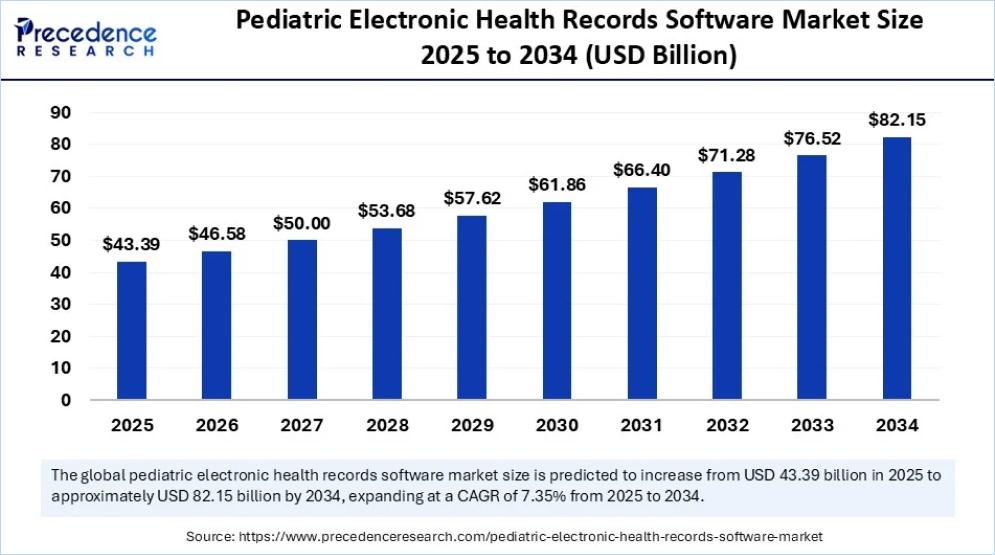
This rapid growth reflects the increasing demand for specialized children’s healthcare technology. Yet despite high overall EMR adoption rates in healthcare, pediatric practices report lower adoption due to the lack of child-specific functionality in generic systems. This gap is driving healthcare organizations to invest in specialized EHR software development tailored specifically for pediatric workflows.
With this guide, you will understand how pediatric EMR software differs from standard systems, the essential features it requires, key Canadian compliance requirements, realistic development timelines and costs, and how to choose between custom and off-the-shelf solutions.
What is Pediatric EMR Software?
Pediatric EMR (Electronic Medical Records) software is a specialized healthcare information system designed specifically for documenting, managing, and tracking children’s health information from birth through adolescence. Unlike standard EMR systems built for adult patients, pediatric EMR software incorporates age-specific clinical tools, growth tracking, immunization management, and developmental milestone documentation.
How pediatric EMR differs from standard EMR systems
Standard EMR systems are designed with adult patients in mind. They use fixed vital sign ranges, standard medication dosing, and documentation templates that don’t account for the rapid changes in a child’s development. Pediatric EMR software addresses these gaps by providing:
- Age-adjusted vital sign parameters that change as children grow
- Weight-based medication calculations are critical for patient safety
- Growth chart integration using WHO and CDC standards
- Developmental screening tools for early intervention
- Immunization tracking aligned with Canadian schedules
Now that you understand what pediatric EMR software is, let’s explore the essential features your system needs to serve young patients effectively.
What are the Key Features of Pediatric EMR Systems?
The key features of pediatric EMR systems include age-specific growth charts, immunization management, age-based medication dosing, developmental milestone tracking, parent and guardian portals, and provincial immunization registry integration.
When planning pediatric EMR development, you need to include features that address the unique requirements of children’s healthcare. At Space-O Canada, we’ve identified the following as essential components based on our experience building healthcare applications for Canadian practices.
1. Age-specific growth charts
Growth monitoring is fundamental to pediatric care. Your EMR should integrate WHO growth standards for children 0-5 years and CDC growth charts for ages 2-20. Include percentile calculations, trend visualization tools, and built-in alerts for growth abnormalities to identify potential health concerns early.
2. Pediatric immunization management
Immunization tracking is critical in pediatric EMR systems. The software should follow the Canadian Immunization Guide schedule with automated parent reminders to improve compliance rates. Generate school and daycare immunization records on demand and integrate with provincial registries like CANImmunize for seamless data sharing.
3. Age-based medication dosing
Medication errors are a significant concern in pediatric care. Your EMR must include weight-based dosing calculators that compute appropriate amounts automatically. The system should suggest age-appropriate formulations, provide comprehensive allergy and interaction checking, and include maximum dose alerts to prevent accidental overdosing.
4. Developmental milestone tracking
Documenting developmental progress helps identify delays and ensures timely interventions. Incorporate standardized screening tools like the Ages and Stages Questionnaire and M-CHAT for evidence-based assessments. Include milestone checklists by age, early intervention referral triggers, and customizable progress note templates for efficient documentation.
5. Parent and guardian portal
Provide secure access for parents to view their child’s health records, book appointments, and communicate directly with the practice. This patient portal improves family engagement, reduces administrative phone calls, and gives caregivers convenient access to important health information, including immunization records and upcoming visit schedules.
6. Provincial immunization registry integration
Connect with provincial immunization registries, including Ontario’s Digital Health Immunization Repository and Alberta’s AIR for real-time vaccination record synchronization. This integration ensures accurate record-keeping across healthcare providers and eliminates manual data entry while maintaining compliance with provincial public health reporting requirements.
Want to Build a Pediatric EMR System for Your Practice?
Discuss your requirements with Space-O Canada’s healthcare software specialists. We understand Canadian compliance requirements and help you plan your project from concept to launch.
Building these features is only part of the equation. Your pediatric EMR must also meet strict Canadian healthcare regulations to protect patient data and ensure legal compliance.
What are the Canadian Compliance Requirements for Pediatric EMR?
Developing healthcare software in Canada requires strict adherence to federal and provincial privacy regulations. For pediatric EMR systems, compliance becomes even more complex due to the involvement of minors and their guardians.
At Space-O Canada, we build compliance into every aspect of development, ensuring your system meets all regulatory requirements from day one.
1. Federal regulations: PIPEDA
The Personal Information Protection and Electronic Documents Act (PIPEDA) governs how private-sector organizations collect, use, and disclose personal information. For pediatric EMR development, PIPEDA requires:
- Consent mechanisms appropriate for health information collection and use
- Data minimization principles ensuring you collect only necessary information
- Security safeguards to protect patient data through technical and organizational measures
- Access rights for patients and guardians to view and correct their information
- Breach notification procedures with mandatory reporting to affected individuals and the Privacy Commissioner
2. Provincial health information regulations
| Province | Legislation | Key Requirements |
|---|---|---|
| Ontario | PHIPA (Personal Health Information Protection Act) | Health Information Custodian requirements, consent rules, breach reporting to IPC |
| Alberta | HIA (Health Information Act) | Affiliate agreements, security requirements, disclosure rules |
| British Columbia | E-Health Act, PIPA | Data residency requirements, access logging, retention rules |
| Quebec | Act Respecting Health Services | French language requirements, provincial health network integration |
| Saskatchewan | HIPA | Trustee obligations, security standards |
3. Special considerations for pediatric data
When dealing with children’s health information, additional requirements apply:
Consent for Minors
Parents or guardians typically provide consent for children under 16, though this varies by province. The mature minor doctrine may apply for adolescents seeking confidential care for sensitive issues like sexual health or mental health services. Your EMR must support different consent workflows based on age and circumstances, including the ability to restrict parental access when legally required.
Data Retention
Pediatric records must be retained longer than adult records in many provinces. Ontario, for example, requires retention until the patient reaches 18, plus an additional 10-year period. Your system needs configurable retention policies that can accommodate these extended timelines and automate compliance.
Access Rights
Parents have access to their children’s records with some exceptions for adolescent confidentiality. Teenagers may have rights to restrict parental access for sensitive information depending on provincial regulations. The EMR must support granular access controls that balance parental rights with adolescent privacy.
With compliance requirements clearly defined, let’s walk through the step-by-step process of developing your pediatric EMR system from concept to launch.
Pediatric EMR Development Process [A Step-By-Step Guide]
Developing a pediatric EMR system requires a structured approach that accounts for clinical workflows, compliance requirements, and user experience. At Space-O Canada, we follow a proven custom software development methodology tailored for healthcare applications.
Step 1: Requirements analysis and planning (4-6 Weeks)
Before writing any code, thorough planning is essential. This phase includes stakeholder interviews with pediatricians, nurses, and administrative staff to understand clinical workflows and pain points. Our development team conducts regulatory assessments for target provinces, gathers integration requirements, and provides technology stack recommendations.
Deliverables:
- Detailed requirements specification document
- Compliance checklist for target provinces
- Project roadmap and timeline
- Preliminary cost estimate
Step 2: UI/UX design for healthcare (6-8 Weeks)
Healthcare software demands exceptional usability. Poor design leads to clinician frustration and workarounds that compromise patient safety. Design considerations include clinical workflow optimization to minimize clicks, accessibility compliance (AODA in Ontario, WCAG 2.1), child-friendly interfaces for patient portals, mobile responsiveness for tablet use in exam rooms, and clear visual hierarchy for critical alerts.
Deliverables:
- Wireframes and interactive prototypes
- Design system and component library
- Usability testing results with clinical staff
- Final UI designs approved by stakeholders
Step 3: Development and integration (16-24 Weeks)
This is the core development phase where your pediatric EMR takes shape. Development activities include frontend development for web and mobile portals, backend API development, database architecture and implementation, third-party integrations with labs, pharmacies, and registries, and security implementation, including encryption, access controls, and audit logging.
Key milestones:
- Sprint demos every 2 weeks for stakeholder feedback
- Integration testing with external systems
- Security assessments at regular intervals
Step 4: Testing and compliance validation (4-6 Weeks)
Healthcare software requires rigorous testing beyond standard QA.
| Testing Type | Purpose | Duration |
|---|---|---|
| Functional Testing | Verify all features work correctly across devices and browsers | 2-3 weeks |
| Clinical Accuracy Testing | Validate dosing calculations, growth charts, and clinical alerts | 1-2 weeks |
| Security Penetration Testing | Identify vulnerabilities before launch | 1 week |
| Compliance Audit | Verify PIPEDA/PHIPA requirements are met | 1-2 weeks |
| User Acceptance Testing | Clinical staff validation in real-world scenarios | 1-2 weeks |
Step 5: Deployment and training (2-4 Weeks)
A successful launch requires careful planning and staff preparation. Deployment activities include production environment setup, data migration from existing systems if applicable, phased rollout strategy starting with pilot users, comprehensive staff training programs, and go-live support with on-site assistance during the transition period.
Understanding the development process helps you plan your project timeline. Now let’s break down the investment required at each stage.
What is the Cost of Pediatric EMR Development?
The cost to develop a pediatric EMR system typically ranges from $100,000 to $150,000 CAD for a basic solution, $150,000 to $220,000 CAD for a mid-complexity system, and $220,000 to $305,000+ CAD for a comprehensive pediatric EMR with full integrations and advanced functionality.
The total investment depends on feature complexity, number of integrations, compliance requirements, and whether you need mobile applications. For a broader perspective on healthcare app development cost, consider how these factors apply across different healthcare software projects.
Let’s break down the costs by development phase.
1. Cost by development phase
| Phase | Timeline | Cost Range (CAD) | Key Activities |
|---|---|---|---|
| Discovery and Planning | 4-6 weeks | $15,000 – $30,000 | Requirements gathering, compliance assessment, project planning |
| UI/UX Design | 6-8 weeks | $20,000 – $45,000 | Wireframes, prototypes, usability testing, final designs |
| Development | 16-24 weeks | $60,000 – $180,000 | Frontend, backend, database, integrations, security |
| Testing and QA | 4-6 weeks | $15,000 – $30,000 | Functional, security, compliance, user acceptance testing |
| Deployment | 2-4 weeks | $8,000 – $20,000 | Environment setup, migration, training, go-live support |
2. Cost factors that impact your budget
Number of features
A basic pediatric EMR with core clinical features costs less than a comprehensive system with advanced analytics, telehealth, and multiple integrations.
| Feature Set | Estimated Cost Addition |
|---|---|
| Basic Clinical Features | Included in base cost |
| Parent Portal | $15,000 – $25,000 |
| Telehealth Integration | $20,000 – $40,000 |
| Provincial Registry Integration | $10,000 – $25,000 per integration |
| Advanced Analytics Dashboard | $15,000 – $30,000 |
| Mobile App (iOS + Android) | $30,000 – $60,000 |
If you’re considering adding telemedicine capabilities to your pediatric EMR, budget accordingly for video consultation features, scheduling, and secure messaging.
Integration requirements
Each external system integration adds complexity and cost. Budget $10,000 to $25,000 per integration, depending on the system’s API quality and documentation.
Compliance certifications
If you need formal compliance audits or third-party certifications, budget an additional $10,000 to $25,000 for assessments and documentation.
3. Ongoing costs
| Cost Category | Monthly Estimate (CAD) |
|---|---|
| Cloud Hosting (Canadian data centres) | $500 – $2,000 |
| Maintenance and Updates | $2,000 – $5,000 |
| Security Monitoring | $500 – $1,500 |
| Technical Support | $1,000 – $3,000 |
| Total Monthly | $4,000 – $11,500 |
Get an Accurate Cost Estimate for Your Pediatric EMR Project
Space-O Canada’s healthcare software specialists can analyze your requirements and provide a detailed cost breakdown, so you know exactly what to expect before committing.
After having a look at the cost of developing a pediatric EMR system, let’s look at the unique challenges. Here’s what to expect and how to overcome them.
What are the Common Challenges in Pediatric EMR Development and [Their Solutions]
Building pediatric EMR software comes with unique challenges. Based on Space-O Canada’s experience delivering healthcare solutions, here’s what to expect and how we address these challenges.
1. Age-specific data complexity
Children’s clinical parameters change dramatically from infancy through adolescence. Your system must handle different vital sign ranges by age group, growth chart transitions from WHO to CDC standards, and age-appropriate screening tools for each developmental stage.
Space-O Canada’s Solution: We build flexible clinical rules engines that adjust parameters based on patient age, with automated transitions between age-specific protocols and configurable alert thresholds.
2. Parental consent management
Managing consent for minors involves complex workflows including determining who can provide consent, handling mature minor situations for sensitive care, and managing access for separated or divorced parents.
Space-O Canada’s Solution: We implement configurable consent workflows that accommodate provincial variations and special circumstances, with clear audit trails for all consent decisions and role-based access controls.
3. Integration with legacy systems
Many healthcare organizations use older systems that lack modern APIs, making data exchange challenging.
Space-O Canada’s Solution: We build integration middleware that can handle HL7 v2 messages and convert them to modern FHIR standards, enabling connectivity with both legacy and modern systems.
4. Regulatory compliance across provinces
Each province has different health information legislation, creating complexity for practices operating in multiple jurisdictions.
Space-O Canada’s Solution: We design compliance controls that can be configured for different provincial requirements without code changes, with documentation templates for each jurisdiction.
5. User adoption and training
Healthcare staff are often resistant to new technology, especially if it slows down their clinical workflow.
Space-O Canada’s Solution: We involve clinical staff in the design process from day one, prioritize usability over feature quantity, and provide comprehensive training with ongoing support during the transition period.
Given these challenges, you may be wondering whether to build a custom solution or purchase an existing product. Let’s compare your options.
Why Choose Custom Pediatric EMR Over Off-the-Shelf Solutions?
Got it! Here’s the revised version with reasons as H3 headings while keeping the comparison table:
Why Choose Custom Pediatric EMR Over Off-the-Shelf Solutions?
When considering pediatric EMR development, you have two main options: build a custom solution or purchase an off-the-shelf product.
Custom pediatric EMR development offers unlimited flexibility, built-in Canadian compliance (PIPEDA/PHIPA), seamless integration with provincial registries, full source code ownership, and scalability on your terms—advantages that off-the-shelf solutions often cannot match.
Unlimited customization for your workflows
Off-the-shelf solutions force you to adapt your clinical workflows to fit the software. Custom development builds the EMR around your exact specifications, ensuring the system works the way your pediatric practice operates—not the other way around.
Built-in Canadian compliance from day one
Custom EMR development incorporates PIPEDA and PHIPA compliance from the start. Off-the-shelf products may require additional configuration or may not fully meet Canadian privacy regulations, creating potential compliance risks.
Seamless integration with provincial systems
Custom solutions connect directly with Canadian provincial health registries like CANImmunize, Ontario’s DHIR, and Alberta’s AIR. Off-the-shelf products often include only pre-built integrations that may not support Canadian systems.
Full ownership of your software and data
With custom development, you own 100% of the source code and intellectual property. Off-the-shelf solutions mean ongoing licensing fees, vendor dependency, and costly migrations if you decide to switch.
Scalability without vendor limitations
Custom EMR systems scale on your terms as your practice grows. Off-the-shelf products limit you to the vendor’s architecture and pricing tiers, often increasing costs as you expand.
| Factor | Custom Pediatric EMR Development | Off-the-Shelf Solutions |
|---|---|---|
| Customization | Unlimited flexibility built to your exact specifications | Limited customization, must adapt workflows to the software |
| Canadian Compliance | PIPEDA/PHIPA compliance built-in from the start | May require additional configuration or may not fully comply |
| Integration | Custom integrations with any system including provincial registries | Pre-built integrations only, may not include Canadian systems |
| Upfront Cost | Higher initial investment ($100,000 – $300,000+) | Lower upfront cost ($20,000 – $100,000 licensing) |
| Ongoing Cost | Predictable maintenance costs you control | Annual licensing fees that typically increase over time |
| Ownership | You own 100% of the source code and IP | Vendor owns the software; you pay for ongoing access |
| Scalability | Scale on your terms as your practice grows | Limited by vendor’s architecture and pricing tiers |
| Vendor Lock-in | None, full control over your technology | High dependency, migration is costly and complex |
When custom development makes sense
Choose custom pediatric EMR development if you:
- Have specific clinical workflows that off-the-shelf products don’t support.
- Need integration with Canadian provincial health systems and registries
- Want full ownership and control of your software and patient data
- Plan to scale or add features over time as your practice grows
- Serve multiple locations with varying provincial requirements
When off-the-shelf may work
Consider off-the-shelf solutions if you:
- Have a small practice with standard workflows that match available products
- Have a limited budget for initial development and prefer spreading costs over time
- Need a solution immediately, with no time for custom development
- Are you comfortable adapting your clinical processes to fit the software
If custom development is the right choice for your practice, here’s how Space-O can help bring your pediatric EMR vision to life. If you’re exploring external development partners, our guide on healthcare IT outsourcing explains how to evaluate and select the right team for your project.
Ready to Build Your Pediatric EMR System?
Let’s discuss your project requirements. Space-O Canada’s healthcare software specialists will provide a free consultation and detailed proposal tailored to your practice’s needs.
Why Pediatric Practices Choose Space-O Technologies for Pediatric EMR Development
Developing a pediatric EMR system is a significant investment that can transform how your practice delivers care to children and families. At Space-O Canada, we’ve helped healthcare organizations across Canada build compliant, user-friendly software solutions that improve clinical outcomes and streamline operations.
Here’s why Canadian pediatric practices choose Space-O Canada for their EMR development:
- Proven Healthcare Expertise: 300+ successful projects with deep experience in PIPEDA, PHIPA, and provincial health regulations
- Canadian-Based Team: Our Toronto office ensures timezone alignment, in-person meetings when needed, and an understanding of Canadian healthcare requirements
- End-to-End Delivery: From requirements analysis to post-launch support, we handle every aspect of your project
- Transparent Pricing: Detailed cost breakdowns with no hidden fees, so you know exactly what to expect
- Ongoing Partnership: 3 months free maintenance plus flexible long-term support options
The right pediatric EMR system improves clinical outcomes, reduces documentation burden, and enhances the experience for families. With Space-O as your development partner, you get a team that understands both the technical complexities and regulatory requirements of Canadian healthcare software. Explore our healthcare software solutions to see how we’ve helped other practices achieve these goals.
Ready to discuss your pediatric EMR development project? Hire healthcare software developers with our healthcare software team or schedule a Free Consultation with our healthcare software team.
Frequently Asked Questions About Pediatric EMR Development
How much does it cost to develop a pediatric EMR system?
Pediatric EMR development typically costs between $100,000 and $300,000 CAD, depending on features, integrations, and compliance requirements. A basic system with core clinical features starts around $100,000, while a comprehensive solution with telehealth, mobile apps, and multiple provincial integrations can exceed $250,000. Contact Space-O Canada for a detailed estimate based on your specific requirements.
How long does pediatric EMR development take?
Development timeline ranges from 8 to 12 months for a full-featured pediatric EMR system. A minimum viable product (MVP) with core features can be ready in 5 to 6 months. Timeline depends on feature complexity, integration requirements, and compliance validation needs.
Can you integrate with provincial health systems?
Yes. Space-O Canada has experience integrating with Canadian healthcare systems including provincial immunization registries, laboratory information systems, pharmacy networks, and billing systems. Integration scope and cost depend on the specific systems and available APIs.
What makes pediatric EMR different from standard EMR systems?
Pediatric EMR systems include specialized features like age-specific growth charts, immunization tracking aligned with Canadian schedules, weight-based medication dosing calculators, developmental milestone tracking, and parent portal access. These features address the unique documentation and clinical decision support needs of children’s healthcare that adult-focused systems cannot provide.
Do you sign NDAs to protect our project information?
Absolutely. We sign non-disclosure agreements before any detailed discussions. Your project information, clinical workflows, and intellectual property are fully protected throughout the engagement.
Who owns the source code after development?
You own 100% of the source code and intellectual property. We provide complete source code handover upon project completion, and we retain no rights to your software. You have full freedom to modify, extend, or transfer the code as needed.


Ready to Build Your Pediatric EMR System?
 All our projects are secured by NDA
100% Secure. Zero Spam
*All your data will remain strictly confidential.
Trusted by


Bashar Anabtawi 
Canada
“I was mostly happy with the high level of experience and professionalism of the various teams that worked on my project. Not only they clearly understood my exact technical requirements but even suggested better ways in doing them. The Communication tools that were used were excellent and easy. And finally and most importantly, the interaction, follow up and support from the top management was great. Space-O not delivered a high quality product but exceeded my expectations! I would definitely hire them again for future jobs!”

Canada Office
2 County Court Blvd., Suite 400,
Brampton, Ontario L6W 3W8
Phone: +1 (602) 737-0187
Email: sales@spaceo.ca