

RCM Software Development for Healthcare: Features, Benefits, and Implementation Guide
Is your healthcare organization losing revenue to claim denials, delayed reimbursements, and billing inefficiencies? These challenges drain revenue, disrupt cash flow, and place unnecessary strain on administrative teams. Ongoing revenue leakage limits financial stability and prevents healthcare organizations from operating at peak efficiency.
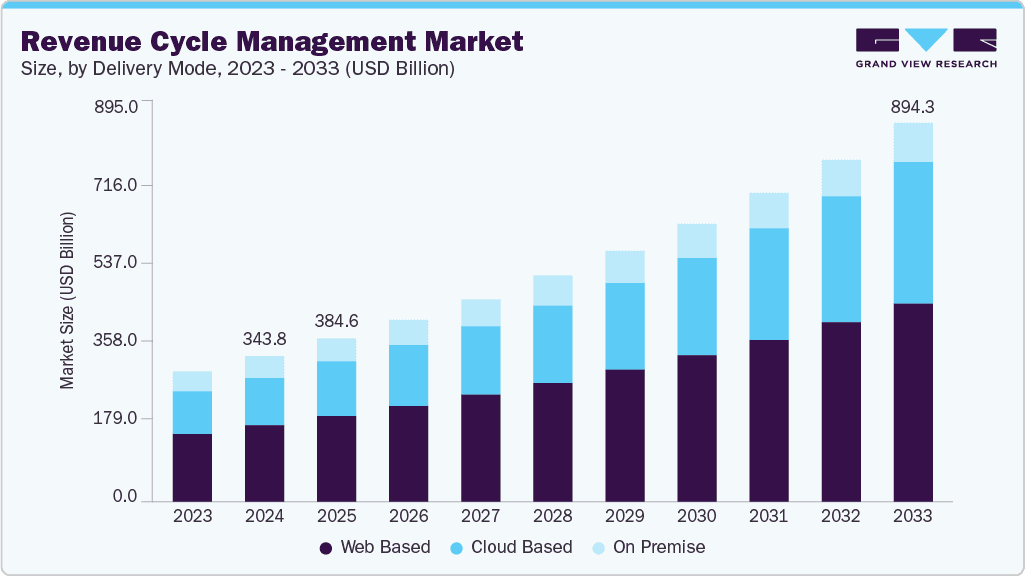
According to Grand View Research, the global revenue cycle management market size was estimated at USD 343.78 billion in 2024 and is projected to reach USD 894.25 billion by 2033, growing at a CAGR of 11.12% from 2025 to 2033. This growth reflects the urgent need for healthcare providers to modernize their financial operations through purpose-built RCM software.
This guide covers everything you need to know about RCM software development. You’ll learn what RCM software does, the essential features to include, the benefits it delivers, and a step-by-step approach to building custom solutions. Whether you’re a hospital administrator, clinic owner, or healthcare IT leader, this resource will help you make informed decisions about healthcare software development company investments that protect your bottom line.
What is RCM Software?
Revenue Cycle Management (RCM) software is a healthcare technology solution that manages the entire financial lifecycle of patient encounters, from initial appointment scheduling through final payment collection. Unlike basic medical billing tools that focus solely on claim submission, RCM software provides end-to-end visibility and control over every revenue-generating touchpoint in healthcare operations.
The revenue cycle encompasses multiple interconnected stages: patient registration, insurance eligibility verification, charge capture, medical coding, claim submission, payment posting, denial management, and financial reporting. RCM software automates and optimizes each stage, reducing manual errors while accelerating cash flow.
For Canadian healthcare providers, RCM software must accommodate provincial billing requirements, OHIP and other provincial health insurance plans, and comply with PIPEDA and PHIPA regulations. Custom RCM solutions can address these specific requirements while integrating with existing clinical systems.
Pro Tip: When evaluating RCM software options, look beyond basic billing features. The real value comes from automation capabilities that reduce manual touchpoints across the entire revenue cycle, not just claim submission.
With a clear understanding of what RCM software does, let’s explore the essential features that make these systems effective.
What are the Key Features of RCM Software?
Effective RCM software combines multiple functional modules that work together to optimize revenue capture and reduce financial leakage. Understanding these core features helps healthcare organizations identify gaps in their current systems and prioritize development requirements for custom solutions.
1. Patient registration and eligibility verification
Patient registration captures demographic information, insurance details, and consent documentation at the point of service. Real-time eligibility verification connects with insurance payers to confirm coverage and co-pay amounts. Automated checks prevent claim denials by flagging discrepancies before patients leave.
2. Medical coding and charge capture
RCM software supports ICD-10-CA diagnostic codes, CPT procedural codes, and HCPCS codes. Coding suggestion engines analyze clinical documentation to recommend appropriate codes. Charge capture automation tracks all rendered services and generates corresponding charges without disrupting clinical workflows.
3. Claims management and submission
Electronic claim submission through EDI 837 transactions validates claims against payer-specific rules before submission. Claim scrubbing algorithms check for missing information and coding inconsistencies. Batch processing submits hundreds of claims simultaneously while tracking each claim’s real-time status.
4. Denial management and appeals
RCM software categorizes denials by root cause, identifying patterns that indicate systemic issues. Automated workflows guide staff through appeals with payer-specific templates and deadline tracking. The system prioritizes high-value denials and tracks appeal success rates for focused resource allocation.
Quick Tip: Track your denial rate by category monthly. A sudden spike in a specific denial type often indicates a process breakdown or payer rule change that needs immediate attention.
5. Payment posting and reconciliation
RCM software processes Electronic Remittance Advice files through EDI 835 transactions, automatically matching payments to claims. The system flags variances between expected and actual reimbursement. Patient payment processing supports multiple methods including credit cards, ACH transfers, and payment plans.
6. Reporting and analytics dashboard
Real-time dashboards display key performance indicators, including days in accounts receivable, clean claim rate, and denial rate by category. Customizable reports analyze performance by provider, location, payer, or service line. Revenue forecasting tools project future cash flow for informed budgeting decisions.
7. EHR/EMR integration
Seamless integration with Electronic Health Record systems eliminates duplicate data entry and ensures billing information matches clinical documentation. RCM software connects with EHR platforms through HL7 and FHIR standards, enabling bidirectional data exchange. Patient demographics, encounter information, and clinical notes flow automatically from the EHR to the billing system.
Organizations investing in EHR software development should plan for RCM integration from the outset. Tightly coupled systems reduce errors, accelerate billing cycles, and provide a unified view of patient information across clinical and financial operations.
These features drive tangible outcomes for healthcare organizations. Let’s examine the major benefits of implementing custom RCM software.
What are the Benefits of RCM Software Development?
Investing in custom RCM software delivers measurable returns across financial, operational, and patient experience dimensions. Healthcare organizations that modernize their revenue cycle operations consistently outperform those relying on manual processes or disconnected systems.
1. Reduced Claim Denials and Rejections
Automated claim validation catches errors before submission, dramatically reducing denial rates. Pre-submission scrubbing identifies missing information, coding inconsistencies, and payer-specific rule violations. Fewer denials mean less staff time spent on rework and appeals. The cost savings compound over time as staff redirect their efforts from chasing rejected claims to higher-value activities like patient engagement and complex case resolution.
2. Faster Reimbursement Cycles
Electronic claim submission and automated payment posting accelerate the revenue cycle from days to hours. Clean claims reach payers faster, and electronic remittance processing eliminates manual payment applications. Faster reimbursement improves cash flow predictability, supporting better financial planning and reducing reliance on credit facilities. For organizations operating on tight margins, this acceleration can mean the difference between financial stability and cash flow crises.
3. Improved Cash Flow and Revenue Capture
RCM software prevents revenue leakage at multiple points in the billing cycle. Automated charge capture ensures all billable services generate corresponding claims. Eligibility verification catches coverage issues before services are rendered. Denial management recovers revenue that would otherwise be written off.
4. Enhanced Compliance and Audit Readiness
Healthcare billing operates under complex regulatory requirements including HIPAA in the United States and PIPEDA and PHIPA in Canada. RCM software maintains detailed audit trails documenting every transaction, user action, and system decision. This documentation supports compliance audits and protects organizations during payer reviews.
5. Operational Efficiency and Cost Savings
Automation reduces the manual effort required to manage billing operations. Tasks that previously required hours of staff time, such as eligibility verification, payment posting, and statement generation, happen automatically. This efficiency allows organizations to handle higher claim volumes without proportional staffing increases. Staff productivity improvements often reach 30% to 40% after RCM implementation. Billing teams can focus on exception handling and complex cases rather than routine processing.
6. Better Patient Financial Experience
Modern patients expect transparency and convenience in healthcare billing. RCM software supports patient-friendly features, including online bill pay, payment plans, and cost estimates before service. Clear, accurate statements reduce confusion and billing disputes.
Patient self-service portals allow individuals to view their accounts, make payments, and communicate with billing staff without phone calls. Organizations investing in patient portal development can integrate these capabilities directly with RCM workflows, creating a unified patient financial experience.
Pro Tip: Patient payment collection rates improve significantly when you offer cost estimates upfront and provide multiple payment options. Transparency builds trust and reduces bad debt.
Take Control of Your Revenue Cycle With Custom Software
Replace disconnected billing tools with a unified RCM system designed around your internal workflows, payer mix, and reimbursement policies.
These benefits translate into real-world results. Here are examples of how healthcare organizations have transformed their revenue cycles with custom RCM software.
Real-World Use Cases of RCM Software
RCM software adapts to diverse healthcare settings, from small practices to large health systems. Understanding how different organizational types leverage these solutions helps identify relevant features and implementation approaches for your specific context.
1. Multi-Speciality Clinics
Multi-specialty clinics in Canada, such as those operated by WELL Health Technologies in British Columbia, use RCM software to navigate diverse fee schedules across provinces and handle mixed billing for MSP and private insurers.
The software automates coding for varied services like family medicine and dermatology, reducing denials from provincial payers by flagging modifier mismatches early.
Centralized analytics help clinics like these identify payer-specific trends, improving cash flow in high-volume environments.
2. Hospitals and Health Systems
Large systems like Alberta Health Services employ enterprise RCM platforms integrated with provincial ADT systems to process millions of claims under the Alberta Health Care Insurance Plan.
These tools manage DRG-like groupings under case-mix methodologies, per diem rates for long-term care, and inter-provincial billing for patient transfers. Executives gain visibility through dashboards for resource allocation and negotiations with regional health authorities.
3. Mental Health Practices
Organizations like the Canadian Mental Health Association branches in Ontario leverage RCM software tailored for session-based billing under OHIP, tracking psychotherapy sessions against annual limits and handling GST/HST exemptions.
The systems alert providers on expiring authorizations from extended health plans and integrate with EHRs for streamlined documentation. This supports sustainable operations amid rising demand for virtual therapy.
Integration with practice management and clinical documentation systems streamlines workflows for therapists and counsellors.
Organizations developing mental health app development solutions can incorporate RCM capabilities to support sustainable practice operations.
4. Telehealth Providers
Telus Health’s virtual care platforms in Quebec incorporate RCM for RAMQ billing with telehealth modifiers, managing place-of-service codes for video consultations across provinces.
The software ensures compliance with varying provincial telehealth coverage, such as OHIP’s expansions post-COVID, and tracks cross-jurisdictional rules for interprovincial patients. Developers of telemedicine apps often embed these features for revenue viability.
Cross-jurisdiction billing becomes manageable when RCM software maintains payer rules for multiple provinces or states. Organizations building telemedicine software development platforms should consider integrated RCM capabilities to ensure sustainable revenue models for virtual care.
Ready to build your own RCM system? Here’s a step-by-step guide to developing custom RCM software.
How to Develop Custom RCM Software? [Step-By-Step Guide]
Building custom RCM software requires careful planning, healthcare domain expertise, and attention to regulatory requirements. This systematic approach helps organizations navigate the development process while avoiding common pitfalls.
1. Define business objectives and scope
Start by identifying the specific problems your RCM software needs to solve. Analyze current pain points: Are claim denials your primary concern? Is manual data entry consuming excessive staff time? Do you lack visibility into financial performance? Clear problem definition shapes feature priorities and success metrics.
Set measurable goals that tie software capabilities to business outcomes. Targets might include reducing denial rates by 25%, decreasing days in A/R by 15 days, or improving net collection rate by 3%. These metrics guide development decisions and provide benchmarks for evaluating implementation success.
2. Gather requirements and compliance needs
Document detailed functional requirements for each module. Include workflow specifications, user role definitions, reporting needs, and integration requirements. Engage stakeholders from billing, clinical, IT, and compliance teams to ensure comprehensive requirement capture.
Regulatory compliance shapes many technical decisions. HIPAA requirements in the US and PIPEDA/PHIPA requirements in Canada dictate data handling, access controls, and audit logging capabilities. Organizations can reference the software requirement specification guide for structured approaches to requirement documentation.
3. Choose the Technology Stack
Technology selection balances performance, scalability, security, and maintainability. Backend technologies like Node.js, Python, or .NET provide robust foundations for healthcare applications. Database selection, whether PostgreSQL for relational data or MongoDB for document storage, depends on data structure and query patterns.
Cloud infrastructure from AWS, Azure, or Google Cloud Platform offers scalability and compliance certifications important for healthcare. Consider data residency requirements, particularly for Canadian organizations that may need to keep patient data within national borders.
4. Design User Interface and Workflows
Effective RCM software balances comprehensive functionality with usability. Role-based dashboards present relevant information to each user type: billers see claim queues and denial alerts, managers see performance metrics and team productivity, executives see financial summaries and trend analysis.
Workflow design should mirror actual billing processes while eliminating unnecessary steps. User research with billing staff identifies pain points in current processes and opportunities for automation. Organizations focused on healthcare app design principles create interfaces that reduce training time and improve adoption.
5. Build Core Modules and Integrations
Development typically proceeds in phases, starting with foundational modules and adding complexity incrementally. Patient registration and eligibility verification establish the data foundation. Claims management and submission form the core billing engine. Denial management and reporting add analytical capabilities.
Integration development connects RCM software with external systems: EHR platforms via HL7/FHIR interfaces, clearinghouses for claim submission, payers for eligibility verification, and payment processors for patient collections. Each integration requires careful mapping, testing, and error handling.
6. Test for Accuracy and Compliance
Healthcare billing errors have financial and legal consequences, making thorough testing essential. Claim validation testing verifies that the system correctly applies coding rules, modifier requirements, and payer-specific edits. End-to-end testing traces transactions through the complete revenue cycle.
Security testing identifies vulnerabilities that could expose protected health information. Penetration testing, vulnerability scanning, and code review verify that the system meets healthcare security standards. Compliance audits confirm adherence to HIPAA, PIPEDA, and other applicable regulations.
7. Deploy and Train Staff
Phased deployment reduces risk compared to big-bang implementations. Pilot the system with a subset of users or claim types, gathering feedback and resolving issues before broader rollout. This approach builds confidence and identifies problems at manageable scale.
Comprehensive training ensures staff can leverage system capabilities effectively. Role-specific training focuses on relevant features and workflows. Ongoing support resources, including documentation, help systems, and access to support staff, sustain productivity after initial training.
Organizations pursuing custom software development benefit from partners who understand both technical implementation and healthcare operational requirements.
8. Monitor and Optimize Continuously
Post-implementation monitoring tracks system performance and user adoption. Usage analytics identify features that need refinement or additional training. Performance monitoring ensures the system handles transaction volumes without degradation.
Continuous improvement incorporates user feedback, addresses emerging requirements, and adapts to regulatory changes. Regular releases add capabilities and fix issues, keeping the system aligned with evolving organizational needs.
Quick Insight: Healthcare organizations that treat RCM software as an ongoing capability rather than a one-time project achieve better outcomes. Plan for continuous improvement from the start.
Fix Revenue Leakage With Purpose-Built RCM Software
Design RCM software that addresses gaps across eligibility verification, coding accuracy, claim submission, and payment reconciliation to safeguard revenue at every stage.
While the benefits are significant, healthcare organizations should be aware of the challenges that may arise during RCM software implementation.
What are the Challenges in RCM Software Development? [How to Overcome Them]
Understanding potential obstacles helps organizations plan mitigation strategies and set realistic expectations. These challenges are manageable with proper preparation and experienced development partners.
1. Complex healthcare regulations
Challenge: Healthcare billing operates under extensive regulatory frameworks that vary by jurisdiction. HIPAA establishes baseline privacy and security requirements in the US, while Canadian organizations must comply with PIPEDA at the federal level and provincial regulations like PHIPA in Ontario.
These requirements shape data handling, access controls, and audit capabilities. Regulations also evolve continuously as governments respond to emerging privacy concerns and healthcare industry changes.
Solution: RCM software must accommodate regulatory updates without disrupting operations. Building flexibility into the system architecture allows adaptation without major redevelopment. Working with experienced development partners who understand multi-jurisdictional compliance ensures the software meets current requirements while remaining adaptable to future changes.
2. Legacy system integration
Challenge: Many healthcare organizations operate EHR systems, practice management software, and other clinical tools implemented years or decades ago.
These legacy systems may lack modern integration capabilities, using proprietary data formats or limited APIs. Data migration from existing billing systems presents additional challenges, as historical data must transfer accurately while maintaining referential integrity.
Solution: Connecting RCM software requires custom interface development or middleware solutions that bridge compatibility gaps. Thorough testing of data migration prevents data loss and ensures continuity of billing operations. Partnering with developers experienced in healthcare integrations helps identify potential obstacles early and design appropriate workarounds.
3. Data security and privacy
Challenge: Healthcare data breaches carry severe consequences including regulatory penalties, litigation costs, and reputational damage. RCM software handles sensitive patient information, including health conditions, insurance details, and financial data. Protecting this information demands robust security measures across all system layers.
Solution: Implementing defence-in-depth security approaches addresses vulnerabilities at multiple levels. Encryption protects data at rest and in transit. Role-based access controls limit information exposure to authorized users. Audit logging tracks all data access for compliance and forensic purposes. Regular security assessments identify and address vulnerabilities before exploitation occurs.
4. Payer complexity and variability
Challenge: Healthcare payers, including government programs and private insurers, each maintain distinct billing rules, claim formats, and adjudication processes. What one payer accepts, another may reject. Payer rules also change frequently as insurers update policies, modify coverage, or implement new programs.
Solution: RCM software must accommodate this variability while presenting a consistent interface to billing staff. Maintaining current payer configurations requires ongoing attention and rapid response to changes. Organizations need established processes for monitoring payer updates and implementing system changes promptly to avoid claim rejections and payment delays.
5. User adoption and change management
Challenge: Technology implementation succeeds or fails based on user adoption. Billing staff accustomed to existing processes may resist new systems, particularly if initial experiences involve learning curves or workflow disruptions.
Solution: Overcoming resistance requires attention to change management throughout the implementation. Executive sponsorship signals organizational commitment and prioritizes RCM software adoption. Early involvement of end users in design and testing builds ownership and identifies usability issues before launch. Celebrating early wins and sharing success metrics maintains momentum through implementation challenges.
Pro Tip: Invest in change management as seriously as you invest in technology. The best RCM software delivers no value if staff don’t use it effectively. Plan for training, support, and ongoing reinforcement.
Understanding these challenges prepares organizations for success. Now let’s explore emerging trends shaping the future of RCM software.
What are the Future Trends in RCM Software Development?
Technology advances continue to expand RCM software capabilities. Organizations planning development investments should consider how these trends might shape future requirements and competitive positioning.
1. AI and machine learning for predictive denial management
Artificial intelligence transforms denial management from reactive to predictive. Machine learning models analyze historical denial patterns, claim characteristics, and payer behaviour to predict which claims are likely to be denied before submission. This foresight allows billing staff to address issues proactively, preventing denials rather than appealing them.
AI-powered coding assistance analyzes clinical documentation and suggests appropriate codes, reducing coding errors and ensuring optimal reimbursement. Natural language processing extracts relevant information from unstructured clinical notes, automating aspects of charge capture that previously required manual review.
Organizations exploring predictive analytics in healthcare can apply similar approaches to revenue cycle optimization, using data to drive smarter financial decisions.
2. Robotic process automation (RPA)
RPA automates repetitive, rule-based tasks that currently consume billing staff time. Bots can log into payer portals, check claim status, download remittance files, and update internal systems without human intervention. This automation handles high-volume, low-complexity work while freeing staff for tasks requiring judgment.
Intelligent document processing combines RPA with AI to handle semi-structured documents like explanation of benefits statements. The system extracts relevant data, validates against expected values, and routes exceptions for human review. This capability accelerates payment posting while maintaining accuracy.
3. Blockchain for claims processing
Blockchain technology offers potential for transforming healthcare claims processing through transparent, immutable transaction records. Smart contracts could automate claim adjudication based on predefined rules, reducing processing time and disputes. All parties, including providers, payers, and patients, would share a single source of truth about claim status and payment history.
While blockchain adoption in healthcare remains early-stage, forward-thinking organizations are monitoring developments and considering pilot applications. The technology may prove particularly valuable for coordinating billing across multiple organizations in value-based care arrangements.
4. Cloud-Based and SaaS RCM Solutions
Cloud deployment models offer advantages over traditional on-premise installations. Scalability allows systems to handle volume fluctuations without infrastructure investments. Automatic updates ensure organizations always run current software versions with the latest security patches and feature enhancements.
SaaS pricing models shift RCM software from capital expenditure to operating expense, improving cash flow and reducing financial barriers to adoption. Organizations exploring cloud-based application development can leverage established cloud infrastructure for secure, compliant healthcare applications.
With these trends in mind, here’s how to select the right approach for your RCM software needs.
How to Choose an RCM Software Development Partner?
Selecting the right development partner significantly impacts project success. Evaluating potential partners across multiple dimensions helps identify the best fit for your organization’s needs and constraints.
1. Healthcare domain expertise
RCM software development requires deep understanding of healthcare billing workflows, regulatory requirements, and industry terminology. Partners with healthcare experience recognize common pitfalls and bring proven solutions to typical challenges. They understand the difference between hospital billing and physician billing, the nuances of payer contracts, and the implications of regulatory requirements.
2. Integration capabilities
RCM software rarely operates in isolation. Integration with EHR systems, practice management platforms, clearinghouses, and payer portals determines how effectively the solution fits into existing operations. Partners need experience with healthcare interoperability standards, including HL7, FHIR, and EDI transaction sets.
3. Security and compliance standards
Healthcare data demands rigorous security controls. Partners should demonstrate compliance with relevant standards and certifications. SOC 2 certification indicates mature security practices. Experience with HIPAA and PIPEDA requirements ensures the partner understands healthcare-specific compliance obligations.
4. Scalability and support
Your RCM software needs will evolve as your organization grows and healthcare industry changes. Partners should demonstrate ability to scale solutions for increasing transaction volumes and expanding functionality. Architecture decisions made early in development determine long-term scalability.
Partners following agile software development methodologies typically deliver better outcomes through iterative development, frequent client feedback, and adaptive planning.
Develop Compliance-Ready RCM Software With Space-O
Partner with Space-O to build secure RCM platforms that align with payer rules, audit standards, and healthcare regulatory requirements.
Space-O Technologies brings deep healthcare expertise to RCM software development. Here’s how we can help transform your revenue cycle operations.
Build Custom RCM Software with Space-O Technologies
RCM software development delivers a strategic boost to healthcare financial performance by reducing claim denials, accelerating reimbursements, improving cash flow, and increasing operational efficiency. Custom solutions align directly with your workflows, payer mix, and regulatory obligations.
Space-O Technologies supports healthcare organizations with purpose-built RCM software designed for Canadian requirements, including PIPEDA and PHIPA compliance, provincial billing rules, and system integrations. We develop secure, scalable solutions that integrate with existing EHR platforms and clearinghouses while driving user adoption and measurable ROI.
Whether you require a full RCM platform or specific system enhancements, Space-O Technologies brings the technical expertise and healthcare domain knowledge to deliver long-term value.
Ready to modernize your revenue cycle operations? Schedule a Free Consultation to discuss your RCM software requirements and explore how custom development can improve your financial performance.
Frequently Asked Questions about RCM Software Development
How much does custom RCM software development cost?
Custom RCM software development typically ranges from $150,000 to $500,000 or more, depending on scope and complexity. Factors affecting cost include the number of modules required, integration complexity with existing systems, compliance requirements, and customization depth. Organizations should also budget for ongoing maintenance, typically 15-20% of initial development cost annually. Despite the investment, ROI often exceeds 200% through reduced denials, faster reimbursements, and operational efficiencies.
How long does it take to develop RCM software?
Development timelines typically range from 6 to 18 months, depending on scope and complexity. A focused solution addressing specific pain points might launch in 6-9 months. Comprehensive enterprise platforms with extensive integrations and advanced analytics may require 12-18 months. Phased implementation approaches allow organizations to realize value earlier while building toward complete functionality over time.
Can RCM software integrate with existing EHR systems?
Yes, modern RCM software integrates with major EHR platforms, including Epic, Cerner, Meditech, and others, through HL7 and FHIR standards. Integration enables bidirectional data exchange: patient demographics and encounter information flow from the EHR to RCM, while billing status updates flow back. Custom integration development may be required for older or proprietary EHR systems lacking standard interfaces.
What is the difference between RCM software and medical billing software?
Medical billing software focuses primarily on claim creation and submission, handling the core billing transaction. RCM software encompasses the entire revenue cycle from patient registration through final payment collection. This includes eligibility verification, charge capture, coding support, denial management, payment posting, and analytics. RCM software provides comprehensive financial management, while medical billing software addresses a narrower function.
Is RCM software suitable for small practices?
Yes, RCM software scales to organizations of all sizes. Small practices can implement focused solutions addressing their primary pain points, such as eligibility verification or denial management, without requiring enterprise-scale platforms. Cloud-based and SaaS deployment models reduce infrastructure requirements and upfront costs, making sophisticated RCM capabilities accessible to smaller organizations. Many practices see the greatest proportional benefit from RCM automation due to limited administrative staffing.
How does AI improve RCM software?
AI enhances RCM software through predictive denial management, automated coding suggestions, intelligent document processing, and pattern recognition. Machine learning models analyze historical data to predict which claims are likely to be denied, enabling proactive intervention. Natural language processing extracts billing-relevant information from clinical documentation. AI-powered analytics identify revenue opportunities and operational inefficiencies that human analysis might miss.


Develop Compliance-Ready RCM Software With Space-O
 All our projects are secured by NDA
100% Secure. Zero Spam
*All your data will remain strictly confidential.
Trusted by


Bashar Anabtawi 
Canada
“I was mostly happy with the high level of experience and professionalism of the various teams that worked on my project. Not only they clearly understood my exact technical requirements but even suggested better ways in doing them. The Communication tools that were used were excellent and easy. And finally and most importantly, the interaction, follow up and support from the top management was great. Space-O not delivered a high quality product but exceeded my expectations! I would definitely hire them again for future jobs!”

Canada Office
2 County Court Blvd., Suite 400,
Brampton, Ontario L6W 3W8
Phone: +1 (602) 737-0187
Email: sales@spaceo.ca