
- What is Secure Telehealth Software Development?
- Why Security is Non-Negotiable in Telehealth Software?
- What are the Key Security Features for Telehealth Software Development?
- How to Build Secure Telehealth Software: A Step-by-Step Process
- Canadian Compliance: PIPEDA and Provincial Health Privacy Laws
- How Much Does Secure Telehealth Software Development Cost?
- What are the Common Security Vulnerabilities in Telehealth and How to Prevent Them?
- Secure Telehealth Development Backed by Space-O Technologies’ Healthcare Expertise
- Frequently Asked Questions About Secure Telehealth Software Development
Secure Telehealth Software Development: Complete Guide to Building Compliant Virtual Care Platforms

 Last Updated: January, 30 2026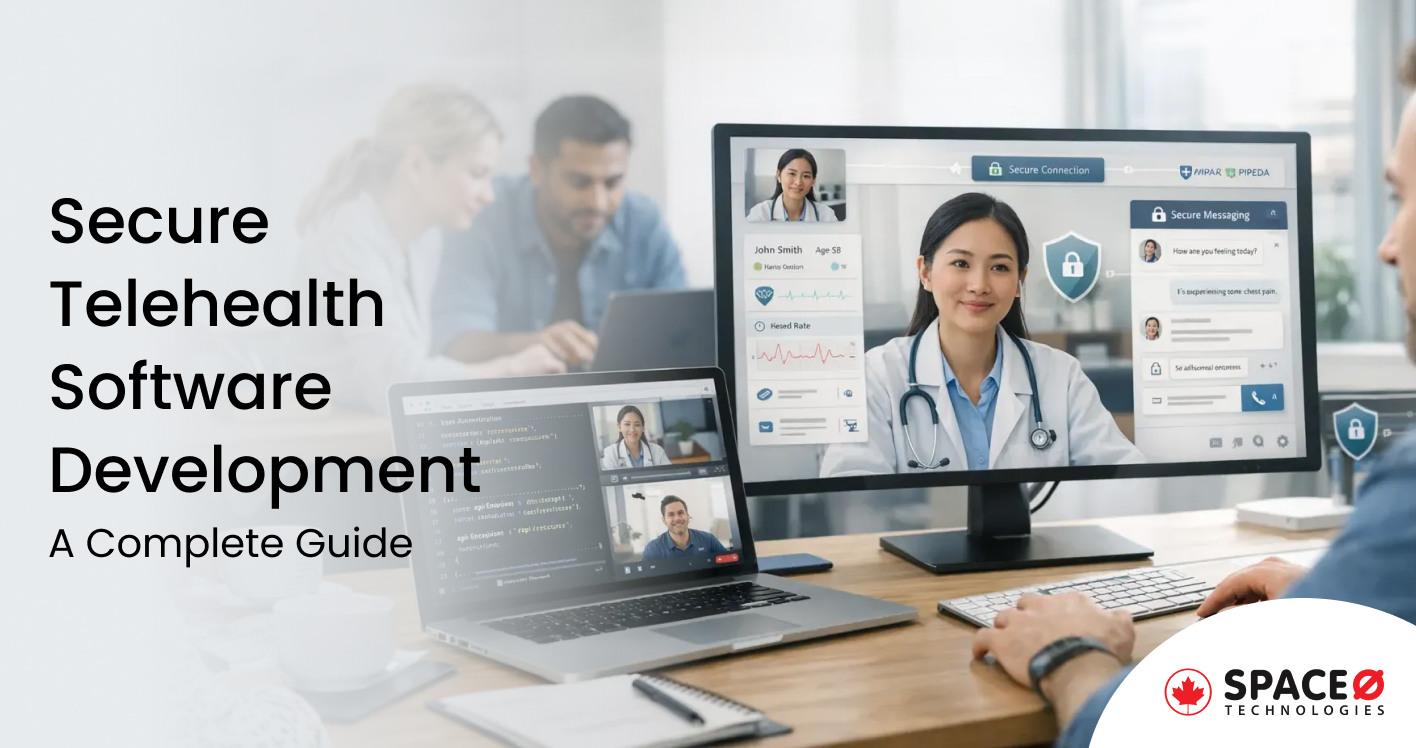
Healthcare data breaches continue to rise across Canada, with federal privacy regulators reporting a significant increase in breach notifications under PIPEDA. According to IBM, healthcare organizations experience the highest average data breach costs at $10.93 million per incident—significantly higher than the global average of $4.45 million across industries.
If you’re planning to build a telehealth platform in Canada, security cannot be an afterthought. Canadian healthcare organizations must comply with PIPEDA and provincial health privacy laws like Ontario’s PHIPA, Alberta’s HIA, and Quebec’s Law 25.
These regulations carry significant penalties for non-compliance and, more importantly, protect the patient trust that healthcare depends on.
The good news? Building secure telehealth software is absolutely achievable when you approach it with the right strategy, compliance framework, and development partner.
Whether you’re a startup developing a telemedicine app or an established healthcare organization expanding virtual care capabilities, this guide breaks down exactly what secure telehealth software development requires.
What is Secure Telehealth Software Development?
Secure telehealth software development is the process of building virtual healthcare platforms with a security-first architecture that protects patient data at every layer while meeting regulatory compliance requirements like PIPEDA, provincial health privacy laws, and HIPAA for cross-border services.
This differs significantly from standard software development. While a typical web application might prioritize speed to market or feature richness, secure telehealth development places data protection, access controls, encryption, and compliance at the foundation of every technical decision.
Organizations looking to enter the telehealth market must understand that HIPAA compliant software development requires specialized expertise that goes beyond general application development practices.
Key components of secure telehealth software
The “security by design” approach means incorporating these elements from day one, not bolting them on later:
- Protected Health Information (PHI) Security: Every piece of patient data, from names and addresses to diagnoses and prescriptions, requires protection
- Encrypted Communications: Video consultations, messaging, and file transfers must use end-to-end encryption. When building video consultation applications, encryption becomes even more critical as real-time streams carry sensitive patient-provider conversations.
- Access Controls: Only authorized personnel should access specific data, and only the minimum necessary for their role
- Audit Trails: Every access, modification, and transmission of patient data must be logged and traceable
- Secure Infrastructure: Cloud hosting, databases, and third-party integrations must all meet healthcare compliance standards
The foundation you establish during development determines whether your platform can withstand security threats and compliance audits. Retrofitting security into an existing platform costs significantly more than building it correctly from the start.
With the core concept established, let’s explore why cutting corners on telehealth security creates unacceptable risks for healthcare organizations.
Why Security is Non-Negotiable in Telehealth Software?
The healthcare industry faces a unique security challenge. Patient data is extraordinarily valuable on the black market, often worth 10-50 times more than credit card information. This makes healthcare organizations prime targets for cybercriminals.
The numbers tell a sobering story
Throughout 2024, 588 data breaches were reported to the OCR, as required by HIPAA. And while that number didn’t set a record, the scope of impact certainly did, with nearly 180 million people affected by those breaches.
The financial impact is equally severe. Healthcare data breaches cost an average of $10.93 million per incident, the highest of any industry. This figure includes regulatory fines, legal fees, remediation costs, and the often-overlooked expense of rebuilding patient trust.
HIPAA violation penalties
According to American Medical Association, the regulatory consequences for security failures are substantial:
| Violation Level | Penalty Per Violation | Annual Maximum |
|---|---|---|
| Unknowing | $100-$50,000 | $25,000 |
| Reasonable Cause | $1,000-$50,000 | $100,000 |
| Willful Neglect (Corrected) | $10,000-$50,000 | $250,000 |
| Willful Neglect (Not Corrected) | $50,000 | $2.1 million |
These penalties apply per violation category, meaning a single breach affecting multiple patients and involving multiple compliance failures can quickly escalate into millions of dollars in fines.
Understanding HIPAA telehealth compliance requirements is essential before launching any virtual care platform.
Beyond compliance: the business case for security
Security isn’t just about avoiding penalties. It’s about building a sustainable healthcare business.
Healthcare organizations that invest in comprehensive healthcare software development with security at the core position themselves for long-term success. Those that cut corners often face costly remediation, legal battles, and the challenge of rebuilding patient confidence.
Launch Telehealth Software Built on Healthcare-Grade Security Standards
Develop telehealth platforms that protect patient data, enforce access controls, and meet regulatory requirements across care settings
Understanding the stakes makes the investment in proper security features clear. Let’s examine the specific security capabilities your telehealth platform needs.
What are the Key Security Features for Telehealth Software Development?
Building secure telehealth software requires implementing multiple layers of protection. Each feature addresses specific vulnerabilities and compliance requirements. Here’s what your platform needs.
1. End-to-end encryption
Encryption is the foundation of telehealth security. It ensures that even if data is intercepted, it remains unreadable to unauthorized parties.
Data in Transit:
All data moving between patients, providers, and your servers must use TLS (Transport Layer Security) 1.2 at minimum, with TLS 1.3 recommended for optimal security. This applies to:
- Video consultation streams
- Text messages and chat
- File uploads and downloads
- API communications
Data at Rest:
Patient information stored in your databases requires AES-256 encryption. This military-grade encryption standard ensures that even if someone gains physical access to your storage systems, the data remains protected.
Video Consultation Security:
Real-time video requires specialized encryption. WebRTC-based solutions should implement SRTP (Secure Real-time Transport Protocol) for media streams and DTLS (Datagram Transport Layer Security) for key exchange.
2. Multi-factor authentication (MFA)
Passwords alone are insufficient for healthcare applications. MFA requires users to verify their identity through multiple methods:
- Something they know: Password or PIN
- Something they have: Mobile device, security key, or authenticator app
- Something they are: Biometric verification (fingerprint, face recognition)
For telehealth platforms, implementing MFA for both patients and healthcare providers significantly reduces unauthorized access risks. Consider offering multiple MFA options to accommodate different user preferences and technical capabilities.
Quick Tip: Start with authenticator app-based MFA rather than SMS. SMS-based authentication is vulnerable to SIM-swapping attacks, making it less secure for healthcare applications handling sensitive patient data.
3. Role-based access control (RBAC)
Not everyone needs access to everything. RBAC ensures users only see and interact with data necessary for their specific role.
Typical Role Hierarchy:
- Patients: Access their own records, appointments, and communications
- Healthcare Providers: Access patient records for assigned patients, clinical tools
- Administrative Staff: Scheduling, billing information, limited clinical data
- System Administrators: Platform configuration, user management, audit logs
The principle of “minimum necessary access” is crucial for HIPAA compliance. A receptionist scheduling appointments doesn’t need access to detailed clinical notes.
Session Management:
Implement automatic session timeouts after periods of inactivity. HIPAA recommends 2-minute timeouts for workstations accessing PHI, though this can be adjusted based on clinical workflow requirements.
4. Comprehensive audit logging
Every interaction with patient data must be recorded. Audit logs serve multiple purposes: compliance documentation, security monitoring, and forensic investigation if breaches occur.
What to Log:
- User authentication events (successful and failed)
- PHI access (who viewed what, when)
- Data modifications (changes to patient records)
- Data exports and downloads
- Administrative actions (user creation, permission changes)
- System events (errors, security alerts)
Retention Requirements:
HIPAA requires maintaining audit logs for a minimum of six years. Ensure your logging infrastructure can handle this long-term storage while remaining searchable for compliance audits.
5. Secure data storage and backup
Your cloud infrastructure must meet healthcare compliance requirements.
HIPAA-Eligible Cloud Providers:
- AWS: HealthLake, CloudTrail, and numerous HIPAA-eligible services with BAA
- Microsoft Azure: Health Data Services, FHIR APIs, compliance tools
- Google Cloud: Healthcare API, FHIR/HL7v2/DICOM stores
For Canadian healthcare applications, data residency becomes an additional consideration. Many provincial regulations require patient data to remain within Canadian borders, making Canadian cloud regions essential.
Backup and Disaster Recovery:
Implement encrypted backups with geographically distributed storage. Test recovery procedures regularly to ensure business continuity if primary systems fail.
Knowing what features you need is one step. Understanding the process of building a telehealth software is equally important.
How to Build Secure Telehealth Software: A Step-by-Step Process
Building secure telehealth software requires a structured approach that integrates security considerations at every phase. Here’s the process we follow at Space-O Technologies.
Step 1: Security requirements analysis
Before writing any code, establish a comprehensive understanding of your security needs.
Conduct a regulatory assessment to identify compliance obligations
Identify all applicable regulations including PIPEDA, provincial health privacy laws, and HIPAA if serving US patients. Document specific compliance requirements for your use case and determine if additional certifications like SOC 2 or HITRUST are needed. This assessment forms the foundation for all security decisions throughout development.
For organizations building HIPAA compliant telehealth platforms, this regulatory assessment must address both federal HIPAA requirements and state-specific telehealth regulations.
Classify all data types your platform will handle
Categorize every data type your telehealth platform will process and store. Identify personal health information elements requiring the highest protection levels. Map complete data flows from initial collection through storage and eventual deletion to understand where sensitive information travels within your system.
Perform a formal risk assessment as required by privacy regulations
Conduct thorough risk analysis as mandated by PIPEDA and provincial regulations. Identify potential threats and vulnerabilities specific to your platform. Document risk mitigation strategies and establish acceptable risk thresholds. This documentation proves invaluable during privacy commissioner investigations.
Quick Tip: Document your risk assessment thoroughly. Privacy commissioners specifically look for evidence of formal risk analysis during investigations. A well-documented assessment demonstrates compliance intent even if you’re still addressing identified gaps.
Step 2: Secure architecture design
Design your system architecture with security as a primary consideration, not an afterthought.
Apply security-by-design principles from the start
Minimize attack surface by limiting exposed services to only what’s necessary. Implement defense in depth with multiple security layers protecting sensitive systems. Design for failure by assuming breaches will be attempted. Separate concerns appropriately to limit blast radius if compromises occur.
Conduct threat modeling to anticipate potential attacks
Identify potential attackers and understand their motivations for targeting healthcare platforms. Map attack vectors specific to telehealth including account takeover, data interception, and insider threats. Design specific countermeasures for each identified threat to create comprehensive protection against likely attack scenarios.
When designing architectures for HIPAA compliant telemedicine apps, threat modeling must account for mobile-specific vulnerabilities including device theft, unsecured WiFi connections, and app-level exploits.
Make architecture decisions that prioritize security
Select HIPAA-eligible cloud infrastructure from providers offering appropriate compliance certifications. Design network segmentation to isolate sensitive systems from less critical components. Plan encryption key management carefully and establish secure API design patterns that prevent common vulnerabilities.
Organizations should also review web application security best practices to ensure their telehealth platforms follow industry standards for secure web development.
Step 3: Secure development practices
Implementation must follow secure coding standards throughout the entire development process.
Follow established secure coding standards
Adhere to OWASP secure coding guidelines throughout development. Implement thorough input validation on all user-supplied data. Use parameterized queries to prevent SQL injection attacks. Encode all output properly to prevent cross-site scripting vulnerabilities that could expose patient information.
Establish rigorous code review protocols
Require security-focused code reviews for all changes before merging. Use automated static analysis tools to catch common vulnerabilities early. Document all security findings and track them through resolution to ensure nothing falls through the cracks during development cycles.
Manage third-party dependencies carefully
Maintain a complete inventory of all third-party libraries used in your application. Monitor continuously for known vulnerabilities in dependencies using automated scanning tools. Establish processes for rapid patching when security issues are discovered in any component.
Step 4: Integration of security features
Implement the security features identified in your requirements analysis phase.
Configure comprehensive encryption for all data
Set up TLS 1.3 for all communications between clients and servers. Implement AES-256 encryption for data at rest in databases and storage systems. Establish secure key management procedures and configure end-to-end encryption for video consultations to protect patient conversations.
Build robust authentication and authorization systems
Implement multi-factor authentication for all user accounts accessing the platform. Configure role-based access controls that limit users to only necessary functions. Set up session management with appropriate timeouts and integrate identity providers if using single sign-on.
Implement comprehensive audit logging
Configure detailed logging for all PHI access attempts, both successful and failed. Implement tamper-evident log storage that prevents modification of historical records. Set up real-time alerting for suspicious activity and ensure log retention periods meet all compliance requirements.
Step 5: Security testing and validation
Thorough testing validates that your security implementations work as intended before launch.
Engage professionals for penetration testing
Hire qualified security professionals to attempt breaching your platform. Test both external attack scenarios and internal threat vectors. Include social engineering vectors in testing scope to evaluate human vulnerabilities. Document all findings comprehensively and remediate issues before deployment.
Conduct automated vulnerability assessments
Run automated vulnerability scanning against your entire application stack. Test specifically for OWASP Top 10 vulnerabilities that commonly affect web applications. Verify encryption implementations work correctly and validate that access controls function as designed under various conditions.
Perform compliance audits before launch
Complete a gap analysis against all applicable HIPAA and PIPEDA requirements. Document evidence of compliance for each regulatory requirement. Address any identified deficiencies completely before launching your platform to patients and healthcare providers.
Step 6: Deployment and monitoring
Launching is just the beginning since ongoing security requires continuous attention and vigilance.
Follow secure deployment practices
Use infrastructure-as-code for consistent, auditable deployments across environments. Implement secrets management solutions for credentials and encryption keys. Configure security groups and network policies correctly. Verify all production security controls are active and functioning before allowing patient access.
Establish continuous security monitoring
Deploy security information and event management tools to aggregate security data. Monitor continuously for anomalous access patterns that might indicate compromise. Track failed authentication attempts and alert immediately on potential data exfiltration activities.
Prepare comprehensive incident response procedures
Establish documented incident response procedures before any security event occurs. Define clear roles and responsibilities during security incidents. Practice incident response regularly through tabletop exercises. Maintain relationships with forensics resources for situations requiring expert investigation.
Following a structured software development life cycle with security integrated throughout ensures your telehealth platform is built on a solid foundation.
Build Secure Telehealth Software Without Compromising User Experience
Design telehealth applications with encrypted communication, secure data handling, and seamless virtual care workflows for patients and providers.
After examining the development process, let’s understand the compliance framework that governs it.
Canadian Compliance: PIPEDA and Provincial Health Privacy Laws
For telehealth platforms serving Canadian patients, compliance with federal and provincial privacy legislation is mandatory. Understanding these requirements is essential before development begins.
1. PIPEDA: The federal framework
The Personal Information Protection and Electronic Documents Act (PIPEDA) governs private sector organizations handling personal information during commercial activities.
10 Fair Information Principles:
- Accountability: Designate a privacy officer responsible for compliance
- Identifying Purposes: Identify why you’re collecting data before or at collection
- Consent: Obtain meaningful consent for collection, use, and disclosure
- Limiting Collection: Collect only information necessary for identified purposes
- Limiting Use, Disclosure, and Retention: Use data only for stated purposes
- Accuracy: Keep personal information accurate and up-to-date
- Safeguards: Protect information with appropriate security measures
- Openness: Make privacy policies readily available
- Individual Access: Provide individuals access to their information
- Challenging Compliance: Allow individuals to challenge your compliance
2. Provincial health privacy laws
Healthcare data often falls under provincial jurisdiction with specific requirements:
Ontario – PHIPA (Personal Health Information Protection Act):
- Specifically addresses healthcare data
- Governs health information custodians (physicians, hospitals, pharmacies)
- Requires reasonable steps to prevent unauthorized access
- Patients have rights to access and correct their health information
Other Provincial Requirements:
| Province | Legislation | Key Considerations |
|---|---|---|
| British Columbia | PIPA | Substantially similar to PIPEDA |
| Alberta | HIA | Specific healthcare requirements |
| Quebec | Law 25 | Strengthened privacy, significant penalties |
| Saskatchewan | HIPA | Healthcare-specific legislation |
| Nova Scotia | PHIA | Similar to federal standards |
3. Why this matters for telehealth development
If your platform serves patients in both Canada and the United States, you need to comply with both regulatory frameworks. This typically means implementing the stricter requirement in each category.
At Space-O Technologies, we understand the nuances of both compliance environments. Our experience building healthcare app development solutions for Canadian businesses means we know how to navigate PIPEDA, provincial health acts, and the interplay with US regulations when cross-border services are involved.
For organizations considering outsourcing healthcare software development, choosing a partner with this compliance expertise is essential.
Pro Tip: When building for the Canadian market, prioritize data residency. Many provincial regulations require patient data to remain within Canadian borders. Ensure your cloud provider offers Canadian data centres and configure your infrastructure accordingly.
With compliance requirements clear, let’s examine what secure telehealth development actually costs.
How Much Does Secure Telehealth Software Development Cost?
Secure telemedicine app development in Canada, with full HIPAA/PIPEDA compliance, ranges from $60,000-$100,000 CAD for a basic MVP, $130,000-$260,000 CAD for mid-range platforms, to $260,000-$520,000+ CAD for enterprise solutions.
Secure telehealth software development requires investment beyond standard application development. The additional cost reflects the security features, compliance requirements, and specialized expertise needed.
1. Cost breakdown by platform complexity
| Complexity Level | Features Included | Timeline | Cost Range (CAD) |
|---|---|---|---|
| Basic Secure MVP | Core HIPAA, encrypted video/messaging, basic auth, audit logging | 3-4 months | $60K-$100K |
| Mid-Range Secure Platform | Full HIPAA/PIPEDA, EHR integration, adv. RBAC, audit trails, payments | 5-8 months | $130K-$260K |
| Enterprise Secure Solution | Adv. security, AI, multi-tenant, full compliance, custom integrations | 9-12+ months | $260K-$520K+ |
For startups looking to validate their concept before full-scale development, exploring telemedicine MVP development can provide a cost-effective path to market while maintaining essential security standards.
Organizations can also explore MVP development services to build a minimum viable product that meets core compliance requirements while controlling initial investment.
2. Factors affecting secure development costs
Compliance Requirements
- Increase base development costs by approximately 30–40% to meet HIPAA compliance.
- Cover expenses related to security feature implementation, compliance documentation, testing, validation, and ongoing maintenance.
Security Testing
- Allocate $6,500–$20,000 annually for penetration testing.
- Budget $3,500–$10,000 per vulnerability assessment.
- Plan $6,500–$26,000 for compliance audits, depending on scope.
Third-Party Security Services
- Expect a 10–20% premium for HIPAA-compliant cloud hosting.
- Invest $650–$2,600 per month in security monitoring services.
- Account for higher fees from BAA-covered service providers.
Ongoing Compliance Maintenance
- Reserve $5,200–$15,600 annually for compliance reviews.
- Budget $2,600–$6,500 per year for security policy updates.
- Allocate $1,300–$6,500 annually for staff training.
- Plan $3,500–$13,000 for incident response planning.
3. Hidden costs to consider
Beyond development, budget for:
- Legal consultation for compliance documentation
- Insurance (cyber liability, professional liability)
- Staff training on security procedures
- Regular security awareness programs
- Potential costs of security incidents
4. ROI perspective
While secure development costs more upfront, consider the alternative. A single HIPAA violation can cost $50,000 per incident. A data breach averages $10.93 million in total costs. Investing in security during development is significantly less expensive than addressing failures after launch.
Pro Tip: When budgeting for secure telehealth development, allocate 15-20% of your initial development cost for ongoing annual security maintenance. This covers vulnerability scanning, penetration testing, compliance updates, and security monitoring that keeps your platform protected long-term.
For detailed pricing specific to your project requirements, explore our telemedicine app development cost guide or contact our team for a customized estimate. You can also review healthcare app development cost factors to understand broader pricing considerations.
Investment in security protects against known threats. Let’s examine the most common vulnerabilities and how to prevent them.
What are the Common Security Vulnerabilities in Telehealth and How to Prevent Them?
Understanding common attack vectors helps prioritize security investments. Here are the vulnerabilities we see most frequently in telehealth platforms and how to address them.
1. Insecure APIs
Telehealth platforms rely heavily on APIs to connect mobile apps, web portals, and backend systems. When these APIs lack proper security controls, attackers can exploit them to access patient data, manipulate records, or disrupt services entirely. Common weaknesses include missing authentication tokens, excessive data exposure in responses, and failure to validate input parameters.
How to prevent:
Prevent this vulnerability by implementing robust API authentication using OAuth 2.0 or similar standards. Apply rate limiting to prevent abuse and brute force attacks. Validate all input data server-side and use an API gateway to centralize security controls. Regular API security testing should be part of your development lifecycle.
2. Weak authentication
Poor authentication mechanisms represent one of the most critical risks in telehealth systems. Attackers who compromise user credentials gain direct access to protected health information, can impersonate providers, and may manipulate patient records. Single-factor authentication and weak password requirements make these attacks significantly easier.
How to prevent:
Prevent this vulnerability by enforcing multi-factor authentication for all users, especially clinicians and administrators. Implement strong password policies requiring length and complexity. Configure account lockout after failed login attempts and manage sessions properly with appropriate timeout periods. Consider biometric authentication options for mobile applications.
3. Unencrypted data
Data transmitted or stored without encryption is vulnerable to interception and theft. This includes video consultations, chat messages, medical images, and stored patient records. Unencrypted data breaches trigger severe HIPAA penalties and destroy patient trust.
How to prevent:
Prevent this vulnerability by implementing end-to-end encryption for all data in transit using TLS 1.3. Encrypt data at rest using AES-256 or equivalent standards. Establish secure key management practices with regular rotation schedules. Ensure all backups are also encrypted and stored securely.
4. Insufficient logging
Without comprehensive logging, organizations cannot detect breaches, investigate incidents, or demonstrate compliance during audits. Attackers may operate undetected for extended periods, expanding their access and exfiltrating data without triggering any alerts.
How to prevent:
Prevent this vulnerability by implementing comprehensive audit trails that capture all access to PHI, authentication events, and system changes. Deploy real-time monitoring with automated alerting for suspicious patterns. Protect log integrity using write-once storage or cryptographic verification to prevent tampering.
5. Third-party risks
Telehealth platforms integrate with numerous third-party services including payment processors, video conferencing tools, and EHR systems. Each integration introduces potential vulnerabilities that attackers can exploit to gain indirect access to your environment and patient data.
Organizations building patient portal development solutions or integrating with existing EHR software development systems must carefully evaluate third-party security postures.
How to prevent:
Prevent this vulnerability by conducting thorough security assessments before onboarding any vendor. Require signed Business Associate Agreements with all parties handling PHI. Implement continuous monitoring of third-party access and apply the principle of minimal permissions, granting only the access each integration genuinely requires.
6. Security misconfiguration
Default settings, unnecessary features, and improper configurations create openings for attackers. This includes default credentials on administrative interfaces, verbose error messages that reveal system information, and unnecessary services running on production servers.
How to prevent:
Prevent this vulnerability by following security hardening guidelines for all platforms and frameworks. Implement configuration management to maintain consistent secure settings across environments. Conduct regular security audits to identify misconfigurations before attackers do. Remove or disable all unnecessary features and services.
Develop Secure and Compliant Telehealth Software With Space-O
Partner with Space-O to build HIPAA-compliant telehealth solutions aligned with privacy regulations and real-world clinical workflows.
Secure Telehealth Development Backed by Space-O Technologies’ Healthcare Expertise
Secure telehealth software development isn’t optional in today’s Canadian healthcare landscape. It’s the foundation that enables everything else: patient trust, regulatory compliance, business sustainability, and ultimately, better healthcare delivery.
We design telehealth solutions using security-first architecture, applying end-to-end encryption, strict access controls, detailed audit logging, and continuous monitoring. This approach protects sensitive health information, reduces exposure to privacy investigations, and supports long-term platform stability and scalability.
Since 2018, Space-O Technologies has delivered healthcare software aligned with PIPEDA, PHIPA, provincial health privacy laws, and HIPAA for cross-border services. Our team understands the regulatory and operational challenges Canadian healthcare organizations face and builds solutions that address both.
For organizations seeking specialized healthcare solutions, we also provide pharmacy app development and healthcare website design services that meet the same rigorous security standards.
Ready to build secure telehealth software that protects your patients and your business? Schedule a free consultation with our healthcare development team to discuss your project requirements.
Frequently Asked Questions About Secure Telehealth Software Development
What makes telehealth software compliant with Canadian privacy laws?
Canadian telehealth compliance requires adherence to PIPEDA’s 10 fair information principles and applicable provincial health privacy laws. Key requirements include obtaining meaningful consent, implementing appropriate security safeguards (encryption, access controls, audit logging), providing patients access to their data, maintaining data accuracy, and ensuring data residency within Canada where required by provincial regulations.
How long does it take to build secure telehealth software?
Timeline depends on complexity. A basic secure MVP typically requires 3-4 months. Mid-range platforms with full compliance and integrations take 5-8 months. Enterprise solutions with advanced features may require 9-12+ months. Security features and compliance documentation add time compared to non-healthcare applications.
What are the penalties for privacy violations in Canadian telehealth?
Under PIPEDA, the Privacy Commissioner can impose penalties up to CAD $100,000 per violation. Provincial laws carry additional penalties. Quebec’s Law 25 introduced significantly higher fines. Beyond financial penalties, organizations face reputational damage, loss of patient trust, and potential class action lawsuits. The Privacy Commissioner also publishes findings, creating public accountability.
Is it possible to use free video conferencing tools for telehealth in Canada?
Standard consumer tools like Zoom, Skype, FaceTime, and WhatsApp lack the security controls and contractual agreements required for compliant healthcare use. Using them for patient consultations creates compliance risks under PIPEDA and provincial health privacy laws. Healthcare-specific versions or compliant video APIs (Twilio, Agora, Daily.co) with appropriate data processing agreements are required.


Develop Secure and Compliant Telehealth Software With Space-O
What to read next

 All our projects are secured by NDA
100% Secure. Zero Spam
*All your data will remain strictly confidential.
Trusted by


Bashar Anabtawi 
Canada
“I was mostly happy with the high level of experience and professionalism of the various teams that worked on my project. Not only they clearly understood my exact technical requirements but even suggested better ways in doing them. The Communication tools that were used were excellent and easy. And finally and most importantly, the interaction, follow up and support from the top management was great. Space-O not delivered a high quality product but exceeded my expectations! I would definitely hire them again for future jobs!”

Canada Office
2 County Court Blvd., Suite 400,
Brampton, Ontario L6W 3W8
Phone: +1 (602) 737-0187
Email: sales@spaceo.ca