
What is Flutter and Why Flutter is Top Choice to Build Apps?

 Last Updated: March, 31 2026
If you are looking to know what is Flutter, here is a quick answer:
Key Takeaways:
- Flutter is a mobile app development framework by Google that enables developers to build high-performance, visually appealing, and natively compiled apps for multiple platforms from a single codebase.
- The key advantages of using Flutter include customizable widgets, cross-platform capabilities, a fast development cycle, and strong community support, because of which it is a popular choice for app development.
- Flutter’s hot reload feature, rich pre-built tools and widgets, and cross-platform capabilities help developers create responsive user interfaces, iterate quickly, and deploy apps on multiple platforms effortlessly.
Read this blog if:
- You have recently heard about the Flutter framework for app development, and you want to learn more about the Flutter framework.
- You want to learn how to use Flutter and develop a cost-effective custom app solution for your business.
- You want to find out why top companies like Google Pay, BMW, Alibaba use Flutter to develop their custom app solutions.
You will learn
- What is Flutter framework?
- What is Flutter used for?
- Is Flutter frontend or backend?
- Is Flutter better than Java?
- How does Flutter help in building native-like apps for both iOS and Android platforms?
According to a report by Statista, 46% of software developers worldwide used Flutter in 2025. That makes the Dart-based Flutter language ecosystem the most popular cross-platform framework today.
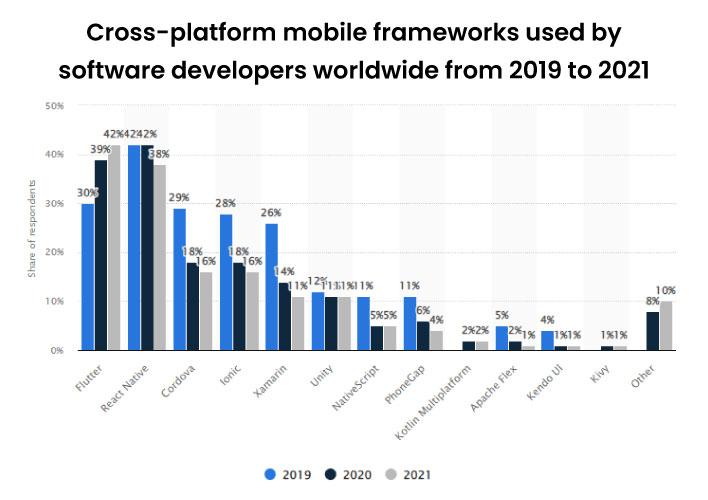
Image Source: Statista
Companies like Google Pay, BMW, Alibaba, and Nubank rely on Flutter for their production apps. To understand why, this blog covers Flutter app development from both business and developer perspectives.
Let’s discuss by knowing almost all the information about Flutter from business as well developers’ perspectives.
Table of Contents
What is Flutter?
Flutter is an open-source UI framework developed by Google for building natively compiled apps across mobile, web, and desktop from a single codebase. It is free to use and backed by an active developer community.
Google first released Flutter in 2017 under the project name “Sky.” Since then, it has become the most popular cross-platform mobile app development framework worldwide.
Many developers ask: What is the Flutter programming language? Flutter itself is not a language , it is a framework that uses Dart, a language also developed by Google. You can write a single codebase and deploy it on Android, iOS, web, and desktop platforms.
By hiring dedicated Flutter developers, you can build a production-ready application for multiple platforms without maintaining separate codebases.
The Flutter framework includes two important parts:
- A Software Development Kit (Flutter SDK): The mobile SDK is a collection of software development tools that help developers to write a mobile app code. The tools available in Flutter are APIs for unit and integration tests, Dart DevTools, and Flutter & Dart command-line tools. It is the only mobile SDK that offers a reactive view of eliminating the use of JavaScript bridge, which helps to communicate JavaScript with native components.
- Flutter Widgets (A Library-based on Widgets): Widgets are a collection of reusable UI elements (text buttons, text inputs, sliders, scrolling, and styling). It allows developers to build an application’s UI depending on the client’s needs. Widgets help to design layout, handle user interaction, and UIViews of the app.
You can check a short brief on the history of the Flutter mobile app framework in the following image.
What language does Flutter use?
Flutter uses Dart, a programming language developed by Google. Dart is object-oriented, class-based, and uses C-style syntax , making it familiar to developers who know Java or JavaScript.
To start building Flutter apps, developers need to download and install the Flutter software development kit (SDK). The SDK includes all the tools needed for compiling, testing, and deploying apps.
Let’s check how Flutter apps function.
How Does Flutter Work?
Flutter apps use the Dart language, and it allows to compile the app code ahead of time into a native machine code (iOS/Android). Then, the rendering engine (built with C++) converts app code into Android’s NDK and iOS’s LLVM. Both the pieces of code are rendered into the wrapper Android and iOS platforms and results into .apk or .ipa files for final output.
Next, we are going to check the reasons why Flutter is the best framework for app development.
Why Should You Use Flutter for App Development?
To give you reasons why you should use the Flutter framework, we have divided this section into two parts.
- Some statistics on the Flutter framework
- Features of Flutter framework
Let’s quickly check some of the statistics on the Flutter framework trend.
- According to a report by GoodFirms, over 2 million developers are now using Flutter worldwide, with 10% month-over-month growth in adoption.
- The 2024 Stack Overflow Developer Survey shows Flutter is admired by 60.6% of developers, slightly ahead of React Native at 56.5%.
- Over 1 million apps on the Google Play Store have been built with Flutter, spanning industries from fintech to healthcare.
These numbers confirm that Flutter is not just popular — it is the leading cross-platform mobile app development framework today.
Let’s have a look into the features of the Flutter app development framework.
Flutter helps developers to develop fast and scalable apps. Following are the features.
- Flutter widgets
- AOT code compilation
- Hot reload
- Single codebase
- Flutter Widgets
Flutter’s widgets reduce production work, and from the business point of view, it is beneficial to launch the product in the market as soon as possible. The native ready-made widgets lessen the work of developers by ensuring there are no or little compatibility issues of components with different OS versions of apps. Flutter has all the essential resources to develop native-like apps. In addition, Flutter doesn’t use OEM widgets like React Native. Instead, it uses its own ready-made widgets. The benefit you get is that the developed application offers the same performance on each platform.
Remember, native technology is totally different because a particular native tech is used for developing applications that operate on a targeted operating system only. If you are curious to learn about the difference between Flutter vs native, check our dedicated blog on Flutter vs native technology. Ahead of Time (AOT) Compilation
Being an entrepreneur, you want to develop a cross-platform app that offers good performance. Native app performance cannot be matched with cross-platform apps. But Flutter is not like other frameworks. It delivers native-like performance from cross-platform apps using Dart’s Ahead-of-Time compilation. This is one reason Flutter consistently outperforms other cross-platform development approaches in benchmarks. With the use of a programming language called Dart, the source code compiles Ahead-of-Time (AOT) into native code for multiple platforms. It removes the barrier of interpretation bridge of communication with platforms and improves the performance.Hot Reload Feature
Another feature of Flutter helps in quick development with the hot reload feature. The hot reload feature helps developers save time during cross-platform development. How? It allows developers to check the applied changes of code in real-time. Ultimately, it reduces the timeline for app development.
Developers take less time to create applications compared to other frameworks or programming languages. Because Flutter apps are quicker to write and require less time and effort to test and launch apps into the market. So, if an entrepreneur wants to test an app idea, Flutter becomes a feasible option to build an MVP version of the app idea. Also, less time means you will be charged less.Single Codebase
Low-cost app development with Flutter is another advantage of Flutter. It provides better app development work and results in fewer man-hours to develop an app because of a single codebase. Thus, the cost of developing a mobile app with Flutter is lower compared with native development. Many of the leading Flutter app development companies highlight this cost efficiency as a primary benefit.
In fact, the GooglePay team has used Flutter to re-built the GooglePay app from scratch that is identical and has similar functionalities across the platforms. It helped them to do more in less time make the app scalable and don’t need to invest much money by hiring developers for iOS and Android versions separately. The following are the advantage GooglePay got.rebuild- Reduced the time of development
- More efficient to manage app
- Saving cost in development
- 35% smaller new codebase
- Smaller in size than the original app
So, now you understand when to use Flutter, moving further you will know the advantages of Flutter for developers.
Want to Develop a Flutter App Solution?
Connect with us. Discuss your project requirements, and our Flutter team will help you build a scalable, fast and beautiful app.

What are the Advantages of Flutter for Android Developers?
Writing Code Faster
Flutter development is faster and more dynamic for creating a mobile application from scratch that is compatible with multiple platforms. This is possible because of the hot reloading feature. It takes only a few milliseconds to reflect the real-time changes when developers add features, fix bugs, or create code of user interface. It allows developers to check the results on the spot and reduces the time barrier in the development process.Single Codebase for Multiple Platforms
Developers get the facility of writing the same codebase for two apps i.e., iOS and Android apps. It reduces the major time of development. Because of a single codebase, developers only need to write test cases once. It reduces the work of developers on developing the same app for two different platforms.Architecture of Flutter
Flutter uses the declarative style of developing the user interface of the application. Using these structures, developers get the flexibility to apply various methods to manage the state of the application as per needs. Flutter is a framework that presents a layered architecture and allows developers to perform full customization and fast rendering. Almost all the components of this framework are in-built and easy to use.GUI and Widgets Components
UI is an essential part of any framework because it determines how the app looks and feels. Flutter provides a rich library of pre-built widgets for layouts, buttons, text inputs, scrolling, and animations. Unlike frameworks that rely on native OEM widgets, Flutter renders its own components using the Skia graphics engine. This ensures a consistent look across Android, iOS, and web platforms. Developers can also create custom widgets or combine existing ones. The Flutter ecosystem on pub.dev now offers over 50,000 packages to extend app functionality.Testing is Easy and Fast
With Flutter, the testing process becomes easy and only requires 50% time to do testing of mobile apps. Flutter offers a set of features to perform testing and also offers widgets testing to run unit tests on the UI of the mobile applications.
What are the Limitations of Using Flutter Framework?
As you saw Flutter has many advantages for businesses to take off, but you should also know the limitations of using Flutter.
Limited Third-party Libraries
While Flutter’s package ecosystem has grown rapidly, it still trails React Native in some specialized areas. For niche hardware integrations or platform-specific features, developers may need to write custom platform channel code. That said, Flutter’s ecosystem is closing this gap fast. The pub.dev repository continues to grow, and Google’s investment ensures long-term library support. For a detailed comparison, see our analysis of React Native vs Flutter.Larger App Size Compared to Native
Flutter apps include the framework’s rendering engine in the final build. This typically results in a larger initial download size compared to purely native apps. A minimal Flutter app starts at roughly 15-20 MB, whereas a native equivalent can be under 10 MB. For most users on modern devices, this difference is negligible. However, it may matter in markets where storage space and download size are constraints.Hardware Interaction Through Platform Channels
Flutter communicates with native device features through platform channels. For apps that rely heavily on Bluetooth, NFC, or custom hardware, developers may need to write platform-specific code in Kotlin or Swift alongside the Flutter codebase. Recent Flutter updates and community packages like flutter_blue have improved Bluetooth support significantly. However, for apps where hardware interaction is the core feature, evaluating native development remains a valid option.
Looking to Hire Dedicated Flutter Developers?
Let our experienced Flutter developers help you to develop a scalable solution. Get in touch with one of the technical professionals.
Next is the frequently asked questions section. If you are looking for more information about the Flutter framework, check the following section.
How Space-O Technologies Can Help With Your Flutter App
Flutter’s single codebase, fast rendering engine, and growing ecosystem make it the leading choice for cross-platform app development. Whether you need a consumer-facing mobile app or an enterprise solution, Flutter delivers native-like performance at a fraction of the cost.
Space-O Technologies is a leading Flutter app development company in Canada with years of experience delivering custom mobile solutions. Our team has built Flutter apps serving thousands of users across industries like ride-sharing, healthcare, and on-demand services.
If you have an app idea, our Flutter developers can help you plan, build, and launch it efficiently. Get in touch for a and project estimate.
FAQ About Flutter Framework
Which are the top apps built using the Flutter framework?
Major companies use Flutter in production. Some of the top applications built with Flutter include Google Pay, Google Ads, BMW, Nubank, eBay Motors, Alibaba (Xianyu), and Toyota. These apps serve millions of users across both Android and iOS platforms.
Is it possible to create web applications or desktop apps using Flutter?
Yes, it is possible to create web applications and desktop apps using Flutter. The single code gets compiled and also works on the web.
Which is the best framework between Flutter and React Native for cross-platform mobile apps?
Both frameworks are best to build mobile apps. Flutter is famous because of its easy-to-use feature while React Native is famous for developing personalized UI of mobile apps. To get more details, check the in-depth comparison between React Native vs Flutter for complete understanding.
Is Flutter better than Java?
Flutter is an SDK for creating cross-platform applications while Java only supports to development of Android apps. Java is a programming language used for creating desktop, mobile and web applications. Whereas, Flutter is a framework that helps to develop a mobile app for different platforms, i.e, iOS and Android.
Is Flutter easy to learn?
Flutter is easy to learn compared to Swift, Java programming language or React Native library. Because the learning curve of this framework is small compared to core language for Android or iOS app programming language.
Is Flutter a programming language?
No. Flutter is an open-source UI framework, not a programming language. It uses Dart as its programming language, which is also developed by Google. Dart handles the logic and structure, while Flutter provides the widgets, tools, and rendering engine to build the app interface.
Is Flutter free to use?
Yes. Flutter is completely free and open-source under the BSD license. There are no licensing fees for development or production use. You can download the Flutter SDK from the official Flutter website, build apps, and publish them to app stores at no framework cost.


 All our projects are secured by NDA
100% Secure. Zero Spam
*All your data will remain strictly confidential.
Trusted by


Bashar Anabtawi 
Canada
“I was mostly happy with the high level of experience and professionalism of the various teams that worked on my project. Not only they clearly understood my exact technical requirements but even suggested better ways in doing them. The Communication tools that were used were excellent and easy. And finally and most importantly, the interaction, follow up and support from the top management was great. Space-O not delivered a high quality product but exceeded my expectations! I would definitely hire them again for future jobs!”

Canada Office
2 County Court Blvd., Suite 400,
Brampton, Ontario L6W 3W8
Phone: +1 (602) 737-0187
Email: sales@spaceo.ca