
Home > Case-study > AI Document Processing Solution
AI Document Processing Solution Development
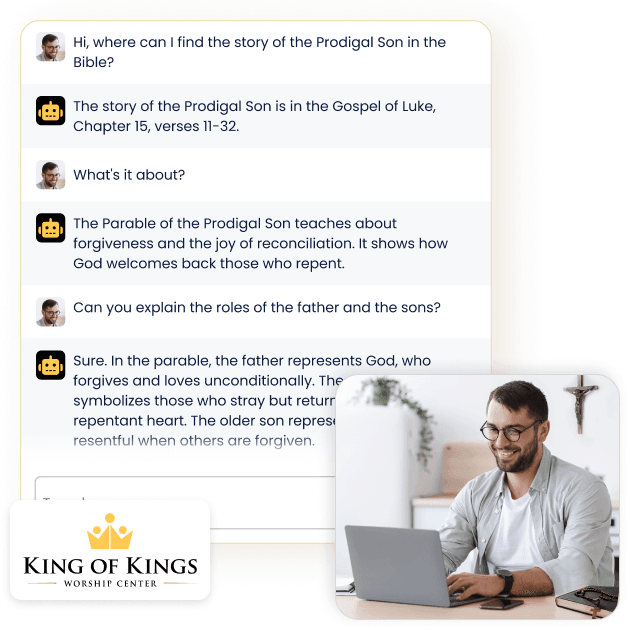
King of Kings is an AI document processing solution designed and developed by Space-O Canada for a USA-based client. It reads and understands a library of documents, then answers member questions in plain language, using OpenAI GPT-4 and GPT-3.5 Turbo with a Pinecone vector database for precise, source-backed responses.
Built as a web app, it works as a complete AI document processing solution, AI document management software, intelligent document processing platform, document AI solution, semantic search app, document management web app, and AI chatbot for documents, and it doubles as an enterprise AI solution, combining semantic search with a retrieval-augmented chatbot so people find the right answer in seconds.
About Our Client
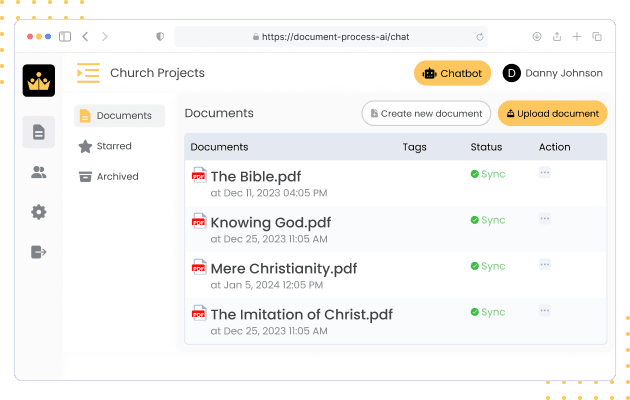
Our client runs the King of Kings Worship Center in New Jersey and wanted a web platform to organize the church’s sessions, livestreams, sermons, and worship materials, and to let members find specific answers and Bible passages, not just file names.
They partnered with Space-O Canada to design and develop the platform as a full-stack web app, with an AI developer, an ISTQB-certified QA, and a Certified ScrumMaster.
How We Built the AI Document
Processing Solution
This document processing software development project was a full-stack and custom AI development engagement spanning RAG application development, combining web development with retrieval-augmented AI. We built King of Kings around six core modules.
Document Upload & Import
1
Requirement
The client needed an easy way to bring in sermons, sessions, and resources from many sources and formats.
Solution
We built document import that pulls files from external sources such as cloud storage or links in various formats.
Semantic Search
2
Requirement
Members rarely search with the exact words on the page, so keyword search was not enough.
Solution
We built semantic search on a Pinecone vector database that recognizes synonyms and related terms, returning accurate results even when a query differs from the document wording.
AI Chatbot Over Documents
3
Requirement
The client wanted members to ask a question and get a clear answer with proof, not a list of files.
Solution
Through GPT-4 integration and natural language processing, we built a retrieval-augmented chatbot on OpenAI’s GPT-4 and GPT-3.5 Turbo that answers member questions with relevant content and source citations.
Shareable Chatbot Links
4
Requirement
The team wanted to point people straight to the right material.
Solution
We added export chatbot links so a user can share a chatbot scoped to specific documents or projects.
Role Management & Access Control
5
Requirement
Different people should see different things, and sensitive material had to stay protected.
Solution
We built role management with Express to assign permissions and access levels by role, keeping documents secure and member data private.
Scalable Full-Stack Web Platform
6
Requirement
The platform needed to grow with the content library and stay reliable for the whole congregation.
Solution
We built the front end in React.js and JavaScript and the backend in Node.js and Express, with PostgreSQL, delivering a scalable full-stack web app.
Key Features of King of Kings

Semantic Search
Recognizes synonyms and related terms to return accurate results even for loosely worded queries.

Chatbot Interaction & Source Citations
Ask questions and get instant responses with relevant content pulled from the documents. Every answer references the source document so members can trust and verify it.

Export Chatbot Links
Share links to a chatbot scoped to specific documents or projects.

Document Import & Knowledge Base Organization
Import documents from cloud storage or links in a range of formats. Upload and organize sessions, livestreams, sermons, and resources in one knowledge base.

Role Management
Assign permissions and access levels by role for security and data privacy.

GPT-4 Q&A
OpenAI GPT-4 and GPT-3.5 Turbo turn a document library into a natural-language assistant.
Who Uses This AI Document Processing Solution
A document AI solution like King of Kings suits any organization sitting on documents people need answers from, including:
Non-Profits & Churches
Enterprises
Legal Teams
Research Organizations
Education & Universities
Customer Support Teams
Knowledge Management Teams
AI Startups
Technology Stack
 React.js
 HTML
HTML CSS
CSS Node.js
 Express
Database
 PostgreSQL
AI Technologies
 Pinecone Vector Database
Our Role in the Project
Space-O Canada served as the end-to-end design and development partner for King of Kings, providing an AI developer, an ISTQB-certified Quality Analyst, and a Certified ScrumMaster to build the platform from scratch.
FAQs About AI Document Processing Solution Development
Most teams ask the same questions before they commit to a custom build. These are the ones we hear most often when planning ai document processing solution development.
What features are required to build an AI document processing solution?
Core features include document ingestion and OCR, text chunking, embedding generation, and a vector database for semantic search. You then add a RAG pipeline that retrieves relevant passages and feeds an LLM to answer questions or extract data, plus a search interface, source citations, and access controls. Enterprise builds also need user management, audit logs, and integrations with existing document stores.
How much does it cost to develop a custom AI document processing solution from scratch?
A focused MVP with ingestion, semantic search, and RAG-based Q&A typically costs $40,000 to $80,000, while an enterprise platform with integrations, role-based access, and high accuracy requirements can reach $120,000 to $250,000 or more. You also pay ongoing usage: OCR services run around $0.0015 per page and managed search or LLM tokens add recurring cost. Final pricing depends on document volume, accuracy targets, and security requirements.
How long does it take to build an AI document processing solution?
A RAG-based MVP that ingests documents and answers questions usually takes three to five months. An enterprise-grade platform with integrations, fine-tuned accuracy, and compliance controls takes six to ten months. Tuning retrieval quality and reducing hallucinations often adds iteration time after the first working version.
How do you build an AI document processing solution (development process)?
The process starts with assessing your document types, volume, and accuracy goals, then designing the ingestion and chunking strategy. Next you build the embedding and vector search layer, the RAG pipeline, and the LLM prompting with citations, followed by the search UI and access controls. The build ends with accuracy evaluation, hallucination testing, security review, and deployment with monitoring.
Why should you hire Space-O Canada to build an AI document processing solution?
Space-O Canada builds RAG and semantic search systems with the retrieval tuning, GPT-4 integration, and security controls that enterprise document workloads demand. The team handles ingestion pipelines, vector databases, citation accuracy, and scalable architecture so your teams can query large libraries reliably. You get a dedicated team, transparent milestones, and support to refine accuracy after launch.
How does an AI document processing solution work and how does it benefit teams with large document libraries?
Documents are ingested, split into chunks, converted to embeddings, and stored in a vector database; when a user asks a question, the system retrieves the most relevant passages and an LLM generates an answer with citations. This lets enterprises, non-profits, and teams search thousands of documents in seconds instead of reading manually. The benefit is faster answers, reduced manual review, better compliance, and freeing staff for higher-value work.
Who needs a custom AI document processing solution, and why build custom instead of off-the-shelf?
Enterprises, non-profits, and teams with large or sensitive document libraries that need control over data, accuracy, and integrations benefit most. Off-the-shelf tools often cannot meet specific security, on-premise, or domain-accuracy needs and limit how you tune retrieval. A custom build lets you adapt chunking, models, and access rules to your exact documents and compliance requirements.
Which LLM or model should you choose for an AI document processing solution, and why?
GPT-4 class models give strong reasoning and accuracy for complex document Q&A, while smaller or open-source models can lower cost and enable on-premise deployment for sensitive data. Many builds pair a capable generation model with a dedicated embedding model for retrieval, and fine-tuning can add meaningful factuality gains. The choice depends on accuracy needs, data residency rules, latency, and per-query budget.
How does RAG improve accuracy and reduce hallucinations in document processing?
RAG grounds the LLM in your actual documents by retrieving relevant passages before generating an answer, so responses cite real sources instead of relying on the model’s memory. This reduces hallucinations, improves explainability, and keeps answers aligned with your domain content. Adding reranking, citation display, and confidence checks further improves reliability for enterprise use.
How do you ensure data privacy and security in an AI document processing solution?
RAG keeps sensitive content in your document store and only sends retrieved snippets to the model, and you can add PII redaction before context reaches the LLM. Encrypt data in transit and at rest, enforce role-based access so users only retrieve documents they are permitted to see, and maintain audit logs. For strict requirements, deploy on-premise or in a private cloud with models that do not train on your data.
Other Solutions by Space-O Canada
See other AI and custom platform projects built by Space-O Canada for clients across North America.
-

AI-Powered Receipt Scanner App
Space-O Canada developed Receipt2Sheets, an AI-powered receipt scanner app with OCR data extraction, Google Sheets integration, and expense tracking.
-

MenuSnap: AI-Driven Food Photo Editor for Delivery Apps
Want to make your menu stand out on delivery platforms? MenuSnap is an AI-powered food photo editor designed by Space-O Technologies to transform your menu images into visual masterpieces.
-
AI Life Coaching App Development
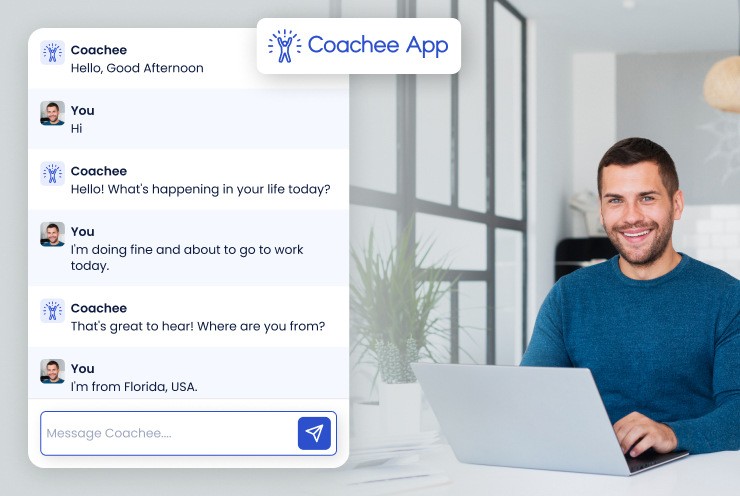
Coachee is a web-based life coaching app developed by Space-O Technologies using technologies like Python, Django, React.js, PostgreSQL, and OpenAI’s GPT-4.
 All our projects are secured by NDA
100% Secure. Zero Spam
*All your data will remain strictly confidential.
Trusted by


Bashar Anabtawi 
Canada
“I was mostly happy with the high level of experience and professionalism of the various teams that worked on my project. Not only they clearly understood my exact technical requirements but even suggested better ways in doing them. The Communication tools that were used were excellent and easy. And finally and most importantly, the interaction, follow up and support from the top management was great. Space-O not delivered a high quality product but exceeded my expectations! I would definitely hire them again for future jobs!”

Canada Office
2 County Court Blvd., Suite 400,
Brampton, Ontario L6W 3W8
Phone: +1 (623) 335-2152
Email: sales@spaceo.ca