
- What is B2C Portal Development?
- What are the Key Features of a B2C Portal?
- What are the Benefits of B2C Portal Development?
- What is the Process of B2C Portal Development? A Step-by-Step Guide
- What are the Key Challenges in B2C Portal Development and How to Overcome Them?
- How Much Does B2C Portal Development Cost?
- How to Choose a B2C Portal Development Company?
- What are the Latest B2C Portal Development Trends?
- Power Your Business Workflows with B2C Portals by Space-O Technologies
- Frequently Asked Questions about B2C Portal Development
B2C Portal Development: Features, Benefits, and How to Build One

 Last Updated: March, 16 2026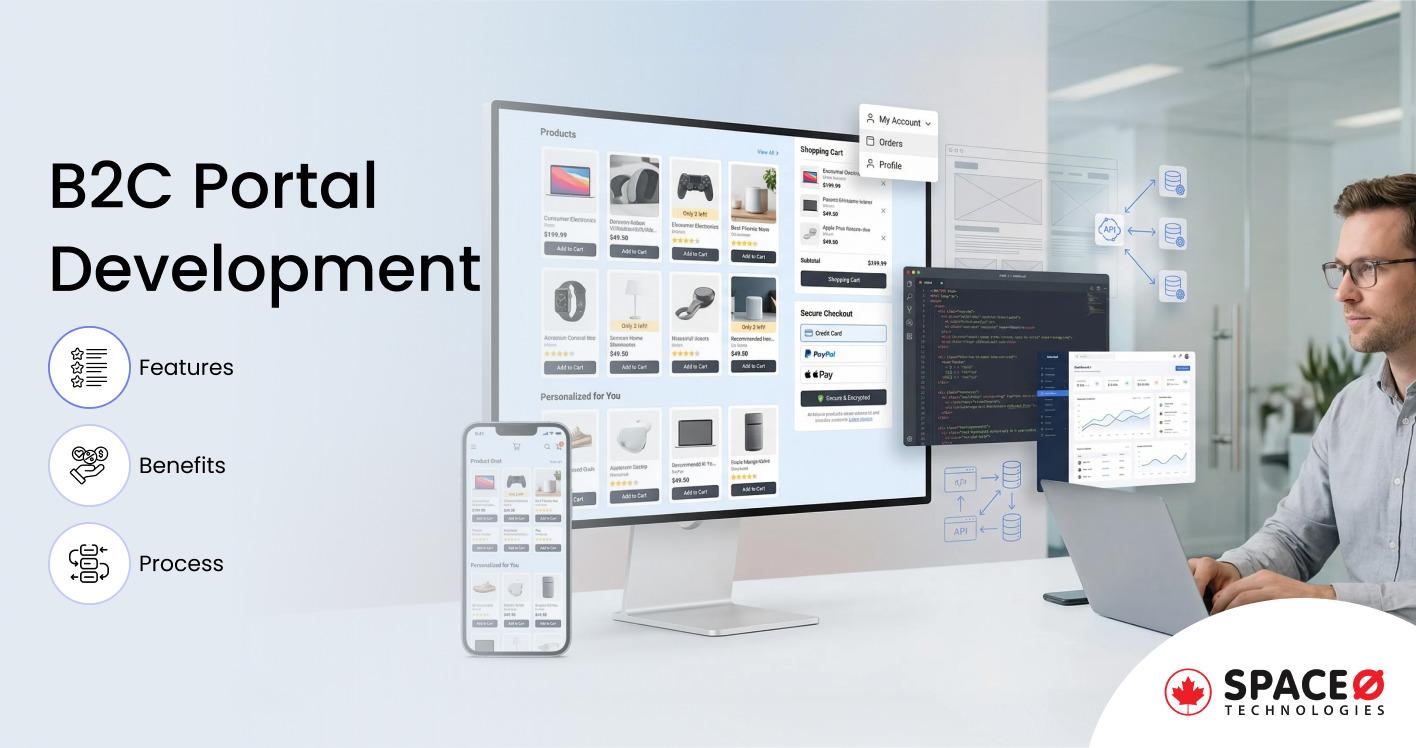
Is your business still relying on disconnected sales channels while your competitors deliver seamless digital experiences? You’re leaving revenue on the table. Today’s consumers expect instant access, personalized recommendations, and frictionless transactions, and businesses that fail to deliver lose customers to those that do.
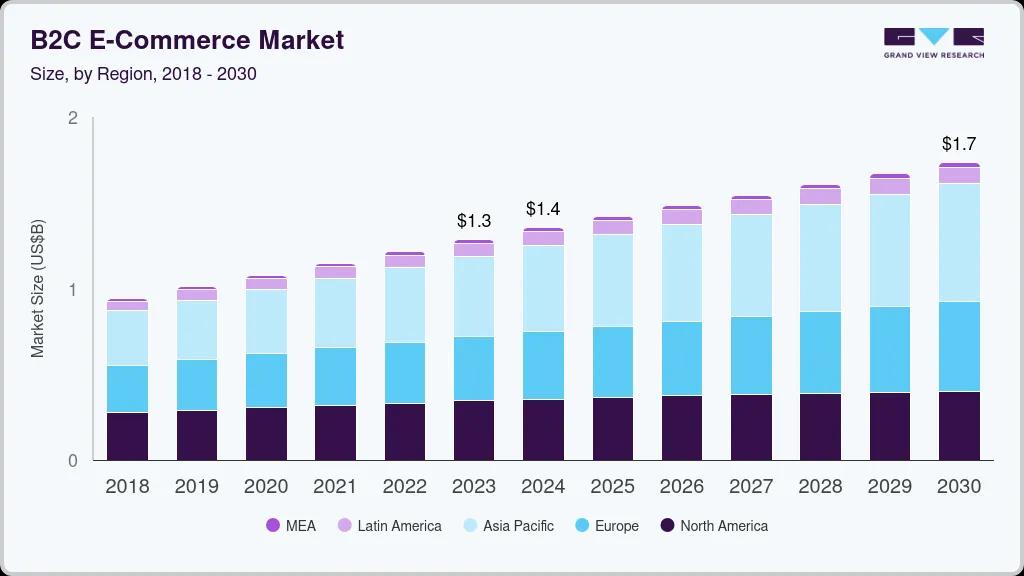
According to Grand View Research, the global B2C e-commerce market size was estimated at USD 5.47 trillion in 2023 and is anticipated to reach USD 17.77 trillion by 2030, growing at a CAGR of 19.1% from 2024 to 2030. This growth is driven by consumers who prefer online shopping, self-service options, and mobile-first experiences. For businesses looking to capture this opportunity, B2C portal development has become essential.
This guide covers everything you need to know about B2C portal development, from core features and benefits to the development process, costs, and challenges. Whether you’re building an eCommerce platform, subscription portal, or consumer engagement hub, you’ll learn how to create a portal that drives sales and customer loyalty.
If you’re exploring broader portal solutions, our comprehensive guide to web portal development provides additional context on different portal types and approaches.
What is B2C Portal Development?
B2C portal development is the process of building a web-based platform that enables businesses to sell products or services directly to individual consumers. Unlike traditional websites, B2C portals provide personalized user experiences, self-service capabilities, secure payment processing, and real-time inventory management, all designed to convert visitors into paying customers.
A B2C (Business-to-Consumer) portal serves as the digital storefront where consumers browse products, manage accounts, make purchases, and interact with your brand. These portals differ significantly from B2B portals, which cater to business buyers with longer sales cycles, bulk ordering, and negotiated pricing. B2C portals focus on emotional purchasing decisions, instant gratification, and streamlined checkout experiences.
Organizations investing in different types of web applications alongside their web portals create unified experiences that capture consumers across all touchpoints.
| Pro Tip: When planning your B2C portal, define your primary business model first- direct sales, subscription, or marketplace. This decision impacts every subsequent feature and integration choice. |
With the fundamentals clear, let’s explore the essential features that make a B2C portal successful.
What are the Key Features of a B2C Portal?
A successful B2C portal requires carefully designed features that guide consumers from discovery to purchase. The right feature set reduces friction, increases conversions, and builds long-term customer relationships.
1. Product management and catalog
Your product catalog serves as the foundation of the entire shopping experience. Essential capabilities include hierarchical category organization, advanced filtering by attributes (size, color, price, brand), and AI-powered product recommendations. Real-time inventory tracking prevents overselling and displays accurate availability. High-quality product pages with multiple images, 360-degree views, and detailed descriptions drive purchase confidence. Research shows 70% of consumers need at least three product images before buying.
2. Shopping cart and checkout
The shopping cart must balance functionality with simplicity. Key features include easy add/remove functionality, quantity adjustments, saved items for later, and persistent carts across sessions. Cart abandonment recovery through automated email triggers can recover 10-15% of abandoned purchases. The checkout process should offer guest checkout options, saved payment methods, address autofill, and order summary confirmation. Every additional step increases abandonment risk.
3. Payment gateway integration
Modern consumers expect payment flexibility. Integrate multiple payment options, including credit/debit cards, digital wallets (Apple Pay, Google Pay, Samsung Pay), Buy Now Pay Later services (Klarna, Afterpay), and local payment methods. For Canadian businesses, integration with Moneris and Interac provides familiar payment options. All payment processing must meet PCI-DSS compliance standards to protect cardholder data.
4. User account management
Registered users expect comprehensive account functionality. This includes order history and tracking, wishlists and favorites, saved addresses and payment methods, subscription management, and loyalty points tracking. Account dashboards should provide quick access to recent orders, pending deliveries, and personalized recommendations based on purchase history.
5. Search and discovery
Effective search functionality directly impacts conversion rates. Implement AI-powered search with autocomplete, typo tolerance, and synonym recognition. Faceted filtering allows consumers to narrow results by multiple attributes simultaneously. Visual search enables product discovery through image uploads, while voice search integration captures the growing segment of voice-first consumers.
6. Mobile optimization and responsive design
With mobile commerce projected to reach 75% of all eCommerce by 2025, mobile optimization is non-negotiable. Implement a responsive design that adapts seamlessly across devices, Progressive Web App (PWA) capabilities for app-like experiences, and touch-optimized interfaces. Page load times must stay under 2 seconds; 47% of consumers expect this performance standard, and each additional second of delay reduces conversions by 7%.
| Pro Tip: Prioritize mobile optimization from the start rather than retrofitting later. Mobile-first design ensures your portal captures the majority of consumer traffic effectively. |
Design a B2C Portal That Integrates With Your Core Systems
Space-O Technologies builds portals that connect smoothly with CRM, payment gateways, analytics, and backend systems to ensure consistent data flow.
These features deliver measurable business impact. Here are the major benefits driving B2C portal adoption.
What are the Benefits of B2C Portal Development?
Investing in B2C portal development delivers tangible returns across customer experience, revenue growth, and operational efficiency. Organizations that implement well-designed consumer portals consistently outperform competitors relying on fragmented sales channels.
1. Enhanced customer experience
B2C portals provide 24/7 availability, allowing consumers to browse, compare, and purchase whenever convenient. Personalized experiences based on browsing history, purchase patterns, and preferences increase engagement. Self-service capabilities, such as order tracking, returns initiation, and subscription management, reduce friction and improve satisfaction. This same self-service model drives patient portal development, where consumers expect 24/7 access to appointments, records, and billing.
2. Increased sales and revenue
AI-powered product recommendations can drive up to 35% of total eCommerce revenue. Optimized checkout processes reduce cart abandonment, while upselling and cross-selling features increase average order values. Subscription models create predictable recurring revenue streams. Direct-to-consumer (D2C) sales through your own portal eliminate marketplace fees and maintain higher margins.
3. Improved customer retention and loyalty
Loyalty programs integrated into B2C portals encourage repeat purchases through points, rewards, and exclusive offers. Personalized communications based on purchase history maintain engagement between transactions. Research indicates that repeat customers spend 67% more than new customers, making retention features essential for long-term profitability.
4. Operational efficiency
Automated inventory management synchronizes stock levels across channels, preventing overselling and stockouts. Self-service portals reduce customer support inquiries by up to 75%, freeing support teams for complex issues. Streamlined order processing and fulfillment workflows reduce manual intervention and errors.
5. Data-driven insights
B2C portals capture valuable consumer behavior data, such as browsing patterns, purchase history, abandoned carts, and search queries. Analytics dashboards transform this data into actionable insights for marketing optimization, inventory planning, and product development. First-party data becomes increasingly valuable as third-party cookies phase out.
Understanding the benefits is one thing, but building a B2C portal requires following a structured development process.
What is the Process of B2C Portal Development? A Step-by-Step Guide
Successful B2C portal development follows a systematic approach that balances speed-to-market with quality and scalability. Space-O Technologies follows a proven six-phase methodology that ensures alignment between business objectives and technical implementation.
1. Discovery and requirement analysis
The foundation of every successful project begins with understanding business goals, target audience, and competitive landscape. This phase includes stakeholder interviews, user persona development, feature prioritization, and technical requirement documentation. Define success metrics such as conversion rates, average order value, and customer acquisition cost early, to guide development decisions.
2. UI/UX design and prototyping
Consumer-focused design prioritizes intuitive navigation, visual hierarchy, and emotional engagement. Create wireframes mapping user journeys from landing to checkout. Develop interactive prototypes for stakeholder review and user testing. Mobile-first design ensures optimal experiences across all devices. Design systems establish a consistent visual language for scalable development.
3. Development and integration
Frontend development transforms designs into responsive, performant interfaces using modern web development frameworks. Backend development builds the business logic, database architecture, and API infrastructure. Third-party integrations connect payment gateways, shipping providers, CRM systems, marketing automation, and analytics platforms.
4. Quality assurance and testing
Comprehensive testing ensures reliability before launch. Functional testing validates all features work as specified. Performance testing confirms the portal handles expected traffic loads. Security testing identifies vulnerabilities before they become exploits. User acceptance testing (UAT) verifies that the portal meets business requirements. Mobile testing across devices and browsers ensures consistent experiences.
5. Deployment and launch
Production deployment includes server configuration, SSL certification, CDN setup, and DNS configuration. Pre-launch checklists verify that all integrations, payment processing, and email notifications function correctly. Soft launches to limited audiences identify issues before full public release. Monitoring tools track performance and errors from day one.
6. Post-launch support and optimization
Launch is the beginning, not the end. Continuous monitoring identifies performance bottlenecks and user experience issues. Analytics review reveals optimization opportunities. Regular feature enhancements respond to user feedback and market changes. Security patches and platform updates maintain system integrity. Space-O provides 3 months of free post-launch support to ensure smooth operations.
| Quick Insight: Start with a Minimum Viable Product (MVP) containing core features, then iterate based on real user data. This approach reduces initial investment while validating market fit before scaling. |
While the process seems straightforward, several challenges can impact your B2C portal project; here’s how to address them.
What are the Key Challenges in B2C Portal Development and How to Overcome Them?
B2C portal development presents unique challenges that can derail projects or limit post-launch success. Understanding these obstacles and implementing proven solutions ensures your portal delivers expected results.
1. Handling high traffic and scalability
Challenge: Consumer portals experience unpredictable traffic spikes during flash sales, holiday seasons, and viral marketing campaigns. Systems that handle normal loads may crash under peak demand, resulting in lost sales and damaged reputation.
Solution: Implement cloud-based infrastructure with auto-scaling capabilities that automatically provision additional resources during traffic surges. Use Content Delivery Networks (CDNs) to distribute static assets globally, reducing server load. Database optimization and caching strategies minimize response times under heavy loads. Load testing before major campaigns validates system capacity.
2. Ensuring security and data privacy
Challenge: B2C portals handle sensitive consumer data, such as personal information, payment credentials, and purchase history. Data breaches damage trust, trigger regulatory penalties, and create legal liability. Canadian businesses must comply with PIPEDA, while those serving international customers face GDPR requirements.
Solution: Implement PCI-DSS compliance for payment processing, SSL/TLS encryption for data transmission, and encryption at rest for stored data. Following web application security best practices ensures multi-layered protection, while multi-factor authentication safeguards user accounts. Regular security audits and penetration testing identify vulnerabilities before exploitation. Privacy-by-design principles ensure compliance from the architecture level.
3. Delivering a consistent omnichannel experience
Challenge: Consumers interact with brands across websites, mobile apps, social media, and physical stores. Inconsistent experiences across channels create friction and confusion, reducing conversion and loyalty.
Solution: Unified backend architecture serves all channels from a single source of truth. API-first development enables consistent functionality across touchpoints. Centralized customer data provides personalization regardless of channel. Responsive design ensures web experiences adapt seamlessly from desktop to mobile. Building complementary web applications alongside your portal extends reach while maintaining consistency.
4. Managing cart abandonment
Challenge: Average cart abandonment rates hover around 70%, representing massive lost revenue. Complex checkouts, unexpected costs, and limited payment options drive consumers away at the final step.
Solution: Simplify checkout to minimize required steps and form fields. Offer guest checkout for first-time buyers who resist account creation. Display all costs (shipping, taxes, fees) early in the process to prevent surprise at checkout. Implement abandoned cart email sequences with personalized reminders and incentives. Provide multiple payment options, including digital wallets and BNPL services.
5. Integrating with legacy systems
Challenge: Many businesses operate existing ERP, CRM, inventory management, and accounting systems. New portals must connect with these systems for unified operations, but legacy platforms often lack modern integration capabilities.
Solution: API-based integration layers connect modern portals with legacy systems without replacing existing infrastructure. Businesses running large-scale operations benefit from an enterprise web development approach that accounts for complex system dependencies.
Middleware solutions translate between incompatible data formats. Phased migration approaches modernize systems incrementally rather than requiring complete overhauls. Custom integration development addresses unique legacy system requirements.
6. Meeting performance expectations
Challenge: 47% of consumers expect web pages to load in under 2 seconds. Each additional second of load time reduces conversions by 7% and increases bounce rates. Slow portals frustrate users and hurt search rankings.
Solution: Image optimization reduces file sizes without sacrificing quality. Lazy loading defers non-critical content until needed. Browser caching stores static assets locally for returning visitors. Database query optimization reduces server response times. Code minification and compression reduce transfer sizes. Regular performance monitoring identifies degradation before it impacts users.
| Pro Tip: Conduct load testing simulating 2-3x your expected peak traffic before launch. Discovering capacity limits during a flash sale is far more costly than identifying them during testing. |
Turn Customer Interactions Into Structured Digital Workflows
Space-O Canada designs B2C portals that replace manual support and scattered tools with automated, self-service processes.
Overcoming these challenges requires proper investment. Here’s what B2C portal development typically costs.
How Much Does B2C Portal Development Cost?
E-commerce portal development costs in CAD scale with complexity and features. Basic portals take 2-3 months and range from $35,000 to $70,000. Medium complexity spans 3-6 months at $70,000 to $140,000. Complex builds require 6-12 months and cost $140,000 to $350,000+.
Understanding the cost of web portal development helps businesses plan realistic budgets and make informed decisions about scope and priorities.
1. Cost breakdown by portal complexity
| Portal Complexity | Features Included | Timeline | Cost Range (CAD) |
| Basic | Product catalog, shopping cart, payment integration, user accounts, basic search | 2-3 months | $35,000 – $70,000 |
| Medium | Custom UI/UX, multiple payment gateways, loyalty program, advanced filtering, mobile optimization, CRM integration | 3-6 months | $70,000 – $140,000 |
| Complex | AI personalization, multi-vendor marketplace, advanced analytics, ERP integration, mobile apps, internationalization | 6-12 months | $140,000 – $350,000+ |
2. Factors affecting development cost
Several variables influence total project investment:
- Feature complexity – Basic catalogs cost less than AI-powered personalization engines
- Design requirements – Template-based designs versus custom UI/UX development
- Integration count – Each third-party system (payment, shipping, CRM, ERP) adds cost
- Mobile requirements – Responsive web versus native mobile apps
- Security compliance – PCI-DSS, PIPEDA, or industry-specific requirements
- Scalability needs – Infrastructure designed for thousands versus millions of users
3. Ongoing costs to consider
Beyond initial development, budget for:
- Hosting and infrastructure – $500-$5,000/month, depending on traffic
- Maintenance and updates – 15-20% of initial development cost annually
- Third-party services – Payment gateway fees, email services, analytics tools
- Marketing integration – SEO, advertising platforms, marketing automation
| Pro Tip: Start with core features in a basic or medium portal, validate market response, then invest in advanced features based on proven demand. This approach minimizes risk while building toward comprehensive functionality. |
Knowing the costs helps with planning, but choosing the right development partner is equally important.
How to Choose a B2C Portal Development Company?
Selecting the right development partner significantly impacts project success. The wrong choice leads to delays, budget overruns, and portals that fail to meet business objectives. Evaluate potential partners across multiple dimensions before committing.
1. Evaluate technical expertise
Assess proficiency in relevant technologies, such as frontend frameworks (React, Angular, Vue.js), backend platforms (Node.js, Laravel, Python), database systems, and cloud infrastructure. Review experience with eCommerce platforms, payment gateway integrations, and third-party API implementations. Ask about their approach to performance optimization, security, and scalability.
2. Review portfolio and case studies
Request examples of B2C portals and eCommerce projects completed for similar industries or use cases. Examine live portals to evaluate design quality, performance, and user experience. Case studies demonstrating measurable results (conversion improvements, performance metrics, business outcomes) indicate outcome-focused development.
3. Assess communication and support
Effective communication prevents misunderstandings and keeps projects on track. Evaluate response times during the sales process, as they indicate support responsiveness post-launch. Understand their project management methodology, reporting cadence, and escalation procedures. Clarify post-launch support terms, SLAs, and maintenance options.
4. Consider compliance and security
B2C portals require robust security practices. Verify experience with PCI-DSS compliance for payment processing. For Canadian businesses, confirm understanding of PIPEDA requirements. Ask about security testing practices, code review processes, and incident response procedures. Certifications like ISO 27001 demonstrate organizational commitment to security.
5. Evaluate cultural fit and partnership approach
Development partnerships work best when values and working styles align. Whether you hire web developers in-house or outsource web development, this cultural fit determines long-term project success.
Partners invested in your success provide strategic guidance beyond technical implementation. Long-term partnership orientation ensures support as your portal evolves.
| Pro Tip: Request references from past clients in similar industries. Direct conversations reveal partnership dynamics that portfolios and proposals cannot capture. |
Making an informed choice leads to successful implementations. Let’s look at current trends shaping B2C portal development.
What are the Latest B2C Portal Development Trends?
The B2C portal landscape evolves rapidly as new technologies mature and consumer expectations shift. Staying current with trends ensures your portal remains competitive and delivers experiences consumers expect.
1. Headless and composable commerce
Headless architecture decouples frontend presentation from backend commerce functionality, enabling faster innovation and consistent experiences across touchpoints. Composable commerce takes this further, assembling best-of-breed components rather than monolithic platforms. This approach allows businesses to swap individual components without rebuilding entire systems, accelerating time-to-market for new features.
2. AI-powered personalization
Artificial intelligence transforms generic shopping experiences into individualized journeys. AI analyzes browsing behavior, purchase history, and contextual signals to deliver personalized product recommendations, dynamic pricing, and customized content. According to industry research, AI personalization increases engagement by 80% and drives significant conversion improvements. Machine learning models continuously optimize based on user interactions.
3. Omnichannel experience integration
Consumers move fluidly between channels, researching on mobile, comparing on desktop, purchasing in-store. Successful B2C portals integrate seamlessly with physical retail, social commerce, and marketplace channels. Unified inventory, consistent pricing, and synchronized customer profiles eliminate channel friction. Social commerce integration enables purchasing directly within platforms like Instagram and TikTok.
4. Voice commerce integration
Voice-activated shopping through smart speakers and virtual assistants represents the next commerce frontier. Optimizing product data for voice search, enabling voice-initiated reorders, and integrating with Alexa and Google Assistant capture early adopters. While voice commerce remains nascent, positioning for growth prepares portals for mainstream adoption.
5. Sustainable commerce features
Environmental consciousness influences purchasing decisions, particularly among younger consumers. B2C portals increasingly feature sustainability filters, carbon footprint displays, eco-friendly product badges, and carbon-neutral shipping options. Transparent supply chain information and ethical sourcing certifications build trust with conscious consumers.
Develop a Secure and Reliable B2C Portal Platform
Space-O Technologies focuses on data security, role-based access, and system stability to protect customer information and maintain trust.
These trends point to a dynamic future. Here’s how Space-O can help you build a successful B2C portal.
Power Your Business Workflows with B2C Portals by Space-O Technologies
A high-performing B2C portal demands more than functional development; it requires a deep understanding of consumer behavior, seamless user journeys, and an architecture built to scale.
Since 2018, Space-O Technologies has helped businesses create B2C portals that engage users, drive conversions, and support long-term growth. Our team works closely with you to translate business objectives into intuitive, consumer-focused digital experiences, supported by modern, cloud-native technologies.
From strategy and UX design to secure development, payment integrations, and post-launch optimization, Space-O delivers end-to-end B2C portal solutions. We ensure PIPEDA compliance, integrate trusted Canadian payment systems, and provide ongoing support to maintain performance and reliability after launch.
With a proven track record, transparent processes, and a focus on measurable outcomes, Space-O helps you build a B2C portal that evolves with your business and consistently delivers value to your customers.
Ready to discuss your B2C portal project? Schedule a Free Consultation with our team to explore requirements, timelines, and investment.
Frequently Asked Questions about B2C Portal Development
1. What is the difference between B2C and B2B portals?
B2C portals target individual consumers with emotional purchasing decisions, simple checkout processes, and immediate transactions. B2B portals serve business buyers with longer sales cycles, bulk ordering, negotiated pricing, approval workflows, and account-based relationships. B2C emphasizes user experience and conversion optimization, while B2B prioritizes complex pricing structures and procurement integration.
2. How long does B2C portal development take?
Development timelines depend on complexity and scope. Basic B2C portals with essential features typically require 2-3 months. Medium-complexity portals with custom design, multiple integrations, and loyalty features take 3-6 months. Complex implementations with AI personalization, marketplace functionality, and mobile apps may require 6-12 months or longer.
3. What payment gateways can be integrated into a B2C portal?
B2C portals integrate with major payment processors, including Stripe, PayPal, Square, and Authorize.net. Digital wallets like Apple Pay, Google Pay, and Samsung Pay provide mobile-friendly options. Canadian businesses often integrate Moneris and Interac for local payment preferences. Buy Now Pay Later services (Klarna, Afterpay, Affirm) expand purchasing power for consumers.
4. Can I integrate a B2C portal with my existing systems?
Yes, modern B2C portals connect with existing business systems through APIs and integration platforms. Common integrations include ERP systems (SAP, Oracle, NetSuite), CRM platforms (Salesforce, HubSpot), inventory management, shipping providers, accounting software, and marketing automation tools. Custom integration development addresses unique legacy system requirements.
How do I ensure my B2C portal is secure?
Secure B2C portals implement multiple protection layers: PCI-DSS compliance for payment processing, SSL/TLS encryption for data transmission, encryption at rest for stored data, multi-factor authentication for user accounts, and regular security audits. Compliance with PIPEDA (Canada), GDPR (Europe), and other regulations ensures legal data handling. Partner with development teams experienced in security best practices and compliance requirements.


What to read next
 All our projects are secured by NDA
100% Secure. Zero Spam
*All your data will remain strictly confidential.
Trusted by


Bashar Anabtawi 
Canada
“I was mostly happy with the high level of experience and professionalism of the various teams that worked on my project. Not only they clearly understood my exact technical requirements but even suggested better ways in doing them. The Communication tools that were used were excellent and easy. And finally and most importantly, the interaction, follow up and support from the top management was great. Space-O not delivered a high quality product but exceeded my expectations! I would definitely hire them again for future jobs!”

Canada Office
2 County Court Blvd., Suite 400,
Brampton, Ontario L6W 3W8
Phone: +1 (602) 737-0187
Email: sales@spaceo.ca