
- What is Corporate Website Development?
- What is the Cost of Essential Corporate Website Features?
- 1. Custom CMS Implementation: $15,000-$50,000
- 2. Multi-Language Support: $5,000-$15,000 per language
- 3. Investor Relations Section: $8,000-$20,000
- 4. Client or Employee Portal: $20,000-$60,000
- 5. Third-Party Integrations: $5,000-$20,000 per integration
- 6. Advanced Search Functionality: $5,000-$15,000
- 7. Accessibility Compliance (WCAG 2.1/AODA): $5,000-$15,000
- 8. Security Implementation: $10,000-$30,000
- What are the Ongoing Costs of Corporate Website Ownership?
- 1. Enterprise Hosting: $500-$5,000/month
- 2. CMS Licenses: $2,000-$50,000/year
- 3. Maintenance and Support: $2,000-$10,000/month
- 4. Content Updates: $2,000-$8,000/month
- 5. Security Monitoring: $1,000-$5,000/month
- 6. SEO and Digital Marketing: $3,000-$15,000/month
- How Does Corporate Website Development Cost Vary by Region?
- Why Canadian development partners make sense
- How to Plan Your Corporate Website Budget: Step-by-Step Guide
- Step 1: Align corporate website goals with business strategy
- Step 2: Define corporate website features, integrations, and architecture
- Step 3: Evaluate and shortlist enterprise-ready website development partners
- Step 4: Compare detailed corporate website development proposals
- Step 5: Allocate contingency budget for corporate website scope changes
- Step 6: Estimate long-term corporate website ownership and maintenance costs
- What are the Key Factors That Influence Corporate Website Development Cost?
- 1. Design complexity and brand customization
- 2. Number of pages and content volume
- 3. Corporate website features and functionality scope
- 4. Technology stack and CMS selection
- 5. Third-party integrations and system dependencies
- 6. Security, compliance, and regulatory requirements
- 7. Development team structure and engagement model
- How to Reduce Corporate Website Development Costs Without Compromising Quality
- 1. Prioritize corporate website features using an MVP approach
- 2. Use proven CMS platforms to reduce custom development costs
- 3. Phase corporate website development strategically
- 4. Leverage component-based design systems for efficiency
- 5. Choose the right development engagement model
- 6. Invest in quality upfront to lower long-term website costs
- What to Look for in a Corporate Website Development Partner
- 1. Enterprise-level corporate website development experience
- 2. Technical expertise across corporate web technologies
- 3. Understanding of corporate branding, compliance, and governance
- 4. Proven project management methodology for corporate websites
- 5. Post-launch corporate website support and maintenance capabilities
- 6. Transparent pricing and cost estimation practices
- How Does Space-O Help Enterprises Plan and Control Corporate Website Costs?
- Frequently Asked Questions About Corporate Website Development Cost
Corporate Website Development Cost: A Complete Guide to Pricing, Features, and ROI

 Last Updated: March, 27 2026
Your corporate website isn’t just a digital brochure—it’s often the first interaction stakeholders, investors, and potential clients have with your brand. A poorly designed corporate site can undermine credibility, while a strategically built platform drives lead generation, strengthens brand authority, and supports business growth.
But here’s the challenge: budgeting for corporate website development without understanding true cost drivers leads to either overspending or underinvesting in critical features. According to Statista, global IT outsourcing spending—including web development—is projected to reach $812.70 billion by 2029, reflecting the growing demand for professional digital solutions.
Whether you’re building a new corporate website or redesigning an outdated platform, understanding the real costs involved helps you make informed decisions. This guide is for CTOs, IT directors, and project managers at mid-to-large enterprises who are budgeting for a new corporate website or planning a redesign of an existing platform. It breaks down corporate website development cost by complexity, features, region, and ongoing expenses—so you can plan your investment with confidence.
Space-O Technologies is a full-service enterprise website development company specializing in corporate and B2B platforms for Canadian and global businesses—not a freelance marketplace or template-based website builder. If you’re exploring options for your next project, Space-O offers comprehensive website development services tailored to enterprise and corporate requirements.
What is Corporate Website Development?
Corporate website development involves creating a professional online platform that represents an organization’s brand, communicates with stakeholders, and supports business objectives. Unlike standard small business websites, corporate sites serve multiple audiences—investors, customers, partners, media, and employees—each requiring tailored content and functionality.
Corporate websites differ from standard business sites in scale, complexity, and strategic importance. They require careful planning, robust architecture, and ongoing investment to maintain effectiveness.
Organizations planning corporate web projects should understand how to create a website from scratch to appreciate the full scope of development requirements.
Ideal for enterprises redesigning outdated platforms, organizations expanding to multiple regions, and companies requiring PIPEDA-compliant, accessibility-ready corporate websites with CRM and ERP integrations.
With the basics covered, let’s get straight to what corporate website development actually costs.
How Much Does Corporate Website Development Cost Based on Complexity?
Corporate website development costs range from $20,000-$50,000 for basic sites, $50,000-$120,000 for mid-size sites, and $120,000-$350,000+ for enterprise platforms.
Corporate website development cost varies significantly based on project scope, features, and complexity. Here’s what you can expect to invest across different tiers.
The following table compares corporate website development costs across three complexity tiers—basic, mid-size, and enterprise—including estimated timelines and additional costs for healthcare-specific compliance and security requirements. All prices are in CAD unless stated otherwise.
| Complexity | Timeline | Base Cost Range | Healthcare Add-Ons (PIPEDA/Security) |
|---|---|---|---|
| Basic Corporate | 8-12 weeks | $20K-$50K | +$5K-$10K (secure forms, basic auth) |
| Mid-Size Corporate | 12-20 weeks | $50K-$120K | +$15K-$30K (CRM + analytics compliance) |
| Enterprise Platform | 20-36 weeks | $120K-$350K+ | +$40K-$100K (portals + EHR APIs) |
Key takeaway: Basic corporate websites ($20,000–$50,000) suit organizations establishing their initial online presence. Mid-size projects ($50,000–$120,000) serve growing businesses needing CRM integration and multi-language support. Enterprise platforms ($120,000–$350,000+) address complex requirements including global deployment, advanced security, and extensive third-party integrations.
1. Basic Corporate Website ($20,000-$50,000)
A basic corporate website suits smaller organizations or those establishing their initial online presence. This tier includes professional design, responsive layouts, essential pages (home, about, services, contact), and basic content management capabilities.
You’ll get a functional, professional website—but with limited customization and fewer advanced features.
2. Mid-Size Corporate Website ($50,000-$120,000)
Mid-size corporate websites serve growing organizations requiring more sophisticated functionality. This tier includes custom design aligned with brand guidelines, CRM integration for lead management, multi-language support for broader reach, and comprehensive analytics.
Most established businesses fall into this category, balancing functionality with budget constraints.
3. Enterprise Corporate Platform ($120,000-$350,000+)
Enterprise platforms serve large organizations with complex requirements. These projects involve enterprise-grade CMS platforms (Drupal, Adobe Experience Manager, Sitecore), extensive third-party integrations, global deployment across multiple regions, and advanced security implementations.
For detailed insights on website pricing across different types, see our comprehensive guide on website development cost.
Pro Tip: Don’t choose the complexity tier based solely on budget. Assess your actual requirements first—an over-engineered website wastes resources, while an under-built one limits growth.
Beyond base development, specific features significantly impact your total investment—here’s what to budget for each.
What is the Cost of Essential Corporate Website Features?
Essential corporate website features such as CMS customization, integrations, security, and portals can add $5,000 to $60,000+ per feature, depending on scope and complexity.
Individual features add significantly to the corporate website development cost.
At a glance:
- Custom CMS: $15,000–$50,000
- Multi-Language: $5,000–$15,000/language
- Investor Relations: $8,000–$20,000
- Client/Employee Portal: $20,000–$60,000
- Third-Party Integration: $5,000–$20,000 each
- Advanced Search: $5,000–$15,000
- Accessibility (WCAG/AODA): $5,000–$15,000Security
- Implementation: $10,000–$30,000
Understanding these line items helps you prioritize investments based on business needs.
1. Custom CMS Implementation: $15,000-$50,000
Enterprise content management systems like Drupal, WordPress VIP, or Sitecore provide robust content workflows, multi-user permissions, and scalability. Organizations comparing platforms should also consider how website design costs for small businesses differ from enterprise-grade CMS investments.
2. Multi-Language Support: $5,000-$15,000 per language
Global organizations require content translation and localization. Costs include translation management systems, language switchers, SEO optimization for each language, and ongoing content synchronization.
3. Investor Relations Section: $8,000-$20,000
Public companies need dedicated investor sections featuring stock information, financial reports, SEC/SEDAR filings, press releases, and event calendars. These require specific compliance considerations and regular content updates.
4. Client or Employee Portal: $20,000-$60,000
Secure portals for clients, partners, or employees involve user authentication, role-based access controls, document repositories, and personalized dashboards. Portal complexity directly impacts development cost.
5. Third-Party Integrations: $5,000-$20,000 per integration
Connecting your website to CRM (Salesforce, HubSpot), ERP systems, marketing automation (Marketo, Pardot), or analytics platforms requires custom API development and ongoing maintenance.
6. Advanced Search Functionality: $5,000-$15,000
Enterprise search using Elasticsearch or Algolia provides fast, relevant results across large content libraries. Implementation includes indexing, filtering, and search analytics.
7. Accessibility Compliance (WCAG 2.1/AODA): $5,000-$15,000
Canadian organizations must meet AODA accessibility standards. Compliance involves design adjustments, code modifications, testing, and documentation—a factor that also impacts website design cost across all business sizes.
8. Security Implementation: $10,000-$30,000
Enterprise security includes SSL certificates, Web Application Firewalls (WAF), DDoS protection, penetration testing, and compliance certifications. For Canadian businesses, PIPEDA compliance adds additional requirements.
Turn Corporate Website Cost Estimates Into an Executable Roadmap
Space-O converts high-level budget ranges into phased development plans with defined deliverables, milestones, and governance checkpoints.
Development is just part of your investment—ongoing expenses significantly impact total ownership cost.
What are the Ongoing Costs of Corporate Website Ownership?
Ongoing corporate website ownership costs typically equal 20–25% of the initial development investment annually, covering hosting, maintenance, security, content, and SEO.
1. Enterprise Hosting: $500-$5,000/month
Corporate websites require reliable, scalable hosting with guaranteed uptime, CDN integration, and technical support. Cloud platforms like AWS, Google Cloud, or Azure provide enterprise-grade infrastructure.
2. CMS Licenses: $2,000-$50,000/year
Enterprise CMS platforms charge annual licensing fees based on features, users, and traffic. Open-source alternatives like Drupal reduce licensing costs but increase development and maintenance requirements.
3. Maintenance and Support: $2,000-$10,000/month
Regular updates, bug fixes, security patches, and technical support keep your website functional and secure. Many organizations partner with web development teams for ongoing maintenance.
4. Content Updates: $2,000-$8,000/month
Fresh content drives engagement and SEO performance. Budget for copywriting, image creation, video production, and content management.
5. Security Monitoring: $1,000-$5,000/month
Continuous security monitoring, vulnerability scanning, and incident response protect against evolving threats.
6. SEO and Digital Marketing: $3,000-$15,000/month
Ongoing optimization ensures your corporate website ranks well and drives qualified traffic. This includes technical SEO, content strategy, and performance analysis.
Important Note: Plan for at least 20-25% of your initial development cost annually for ongoing maintenance and improvements. Underfunding post-launch support leads to security vulnerabilities and declining performance.
Location also plays a major role in pricing—here’s how regional rates compare.
How Does Corporate Website Development Cost Vary by Region?
Corporate website development costs vary by region due to differences in labor rates, compliance expertise, timezone alignment, and enterprise experience.
The development team’s location significantly impacts corporate website development cost. Here’s how hourly rates compare across regions.
The following table compares hourly development rates across five global regions—North America, Western Europe, Eastern Europe, Asia, and Latin America—with notes on compliance expertise and timezone alignment for Canadian organizations.
Note: Hourly rates shown in USD for global comparison. Request CAD-equivalent estimates during consultation.
Why Canadian development partners make sense
pace-O Technologies has delivered 200+ enterprise web projects since [founding year], specializing in scalable, PIPEDA-compliant corporate platforms for Canadian and international businesses. The team combines enterprise-grade development expertise with local market knowledge—providing same-timezone collaboration, regulatory compliance, and verifiable Canadian project references.
For Canadian organizations, working with local development partners offers distinct advantages:
- Same timezone collaboration: Real-time communication without scheduling challenges
- PIPEDA compliance expertise: Understanding of Canadian privacy regulations
- Cultural alignment: Familiarity with Canadian business practices and market expectations
- Local references: Ability to verify work with similar Canadian organizations
- Easier legal agreements: Contracts under Canadian law simplify dispute resolution
If you’re considering Canadian development resources, explore options to hire web developers with enterprise experience.
Pro Tip: Don’t choose partners based solely on hourly rates. A $50/hour developer who takes three times longer delivers less value than a $150/hour expert who builds maintainable, scalable solutions efficiently.
Now that you understand the costs involved, here’s how to plan your budget effectively.
How to Plan Your Corporate Website Budget: Step-by-Step Guide
Effective budget planning prevents cost overruns and ensures your corporate website meets business objectives. Follow these steps to plan your investment strategically.
Step 1: Align corporate website goals with business strategy
Start with clear goals for what your corporate website should achieve. Common objectives include generating qualified leads, supporting investor relations, attracting top talent, building brand credibility, and reducing customer service inquiries. Define measurable KPIs for each objective like conversion rates, time on site, and application submissions.
Step 2: Define corporate website features, integrations, and architecture
Create a detailed requirements document covering page inventory and content structure, required features and functionality, integration requirements with CRM and ERP systems, security and compliance needs, performance expectations, and multi-language requirements. The clearer your requirements documentation, the more accurate your quotes will be from potential partners.
Step 3: Evaluate and shortlist enterprise-ready website development partners
Identify three to five potential partners based on portfolio of similar corporate websites, technical expertise in required technologies, client references and reviews, communication quality during initial discussions, and understanding of your specific industry. Thorough research prevents costly mistakes from choosing inexperienced or unsuitable development partners.
Our guide on the top website development companies can help you start your evaluation.
Step 4: Compare detailed corporate website development proposals
Ask shortlisted partners for comprehensive proposals including detailed scope breakdown, timeline with milestones, team composition, technology recommendations, pricing structure whether fixed or time-and-materials, and post-launch support options. Comparing detailed proposals enables informed decisions based on value rather than price alone for optimal outcomes.
Step 5: Allocate contingency budget for corporate website scope changes
Corporate website projects frequently encounter scope changes, unexpected technical challenges, or stakeholder requests during development. A 15-20% contingency buffer prevents budget crises and allows flexibility for necessary adjustments without compromising project quality or requiring difficult conversations about additional funding midway through development.
Step 6: Estimate long-term corporate website ownership and maintenance costs
Include first-year operational costs in your total budget planning. Factor in hosting and infrastructure expenses, maintenance and support retainer fees, content creation and updates, security monitoring services, and marketing and SEO investments. Understanding total cost of ownership prevents surprises after launch.
Avoid Hidden and Long-Term Costs in Corporate Website Development
Space-O helps identify cost drivers such as compliance, performance optimization, content workflows, and future scalability early in planning.
With your budget planned, let’s explore what drives these costs in more detail.
What are the Key Factors That Influence Corporate Website Development Cost?
Design complexity, CMS choice, integrations, compliance requirements, and development team structure are the primary factors influencing corporate website development cost.
Understanding cost drivers helps you make informed trade-offs during planning and negotiations.
1. Design complexity and brand customization
Custom designs created from scratch cost significantly more than template-based approaches. Enterprise corporate websites typically require a custom design to align with brand guidelines and differentiate from competitors.
- Template-based design: $3,000-$10,000
- Custom design (basic): $15,000-$40,000
- Custom design (advanced with design system): $40,000-$100,000+
Smaller organizations exploring template-based options can review our guide on how to build a website for small business for cost-effective alternatives.
2. Number of pages and content volume
More pages mean more design, development, and content creation work. Enterprise sites with hundreds of pages require sophisticated information architecture and content management workflows.
3. Corporate website features and functionality scope
Every feature adds development time. Prioritize features that directly support business objectives and consider phased implementation for nice-to-have functionality.
4. Technology stack and CMS selection
Enterprise CMS platforms like Sitecore or Adobe Experience Manager offer powerful capabilities but require specialized expertise and carry higher licensing costs. Open-source alternatives like Drupal or WordPress reduce licensing fees but may increase development complexity.
Organizations evaluating technology options should understand web development technologies to make informed platform decisions.
5. Third-party integrations and system dependencies
Each integration requires API development, testing, and ongoing maintenance. Complex integrations with legacy systems cost more than standard connections to modern platforms.
6. Security, compliance, and regulatory requirements
Regulated industries (financial services, healthcare) face additional security and compliance requirements that increase development costs. Canadian organizations must ensure PIPEDA compliance for handling personal information.
7. Development team structure and engagement model
Team composition affects both cost and quality:
- Freelancers: Lower rates but limited accountability
- Agencies: Higher rates with comprehensive services
- Dedicated teams: Best for long-term projects requiring deep product knowledge
For complex corporate websites, many organizations choose to outsource web development for consistent quality and dedicated communication.
Understanding these factors helps you find ways to optimize spending—here are proven strategies.
How to Reduce Corporate Website Development Costs Without Compromising Quality
Organizations can reduce corporate website development costs by prioritizing MVP features, using proven CMS platforms, phasing development, and investing in quality upfront.
Smart cost optimization preserves quality while respecting budget constraints. These strategies help maximize value from your corporate website investment.
1. Prioritize corporate website features using an MVP approach
Launch with essential features and add enhancements post-launch based on actual user feedback and business needs. A phased approach spreads costs over time and allows you to validate assumptions before investing in advanced functionality. Identify features directly impacting business goals and prioritize those for initial launch.
2. Use proven CMS platforms to reduce custom development costs
Don’t build custom solutions when proven platforms meet your needs effectively. WordPress, Drupal, and similar platforms offer extensive functionality out of the box, significantly reducing custom development requirements. Leveraging established platforms provides reliability, community support, and abundant resources while minimizing development time and associated costs.
3. Phase corporate website development strategically
Break large projects into phases with clear deliverables and defined milestones. This approach reduces initial investment requirements, allows course correction based on learnings, spreads budget impact across fiscal periods, and demonstrates value before committing to full scope. Strategic phasing enables better resource allocation and risk management.
4. Leverage component-based design systems for efficiency
Invest in a reusable design system rather than designing every page from scratch individually. Components like headers, footers, cards, and forms can be reused across multiple pages, reducing design and development time significantly. Design systems also ensure visual consistency throughout your website while accelerating future updates.
5. Choose the right development engagement model
Match your engagement model to project characteristics for optimal cost efficiency. Fixed price works best for well-defined projects with stable requirements. Time and materials suits evolving requirements or exploratory phases. Dedicated teams are ideal for long-term development with ongoing enhancements and continuous improvement needs.
6. Invest in quality upfront to lower long-term website costs
Cutting corners during development creates technical debt that costs significantly more to fix later. Quality code, thorough testing, and proper documentation reduce long-term maintenance costs substantially. The cheapest development option rarely delivers best value, so focus on total cost of ownership rather than initial price alone.
Pro Tip: The cheapest development option rarely delivers the best value. Focus on total cost of ownership—including maintenance, updates, and opportunity costs—rather than just initial development price.
Choosing the right development partner is equally critical to managing costs and ensuring quality.
What to Look for in a Corporate Website Development Partner
Your development partner significantly impacts project success. Evaluate candidates against these essential criteria to ensure successful collaboration and optimal outcomes.
1. Enterprise-level corporate website development experience
Review portfolios for corporate websites similar in scale and complexity to your project requirements. Ask for specific examples demonstrating relevant expertise and request references you can contact directly. Partners with enterprise experience understand the unique challenges and expectations of corporate website projects better than generalist developers.
2. Technical expertise across corporate web technologies
Verify expertise in your required technologies including CMS platforms, programming languages, and integration capabilities with existing business systems. Ask about team certifications, ongoing training programs, and how they stay current with evolving technologies. Technical depth ensures your project benefits from best practices and modern approaches.
3. Understanding of corporate branding, compliance, and governance
Corporate websites have unique requirements around branding consistency, regulatory compliance, stakeholder management, and governance processes. Partners should demonstrate clear understanding of these nuances through relevant experience and thoughtful questions during discovery. This understanding prevents costly misalignments and ensures appropriate solutions.
4. Proven project management methodology for corporate websites
Ask about project management approaches, communication cadences, reporting structures, and how they handle scope changes during development. Established processes indicate organizational maturity and reduce project risk significantly. Clear methodologies ensure projects stay on track, within budget, and meet defined milestones consistently.
5. Post-launch corporate website support and maintenance capabilities
Development is just the beginning of your website’s lifecycle. Evaluate maintenance packages, response time guarantees, and long-term support options carefully. Partners offering comprehensive post-launch support ensure your website remains secure, updated, and performing optimally long after initial development concludes without seeking new vendors.
6. Transparent pricing and cost estimation practices
Partners should provide clear, detailed estimates explaining exactly what’s included and what costs extra beyond base pricing. Vague pricing often leads to budget surprises and strained relationships during projects. Transparent partners like Space-O Technologies build trust through honest communication about costs, timelines, and potential variables.
Make Confident Decisions About Corporate Website Investment
Space-O helps leadership teams understand how governance, security, integrations, and brand standards shape total website cost.
How Does Space-O Help Enterprises Plan and Control Corporate Website Costs?
Building a corporate website requires more than strong visuals—it demands strategic planning, technical depth, and long-term scalability. Space-O Technologies helps organizations design and develop corporate websites that support business goals, strengthen brand credibility, and adapt as requirements evolve.
We offer end-to-end corporate website development, covering strategy, UX design, development, integrations, security, and post-launch support. The team builds scalable, SEO-ready, and PIPEDA-compliant platforms, prioritizes performance and accessibility, and aligns features with real business needs.
What Do Clients Say About Space-O’s Corporate Website Development?
Space-O Technologies is rated 4.8/5 on Clutch from 75 verified client reviews.
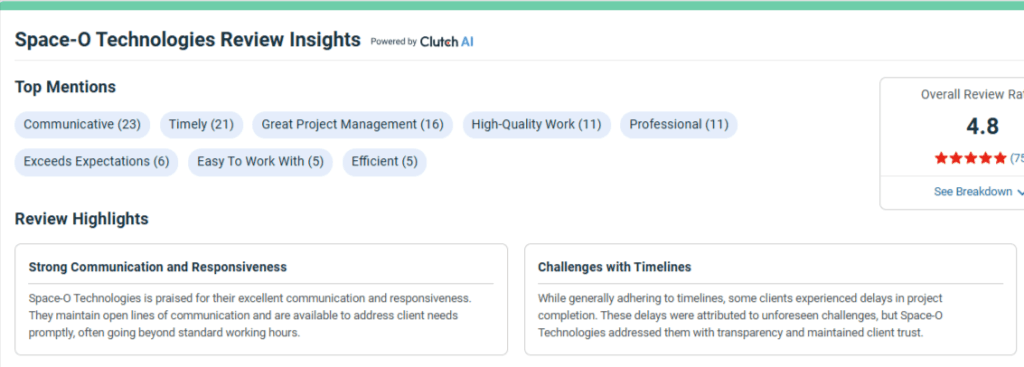
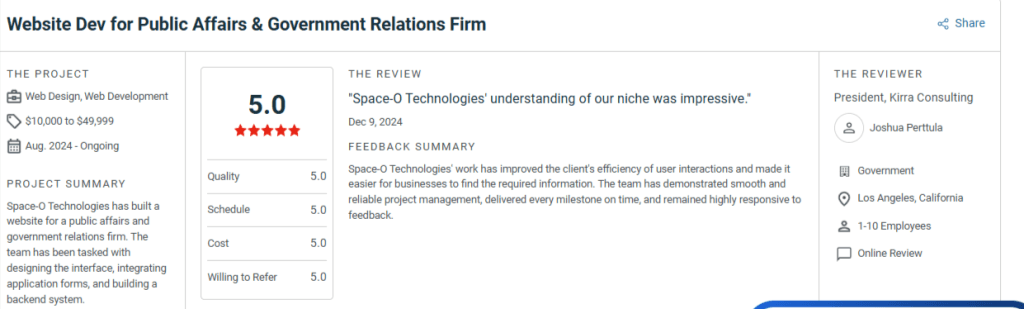
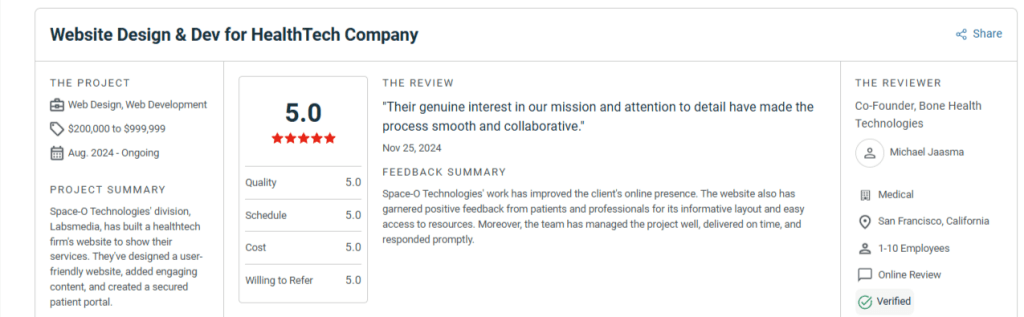
Clients consistently highlight Space-O’s proactive project management, on-time milestone delivery, and deep understanding of client-specific business requirements. Both web development engagements were delivered within the $10,000–$49,999 range with perfect 5.0 ratings across all evaluation criteria.
With transparent engagement models, experienced enterprise developers, and ongoing maintenance support, Space-O ensures your corporate website remains reliable, secure, and ready for growth—whether you are launching a new platform or modernizing an existing one.
Whether you’re building a new corporate platform or modernizing an existing website, our team provides the technical expertise and strategic guidance to maximize your investment.
Ready to discuss your corporate website project? to explore how Space-O Technologies can design and develop a corporate website that reflects your brand, supports your business objectives, and scales with your organization—strategically planned, professionally built, and engineered for long-term growth.
For Canadian enterprises planning a corporate website, Space-O Technologies provides strategic guidance, PIPEDA-compliant development, and enterprise-ready solutions tailored to local business, regulatory, and scalability requirements.
Frequently Asked Questions About Corporate Website Development Cost
How much does a basic corporate website cost?
A basic corporate website with 10-15 pages, responsive design, and standard CMS typically costs between $20,000 and $50,000. This includes professional design, essential functionality, and basic SEO optimization. More complex requirements increase costs accordingly.
What is the average timeline for corporate website development?
Timelines vary by complexity. Basic corporate sites take 8-12 weeks, mid-size projects require 12-20 weeks, and enterprise platforms need 20-36 weeks or longer. Factors affecting timeline include design complexity, content volume, integrations, and approval processes.
Should we build custom or use a CMS platform?
Most corporate websites benefit from proven CMS platforms like WordPress, Drupal, or enterprise solutions like Sitecore. Custom development makes sense only when no existing platform meets your specific requirements. CMS platforms reduce development time, lower costs, and provide ongoing community support.
How do we choose between fixed-price and dedicated team models?
Choose fixed-price for well-defined projects with stable requirements and clear deliverables. Select dedicated team models for long-term development, evolving requirements, or when you need ongoing enhancements and support. Many organizations start with fixed-price for initial development and transition to dedicated teams for maintenance.
What ongoing costs should we budget for?
Plan for annual ongoing costs of 20-25% of your initial development investment. This covers hosting ($6,000-$60,000/year), maintenance ($24,000-$120,000/year), security monitoring ($12,000-$60,000/year), and content updates ($24,000-$96,000/year). Enterprise CMS licenses add $2,000-$50,000 annually.
Should I redesign my existing corporate website or build from scratch?
Redesign makes sense when your current site has solid underlying architecture but outdated design, poor mobile experience, or limited functionality. Build from scratch when you need a fundamentally different technology stack, have accumulated significant technical debt, or require capabilities your current platform cannot support. Space-O provides a free technical audit to help you determine the most cost-effective approach for your specific situation.


Get a Practical Cost Breakdown for Corporate Website Development
 All our projects are secured by NDA
100% Secure. Zero Spam
*All your data will remain strictly confidential.
Trusted by


Bashar Anabtawi 
Canada
“I was mostly happy with the high level of experience and professionalism of the various teams that worked on my project. Not only they clearly understood my exact technical requirements but even suggested better ways in doing them. The Communication tools that were used were excellent and easy. And finally and most importantly, the interaction, follow up and support from the top management was great. Space-O not delivered a high quality product but exceeded my expectations! I would definitely hire them again for future jobs!”

Canada Office
2 County Court Blvd., Suite 400,
Brampton, Ontario L6W 3W8
Phone: +1 (602) 737-0187
Email: sales@spaceo.ca