
- What is ERP Development Outsourcing?
- Why Do Companies Outsource ERP Development?
- ERP Development Outsourcing Models: Choosing the Right Approach
- How Much Does it Cost to Outsource ERP Development?
- What are the Common Challenges in ERP Development Outsourcing and How to Overcome Them?
- How to Choose the Right ERP Development Outsourcing Partner
- 1. Verify ERP-specific experience and portfolio
- 2. Evaluate the technology stack and architecture approach
- 3. Check compliance certifications and security protocols
- 4. Assess communication practices and project management
- 5. Review engagement models and pricing transparency
- 6. Confirm post-launch support and maintenance
- 7. Check client references and independent reviews
- 8. Evaluate cultural fit and long-term partnership potential
- ERP Development Outsourcing vs. In-House Development: Which to Choose?
- What are the Best Practices for Successful ERP Development Outsourcing?
- 1. Define detailed requirements before engaging a partner
- 2. Start with a pilot module before full-scale development
- 3. Establish clear governance and communication cadence
- 4. Prioritize data migration planning from day one
- 5. Plan for change management and user training
- 6. Negotiate post-launch support terms upfront
- ERP Development Outsourcing With Space-O Technologies
- Frequently Asked Questions about ERP Development Outsourcing
ERP Development Outsourcing: A Complete Guide to Cost-Effective ERP Solutions

 Last Updated: March, 27 2026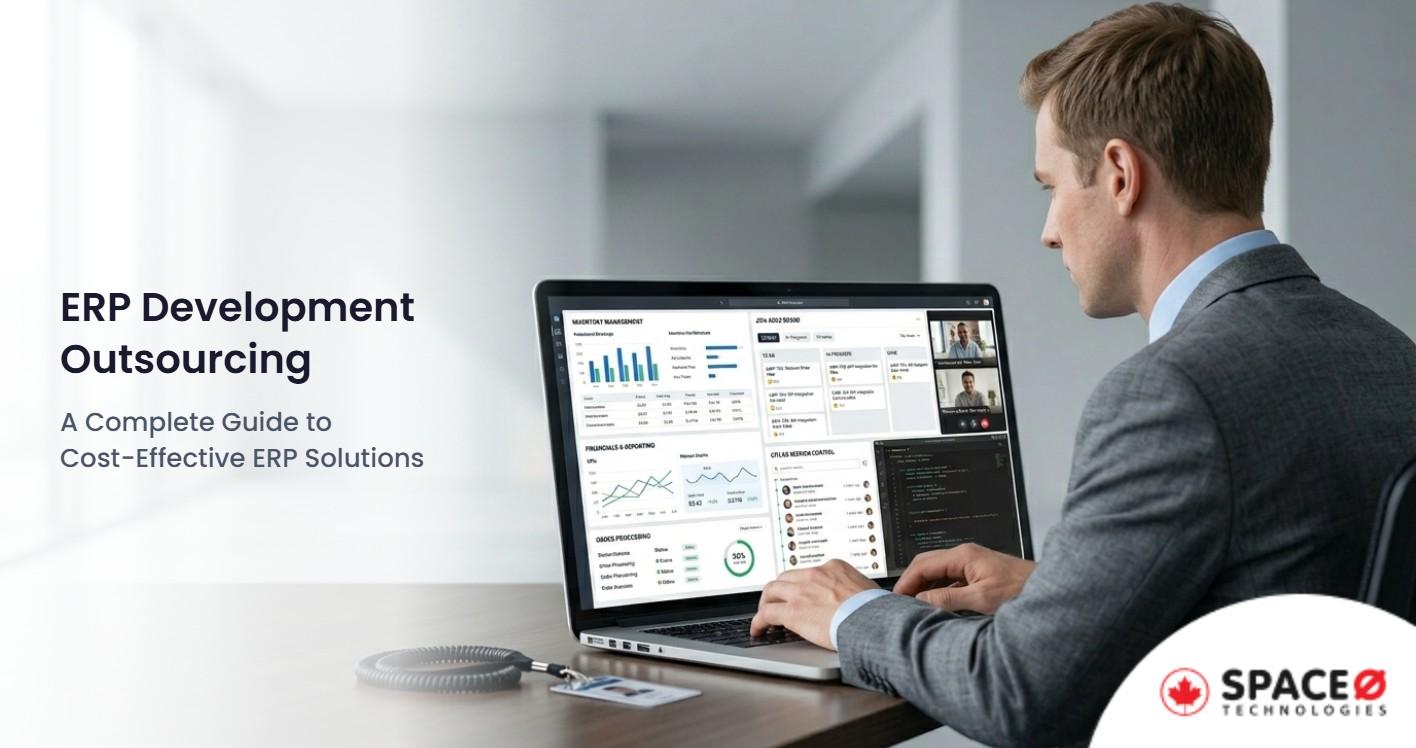
Does your business need a custom ERP system but lack the in-house expertise to build one? You are not alone. Developing enterprise resource planning software requires specialized skills spanning finance modules, supply chain workflows, inventory management, HR systems, and complex third-party integrations. Most companies simply don’t have that depth of expertise sitting on their bench.
That’s exactly why ERP development outsourcing has become the preferred approach for businesses across North America. According to Deloitte, 80% of executives are planning to maintain or increase investment in third-party outsourcing.
Companies that outsource to experienced ERP development partners gain faster deployment timelines, proven development methodologies, and access to teams who have already solved the exact challenges they are facing. For organizations already evaluating their options for ERP software development, outsourcing often becomes the most strategic path forward.
This guide covers ERP development outsourcing in practical terms. You will learn what it involves, when it makes sense, the key benefits and risks, outsourcing models to consider, realistic cost expectations, and how to select the right ERP development partner for your project.
What is ERP Development Outsourcing?
ERP development outsourcing is the practice of hiring an external software development company to design, build, integrate, and maintain a custom ERP system instead of relying solely on an in-house team. The scope typically covers the full development lifecycle from requirement analysis and architecture design through module development, third-party integrations, data migration, testing, deployment, and post-launch support.
This approach is distinct from simply purchasing an off-the-shelf ERP platform like SAP, Oracle NetSuite, or Microsoft Dynamics. When companies outsource ERP development, they are investing in a system built around their specific business processes, compliance requirements, and operational workflows. The outsourcing partner brings ERP-specific expertise that most internal IT teams lack, including experience with modular architecture, complex database design, multi-department integration, and industry-specific compliance standards.
Organizations investing in enterprise software development frequently turn to outsourcing when internal teams lack the cross-functional expertise required for ERP projects. Building a custom ERP system demands knowledge spanning finance, supply chain, human resources, and procurement skills that are rarely available within a single in-house team.
Pro Tip: Before engaging an outsourcing partner, document your core business processes and identify which ERP modules are essential versus nice-to-have. This clarity accelerates the discovery phase and results in more accurate proposals.
With the core concept established, let’s explore the strategic reasons why companies choose to outsource ERP development rather than building in-house.
Why Do Companies Outsource ERP Development?
The decision to outsource ERP development goes beyond reducing costs. It is a strategic choice that helps businesses move faster, access deeper expertise, and reduce the risk of implementation failure. Here are the six key reasons companies across industries choose to outsource their ERP projects.
1. Access to specialized ERP expertise across industries
ERP development requires a rare combination of domain knowledge and technical skill. A manufacturing ERP needs production planning and bill of materials management. A healthcare ERP requires HIPAA and PIPEDA compliance. An insurance ERP demands actuarial calculation engines.
When you outsource ERP development, you get immediate access to teams who have already built ERP systems across these industries and understand the domain-specific requirements that general software developers miss.
Space-O Technologies, for instance, has delivered ERP-adjacent systems for manufacturing automation, aviation maintenance, and agricultural operations, bringing a cross-industry perspective that strengthens every new ERP engagement.
2. Significant cost savings compared to in-house teams
Building an in-house ERP development team in Canada means hiring senior developers (CAD 110,000–CAD 170,000/year each), project managers, business analysts, QA engineers, and DevOps specialists. Add benefits, office space, equipment, and training, and you are looking at CAD 550,000+ annually before a single line of code is written.
ERP development outsourcing converts these fixed costs into project-based expenses. You pay for the expertise you need, when you need it, without long-term employment commitments. For a broader understanding of cost dynamics, our guide on the cost of outsourcing software development provides detailed breakdowns across engagement types.
3. Faster time-to-market with proven methodologies
Experienced ERP outsourcing partners have established frameworks, reusable components, and streamlined processes that accelerate delivery. They have already solved common ERP challenges, user authentication across modules, role-based access controls, data synchronization between departments, and can apply those solutions to your project immediately.
McKinsey reports that outsourcing can achieve 30–40% quicker deployment compared to in-house development. When your competitor is already automating their operations with ERP, speed matters.
4. Scalable team structure for each project phase
ERP projects have variable resource needs. You might need 10 developers during the core development sprint, but only 3 during testing and deployment. With outsourcing, you scale your team up or down based on project phases without the complexity of hiring and layoffs.
This flexibility is especially valuable when you need specialized skills for limited periods, an Odoo developer for platform customization, a database architect for data migration, or a security specialist for compliance testing.
5. Reduced implementation risk through experience
ERP projects carry significant risk. According to NetSuite, 51% of ERP implementations face disruptions, and budget overruns are common. Experienced outsourcing partners reduce this risk through proven quality assurance processes, structured project management, and compliance expertise. Partners with ISO 9001 and ISO 27001 certifications bring documented quality systems that minimize defects and security vulnerabilities.
6. Focus on core business operations
Managing an ERP development project is a full-time job, sprint planning, code reviews, architecture decisions, testing coordination, and stakeholder communication. When you outsource, your leadership team stays focused on business strategy, customer relationships, and revenue growth while the development partner handles the technical complexity.
Outsource ERP Development With Better Cost and Scope Control
Space-O Technologies helps organizations reduce ERP development overhead by delivering structured, well-governed outsourcing models with clear scope definition.
These benefits become actionable when matched with the right engagement structure. Here are the main ERP outsourcing models and how to choose between them.
ERP Development Outsourcing Models: Choosing the Right Approach
Not all outsourcing arrangements work the same way. The model you choose affects everything from cost structure to team dynamics to the level of control you maintain over the development process. Here are the four primary engagement models for ERP development outsourcing.
1. Dedicated development team
With this model, you build an external team that works exclusively on your ERP project. They integrate with your processes, attend your meetings, and function as an extension of your organization. This is the preferred model for complex, long-term ERP builds spanning 6–18 months.
Best for: Companies building comprehensive ERP systems with evolving requirements. You maintain high control while leveraging external expertise. Monthly costs are predictable, and the team accumulates deep knowledge of your business processes over time.
Organizations looking to hire a dedicated software development team for ERP projects benefit from continuity, accumulated domain knowledge, and the ability to iterate quickly based on stakeholder feedback.
2. Project-based outsourcing
This is a fixed-scope, fixed-price engagement. You define the ERP modules, features, and deliverables upfront, and the outsourcing partner delivers against that agreed specification.
Best for: Well-defined ERP modules where requirements are unlikely to change significantly. Think about building a specific finance module, inventory management system, or reporting dashboard. This model offers cost certainty and clear timelines, but less flexibility for mid-project changes.
3. Staff augmentation
Staff augmentation adds specific ERP developers to your existing in-house team. Need a Python developer with Odoo expertise? A .NET specialist for backend ERP modules? A database architect for data migration? This model fills precise skill gaps without outsourcing the entire project.
Best for: Companies with strong internal project management but lacking specific technical expertise. You retain full control over priorities and workflow while accessing specialized skills on demand.
4. Managed ERP services
This is an end-to-end engagement where the outsourcing partner handles everything, development, deployment, maintenance, and ongoing optimization. You provide business requirements and strategic direction; they manage the entire technical execution.
Best for: Organizations wanting a hands-off approach with a trusted partner who takes full ownership of the ERP system’s technical lifecycle.
For a deeper comparison of engagement structures, explore our detailed guide on software development outsourcing models.
With the right model in place, understanding the real costs involved helps set realistic expectations and budget. Here’s what ERP development outsourcing typically costs.
How Much Does it Cost to Outsource ERP Development?
ERP outsourcing costs for Canadian businesses typically range from CAD 120,000 to over CAD 2,200,000, depending on system complexity, module count, integration needs, and engagement model, allowing for effective budgeting across basic to enterprise‑scale projects
ERP outsourcing costs vary significantly based on system complexity, module count, integration requirements, and engagement model. Here is a realistic breakdown to help you budget effectively.
1. Cost breakdown by ERP complexity
| ERP Complexity | Modules | Team Size | Timeline | Estimated Cost (CAD Onshore) |
|---|---|---|---|---|
| Basic ERP (3–5 modules) | Finance, inventory, HR | 4–6 developers | 3–6 months | CAD 120,000–CAD 350,000 |
| Mid-range ERP (6–10 modules) | + CRM, supply chain, reporting, analytics | 6–10 developers | 6–12 months | CAD 350,000–CAD 900,000 |
| Enterprise ERP (10+ modules) | Full suite with AI, advanced analytics, multi-location | 10–20+ developers | 12–24 months | CAD 900,000–CAD 2,200,000+ |
2. Key factors that influence outsourcing costs
Several variables determine how much you will pay when outsourcing ERP development:
Module count and complexity: Each functional module adds development effort. Core modules like finance and inventory are foundational, while specialized modules like insurance claims processing or manufacturing production planning require deeper domain expertise and cost proportionally more.
Third-party integrations: Connecting your ERP with payment gateways, CRM systems, eCommerce platforms, or legacy databases adds integration development costs. Complex integrations with older systems lacking modern APIs require additional effort, typically CAD 10,000–CAD 60,000 per integration.
Compliance requirements: PIPEDA compliance for Canadian businesses, HIPAA for healthcare, IFRS 17 for insurance, and ISO standards for manufacturing all add development and testing overhead. Industry-specific compliance can add 10–25% to base development costs for Canadian ERP projects.
Data migration complexity: Moving data from legacy systems into a new ERP platform involves extraction, cleansing, transformation, and validation, often consuming 10–15% of the total project budget.
3. Outsourcing cost vs. in-house development cost
| Cost Factor | Outsourcing | In-House |
|---|---|---|
| Developer salaries | Included in project/retainer fee | CAD 110K–CAD 180K/developer/year (Canada) |
| Benefits and overhead | None | 25–40% of salary |
| Infrastructure and tools | Partner provides | CAD 25K–CAD 70K+ setup |
| Management overhead | Minimal — partner manages team | Significant — internal PM required (CAD 130K+) |
| Scalability cost | Adjust team size as needed | Hiring/firing costs |
| Total first-year cost (mid-range ERP) | CAD 180,000–CAD 450,000 | CAD 750,000–CAD 1,300,000+ |
4. Hidden costs to plan for
Beyond development fees, budget for data migration, user training, change management, post-launch maintenance (typically 15–20% of initial cost annually), and integration testing with existing systems. Companies that account for these upfront costs avoid budget surprises mid-project.
Pro Tip: Request a detailed cost breakdown from potential ERP outsourcing partners that includes development, testing, data migration, training, and at least 3–6 months of post-launch support. Transparent pricing is a sign of a reliable partner.
Understanding costs is essential, but outsourcing also comes with challenges that require proactive planning. Here’s how to address the most common risks.
What are the Common Challenges in ERP Development Outsourcing and How to Overcome Them?
ERP development outsourcing delivers significant advantages, but success depends on addressing potential challenges before they become project-threatening issues. Here are the most common obstacles and practical solutions.
1. Communication gaps across time zones and teams
The challenge: Misunderstandings multiply when working across time zones and communication styles. A module you described one way gets built differently because of interpretation gaps. Questions sit unanswered for hours, slowing decision-making.
The solution: Establish overlapping working hours for real-time collaboration. Use structured communication tools. Slack for daily updates, Jira for task tracking, and regular video calls for sprint reviews. Assign a dedicated project manager as a single point of contact.
2. Loss of control over the development process
The challenge: When development happens externally, you may feel disconnected from progress and decisions.
The solution: Clear SLAs, milestone-based delivery, regular sprint demos, and access to project management dashboards provide real-time visibility. Choose partners who follow Agile methodologies with transparent sprint reviews where you see working functionality at every iteration.
3. Data security and intellectual property protection
The challenge: ERP systems handle sensitive business data, financial records, employee information, customer data, and proprietary processes. Sharing this with an external team introduces risk.
The solution: NDAs and IP ownership agreements are non-negotiable. Verify the partner holds ISO 27001 certification for information security. Ensure data encryption at rest and in transit, secure development environments, and compliance with PIPEDA for Canadian data protection. Use code repositories you control so you always have access to your source code.
4. Quality assurance across distributed teams
The challenge: Code works but is not maintainable. Modules function individually but break during integration. Quality issues surface months after deployment.
The solution: Define acceptance criteria for every deliverable. Require automated testing, manual QA, and code review processes at each milestone. Choose partners with ISO 9001 quality certification and documented testing methodologies that include unit, integration, system, and user acceptance testing. For a balanced perspective on managing these tradeoffs, explore the pros and cons of outsourcing software development.
5. Scope creep and budget overruns
The challenge: Requirements evolve during development. New features get requested, priorities shift, and suddenly the project exceeds its original scope and budget.
The solution: Create a detailed Software Requirements Specification (SRS) before development begins. Establish a formal change request process with cost impact analysis for every scope change. Use fixed-price agreements for well-defined modules and dedicated team models for components where requirements may evolve.
6. Cultural and process alignment issues
The challenge: Different working cultures, holiday schedules, and communication styles can create friction in long-term engagements.
The solution: Choose partners with proven experience working with companies in your region. Partners who have served Canadian and North American clients understand business communication expectations, compliance requirements, and decision-making processes. Conduct trial projects before committing to full engagements to evaluate cultural fit.
Scale ERP Development Resources Based on Business Needs
Space-O Technologies offers flexible outsourcing models that allow you to increase or reduce ERP development capacity as project requirements evolve.
With challenges addressed proactively, the next critical step is evaluating potential partners, here’s a structured framework for selecting the right ERP outsourcing company.
How to Choose the Right ERP Development Outsourcing Partner
Selecting the wrong ERP outsourcing partner can derail your project, waste your budget, and set your business back months. Use these evaluation criteria to make an informed decision.
1. Verify ERP-specific experience and portfolio
Look for case studies in your industry. A partner who has built ERP systems for manufacturing, healthcare, or insurance understands domain-specific requirements that general software companies miss. Ask for live demos of previous ERP builds, not just screenshots. Check how many ERP projects they have delivered and in which industries.
2. Evaluate the technology stack and architecture approach
Ensure the partner works with modern technologies like cloud-native architecture, microservices, API-first design, and has expertise with platforms relevant to your requirements. If you are considering Odoo as your ERP foundation, explore our comparison of Odoo vs NetSuite to evaluate platform fit before engaging a partner.
3. Check compliance certifications and security protocols
ISO 9001 (quality management) and ISO 27001 (information security) certifications demonstrate mature processes. Verify knowledge of region-specific regulations, PIPEDA for Canadian businesses, HIPAA for healthcare, GDPR for EU operations, and industry standards like IFRS 17 for insurance.
4. Assess communication practices and project management
Transparent reporting, dedicated project managers, defined escalation paths, and familiarity with Agile/Scrum methodology are essential for ERP projects that span months. Evaluate communication quality from the very first interaction, responsiveness, clarity, and proactive problem identification are indicators of how the engagement will operate.
5. Review engagement models and pricing transparency
A reliable partner offers multiple engagement models like dedicated team, project-based, and staff augmentation with clear, upfront pricing. Avoid partners who provide vague estimates or resist detailed cost breakdowns. For a structured approach to vendor evaluation, our guide on how to outsource software development covers the step-by-step selection process.
6. Confirm post-launch support and maintenance
ERP systems require ongoing maintenance, bug fixes, security updates, performance optimization, and feature enhancements. Ensure the partner offers structured post-launch support with defined SLAs. Partners who include a free post-launch maintenance period demonstrate confidence in their delivery quality.
7. Check client references and independent reviews
Request references from past ERP clients and have direct conversations about their experience. Check independent review platforms like Clutch, GoodFirms, and G2 for verified feedback. Look specifically for reviews mentioning ERP or enterprise software projects. Our list of top software development outsourcing companies provides a starting point for vendor evaluation.
8. Evaluate cultural fit and long-term partnership potential
ERP projects are not one-off engagements. They require ongoing collaboration, often spanning years of maintenance and enhancement. Assess how the partner communicates, handles disagreements, adapts to feedback, and whether they approach the engagement as a partnership rather than a transaction.
Pro Tip: Request a small pilot project or proof-of-concept engagement before committing to a full ERP development contract. This reveals the partner’s actual capabilities, communication style, and delivery quality without significant financial risk.
Beyond choosing the right partner, understanding how outsourcing compares to in-house development helps validate your decision, here’s a direct comparison.
ERP Development Outsourcing vs. In-House Development: Which to Choose?
The build-versus-outsource decision depends on your timeline, budget, internal capabilities, and long-term strategy. Here is how they compare across key dimensions.
| Factor | Outsourcing | In-House |
|---|---|---|
| Upfront Cost | Lower — pay per project or monthly retainer | Higher salaries, benefits, and infrastructure |
| Expertise | Broad ERP expertise across multiple industries | Limited to the current team’s experience |
| Time-to-Market | Faster — established processes and ready teams | Slower — hiring, onboarding, team building |
| Scalability | Highly flexible — adjust team size per phase | Constrained by headcount and hiring timelines |
| Control | Moderate to high — depends on engagement model | Full direct control |
| IP Ownership | Full ownership with proper contracts | Full ownership by default |
| Long-term Cost | Variable — project-based expenses | Higher — ongoing salaries and overhead |
| Risk | Lower for ERP-specific projects (experienced teams) | Higher if the team lacks ERP domain expertise |
When outsourcing makes more sense
Outsourcing is typically the better choice when your in-house team lacks ERP-specific experience, you are working against tight deadlines, budget constraints prevent hiring a full development team, or you need industry-specific compliance expertise. Companies evaluating this decision will find our detailed comparison of in-house vs outsourcing software development especially useful.
When in-house development may be preferred
In-house development works better when you have a skilled internal team with proven ERP experience, ERP is your core product offering, you need absolute control over every development decision, or you plan to maintain and enhance the system continuously with a permanent team.
Whether you outsource or build in-house, following proven best practices ensures your ERP project delivers the expected results. Here’s what leading organizations do differently.
What are the Best Practices for Successful ERP Development Outsourcing?
Following these best practices maximizes the chances of a successful ERP outsourcing engagement while minimizing risks and budget surprises.
1. Define detailed requirements before engaging a partner
Create a comprehensive Software Requirements Specification (SRS) covering modules, workflows, user roles, integrations, compliance needs, and performance expectations. The more detailed your requirements, the more accurate your proposals and the fewer surprises during development. Include both functional requirements (what the system must do) and non-functional requirements (performance, security, scalability).
2. Start with a pilot module before full-scale development
Begin with one ERP module, like finance, inventory, or HR, to validate the partner’s capabilities, communication style, and delivery quality before committing to the full build. A successful pilot creates confidence and establishes working patterns that scale to the complete project.
3. Establish clear governance and communication cadence
Define a communication structure before development begins. Weekly sprint reviews for the development team, bi-weekly stakeholder demos for business sponsors, and monthly steering committee meetings for executives keep everyone aligned. Document decisions and action items from every meeting to maintain accountability.
4. Prioritize data migration planning from day one
Data migration from legacy systems is often the most underestimated aspect of ERP projects. Start planning data extraction, cleansing, transformation, and validation early. Conduct migration rehearsals before the production cutover to identify and resolve issues while time remains.
5. Plan for change management and user training
ERP adoption fails when end users resist new workflows. Budget for role-specific training, create comprehensive user documentation, and involve end users in user acceptance testing (UAT). Super-user programs that train department champions create internal support networks that accelerate adoption. Understanding current software development outsourcing trends helps organizations prepare for emerging best practices in distributed team collaboration.
6. Negotiate post-launch support terms upfront
Ensure the contract includes bug fix SLAs, security patching, performance monitoring, and a defined period of post-launch support. A minimum of three months post-launch maintenance is standard practice, with options to extend through maintenance retainers.
Turn ERP Development Outsourcing Into a Strategic Advantage
Space-O Technologies helps organizations leverage outsourcing to improve delivery speed, cost efficiency, and overall ERP project outcomes.
With a clear understanding of benefits, models, costs, and best practices, here’s how Space-O Technologies delivers custom ERP development outsourcing with proven results.
ERP Development Outsourcing With Space-O Technologies
ERP development outsourcing delivers results only when you partner with a team that combines technical depth, domain expertise, transparent processes, and a strong commitment to long-term success. Space-O Technologies brings all of these together to help organizations build reliable, scalable ERP systems.
With over a decade of experience and hundreds of successfully delivered software solutions, Space-O has the expertise that ERP projects demand. The team has implemented ERP and ERP-adjacent systems across manufacturing, operations, finance, supply chain, and asset management, demonstrating the ability to handle complex, business-critical workflows.
A broad technology stack including Odoo, Python, .NET, React, Node.js, and cloud-native architectures, enables full-stack ERP development across finance, inventory, HR, CRM, reporting, and analytics.
Space-O also prioritizes security, compliance, and predictability. ISO 9001 and ISO 27001 certifications, deep knowledge of PIPEDA and Canadian regulatory requirements, flexible engagement models, and transparent pricing ensure confidence throughout the project lifecycle.
Ready to explore ERP development outsourcing for your business? Schedule a free consultation with Space-O Technologies to discuss your requirements and discover how we can help.
Frequently Asked Questions about ERP Development Outsourcing
How long does it take to develop an ERP system through outsourcing?
Timelines depend on scope and complexity. Basic ERP systems with 3–5 core modules typically require 3–6 months. Mid-range systems with 6–10 modules and third-party integrations take 6–12 months. Enterprise-grade ERP solutions with 10+ modules, complex data migration, and advanced analytics may require 12–24 months.
What is the average cost of outsourcing ERP development?
Costs typically range from CAD 80,000–CAD 200,000 for basic ERP systems to CAD 450,000–CAD 1,200,000+ for enterprise‑level solutions. Key cost factors include module count, customization depth, third-party integrations, data migration complexity, and compliance requirements. Request detailed cost breakdowns from potential partners that include development, testing, data migration, training, and post-launch support.
Is it safe to outsource ERP development with sensitive business data?
Yes, when proper safeguards are in place. Require NDAs, IP ownership agreements, and verify the partner holds ISO 27001 certification. Ensure encryption at rest and in transit, secure development environments, and compliance with data protection regulations like PIPEDA for Canadian businesses. Use code repositories you control and define data handling protocols in the contract.
What ERP modules are most commonly outsourced?
Finance and accounting, inventory management, HR and payroll, CRM, supply chain management, and reporting and analytics are the most frequently outsourced ERP modules. Industry-specific modules, claims processing for insurance, production planning for manufacturing, and patient management for healthcare are also commonly outsourced because they require specialized domain expertise.
Can I outsource just part of my ERP project?
Absolutely. Many companies outsource specific modules or development phases while keeping other components in-house. Staff augmentation models allow you to add specialized ERP developers, such as an Odoo developer or a .NET ERP specialist, to your existing team without outsourcing the entire project. This hybrid approach gives you both control and access to specialized expertise.
How do I ensure quality when outsourcing ERP development?
Establish clear acceptance criteria for every deliverable. Require automated and manual testing at each milestone. Conduct regular code reviews and include independent QA testing. Choose partners with ISO 9001 certification and documented testing methodologies covering unit, integration, system, and user acceptance testing. Sprint demos provide regular visibility into work quality before final delivery.


Need ERP Development Without the High In-House Costs?
What to read next
 All our projects are secured by NDA
100% Secure. Zero Spam
*All your data will remain strictly confidential.
Trusted by


Bashar Anabtawi 
Canada
“I was mostly happy with the high level of experience and professionalism of the various teams that worked on my project. Not only they clearly understood my exact technical requirements but even suggested better ways in doing them. The Communication tools that were used were excellent and easy. And finally and most importantly, the interaction, follow up and support from the top management was great. Space-O not delivered a high quality product but exceeded my expectations! I would definitely hire them again for future jobs!”

Canada Office
2 County Court Blvd., Suite 400,
Brampton, Ontario L6W 3W8
Phone: +1 (602) 737-0187
Email: sales@spaceo.ca