
- How Much Does It Cost to Develop a Telemedicine App?
- What Is a Telemedicine App and How Does It Work?
- Why Building a Telemedicine App Is a Smart Move in 2025
- Telemedicine App Development Cost Breakdown by Phase
- 5 Key Factors That Influence Telemedicine App Development Cost
- Hidden and Ongoing Costs of Telemedicine App Development
- How to Reduce Telemedicine App Development Costs Without Cutting Corners
- How Space-O Builds Secure, Compliant Telemedicine Apps
- Get a Customized Quote for Your Telemedicine App
- Frequently Asked Questions about Telemedicine App Development Cost
Telemedicine App Development Cost: Complete Pricing Breakdown

 Last Updated: January, 28 2026
Telemedicine app development cost in Canada generally ranges from $40,000 to $400,000+, depending on features, platforms, and compliance requirements. Healthcare providers, clinics, and startups search for cost estimates to plan budgets, assess feasibility, and understand the investment required to launch secure virtual care services. Many teams also compare cost structures before deciding whether to build an MVP, develop a full telehealth platform, or modernize existing workflows.
Budget expectations shift based on user roles, EHR needs, privacy controls, and backend infrastructure. Demand for secure digital healthcare solutions continues to grow across Canada and the US as more organizations adopt remote consultation models.
For a broader context on app budgeting, review the app development cost guide. Many healthcare organizations use telemedicine to expand access, reduce wait times, and modernize patient services. Space-O Technologies, being a leading telemedicine app development company supports these goals through structured development, transparent estimates, and experience with 100+ global clients since 2018.
Telemedicine cost ranges:
- Basic telemedicine MVP: $40,000–$80,000
- Mid-level telehealth app: $80,000–$180,000
- Enterprise-grade telemedicine platform: $180,000–$400,000+
How Much Does It Cost to Develop a Telemedicine App?
Developing a telemedicine app in Canada and North America generally costs between $40,000 and $400,000+, depending on app complexity, integrations, platforms, and compliance needs. These ranges align with standard healthcare software budgets across the region.
Cost ranges in Canada and North America (in USD):
- Basic telemedicine MVP ($40,000–$80,000): Covers authentication, appointment booking, virtual consultations, and payments.
- Mid-level telemedicine app ($80,000–$180,000): Supports multi-role access, EHR integration, analytics, and improved UI/UX.
- Enterprise telemedicine platform ($180,000–$400,000+): Offers multi-specialty workflows, remote patient monitoring, wearables, and AI-driven features.
Factors Impacting the Telemedicine App Development Cost
1. Average cost by app complexity
Basic MVPs usually start around $40,000 and rise as compliance, workflows, and stability requirements expand. Mid-level apps often reach $100,000–$200,000 due to EHR integrations, real-time chat, and secure databases. Enterprise apps exceed $200,000 once complex workflows, cross-platform access, and specialty modules enter the scope. Healthcare apps require engineering for encrypted data storage, protected communication channels, and regulatory alignment.
Planning for post-launch support remains important. Many teams budget ongoing updates based on the cost to maintain an app.
2. Cost ranges by platform (iOS, Android, web, cross-platform)
A single-platform MVP may stay within $25,000–$60,000, while multi-platform builds usually move to the $60,000–$90,000 range. Web dashboards, provider portals, and admin consoles add to the scope. Platform choice influences cost because native and cross-platform frameworks require different engineering efforts. Native builds for both iOS and Android can raise budgets by 30–50%. Many clinics choose cross-platform frameworks to optimize early costs.
3. Typical development timeline for telemedicine apps
A functional MVP takes 3–4 months for design, development, and basic QA. Mid-level apps require 4–8 months due to multi-role structures and backend configuration. Enterprise builds often need 8–12+ months to handle privacy regulations, EHR connectivity, scalability, and performance testing. The mobile app development timeline varies based on feature depth, integrations, and review cycles. Visit our app cost calculator to create a project estimate tailored to your requirements.
Plan Your Telemedicine App Budget Today
Get expert guidance to define features, estimate costs, and build a clear roadmap for your telemedicine app based on your healthcare goals and constraints.
What Is a Telemedicine App and How Does It Work?
A telemedicine app allows patients and healthcare providers to communicate through secure video, audio, chat, and shared medical records. Clinics, hospitals, and startups use these apps to reduce wait times, improve access, and streamline consultations across Canada and North America.
Telemedicine platforms typically include patient, doctor, and admin roles. Patients manage registration, scheduling, virtual visits, and payments. Doctors review patient histories, conduct consultations, and issue e-prescriptions. Admins oversee provider settings, permissions, pricing, and reporting. This structure supports efficient communication while maintaining privacy and compliance.
Key workflows usually include sign-up, verification, specialty selection, appointment booking, virtual consultation, treatment planning, and follow-up visits. Early workflow planning helps teams reduce rework and maintain consistency across patient and provider journeys. Learn more about healthcare workflows in the hospital management system guide. Teams planning workflows, compliance, and integrations can explore broader best practices in our healthcare app development guide, which covers regulated app design from concept to launch.
Why Building a Telemedicine App Is a Smart Move in 2025
Healthcare organizations continue expanding their digital services as patient demand for remote care grows across Canada and the US. Market forecasts show sustained growth for telehealth through the early 2030s, driven by rising adoption, operational efficiency needs, and improved access to care.
Benefits include:
- Broader patient reach and reduced wait times
- Lower no-show rates and more efficient clinician utilization
- New revenue channels for clinics and faster market entry for health-tech startups
These trends make telemedicine a practical investment for organizations planning to modernize their service delivery. Explore digital health trends in the best health apps guide.
Telemedicine App Development Cost Breakdown by Phase
Healthcare app development follows several phases, and each phase contributes to the overall budget. Costs reflect design effort, engineering complexity, integrations, mobile application architecture, and QA depth.
Telemedicine Development Cost Breakdown (Approximate)
| Phase | Activities | Estimated Cost |
|---|---|---|
| Discovery & Planning | Requirements, workflows, compliance review | $4,000–$15,000+ |
| UI/UX Design | Wireframes, patient/doctor screens, accessibility | $8,000–$30,000+ |
| Development | Frontend, backend, APIs, integrations | $30,000–$150,000+ |
| Testing & QA | Functional tests, security tests, load tests | $8,000–$40,000+ |
| Deployment | App Store setup, server configuration | Up to $15,000+ |
Phase 1: Discovery, requirements, and compliance planning
Discovery defines workflows, compliance needs, and functional priorities. Telemedicine projects often include privacy assessments, validating app idea, user journey mapping, and scope documentation. Many teams allocate 10–15% of the total budget to this stage because clear requirements reduce costly mid-project changes.
Phase 2: UI/UX design for patient and provider experiences
Design includes layout planning, accessibility standards, color systems, and component mapping. Telemedicine apps require intuitive flows for fast navigation. Additionally, designers need to keep up with the latest mobile app UI/UX design trends. Costs range from $8,000–$30,000+ based on screen count, user roles, and dashboard complexity. Patient and provider interfaces often need separate layouts.
Phase 3: Development, integrations, and backend setup
Development covers frontend engineering, backend APIs, authentication, video consultations, chat modules, and EHR connectivity. Projects that include device integrations, analytics dashboards, or multi-role structures require larger engineering effort. The $30,000–$150,000+ range reflects feature volume, platform count, and integration layers. See common frameworks in our mobile app development frameworks guide.
Phase 4: Testing, security checks, deployment, and initial support
QA includes functional, device, integration, and performance testing. Healthcare apps must also meet encryption and data protection requirements. Testing often accounts for 20–30% of development budgets. Deployment involves environment configuration, DevOps support, and app store submissions.
Need Clarity on Telemedicine App Features?
Understand which features fit your goals, compliance requirements, and budget. Get a tailored feature list aligned with real-world healthcare workflows.
5 Key Factors That Influence Telemedicine App Development Cost
Several variables influence the final project cost beyond development phases. Telemedicine apps must support secure data handling, predictable performance, and scalable backends.
1. App complexity and use case
Telemedicine MVP app development includes video consultations, appointment scheduling, patient and doctor profiles, and basic notifications. These products are designed to validate market demand with minimal risk and usually cost between $40,000 and $80,000.
Full-scale, multi-specialty telemedicine platforms support multiple departments, provider roles, and advanced workflows. These solutions require robust backend infrastructure, complex role-based access, reporting, and integrations, pushing development costs to $150,000–$400,000+. Multi-location clinics often need expanded admin dashboards and analytics, which further increases scope and cost.
Niche telemedicine apps—such as mental health, dermatology, pediatrics, or remote patient monitoring (RPM)—are built around specialty-specific workflows.
- Mental health platforms require secure messaging, flexible scheduling, and session continuity.
- Dermatology apps often include high-resolution image uploads and AI-assisted analysis.
- RPM solutions rely on medical device and API integrations, increasing complexity.
Depending on requirements, niche apps typically cost $50,000–$150,000+, with device-based solutions trending higher.
2. Features and functional scope
Feature selection is one of the largest cost drivers in telemedicine app development.
- Patient-side features such as registration, appointment booking, virtual visits, payments, notifications, and access to medical records are essential. Adding detailed profiles, visit history, and prescription tracking improves care quality but increases design and development effort.
- Doctor-side features include scheduling tools, patient records, consultation management, visit notes, and e-prescriptions. Clinical workflows must be accurate, intuitive, and compliant, requiring additional UX design and engineering time.
- Admin panels and analytics allow healthcare organizations to manage users, roles, pricing, permissions, and reports. Multi-location or enterprise setups often require hierarchical access controls and advanced performance tracking, which adds backend complexity.
- Advanced capabilities—such as EHR/EMR integrations, e-prescribing systems, AI-powered triage, and IoT-based remote monitoring—significantly increase development time, testing, and documentation. Platforms with healthcare-grade integrations often exceed $200,000 in total cost.
3. Development Region and Hourly Rates
Geographic location directly affects pricing due to labor costs and the availability of healthcare expertise.
Typical project cost ranges by region:
- India: $40,000–$200,000
- USA: $100,000–$280,000
- Europe: $100,000–$250,000
- UAE: $90,000–$240,000
Average hourly rates:
- North America: $80–$150/hour
- Eastern Europe: $40–$80/hour
- Asia: $20–$50/hour
These differences reflect not only labor costs but also regulatory experience, engineering maturity, and communication practices.
4. Hiring and engagement model
The engagement model plays a major role in overall budget planning.
In-house teams offer close collaboration but increase costs due to salaries, onboarding, training, and long-term retention.
Healthcare-focused development agencies provide structured processes, domain expertise, and dedicated teams, making them well-suited for regulated telemedicine projects.
Freelancers may reduce upfront expenses but often introduce delivery risks, limited availability, and challenges in maintaining security and compliance standards.
From a contract perspective:
- Fixed-price models work best for clearly defined MVPs
- Time-and-material models support evolving requirements
- Dedicated team models are ideal for long-term telemedicine platforms and health-tech products and grade hardware integrations often push enterprise projects beyond the $200,000 mark.
Hidden and Ongoing Costs of Telemedicine App Development
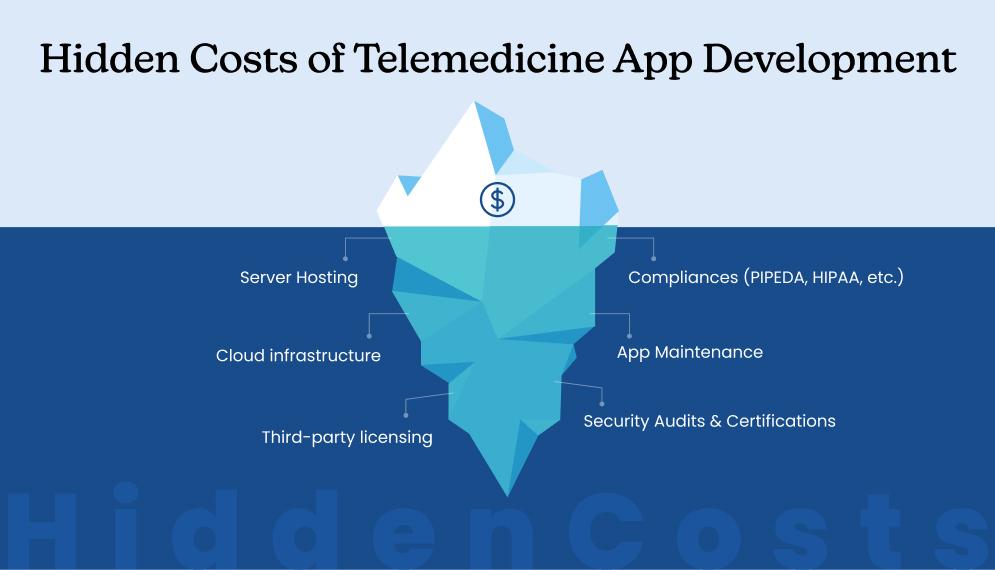
Telemedicine apps require ongoing investment for updates, monitoring, support, and infrastructure. Hosting, security patches, and scaling decisions influence long-term cost planning.
1. Hosting, cloud infrastructure, and DevOps
Cloud hosting for telemedicine ranges from a few hundred to several thousand dollars per month, depending on usage, video traffic, data logs, and storage needs. Teams often raise hosting tiers as user volumes grow.
2. Maintenance, updates, and support
Mobile app maintenance usually equals 15–20% of the initial development cost each year. Updates include new OS releases, UI improvements, backend monitoring, and security enhancements. Healthcare apps require ongoing regulatory checks to ensure continued compliance.
3. Licensing, certifications, and compliance-related costs
Telemedicine apps serving Canadian users often require PIPEDA or PHIPA compliance. US-facing apps must follow HIPAA standards. Costs include legal review, privacy impact assessments, and security audits. Requirements vary by province, state, and intended use case.
How to Reduce Telemedicine App Development Costs Without Cutting Corners
Healthcare organizations reduce budgets through careful planning, phased releases, and reliable integration choices. A strong discovery phase helps teams refine scope and prioritize core features.
Start with a focused MVP and clear scope
A focused MVP reduces costs by 30–50% and accelerates release cycles. Clinics gain early insights into patient behavior to validate the app idea and adjust future development accordingly. Scope clarity avoids unnecessary rework.
Use cross-platform development and reusable components
Rather than choosing between React Native and Flutter, cross-platform frameworks reduce early development cost and shorten delivery time. Many clinics achieve faster rollouts by reusing UI kits, component libraries, and backend modules.
Leverage proven APIs, SDKs, and healthcare integrations
Reliable video, chat, and payment SDKs reduce custom development effort. Healthcare-grade integrations require certification-ready components. Using established vendors helps teams avoid unexpected issues.
Plan security and compliance from day one
Security planning from the start prevents costly redesigns. Early decisions regarding encryption, identity verification, and data retention support long-term reliability.
How Space-O Builds Secure, Compliant Telemedicine Apps
Telemedicine is one of several regulated solutions built under our healthcare app development services, which focus on security, scalability, and compliance across Canadian and US healthcare standards.
Space-O Technologies develops secure telemedicine and virtual care solutions for clinics, hospitals, and health-tech startups across Canada and the US. The company has operated since 2018, served Fortune 500 clients, and supported 100+ organizations worldwide. A 65% repeat and referral business rate reflects long-term trust in the company’s delivery quality.
Healthcare organizations choose Space-O due to its expertise in custom software development, mobile app development, AI/ML engineering, and secure backend architecture. Teams prioritize privacy, performance, and compliance aligned with Canadian and US healthcare regulations.
Telemedicine and healthcare app expertise at Space-O
Space-O delivers telemedicine platforms for a range of healthcare businesses. Teams build multi-role dashboards, secure communication modules, scheduling systems, analytics, and privacy features. Strong domain knowledge ensures smooth implementation, reduced risk, and optimized resource allocation.
Our step-by-step development process for telemedicine apps
Space-O follows a six-step development approach:
- Analysis and planning
- UI/UX design
- Development
- QA and security testing
- Deployment
- Maintenance
Each stage focuses on platform stability, secure data flows, and consistent performance under real-world conditions.
Build a Secure, Compliant Telemedicine App
Work with a team experienced in healthcare data security, scalability, and regulatory standards across Canada and the US. Start your project with confidence.
Get a Customized Quote for Your Telemedicine App
This guide outlines clear cost expectations for telemedicine app development across different scopes and use cases. Healthcare organizations can use these insights to estimate initial investment and plan long-term scaling. However, final estimates require a detailed understanding of workflows, compliance needs, and integration depth.
Space-O Technologies helps clinics, hospitals, and health-tech startups identify the right features, technical stack, and rollout strategy. Teams also support resource planning to optimize budgets and reduce unnecessary development cycles. Contact Space-O Technologies for a free consultation and receive a transparent, customized cost estimate for your telemedicine app.
Frequently Asked Questions about Telemedicine App Development Cost
Is it cheaper to build a telemedicine app with third-party APIs?
Using video, chat, or identity APIs reduces initial engineering effort, but long-term subscription fees increase operational cost. Teams often combine custom modules with selective API use to balance cost and scalability.
How do compliance requirements affect telemedicine app development costs?
Compliance adds cost through documentation, encryption layers, audit logs, secure storage, and testing. Apps intended for Canada or the US must align with PIPEDA, PHIPA, or HIPAA, which increases effort across development and QA.
What is the most cost-effective way to start telemedicine app development?
Most organizations begin with a focused MVP containing essential patient and provider workflows. This helps validate adoption, reduce risk, and refine scope before investing in advanced modules or integrations.
Do telemedicine apps require separate builds for web and mobile?
Many teams build mobile apps and provider dashboards separately because workflows differ. Cross-platform frameworks can reduce mobile costs, but admin portals usually require a dedicated web build for efficiency and usability.
How much should organizations budget for yearly maintenance?
Healthcare apps generally require 15-20% of the initial development cost each year. Maintenance includes OS updates, security checks, compliance reviews, performance monitoring, and feature enhancements.


What to read next



 All our projects are secured by NDA
100% Secure. Zero Spam
*All your data will remain strictly confidential.
Trusted by


Bashar Anabtawi 
Canada
“I was mostly happy with the high level of experience and professionalism of the various teams that worked on my project. Not only they clearly understood my exact technical requirements but even suggested better ways in doing them. The Communication tools that were used were excellent and easy. And finally and most importantly, the interaction, follow up and support from the top management was great. Space-O not delivered a high quality product but exceeded my expectations! I would definitely hire them again for future jobs!”

Canada Office
2 County Court Blvd., Suite 400,
Brampton, Ontario L6W 3W8
Phone: +1 (602) 737-0187
Email: sales@spaceo.ca